Ep#19: The AI Playbook - How Founders Must Adapt
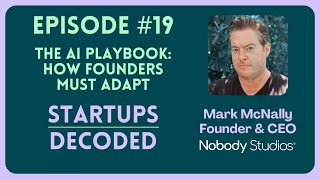
Andy Walsh and Mark S. McNally discuss how founders need to rethink strategy as AI reshapes startups. They cover the venture studio model, fundraising in an AI-driven market, and why soft skills matter more than ever when technology moves this fast.
They are contentious for a reason. So one you think in the future state, Right. So you assume, okay, these breakthroughs are going to happen.
Right.
AI is amazing right now. It's really exciting for a lot of people, but I know or believe that we're going to have general AI intelligence in the next 18 to 24 months.
Right.
So it means human level thought. We're not there right now. Anybody who's tried to do, you know, max out GPT realizes you're doing a lot of prompt engineering, you're doing a lot of correcting, you're doing a lot of scolding. It's still empowering and it's still exciting, but it's not quite there. But when you could be Talking to a PhD level AI, I mean, that's a game changer.
Welcome to Startups Decoded, where we uncover what it really takes to build and scale startups. I'm Andy Walsh, founder and strategist. Each week we will bring you actionable insights and real stories. Let's dive in. Hello and welcome back to Startups Decoded. My name is Andy Walsh. This is a podcast where we look at the breadth and depth of startups and in 2025 we've seen some really big changes happen, primarily with the integration of AI. Today I've got my colleague and boss, Mr. Mark S. McNally, CEO of Nobody Studios. Welcome, Mark.
Hey, Andy. Thanks for having me.
This is a treat. We love talking shop whenever we get on calls, but this time we're going to go a little bit deeper because it's a really interesting time in the Nobody Studios world as far as how the venture studio thinks about creating companies. So that's going to be the focus today. But to set up for people listening in, I'd love to explore your backstory and obviously I know it pretty well, but I think there's some really interesting things that you've done that allowed you to be in the position that you are now. So I'll throw it to you.
Yeah. So first I was born. I'm scared really quick. I mean, I've just been doing startups for almost 30 years and I started my career doing in actually army special operations for six years. So like my first, that was my non commercial starting point. But I had businesses when I was like 10 years old and 14 and you know, I've always been kind of in that mindset. I was born not too far outside of Silicon Valley, so I guess I was able to see, you know, people that seemed like they were creating the future and I noticed that they were driving nice cars. And that was like, that was my motivation when I got out of the service. I got really fortunate and it changed my trajectory that I came across a few technologists in the back of a warehouse in 96 that had this idea they could connect buyers and suppliers on this new thing called the Internet. And I joined them as one of the first 10 employees and we scaled it to almost a thousand employees and went public on the Nasdaq and I rose to number three, four guy in the company. So everything that was product marketing strategy was on my side of the house. And we ended up peaking at about a 4 1/2 billion dollar market cap in 2000. Pretty heady days for 25 year old Mark to go from cleaning the bathrooms in a warehouse to ringing the bell in Manhattan and you know, enjoying all the, you know, part of that process that goes along with it. For me it was a startup dream that I'd always had, but it was kind of my first big, you know, big hit. And I think when you have that kind of thing in your first, you know, stop a lot of people, it's their later stops in their career. But for me, it was my very first stop in my career. I mean it just changed my trajectory. One I had learned so much in that process that it emboldened me to keep doing it. I think when you have that or you taste that kind of success, you think that everything should be or could be that way. So I've been striving to find that and capture that lightning in a bottle of sense. But yeah, quick story, Since I've done 14 startups where I was a founder or very large shareholder from mostly 0 to 1. So grabbing something from a whiteboard, all early stage stuff and about a third of those we found exits, a third of those we failed miserably and a third of those are still out there, so, and really across different industries. So I guess I came to the, you know, about five years ago we started the studio. I came to that spot with a lot of experience, hands on, across multiple industries of building, being an operator, being a founder. In addition, I was a mentor or small angel to another couple dozen companies along the way. So a lot of different data points and exposures to what was right and wrong about company creation. And yeah, that's my backstory before the studio.
It's so good. And every person that I've talked to and I always have this follow up question has done something quite different. There's never been a linear path. They'll explore a certain career and then pivot or stop and do something completely different. And the range of skills seems to be today a superpower. And I've done it. And I think it's probably where we first connected as well. It's just talking about all the things that you need to be able to do. So as far as today and thinking about Nobody Studios transitioning from that, that breadth of skills and the success that you'd had, what were some of the things that triggered you to start? Nobody.
Yeah, well, so I got to that point, you know, five years ago. I was coming off a small exit and my boys were, you know, 9 and 10 at the time. And I'd been working gleefully, you know, 80 hour weeks without really thinking about it. So I very took a very conscious break and the question in my mind during that break was whatever I do next is like the second half of my career. It's not going to be just the next transaction.
Right.
And I was very much focused on trying to, you know, define what would define success for that second half of my career. And you know, I ended up playing with lots of different ideas. I mean, it was pretty open soul searching, to be honest. I could have ended up being a farmer in Africa, but I determined that the startup vehicle is a thing that I still believe is as amazing, if not more amazing than ever in terms of the ability for a mere mortal to point to something that doesn't exist, hopefully properly irrational, and they have a decent chance of pulling together the resources and the people and making a good run at it. And I just think it's the only spot that, you know, unless you're born into tremendous wealth or you, you know, you're elected official or something, it's the only place that, know, we can actually try to move the needle and make the world different. And that makes me tick. That gets me out of bed. So when I concluded that, that I was going to double down on startups, then there was this domino effect of like, oh yeah, but, and all those yeah buts were yeah, but startups suck and raising capital sucks and rebuilding a team after you already built a team, you know, 12 other times in your career, you know, that sucks and not even sucks, it's more just inefficient, you know, and also when you decide which companies to create, that's changing.
Right.
One of the things we said when I was saying, well, what's different about that point in my career five years ago compared to when I started 27 years ago and 27 years ago, you could point at something that no one had ever thought of before. And if you're the first mover, you could carve out a decent moat. You know, you'd be the first person to actually get some traction, have some brand recognition. It was really hard for people to play catch up. You know, once you had a one or two year ahead up head start, you're, you know, you're in the lead unless you screwed it up. And I think that what has changed, and we predicted this five years ago, as we said, technology has been increasing in speed, you know, during that first 22 years. But we said it's going to go into hyperdrive in a way that people can't even fathom. And so you come up with a good idea, you put it out there, you start talking about it, and you might be the first one with the idea, but someone else is going to catch up to you in like three months or two months or two days.
Right?
And that's what we said back then, and it's chem true. You know, we said this before GPT and now in the last, you know, couple years, it's just dizzying, but it's even more dizzying to start to contemplate what's going to happen in the next couple years. And so I just think that that was the motivation was to go build something special. And, you know, we also thought that valuations are getting crazy and the amount of money that was going into startups was getting crazy. And in a lot of ways, that trend itself was a real trigger for me because I saw so many times that, yeah, 5% of the companies can do really, really well, but 95% don't. And every time one doesn't, there's investors that lose money, but there's employees and executives who spent years of their life pursuing something that doesn't pan out.
Right.
And I just felt that there had to be a better way to do things. Smarter, faster, with leaner investments, you know, really push the boundaries of how fast you could move. But also if you do this within a ultimately the structure that became the venture studio. We didn't know it was called that when we started, but you end up getting this couple things. You get what I call the Kritsu effect, which is, you know, everybody's helping each other, pulling each other in different directions. And, you know, the talent of any company is a talent of the entire company or any one company. And so you get a lot of benefit from building 5, 10, 15 companies at once because you get this distributed knowledge and Connectivity. And we have the chance through that vehicle or that structure that we created to incentivize everybody across all the companies. So anybody working on any one of our companies, that nobody gets equity in every other company we create. And so again, that's incentivization for people to work together. And every VC website on the planet says these kinds of things like, hey, if we invest in you, you're joining a family of entrepreneurs and connectivity. But it's basically all bullshit. You know, I've been a part of 13 venture backed companies and never once has another portfolio company helped me in any way. And I can only think of a few times that a partner in a fund has actually done anything other than show up at a board meeting and criticize. So I think that's probably changing for them as well because I think that they're getting pressure from the studio model. But you know, I think in our world we just thought if we got this right, you could really build this kind of circus tent of ideas and talents and connections. And even the things you get wrong aren't really wrong. Again, in a VC world, you've got to decide, was it success or not? Kill it or keep it alive. In our world you can even mess things up and it might become a building block for a future company in our structure. So yeah, I guess you asked me the motivation, that was my backstory and how it transitioned, but again, it was really about, okay, well, if we really want to be at the forefront of company creation in the next five, 10 years, how would we do it differently? We still spend a lot of time asking ourselves that.
It makes a lot of sense with your backstory and what you're doing and why. Because what you've had exposure to is so much from the failures to the successes, et cetera, and identifying along the way that there's a lot of repetitiveness that happens within a startup and the system and how you operationalize. A business has steps that you go through consistently every time. So if you're surrounded by great people who can repeat those and scale and multiply, then you can see the common sense as to why that model works. And I think being able to create impact at scale is the other piece within that too, and even fundraising. And I think it's a thing we'll touch on a little bit today. I was reading some data from Pitchbook just the other day around repeat founders. So if you've had an exit and then you go back again or even a third time, the chances of getting funded are so much higher. Than first time around, which makes sense because you're a known entity, et cetera. So for nobody studios coming out of the gate with a strong company after another strong company, you would assume based off that, that you're going to have a really vibrant investment within the portfolio that grows collectively and everyone wins in that situation.
Yeah, I mean, I think it's, I mean it makes sense that if you're a successful exited founder that it's easier to move forward a second deal. But it's just this horribly pitiful chicken and the egg problem.
Right.
Like how do the best founders find the funding if they have never. This are first time founders.
Right.
You know, I think, I think funding itself is something that is going to be radically impacted in the next couple years. I still, as much as I've done it and know about it and have been successful at it, I mean, I don't know, I've raised, been involved in raising $600 million or something like that, personally, I still find it to be the most inefficient and painful process.
Right.
And so unless you're doing the exact same type of company in the exact same space and your previous experience completely translates, it can be really hard to get people in a new sector to appreciate your previous success.
Right.
Or believe you'll be successful. So, you know, I think that that's ripe for, you know, pretty radical disruption and I hope that's true both for the growing class of investors that want to be part of this. But for many founders who again I think the first 12 to 18 months, I would bet 80% of founders time is focused on raising capital, which has nothing to do with company creation or value or finding good customers or the things that we should be focused on.
Yeah, and that's, I've heard it a lot on these podcasting conversations is how does that become easier? How do you identify the right business? How do they become efficient? Because there's a mutual win for everyone in that. Yet there still seems to be a lot of tension in that relationship and just double down a little bit. You mentioned there around the relationship between a VC and a founder. And I had Jason Schumann from Primary VC on and the co founder of their fund, Ben sun, basically the key motivation for him as an exited founder to start primary was the lack of support that he had from VCs and they, they have a very heavily stacked VC platform team. So a lot of people that help with hiring, with marketing, with creative and things that lift all their portfolio up, but in theory you should see better returns And I think they're hitting, I think maybe fund four coming up. So they've got past 1 billion AUM. But within that, as far as a studio, thinking about that relationship, you've got a team of people that are either industry experts, exited founders, have done a lot in the startup space, consistently within there. And recruiting the team that you touched on before is one of the hardest things. I remember my first startup, that first employee to employee 10 is just hard work, culture, skills, what you're able to pay them. There's so many challenges in that first phase. So if we're able to help those people join your team, let them grow, let their skills influence the success of what you're having, it creates a much bigger opportunity. So for you, if you're retaining those people and you've got good VC relationships, you would again expect a venture studio to drive much better success on the fundraising side too.
Yeah. Yes and no. I mean, so I think our, our viewpoint and strategy is that we need to have, and we'll continue to raise more capital so that we can give the early stage companies more capital. So we have one model which is build a company and get it off the ground at some point it needs its own capital, but that's still a very early stage capital. And so we believe we'll have to be pretty active in that. We might even create our own fund, you know, this year. So there'll be things we'll do besides our own direct investment into the studio that will create, you know, resources to just make that transition phase faster and less painful. Because the area that I think venture studios make it harder to raise capital is that a lot of people who want to fund that stage don't know how to make sense of a studio, right? They're like, wait, am I betting on you as a founder? Wait, what are you? You're a studio. That's an amorphous thing, right? Like, and they're used to saying, I bet on Andy, he's the guy who's going to get it done. And that's important. We believe in people too, and we believe in founders, co founders. But the studio model for an investor, an external investor, is really hard in the early stages. What I think becomes really easy is when you are like, you're almost being funded on your own credit, right? Like when you have revenue and profitability and growth, investors look past all these other things and just say, I want to be part of that, right? If you're killing it on all your metrics, then you're easily fundable. But at that early stage, that's very rarely the case. You're still somewhere in this amorphous. And I've always said that, you know, people who have not done a lot of fundraising don't understand one basic thing. A VC or, you know, high volume investor looks at probably 300 deals a year and they're going to shortlist maybe 10 or 20 to go deeper on, and they're probably going to make two or three investments. So those odds aren't very good right now. How do you go from 300 to 3? That's 1%. How do you eliminate 99% of the deals? You have what I call fast filters. You say things like, I only invest in people who went to an Ivy League school. Okay, well, I just cut the list down half. You know, I only go invest in people that I can drive to the board meeting. Okay, that's got to be within 45 minutes. Okay, that just cut people in half. And they have these fast filters. You know, they have these things they like to ask their interview questions or whatever, but that helps them narrow it down from 300 to 20 and then three way faster. That has nothing to do with you as your deal has nothing to do with, you know, you as a founder just has to do with them and how they've decided to narrow the world. But again, it's, it's a numbers game if you want to fill, get through that filter. And I think a lot of founders mess this up, they'll have a really positive conversation or, you know, an investor who's really charismatic and giving them what they think is good feedback. But they have no intention of investing.
Right.
They're just being polite. And sometimes the ones that are tougher on you are the ones that actually want to invest. They just want to test your mettle and see how convicted you are on your ideas. But that's the kind of thing you can coach and you can train. You don't need to have all the experience to do it. But there's not enough people talking about that, in my opinion. But yeah, anyway, it's an efficient world of fundraising. Ultimately, again, our strategy is to, with our full maturity of our models, to make sure we have enough capital across our multiple vehicles to make that early stage as easy as possible, even if we're writing all the checks or being a big part of it, to make sure that at some point the business itself, on its metrics, is completely fundable.
Yeah. Within that, the strength as well then from what I see, is the ability to have consistent things that you're tracking and setting up from your early prototype and validation, all the things that you go through, you start to build a standardized process of steps that you go through, ways that you measure and you're consistently presenting that and that gets you ahead of the pack immediately, particularly against first time founders who are still working out how to do that for the first time. So I think that's the strength and I think to segue into today's topic, which I think is going to be very juicy for a lot of people, is the studio started five years ago where all of these new platforms that have been powered by AI didn't exist. AI existed and LLMs are around, that's been around for quite some time now. But how they're accessible to everyone en masse and that democratization has completely changed the world from big corporations to startups. So for you right now, you touched on it a little bit. But I'd love to explore your thesis five years ago when you started nobody to today. And what are some of the catalysts or the things that you've now started to shift based off the world that we now live?
Yeah, well, first of all, most of my opinions here are part of our secret sauce and I don't want anybody else to know about it. So I'm not going to talk about any of it.
That's good. That makes for a good episode.
Look, the one of the X that I came off of where I kind of took my sabbatical and created the thesis for Nobody was an AI company. And I have some patents still from that. So I've got patents in AI going back like eight or nine years before it was popular. I literally remember being laughed out of a, you know, VC's offices trying to raise for that company. They're like, AI, I've lost money on AI in the 70s and 80s, 90s and 2000. Get the hell out of here. You know, and the joke back then for a lot of AI founders was like, you know, this is the decade that AI is going to come to life and it has been for five decades, right? Because everybody thought it was going to be this is the year, this is the year. But you need this perfect convergence of compute power, scalability in the cloud. There's other breakthroughs of underlying technologies. You needed this perfect convergence to make GPT come to life the way it did. But the idea of it has been talked about for hell of a long time, right? So people who are in the know whenever else is like, oh my God, look at GPT like you almost had this disgruntled frustrated genius. And a lot of technologists are like, duh. I talked about that in the 80s. Like I knew that was going to happen, but it's different from it being possible and then suddenly it happening, right? And so I think that you know, GPT being released what, three years ago, whatever it was, I think that was the aha moment for the world, you know. But even technologists who've been thinking about it for a while, like I personally found myself re energized of things. I'm like, well someday that'll happen, but who knows when. But when you saw the speed of innovation, then it like really sucked my brain back into the space to say, to really start to contemplate what the next steps would be. And I think it's changed the game for people who have been doing this for a while. Again, you're used to thinking you have, you know, 1, 2, 3, 4 years ahead, start on something. And I started realizing that, you know, there's this concept of like, I'll go back to the movies we've watched, like Terminator, you know, they, they plugged in Skynet and like a day later the machines took over. You know why? Because the AI was so powerful that it could do deductions and reasoning and play out war games at a fraction of the time that we can even articulate a sentence, right. And so the speed, it's like the previous technology breakthroughs actually add exponential velocity to the next stage. And I think that's exactly where we're at right now. What's going to happen in the next three months is mind blowing. Like what we'll be talking about this summer is mind blowing compared to where we're at right now. But it's only possible because of where we're at right now. And then what we'll be talking about at the end of the year is gonna be like science fiction. But it's only gonna be possible because of the breakthroughs from the summer. And I think that that being in that spot is stretching. And I personally love this space cause I consider myself more forward thinking kind of vision person. But it's stretching me even to think through what is really gonna be, you know, the end state. You know, a year or two years, three years. And you gotta be thinking in that space to build the right companies. Not how you build them or whatever else, but build the right companies that are relevant. Because I think there's some things that are become very commoditized and if it just requires somebody to be a coder. If it's just a digital product, it's gonna be hard to carve out a mark, a moat and be like a first mover because someone else can be right behind you in two days.
Right.
Or 2,000 people can behind you in two days. And I just think that that's been. We spent a lot of time thinking about it and I won't give away all the secret sauce, but I think it's really interesting to figure out ultimately what companies you'll build that are truly valuable and defensible in an AI era.
The moat conversation has been pretty consistent in previous conversations too. And the lack of ability to build one at scale, it doesn't seem to be a factor like it was before six months head start doesn't mean anything because someone can build something on all of these no CO platforms as an example and get something in market, get early revenue and get funded. And if they have a connection with a VC that the other one doesn't have, they may get capital and get market share just because they've got that relationship. So being competitive today and into the next few years, it feels like to your point, you've got to be able to find these things that no one's thinking about. And I've referenced before on great book Mike Maple, sorry Mark Maples, which is patent breakers and he talks a lot about being able to see around corners and he talked about there within the vision it's how do you think about the behavior of the world that we have now? And I use the iPhone and the app store as a good example that most people would relate to is that by just opening that up it created a whole bunch of businesses that are now, you know, some of the multi billion value businesses off the back of that and it's that marketplace style to be able to do it. And there'll be things like that that will start to happen from an AI front. So you really have to be sort of living in that almost Terminator state to sort of think about okay, if X happens then what does that mean for Y And what business can we create around that?
Yeah, 100% we, we talk a lot about internally around what we call non obvious business models. So you'll, you'll see a lot of people with thesis around deep tech or tough tech, you know, things that are just massive breakthroughs someone's got to figure out and they're exciting and they're true, they need to be figured out. But I almost operate knowing that between the Googles and the metas and the Microsofts, like someone's going to figure that out and they're putting hundreds of billions of dollars at some of those big things. I don't think that tough tech and deep tech is the game of startups personally in today's day and age. Unless you're one of those lucky startups that can raise $100 million in day one, I just think it's a really hard game. But if you operate in that mode of saying, okay, that is going to happen. So let me close my eyes and imagine I'm in the world that already happened. Now what businesses need to exist, what technologies are needed now, right? That opens up this whole universe of what we call non obvious business models that you can get a head start on saying, I know this breakthrough is going to happen and I'm going to be ahead of everybody else to build that supporting business.
And if you looked at say fast food and delivery and what that means today, and it's such a huge market, but people talked about drone delivery, I think maybe it was Domino's or Pizza Hut, having the little mobile cooler boxes that are remote control that drive it around and they're really obvious things. But if you think about which is what I'm hearing from you is the things that happen all the time, like if you're going to school and there's things that you need to do with school as a parent, like what are the things that make your life easier? I interviewed a guest the other day, Zoya, and she's got a company called Orgo, which is designed to help parents plan their kids, travel for sport, for school trips, who's picking who up, carpooling, all those elements. And if you think about what it's doing is connecting parents and kids, optimizing that experience and that can scale across any industry. And when you start to pair it up with other areas with through AI, her business all of a sudden can scale exponentially as well. So there's existing businesses that can just double down and make more revenue with less people. But then there's whole new categories. And if you're thinking about new categories at nobody, what sort of things do you do to think about ideation?
Yeah, I think it's two points and they are contentious for a reason. So one you think in the future state, right. So you assume, okay, these breakthroughs are going to happen.
Right.
So AI is amazing right now. It's really exciting for a lot of people. But I know or believe that we're going to have general AI intelligence in the next 18 to 24 months, right? So that means human level thought. We're not there right now. Anybody who's tried to do a, you know, max out GPT realizes you're doing a lot of prompt engineering, you're doing a lot of correcting, you're doing a lot of scolding. It's still, you know, empowering and it's still exciting, but it's not quite there. But when you could be Talking to a PhD level AI, I mean that's a game changer. So you put that hat on and say, okay, two years from now we're there. How does that change travel? And then suddenly you look at existing business models, Travelocity or Orbit or you know, Expedia and these kind of big platforms and say are they going to be in a position to make that leap or are they, do they have innovators dilemma?
Right.
Is their incumbent success going to be in their way of that leap? And that you have to ask that question for every business model in every industry and some that the answer is obvious that they can or obvious they can't or sometimes murky, who knows. But if you do this and this, you can carve out your value. And so we ask ourselves those questions. But we also like to be very now and present in our ideation as well, which is, you know, somebody told me earlier in my career and I repeated it many times, which is, you want to be successful in business, find a problem with a checkbook attached to it. And if you're doing anything outside of that, right? And a lot of startups are and I spent half my career doing it right where you're going and going, this would be really cool. Can't you imagine it? And you're trying to capture people's imagination like oh yeah, cool. But it's not a pressing problem and they don't have a budget for it. So you're fighting uphill. And you know, if you could find someone who's like this is the biggest problem in my organization or this is the top five problem in my organization and we have $200 million set aside to solve it now you can hit revenue really quick, right? So we try to go from both sides. Where is the business going to be in five years and is there any really interesting models there we can carve out or where is it right now that people can benefit immediately but we can be a real fast mover on revenue. And you know, the last part of that would be again without giving away secret sauce, but in the AI world I think Let me put it this way. Forget studios and company creation. People have asked me with what you know about AI, Mark, what do I tell my teenager in terms of what they should do in their career?
Right.
There's a pretty strong argument that a good chunk of business, you know, people who career channels and titles and specialties that you could have made a good career of 20 years ago or 10 years ago are going to be gone in the next five years. So my answer to that is almost now. Always I think the hardest thing for AI to master or replicate will be soft skills, you know, So I wouldn't have said this five years ago that if you asked me who's going to be more relevant or less relevant, a salesperson or a developer, I probably would have leaned developer more relevant 5 years ago. And now I think it's the opposite. I think a salesperson who knows how to have that instinct to build relationships and build trust and be persuasive and listen and respond and answer questions and problems, and that's a unique soft skill that is really hard for AI to replicate. You know, as much as you can trust AI to give you an answer on, you know, things that are fact based, it's different than trusting AI to do what's right for you or to take care of you if something goes wrong.
Right.
It's a different kind of trust. And so I just think the soft skills, you know, are something we think about a lot in terms of the kind of businesses we'll create today and moving forward versus ones we would have done four or five years ago. And then, you know, I talk a lot about stickiness like, or the last mile, like what is that hard stuff to do? You know, if at the end of the day AI concludes we need to grab this plug and connect it to that plug.
Right? Great.
Good for you, AI, you can't do it, can you need a human to do it.
Right.
And so we get attracted to models where there's some kind of physical heavy lifting that AI can't do on its own. Hmm.
It's gonna be so interesting to watch how something as simple as a networking event and how people connect with each other and how those relationships, to your point, can drive sales. Cause I am sure that you're seeing the same thing and everyone can relate that. I know my inbox on email or LinkedIn, whatever it is, there's so many things that are clearly bots or agents people are using to do sales. And if you get so many messages, it's just noise and no one's gonna cut through. So it's, you have to find alternative path, particularly going back to the point before where if it's easier for products to be built by competitors at scale. And from what you're saying, it sounds like the sales is going to be critical for someone to be able to engage the right target audience and turn them into a trial and then a retained customer. Ongoing.
Yeah, I think sales, I think partnerships is, I'd call it the same skill set. Like I don't see AI doing a strategic partnership anytime soon.
Right.
Strategic partnership is being able to reach out to somebody and explain how what's good for me is good for you. Together we're stronger building that trust. There's probably always going to be some in person kind of element to it and it could be negotiated over months. I have trouble having AI keep context in my conversations minute by minute, let alone over months. I know that will get better as a problem, but it's not going to be the kind of thing that you build trust and relationships to get someone to say, you know what, we could pick 10 different people to do a partnership with. And we're picking you because partnerships are the kind of thing. It's a soft asset, you know, it's not something that AI can study, it's not something you can dissect and try to replicate. It's not something that can be automated. So, you know, again, we're attracted to models where there's that kind of element involved because you start to carve out defensibility.
Right.
Right now AI is being trained on all public models, right. Or public data sets. Anything I can find, it's licensing data, it's doing everything it can to find these public data sets. But let's say you're a unique. You're a 30 year owner and founder of the leading engineering firm for sprinkler heads. That's sitting on your hard drive or your unique cloud.
Right.
And most of it's probably up here. That's the kind of thing that, you know, you might have a $100 million business or $50 million business doing that I won't be able to access that, won't be able to learn from it, won't be able to replicate it. And so, you know, there's again always some element of a unique data set, you know, soft skills or soft assets that are hard to replicate. In the AI era now, I think the bets are off. In 10, 15 years, I think everything will be available in the AI area. They'll suck it out of our brains. But I think that that's the phase we're in right now.
I know from my own personal usage and I use a couple of different platforms, but using just ChatGPT. Plenty of times it's been wrong where I know what information's given me, but it delivers it with such confidence and even now personality that makes you feel confident and it's. You can get caught out with that. So it's still at that point where it doesn't feel like it has the ability to say no. It's trying to please you all the time, which is concerning. If you don't have the expertise and that knowledge to be able to do that, it can catch you out. So once we get through that point, what you were describing there, then it opens up something much more as far as how you use it. But for now, the other area I'd love to touch too. You talked about AI opening up the ability to create new businesses, but from a effectiveness and scale perspective, all the things that you read today are a lot about how do you grow revenue within your company with less people ultimately. So bottom line is having a huge shift off the implementation. What sort of things are you seeing or implementing and talking about that allows you to sort of multiply at scale using that strength of the Studio team.
Yeah. I mean, again, without going into specifics on our secret sauce and a blanket statement would be everything we do, we're trying to figure out how to augment with AI or empower with AI. Right now we might be on the forefront of that, but it's something we'll carve out for six to 12 months. We don't think that's the long term differentiator.
Right.
But I do think there's a tremendous amount of things we do that where the soft skills are not like the human isn't the best way to do it.
Right.
And in a previous life I'd sold predictive analytics into the healthcare industry. And you know, we had a saying back then, this was like nine years ago, we'd say, you know, the, the cognitive ability of a, you know, call, you know, doctor level educated person to process data points is about 10 data points. So if I meet with you as a patient, I can factor in 10 different things in my head and make my decision. Now there may be 20 or 30 available to me, but my bias and my history, my experience is going to whittle that down to the five or ten things I choose to focus on right now. If you go back 50 years ago, the amount of data points available to A physician was around 10. If you go 10 years ago, the amount of data points available to physician was a couple hundred. You go to today, it's more like a thousand data points available to a physician. And five years from now, I mean, it's going to be limitless, exponential amount of data points. So the best doctor in the planet doesn't matter what they say or what they, their opinion of themselves. Maybe they're an overachiever and they can process 20 data points at once, or 30, but they're never going to be able to filter through all those things.
Right.
And so it's obvious at that point you need, machines are getting better at that process, right? So anything in your business model where, you know, there's crunching, there's probabilities, there's analysis, there's, there's sorting, there's that kind of stuff, you already know that you're better off not having a human do it. You can just make that assumption. Now we have a lot of humans doing that, that kind of work today, you know, a lot. You know, and I'd say the best career in the last 15, 20 years has been developer, you know, probably the last 10 years has been data scientists. And I'd say both of those are gonna be obsolete in five years flat, except for the highest level thinkers. But the run of the mill, you know, hey, I went and became a data scientist five years out of college. I'm making 300 grand a year that's done so. But I think we also have to adapt to that, which is kind of weird and ironic. When I started my career, we were just coming off the era where, you know, it was valued that you're at General Motors for 25 years, you know, or you worked at ITT for 30 years. Those things were, you know, valuable. And there's this kind of transition period where you can hear people kind of selling a narrative like, yeah, but if I've worked at five places in 10 years, that's actually a sign of my creativity and, you know, aggressiveness and. But it wasn't completely landing with the older generation. And now it's like, if you're not willing to work at 20 places, the next year you might be irrelevant. Like so much is going to be changing and nobody has the actual answer. There's a lot of people thinking about it, you know, I'm one of them. There's some things that may be more obvious than others, but what the actual career paths are going to look like and roles are going to look like is, you know, Going to change our lifestyles, our careers, certainly for us, changes how we think about building teams, recruiting people, hiring people, and you know, ultimately where you're going to make your investments. To come full circle to your first question, I think some obvious things will be some of the biggest cost centers, which is or most important metrics of the company. What does it take to build a product, how fast can you build a product, what does it cost? And then how do you sell that product and how fast can you sell that product? And how many times can you sell that product and how efficient can you sell that product? I think those two areas without much hesitation in my mind, will be radically transformed in the next five years.
Do you think then that in a traditional startup we'll start to see those types of businesses be more like a venture studio where you're able to prototype and test and kill an idea faster without the emotional attachment? Because if you're able to do that quickly and get market feedback, you'll have a bit of a sense as far as whether it's feasible to move forward or not with the business. Do you think that that intelligence is coming sooner rather than later?
I mean, I think pretty quick. I'd say again in five years there'll be companies that walk in to raise capital where they're able to tell a story of the 37 things they experimented with and how that narrowed it down to six things in a short period of time. Those will stand out far and away from the rest and will be the ones that get funded. And folks that are approaching it, maybe in the current mode or the previous era mode, they have one idea, maybe they made one pivot in a year and they're very people based. I just think those aren't going to be very fundable. I really do believe you're moving into a phase right now where you have people who think the old way or people who have built businesses successfully the old way. And there'll be people who are building AI, native AI first from day one. And that's going to be the US versus them. It's going to be brutal. Now if you built a successful business, you might be able to preserve that 5, 10, 15 years because of your brand equity relationships, stuff like that. But the AI first companies are going to eat most people's lunch moving forward.
Such good advice. So any founders listening, thinking about how do you validate a cross platform and start to go wider to narrow it in, rather than starting with something so single minded to be fascinating to watch how that plays out and to Close out. I'd love to hear a little bit what's happening at Nobody right now.
We're head first into the AI world and pretty deep crevices and niches and thinking through what that looks like. And I think that's exciting, both in how we empower the studio, but also kind of touched on it, like what kind of companies we should be creating. And it's okay that that's changing, you know, as a new world we live in today compared to five years ago. So we're spending a lot of time thinking about what is that right profile of, you know, what to build or what not to build. Look, I think we've. We've been successful at being one of the, probably the biggest brands in this space. A lot of people know us, a lot of people are rooting for us. We've got a great group of investors that are part of getting us to where we're at right now. And. But I think we're about to shift gears and I think that hopefully, you know, we're knocking on wood, but, you know, we should be in a spot in the next 90 days where we close our first significant round of funding in terms of like one tranche. Tranche of funding. We've raised more than most studios. We've done well over the last four years, but it's different to get one big tranche that gives you a couple years of hyper growth. So that'll be a big step for us. And I think it's a, you know, I'm a. I'm a rational optimist or a skeptical optimist. I look at it as the silver lining of maybe some of our previous funding transactions. Us walking away from one and another one walking away from the transaction. I actually think the silver lining is we're in a perfect spot right now to scale with our current vision and our current awareness of where the world is going. And had we been more successful earlier, we would have built the wrong organization and we probably would have been pretty deep into building the wrong companies. So I accept and I'm kind of sickly grateful for where we're at right now. We've been able to do some cool things, build a great team, build a lot of recognition, but again, knock on wood, we should be going into hyper growth pretty soon.
The world can be a funny place sometimes, in what seems like a challenge can sometimes open a much bigger door and a bigger opportunity.
So good.
Mark, thank you for making the time today. It's been a real treat to unpack what's happening at Nobody, but also around AI and the influence it's having today and into the future. So thanks again for the time.
Thank you Andy, and congratulations on your success with the podcast. I look forward to being back on someday.
100%. It's been fun. You're listening to Startups Decoded. Thank you for joining. Please share with your friends and raise ratings. All helps me to grow and keep doing these episodes. Thanks again. Grow and keep doing these episodes. Thanks again.
More from Andy



EP#88: Why Most Founders Misread Their Own Traction. Vanessa Larco - Premise VC

EP#87: Founders Obsess Over the Raise. Investors Care About This More. — Carina Cunha






Ep#86: Early Decisions That Define Your Startup Forever. With J.P. Morgan Asset Management
