Ep# 2: Founders: The Secret to Hiring the Right Marketer at the Right Time - with Lucy Woolfenden.
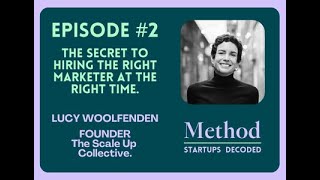
Lucy Woolfenden on when startups actually need to hire a marketer and what that person should do first. She breaks down how marketing roles change as companies grow, and why culture and community matter more than polished campaigns early on.
Welcome to Method, where we decode what it really takes to build and scale startups. I'm Andy Walsh, founder and strategist. Each week we'll bring you actionable insights and real stories. Let's dive in. Hello and welcome back to episode number two of Method Startups Decoded. Super excited this week to have Lucy Woofenden. Lucy and I have known each other for probably over 10 years now. We'll talk about a bit more about our history, how marketing has evolved, what we can look to today as far as best practices and look into the future. First and foremost, I'd love to welcome Lucy. Thanks for joining me.
Thanks so much. It's exciting to be here.
It's a treat. And as I said, we've gone way back. When I first started my business in 2012, we were at Skype and Skype became our first client and we got to work closely together and I think that's probably a good place to start at that time. I think when we first joined, it was just going through the acquisition phase. Right. Ebay had sold Skype to Microsoft and there was a shift that was sort of going on at the same time.
Yeah, definitely. I think Microsoft had still kept it quite as a separate business unit for that first year or so. It was only really a couple of years in we were working where we started to really be brought into the different sections and we. And we'd work more with more of Microsoft. It was an interesting time, though. It still felt very much like a startup, even with 300 million users and even with the amount of money it had behind it, it still had that sort of drive and energy of, here's a great idea, can we make it happen? And that's where you and I would come in.
Yeah, 100%. And I. And I felt that too. The way that the business was approached, it was always felt like there was a lot of growth hacking and happened and it felt like there was a lot of freedom to be able to do what you were doing. And I think just to sort of go back then when you first started, were they still technically owned by ebay or were they under the Microsoft piece when you first joined under the Microsoft piece?
Very much. I think so. We'd gone through the acquisition and we were being onboarded because I think that was the reason for the end of Project Charlie, which she won't talk about.
Yeah, there was a lot of great thinking, a lot of great work done and unfortunately not much of it saw the light of day, which is a shame. But that's life and innovation and I think great place to start. So when you're thinking about 10 years ago, the growth of a startup and it's very different tech platform like Skype. Skype was an institution in the sense of globally, how people used it, what it was known for, and pretty much became a verb in itself. As much as Skype definitely tried to resist it becoming a verb. I'm fascinated with that too as far as that experience today. But for you working on a brand at that scale, which is very much sort of innovation focused, a great startup that had had huge global success, what are some of the things that apply to what you're doing now as far as some of the skills you learned, the thinking, how you test and learn, et cetera, what are some of the big pieces that you think sort of inspired the work that you do now?
Yeah, definitely. Good question. So I think one of them really is about behavior change. And that's I think very much. You know, we had 300 million users that were using Skype on desktop and irregularly. So it was all about connecting families abroad at that point there wasn't people didn't think about using video message or video on their mobile to speak to their friends that they would see on a more regular basis. And that's what we were really doing with, with all the campaigns or the partnerships we did was changing how people used it and how people would communicate with their friends. Start group chats like we did with all the musicians, send video messages like we did at where we, where we got people to record the video messages and then turn it into music. You know, that was all about behavior change. And that very much is the same now with a lot of what we're doing. We're working with startups that are, aren't mirroring other people so they're trying to do something different. And therefore we have to help people and guide them on the way as to why they should be doing it and why it's important for them to make that effort to do something new?
Yeah, absolutely. To give people some context today, can you describe what your agency is now as far as like Scale Up Collective working with startups at different stages, but what does a normal weight look like?
Yeah, brilliant. So Scale Up Collective is about five years old. We work as a marketing partner for tech startups and scale ups and in that it might be, if they're very early stage, we will come in, we'll do other audience insights who really deeply understand the behavior motivations of the customer, the target ICP for launch work through what their launch strategy is. So what's the three or four key growth levers they need that will get them to that next stage and then build out their marketing team or marketing function, be that mix of freelance full time agency support and really work with them at each stage of what do they need to get if they're pre C to see seed series A. The other sort of point at which we come in is more generally with B2B's. But at the point they might be plateauing or they've just got more funding. So often they've got private equity funding or series A and at that point they need to really expand out of their current networks, out of their current markets and therefore they need a developed brand and A and a real great strategy to be able to get in front of this new audience, a new market and therefore so it's generally, you know, at that point the B2B is probably on sort of 10 to 15 million ARR. So different stage but generally still very much of setting up that marketing in the first place.
Yeah, it's definitely an art. And my experience around startups and I think this would be an accurate statement is that most founders and co founders come from technical backgrounds, financial backgrounds, legal backgrounds. Rarely do you see a founder who comes from a marketing or creative background. So typically the gap that most have is that skill set to think about your brand story, communication channels growing, retaining audiences, et cetera. So it makes sense that someone like you exists. Let's start at the early stage. How early would you get involved with a startup as far as thinking about the definition of their brand and really sort of simple hacking at the start of that journey.
Yeah, see the first part would be very early stages. They're really going into mvp. We could be working with them on the audience insight. So really they've probably got an idea but at that point they haven't done that much in terms of talking to the current audience or talking about what their current behaviors are, what motivations are, what's important to get first to market and how can we inform the product strategy. So that would be the first part that we really get involved in. The next part is as they get closer to actually launch and there we'll work with them, whether that's, you know, about building up a wait list or building up an initial audience to go to, making sure the build building blocks are there, you know, how, how will you reach out? What do you need to be able to show yourself as a legitimate business and you know, in the early days, it's quite difficult to prove trust because they don't have the case studies, they don't have that. So it's, you know, if that's building personal brand or being able to get the, the founders out there talking on stage is talking about why they do what they do, creating partnerships to create that sort of deferred, deferred trust and them out. And then it's about thinking about depending on their budget and their goals, what is that team that needs to deliver it? Because it isn't a fractional CMO that should be delivering their daily, daily social or their content. It's just, it's not, you know, it's not a practical or efficient way of running a team. So depending on what it is, you know, we're just working with a review platform that's very much aimed at Gen Z. So the first person we're bringing on will be a content, a TikTok content creator. They're also working with sort of, you know, a B2B that's just got private equity. The first person really is a B2B marketing manager that's very good at executing, that's very good at working through everything that's needed, working with the sales team, creating some content themselves. I think it's one thing that we come across a lot is that the first marketing manager is expected to be able to do everything and nobody can do everything and nobody is an expert at everything. And so it's really working out. Should they be, you know, a T shirt marketers? They're very good if we know it's a going to be a strong content creator. Is that the core skill? But then they're able to do other things and we're able to bring in other experts in as and when they need it. Or is it just about having somebody that's that marketing engine of activity that's delivering and getting things out there, working with the agencies. So yeah, it really depends on what they need. But it is classic time is thinking this marketer can do everything as well as strategy.
Yeah, it's a lot to take on and I think today you cannot rest on your laurels either as far as technology advances. The way that you actually find customers, retain customers, even build products has had such a huge step change in the last 12 months to probably two years. So let's, I think what you just summarized is a really great sort of package. Like if you could put that down on a piece of paper and turn that into a framework for founders to be able to use like let's maybe try and put it into some blocks. So some of the things you talked about there was around your brand, first and foremost, thinking about what you stand for, how you tell that story from a company perspective, but also a founder perspective, what sort of things are you doing in that building block for brand?
So really we need to be really clear in the role of storytelling, the role of personal brand. We know especially if they're in early stages of funding, if we can drive the personal brand of the founders, we know they're more likely to get funding. And partly that's about building trust. It goes back to, you know, if they don't have the case studies and they don't have the product that they can go back to. Early customers and early investors really want to know that they can trust the team to deliver something. And so that's why it's so important. So the building blocks really is understanding deeply what the, what the audience need, what are the we talk about, we use jobs to be done and the four forces. So what is it that the customer is trying to achieve by using your product? What are they currently doing now without it? So what's the alternatives? What is it about the full forces of the push and pull factor? So push, what's happening externally that's going to push somebody towards your product? What is it about your product that's going to pull somebody there? And then what's the inertia and apathy? What is the reason, what are the reasons that somebody wouldn't do that? And all of that messaging as well as feeds into the positioning. So why are you here? What are you doing? How do you achieve it? So starting really with that key messaging that we can then use across and we're looking at the customer journey, what do we need people to do from first touch of the brand through to sign up or download whatever that action is, that acquisition action, to becoming a referrer and a champion for that brand and really working through, making sure that each of these steps, even if basic in the beginning, is setting clear and taking out any points of friction that there could be, but building trust along the way at each point.
Yeah. And it's within that. I love the idea of the brand storytelling piece. I'm a brand strategist myself and I think it's really important that you're having consistency and sort of iterating on that as you evolve. What are some of the things that you would set up to be able to stress test ultimately what that framework looks like, the messaging, what sticks, what resonates, etc. Say you're working across any sort of performance or paid based activity to social feedback and sentiment, et cetera, through to straight up sort of quantitative work. What are some of the tools that you would use in the mix there to sort of be able to test and learn?
Yeah, sure. So we do. We use qualitative research, so interviews and groups in the first place to really start to gather all of this and the hypotheses around it. We'll then use quants as surveys to really refine these and priorit. Then we'll start with using paid. So think about meta ads, using those to constantly test and optimize on conversions and messaging, creative brand story, etc. As well as customer listening and making sure we're getting feedback constantly. And not just positive feedback, we need the negative feedback as well. Because finding out why somebody didn't buy your product is actually a really crucial piece of evidence. And just keeping going with the, you know, we'll set up things like Feedback Fridays with clients. So the marketing manager is on a weekly basis talking to a couple of clients and that will be to keep making sure we understand what's happening now with their behavior, you know, what's changed. There's constantly in any market we're in this constant innovations, there's constant launches and people generally are quite curious. They'll be trying different things and thinking about it. So we need to know what else people are thinking about and that's a really good way of just keeping that temperature check understanding. Therefore what we need to build next, what we need to be talking about and what matters to them.
And yeah, and I think that you've really hit on something there that I'm truly believing which is around community. And community is quite a broad piece, but I think for a young startup, right through to an established startup, knowing the people that are part of your ecosystem, from customers to partners to investors, et cetera, is there anything that you're doing like formally or informally to try and nurture community and what does that look like in a typical framework that you would have for your clients?
Yeah, so I think community is different for every brand. So some brands is more of an audience and it's more about sharing content in more of a one way. So you're giving them useful content on a regular basis that is informing them and helping them achieve their goals. Building through to community where people need to be brought together and they want to be brought together and pass it. And you are able to achieve that through your business, through Your product and often that's with partnerships and slightly separate your core product marketing. It needs to be, you know, if that is, say we've been working with a brand and we're building out a community of data product managers. You know, it's a really niche small audience that don't have other places to go. So how do you create a place that they want to go to? They feel informed and they therefore, at the right time will then maybe consider your, your product when they need it. So it's a real long term play. And I think people underestimate the amount of time and effort it takes to create a community versus an audience. And whether that's right or not, the other way that we've had great success of that is partnering. I think people forget that you can create community with other brands as well. And then therefore it's the same community. They're getting everything they need from both brands. And I think that's also an option, especially in the early stages where you don't have the time or the budget to be really feeding that community and driving that community.
Yeah. Great. And listening to you say that. I love that sort of contrast of community versus audience. If you're seeing the customer as someone who just purchases a product and it's very much sort of done and they're out the door and they hopefully come back again. Like particularly today as well. We're defending your startup as far as within your category from competitors. Like the development times to build a business have shortened right up. The ability to find customers has become more automated. There's a lot of things that means people can not only catch up to you, but pass you if you're not doing all the foundational things. And I think that that has changed dramatically. Right. Over the last 10 years is the ability to grow. Like you saw that classic stereotype where say call it 2010 to 2015 period, where you would start to build your startup, you would get capital injection, you'd do a whole social media campaign, maybe some tactical outdoor media in target areas. And that was probably all it was as far as like simplifying that early stage marketing budget. And I'm simplifying it very deliberately. But fast forward to today to defend your business and build a moat. The community versus audience feels like it's one of the most crucial things that you can have.
Yeah, I definitely agree. I think it's just very important to understand exactly what is the value that you can create for your audience and making sure you're building it for that. We've just seen especially in the tech sector, there are lots of communities that just aren't needed and they seem to be more for the brand than the audience. And I think that's where people see through that straight away. So it's so important to keep going back to what does your community need? How can we serve them better? How can we build an authentic relationship with them and be seen as a value add to their lives? Is really, I think where people do that well is then people succeed and that can be done through a really good content creator content strategy as well as sort of physical meetups or you know, community areas where you have more chat and sharing of debates.
Yeah, and I think that nurturing from everything that I've seen most recently in the last one to two years is having a first name basis with some of your customers. I've seen seen various young, I'd say more younger co founders actually get to a point where they feel like they know their first 50 customers on a first name basis. They're speaking to them, they're getting feedback and one, it builds a rapport so you're getting that feedback like you talked about. But two, there's something quite amazing and even though the co founder is a normal person that you would see walking down the street, there's something about talking to the CEO or founder of a company that makes you feel more important when you're doing those things. It's just a great human quality. And I even right through to later stages where you may be growing, you have really amazing penetration compared to competitors. But I think even at the latest stage that actually still speaking to those customers and getting that feedback is important. Would you say that you see the same thing?
Definitely. And especially in these really early stages because any of those first 50 customers, they're really going out on a limb because they have, you know, There are already 100 good reviews on anywhere to prove that. So they really do deserve that extra effort to go in and really talk to them. I think it's really interesting and we often see that you'll get the first 50 customers are people that really care about something. They might not necessarily be reflective of your longer term audience but they are really, really crucial and they're the people that will go about shouting about it. They're the people that if you do a crowdfund they'll probably give money to, you know, they'll get other people on and they'll the first people you can get reviews and case studies and content from as well. So building any relationship with Them is so important, I think. And I do think you touched on a good point where I do think it shouldn't just be down to the marketing manager to speak toward the audience. And actually we find that when we do all of the audience insights, it actually brings a lot of the business together because it's useful for everybody. Every part of the wider team needs to know what the audience care about, what the customers care about, what they don't care about, what's going well with the product, what's not. So I think it's also a really good way of continually bringing teams together, even as you scale and you become more separated functions to bring them together and make sure that they're always going towards what that North Star is, which should be about creating good behavior and good relationships with the audience and your community.
Yeah, it's very important. And I think the later stage, that sort of internal community, I'd call it from a team member perspective within the business, everyone being able to hear the same information. We're always trying to find a way to be effective with how we consolidate feedback, how we sort of get the TLDR version of everything because we're moving at such a great pace. But some things are more important than others. And I talk to my founders that I mentor or advise for regularly about what are the things that will make a difference today. But to be able to make that informed decision, though, and you touched on it there, and I think it's a really important point, is the ability to make sure that you're not resting on information that may be old or even from your own experience perspective. If you learned something five years ago, 100%, it's not going to be all relevant today. So how do you make sure you're staying contemporary as far as technology, customer feedback, competitors, et cetera. And what you just described as far as that team session feels like the best way to sort of truly immerse and almost prove yourself wrong deliberately. We're never experts and if we get complacent, then that potentially could be such a downfall for your company. So my question within that for you, I guess, is how have you potentially, even with your marketing program, looked at culture within a startup and how they think about how they work together, not just what they create and put out in the world.
It's a really good point and I do think it's so important because the culture of a startup is almost as important as their marketing strategy in a way, I think because it is about everybody working together. One of the most important Things is aligning our goals. So if a sales team and marketing team aren't working well together, even in the very early stages, it will be detrimental. And we often go into a business where you hear the marketing team saying we're driving loads of leads and the sales team saying we're not getting anything for marketing, it's just all dross. And it's because they don't have the same goals, they're not working together. So really from the top, looking at business goals and bringing in the okrs of what is it that each team needs to be doing to hitting those and regular working. So for example, at Yacht, what we did to help with that was create cross functional teams for each part of the customer journey so that product and marketing design were all working together to improve and optimise each stage. And it also meant that the teams were working. We had much better working relationships because we're working together on the same goals. So I think that is really important. I think when we're building out a team, it's about making sure we've got really clear values. So we actually score candidates against values as much as skills. Are they going to be the right people that work in that team together? Are they going to understand the values of the company and align with them? Are they going to understand and care about the audience and what feeling and doing? Because it is that sort of, you know, all hands on deck in the early days, isn't it? You can't have somebody that just comes in to do a job and doesn't connect with the rest of the team.
Yeah. And having that unified purpose and being transparent about that. I was talking to one of the founders in my portfolio just the other day about the same thing is the level of transparency that you have with your team. Say you're doing fundraising and you've got a target of a million dollars and you're at 500,000 and you're feeling good about it. Actually sharing that with your team can be empowering. But then the double edged sword of that is if you're below target and you're not hitting the number and creating some stress within the team as well where they feel like they're not hitting target and is their job potentially exposed. Like there's things where it's really hard to know the right thing to share. But I think at a core level, like you said, the values and the purpose, that's how you find great people that that will want to be part of your mission as a startup and will be dedicated. But also will think the same way, challenge in the right way and be able to grow. And I think going into the next part of that, for me, you touched on it quite elegantly there before. As far as the people that you hire, when you're a young startup, as we talked about at the start, typically you're not going to have a marketing person as part of your team. How do you start to. You talked about how you build your marketing strategy, how do you find the right person on that first hire and what sort of thing should they be responsible for? Short terms.
Yeah. And I do think, I think also something that I really, really believe in is that a marketer doesn't necessarily have to be the person that's going to go with you from pre C to series B and C. You know, some marketers, it's such a different skill set to get some from 0 to 100, then go from a million to 5 million, you know, and so think it's also just making sure you've got the right people for the right time. It does depend. We generally would look at the strategy first before we make the hire. Because then if we know, say for the example with the TikTok creator, it's going to be all on TikTok, then we know that that is that whereas a different business that would be completely the wrong skill set and wouldn't be useful if they're going to have to be driving a lot of, lot of CRM and cloud outreach and LinkedIn brand building. So it's really important to sort of identify what are the core skills they need. Then we split it so we think about the values, what is it, what type of person is going to be doing? And generally it is that start to finish as someone that's really good at just getting all the jobs done. It is going to be about somebody just that gets excited about the fact that it does all change and that it isn't concrete and their days do look different. And I think that's such a. I think people need to be honest and candidates need to be honest about whether they do actually enjoy that or if it causes stress because they're not going to be good if it causes stress. Because even in a well funded startup there's a lot of change, there's a lot of movement and that I find that fun, exhilarating. Other people think that's awful and they just want to know what they're doing in the next 12 months. But based on that, to go back to your point about how to talk, I do believe that the transparency is key. And actually, if, you know, funding is down and they're not reaching their target, all the teams need to be motivated to help drive it. And for example, there isn't a business if they need funding to get to the next level. There is no business if they don't get that funding. So marketing needs to be focusing on how to engage the investors. Sales team needs to be thinking about that outreach product needs to be thinking about how they can show it in a different way and get people engaged, you know, So I think actually if you come, if a founder is in that place and they can go to the team and say, look, we've got 250,000 towards a million, let us work together to get that next 750, as well as feeling excited that they're part of it, they'll also just be more of a chance of hitting that target. I think if a founder is just taking all that stress and not explaining it, what will generally come out is that they're quite stressed, they're not engaging well with their team and their team starts to worry anyway. So it is really important, I think, that transparency and team player and this founder not feeling that everything's on them, especially from a funding perspective, is, is really important. And you see that being so successful in so many startups.
Yeah, very true. And I think you touched on it there with the OKR piece. If you have common values, you have goals and metrics that are clear, your OKRs are set, everyone's working towards a common goal. So if there's patterns that you can observe, that you can overcome, things you can remedy, that needs to be a team effort and not so siloed. So having that transparency and alignment, one helps people know what they're working towards, should create a more collaborative environment. But I think the other piece in there too, that to sort of dig into it a little bit, is very much around how you prioritize. You talk there about the marketing role and day in, day out it can change and you just don't know what's going to happen. In market competitors, there's lots of, like, geopolitical events that happen. There's things that you just can't control. So you have to have that mindset of today. I'm going to adapt what I thought I was going to do and move forward. But metrics and OKRs allow you to do that with some level of confidence because if you have to change, you're still working towards the same goal. It's how you get there has been adaptive Right. So within that, as far as the person, if I'm hearing you, the personality traits you're looking for is someone that is pragmatic enough to be able to realize that they're not going to have the same day, that things will be stressful, but they need to be organized enough to understand what they're doing and why, to make sure they're making progress, even though it may feel sort of hard day to day.
Yeah, totally. They need to keep going back to what is important. And that's what we'd work on with our teams is what is going to hit your goals, is that and going through that filter of everything on their to do list and what's the priority? What's really going to make the difference this week and where should they not be spending so much time? You know, you'll speak to a marketing manager and they'll have wasted a day trying to edit a video. And is that going to get more than a few likes on LinkedIn? You know, that's so it's about really making sure they're constantly in that process of thinking, is this, is this the right thing to do for the business? Am I going to hit my goals by doing this? How can I prioritize and asking for help when they need it? I think one thing that we see far too often is vanity metrics like caring about how many likes or how many views they get on something, when actually it, it doesn't matter. You can get a thousand views and it not be any of your target audience. You get five views and it could be your, your core icp and that's what's going to get you, you to the next sale. And I think that's where we really, really need to focus and think about what are the metrics that are important? What should you care about? How do you know from that sort of health perspective, how do you know how healthy the business is and how close you are to hitting those goals?
Effectiveness is very much the theme in that, in the sense of how you set goals, how you measure success and not getting caught up in superficial things, like you said, from the vanity metric perspective as well. So I think the effectiveness piece is a great way to sort of set up the next chapter in that. So you want to bring somebody on, you've got a sense, you're working with the founders to be able to help carve out the strategy. What that person needs to be able to do when you're hiring that person. The term fractional has become really popular in the last few Years and I see it used interchangeably with someone who's a consultant and someone who does fractional marketing, for instance. Do you see those two roles as different in their responsibility or are they the same thing?
I think it depends what, what you need. So the point of a fractional is, especially if you're looking at a CMO or a C level, fractional is to bring in the leadership and strategic point. When you don't need that full time in house, you can't afford it full time in house. Where that can differ, I suppose. Is it for the next 12 months that you need a senior leader to be able to come in on maybe a day, a week or keep checking in with the team? So making sure that the reg are in the team, are they doing the right thing? Are they prioritizing the right thing? Have they got problems that you can solve quickly? What's the planning? Do they need to be able to go into an investor meeting or with a partnership meeting so they've got some DC news to talk about the strategy, or is it that it's going to be for a short period of time? So some of our fractionals, we've got a platform of over 100 fractional CMOs and they'll go in at the point of which someone needs a product launch or they're going into a new market. And for a certain amount of time it's important that they invest and have that seniority and strategy in house on the floor and general, that will be more sort of two, three days a week to make sure there's enough time that they are really working on that short piece. And that's generally about a three month project if you want to put some time to it. So they're the two different ways. I think there's a difference between a freelance marketer that is coming in to do a delivery role than a fractional C suite that's coming in to do the leadership and strategy. And I think that's probably where sometimes it's a bit interchangeable.
Yeah. The way that I've heard it described, which I quite liked as well, is very much the leadership capacity. A fractional person coming in should be able to not just do the work, but have a history and experience that adds value to the company at large. And the way that they build out a plan, give team confidence, give investors confidence, partners, there's something that they bring to the table that a consultant may not bring. They're going to come in, they'll do their work and they probably won't feel as if they're committed. It's very much a sort of A to B type journey that's clearly defined. Whereas I love the fractional from a culture perspective in the sense of they're taking responsibility here and they're going to help your business grow, not just with direct results from their functional role, but also like a wider impact. As far as their years of experience.
Yeah, 100%. They should be able to work as a team with the leadership team, the management team, as well as with their marketing team. So really it's understanding, translating what's needed from the leadership team into what that means for the marketing team. And so therefore they have that more of a leadership and understanding of how teams work together, how we can get the most out of themes and building up a really good ways of working within the business as well.
Okay, yeah, that makes sense. So the more curly question, and I'm sure that every founder struggles with this, how do you try and budget for this role as far as how much do you need? Not literally how much you pay someone, but how do you get the right balance of some form of wage equity? Is that sort of a common mix on that? Because it's complicated. Because ultimately you need that person. If they're thinking like a salesperson but doing a marketing role, most of it needs to be revenue focused, I would assume to sustain itself and build momentum. What are some of the things that you would talk to your clients about when they're thinking about. About cost, longevity metrics for revenue. What goes into that mix?
Yeah, I think the reality is that most people need a wage and that especially when it's really early stage, equity is a big risk. So there's only going to be a certain amount people can do for equity from a early stage. It's obviously slightly different once you're at the sort of enterprise level because you know that that share value is. There's a tangible amount of funds with that. And so I would say the majority, if you're paying somebody to do a job, you need to be paying them a salary first. They can then take equity as an additional way to show that they really care about the business. But certainly a lot of our fractionals really need. They need a paycheck, they need to pay the bills. So it isn't however much it sounds. It would be lovely to just get paid in equity. It just isn't a reality unless an exit founder or they have other revenue means.
Yeah, yeah, that makes a lot of sense as far as life and money and responsibility to be able to do that, then how a founder can help try and rationalize that decision in the sense if they're paying someone to come in and do a certain role. The way that founders and early employees typically work is they're all in and it becomes their life to a certain degree with what they're doing. So someone that drops in to play a certain role, how do you make it sort of self fulfilling? So the person that comes in has clear responsibilities on growth, but that growth has an attachment to revenue where you can get from point A to point B with investment. And investors are always asking this, right, if they put money into your business, how are you going to spend it? And then what does the result of that spend look like? And I feel that's very much directly attached to that role. So how would you go about establishing that framework of what success looks like and how do you then check in on that as you go?
Yeah, it's really important. I think the, I've seen a lot where people just are quite laid back in their approach to any to that advisory role, whereas you're very much always put tangible objectives that can be hit and that can be delivered against any contract. I would say the problem and the struggle with revenue as a goal is there are many more things than what a fractional is doing that will affect whether revenue will happen or not. So I think it has to be realistic and useful. But I think taking that level of presumption out, whereas, you know, founders really excited because they've got somebody with good brand experience, good brands on their cv, into the team and then the reality of what can be achieved, especially on a fractional basis, needs to be taken into account. So it's just, I think generally it's about having a good conversation and good idea and be able to present, you know, relevant and accurate goals that you can hit in the amount of time that's needed.
Yeah, great. It's something that, again, if I was to really summarize some of the conversations today, there's some real themes around metrics and goals and having a clear plan. Today there's some real themes around metrics and goals and having a clear plan. Just feeling like that you're doing lots of things but not making progress is not going to help you. Being able to stop and pause and actually define what you need to do, what's going to help and have a way to objectively assess that. So we're coming to the time here, but I always like to talk about what you're working on and what are some of the things that are exciting for you coming up in 2025.
So one of the, one of the interesting parts, there's quite a few different ones, but one of the interesting parts for us is we tested this fractional CMO platform from September and we've seen some really good results, some really good response and we'll be pulling that apart from the core scale up brand this year and really driving that as a slightly more separate entity. And it was really exciting when I started. Originally my business is part time CMO because the term fractional didn't exist five years ago. Now seeing that, that, you know, there's so many good people on the market, there's a real need, there's a real understanding of what it is. But people do to your point before about how can we show value. People don't understand what they need, always what they need within the business especially people get quite excited by big brands, etc. That aren't the right skills. So what we can do is really match make the right clients to the right fractional CMOs. So I think that's a really exciting part. Another shift that we've got this year is moving into more fractional teams and being able to not just do the fractional CMO and the growth strategy and insights, but actually become a fraction, a full fractional delivery team for some tech startups and tech businesses. So that's quite exciting. And yeah, I think there's the opportunity to work with founders at different stages that are really passionate, that can really make a difference and solving actual problems is really exciting.
Yeah. And I love what you do and the work you're doing so important for startups it feels like that more than ever it's something that is critical for not just short term success, but long term sustainability as well. And having that experience is really important. Okay, so we're coming to an end. Lucy, how can people reach out to you? I'll definitely include some links and contact details in show notes within the podcast itself. But what are the ways that people can come to you and what sort of things would you recommend that they speak to you about?
Yeah, come and connect with me on LinkedIn. That's where I spend most of my time when I'm not with clients. I think talking to about we do a lot of insight work. So if you're thinking that you need to develop your brand or go for a different, slightly different icp, then we can definitely talk about that. If you're looking to launch a product or you feel your growth is really plateaued, it's definitely where we're at. Or if you feel you haven't got the right skills in house and your marketing isn't going in the right way, then we can also come in and review and build out build out the right team for you. So yeah, please get in touch. We love talking about marketing and I.
Can 100% endorse Lucy. She's not only a good person but great at what she does. So Lucy, thank you for taking the time to speak to me today. This has been so good. We could talk more and more, I'm sure about this. There's plenty of themes but maybe we'll have to get you to come back again one day. So thank you to everyone for listening to Method Startups Decoded. Please follow us, Share it with your friends. 5 star rating is always nice as well. And of course tune in to next week's episode. Thanks for coming. Look forward to seeing you on the next one.
Brilliant. Thanks so much.
More from Andy



EP#88: Why Most Founders Misread Their Own Traction. Vanessa Larco - Premise VC

EP#87: Founders Obsess Over the Raise. Investors Care About This More. — Carina Cunha






Ep#86: Early Decisions That Define Your Startup Forever. With J.P. Morgan Asset Management
