Ep#27: The Secret to Raising Capital? Tell Your Story, Don’t Sell - Dr. Ankur Pathak.
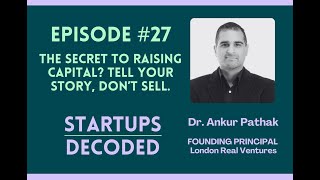
Andy Walsh talks with investor and former healthcare professional Dr. Ankur Pathak about raising capital for startups. Pathak argues founders should tell their story instead of selling, and discusses how to build relationships with investors and use digital presence to attract funding.
Most founders, this is a dirty secret. Don't know that investors are human beings. It's a dirty secret. I know. Don't tell anybody. And so we fall into fomo, we fall into who we like personally that we want to actually follow up with and then proceed further along the process. You mentioned personal brand. That is the single best way that you can possibly stand out from the crowd. Because the very first thing that I'm going to do, or one of the very first things when Andy says that he's got a project that he wants investment for is I want to see what Andy's digital footprint is. Where is Andy? And if all Andy is doing is having an intern post content under his company brand, I don't care about Andy. And so you are no different than anybody else.
Welcome to Startups Decoded, where we uncover what it really takes to build and scale startups. I'm Andy Walsh, founder and strategist. Each week we will bring you actionable insights and real stories. Let's dive in. Hello and welcome back to Startups Decoded. My name is Andy Walsh. I'm the host producer, all in one. Today we're joined by one of my favourite people and I declared it earlier that he's my favourite Canadian. Dr. Ankar, welcome to the show. You're my first doctor too, which I'm very excited about.
Love it. I won't ask if I'm the first Canadian. We'll stick to me being your favorite Canadian. Thanks for having me on, Andy.
My pleasure. And let's just make you my favourite person. Every time we jump onto a call, it becomes something where we both want to help each other, but I find that you somehow have this beautiful way of asking me questions and digging into me and somehow manage to take the heat off yourself. So today I'm actually quite pleased that I get to reverse that and interrogate you in the best possible way.
Bring it. I welcome it.
Well, today we're going to be looking at how good is your startup story and your background and what you're doing now is right in the heart of storytelling. And I think it's really important and there's a lot of change happening at the moment. Biggest understatement of the year as far as fundraising, building businesses, all the things that go around, the life of a founder and being in a startup. So to kick things off, I love to be able to understand a little bit about your background, what you do. Being the first doctor, I think it's going to be really important to set up your path out of university into that world to pivoting into the investment world. It's fascinating and I'd love to be able to get into the detail of that a little.
Yeah, 100%. So first of all, again, thanks for having me on. And where I started is, you know, from university, went to chiropractic school. That was a four year journey post, post university. And so I ended up doing 15 years all in the healthcare space, being a chiropractor and also an acupuncturist. So and we'll get to more about the story part of it for startups. But you start to hear, I mean, every day you're dealing with patients, every day is somebody's story. Every day went from a great time to a tragic time for me at that point because of just the pain and injuries that you were dealing with. But story was always a common thread. Did that for 15 years. But during that time you also realize if you know anybody in healthcare, they don't care about money the same way they don't want to talk about it. They say someone else is better suited to deal with it because they went to school for it. So they will pass on all the responsibilities to somebody else to manage their own finances. So what had happened for me is first I became an edtech startup founder. So did, did Cairo for both 13, 14 years, became an edtech startup, made all the mistakes that I see everybody else making and that's why I feel for them because I've been there. And what ended up happening was I jumped back to being a Cairo. So I took maybe a two, three year hiatus, went back, practiced for another couple years and then realize that the language of money is a universal language. And if you don't take care of that for yourself, you cannot blame that on anybody else. Nobody's going to take care of your money as if it's their money. Regardless of what we think, they're putting food on their table with your money. And so you can never say, I didn't do this, I don't do this. And you can't put your head in the sand. So that's kind of where we got to. My wife's a dentist, so we're both healthcare, don't want to talk about money, don't care about it, somebody else can do it. And finally we say, if I'm not going to do it, I can't blame anybody else. And so took all the responsibility and the pandemic, it rolled around at the same time. I would say 2019 was when it started the mind frame for me, 2020 was really where I took control of everything, our investments, everything that had to do with what we were doing was on me. And so the pandemic came around. I got involved with crypto at that point. I had seen crypto through the media platform that I'm a part of now called London Real. Seen a couple of guests, never pulled the trigger, but it always seemed fascinating. Pandemic rolled around, same guests came back on. And I said, I got to. I got to put my foot into this pool that we have here, this crypto pool. And so just kind of went down that journey. And lo and behold, the media company that I followed ended up creating a venture arm, an investment arm, and I was at the right place at the right time. And now I invest in early stage startups in the crypto space and I get to help them manage the same mistakes that I made all throughout those years.
I think it's really important. And any person who's in healthcare and taking care of other people, there's a certain set of skills that you learn to be able to listen, have empathy, and ultimately be a partner for them with whatever they're going through. And that could be something proactive, it could be intervention. There's a lot of things that you're dealing with, but you also get a really good taste into people's lives. If you go to any dentist, it's a bit harder because it's harder to talk. But when you go into a chiropractor, I became quite good friends of mine. Chiropractor, he's new about my life. We'd have a chat and I think you get this really nice litmus test and crowd feedback as far as the things that people are worried about, what they're doing, et cetera. And ultimately people are sharing their stories with you. You get to have a connection. And as human beings, we're hardwired to tell stories. And we're gonna unpack today a little bit about storytelling. But first, I'd love to go into London Real Ventures. It sits at this beautiful intersection of media and an investment syndicate. Right. So how do those two things come together? You said that the media platform came first.
Yeah, the media platform has been there for about 14 years. And I always say the best way to describe the type of media is think Joe Rogan, just more professional with higher quality production, as easy way to put it. None of the fun that Rogan gets to have, let's just put it that way. But the platform's been there for a Very long time, the stage has been set for guests across all different industries, whether it be, you know, Robert Kiyosaki, Grant Cardone's, Tim Drapers, all these kind of individuals, actors, celebrities, but there's also tech innovators, those who are playing in the investment space, all being sprinkled in at the same time. And so what we realized after 14 years was we've got a great platform for people to tell their story. The platform's always been about giving information and knowledge to the masses that otherwise wouldn't have it. So that's the whole point of that platform. And so if you're dealing in a very tech heavy space, the most difficult thing for the founders is to get a voice out. But the most difficult thing for the audience is to actually be able to digest that, that story. And so we found that that's, that's our sweet spot. We're able to package it in a way that people can understand it, are interested in understanding someone's story and then taking them along the journey of why this is important in the future. So we're just at a good time, a great place with an already established platform.
It's, it's great. And as anyone who's a founder would know, getting attention, getting people, your target ICP to engage and that could be customers, it could be investors, strategic partnerships. There's a lot of people that need to be able to find out what you're doing. So having that at your disposal feels like a real superpower to be able to bring in founders that you invest in and amplify their story on that. So I think I read that's 5 million plus that you have on a database, is that right?
Correct? Yeah, across, across the years on all different platforms.
So good. And what type of people are we seeing on London? Real platform?
What type of people are guests? The audience? Yeah, I would say you're looking at more of an elderly crowd. I would say 40 plus, 35 plus is where we go now, being in this new blockchain AI space. Now, of course, the audience has also gotten younger with that, but we are spread across the globe. I would say the heavy focus is North America and Europe is where we play the most, but we've got members across every different content in pretty much every different countries. A younger crowd is now cropping in, but I would still say the demographic is probably around 30, 35 plus.
And as far as careers, are they founders, are they investors? Healthy mix of both, all across the board.
Those who are content with their jobs, who want More information, those who are looking to transition out of their job, those who are tech founders, and those who don't care about tech at all. Because as you know this, it's the story that grabs people's attention. Not really the technology, not really the specific industry, but mainly the story behind what you're doing.
Yeah. And it's that human part that I talked about before that's important. So from an investment standpoint, you have a syndicate of folks that have come together to invest. So as part of that investment strategy, once you sign someone on, do they immediately get exposure through the platform? Do you wrap that up as part of your offer to your portfolio?
The founder themselves? Once we invest in them, yeah, that's, that's part of what we do and that's, that's our value add. As you know, and as most founders know, you can get capital from almost anywhere. What's the value that comes with that capital? And for us, what's great is the unique value of a media platform. And so with all the founders that we invest in, yes, they get capital, but the meat of what we provide is bringing them onto that platform, letting them share that story and helping them craft that story as we package it, packaging out to the public, I guess.
To give that a bit more color. What stage are you investing at as far as startups? Is it consistent? Is it a mixture?
I would say generally anything after pre seed is where we play.
Yeah. So you're helping then give startups a voice when they probably don't have much of an audience or profile too. So to be able to leverage the credibility of your platform in amplifying stories, introducing founders to a network of people that could be their next investor or the next customer as well, feels like that's a, a real move for, for young startups as well at that stage, 100%.
And what we also do is we cut up the pieces, we make sizzle reels, we make these hero assets. Essentially we give you a 90 second business card that you could just send anybody and they instantly know what you're trying to do as opposed to having to give them a full pitch to try and figure it out.
I'd imagine that like being an angel investor now has become more mainstream, I would say, as people have heard stories about. I had a great one the other day about a man who was an early investor in Snapchat and he was really good friends with his elderly neighbor and she was, I think in her 80s and she had maybe five or $10,000 that she put into Snapchat as one of the first like group of 30 investors say, and like off the IPO, I think she ended up getting over 10 million. Those stories resonate with folks because it feels like an easy way to get in. But on your platform, I'd imagine that folks who had never thought about investing in startups are learning about it and looking for opportunities to get in early and you're bringing those opportunities to them. Would you say that you're creating angel investors on the platform for folks that have some disposable income that may be looking to get into investment?
Absolutely, absolutely. Like you said, a lot of times you don't even know anything about that world until you are able. You're shown something or you hear something. Even if someone were to say, hey, you know, I made $10 million in an early stage investment, people don't know what that means. How do you get the deal, how you get a part of it? What does it look like on the other side of things when you do invest? It's kind of a gray world that if you're not a part of that world, very, very difficult to get access to that information. So, yeah, we're going to build some awareness and we're going to help people who do want to become angels, if they fit the bill, to be a part of what we do.
So is that part of the content strategy then is not just presenting businesses but actually talking about the industry at large and Stages intel, things that allow people to be empowered to be able to take their own steps into investment or startup?
Yeah, look, I would say that the media platform, once the founder comes on, we try and make it all about them, what their story is, you know, where they are in their journey and kind of why we want to highlight them going forward. What we have done is we have created some courses along the way. In particular when it comes to the crypto space, how to get involved, how to understand the space and then as you get more comfortable, then there are ways to then become part of the investment group. So that is a part of it. But I would say when you come on the media platform, we want to make it all about you. But by doing that, you now give awareness to other people who may be interested in what you are doing.
Yeah. Great. And for you then as far as your role day to day, are you sitting on the media platform side and the investment side or are you purely on investment now?
Yeah, purely on the investment side. We've got the media team that have been doing it forever. So I don't get in their way. They don't get in my way. But we make sure that we marry the two together.
Yeah. And then talk us through a little bit more about the syndicate as far as if you can share anything about AUM funds, where you're at sort of with your growth at the moment.
Yeah, I would say that we've been there since about 2022 is when we started. We've invested probably in close to 100 deals, maybe a little bit more than that over that time period. We've invested over $20 million throughout the process. And look, the beauty about what we do with our investors, with our investor base, it's not you giving me your money and me making a decision for you. We bring the founders on, we have a nice chat, we do it in front of our investment group. Every single investor gets to decide if this is something that resonates with them and then they go ahead and make their investment in that.
I'm always fascinated. I had Helena Wasserman on, she was episode one. So she got all this started for me and she's part of a syndicate as well. Specific in climate and they have the same approach as far as getting, getting the masses ultimately aligned on where they invest and where they don't. If you've got a lot of people, what does that approval process look like? Do you, do you have a majority like you would have in a vote situation? Obviously it's going to be impossible to get 100% of everyone aligned on that. So are there sort of like rules around how you start to make those decisions?
Yeah, I mean, definitely we want a majority. Right. We look for, you know, anywhere from 85 to 90% plus acceptance rate for the deals that we want to be a part of. Ultimately what we also want to provide to our founders is 50 to 100 plus investors, angel investors, who are organically and actively promoting them because they love them, not because they've been told to do so, not because they're incentivized. So. So naturally we want the majority to be in on it.
Yeah. Are they the type of folks that can help early stage businesses connect to customers? Do they have networks of their own and, and does that sort of become part of their sort of modus operandum?
They can, I will say this though, I mean, typically we look for a little bit more seasoned of a founder and team and so majority of the times they have things that are already rolling in whatever fashion that they like and if they need help from us, great. It's, it's more of a cherry on the top than it is a necessity for the startup founders that we pick.
So for people that don't know much about syndicates, talk us through a little bit about how they work. If you've got a group of people that are investing into a pool, then you have other people that are actually looking at deal flow and implementing that. How does that sort of workflow come to life?
Yeah, look, I mean, if you're part of a group, you're going to be presented with deals, with projects and there may be one member doing that deals, full sourcing, there may be multiple. Really depends on the size of the team. And then what would happen is there will be a filtering process for those deals, those projects. The team members themselves will decide, okay, look, these are some of the best ones that we think that are going to make it or the best ones that we want to just present to our group. And so they will present that to the group. Now, how it's presented always differs. It could be through emails, it could be through, you know, telegram, chats, messaging platforms, whatever. Discord, however they kind of manage their group setting is where they will kind of fit their actual deal flow in and then people will decide for us. We like to have zoom calls. We bring our founders on, we have whoever can make it on that as an investor base. They get to watch them, they get to see them in real time. You get to hear directly from Andy about why he thinks what he's building is amazing. I get to hear your passion. Are you in it just for the money? You know, those little intangible things that I can't pick up just from a deck we like to present to our group and then after that there are different platforms that allow you to invest through them. So if you're looking at an equity deal, it could be Angellist, it could be Carta, it could be a whole bunch of things. If you're in our crypto space, we've got other platforms that will allow you to do those token investments that way.
Yeah, great, that's so helpful. So for if you're a founder and you're looking for investment in that pre seed stage that you play in, would you say that how they approach their conversation for pitching and presenting is different to a more traditional VC as far as how they present the approval process, due diligence, or do they run sort of fairly similar apart from obviously having a collective of folks that need to buy into it?
So I will say this, you know me, I think regardless of how you're doing your Raise. It's always about the relationships, always about the relationships. So whether you're going to go to a syndicate, there's still going to be someone who is the point person for you, someone that you're going to present the deal. Now, their back end may look different. It's not a fund, it's a syndicate. But there's still one person or, you know, main people that you do have to deal with in order to get to the capital side of things. And so if you can build a relationship, I don't care if it's private equity, I don't care if it's traditional investing or it's crypto investing or syndicate. For me, the process is the same. You build that relationship to the point where they want to present you to wherever the capital is. And I think I'm sure we'll go there. But I want to touch on it now. Is the most important thing is a founder needs to build interest, not get a check at the end of a pitch. Not any of that. It's. Can you be memorable enough for 24 hours to make me feel comfortable to take your deal and present it either to my investment committee, to my partners or to my syndicate? That's literally all you need to do.
Yeah. Great. And we are definitely going to go into that. So if you're a founder right now, it's still tough. The market is confusing at best. It's been fluctuating since 2020, where it was flying high and now kind of feels it's lost the wind in the sails a little bit. But I'm still seeing a lot of positive news for startups getting investment. Probably seen less exits, I think I would observe there. But as far as how you approach investors, get in front of them and secure an investment that is more competitive, I would say right now. So thinking about storytelling, which is a core part of what we're doing today, if you're a founder and you've just started a company, what sort of things would you give them as advice to think about their own personal brand, the company brand storytelling, and how they start to get a bit of a snowball effect of something that's much bigger than the product alone.
Glad you asked that. Most founders, this is a dirty secret. Don't know that investors are human beings. It's a dirty secret. I know. Don't tell anybody. And so we fall into fomo, we fall into who we like personally that we want to actually follow up with and then proceed further along the process. You mentioned personal brand. That is the single Best way that you can possibly stand out from the crowd. Because the very first thing that I'm going to do, or one of the very first things when Andy says that he's got a project that he wants investment for, is I want to see what Andy's digital footprint is. Where is Andy? And if all Andy is doing is having an intern post content under his company brand, I don't care about Andy. And so you are no different than anybody else. And most founders that I've spoken to have, they want to wait until they've gotten traction before they start to say anything at all. And I always tell them, and I stole this from Gary Vee, is you want to document the process. That's what people fall in love with. I mean, there's a reason why Elon Musk has more followers than SpaceX, why he has more followers than Tesla. They care about Elon. That's what makes Tesla and SpaceX so appealing. And so as a founder, if you are starting your journey, document it, show them the highs, show them lows, and they're going to see that. You mentioned since 2020. If I can see Andy's digital footprint since 2020 and he's still kicking today, that shows me character in Andy. Because your product might change six months from now, nine months from now, maybe this one doesn't even work and you go on and create another startup. I want to follow Andy. And so what ends up happening now is when you get in front of me and I've been following you, I'm already a fan of Andy. And so there's less pressure on your pitch because I kind of know who Andy is. I've seen the journey. And so to your, to your question, the best thing, single best thing, I don't care if it's LinkedIn, it's Twitter, wherever it may be, YouTube, document your process, speak about what you're doing, become an authority in what you're doing, and then let. Let everything else fall where it may.
I'm saying that a lot on LinkedIn and when I say a lot about people that have really lent into that. There's a young startup out of Switzerland that I follow, and the CEO shares very openly his strategy for sales and what he's doing, short form is sits down with his content director for an hour. They have a call like you and I are having right now, and they talk about challenges, issues, achievements, et cetera, and they just do that. And then his content director goes away and turns all of that into a series of content that they share so every week they're tracking and documenting their journey. And what he's even doing is actually demonstrating by showing examples. And there was one that he did for 20 VC out of the UK, which is a great platform created by a young kid at the time. I think he was 19 when he started that business. But he actually broke down everything that he did from inception through to now by looking at all his content strategy, the way that he's had storytelling and how he built his business, packaged it up into a 25 minute video and shared it. Because that process was useful for his target audience to be able to do so he spent time doubling down on someone else's story, amplified that, but by doing that, demonstrating, one, that he wants to help people succeed, and two, that people love those stories around the journey. Because a lot of people get stuck focusing on the end game, fundraising. Great example. If you're on the hustle for a year to get a $5 million raise, that has a lot of ups and downs as you go through it. It's tough, but typically you just see the result. It's either you raise your funds or you didn't and people really attach to that bit. But I feel like that, that dopamine hit of closing the fund is great for, but then it goes away. So if you're enjoying the journey and the purpose of why you're doing it and seeing that as a step towards greater progress, greater market share, all those things, I think as an employee or even as a founder, you're getting much more joy out of enjoying the journey, just like you described there. For people that love to follow that.
Story, 100% agree with you. And I'm going to touch on what I hate about fundraising mode. There should never be a fundraising mode. Because fundraising mode to me is not about closing checks, it's about did you build relationships? Did you create a win for somebody else? Did you develop something outside of hey, I need money? Because let me tell you now, when the time comes for you to ask for money, if you've built those relationships, people will invest in you without ever seeing a pitch. Then they'll invest in you without ever getting a 20 minute pitch from you about why you should invest. They already know you. And so to me, if they can, if founders can really embrace. You mentioned the process, but I'm going to mention the skills involved with pitching. Just communication. You are always pitching, whether it's for capital, whether it's for team members to join you, whether it's for advisors to jump aboard, whether it's Vendors to accept you or whether it's your customers should pick you over the 17 other competitors that you have. That skill is always important, just like relationship building. So to me, that is the process, as you mentioned, and after that, closing checks is easy. If Sam Altman tomorrow says, I want to go create anything in any industry, people will invest in them. Now, I understand those are some big names that I use, Elon or Sam, but if you've shown a track record of doing something great and you've built relationships, they don't care the specifics about your next project. I'm in, I'm in. And that's it. Because you've built that relationship with them along the way.
And as human beings, we like to be able to feel like we know someone and trust them. And if you're coming in cold and trying to sell off your first step into that conversation, 99% of the time, it's going to fall flat unless you somehow get lucky and find the perfect customer who at that moment in time is looking to buy and likes the sound of your product. I didn't use my inbox on LinkedIn as an example. I reckon I get 10 to 20 emails a day for people selling me an AI lead generation service. And it's, and it's so fascinating. Like, I would love if I had some time to go through that and look at the tactic that they're using, from dad jokes to straight into, this is what we do. This is how much it costs. Some of it's very clumsy and be able to consolidate and say, hey, this is what I get. The ones that I'm most interested in are the people that try and form relationships first. Don't sell to me. Demonstrate to me that I can trust you and you're going to add value. Show me where you've done it before. Coming in hot and trying to sell off an introduction where I've never even spoken to you before, I've never met you, you've just came in and slid into my DMs, as they would say, like, it's just not going to stick. In fact, I find it offensive.
This goes back to your personal branding story. The whole point behind that is to get somebody to feel like they already know you and trust you. That's. That's where you want to be, right? I'll tell you, the most confusing thing that you can ever do to somebody is help them without ever having an ask in return. That doesn't happen. It's such a low bar. It never happens. And they will Question it and they will think there's something behind it and they will wait for the other shoe to drop. And when it never drops, they're very confused by it. And if you can continue to do that over and over again, now you've got a relationship where people are open to when you do have an ask, which is what you said, right?
It's so good. And I've got a friend in London and he takes the same approach. Rather than trying to sell, he spends his time matchmaking. So within his own network, finding someone else in his network that should talk to each other, introducing them and then just leaving them to their own devices to work out if they can work together or not. And he's found that it pays off 10 times the time that he invests in doing that because he just wants to see good people who have common agendas and goals to be able to collaborate and achieve things together. And all those people, don't forget, they're like, oh, remember, remember Tim connected us at this point. So they go, oh Tim, by the way, I know you're doing this. He's a person that I know. And he just gets lead after lead after lead from all these people that he's just helped on their journey 100%.
I always say that if you can help somebody else when they will always remember you, they'll always remember you. And if you can do that repeatedly, they will trip over themselves to try and help you. They want you to ask them. And so really it's about when is the right time for you to ask and everyone is there to support you because you've helped everybody else win. And so again, same part of the journey when it comes to startup founder doesn't mean that you're going out trying to connect everybody, but it also doesn't mean that everybody you see is an investor and you're going to pitch them. And I think for me it's kind of like, it's kind of like when a doctor goes to a party and everyone knows that individual is a doctor. So now they want to share and ask all these health related problems when all that doctor wants to do is unwind and not talk about work. Same thing as an investor when you are meeting someone for the first time. Just because they say they're an investor doesn't mean your cold pitch, your elevator pitch, starts immediately, build a relationship and then go from there.
I say it myself all the time. I do a lot of events here in New York and If there's any VCs in the room and founders get a sniff. It's like, I don't know the best way to describe it, like a bunch of pigeons on some seeds on the ground. It's a lot and it's fascinating the different approaches, but going straight in off the bat, it's not going to land well. So it's demonstrating value in what you're doing. And I know one of the things that you talk about, I follow your content a lot. It's always very insightful paraphrasing here. But I think you talk about long term value driven relationships and that is the, I guess the truth that goes behind who you are and what you're doing and just sharing, just being informative and demonstrating your hustle, demonstrating your thinking, your innovation, your team, all these things that's inspiring. Even if you don't want to invest, that's what people lean into a hundred percent.
And look, from an investor standpoint, what's the scariest thing is you're going to take my money and run. That's the biggest risk. Right? No matter how much you may have had a conversation and a condensed amount of time, that's still always the risk. So if you build the trust, if I'm at the character that I'm dealing with, I don't have that worry or less of a worry. I'm good, I'm good. And so when you're saying about having long term value driven approach, when people know you're in it for the long haul, that worry is significantly reduced. When they understand that you're trying to build your team up, when you're trying to do good and make an impact and help customers, everybody, I don't care what they say, they say roi, everyone talks about roi. But the real impact is helping long term. Everybody wants to leave somewhat of a legacy. And so all those who said that they early investors in Uber or Facebook or Snap, they can say that millions of people got to experience a certain value because they were an early stage investor. And hey, if I didn't invest, maybe you wouldn't be around right now. Right? And maybe these millions of people wouldn't have gotten access to your product because you would never have made it. So long term value approach is the best way. You may not get short term capital. I want to make that very clear. Right. I think everyone always like, okay, well if I do this, I'll probably get a yes, okay, Capital. No, that's not what I'm saying. You may not get it as quickly as you want it, but over time the process then becomes easier and then you get to a point where you're saying no to the money. And that's where I want every founder to get to.
Yeah. So obviously it's like if you were to look at some core ingredients like that part of who you are and having integrity and profile and trust and respect is one. But obviously there's a lot more to what you look at as far as the business I've created, the product, any momentum, any data that they've got, there's a lot in that. To skip forward a little bit, I'd love to know from a syndicate point of view, it's connected to storytelling and community. But once you've invested in a company, how do you typically work with them after you've signed the deal and released the capital?
It's really all about when they're going to do a launch. We want to time things for them so that they can harness that momentum and that attention in the best way possible. And so really it's about booking what fits as a slot to get them in studio. What fits for Brian, who is the host, founder and CEO of London Real, where he can have that interview process for them. So once we sign on the dotted line, it's really a logistics point after that, when can you make it in studio? When can Brian do it and what's the best time for you? We've had founders who have done a major launch and did not utilize what was on the table, did not work out well for them, or as well it could have. We've had founders who have done it too early. They weren't ready to harness all the attention they got at the time. And so. So it's really just managing what's the good time in your roadmap and what's a good time for studio time.
Makes sense. Do you join boards as part of your investment or is that something that you're taking as a smaller share in portco?
Not necessarily. I mean, we'll be advisors, we'll sit there at times, but we're not looking to take a majority share of the round. We're not looking to get on boards. That's not necessarily what we're trying to do.
Yeah, makes sense. I would assume that. And then on the community and storytelling piece, it's obviously a passion of yours and what you're doing, Are you helping give intel, experience, advice to founders in your Portco on that and the power of that.
I will help them. What's great about Brian and him doing this for 14 years is he's. He's great at pulling that out. And no matter how well you're. I'm glad you brought this up. Someone say something here. Everyone is stuck on having a great story. Very few are telling you that you need to be able to communicate. A great story is a very big difference. Andy might think his background, his process is a beautiful story, but Andy can't communicate to me that roadmap that process. So to me, it doesn't sound like a great story. So having a great story is one thing, but if you can't be communicated, it doesn't matter. And so where Brian fits in is he does a great job of bringing that out of you and makes it sound much better than probably it sounds in your head. And so while you make it sound flowery, you make it sound great in your mind. A lot of times, as you know, the audience doesn't understand. They didn't. They can't connect the dots because they weren't a part of those dots. And so we'll help them in studio at that time just from a regular conversation. And I think one of the great things, which is what you're doing now is having long form conversation. Founders are so used to, you got five minutes, you got 15 minutes, go. Very difficult to get your story out in a way that people are actually, they're embracing your journey. It's hard to do that in an actual pitch. And so when you have long form, content gives them much more color.
And what an amazing session as a founder to not only get capital, but to learn from someone who has this bigger picture vision, to be able to extrapolate information from you and help craft your story. And it's a real skill. We had Sydney Scalicki on episode four and she talked about for technical founders, which is her niche as a coach, how do you tell your story as an individual and as a company? And it's fascinating her process of that because you need to be able to articulate your story in a way that's comfortable for you. You don't want to have to rope learn anything, but you also need to feel confident that it is your story and that you can own it. You don't want to have a script like you're an actor to regurgitate. So trying to find the balance of both is important. You need to be native, but you also need to do it in a way where if you have maybe two floors in an elevator with someone who asks you a question, you need to have one sentence that can impact them in a way that you stick in their Mind. Whereas if you sit down like we are now for an hour, you need to also have enough depth and breadth to be able to keep people engaged for that time. And both of those are very different skills.
100% agree with you. I'm kind of against the elevator pitch. Outside of Shark Tank, I don't see people riding an elevator and saying, oh yeah, you know what, I'm going to give you a million dollars tomorrow. It's just, it's, it's. I'm not going to say it's a gimmick, but it kind of is a gimmick. Right. And I'll boil it down to whether you're doing a 20 minute session or a 30 second session. Energy and your attitude. I can't verify your stats in an elevator, I can't verify your team, I can't verify your industry. But I'm looking at you. And so if, if again we talk about being memorable, if I walk out of that elevator, there's something different about that person. When I've had 100,000 pitches I've been a part of, there's something here I need to follow up. That's what you want. It's not so much what are the words that you use to now get me? Oh, okay, now you know you are in the cleaning industry and so I got to invest in this. That's not what's happening. Is there something magnetic about you that makes me want to actually follow up with you? By the time they follow up, they've probably forgotten what your pitch actually was, but they just remember that Andy is someone I should be following up with. So this whole thing about having a great elevator pitch, I'm over it. I don't care for that at all. Because that person who hears it, still going to go somewhere else to talk about it. I'm still going to go talk to my fellow colleagues, investors. Have you heard about Andy? What about this? What about his industry? I'm going to look at portfolio companies. There's all that work that's still going to be left. Your pitch really didn't play all that much of a role. It just, there's something about Andy that I do want to follow up and what he's doing.
Great advice. And it's kind of, I guess it's a virtual version of the cold email in your LinkedIn inbox to sell you something on the first communication which is never going to stick. And I remember I was in a workshop around storytelling and it was the bookend approach as far as in a very in A short conversation, the things that you can do. And I'm from Tasmania in Australia and more often than not, I would say 99% of the time that anyone that I meet here in New York hasn't met someone from Tasmania. So my ability to lean into that as, you know, a very remote state of Australia, a long way away and people know the Tasmanian Devil. So I can lead with something quite random as far as, oh, do you know the Tasmanian Devil? That's where I'm from, type piece. Because immediately you have a visual trigger for someone to know. Okay, I know that. And the next time they see me, they'll associate me with a Tasmanian devil, which is a two way prompt. I've thought about what I've said, but they also lost my microphone there. I got a little excited.
I should leave that in. I love that. I love the bloopers. They're hilarious.
But go on, that's good. I've got a little a made up microphone stand for today, so it's not.
As stable as it stacked on some books.
Yeah, man, it's.
I've done that many times, I promise.
I'm a professional.
All right, go on.
Yeah, so I, I tell that story and then I typically. And we've actually worked on this together. You've been a really good mentor for on the way in our conversations. What are the things that I've done historically that make me different than someone else? So I lean on the Tasmanian part. Being someone who came from Tasmania, moved to New York City, started a business, sold it, started another one, sold it. And then having exits and then talking about maybe one other fact or something that I've achieved and then use that as a tool to try and get that person to then prompt me with a question. Rather than tell them things, just give them a couple of hooks that they're curious to learn more about. So then you'd start a natural conversation and. And you've been really helpful to me, as I said, in really consolidating what I talk about and how I communicate who I am.
I love that. Again, it always comes back to being memorable. One other point about that elevator pitch though, I hate how random it sounds. I was just in an elevator. Elevator. And there was just the perfect investor. No, it shouldn't be like that. It should be. I know this investor rides this elevator every day at this time. And I've done research to find mutual connections. I've done the work before I ever stepped forward foot in that elevator. So while to that investor it looks like it's a serendipitous meeting. I've done the work. I know how to be memorable. Hey. Oh, you're so and so great. That's amazing. I had just had lunch with a mutual contact. Right. I'm Andy from Tasmania. And there's all these little things that are going to click that make you different, but there's nothing more. There's nothing more to stand out than an investor seeing a founder that's done the work.
Yeah, that's. Oh, sorry. Keep going, sir.
No, no, I was just gonna say, because no investor wants to feel like if you remove me, you'll just insert somebody else. There's nothing. There's nothing special about our meeting. If I know that if I wasn't in that elevator and it was a colleague of mine, you'd have the same conversation that nobody cares for that. But go on.
And there's a great story that I heard on Venture Unlocked, Samir Kaji's podcast. I'm such a loyal listener and I forget the name of the VC now, but it was someone in San Francisco and they just happened to have a rug store right near Sandhill Road, which is sort of the epicenter of VC firms in San Fran. And he just happened to go to the local cafe. And then he had a real passion for numbers. He wasn't just selling rugs in this store. And investment and then got to know a whole bunch of senior execs in different funds that were located in that area. And then off the back of that started had some meetings and built out his own VC fund. And just that story of someone who was just curious and interested in something, built relationships with people that are notoriously really hard to even get an email reply from, let alone have a conversation with.
Listen, nobody wants to. What do the kids say? Be thirsty. Nobody wants to invest in someone who looks and sounds thirsty. It's kind of like dating, right? The more you are, hey, I want to date you. The other person kind of turns it off and says, yeah, you know, I mean, you probably do this with everybody. So, no, I don't. I don't care to date you. It's very similar in the investment world. If you come across as desperate already, there's a point of, there's already an uphill battle for you. So just to your point, a person made relationships. He didn't go there. Instead of saying, give me a job, give me a job, give me a job. They just started to get to know him. And then once the ask was there or whatever happened where it just fit for him to work there. Then they offered that to him. He was the first name that probably came to their mind.
Yeah, that's, it's interesting. And I think if you were to step outside of being a founder and think about you as a human being and how you interact socially, the dating example is a great one. Would you just walk up to a perfect stranger in a bar and just start brain dumping all the great things about yourself and expect that they're going to be interested? They wouldn't, of course. So being a human and not trying to be desperately selling is just, just practical advice that people would know whether they've pitched for fundraising or not.
And funny enough, an investment is a marriage. When I give you money, that's, this is a long term contract. So let's go even one step further than dating. If you went up to someone random at a bar and said I want to marry you, sounds very creepy. I mean, your chances of success with that line is very slim. Maybe zero percent. Right. But that's the same approach that use to an investor. I may not even be an investor in your space, but you would just want to pitch me because you heard I'm an investor. There's so many off putting things that are done in the space. And I will say this too. I mean, like I said, I've been a founder, so I understand the, the narrative is pitch everyone, anytime, anywhere. Right. It's a volume game. Someone's bound to say, like to me, that is exactly why founders get frustrated, why they burn out because they are pitching the wrong people. Now you still may get no's, but at least they're the right nos or quality no's in your space and maybe they can give you some feedback why they're giving you a no. But if Andy invests in Rugs and I'm selling a fintech platform, your no means nothing to me, doesn't help me in any way. And I just wasted time, energy and effort. And then what ends up happening is now Andy's disgruntled because he's pitched 300 of the wrong investors. Now when he meets the right investor, his pitch is terrible because his energy of that of I'm just going to get a no because I've done this 300 other times. And so, so knowing the right investor, knowing the right people before you start pitching is imperative to me. It's everything to me.
Yeah, it's, it's kind of like you're going for a job. I'll use that as an example. You're researching about the company, the work that they do, et cetera. It's so easy to get information around a VC fund and look at examples of who they invested in, their category, their thesis, the people in the business, who are the investors. It'll take like, use ChatGPT. You'll get an answer in 30 seconds. It's like there's no excuse today to not do the research because one, you waste their time, which makes it harder for someone else who actually can get funding from that person. And two, as you said, it's demoralizing. You start to get really down as a founder that you can't raise money. It's like, stop asking the wrong person. Spend a little time and have a healthier conversation and build that relationship.
And can I tell you on a weekly basis, maybe one founder knows my portfolio before I get on a call. Maybe I see, I see five to 10 pitches a day, every day. We don't even need ChatGPT. Every firm has a site. Click on portfolio because you might be pitching to someone who has your competitor in their portfolio. Now they're just using you for information to go feed your competitor. Right. It's such an easy point of conversation. Hey, I saw you invested in so and so this is how we compliment them or I know the founders or something where you can mesh what they are already interested in with your. With your story. I'm going to listen to Andy if, if his, if he knows mutual people or knows my portfolio. You already have my ear because you've done some work.
Great way to finish up today. We're getting close to time and I always get sad at this point on our conversations because they're always so rich. And I'm going to book one into you not to do a podcast but just have a bit of a check in which I always appreciate that time. But as far as London Real and what you're working on, is there anything that you're looking at moment if you're a founder and looking for investment? Tell us a little bit about, I guess your categories and what deals you're looking at.
Yeah. So first and foremost, we are exclusively in the blockchain space. So that one make that clear. We are in the blockchain space. If it is AI, it still has to have blockchain touch points to it. What does that mean? That means we typically look at, we're open to equity deals, but there's something called a token race. And so that's kind of where we play, where it's not just equity, There is a token play to it. So, so that's first and foremost in terms of the niches in the space or the verticals. We are vertical agnostic, industry agnostic, within blockchain. So could be across the board. Whether it's AI, whether it's gaming, whether it's decentralized finance, we're fine with it. We don't care where you are in the world. That's. That's not important. And I will say that the only thing that we don't really look at is pre seed. It's very tough for us to invest in there. But any stage after pre seed is where we look at and so that's us in a nutshell.
Right. And just for people that didn't hear that one comment in their blockchain. So yes.
Don't be bringing highlight that.
Yeah. Don't be bringing climate tech or an E commerce platform.
So you can, you can as long as it's on the blockchain.
Okay.
Right. But I don't want the equity deals that are in traditional world. That's not what we play in.
Okay, great. I'll just say it one more time. Blockchain. So good. It's always a treat. And I know that we've been talking about doing this for a while and that's, that's on me, but I'm glad we've had the time today. Thank you so much for joining us.
Thank you for having me. And I look forward to the next one.
Beautiful. You're listening to Startups Decoded. My name is Andy Walsh. Follow Share Positive ratings help us continue. We've got real momentum now and more big guests coming up. I dot Danka. So I'm really stoked to be part of this experience and look forward to seeing you when we drop our next episode.
More from Andy



EP#88: Why Most Founders Misread Their Own Traction. Vanessa Larco - Premise VC

EP#87: Founders Obsess Over the Raise. Investors Care About This More. — Carina Cunha






Ep#86: Early Decisions That Define Your Startup Forever. With J.P. Morgan Asset Management
