Ep#28: How Great Founders Build Trust: The Startup Advantage You Can’t Fake - David Homan
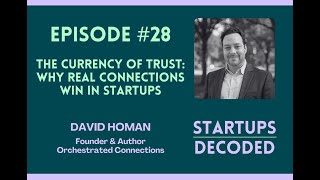
Andy Walsh talks with David Homan about how founders build trust and why it can't be faked. Homan, a former musician turned connector, built Soar, an AI platform that orchestrates meaningful introductions in professional networks. They discuss resilience, purposeful networking, and why authentic relationships matter more than transaction-focused connections.
Everyone who puts relations first, who focuses on being proud of what they've done, not arrogant, but just confident in it. People invest in people, they invest in confidence and they, in the world of founders and mental health, they invest in the people they believe will be honest about where they are, as opposed to hide it. And that's a commonality I've seen across meeting tens of thousands of people and consolidating the best so far, 20, 100, into the networks that I've built. Because everything I found was that when we can see people lying to themselves, we're pretty sure they're going to be lying to us by default, whether they intend to or not.
Welcome to Startups Decoded, where we uncover what it really takes to build and scale startups. I'm Andy Walsh, founder and strategist. Each week we will bring you actionable insights and real stories. Let's dive in. Hello and welcome back to Startups Decoded. Today we're looking at orchestrating connections, and by that I mean how do you think about telling your story, building community and then using that as a vehicle to be able to grow. Today, I'm really happy to have David Homan. Welcome to the show, David.
Thank you, Andy. Such a pleasure to be here.
I'm looking forward to today because when we first met, just some of the examples that you gave as far as where you came from and the people that you know and how you've created that. For me, it was masterclass in thinking about the active process that you need to do to build trusted relationships. And it's something that I have needed to work on myself. I wasn't a natural networker to be able to meet people who are perfect strangers in a room. Everyone assumes that I'm that guy, but I never have been. I've had to work on it to give people some context. Let's go back to work where it started for you. In thinking about your transition from musician to connector, or if there was a linear journey, I'd love to hear your story about how that got started.
Yeah, happy to. And the thing I'd say, right, every one of us is always working at how we build relationships. Every decade of my life, something has changed drastically that's made me rethink my narrative. Who's around me, even who makes the cut for my, you know, 25th, 30, 35th, 40 now, 45th birthday parties. And it's amazing to see how few people stay in any longevity with you unless you have a purpose and a shared intent with them. So that might sound Eloquent. Now I knew none of that when I was 12, I got really sick. I was a pianist, not a composer at that point and I quit piano. The illness stopped baseball as a career for me and got me only back into softer because it was something it was more naturally inclined for. But that year, which was the start of my sixth grade, I became asocial. I went from that kid everyone thought could be a leader to the kid that was heavy, set on a good day, shy, and nowhere near the person that other people used to see me as or the way they see me now. And every, every moment since then has been this journey to figure out where I fit in. Until I realized I had to build my own community of people who didn't feel that they fit in. And that whole time. Cause I've never stopped my music career. I've been improvising, composing music, ballets, modern dances, some orchestral, a lot of chamber. My daughter will always joke. My older kid, Eva, you can just say an Alexa, play the music of David Homan. And it's that easy. Yet we don't connect around most of what we are passionate about unless we're intentional and vocal about it. And I've had to learn that in a very serious, studied way of how to be authentic but also be proud of everything that I've done.
Do you find, and I'm doing this a lot lately myself, is the active reflection about different periods in your life because as you get older, you learn new skills, you have maturity around experience, and alias wins things that happen along the way. Do you look back at those moments and try and mentalize it and think about, okay, within that time in my life, what did I learn? How can I apply it now? And is there some kind of cathartic or almost cleansing process that happens by looking back?
I don't know if I'd say it's cathartic to look back. I think, you know, I've had these two things driving me my entire life. I wanted to live a life without regret. Obviously I have things I wish I did differently, but if I lived a life of regret, I wouldn't love where I am now. And I really want to love the journey as hard as it is. I'm divorced three years, just moved apartments, have a startup launching out of beta I'm raising for, have a book coming out, juggling between five to eight clients. My kids are starting middle school and third grade and I don't sleep well at night. I go to bed just fine. I just wake anxious early with unsettled thoughts of how to figure this out. And I could compartmentalize and look back at everything I've learned. I'd rather focus on what I've learned. That's gonna give me the resilience to get through everything that is in reality. Andy. My choice to be in these situations. There's no one but me that put, yes, there's things that could have happened differently in my life in many different ways, but I want to love the journey and where I'm going. And for that, I have to always keep perspective on not just what I learned or what I could do differently, but how I can continue to make what I believe are the best choices of the time, even if they might cause me hardship later.
And the resilience that comes through heartache or hard times. And the low points that you have in your life and if you're pragmatic, human allows you to be able to look at those times and you navigated it, it can give you confidence that anything that comes your way in the future, you have the ability to be able to think about, okay, what's happened, how do I solve for this, and then how do I move forward? And I find it fascinating. You talk about there, as in elementary school, going from leadership to then being asocial and then coming back out of it to do what you do now. Talk to me about the point where you realize that connecting with people and then being able to turn that into a business was something that became real rather than just part of networking, which everyone does. Like, for you, was there a moment when you realized that this can actually be something that turns into a career?
Absolutely. It took me five years of it staring at me in the face to realize it. So everyone, right, every founder in particular, everyone needing to raise capital, find the right deal to think about having that need and then building the relationships to solve that need. And I realized that wasn't the right mentality for how I needed to live my life. I needed to build the relationships without the need to trust my instincts on who was around me. And then when I had a need, that need became fulfilled. And that was that aha moment for me. I had spent two years after the housing bubble, recession, and the Bernie Madoff Ponzi scheme just learning how to network differently. Every event I went to, every person I talked to, I found what's now called the Connector or the Super Connector, and I befriended them. And what I didn't realize is that by connecting them to each other, I could build a global community spanning 35 countries. And 187 cities to date. I didn't realize that what I talked about would speak true to them, most of whom are the upper echelon of the connected people you want to meet on this planet. It's why my book coming out, Orchestrating Connection, has this focus on a playbook of how to do this, because I've lived that, and I lived it in an asinine way of doing it without realizing it. Helping people, that expectation of return, and then suddenly being seen in a way that everyone else saw me but myself. And when I turned that around was when I realized the same way that I find resonance when I write music that people listen to was the same exact process to find resonance between and amongst people and orchestrate those connections. And only when I took that music world of mine, the executive world, the connection world in between, and I realized I was one person doing this, not three different hats. That's when I consolidated everything into what is now called orchestrated connecting.
And I see the relationship there. And I have a background in music as well. I had an audio branding business that I started here and sold. And in that process, you start to learn a lot about human beings and psychology and things that are part of our DNA that go right back to the early days of storytelling that then turned into songs. So that was a way to record history. It was a way to maintain the strength of culture through generations when there were no other means to be able to record that history. So the ability for you to create and connect with people in different ways, because I flip it the other way and go, well, anyone that listens to a piece of music, here, here's something different. And I don't mean literally, but their interpretation of what it does to them. And it could be a chord progression, it could be a lyric, it could be a beat that just makes them move. There's things everyone interprets in a different way, and if you apply that to a human relationship, everyone that meets David is not going to see you through the same light. So you need to have this ability to be agile and think about your relationship with each person in context of who they are and how you know each other.
It's completely true. I know from your background and the success you've had from that into where you are today, that you are a study of human beings, everything. And now this incredible podcast you've launched is just a study into what makes people tick and be able to interact and succeed, because we're all looking for that magic solution. And the thing is, it doesn't exist. I've met some of the most prominent billionaires, celebrities, leaders on this planet. And they are striving for what they want, not resting on their laurels. And I've met some of the most arrogant, horrible people who will convince you they are greater than everyone else. And by virtue of having to create that sense that they are greater, we know they know they're not. And then I meet and this is. These are the people I care about. And I believe there's more of us than we think there are who are naturally curious, intimate and vulnerable to view that journey of loving, that journey of who's around and with them, not just what they get from it, but it seems like those people are an anomaly in this day and age. You know, the. The second part of the book my co author Noah Askin and I wrote is how to build purposeful community in a tribal world. We feel we've fallen back on those tribes to stick with the people who look like us, who talk like us, who want the same things. And the thing that I just fail to understand is if you're around everyone who wants the same thing as you, then how can you all get it? And if you're around a world of diversity, around a world of people who approach the world with empathy and compassion and can be successful, why wouldn't you want more than that and more of that? And we just live in. We live in a space now where everyone wants to take up more space because they think they deserve it. When I go back to that, living life without regret, I've never thought I've deserved anything. I've wanted to earn it. Cause I wasn't born with a network. I wasn't born into privilege. But I built it authentically. That's why I wrote a book about it. And it's why after six years, I found investors and people to build a startup called Soar. Strength of authentic relationships. It's called Soar Connect for trademark reasons. And the goal was how can we systematize authentic connection? How can we visualize it? How can we create an accountability? And how can we filter out the people that want to take from us so that they don't take from others that we love and respect?
So elegant. And I love the notion of tribe. And my background is in creative and culture strategy, which is all thinking about from a storytelling lens. What are the things that unite people? And there's foundational things around trust. Or it could be just sharing food. It could be where you live and there's things that connect you But a tribe by definition is where it's aligned on passions. You have this unified thing that you're all passionate about that you want to do. Yet how you come together is always unique. And I think understanding the human part of a tribe is something that I've always been fascinated by. And you're right, I'm a curious person and I love the study of how humans think. And on here we tackle practical things around how do you apply someone else's experience to something that can be easily digested and used ongoing by other founders who we talk to? But I think the other part of it is also the human side. What are the, what are the feelings that you had through each of these phases and how did you overcome it? Something that I'm really curious on that you touched on before. Someone who is really well known, a successful entrepreneur, they're a household name in in the venture world, that person versus a first time founder who goes to their first networking event and is trying to just work out the world. Are there commonalities between people you would assume are amazing versus someone who is learning it for the first time?
Here's the common thread I see for everyone who is not successful and becomes it and everyone who is successful and actually does deserve it or earned it. They don't let other people's opinion of them or people's belief or investment in them define who they are or their value or their purpose. And when we live in this world of the perils of social media and we look at how many likes we have, how many follows all of that. Right? I'm I'm proud of your podcast because the content is killer and key. It's also then relevant that you this is a rising top podcast in the market but you listen to how many people do it who had success or fame and didn't get the following because they asked the questions they wanted to hear and not the questions that the audience wanted to need. And in that every early founder I've met and my network includes tons of them along with insanely successful name brand VCs and family offices and the rest. Everyone who puts relations first, who focuses on being proud of what they've done, not arrogant, but just confident in it. People invest in people, they invest in confidence and they in the world of founders and mental health, they invest in the people they believe will be honest about where they are as opposed to hide it it. And that's a commonality I've seen across meeting tens of thousands of people and consolidating the best. So far 2100 into the network that I've built. Because everything I found was that when we can see people lying to themselves, we're pretty sure they're going to be lying to us by default, whether they intend to or not.
Yeah, and you caught it out before the people that have a false sense of who they are versus someone who is vulnerable and genuine. And for a lot of people, they get nervous about being who they are. And they undervalue, I guess, what they bring to the table. The strength, their experience. So sometimes they feel like they almost have to create a narrative to be able to feel like that that's the person that someone else wants them to be rather than backing themselves. Did you go through that? Do you see that in other people? As far as trying to overcome that hurdle to go from? I know myself, I'm not egotistical, but I can confidently articulate my story and build deep connection.
So I believe. Andy, we live in two competing narratives of our lives. It's what we think our narrative is, is the one that we share. What we believe the actual narrative to be is the one we never want to talk about. And the authenticity that comes with actually understanding. It's a combination of those two. Gives you that mindfulness and that approach. And this takes a lot of self work. So here's one version, right? I'm that shy fat kid who never grew up, was afraid to take risks. I took risks because I felt I had to. I got out of college, I went to grad school. Cause it was the only way to get to New York. And I thought I could live there. I had a panic attack. I moved back home. I nearly never came back. Then, because of my abilities as an executive in nonprofits, I got a job. That job turned into a nightmare three years later when the Bernie Madoff Ponzi scheme happened. And my 15 minutes of fame was entirely people asking me what I did wrong. Which was a choice made by the foundation. When I was 13, when I was not involved in the foundation. And then I was in a job. And then I got another dream job working with the family office to run a film company. And Covid hit and Hollywood died. And then I left that and tried to build a business. And as I built a business needing the capital and the time, my marriage fell apart. And here I am. And that is the story in my head every moment of every day. And I cannot escape that feeling that everything I've done will become a failure, is a failure, even when there's constant validation. And then I think When I talked about what we earn in life, what's that other version? I was a kid who got over near death when I was 12. I didn't fit into every community, but I became, you know, an athlete again and played soccer through high school. Then not competitively, but very actively in college I started writing music. My music's been at Carnegie hall and touring the world by 26. That job I got was a job most people didn't get till their 40s. And I read I led that foundation out of a lawsuit and out of total losses to stability that got me through a board I joined because of something passionate to me to work with Ray Dalio's family and to build a film company and to support, you know, his son and his daughter in law with some of their incredible work. And then I used that skill set to build a business that for the last five years has been thriving with a deep consultancy that then grew my network from 40 to 400 to 2200 and counting. And in that I raised for a startup in two and a half months last year in one of the hardest times for early stage founders to raise. And over $500,000 came in from a network that I built. As I built that product out and as my book is starting to come out, I've nearly raised 2/3 of my next round. With some of the biggest family offices and capital firms on the planet going, I can see more uses for Soar than any other startup since LinkedIn and HubSpot and Apple, you know, if they all had triplets together. And the potential of all of that is sitting right there. And I still feel every part of that other narrative with me that none of, none of this leaves you. And I've met so many incredible people who sit with that and doubt themselves. It's what you do from that that matters. It's how you are authentic in that story and those lessons learned, right Every five years, every decade. It's about understanding that if you're not going to stop yourself, then you need to build up a community around you who's going to help you become unstoppable with them.
Amazing. Thank you for sharing that. The question that I have, do you think that you were always resilient or is it something that you've had to try really hard to build, to be able to keep facing forward and through the twists and turns that you just described? Because resilience is such a key skill for a founder to have and you're going to fail, which I have real issues with that word Things don't go your way. But I think resilience is critical and being able to find a path forward. Some people are just naturally can take stress on and be resilient and others have to work really hard. Looking back and even today, like how would you think describe your native instinct around resilience and help comes up as part of your job.
In pre K there was a bully named Davey, which is why you can call me Dave, you can call me David, you cannot call me Davey if you want to stay my friend. And this kid, he picked on other kids and at 4 years old, Andy, I hate bullying. My triggers in life are hypocrisy and injustice. I don't think we can ever be perfect, but I think we should try to live in a more just world where we're not hypocrites. And this little kid, and he was a little kid, he would smack down all the girls and all the boys that were smaller than him until as the story goes, my mom got a call one day and it was from the teacher and the woman who became a close family friend, who cleaned the entire school and essentially watched after me. And they called me in, they told my mom that I had stopped the bully, that he had a bloody nose, therefore they had to send me home. But they weren't punishing me, they were sending me home on the way to and this will date how old I am. This can't be yogurt, which was before 16 handles and Pinkberry and everything else. That was the only one. And I stood up to somebody doing something to somebody else. And nothing has stopped me since that moment that has I faced in my life. That wasn't a moment where I want to use everything I have resilience for to stop the hypocrisy, the injustices and the imbalances of power that make a whole bunch of arrogant, powerful, selfish people maintain their power when the world has needs that could be easily met. And that is from sustainability and climate change to poverty to human trafficking. I don't understand why if people in this world have such power, they turned a blind eye to it. Except for the one thing I know is true, which is nothing right now will damage their reputation by their apathy. And I've dedicated my life to build a global network coming out tech, every part of it is the same goal. What if we could get more people to be purposeful and hold themselves and others accountable? What would happen if we actually showed the consequences of no longer being in a community because of the bad actions that we took. And all that goes back to me as David or Dave facing off against this four year old kid who was gigantic in our eyes. And I went behind him on my hands and knees and he fell back over me because he was just running around trying to torture people and he hurt himself slightly. He was fine. I'm not trying to say I was perfect in this situation as I don't advocate violence, but that shocked him into realizing he wasn't impenetrable and he soon went from being the bully to being a friend of everyone. I don't know what possessed me to do it then. This was 42 years ago. But ever since then I have rallied against this idea that we should sit by when others need help to the point where I promise too much help. But I do my best to be honest about doing everything I can to help people.
How do you balance thinking about your morals and what you just described with networking, where you're going to be meeting and integrating with people that don't share the same philosophy as you or same outlook and prioritisation of of those things? Do you have to separate them sometime? Are you able to carry that through in all conversations and separate your clientele? Because we all face challenges of dealing with people that we have to who have completely opposing views to us, but there's a necessity to work with them and sometimes there's not an alternative. But how do you think about the difference between staying true to yourself versus growing a business and networking with so many different types of people?
I have an advantage other founders don't have, which is that I spent 10 years building a purposeful network with an ironclad rule and I spent the prior five years setting up the seeds and planting the trees for it. So the advice I did I give could not be the same for somebody just starting out as where I am now. But I'll tell you this, a decade ago when I launched my network I said I only want to be around action oriented natural givers that I or somebody else would leave my kid. Now I have two so kids with you and that was unassailable. Everyone thought it was limiting. 67 giving pledge billionaires I have access to later acres of celebrities and Hollywood and the West End and Broadway and Bollywood all through. Not just those people, but more so the people who were the gatekeepers and the trust most trustworthy. And by limiting something I freed something in people to either be that high integrity person you want to do business with or not. And by building a global network that way. That's why I hope I'm poised for the success that I've been working towards. But honestly, I'll be upset if it doesn't happen. But I've been able to help over 10,000 people to feel part of what they need to have purpose on this planet, which is mostly to help other people. That's the right measurement of it. But it's a really challenging thing, right? That question's hard because if we could just work with the people we love, we would. But we have to because we need money, we need access and we need that power. So all I'd ask is trace. Then what happens to all those founders who end up without the shares they needed for their blood, sweat and tears? Look what happens to those founders who took investors that prioritized their investment above everyone else who came in earlier. Look at what happens with the private equity of the groups that buy it at a margin because investors waited too long. And then we end up in these situations where all These very arrogant VCs, not all of them, but many, think they're the God's gift on this planet. And what are their percentages of success? Right? If the venture world was so smart, then why did 9% of startups still fail when we have gotten better to fund the right ones? By this point, this is a world where everyone will posture to say they are the best at something and no one will say that they're doing their best because you can't do that. And therefore we fall prey to that endless world of let's hope the next person will save us. I didn't prescribed to that starting 10 years ago, I said I do not care if this person is an incredibly prominent person and they're schmucked. They don't get to come to my events. I will not put them in my world. And then you know what happens? Somebody goes, hey, I got this call I want, I want you to take. It's with somebody I really trust. I don't make this intro for anyone else, but I'm going to do it for you because you have a moral compass with who you'll connect with. And then I could name people on this planet by naming a single name, their first name, people would know them. But it's not about the name dropping of it. My publicist from my book probably wishes I would name drop all the people that I've met who trust me. But why would you trust me if I go around being like, I met Andy Walsh. Do you know Andy Walsh? I know Andy Walsh. Do you want access to Him I. Those people will get that. You know, they might get rich quick, they won't live purposely. I've taken the long game and I encourage other people to take even the middle version of it. Do the self work, be accountable and ask the most of the people who are the closest to you because they will, as all the science shows, define your life and learn to love that journey with them, whatever happens from it.
I love that there's lessons there for me in thinking about how I communicate and not to make this episode about myself, but I find that I'm fortunate to be in the front row seat and just absorb so much insight from people. And what I heard there was your ability to earn trust with a lot of people and build that over a period of time. Because you can't just activate a network overnight. It takes time and energy. And in a world where it's easy to connect, you're not really connected. It's superficial. And it's not like you can call those people and say, hey, I've got this opportunity or I need some help. I've been able to have something that you stand for and that you're known for and then earn trust over a period of time and that grows. And I'm seeing that myself. And I'm like you, I'm humble. I don't talk about the things that I've done in a way that's out of context or the people that I know. If it's important for part of a conversation, then of course I'll talk about that because, you know, I see it as a brand versus product statement. Your brand of David Homan is very much around trust and morals. Where your product, the people that you know, what are the things that you can help them with and what insights do you bring? So the connections that you're making are not just a handover to this person that could help. There's context and there's outcome that come with it too. So it's not just the relationships, it's the experience to make sure that you're almost giving them an alley oop to continue what they need to do.
You know, my eight year old thinks when I give him an alley oop, he can dunk even though he's four feet tall. Right. And I think of that as this analogy of like we all think that we could be that giant who can just slam dunk and the chances are there's 2% of us that even get to that height that could do it. But my kid Max dreams Andy, he dreams of that. Because he thinks if I just get it to him with the right angle, that time will. The time his kicks and his leaping ability, which is about as good as mine, gets him there. When I know the reason you were my favorite person we met at that conference several years ago was because we had a real conversation. Everything else was platitudes and posturing and probably those people were the people that I should have networked to meet. But I've learned. And then what Somebody who walks in, name dropping something. Somebody who's instantly telling you about their deal. Like I've. I in the book. Like we've categorized all these different type of takers. I thought there were 14 when I started to publish this book. I already have two more. And now we've also archetyped the connectors, right? The conveners and the silent givers and the thoughtful and all the rest, you know. But. But it's this idea that like people, we see people coming that way. Why don't other people see themselves coming that way? That's because we all think we can just do that slam dunk, even though we're four feet tall.
It's such a nice analogy. And I, and I have an 11 year old daughter as you know. And it's the same kind of thing. I find that I learn a lot from. From my daughter and part of it there's qualities that she has that I have that. So it's almost like looking at a mirror sometimes with things that she's doing. But there's a sense of play and naivety of sorts in a beautiful way. And I think that's what I bring to the table when I'm speaking to someone. It's. I never assume that I know more than someone else or that there's something I need to tell them. I start with a series of questions which is a curiosity led about who they are, what they're passionate about and what are the things that we have in common and build that. And it's. And it's like dating in a way. And the people that date well are the ones that are themselves from day one. Like creating a narrative for who you are never works because you eventually get caught out because you can't hold that up for that period of time. So I think that authenticity is key to step that into this, pay it forward and then to get it back a little bit. This is something that I've talked a lot about on other episodes and I'd love to get your take because I've seen and heard from other people And I do it a little bit is I find connecting two people to each other that have a mutual win win to know each other comes back and pays you at some point in the future if it's either directly or if it's through brand reputation and referrals. What's your take on that as far as, like, your business is literally orchestrating connections. So for you, you're able to tap into your network, but ultimately the commercial side of your business is how do you help people find each other that elevates whatever they're doing.
Zen, think about this a couple ways. Easiest way we talked about trying to find that resonance when you do that one time, it feels really good. When you do it 20 times, it feels great. When you do it 100 times, you can't keep track of and it's like a balloon with a slight leak at some point falls back down to the floor. And you're surprised that it's sunk because it's just been so gradual to get back down there. First rules of my network, the only one I enforce is called honoring the chain of connections. So here's what I found, right? The world works on introductions. I've had some of the most arrogant people challenge me on that. I had this one private equity guy come to me and say, well, your world is just these. She like, you guys should like each other, please take a call. And I pushed back to him at a family office event I was at about two years ago now. I was like, okay, tell me your top five deals. And he told me them very, very proudly. He knew them off the bat. And then I said, who introduced you to those deals? And that's when he paused. And I tell you this in the context of the fact he had not honored that chain with one of those two who was actually the person that introduced him to deals 1, 2, and 4, because that person had made a mistake. They had not demonstrated the value they were giving him by introducing him to somebody that could result in that deal. But he had also made that mistake of being dishonorable back to his top performing introducer. So when we live in this world of a currency of introductions, you cannot lead with, here's what I get from it. But you do have to lead with, here's the value I'm giving and the time and the energy that I've put in to build this. And the question, right, would you respect that? Would you honor it back to give me feedback? So 80% of my network, my time is spent giving people introductions. I think would benefit Both of them. A lot of business happens. People haven't co invested, they've joined boards, they've gotten major speaking opportunities. I get the gratitude from that. It does build my reputation. But I ask nothing in return, especially monetarily. But then when I come in with an example for a client and I identified this is a client, this is somebody I've engaged with to strategize, to coach and to connect them, I ask people to opt in, I asked them to take their time, and in some cases I can say there's a return for them as well. In most cases they are more than happy to do it because I gave them permission to ask without any ask back to them. And by doing that systematically, I built an entirely different network than most others. Because you're in it for what you need, but you thrive in it for what you give. And that psychology of those two can work together. Because when I speak about honoring the chain, I talk about how when you do that, when something has happened to you, that it makes you more successful. You have permission to be selfish and to gloat about that, but the mechanism by which you do it should be to express gratitude to those who believed in you and helped you achieve that success. And thus. Thus we can be both selfless by expressing that gratitude and selfish by sharing our success at the same time. It's possible to balance these and to have a business, to have a community where transaction occurs. But everything stays relational.
Do you have an instinct on a percentage of how many people are doing the right thing with those introductions and acknowledge how it helped them and then they give it back versus the ones who are takers? Do you have an instinct as far as what percentage would live in each lane?
In my network, it's 90% who are active. The other 10% are gone within a year. I've forcibly removed over 40 people now for being disrespectful and not honoring this. I enforce these rules because if you ask people to be the best versions of themselves and you encourage them to do it, and they see the demonstration of that, either by being the giver or being given to you can elevate people. That's why even though I love the way you described a tribal community, my co author Noah and I call this a purposeful community. Because that purpose and intent can transcend what anyone's desires or wants are into. Just matching our needs. And when you match those needs, ask to ask. There's no imposition. That's the nature of Soar. The startup I built, it's not just to have a better personal CRM and have an ecosystem understanding. It's this idea of what if you could build a sophisticated LLM where the AI helps you match asks by people's passions and interests, but based on the privacy of each of our networks, never showing the rest of the world who we know, but having technology suggest to us with greater efficiency. Wouldn't it be great, Andy, if you spoke to this person about one of your next companies you're going to build? Wouldn't it be great if you made an ask of me and I could turn back around and say, you know what, these are the six people who are ready to talk to you. We live in a world where all of this seems so hard and in my world it's asked with curiosity. Ask for an opt in and the more you learn that the more you match it, the more people honor it.
Let's go into that a little bit more. So soar, your startup is very much the AI forward facing version of what you do day to day orchestrating connections. If you're a founder or anyone in venture, which is from what I understand the like your sweet spot within that, what are people coming to you for on that product? How does it help fulfill their needs or the challenges that they're facing?
Let me answer that just with the qualification which is my purposeful sweet spot is no specificity. Besides connector, I have people working with women in sports and anti human trafficking in founders and investments and private equity buying beauty companies. I have somebody working to revolutionize the world of music through blockchain and digital tokenization of every note you record. So I purposely left my network broad. But I'm not naive to what power means in this world. Therefore, a large amount of my network are those who have or have access to means and those with vision and purpose. And I believe by merging those together you have great success. So yes, a great deal of my network, our founders, exited founders, venture capitalists, seed investors. A lot of these people run different networks or communities. You know, three friends on the network founded Princeton Angels, another one founded Harvard Business Angels, another one founded NYU Angels, another one founded Brown. So they're all the conveners, the people who see the collective need. And in this the one thing you need is you need an answer to your ask. I need to, I need to find a new CMO for my startup. We just got our series A funding and now we need to scale. I've been doing this part time. I need to raise a new round for my company. One of my Board members of my startup, Jeff is looking at the connection between brands and gaming. He needs the top brands on this plan, from Target and Walmart all the way down to want to align with this purpose of gamification, community building, to increase their brand and achieve social impact. There are a thousand of these variations. I have zero capacity to visualize, even though I'm really good at this, to visualize the chain of connections it takes to get from person A to B to C to the success for Jeff or somebody else in my network. And so the idea was, what happens if you take everyone's personal network which exists in our phones, exist in our head, but are fragmented between our, our email, our calendars, our WhatsApp, our LinkedIn, our X, our slash Twitter, every variation of how we communicate. And then if I were to need to text you after this and you and I have called each other, what if I didn't save your number and I have to go see if it's in an email and then I have to email you, hey, what's your number? I forgot to mention this. Like that's the insaneness of the way technology has kept this all fragmented instead of user focused. Because all of what this is, is, is our contact book, it's our address book. And then it's Google or Yahoo or Bing or whatever variation of people use to figure out how to get the person we need and are they actually connected to the person we know. It's a, it's a very complex solve for one goal. And I'll give you like an example of a group I am champing to help them, right? I talk about injustice in this world. I think it's horrible that the majority gender on this planet has less access to everything because we live in patriarchal societies and one of the most admirable couples I ever met, ASR Malik and his wife Malala, I'm helping them. They just launched a sports fund called Recess. I'm using my network power with no monetary gain to drive a get to every single wealthy sport team owner especially who is matriarchal or has strong women in their family. Their premise is invest in the world of women and sports and sports tech. If we have equal visibility for women, we may then get soon after equal access, equal pay, equal education or opportunities for any of that. In a world where we all depend on women and yet we do not empower them. That's their ask, right? What if the tech could then make that ask? Go to everyone who trusts me, say to you to then to the people that you've interviewed on this podcast to say, do you know somebody? Then all of a sudden, we have that collective will with layers of trust, able to solve something where somebody else on the other line is going. I'm a female sports team owner. I own three, you know, football teams globally. I own an NFL team. I invested in women's basketball. But I can't solve this problem of men get paid this and women get paid this. And yet the US Women's World cup team, oh, my God, I love watching them. They're incredible. And they should have earned way more than they did. And instead there's controversy over global gold medal repeated champions having to scrape by in comparison to people I didn't want to watch. Like, that's an injustice. And a global human rights figure who survived and built resilience through my resilience. Nothing I've ever done in my life has compared to what Malala had to go through. And she turned that into something purposeful and intentional. I want to help with what if tech could solve that quickly and then we all align for it, then we see a result from it. And what if you were part of that? And I honored because you were part of that technological chain, being that type of person who helped without an expectation of return. Therefore, when you got your return, it was much greater. I believe technology can do that. I believe community can do it. I just need to think. We need to look up, as I tell my kids, look at the sky, breathe this air and realize you are not as important as you think you are. But we collectively can be. And the more we do that, the more we move from tribal to purposeful communities. We solve this because then we're accountable to each other as opposed to blaming each other for our problems.
So good. And I definitely need to bump into that. My CRM is fragmented across various places and centralizing connections for me, which that's how I make a livelihood. Not to the same level of you, but it's really important for me to be good to finish up today. Cause it's very much connected. Your book is out on August 5th. The website is orchestrated. You can get links there to purchase the book. We've covered a little bit today, but if you're a founder who's thinking about how do I build my network in a very structured way, what are the key things that people will get from your book?
Here are the five principles in a nutshell, as we close this out. So instead of walking into a room, because as a founder, you have to go into all these rooms and all these incubators and all these places to find the right person. What if you had done the self work first, to understand why you're doing this? Not because it has to happen for you, but the need you're fulfilling, whatever that might be. And then what if you could pause as you walk into that room and look at the culture of that room and just study a little bit differently? The way I say, I tell my kids to just look up at the sky when they think their problems are the greatest things on this planet. Like my 8 year old losing Super Mario Odyssey and not being able to beat a level until he realizes he can go on YouTube and look up for YouTube kids to cheat for it and figure it out in eight seconds. But then he goes back and he has to learn and he has to do it, because you still have.
More from Andy



EP#88: Why Most Founders Misread Their Own Traction. Vanessa Larco - Premise VC

EP#87: Founders Obsess Over the Raise. Investors Care About This More. — Carina Cunha






Ep#86: Early Decisions That Define Your Startup Forever. With J.P. Morgan Asset Management
