Ep#29: The Post-Product Market Fit Playbook: Scaling, Systems, and Survival - with Adrian Fagerlund
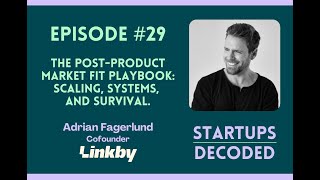
Adrian Fagerlund, co-founder of Linkbee, talks about scaling after product market fit. They cover fundraising, building global teams, and keeping culture intact as you grow. Linkbee went from finding fit to managing the systems that let you actually scale.
So if you have, when you have USPs unique selling points, you have a founder story, you have something that you're proud of that can now very easily, very cost effectively and measurably be news here, there and everywhere on a global scale if you want to. And again, back to the bigger advertisers when they don't have to wait for a new product launch, they don't have to wait for a big piece of agency, handled strategy thought after, you can make anything new that you wanted to and quickly and cost effectively. So in the terms of like reinforcement and being top of mind and capitalizing on anything a brand does that they're proud of, you can now have a venue to make sure that the biggest, loudest voices on earth talk about it all the time. That's extremely potent when it comes to enforcing brand.
Welcome to Startups Decoded where we uncover what it really takes to build and scale startups. I'm Andy Walsh, found founder and strategist. Each week we will bring you actionable insights and real stories. Let's dive in. Hello and welcome back to Startup Decoded. In the journey of a founder you go through a lot of milestones from fundraising to product market fit to potential exits. Today we're jumping in at a post product market fit level but also post series B raise. And to unpack that I've got Adrian Fageland who's from Linkbee. Adrian, welcome to the show.
Thanks a lot Andy. Appreciate, appreciate it. Excited to be on.
It's kind of nice for me. I've got this Australian alumni, I will call it, as far as legacy from where I was working originally but now part of my extended American community based here in New York. And it feels very timely that a business that came out of a business that I worked alongside back in Australia is now scaling across the US with an investment and to be able to connect the dots for me, I, I take a little pride in doing that as well. So to set up our conversation today, I would love to be able to look backwards on yourself and Linkby's journey.
Yeah, absolutely. It's have a pretty unconventional background I think. My first sales job, I always joke was door knocking in Sweden where I'm from selling Christmas magazines to old ladies when I was 8 years old. But long time after that I ended up in Australia where I was in a different industry altogether. That industry then brought me to meet my now business partner and co founder Chris, who had set up a Australia's biggest youth publishing platform called Pedestrian tv. We met there he was leading that. I worked with him there. He ended up exiting that to Australia's biggest TV network called Nine. And during that time at Pedestrian tv, which is a youth publisher, we saw some holes that we wish were different for us as a publisher. We also saw some things that advertisers really wished existed and that's kind of the birthplace where the idea for Linkbee came about. And then as Chris exited that business, we got together and started Linkbee and that was five and a half years ago.
I feel like that Chris has been one of those people and this is the second time it being really future facing and seeing a bigger opportunity. When he started Pedestrian, he was in advertising and saw that there was a real opportunity in the digital space for storytelling where Street Press was still big. Digital was kicking off, but there was nothing in that space that was really strong and, and they obviously had an amazing exit and great success with that and a lot of sub brands. And to do it now a second time, thinking about the evolution of technology, how products need to be able to adapt to new platforms that are built and then how brands and customers ultimately find each other and how you optimize that. So good to start today with a foundation around linkbee. In simple terms, how does Linkbee work and add value to a business?
Yeah, absolutely. So in the space of premium publishing, it's basically a performance PR platform. So it allows advertisers of all sizes. We work with the likes of Apple and New Balance and Agustina Badar and all these different brands from all over the world where they want to access premium publishers. So the biggest publishers in the world with the furthest reach and use do so in a performance manner, which means they can do it on scale. So you can, on the platform you can create quick brief, you choose your power platform. So it allows advertisers of all sizes. We work with the likes of Apple access premium publishers. So the biggest publishers in the world with the furthest reach and use do so in a performance manner, which means they can do it on scale. So you can, on the platform you can create quick brief. You choose your publishers, your timing, your CPC cost per click, and then each individual publisher that you choose to work with, their editorial team will write a dedicated article all about the things that you want to talk about as a brand again, that then gets distributed through those, those publishers. And the kicker again is the performance aspect, which is there's no cost involved unless the publisher that you chose to work with successfully drives traffic from that, that article into whatever environment you want to drive them to. So brands use it to unlock scale of use, the price point and then also global reach. Because we're. We started in Australia, now our biggest market is the us we're also in the uk. We just broke ground in France, Holland, we're in Singapore, Canada, New Zealand. It's never been easier for advertisers to work with premium publishers, substacks and newsletters as well.
Yeah. And the ability to get pickup organically through press has changed dramatically. Is we've seen a decline in the amount of journalists that work in publishers. The commercial model has completely changed because we've got a proliferation of content and that's only going to grow. There's a startup I went to for a launch event the other day called Gnome G N O M I which is an automated news generator. I'm not sure if you've seen Particle really amazing app as well for aggregating news stories very sort of agnostically. And I look at worlds like that, which means that content's distributed in more places, it's more dynamic, multiformat, et cetera. And even as a publicist, if you're great at what you do, it's almost impossible to keep up with the proliferation of new publishers and distribution options as well.
100% I think there's. There's ways that publishers keep the lights on, whether that's ads or end of site experiences or autoplay videos if you choose to go down that path. But what readers come for and what it exists for is obviously content. And what we wanted to do, again coming from being a publisher, is we wanted to do what we were best at, which is create great content that engages an audience while also keeping the lights on. And that's kind of where we see where we're playing because we allow the publishers on the publisher side of the marketplace. They get a complete waterfall of ongoing advertising brands from all over the world that they can pick and choose from and create the content in the best possible way they know how as they need to engage their audience as much as possible. Because that's when you read it and you click one of the links in the content and you as a publisher then unlock the CPC as in the remuneration for the work you've done so biasedly. I find that it's the reader gets what they want, which is the content they've sought out the publisher for. The advertiser gets what they want, which is the brand lift the brand, building the awareness and hopefully the sales on the back end of that content. And the publisher gets to do what they do best, which is again, create content for their audience that they are proud of.
It feels like a more effective way to think about curation and connecting the dots between editorial and advertising. Historically it started out where you had editorial teams, say in print even, and then you would have advertised sales reps just selling ads around things and it was very separate. And then digital publishing obviously started to shift that and then it's gone now into full paid for content model. And if you watch any TV or read news, sometimes it's hard to know what's news and what's paid for. Sometimes some people state that as well. But I feel like that there has to be some kind of cleansing process for quality content. And if you have, which I'm seeing a lot of recently, where major tech companies are employing editors from major news publications to help articulate their story and they're optimizing the way they distribute their own content, where the onus of storytelling then sits more on the brand side rather than the publisher side. So for a publisher with less team members to be able to choose interesting stories that are relevant to the audience. Thinking about that curation model that we shifted to, are you seeing that that's a trend that's going to happen and keep going? Is that curation versus creation? Because it's happening obviously across the board. Is that something that's happening in two? Would that ultimately drive your business? I'd assume.
I think the secret sauce to what we're doing is we're allowing the publishers to do their own thing. So the way it works from an advertiser perspective is you can create one brief. That brief can then go to multiple markets if you want to, or stay local if you want to. But then you choose the publishers that you want to work with and then it's up to that publisher to again write that content as they best see fit. So in that sense, I think unlike traditional PR or doing a advertorial partnership where the publisher kind of just had to bend and go, okay, we'll just copy and paste whatever the brand wrote in their own tone. One, one fits all. What we found and is that that causes a lot less engagement because to your point before, you just write good content and you slap ads around it that used to be effective, it's getting less and less effective. And so is the likes of advertorial content where a reader is savvy enough to go, okay, this is clearly a copy and paste of the brand's PR team who's Spinning their own yarn. The idea of getting the publishers to write the content individually makes for a lot more engageable content because again, if you go on pedestrian TV is a good example. They have an extremely Australian, unique, youthful tone. On the same brief you can have them Forbes, cnn, Marie Claire and Vogue who all have extremely individual ways of talking to their audience. And from this one brief you get different pieces of content that all do exactly that, which is again, talk to their audience. So from where we come in, we try our hardest to empower those, those voices, those journalists from each individual publication to again do what they do best, which is talk to their audience.
And thinking about different scales of business. With the say you're an early stage founder, you're either self funding pre revenue and thinking about trying to get some press for investment or strategic partners, et cetera, through to global brands. You mentioned like Apple. Are you seeing the adoption now more early stage businesses using Linkby or is it traditionally more established businesses?
Yeah, I love that question. I think originally it was definitely younger businesses that were trying desperately to take market share from the big end of town. And traditionally again working with publishers on scale with dedicated content would be a timely and costly adventure which would kind of fence out those type of advertisers. So they would spend most of their advertising dollars on the likes of Meta and Google and performance venues. So that's kind of where the idea for us came, where at pedestrian, the publisher that we worked at, the brands that were keeping the lights on were the big banks and Coca Cola and the likes because they had big media agencies and big budgets. And we would cut a small piece of that and then create content for them and keep the lights on. But when we looked at the amount of advertisers that were example for advertising on Facebook, we wanted to approach them, but they're like, you know, there's, there's ease of use here. That was limited budgets, there's measurability which was a key point, that working with the publisher is great. You build that awareness and the brand trust and hit all those notes of the upper funnel of the marketing funnel, upper part of the marketing funnel. But when it comes to conversions and measurable results, that was kind of not part of the equation. So what we did is we married those two together so you can get all those amazing things that brands need to scale truly and compete against the big end of town, which is the awareness, premium awareness in the, the right type of environment, the brand trust that having other voices, trusted voices, talk about the brand and why they love it all. That is fantastic. But what we also wanted to do and needed to do to attract that side of town of advertisers was to offer that conversion ability and the measurability to. Meaning that you. The way it works again is it's only when someone clicks off the content into the brand site, that's when there's a fee, the payment. So, and it's also measurable. You can obviously capture all that audience and they come with a lot of context. So because that they've been at their favorite publisher, they read all about what the brand is about, they might have an offer in there. By the time they choose to leave their favorite publisher site and go into the brand site, they usually do so with intent because again, the context is already there. It's not like you're jumping from a small ad next to your uncle's cats on Facebook and don't know what you're getting into. Here you know exactly what you're getting into. So the likelihood of converting is so much larger. So it works on both ends of the marketing funnel, meaning the awareness, the consideration, all the way down to the conversion. And again that the fact that we managed to create that opened up a door for a completely new type of advertiser, which is fantastic that you know, the early, early brands that are graduating away from social media and so forth into premium publishing, but also for the bigger end of town to just have an easier way to. If they have a message they want to get out, they don't have to do the whole rigmarole of speaking to individual publishers or setting up an undoubted market or creating credit lines and doing all this stuff. They did simply just need to jump on the platform, choose the publishers they want to work with, get their message uploaded, and now they can be across 50 different publishers at the same time in a turnaround of 48 hours. And there's a bonus of measurability there as well, which is again becoming the norm across even the big end of town through the tier one agencies and so forth. So having those two ends of the spectrum, both the challenger brands and the leaders of every category, both using the platform has been fantastic. It's really great. So it's, it's. We're hitting everybody on in terms of size, which is fantastic.
Yeah. Part of the reasoning behind that question for me was also that the data you have access to and the trends that you're starting to see as well. I mean, obviously you have customer usage and retention and all the things you would Map traditionally on a product, but you've also got a barometer or almost live dashboard about categories of businesses, age of business size, annual spend, et cetera. To be able to go okay, like where, where are all these things benchmarking and what analysis can we do to help storytelling to be able to demonstrate to people across industries? These are what we're observing through our platform.
Exactly. And I think the usage, what it has also done is it's opened up more moments for advertisers to engage in content before it used to be because of the time and the cost that it involved. Only big moments would be would warrant going to a publisher with a budget. Now even the smallest news as like I can think of an example where an influencer or a creator has done something with a brand that same day. We speak to the brand and create a piece of news and a content hook around the fact that you know, insert creator loves this brand for XYZ reason. Even such a small thing can now be a content led campaign or if it's engaging in, you know, key dates. So BFCM is around the corner this Mother's Day, Father's Day, Christmas, click frenzy, all these different key dates within within. You can now amplify that and make sure that even though it's super busy and everybody is in their their dog is activating, you can now work with the voices that people seek out guidance from, for example, what to spend your hard earned cash on during bfcm. Now we can work with publishers to all kind of fight for the brand for that attention. So those type of key dates go absolutely nuts for us, which is great and it gives a new venue again for younger advertisers. Should we say to fight with the big boys in Big End of Town because they now compete for the same space in these premium environments and within.
That process as far as writing the content to be able to go into linkbee to get picked up, are there best practices, what are some of the things that you would recommend? And I'm thinking now through founder lens, you don't have it. You might not even have a marketing team, let alone a publicist within that. What sort of information do you need to put up there to try and get pickup?
Yeah, it's easy. It's easy because we built it in with that in mind that you don't need content creation experience, you don't need PR experience. I'm repeating myself. But all the heavy lifting is done on the publisher side. All they need is the building blocks. So the way it works is you sign up to our platform, it's free, takes a minute. Once you do that, you can then create your first brief. You put in your metrics like you would any performance campaigns and run some timing and budget and you select your publishers. But then in the field of where you provide the information, we refer to it as building blocks. The hot tip is definitely not to write War and Peace and just go absolutely nuts. It does happen. Then we just got to, you know, make some cuts. The best practice is really just to give the building blocks on who you are, what you're trying to do, what your product and why people love it. And if there's an offer involved, you just copy paste that in and then send it to the publisher, because then they lift that and then again do what they do best, which is talk to their specific audience. So one brief can lead to 20 different stories with all with a different tone of voice, look and feel to fit perfectly within said publisher's content ecosystem. Having referred to it as building blocks, the hot tip is definitely not to write War and Peace and just go absolutely nuts. It does happen, then we just gotta make some cuts. The best practice is really just to give the building blocks on who you are, what you're trying to do and what your product and why people love it. And if there's an offer involved, you just copy paste that in and then send it to the publisher because then they lift that and then again do what.
They've done that myself numerous times. That would be really helpful as a resource and. And to connect it back to Linkbeam, where you're at. We caught up in New York when you're over here last time and you're at a really interesting stage where you just closed a $15 million Series B. So congratulations on that first. That's amazing, particularly in this environment.
Yeah, it's been great. It's been a really great journey. And yeah, it's. We just did our press release this week, so the amount of congratulations and appreciation we've gotten from our peers in the market, like being an Australian startup, do best, which is talk to their specific audience. So one brief can lead to 20 different stories, with all with a different tone of voice, look and feel to fit perfectly within said publisher's content ecosystem.
Having done that myself numerous times, that would be really helpful as a resource and to connect it back to Linkbeam, where you're at. We caught up in New York when you were over here last, bootstrapped originally.
Then we did our seed round with our investment fund, which is a Small boutique fund here in Australia and then another one called Perennial. But then for our Series B, we went over to the States because our fastest growing market by far is the us so we wanted to double down on that and Volition Capital found us and it was fantastic. And now we did our Series B with them, which has been nothing but fantastic.
And scaling is one of the biggest challenges I think startups face and having time and you're at a really interesting stage where you just closed a $15 million Series B. So congratulations on that first. That's amazing. Particularly in this.
Yeah, it's been great. It's been a really great journey. And yeah, it's. We just did our press release this week, so the amount of congratulations and appreciation we've gotten from our peers in the market, like being an Australian startup.
And going through the full journey, it creates a whole nother series of things that you have to think about from people from compliance, different countries, laws, tax. It's a lot at stake and sure, you might have momentum and that feels good and looks good for people on the outside, but it creates a lot of challenges. And for you now to capitalize on the growth within the US market for you. It's not lost on me that linkbee obviously becomes a very powerful tool for you guys as well to use it to be able to talk about your own story. How does that happen for you? Obviously you've been doing it already, but I assume you'd be a super user and if you're not, then some questions need to be asked to somebody.
Bootstrapped originally. Then we did our seed round with our investment fund, which is a small boutique fund here in Australia, and then another one called Perennial. But then for our Series B we went over to the States because our fastest growing market by far is the us so we wanted to double down on that. And Volition Capital found that's so interesting that you say that because we actually haven't. That's. Truth be told, we haven't. Us. And it was fantastic. And now we did our CSB with them, which has been nothing but fantastic. I think we. Similar to what we just spoke about, we had a few business B2B publishers write about us and our journey, you know, the little engine that could from Australia type of angle, which is fantastic. But we don't have a B2B product yet, so we're focused on D2C direct to consumer advertisers. We do work with the likes of Forbe and Business Insider and a few.
Of them we have and scaling is one of the biggest challenges I think startups face. And having gone through the full journey, it creates a whole nother series of things that you have to think about from people from compliance, different countries, laws, tax. It's a lot at stake and sure, you might have momentum and that feels good and looks good for people on the outside.
We're the few businesses that have done something similar and I do think it's a intelligent strategy because even if you're a brand trying to get funding, having some of the most respected outlets in the world talk about you en masse definitely helps that conversation. But you know, we have a saying in Swedish which translates to the baker's kids don't get any buns. Meaning if you spend all your days baking buns, that's the last thing you want to do when you come home. No, but all jokes Aside, I think B2B is something that is on the dev map for sure to have more B2B publishers, creators, substacks and newsletters on the platform. But we're not there yet, so we actually haven't used our own, we haven't gotten high on our own supply.
But it creates a lot of challenges. And for you now to capitalize on the growth within the US market for you, it's not lost on me that linkbee obviously becomes a very powerful tool for you guys as well to use it to be able to talk about your own story. How does that happen for you? Obviously you've been doing it already, but I assume you'd be a super user and if you're not, then some questions need to be asked to somebody just yet.
But yeah, when the B2B arm is fully rolled out, that is definitely something we plan to do as well.
And looking at your growth, when you've got native growth in the USA and servicing that market from Australia again, I did it. I started my company in Australia and came to New York to do that. And growing pains happen in business. Moving from one country to another is a whole other thing. And I recently did an episode with linktree which comes out that's so interesting.
That you say that, because we actually haven't. That's. Truth be told, we haven't. I think we. Similar to what we just spoke about, we had a few business B2B publishers write about us and our journey. You know, the little engine that could from Australia type of angle, which is fantastic.
Beginning of Season two and they've made a deliberate effort to switch from.
But we don't have a B2B product yet. So we're focused on D2C direct to.
Australia, mod to the US and Alex, the CEO has moved to San Francisco and for them, that was their approach to being able to be on the ground. And culturally, the US is very much a who, you know, networking type situation. I think in Australia, being a smaller market, it's easy to get an introduction to someone because it is small in the us you've got to have boots on ground to scale and build those relationships. So to start off on thinking about passing product, market fit, getting a decent Series B investment, how do you start.
To think about planning consumer advertisers? We do work with the likes of Forbe and Business Insider and a few of them, we have worked a few businesses that have done something similar. And I do think it's a intelligent strategy because even if you're a brand.
On how you spend that capital and how you measure success and growth and doing that in a way that is, I use the word respectful to the money and to your point that, you know, you don't want to over capitalize on things, you need to be very strategic and very measured on what you're doing.
Yeah, no, great question and probably a long answer because we've been very fortunate in that we started here in Australia, of course, and then we very leniently went to the uk, Meaning we set up one person there to see if is this something that would actually translate for the UK market as well. And that turns out that was the answer was yes. This amazing woman called Caitlin Hibbert, who we worked with before as well. She saw she's half Australian, half from the uk, so she moved over there and yeah, the rest was she built a team around her and then as we saw that that was working, we did the same thing in the us. We actually started with a Canadian team and then over time, as that grew into the US market, we now, our biggest office is now already in New York. We have an office in la, we have one in Denver and we still have an office in Toronto and one in Vancouver as well. So now that we have this investment and we've seen this enormous growth in the us, we are tripling, quadrupling down. I'm actually moving over to New York myself. The team that we have there now is the biggest team, our C CEO, Vanessa Lawrence, who also comes from Pedestrian. We moved her early over to New York so that the other side of the platform is led from New York as well. She has her majority of her team there, so we're really doubling down. And what We've been fortunate to see as well is that in creating this product we've basically created a secret weapon for advertisers to build their geo. So their generative engine optimization, basically their SEO for, for AI. Because LLMs or large language models, the saying is they, they are what they eat and what they eat is content. And now through us, it's never been easier to have real content in the most reputable places on scale. So that kind of helps feed that machines. A lot of the advertisers that we work with are very strategically using us as a, as a tool to build that SEO for their AI, their geo, which is giving us a lot of opportunity, especially in the us. So the tripling down, the doubling down there is really what that money is for. And we're already started that process of doubling the sales team in New York, expanding the publishing team significantly as well. And more excitingly I think is that we built everything in house. So the third co founder is Andrew Chack, he is an amazing programmer. We have data learning expert, we have all these different tech guys in this amazing team. That team is now also being doubled using this money, thank God, because we have a roadmap and a dev map that is extremely exciting and very long and now with double the force of the programmers and this extremely talented group of people whose world I personally don't understand. So I'm very glad we have that in the team and they are just going hell for leather to just hit all those new things that we're building, including more tools to tap into geo, AI powered and machine learning backbones to the platform that allows advertisers to simply just jump on, say what they want to happen, what they want to achieve and then the platform will build that for them using that intelligence. So there's a lot of things that the money is going to scaling the tech team, scaling the sales team and then just doubling down on the success that we've now seen with all these new changes in market and making sure that we are leading that charge, which.
Is exciting for me. A daily activity of keeping up to date with what's happening on new products, new features and the fact that there's a running joke now of how many businesses did OpenAI killed with a new feature which is reflective of people trying to find shortcuts to revenue growth and creating sustainable companies that are really single minded but can be eaten very quickly. And I've seen AI businesses for everything and many of them are so unnecessary and won't last because there's Almost too niche and too gimmicky on what they're doing. But for you now. And I had a great episode with a guide. Nick sober talking about building products in the world of AI and prioritization. And I don't want to focus on product, but as far as post raise having money in your bank, thinking about what are the things that move the needle, what's your process been like for prioritization? Not on product, but holistically across the divisions within your company, from sales to marketing to product development. Other areas that allow you to grow with confidence. Ultimately, yeah, I think for us, you.
Know, finding product market fit in the US was not the end goal. It was kind of the starting gun, which I was kind of hinting on before. And for us, it's really been about. We're, we're quite, we're very strategic in how we spend those funds, that every aspect of the business leads back to an ROI and an efficiency number which we're obsessed with. And how do we make everything more efficient? How do we make each campaign for each advertiser more efficient? How do we get the workflow more efficient? How do we get the selection of what publishers and partners you want to work with? We have this kind of Northern Star, which is like a 10x star experience. We want to make every aspect of the interaction you have, either as a advertiser, as a reader, a consumer, or as a publisher, a substack, a newsletter, whoever works with us, a creator to just make it as intuitive and as easy to use as possible. Because I feel like in that world that we just talked about, people are getting, and I mean this facetiously but like lazier and lazier people have less, less patience and less time, ironically to dedicate to doing certain tasks. So what we want to do is we want to use the funds strategically, create improvements to what we've already created, which is working really well, but then adding strategic improvements at every single corner of what we do, even visually. We just launched our rebrand, so we kept it pretty low key with our brand and the look and feel of the brand and what the website looked like. And we just, as of three weeks ago, we've launched a complete refresh of everything. Even the logo got a complete rebrand. Our collateral, the website, the backbone to the website, the platform that, that advertisers and publishers use, everything is getting a huge rehaul overhaul. And that's what you see. But that kind of is happening throughout the whole business where we're also hiring some amazing talent. We already have amazing talent in the team, but now we have the luxury to hire people who's been in the industry for a long time who come in with heavy, heavy experience in all aspects of the business, whether that's sales of people scaling in New York. To your point, it's who you know. Now we can afford people that know someone, which is fantastic. It will help me brilliantly as well when I move over. Because again, you know, we, you and I talked about this prior, but, you know, cracking New York is the ultimate frontier for a founder, I think, and it's very luxurious for me because again, we have the funds and the network now to create a team that is well tried and tested within that environment. But then again, the dev team, the publishing team is amazing. We found talent because we're remote first as well. This is a bit of a cliche, but we are truly remote first. We have the luxury to gather talent from every corner of me brilliantly as well when I move over. Because again, you know, we, you and I talked about this prior, but, you know, cracking New York is the ultimate frontier for, for. For a founder, I think. And it's very luxurious for me because again, we have the funds and the network now to create a team that is well tried and tested within that environment. But then again, the dev team, the publishing team, is amazing, we've found, because we're remote of the world and we have. So we have people all over the map, but one thing they have in common is they kind of share our vision and they're ambitious and hungry and they bring their own ingredients into the soup that now is Linkbee, which has been so fun to do as a founder. Like, as everybody asked me, what's the favorite part? Building the team, finding this talent, learning from them, working together with them has been by far the best part of this journey.
Yeah, I see more of that myself at Global office of Such, where there's people with expertise that come from different places. But the thing that I love about that too is that you get really unique insights. People's lived experience is always different first as well.
This is a bit of a cliche, but we are truly remote first. We have the luxury to gather talent from every corner of the world and we have. So we have people all over the map, but one thing they have in common is they kind of share our vision and they're ambitious and hungry and they bring their own ingredients into the soup. That now is Linkby, which has been so fun to do as a founder. Everybody asked me, what's the favorite.
And there's opportunity that one person may see that everyone else misses just by chance of friends in the network, the city that they live and what's happening from an evolution perspective. And that melting pot as you described, allows you to be really proactive as well and. And stay up to date holistically. Because that, as I touched on before is. Is a lot of heavy lifting to be able to do that well. And thinking about the team globally from a culture perspective, one of the things that you see all the time is that as companies go in that scale phase and they go from having 30 employees to 100 employees, like retaining a sense of who Linkbe is, whether that's baked in an Australian culture, which is much more chill compared to the New York hustle. And how you thought about defi part.
Building the team, finding this talent, learning from them, working together with them, has been by far the best part of this journey.
Yeah, I see more of that myself at global office of such where there's people with expertise that come from different places. But the thing that I love about that too is that you get really unique insights. People's lived experience is always different. And in that and scaling that and creating the right environment where people feel like they do belong and they are part of something that has a pulse that they believe in.
Yeah, I couldn't. Yeah, this is close to my heart. I think there was definitely some learnings to be had during that journey because to your point, I personally. So I'm Swedish, but I spent a majority of my career here in Australia. And I find that the Australian way of doing business is almost like the perfect Goldilocks way of doing it. Everybody's very straightforward. If you say yes, you mean yes. If you don't like something, you say it straight out. Which in my ignorance I kind of thought was how it works in the rest of the world. But now having worked, you know, very closely in North America and Southeast Asia, over in Europe, everybody has their own song and dance in a way. And I think it's. For me it's a matter of harnessing that and definitely having like local nuances, but then having values, processes on the boring side, but like just setting very clear outlines on what's expected in the business with local adaption to culture and how people like to interact with each other or how people are when it comes to all aspects of business. I'm trying not to get myself in trouble here. But what I mean is I think it's been a really interesting learning for all of us that you can't just copy and paste something that you think is the right thing to do because it doesn't fit culturally. It's a matter of having values that you, that you really stand by and that are inspirational for the, for the team, but then also very much listening and being present and traveling and learning and getting to know people for real. And then I think we're in an advantage as well because of everything is built in house. From a tech perspective. We have all these different experiences from different sides of the fence, different levels of experience. We keep it extremely flat in the sense that some of the best ideas in the business have come from people that have walked a different path in their career. They come in here, they come with a local perspective, and then they go, hey, here. From my experience, we should do this, this and that, and the platform should have the functionality to do this, and we should cater to this. And again, we say that we dream it on a Friday and Andrew's and their and his team build it on a Monday. And it's an extremely speedy and effective way of working. And again, finding all this talent with different perspectives and then feeding that back in. Not every idea is a great idea, but there's definitely some amazing ideas in there that again, has shaped what we're doing and how we're doing it to date. So to sum it up, yes, there was learning in terms of making sure that the Australian, the amazing Australian culture, working culture, is present throughout the whole business and appreciated, but with local adaption definitely included. And then again, just working with the people that share that vision and listening to them at the same time.
What you just described is so important to me. And any job that I've had, any company that I've created, having a culture of openness and people have the ability to feel safe and comfortable, to put forward ideas. Obviously it doesn't mean that we want to create a bunch of oxygen thieves and everyone feels like they have to contribute because if everyone tries to have a voice, it'll slow things down. So you've got to be able to curate that in the right way. But the best ideas come from anyone and everyone. It doesn't come from the most experienced person or someone has expertise. And one of my favorite books ever is David Epstein Range, and he talks a lot about that as far as the skills that people have. And there's so many great examples about someone who's a specialist as a surgeon, who's purely working on the heart. And the stat that I've repeated probably several times on here Is that if you went to a hospital with a heart problem, you have a higher chance of surviving if there's no heart specialist there compared to a generalist ER doctor. Because they look holistically, if you know something so intimately and there's opportunity that one person may see that everyone else misses just by chance of friends in the network, the city that they live, and what's happening from an evolution perspective. And that melting pot as you described, allows you to be really proactive as well and stay up to date holistically. Because that, as I touched on before, is a lot of heavy lifting to be able to do that. I think the mind can take shortcuts and sometimes get to the same result without trying to challenge your own thought process. So having someone else understand the process that you need to go through, but without the expertise can sometimes identify as something that you overlook because you've made that assumption 10 years ago. So I love the ability about where you get ideas from. And I think too for someone in a company, particularly a startup, knowing that their voice is valid creates loyalty, it creates better innovation. And the culture then overflows in so many positive aspects.
I couldn't agree more. And that's something, you know, I can back that up. We've built this company with that very much in mind. So a couple examples is we have an ESOP program, an employment stock option program where everybody who works with us owns a small part of the business. When we grow and we then trying to get funding, having some of the most respected outlets in the world talk about you on mass definitely helps that conversation. But you know, we have a saying in Swedish which translates to the baker's kids don't get any buns. Meaning if you spend all your days baking buns, that's the last thing you want to do when you come home. No, but all jokes Aside, I think B2B is something that is on the dev map for sure to have more B2B publishers, creators, substacks and newsletters on the platform. But we're not there yet. So we actually haven't used our own, we haven't gotten high on our own supply. This amazing things like, you know, the funding round happens that everybody benefits of that we have a team target, meaning if we grow as a business, everybody in the business gets bonus which is necessary as well because of the amount of collaboration we have across teams. Whether it's collaboration between the publishing team and the sales team, different sales teams in different markets, our customer service team, our tech team, our finance team, all of them Collaborate in. And I think one thing we do as well is that I personally am an obsessed because how I learn is you can't just tell me to do something. I need to know the reasoning why, the literal why we do something. So throughout the whole business, we educate everybody in the business on why we want you to do this. There's a reason for this. And when you get that perspective as an employee, speaking from my own experience, when you're trusted into the room, so to speak, when you're giving insight into why things are moving in the way they're moving and why decisions on even the highest level are being made in the way they are, you then have that perspective to most of the time comfortably put your hat in the ring. If you have an idea, you feel comfortable to say, this is my journey, it looks just like theirs. I've seen this. This is my suggestion. Obviously, every single suggestion is treated with deep respect, even if it's not the direction the company goes in. And I think once you've proven that once, twice easier in a smaller team. But as we've grown and become almost 100 people, that still lives true because it continuously happened and new employees witnessed it happening. So that trust for us and that way of working is part of the backbone how we structure the whole business.
Very healthy and a lot of things there that I've observed too. And the transparency piece on the reason why is really critical too. You're not trying to get someone to just go ahead and do something just yet.
But yeah, when the B2B arm is fully rolled out, that is definitely something we would plan to do as well.
And looking at your growth, when you've got native growth in the USA and servicing that market from Australia, again, I did it. I started my company in Australia and came to New York to do that. And growing pains happened to business. Moving from one country to another is a whole other thing. And I recently did an episode with linktree which comes out beginning of season two, and they've made a deliberate effort to switch from Australia to the US And Alex, the CEO has moved to San Francisco. And for them, that was their approach to being able to be on the ground. And culturally the US is very much a who, you know, networking type situation. I think in Australia, being a smaller market, it's easy to get an introduction to someone because it is small. In the US you've got to have boots on ground to scale and build those relationships. So to start off on thinking about passing product market fit, getting a decent series B investment, how do you start to think about planning on how you spend that capital and how you measure success and growth and doing that in a way that is, I use the word respectful to the money and to your point that you don't want to over capitalize on things, you need to be very strategic and very measured on what you're doing.
Yeah, no, great question and probably a long answer because we've been very fortunate in that we started here in Australia, of course, and then we very leniently went to the uk, meaning we set up one person there to see if is this something that would actually translate for the UK market as well? And that turns out that was the answer was yes. This amazing woman called Caitlin Hibbert who we worked with before as well. She, she's half Australian, half from the uk, so she moved over there and yeah, the rest was she built a team around her and then as we saw that that was working, we did the same thing in the us we actually started with a Canadian team.
And then, because if you're just given a task, you go from point A to point B and you're not thinking about the path you need to take and the variables and you're not really thinking ahead. And it also, I think, takes away a little bit of accountability. It's like it's borderline micromanagement as well. So I love to hear those things. And pivoting back to the product, we talked about budget a little bit as far as how you spend your money. I look at companies like Canva who recently acquired Magic Brief, and that's basically extending their journey that they can take or customers can take rather on the Canva product. So you get more insights, you get more reporting. As far as linkbee in the future, it makes sense that the element of strategy, content creation, distribution in a paid model creates bigger opportunities as well. Where do you see the future, not just for linkbe, but the category as a whole in that content creation distribution from an advertising editorial perspective, what are some of the things that you're seeing in that space?
Yeah, I'm not necessarily the expert, but what I'm seeing personally is that audiences are forever. And the question is where are they? And there's going to be movement on where they exist. And you know, the clear comparison is obviously moving in from traditional publishing into social and to creators. And I think where we sleep comfortably at night is that we've created a platform that can adapt all those different venues, whether it's podcasting or creators or a new medium. We haven't even seen yet our model is adaptable because you're going to have to monetize. That's just, you're going to have to keep the lights on as a, as an outlet that people come to for information. So our model is copy pasteable into those different environments, which is a great position to be. That's evident of our pivot from traditional publishers into newsletters like the likes of Morning Brew and a few others which have proven very successful with our advertisers into substacks, individual creators that create their own platform. So we work with them now and we have in the works a few other venues as well which has not launched yet. That coupled with the whole Geo thing as well, like showing that hey, there's a new thing on the block now which is Geo Generative Engine Optimization. Everybody's scrambling to kind of keep up with that. Well, turns out that we have a way to do that as well, so future proofing ourselves in that direction at the same time. So again, I don't know where audiences will move to next. It's fantastic to see that a lot of the publishers that we are working with, despite some of them having challenges in terms of growth, some of them are really growing and having a deeper audience and we are seeing some fantastic results and we're helping them monetized in a way that again they really like and therefore they can do more, have more writers on staff. It's easier to make your writer an asset rather than an expense just by having them creating a few stories of this kind a week makes them ability that gives them that ability to again use that money elsewhere and double down and make sure that they have growing audiences. So it's kind of like a self feeding snake in that way, which has been great to see. Yeah. I don't know Andy. I don't know if I am the right person to answer the future of public publishing and this whole industry. But I know that we are set up for whatever may come, which is a comfortable fit to have.
Yeah. And I look at an app like Particle which I've just downloaded recently, which is really interesting take on aggregating facts across a range of publications and then writing their own content, almost like researching. But they acknowledge the source of the content too in the sense of if it's left or right leaning, the type of publications, the size, the credibility, and you can do written content, audio content, video content, and it's very personalized and I know they're paying publishers for access to their site for the content. So they're doing the right thing. But again, because of the world of AI and its ability to be able to take lots of information, process it really quickly and put it together, it creates a new distribution channel that you need to be able to show up in. Right.
And I think that what it goes back to is trusted sources. Right. I think they're good at doing what you just said, but what they're relying on is trusted sources because there's a lot of stuff everywhere that they shouldn't be putting forward. So I think how you quote unquote rank as a content creator or as a publisher is important because that's the way those large language models are built is that they scrape where trust can be had. And that's why it's important as an advertiser to make sure that you exist within those trusted channels. There's, it's easy and tempting to buy the cheapest ads available and they appear God knows where in a format that doesn't really is conducive to the environment. And again, biasly, I find that sometimes that's even wasted money, especially if you don't have the backbone of the trusted content that then that reinforces. If you just go into the discount bin of ads and channels, it's a tough slog to build a brand, especially a trusted one that has longevity more than a flash in the pan drop shipping kind of situation.
Yeah, agree. And I look at it as like simple test case on ChatGPT and within there there's times when I'll put information in and it will get it completely wrong and I know factually it's off and then you call it out and it almost apologizes to you now for getting it wrong, but you just need to be able to understand the source. To your point, but it's an interesting trend to watch as far as how content is created and distributed and where you show up into the future. For anyone thinking about using linkbeek, what are some of the things that you think it would most benefit if you're a young founder or more established brand? Like what are some of the things that you'd love to be able to sort of share with people about why they would come to you?
Yeah, it's close to my heart. Like we spoke about that when younger brands can now take a piece of the pie away from the big advertisers with the big budgets and dedicated teams in house and all that, so you can work with the brightest voices on earth, the people, the voices that people actively seek out to get them talking about your brand. So if you have, when you have USPs unique selling points, you have a founder story, you have something that you're proud of that can now very easily, very cost effectively and measurably be news here, there and everywhere on a global scale, if you want to. And again, back to the bigger advertisers. When they don't have to wait for a new product launch, they don't have to wait for a big piece of, you know, agency handled strategy, thought after, you know, you can, you can make anything news if you wanted to and quickly and cost effectively. So in the terms of like reinforcement and being top of mind and capitalizing on anything a brand does that they're proud of, you can now have a venue to make sure that the biggest, loudest voices on earth talk about it all the time. That's extremely potent when it comes to enforcing brand. Like any campaign that comes to mind is when Uber Eats launched grocery deliveries, like a one hour grocery delivery, they gave us a brief on a Monday. By the Tuesday we had them on 25 different publishers, all individually talking about what they're going to order and why they love that. That type of scale and amplification just wasn't available before. So from the big end of town, that's available. It's great for the publishers as well because they again get budgets from things that wouldn't normally carry a budget, but then down to the challenger brands, they can now see their brand. One classic story that comes to mind is this amazing Australian beauty brand started by this woman named Rachel and her mom in her garage in Covid. We met early on her journey. She started in Australia, we worked with the publishers, helped her there. She did amazing things around this as well. She's, she's very good at what she does. But then when she was ready for the U.S. we had her own Vogue and Meredith and all these amazing beauty titles in America. And now that business is. I don't know how big she is now, but she's partnering with all these different businesses and she's in the biggest retailers in America and in Australia. And that kind of shows that obviously she did a lot around what she did, but we were a small part of that journey and watching something like that makes me proud and happy.
I love hearing those stories because it's kind of like everyone wins together situation. It's that type of product, right? Success on your platform, grow success across the board. So there's a lot of halos kicking about when, when things go well, which is in Covid.
We met early on her journey. She started in Australia. We worked with the publishers help her there. She did amazing things on around this as well. She's. She's very good at what she does. But then when she was ready for the U.S. we had her own Vogue and Meredith and all these amazing beauty titles in America and now that business is. I don't know how big she is now, but she's. She's partnering with all these different businesses.
And she's in which is awesome to see. Adrian, this has been fascinating. I clearly like edging for the B2B1 to come out on both sides. I would be pushing myself out there but also open to be able to integrate into the podcast as well as my audience grows pretty quickly too. So I'll be staying close to you and looking forward to seeing and hearing a lot more about Linkby in the US as well.
Yeah, I love it and thanks for the chat. I'm a big fan of the podcast and I love what you do as well. Personally, I'm excited for my New York move which is happening next month and I'll see you in person and we can go to Old Mates, the Australian bar in Manhattan and have some. I was almost gonna say we've got Fours Fosters but as we know, no one in Australia drink Fosters. It's a scam.
It's hilarious. And I've been here for a long time and going to a space where.
There'S a much higher biggest retailers in America and in Australia and that kind of shows that obviously she did a lot around what what she did but we were a small part of that journey and watching something like that is. Makes me proud and happy.
I love hearing those stories because it's. It's kind of like everyone wins. A percentage of Australians can be jarring. It sounds foreign which is crazy. I obviously still sound Australia situation. It's that type of product. Right. Success on your platform grows across and I am Australian, but just the mass group. It's quite the experience to have.
It's an amazing community. I've been humbly let into this even though I am Swedish. I've been led into the Australian New York community and it's a bunch of legends just doing amazing things and just a bunch of super ambitious people killing it, which is fantastic to see.
Yeah, agree there's a different attitude and I think people have made some real waves globally with some startups that have open doors. So yeah, exciting to see you here when you come back and appreciate you making the time to chat today about Linkbee thank you so much.
It's been fantastic. Thanks a lot.
Thanks, Adrian. My name is Andy Walsh. You're listening to Startups Decoded. Listen, subscribe, share with your friends. We keep growing. We've got really interesting opportunities now for sponsors and partners. So reach out to me. Hello@startups decoded.com and we'll see you next week. For us, the board. So there's a lot of halos kicking about when. When things go well, which is our next episode. Thank you. Which is awesome to see, Adrian. This has been fascinating. I clearly like edging for the B2B1 to come out on both sides. I would be pushing myself out there, but also open to be able to integrate into the podcast as well as my audience grows pretty quickly too. So I'll be staying close to you and looking forward to seeing and hearing a lot more about LinkBee in the US as well.
Yeah, I love it and thanks for the chat. I'm a big fan of the podcast and I love what you do as well. Personally, I'm excited for my New York move, which is happening next month and I'll see you in person. And we can go to Old Mates, the Australian bar in Manhattan and have some. I was almost gonna say we've got Fours Fosters, but as we know, no one in Australia drinks Fosters. It's a scam.
It's hilarious. And I've been here for a long time and going to a space where there's a much higher percentage of Australians can be jarring. It sounds foreign, which is crazy. I obviously still sound Australian and I am Australian, but just the mass group. It's quite the experience to have over.
Time, as that grew into the US market, we now. Our biggest office is now already in New York. We have an office in la, we have one in Denver, and we still have an office in Toronto and one in Vancouver as well. So now that we have this investment and we've seen this enormous growth in the us we are tripling, quadrupling down. I'm actually moving over to New York myself. The team that we have there now is the biggest team, our C CEO, Vanessa Lawrence, who also comes from Pedestrian. We moved her early over to New York so that the other side of the platform is led from New York as well. She has her majority of her team there, so we're really doubling down. And what we've been fortunate to see as well is that in creating this product, we've basically created a secret weapon for advertisers to build their Geo. So their Generative Engine Optimization, basically their SEO for AI. Because LLMs or large language models, the saying is they are what they eat and what they eat is content. And now through us, it's never been easier to have real content in the most reputable places on scale. So that kind of helps feed that machines that a lot of the advertisers that we work with are very strategically using us as a tool to build that SEO for their AI, their geo, which is giving us a lot of opportunity, especially in the us. So the tripling down, the doubling down there is really what that money is for. And we're already started that process of doubling the sales team in New York, expanding the publishing team significantly as well. And more excitingly I think is that we built everything in house. So the third co founder is Andrew Check. He is an amazing programmer. We have data learning experts, we have all these different tech guys in this amazing team. That team is now also being doubled using this money, thank God, because we have a roadmap and a dev map that is extremely exciting and very long. And now with double the force of the programmers and this extremely talented group of people whose world I personally don't understand. So I'm very glad we have that in the team and they are just going hell for leather to just hit all those new things that we're building, including more tools to tap into Geo, AI powered and machine learning backbones to the platform that allows advertisers to simply just jump on, say what they want to happen, what they want to achieve and then the platform will build that for them using that intelligence. So there's a lot of things that the money is going to scaling the tech team, scaling the sales team and then just doubling down on the success that we've now seen with all these new changes in market and making sure that it's an amazing community. I've been been humbly let into this, even though I am Swedish. I've been let into the Australian New York community and it's a bunch of legends just doing amazing things and just a bunch of super ambitious people killing it, which is fantastic to see.
Yeah, yeah, agree there's a different attitude and I think people have made some real waves globally with some startups that have open doors. So yeah, exciting to see you here when you come back and appreciate you making the time to chat today about linkbee.
Thank you so much, it's been fantastic. Thanks a lot.
Thanks Adrian. My name is Andy Walsh, you're listening to Startups Decoded. Listen, subscribe, share with your Friends, we keep growing. We've got really interesting opportunities now for sponsors and partners. So reach out to me. Helloartupsdecoded.com and we'll see you next week for our next episode. Thank you.
We are leading that charge, which is exciting for me.
A daily activity of keeping up to date with what's happening on new products, new features and the fact that there's a running joke now of how many businesses did OpenAI killed with a new feature which is reflective of people trying to find shortcuts to revenue growth and creating sustainable companies that are really single minded but can be eaten very quickly. And I've seen AI businesses for everything and many of them are so unnecessary and won't last because there's almost too niche and too gimmicky on what they're doing. But, but for you now. And I had a great episode with a guide. Nick Sober talking about building products in the world of AI and prioritisation. And I don't want to focus on product but as far as post raise having money in your bank thinking about what are the things that move the needle, what's your process been like for prioritisation? Not on product, but holistically across the divisions within your company from sales to marketing to product development. Other areas that allow you to grow with confidence. Ultimately, yeah, I think for us, you.
Know, finding product market fit in the US was not the end goal. It was kind of the starting gun which I was kind of hinting on before. And for us it's really been about we're quite, we're very strategic in how we spend those funds that every aspect of the business leads back to an ROI and an efficiency number which we're obsessed with. And how do we make everything more efficient? How do we make each campaign for each advertiser more efficient? How do we get the workflow more efficient? How do we get the selection of what publishers and partners you want to work with? We have this kind of northern star, which is like a 10x star experience. We want to, we want to make every aspect of the interaction you have either as a advertiser, as a reader, a consumer or as a, as a publisher, substack, a newsletter, whoever works with us, a creator to just make it as intuitive and as easy to use as possible. Because I feel like in that world that we just talked about, people are getting, and I mean this facetiously but like lazier and lazier people have less, less patience and less time ironically to dedicate to doing certain tasks. So what we want to do is we want to use the funds strategically, create improvements to what we've already created, which is working really well, but then adding strategic improvements at every single corner of what we do. Even visually. We just launched our rebrand so we kept it pretty low key with our brand and the look and feel of the brand and what the website looked like. And we just, as of three weeks ago, we've launched a complete refresh of everything, even the logo got a complete rebrand. Our collateral, the website, the backbone to the website, the platform that advertisers and publishers use, everything is getting a huge rehaul overhaul and that's what you see. But that kind of is happening throughout the whole business where we're also hiring some amazing talent. We already have amazing talent in the team, but now we have the luxury to hire people who's been in the industry for a long time, who come in with heavy, heavy experience in all aspects of the business, whether that's sales or people scaling in New York, to your point, it's who you know, now we can afford people that know someone, which is fantastic. It will help me brilliantly as well when I move over because again, you know, we, you and I talked about this prior but you know, cracking New York is the ultimate frontier for, for a founder, I think. And it's very luxurious for me because again, we have the funds and the network now to create a team that is well tried and tested within that environment. But then again, the dev team, the publishing team is amazing. We found talent because we're remote first as well. This is a bit of a cliche, but we are truly remote first. We have the luxury to gather talent from every corner of the world and we have. So we have people all over the map but, but one thing they have in common is they kind of share our vision and they're ambitious and hungry and they bring their own ingredients into the soup that now is linkbee, which has been so fun to do as a founder. Everybody asked me what's the favorite part? Building the team, finding this talent, learning from them, working together with them has been by far the best part of this journey.
Yeah, I see more of that myself at global office of such where there's people with expertise that come from different places. But the thing that I love about that too is that you get really unique insights. People's lived experience is always different and there's opportunity that one person may see that everyone else misses. Just by chance of friends in the network, the city that they live and what's happening from an evolution perspective. And that melting pot, as you described, allows you to be really proactive as well and stay up to date holistically, because that, as I touched on before, is a lot of heavy lifting to be able to do that well. And thinking about the team globally from a culture perspective, one of the things that you see all the time is that as companies go into that scale phase and they go from having 30 employees to 100 employees, like retaining a sense of who Linkbee is, whether that's baked in an Australian culture, which is much more chill compared to the New York hustle and how you thought about defining that and scaling that and creating the right environment where people feel like they do belong and they are part of something that has a pulse that they believe in.
Yeah, I couldn't. Yeah, this is close to my heart. I think there was definitely some learnings to be had during that journey because to your point, I personally. So I'm Swedish, but I spent a majority of my career here in Australia, and I find that the Australian way of doing business is almost like the perfect Goldilocks way of doing it. Everybody's very straightforward. If you say yes, you mean yes. If you don't like something, you say it straight out. Which, in my ignorance, I kind of thought was how it works in the rest of the world. But now, having worked, you know, very closely in North America and Southeast Asia, over in Europe, everybody has their own song and dance in a way. And I think it's. For me, it's a matter of harnessing that and definitely having, like, local nuances, but then having values, processes on the boring side, but, like, just setting very clear outlines on what's expected in the business with local adaption to culture and how people like to interact with each other or how people are when it comes to all aspects of business. I'm trying not to get myself in trouble here. But what I mean is, I think it's been a really interesting learning for all of us that you can't just copy and paste something that you think is the right thing to do because it doesn't fit culturally. It's a matter of having values that you. That you really stand by and that are inspirational for the. For the team, but then also very much listening and being present and traveling and learning and getting to know people for real. And then I think we're at an advantage as well, because everything is built in house from a tech perspective. We have all these different experiences from different sides of the fence, different levels of experience. We keep it extremely flat in the sense that some of the best ideas in the business have come from people that have walked a different path in their career. They come in here, they come with a local perspective, and then they go, hey, here. From my experience, we should do this, this and that, and the platform should have the functionality to do this, and we should cater to this. And again, we see.
More from Andy



EP#88: Why Most Founders Misread Their Own Traction. Vanessa Larco - Premise VC

EP#87: Founders Obsess Over the Raise. Investors Care About This More. — Carina Cunha






Ep#86: Early Decisions That Define Your Startup Forever. With J.P. Morgan Asset Management
