Ep#3: How Can Founders Scale High-Performance Teams? With Crystelle Desnoyer
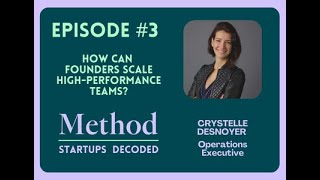
Crystelle Desnoyer talks with Andy Walsh about building startup teams that actually work. She covers intentional hiring, keeping people around as you grow, and how AI changes what founders need to do.
Welcome to Method, where we decode what it really takes to build and scale startups. I'm Andy Walsh, founder and strategist. Each week we'll bring you actionable insights and real stories. Let's dive in. Hello and welcome back to Method Startups Decoded. In this episode, we're joined by the amazing Crystal Desnoyer. I've known Crystal for a few years now here in New York. Quite an amazing operator as far as I'd say people, culture, operations. There's a lot that goes into Christelle's history. I'll let her do the full introduction, but first and foremost, welcome Chris.
Thank you so much, Andy, for having me today. Really exciting to kick off your podcast in the early episodes and thanks for having me.
It's great. It's just so good to sit down with people that have done fascinating things in their career and unpack and pick their brains as far as what they're doing and why. And I'm a person who loves to learn and I like a good conversation as well. So I feel like today's gonna be a good one. So you've had such an interesting background from the startup world into more corporate world. Can you just give us a bit of context as far as where you started out in the startup space and what sort of things that you've been working on?
Yeah, so I mean, for me, obviously just like you have an accent and moving to the US was no easy feat. So I went to grad school in San Francisco and that was my way in. And then I just got a one way ticket to New York and have been here ever since. So it's been 14 years now. And unfortunately, you know, being a 22, 23 year old with no experience, no MBA, coming out of business school, I couldn't actually get into the consulting companies, which is a standard path coming out of business school. So I found this consulting company that was in fact not really a consulting company. It was, and it wasn't in that it had all the execution that went with it. And so I ended up supporting European SMEs, establishing themselves in the US in tech, so doing software and hardware. So anything that went from quantum lasers that fill probably a whole New York apartment all the way to microelectronics and, you know, SAS plugins, you name it. I've worked in all different fields over a very, very short amount of time and worked my way up managing projects all the way to 12 companies simultaneously.
That we were building to connect two people. You learn something, someone may get access to Something that they wouldn't otherwise. And it feels like there's this really nice, perpetual sort of cycle that happens where you're able to yourself get these amazing things happen to you because you've helped someone else out. And I love that here. And I think New York for me is one of those cities that has a really strong community. And I have a genuine sense that people do want to help you out and they're trying to help lift you up. And I think that's pretty rare in the startup world.
I agree. I mean, New York has such a culture of connecting with others. Most people are events, multiple events a week, right? Just to connect with people. Sometimes it's intentional. They're looking for something specific. Actually, most of the time that's the case. Right. What you're talking about is a serendipitous networking, which is great, but you know, people have such tight A's here that I don't know that that's, that's what occupies most of people's time. Let's say people are quite intentional. And that's what I love about it. For me, you know, the word community gets thrown around a lot, especially in companies. They're like trying to build community, to build pipeline, blah, blah, blah. So community, it's more that sense of belonging. It's a lot more emotional than transactional. And it's, you know, when you're building a company, it's just such a lonely thing. You literally feel like a failure every day, even if that's not the case. Right? But that's how you feel. You're not doing enough, you're not doing it fast enough, you're not meeting the right people, you don't have them in your network, etc. That ongoing perfectionist voice, right? And so being in that community or group of people that actually feel that way and are able to vulnerably share. And that's the thing, right? When you're part of a community, it's not like just having common interest. That's a superficial way of doing it and connecting. It's more like being able to vulnerably communicate, hey, I'm struggling with this. Can you help me out? Because you have that skill set, or hey, I really need this type of mentor person because I failed at doing this and really being open to sharing the journey. I think that's what makes a community strong versus a community. That's just superficial, if that makes sense. So again, the word community is thrown around a lot, but it's more about the strength of it and how people connect with one another and that's what I care about the most. And so sometimes it's hard to connect. Right. And I happen to go in deep with people when I do connect and they're part of my network. And so what I love doing, it's connecting at the end of the day, my friends and net of people that are able to do that and have that EQ mindset and possibilities is incredible. And it's still happening. Right. Like, not everybody in that community that you're referring to has connected at the same time level that I've connected with them. And so obviously it takes time, but I'm looking forward to really having happen and I don't know, maybe we'll talk about it in a year and see what happens or what didn't happen out of it. But it's really important for me to connect people all the time just because I have that ability to do that really quickly and really deeply. And so I support people in doing that. And a lot of the founders I've supported last year, I think I have to count, I was actually writing a LinkedIn post to kick off 2025 on that topic is the founders I've supported, whether like full on, on advisory boards or just had an office hour with them and that's really what they needed the most, is to connect with the right people to make things happen. And so that's magical. I love sparking those.
Yeah. And it's, it's definitely very powerful. And I think for me it's put us here and I was very thankful for that's happened. So the topic today, and it's very connected to what you just sort of touched on there is how can founders scale high performance teams? And you talked about community. Community happens from a startup perspective. It starts within the company. Right. It starts at.
It's been really great, I have to say, the past few years to do that.
Yeah. And I've definitely been fortunate to have met you and your community here in New York. Your passion to let people discover each other, curated by you quite often and find ways to be able to do something fun. And I think that I've already got a lot of things out of this and the community part of that is as important as the technical skills. Right. And we both come from that space where connections and community are core to driving not only our careers, but helping everyone collectively. And I want to sort of look at what something you just said then, as far as that giving back part from you in your first job out of studying at university. You described a lot of different things that you had to do building multiple companies at the same time. Was there someone within that team or even through those years that was sort of giving you more than what you probably realized at the time? On reflection, you look back and go, okay, that person or those people were really instrumental in sort of giving me more than what I probably took, you know, at that time.
I mean, I, I have a very special relationship with all my CEOs. I've had the privilege to report to CEOs my entire career. And I think, you know, CEOs a special breed of humans, they've been through their own journey before they got there. And so, you know, some of them are better mentors or coaches than others, obviously, because that's a skill set in its own, in itself. Sorry, but my very first bath, he was like such a visionary and he's the one who taught me to network actually, but network in a meaningful way. So not network and like, and you know, there's a lot of debate right now and networking transactionally is a good or bad thing. And you know, there's never a black and white situation. We're adults, so. But he's the one who taught me to connect creatively. And sometimes he was so far fetched that would look at him and be like, how did you even make that connection? And I think like, he's the one who taught me that specific thing, if I had to pinpoint one thing. He taught me a lot, obviously, but you know, he gave me a lot of rain. And he knew also that I was a fast learner and an executive, you know, early on. And so he kind of let me do my thing and figure things out by myself and he figured out that I learned that way as well. And so he was a great boss in that specific way. But definitely creative networking, connecting those dots. Like he's the one who taught me that early.
And the thing with networking, I love where it feels like it gives back to you without the intention of that happening, where you're able, foundational culture, the founders, what they're building and ultimately how they scale their business. So in the early stage, just getting into the like, I guess the foundations or building blocks of company culture, operations and how all those things come together. I'd love to set that up as far as like what type of things you're looking at, like just to help understand you and the type of thing you look at within these businesses, like how do those things come together from a people and operations perspective.
There's a lot to unpack that. So recruiting is such a skill set, especially depending on the phase of the company. So let's start with the day one of building a company. You have to hire your first employee, right? Those people are going to be heroes. They're going to be people that are intrinsically motivated, are probably underpaid, that are in for the journey. They believe in you as a founder, and sometimes it's not always you. Sometimes it's just a mission or the idea, and they'll come on board despite you sometimes, right? So that happens also, and it's really about able to gauge that intrinsic motivation, but also that tolerance for pain and the values that you have, right? So like when I was hiring at Pomelo, for instance, my first. I think I started December 10th, if I remember correctly. As a first employee, there was nothing. We didn't have a name. We didn't even know what we were going to sell, right? And I had to hire two people. And what I cared about the most was, okay, are these people gonna actually, like, be in it with me, work long hours, work weekends, and really care about the mission, which was supporting female empowerment? So, yes, we were, you know, in the influencer marketing business, and we eventually decided to sell hair care. I had never done beauty in my life, right? And frankly, it didn't really matter. It was about the messaging and the mission behind it. So selling sustainable haircare and supporting women in feeling confident, right? Like, that was the thing that we defined early, the why. And so I was able to go find people that really cared about that, that were motivated because they just wanted to build their careers and learn a lot fast. And so you really have to define what you're looking for and why you're looking for it. Right? And then, you know, in a way, it's a bit of a gut feel, unfortunately. And that's not great for dni, obviously. But if you're intentional about your DNI and you know exactly what you're looking for, then generally it works pretty well. Obviously, not everybody has that superpower, so I wouldn't recommend everyone doing that. And then, you know, you hit Series A's around 20 to 50 employees, right? Those are the people that are not the superheroes that want to take on as much as possible, because you're already managing those people that have to, in fact, reduce their scope, right? And it's not easy to have superheroes that have been building the company with you, and all of a sudden you're reducing their scope because you're Specializing every role and focus, et cetera. So you're already managing that, which is difficult. And then you're hiring. The new folks are able to really stay focused that have a bit more expertise in that domain that you're assigning them to, et cetera. And once you hit 100, 150 employees, you need people that love process, that love being in an organized system that aren't, you know what I call them, cowboys in that, you know, wild, singular humans that can make anything, that love that freedom. Like, unfortunately, you need to organize the company a little bit more and that want to work with people within the system. So very different humans and very different personalities and things like that. Then I mean, obviously you define your general values, which is probably honesty and integrity and all that stuff, right? So I mean, at the end of the day, you just have to be intentional. And that's a word that I use a lot, whether it's in operations or hiring. A lot of what I've seen honestly in the past 24 months is that the hiring has not been intentional. Like, the processes are not clean. They're not defined with the hiring managers. The hiring managers don't know what they want. They change it during the process. I mean, it's been a mess, to be honest. And so I would call out a lot of the TA teams and HR operations team to kind of pause maybe and think really about their 2025 planning and work very closely with the budgeting and the hiring managers that do own that budget. At the end of the day, instead of rushing through things and either hiring and firing fast or just being able to be intentional about the process itself. Right. We were talking about operations. You have a role, I don't know, a product manager role that you're hiring for. Right. You want to have a job description that's actually descriptive of what you're doing and expectations as well as a clean process. Okay, you're going to first speak with this person and then this person. You're not going to wing a process. And it's just not good practice. It doesn't make the company look good. Candidates talk to one another. I mean, it's just not best practice. And I don't know. That's not how I do things. I like to do things well and in a fair way. And candidates time matter, you know, it really does. So especially for if you do think intentionally about your dni, applying for jobs and interviewing takes a lot of time. If you're doing 13 interviews in a process, there's something very wrong with the company. Like the fact that you can't make a decision within maybe five conversations makes me question the whole department of HR and talent acquisition in most companies, frankly, that do that. And you hear that all the time.
Great. And I realize that that was a big question. So let's go into some chapters there. Some of the things that I heard. The first one is around obviously culture and people's values individually. And you talked about sort of three core stages as far as what people expect at each stage and that the first stage in that pre revenue stage, potentially or even early revenue, it's very much a get things done, moving forward at pace, lacking structure. So that type of personality right through to you said at the latest stage where you need someone who's process driven, who can get stuff done and is taking something that's been massaged and evolved and had that dynamic feedback loop and then driving the scale, how do you, the question within that, how do you start to connect those early stage employees to the later stage employees if they're coming with different mindsets, what's some of the things you can do to sort of align on the culture fit there?
So that's a great question. And I had to ask myself that very question actually when I was building before my, my role at techstars. These people are incredible humans. Like their tolerance for pain is ridiculous. It's similar to yours as founder. Right. And so it's really about leveraging their skill set generally. And that's not always the case, but generally they're pretty good storytellers. And so if you can scale yourself through them by empowering them and training, you know, the newbies in just being able to share that energy because the other ones don't have a similar energy and passion. Right. And so you want the passionate people to drive and trickle down that passion throughout the organization. And so you then leverage, you know, the skill set of those people. Some of them are actually really good, I don't know, community building within the organization. Some of them become chief of staff, some of them become more just a general people, the internal comms people that will want to drive those all hands meetings because they are very good at sharing, you know, their own stories or just even highlighting other people. Right. They're generally extroverts, to be honest. So it's a lot easier to kind of leverage that skill set and you want to highlight them because frankly, as a founder, without them nothing would have happened. So you want to give it back to them by giving them a lot of visibility. What's Difficult is, as I said, you have to reduce their scope at some point. And a lot of them are generalist when they start in a new company. And so that's what's hard, is to really make sure that they feel valued regardless of the scope, if that makes sense. And so some of them will be more attached to it than others. And it's just being able to support that explain, but also promote and just continue developing them and their skill sets and the continuous education that they care about and want. And sometimes, I mean, that's happened where those people just don't want their scopes reduced or they realize that they were really good at sparking the company. And then you'll support them and you'll be like, okay, well I'll help you get your next thing or find your next company to scale from scratch on. You know, we'll make sure that your equity is vested so you won't lose anything because without you, nothing would have happened. Like there's all those negotiations that happen and it's really on an individual basis. And it's about either leveraging them and being able to shift them in something that makes sense for the organization and, and for them for their career path and personal goals, or it's, you know, just supporting them. And in leaving at the right time, right. There's a lot of CEOs that we've seen, not just employees, right, that leave at a certain time in the scaling of their own companies because they say, I'm good from zero to 50 employees, I don't want to manage it. But beyond that, right? So it really, really depends.
I think that I definitely agree on the extrovert piece in those early stage employees. It feels a lot like investment in a way. If you could join an early stage startup as an employee, like there's much higher risk because you sort of, you're buying into someone else's vision mission, like something that you feel passionate about. It's not about the money because you're not getting paid much. You might get some equity as part of an early stage employee program that you have within that company, but you're committing to something bigger than, you know, a more traditional type job. Whereas a later stage bet, it's more quantifiable. If you're joining a company, you've got a sense of how long they've been around, how many staff they have, and it feels like you can make a more rounded type of decision. And those two decisions are definitely two different types of personalities. And I think managing both requires a different Set of skills?
Yeah, no, for sure. I mean, you have to. First of all, you have to be exposed at some point to both. It's really hard to manage teams if you haven't been exposed to it. Like I had never been in corporate America until I was the chief of staff at techstars. And so all of a sudden I was exposed and it was techstars. So there was a good mix, you know, of those superheroes and entrepreneurial spirits versus more corporate. And so that was super interesting for me to see and just learn to be exposed to and understand, you know, that language and their preferences. And again, it's more of an individual basis rather than like buckets of people. But I think my experience at Kyndryl, spinoff of IBM, so very, very corporate America, very different to what I had seen and it was incredible. I love that experience because again, I'm a curious being and I like learning and just being exposed to as much as I can. And so being able to manage during those different stages, you kind of have to be exposed to it. And so if I had any recommendation to give to young people that starting in the world is to really be intentional about being exposed to all those different stages. So get your first job in a big company, get a second job in a startup, get your third job in a medium scale company. Because if you really want to become a CEO or be part of a C suite, you'll need that breadth of experience in order to inform all your decisions. And it's one thing to be an expert at scale, but it's another to really build things from scratch. And so I think if you want to have a full breadth in your career, it's really, really great to see all those stages of scaling.
Yeah, it's great advice and I've been fortunate to have moved between industries, different size of companies, to founding my own companies. And everyone has been a learning experience. That together, I feel helps me be much more well rounded and probably more valuable at this point in my career too. But I think having a mix of all those things is actually a superpower in a way to be able to learn, absorb and have a better perspective potentially as far as like looking at things from different viewpoints rather than being so single minded with how you think.
I totally agree with you. And also you're able to support the ones that don't have that experience yet to scenario, plan and see further ahead what's coming and to be able to prepare for it. So obviously I'm an operator, so risk management is number one. In what I do and identifying single points of failures, etc. And you know, just being able to warn, say, hey, this is going to happen in six months, we need to prep for it today. And so that's actually a lot of what I speak about, is that once you've seen that breath, you're able to build a company day one, to get ready to scale to 150 million in revenue, 300 employees, but only if you really have done it enough times and failed enough times and learned enough times as well, and done all those post mortems to then really be like, okay, today I'm going to build my 27th company from scratch, but I'm going to like have it so ready that, you know, it won't change anything. One example is we were, we were 32 employees at Palmetto and we were making 34 million in revenue year two. That was insane. I mean, just completely crazy. And Covid did nothing to us. Obviously it helped us because we were a D2C brand and those were exploding in terms of revenue, but operationally we just went from in person to remote and it changed absolutely nothing because we had built our culture intentionally, we had built it over slack because we were working internationally on top of it immediately. So again, I go back to that word intentionality and making sure that those five pillars of scaling are really, really focused on. And if you can't focus on it as a founder, try to get someone that does that, wakes up in the morning and literally thinks about that one thing that you care about so you can be intentional as a company. That's really key.
Yeah, it's such good advice. For the work that I do. I apply similar principles across the board. So people talk about a sequence in a product. I run the same thinking for the growth of a business. So any startup, doesn't matter what category, you're going to have a series of events that will 100% happen. And you'd probably say 70, 80% of those are going to be the same in every startup. So knowing what's coming to get to a point that you're trying to hit, from staff to operations to if you have an office space to technology, all the things that you'll have to think about to be able to scale with confidence, you don't need to do them all at once, but knowing that they're going to be milestones that you have to hit and even thinking about who's the person that can do that, where do you need help, how much do you need to spend? And being Ahead of that, I feel like that what you just described and your skill set is the ability to sort of know what's coming around the corner to a certain degree and be prepared for that, but also set it up as a vision, as a metric, almost where you're able to go, okay, like we're getting to this point, this is what's going to happen at this point. So I turn that into a question for you. Thinking about that process. How do you, how do you take an operational side of things for a young early startup where there's a lot of hacking, there's a lot of testing and learning, improvisation sometimes, how do you sort of think about operational process and turning that sort of what feel like mayhem and chaos sometimes into a more well oiled machine. So when people join, as you scale with, they have a really good idea about this is the company, this is what they do, this is how they run it. And you can train someone on that. How do you go about just even understanding that company and then building out a way to make sure that it's streamlined and effective?
I mean, there's a playbook and a lot of people don't believe me, but it's not about what you're building in terms of like what's the product, right? It doesn't matter whether it's SaaS or, you know, B2B or B2C. There's a little bit of a tweak for B2C obviously, but it's fairly similar. So the only reason it's chaos is because most people are focused on the product and not actually on scaling. So I'll give you an example and maybe we can just do a quick reminder of the five pillars of scaling, right? So you have revenue operations, hr, talent acquisition, operations. You have communications, which is like, I'll give you an example, quick example to illustrate. It's like, what are you using as your internal tool? Is it slack, is it something else, is it email, how often, What's a cadence? That's all the internal stuff, but you have the external stuff too. What are you using to write your press releases, what are you using to distribute it, et cetera, right? In order to talk about what you're doing and do a bit of a flywheel effect and then you have access to capital. Why are you using, you know, are you going to set up Juniper, are you going to set up Carter, all those systems for your fundraise, et cetera, Right? And then finally your mindset. So what you're going to do to foster the culture that you want as a CEO and founder within your organization. You need process around that, you need cadence around that. And that's what you call like business cadence. You need those off sites. If you're a virtual first company, you need those weekly huddles or monthly huddles depending. Right. Like those. And that feeds into the internal communication, but also like that growth mindset needs to be integrated. Are you going to implement okrs, things like that? Right. So. So all of that's operational talk and that's a playbook that you can do no matter what you're actually building. So to go back to your question again, if it's chaos, that means you're not focused on how you're building your company, you're focused on how you're building your product. And that's a problem.
Yeah. And you talked about at the start of the episode that there seems to be this evolution that's happened with new tools like AI. Great example from just something simple for a person that's hiring someone, skimming a resume and getting key data and making an assessment if that person's suitable or not based off that read. And we know that it's not perfect, but they've adopted a system through the interview process. Where do you think in the last couple of years that we've gone off the rails a little bit and that role within corporations to help them scale has sort of lost their way. What are some of the issues that they're not probably acknowledging or trying to repair to be more effective?
I mean the use of AI and that's why I keep talking about AI is like the Internet. We use the Internet as a tool every day now. Right. It's integrated in our day to day AI is the same. So. So it doesn't replace anyone other than it makes you gain scale and speed. There's this company called Invisible. Incredible. They hired at the time, I think 700 plus people with two people, two talent acquisition people hired that number. And obviously granted it was a bit specific and it was a bit more like manual work and things like that. So it wasn't, I don't think it was knowledge management. And frankly, like don't quote me on this, I'll have to ask them to get that information. But it's just incredible how fast you can get through a big pipeline of candidates. But it doesn't mean that that process needs to be horrible for the candidates. And that's what's, you know, mind blowing, is that the UX and the user journey of the candidates can be excellent. Even if you're using AI in order to be faster and more productive. So it doesn't mean you're, you're, you're not going to hire like 50 talent acquisition people to do the same job. Sure. But at the end of the day, you're running a business and you know, you have opex and if you can hire excellent talent acquisition people that you pay more in order to get that result, I mean, by all means, that's my take on it. It's maybe not that popular, but I think if you're, if you're very good at what you do, AI will not replace you. It'll just be an extra tool for you to do things at the speed that you're actually supposed to do your thing and implement your superpower. So I think it's great. That's a talent acquisition side, but like communications, like a lot of copy, you know, has been being written through ChatGPT, perplexity, Gemini, et cetera and same thing. It's just prompting. And prompting is in fact helping you use your critical thinking and what we're good at as humans instead of wasting time cranking stuff out. Right. I don't know. I use it all the time to create a lot of content and it's an incredible process and I have a great time with my ChatGPT colleague in a way. And sometimes I'll think out loud and it depends how good you are using it. And yeah, no, it's definitely a great sounding board, I must say.
Yeah. I love the iteration process that I now have with. I use perplexity primarily and just that thinking and having a strategy background. I love storytelling, but having database storytelling, so you're actually making sure you're doing the right thing because right now having any confidence in the information that you're given, you can't have just the data sources of where it's coming from. It will give you something with such confidence that you don't know whether it's right or not unless you have the expertise. And you also don't know whether it sounds right and will someone actually relate to that. There's a lot of human element that comes through that personal experience of your own career. But going off on a slight tangent on that one, but back into the process side of things, I agree. Like, if you think about the dot com boom and everything that went into that, like businesses were growing at breakneck speeds, the money that was getting invested was crazy and there was this huge cliff that happened. And for me, I see AI as a back end tool that allows you to do things that you couldn't do, you know, one, two years ago without having some serious engineering go behind it. So right now, as far as that process, I think that what I'm seeing as well is that the right people maybe are not finding the right jobs. And then if that's the case, then it has a really negative impact on, on culture, on retention, on those things. So as far as that process of finding the right people but then retaining them, what are some of the things that if you're scaling the company that you need to think about and there's all those stereotypes of like, oh, you'll have a ping pong table and we'll have Taco Tuesday and all these things, but what are some of the things that you've either seen work well or maybe even not work well on the retention side? Just maintain that culture outside of that single vision of what you're trying to achieve?
I think this is an excellent question, an extra tool for you to do things at the speed that you're actually supposed to do your thing. And I think most companies haven't figured it out. They're very good at acquisition just because it's a numbers game. But retention is interesting. Why is it interesting? We have five generations in the workplace for the very first time ever, which completely care about very, very different things and even don't have the same values, the same work ethic, the same, you know, independent need for independence, the same personalities and all that good stuff. Right. So there's that one factor that's massive that most people ignore. Just recently, I think it was last week, EY published one pager on different data points regarding the five generations. But I've been speaking about this for about three years now, so it's kind of great to finally see that be top of mind with AI obviously provoking that a lot because, you know, a lot of the older generation are like, what's a GPT? So whereas, you know, you have Gen Alpha that's just already using it to do all their homework and you know, it's already been integrated into education system, so. So the speed at which people are used to doing things between the different generations is just so different. Right. So does that piece, there's a second piece that the younger generations and millennials and younger generations a lot more educated in doing stuff. So let's talk about the startup world. The venture capital process is no longer an elite group. Like just in New York, you have 1200 VCs, right? Just in this one city, meaning that everybody's like fundraising a fund for a fundamental. And that means they understand that process. A lot of the employees, unfortunately, let's say the women, people of color, et cetera, are not as educated in that space in negotiating their package. For instance, most people don't know that they should negotiate their severance as they start a new job. Right. Most people don't know how to negotiate equity or don't understand what equity is, investing, etc. So there's a lot of education that needs to happen in general on the individual basis. And then companies, they use tools, as you said, like the more fun tools that kind of generate some sense of belonging. But, you know, we're all working remotely now, so the sense of belonging. Most remote cultures are either not intentional, so not good, or they're extremely good because they figured it out. But that's like probably maybe five companies that I know of at different scales. So Dropbox is one of the first ones, actually, that went virtual, virtual first, rather, and stayed like that in comparison to the other big tech companies. There's a company called Sharebyte, for instance, a series B company, and they support virtual first workplaces by helping HR departments fund meals. So, for instance, if you want to go have on a geographic basis, like a meal with your colleagues, but you happen to all work from home, then you can, and the company pays for it. And there's a whole process for that. So there are a lot of companies actually that are supporting that. But unfortunately, most HR departments, they don't really know what to do in terms of how to create and foster that sense of belonging, to have that retention. There was a study, I think it came out maybe last year before that, where if you have a best friend at work, you're more likely to stay. And so being able to create those moments for people to connect deeply, to build those friendships. And that starts with onboarding. And that's part of business operations, basic business operations, your onboarding process and your cohorts, the buddy systems and mentoring systems I hear every day. Oh, my mentor. I mean, yeah, we speak once a month. Sure. That's not real mentorship. Right. There's processes and systems to create a little bit more space for emotional connection rather than process connection. But most places there isn't even a process connection, so. So I think starting with that is a good way to do it. So again, Coptcha starts with day one of the employee and mapping out that user journey. Super important. And so onboarding, my biggest thing being a scuba diver is the buddy system. It's really your trauma bonding and starting at this company where everything's a mess or not right. But you're starting together and all you got is one another basically. And that usually creates incredible bonding. And I've seen it in all the companies I've built and you know, unfortunately for myself I don't have that because I was the one being the spark. But it's really great to see the teams continue those friendships years and years beyond, you know that, that moment in time where they worked at that company.
Yeah, that's good advice. And I joined a startup during the pandemic and we didn't get to meet in person for must have been close to 18 months, I would say 12 to 18 months. And it was amazing. The difference of having a couple of days together as a team, like the effectiveness that came off the back of that. There's a sense of camaraderie. You have closer bonds with people and it builds trust in the sense of like you are in this together. Whereas if you never meet the person then like the relationship is, is never going to be as strong and you talk to that emotional connection that you have with someone. There's, there's so much that goes into that and it's, you know, we've got a live case study happening right now with the pandemic driving that and then we've had a shift. It'll be interesting at what point in the coming years that that work from home versus in office will it ever go back? I don't think so, but we'll get a good sense of how people feel. Company success and effectiveness and this next generation of technology which is coming through, there's so much at play and I think today it's probably a good place to sort of to wrap up as far as the next 12 months. And some of the things that you're seeing, like what, what would be something that you would love to see change in that scale up stage of startups as far as people and culture or what. What are some of the biggest things that could probably drive an impact?
Oh, it's hard to choose lots of things. But I think like I'm going to go back to that special word that I really like. If you're intentional about what you're doing and you really want to build a company that's going to last more than six months, then you need to think about what it's going to look and feel like two years down the road. Right. 110 employees let's say, and not being afraid to do that because yes, you're so busy in the day to day trying to survive, get funding, etc, but first of all it grounds you, right? If you're looking in the future and you're like, okay, I am now today, you know your NPV situation. Today I am the CEO of 110 Employee Company. And then it actually helps you act like it because it's not the same as when you're a founder of a product with an intern. You don't act the same. And being able to project yourself into that will help you in just even that energy with investors, with understanding where you're going and giving some distance to whatever you're building just because you know you can get lost and being grounded just helps focus. And I understand it's hard to do it all the time, but maybe like you know, 15 minutes at the end of every day, whenever you define the end of your day, right? Because I understand that can be 14 hour days is sit down and be like, okay, let's say that today, two years down the road, I'm the CEO of 110 person, you know, company. What would today would have looked like? What, what would I have done differently? Would I have taken that call? Yes or no? Would have written that email that way? Like things like that. Do a little bit of a post mortem every day, 15 minutes and project yourself two years down the road in how you would have dealt with, you know, that specific day. I mean, I do that quite often actually in order to stay focused in where I'm going as opposed to what I'm doing.
Great advice. And what a perfect way to end today's episode. I don't do that, but it sounds like something that I should do as well. I'm a reflective person and love to learn and grow and I'm always open for feedback. But I think if you're a founder, that kind of just regimented process is actually so helpful because it's easy to get lost in everything happening and not think about success, think about failures, think about all those things as a company level, but also at a personal level, which is the, the secret sauce, right? As an inspiring leader with intentionality, like you need to be at your best and that requires a lot of outside looking in type thinking. So Christel, it's always fun. I love that we did this in a formal capacity on a podcast. We do this a lot out in person, but I appreciate you making the time. I know you've got a lot going on as well, like usual, which is always fun. But thank you for joining. Thank you everyone for tuning in. This is Method Startups decoded please like follow, share, do all the things that help us us grow and continue these conversations and look forward to joining you again in our next episode.
More from Andy



EP#88: Why Most Founders Misread Their Own Traction. Vanessa Larco - Premise VC

EP#87: Founders Obsess Over the Raise. Investors Care About This More. — Carina Cunha






Ep#86: Early Decisions That Define Your Startup Forever. With J.P. Morgan Asset Management
