Ep#66:Why Every Founder Is Already a Generalist (They Just Don’t Know It) — Milly Tamati
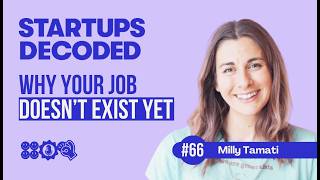
Milly Tamati built Generalist World from a $100-a-year experiment into an 800-member community for founders who wear many hats. She argues that every founder is already a generalist, moving fluidly across skills, and that specialist career ladders are becoming obsolete as AI and low-code tools let people create across domains.
Chapters
And my topic of conversation was your job does not exist. Like your future job does not exist. And if I had run this workshop with my Generalist World crew who are typically, you know, 35 to 50, that's kind of the age range. They'd be like, wow, yeah, like, whoa, this is like new and that's so true. But these 16-year-olds were like, duh, we know.
Welcome to Startups Decoded, the show that gets real about what it takes to build a successful startup. I'm Andy Walsh, 2 times exited founder, strategist, and your host. Each week I talk with top founders, investors, and operators to unpack the plays that drive real traction, not just headlines. If you're building something bold, this is where you'll get the honest insights to scale with clarity and confidence. Let's keep growing together. Hit subscribe and share with your community. It would mean the world to me. Hello and welcome back to Startups Decoded. My name is Andy Walsh. When you first start your career, you can go down the path of a specialist or a generalist. For me, it's something that I relate to from a long history of doing lots of types of roles. Today I'm very, very fortunate to have Millie Tamati. Millie has got a company called Generalist World. Welcome.
Thank you. So, so happy to be here.
I love that your story started in New Zealand. We were neighbors between Australia and New Zealand, but you've gone on this like really interesting journey, like geographically in different countries, but also from a career perspective. Can you give us a little bit of context on what made you take the leap and what were some of the things that stood out? On that to land you where you are today?
It's a great question. I don't know if like 19-year-old me had a good like strategy to why I took the leap. I grew up on a farm in New Zealand, grew up milking cows, very, very rural. And the simple answer is I didn't want to do that for the rest of my life. I didn't want to take over the herd. And so I went to university. I did all the right things. I got a degree in teaching and it was kind of in my last year of my teaching degree that I just had this burning fire in my belly to be like, I wonder. What else might be out in the world. And originally I was meant to go overseas for 1 year. That was when I was 20. I'm now 34 and I live in Scotland. So that clearly didn't quite work out. And that arc over the last, say, 14 years, I guess a thread that's kind of tied it all together is travel. So I was a tour guide for many years, which is like, it sounds like it's completely unrelated to what I'm doing now, but it's actually the foundation. And this is like the classic generalist thing. Everything kind of builds on top of each other. And I guess my north star when I was traveling was make enough of a living just to keep traveling. And I did that pretty successfully, as in I didn't have a lot of money while I was traveling, but I had a lot, a lot of stories. I was able to fortunately travel quite slowly through around 65 countries over that time.
I love the travel part of it. For me, I did a lot of travel. I went through a few states in Australia first and then went to London and did a few years, but traveled a lot through Northern Africa, Western Asia, and Europe. And I look back at those experiences of meeting such a variety of people and some of the different culture experiences. Experiences I have was so enlightening that it fueled a curiosity that I already had. There's a little bit of nature and nurture side by side, but for me, like, curiosity led into exploring different types of things from a work perspective as well. And it has always been like an itch that I feel I have to scratch. For you, like, your career, you went from teaching to doing something very different now. Where do you think the intersection is there of like those personal experiences fueling the professional side?
Wow, this is a great, like, this is like a therapy session. Because I guess it's that like quote, you know, how you do one thing is how you do everything. And even when I look back in high school or university, like, I was the person who wanted to do everything. I wanted to have my fingers in all the honeypots. Like, that was where I got my energy and my excitement. And so, yeah, I, I'm, I'm not sure really.
Yeah. Well, then let's look straight then into the career part. What were some of the jobs, probably after you finished doing this world travel? Like, where did you put some roots down, and what were you working on?
Yeah, it took me a long time to put roots down, but I guess over like my career of, say, like the last 15 years, um, I went from from taking thousands of people on tours to then running and managing the tours to then creating the tours. And that's when I got my first taste of creating a product, and I was like, oh, I love it, I love the creation. Um, so, and then I got, um, headhunted to move to the Philippines and start this tour company from scratch. And I was like the youngest. There was 3 guys, I was the only woman, and I was the youngest. That was a baptism of fire because that was a literal from, from nothing to something. And over the years I've had just like the, the strangest and most interesting, and for me, like, array of jobs. So, you know, I, when I was in Australia, I co-founded a wine tour company, which was fantastic. It was so much fun. I've co-owned a hostel in Thailand. I've been a writer for Tourism Japan, helped create a short film about women in construction in Canada. I started and failed to create an illustration agency in the UK. I was a director of miscellaneous for a tech company. You name it.
And I'm guessing that the, like the curious theme I'm going to talk about a lot today, but as far as those opportunities, would you say that that is part of connecting with people and being in communities, or were you seeking out something different that just stood out? Like, how did they come about, those type, the breadth of opportunities?
Always followed my nose. I follow my nose and I kind of pride myself on being a really good listener and being really able to connect with lots and lots of people. And I actually credit that probably to my travel days and my tour guide days where you really had to connect with people and I don't know, there's something about like the more experiences that I collected, the more it kind of feels like opportunities are starting to come to me. I guess it's like increasing your surface area of luck. And as I get older, my connections seem to be getting wider and broader and I kind of, you know, I'm in New York for the week and I'm sitting on a couch with you having a podcast, you know? So, um, there is something about like following your nose and People are, um, it's almost like a magnet. People want to be around people who are curious and interested and having fun and passionate. So I think, yeah, there's a, there's a push-pull.
I love it. And it sounds like there's a level of no fear of failing is what I would say. And that curiosity turning into having a belief in yourself as well to step into something new. And what you describe for a lot of founders is probably that path. They work somewhere and like you talk about your tour guide experience and that growth, getting exposed to more, and it just gives you either inspiration or or insight, and sometimes both, to bring together to then go off and do your own thing. And that's the life experience. But the breadth of it feels like that, that was a catalyst to what you're doing now. To set the scene on the other side, and it's something we won't go into, but I think it's important today to look at the specialist and we'll put some definition around the two. By specialist, like for me, the easy example is someone who starts in medicine and goes through and becomes a heart surgeon.
Sure.
Yeah, you get, you start wide in medical field and then you start to narrow down and just do one thing. And then the generalist, you could be, say in the same field, you could be an emergency doctor, but in that role, the reason I would call it a generalist is because you have to have knowledge of everything, anyone that comes through the front door, but it's not textbook generalist. Like for you, how would you describe now in a modern business what a generalist is?
Yeah, it's so funny because the definition of this just keeps evolving over In some ways, I feel like I've been working on this for 4 years, and in some ways, I feel like I'm getting closer to an answer, and in some ways, I feel like I'm getting further away because we now have this community of like, you know, 800+ people. And inside, we actually have a lot of specialists. And every time they come in, I'm like, okay, my definitions of what I think we are creating here for these people kind of get a bit challenged. So, the patterns I see is that a generalist is someone who has probably lived quite a few lives. Maybe that's in their career or maybe that's like personally as well. Maybe they've traveled, et cetera. It is someone who has a beginner's mind or they're very comfortable in like ambiguity and they're very comfortable in starting again and like taking what they've learned from one discipline and applying it to another. They're typically the person who gets shit done. They're typically the person and everyone knows who that person is on the team. It's like, you know who you go to. It's a person who's the fixer, who can tape it all together or who knows how to bring it all together. And I mean, the whole reason I started generalist world is because the best thing I could say about my work, I was like, oh, I wear a lot of hats. I don't know. It doesn't sound that valuable. Like I don't really know how to position myself. And I think one of the biggest mind shifts for me was saying it in like, if you asked me 4 years ago, I was like, I'd want to hide under the table and be like, yeah, I've done all these different things. Like, I don't really know how to talk about it, but now I'm like, I've done all these different things and I'm, that is what makes me valuable.
It's the textbook response that you get going through high school into university is to choose a career path and you go through different tests and things and they try and set you on this specific trajectory and people get a sense of security from that. If you know something, you know, there's always gonna be this field, whereas if you bounce around, it's like, are you starting over again? And when we're out in the world from a tech perspective, which I'd love to explore, but later on is tech has now created a playground for people where being a generalist is almost a necessity, not, not the nice to have, but to look at some of the ways that a generalist can, like, look look at the world differently and solve problems. Like, which one of the things I love seeing is where someone from an adjacent field can come into something else. They don't know much about the subject matter, but running different processes, ways of thinking, by asking different questions, allowing quite typically a bunch of specialists to solve something that they couldn't collectively.
Yeah, it's like, it's well studied that when you have a bunch of, say, deep specialists in a room, it's like you can't see the forest for the trees. So it's like, okay, you're going to come up with probably the same solutions. But when you have someone who has this different, it might be vastly different. It might be a, I mean, you know, tour guide to founder, like what's the connections there? And so, there's things that only I could see because of those experiences. And we were kind of like jamming just before this around how it's really not this argument, this very old archaic argument of like, what's better, a specialist or a generalist? But it really is about how do we have both and how do we make space for both to be able to speak to each other.
And I've faced this myself. I've worked in the creative industry historically, and that alone gave me a lot of breadth of skills. But then I went into tech and doing my own startup. I now have a podcast. I worked in media a little bit, and I've got this really unique group of skills. But if I went and applied for a job, I think back previous to my first startup, I'd apply for a job and they're like, well, you don't kind of fit.
Totally.
And that was something that I got all the time was the—
No, you can do it.
Yeah, absolutely.
With your eyes closed.
Yeah. And for some reason they felt that it was a blockage there where I'm like, well, if I have adjacent skills that actually makes me operate differently and ask different questions. And I've had great success and that's why I'm sitting here today. Totally. Now, if you're starting a job, like, I don't know how young some of the people are that are part of Generalist World, but any just even insights you have around people that start a career and are quite happy to bounce around. Do you think there's enough knowledge for people to explore how they go, well, I'm going to try this for a bit and then bounce over here and do this. Do you think it's even an option that people realize that they don't have to specialize?
I think it's becoming more a part of the psyche. And it was quite funny, a year or so ago I ran a workshop with the London School of Economics and I had brought in 116-year-olds. And my topic of conversation was your job does not exist, like your future job does not exist. And if I had run this workshop with my Generalist World crew who are typically, you know, 35 to 50, that's kind of the age range, they'd be like, wow, yeah, like, whoa, this is like new and that's so true. But these 16-year-olds were like, duh, we know. And so I think there is a generational thing where, you know, I was brought up in a time where you worship the ladder, you climbed, like that's what you did. You, you got on the rung and you climbed. And I remember looking around and always feeling like an odd duck for not like ducks can't even climb ladders. That's probably the first problem. But I do think it's becoming so much more part of the mainstream conversation. Now that we have, you know, 10,000 specialists with PhDs in our pocket and it costs $20 a month to access them. I've been doing this now for 4 years and each year as we go on, like, ah, the zeitgeist, the timing feels like it's shifting to people being like, it's actually now becoming a risk to just have one skill and one domain. And because like, what happens if that disappears tomorrow?
Absolutely. And the structure that has been in place for a long time, where you go through the traditional education system, that you get a job, you might do an internship as a path into that. It's very well trodden and it's almost forced in a way. So being able to think about like the next generation and, and I love hearing that because obviously they're tapped into every piece of content there is, too much so. But also with that, they see people who maybe had an expertise in something and are making money and they see all these like entrepreneurs in different ways and some of them are more traditional like big tech. And then other ones are just people who are making like tens of thousands of dollars a month on Instagram doing one random thing. And people learn all these lessons and share it. So you're living in this deep immersion consistently, I find. And for people that have been in Generalist World, by that contrast, do you think that there's this like culture within Generalist World people where they're thinking and acting like those 16-year-olds that you were talking about? Or are they still set in their old ways where they feel like you need to do both? Because I find it's very different.
Great question. I think it is a spectrum. You get people who are hardcore like me on the, like the, we're free, we have agency, we can do whatever we want. Like it's all made up. It doesn't matter. You can literally do whatever you want. And then we have people who I think deep down resonate with the generalist identity and the generalist way of being, but there's a permission slip that's needed. It's like a lot of unlearning to be like, oh my gosh, like, am I really going to come off this like treadmill? And I, I I think coming off the treadmill of the specialist treadmill, let's call it, maybe isn't even for everyone. Maybe that works for you. And if it works for you, great. You're actually in a fantastic place because the world with the work particularly was built for specialists. The way that we hire, to your point earlier, they look for cookie cutter. It's like, have you had 14 years in this exact one thing? Great. Okay. Then let's pull you over here. Yeah.
And for me, I look at the difference as far as an attitude in me and I'm a different age group now, but I still like to be, I've be inspired and have purpose for things that give me passion with what I'm doing. And for me, the breadth allows me to do that because I use a lot of the same skills and systems, but I apply it in a different lane.
Love it.
And, and that adaptability for me is what sort of personally keeps me going. If you, I'd like to build on that, that group that you had, those 16-year-olds, like what were some of the things that you were talking about as far as like that path to your job doesn't exist in the future? Like how do you start to help educate people in a more structured way on the things that they should be exploring to think about how they piece together what their own future looks like?
It's a great question because it's a very nebulous area. I feel like where I really feel for people who are 16 and coming in because it's not like, you know, when I was coming out of uni and there was a kind of trodden path, at least for the next 15 years, it would've been kind of stable. Now it's like, oh my gosh, I really don't know what your world is gonna look like in 4 years, let alone 15, let alone 30. And I think the key to all of it is just gonna be being really adaptable. I've seen that even the big guys like LinkedIn now is like nonlinear careers, adaptability, like number one skill, adaptability. And I think this is now becoming again, part of this like mainstream conversation. But I think like the truth is I don't know what's coming and anyone who tells you they know what's coming, be suspicious, I think, because it's changing so fast that all we can do, I think, is stay light on your toes. Stay light on your toes. And I really haven't ever gone wrong with following the things that light me up and following the things that make me curious. It's never really failed me.
I've heard a lot of conversation recently around soft skills and hard skills and the ability to have soft skills where connections that you form, you're learning, you're finding opportunity, you start to collaborate with people as well, and you're learning and immersing through that whole time, right? And then the hard skills are the things that you have to learn on the fly. Like anyone who says they're an expert in something today, like you might have a handful of people, but most of them have probably spent a month on it, 6 months on Does it make you an expert? Probably not. We're at a point where being adaptable to be able to not just like get a job and survive, but to thrive, like you actively have to be learning. Like there's so many interesting people on LinkedIn despite the AI mess that happens on there, but people who actually have spent time and are sharing genuine content and personal experiences and things that they've built to be able to test and learn on different platforms, that curiosity again, coming back to that sentiment of career path you choose, but also the platforms you use. Yeah. Is that something that's talked about now as far as like in a generalist world sense of the people and their skills, but then also the hard skills, like how are they thinking about the world we live in today and how it connects to what they're doing?
So you're saying how are people within the community feeling about this balance between hard and soft skills?
Yeah, because they're natively going to default to being curious and looking at what's coming through.
Yeah.
And the adoption, depending on where they're at in their career, because I put myself in that bucket. Yeah. But I'm like I'm not baby stepping in, there's some platforms I use every day, but I need to do some building and need to get automated more to free up my time to do the things that I want to do. Cause there's tasks like inherently that you find uninspiring. Yeah.
And I think what you bring up, it raises an interesting question for me, which is around like, what is an expert? So what does it mean to be an expert in this hard skill? And because I think the, one of the like maybe shadow sides of LinkedIn and anyone being able to post anything they want is anyone being able to post anything they want and being like, yeah, I'm an expert. I can say that I'm an expert in AI automation. I'm not, but I could say it. Like, and so I think where we're heading and what I'm, I also see this, we talk about it a lot inside Generalist World, is like this kind of show, don't tell mentality. Like, I could tell you that I'm like all of these different, I have all these different expertise and I'm like the top 0.1% in the world, but show me. Like, what have you built?
What?
And I think that's where we're headed. Like, the idea of a CV to me for a long time has felt laughable. It's silly. I'm like, what do you mean? One page of like, they all look the same and people are stuffing keywords into them for that ATS. Like the body of work is what I encourage our members to create and to have this portfolio, body of work, whatever you want to call it, where I don't know, I also think this is a tangent, but we can go there if you want. But it's like, are we all going to have 9 to 5s in 10, 15 years? Like the rise of the fractional, that's also something I'm seeing loads in generalist world because people are kind of like mid to senior. And they're opting out of corporate. Like, phew, I think I've had enough. And so they're taking on 1, 2, 3 clients, making a great living, getting to be generalists and like go and have impact. So that's also kind of part of this conversation.
Yeah, it's interesting because right now anyone can repurpose anything and like they do it directly through someone that has got success or they're doing it through a range of LLMs or different platforms that can help them craft and curate what they want to do. So like trust is eroded because anyone can pitch themselves as something. And I find it interesting, like I've never thought about it before, but like a resume is so archaic if you think about it. And like the ATS coming in to scan and it's like, it's not really that exciting. It makes sense. But if you think about the world that we live in and like right now we're having ways that we can say reach our customers. If we're ever a startup, we can automate outbound and paid media and we have all that dynamic and we are basically just watching a dashboard. But then if we, the next step, and I've had conversations conversations on the podcast about this already, is future state planning where we know with high accuracy, like, what's going to happen in the future and using data to assess that. But then the other side of that too is the consumer part. Because if you think about now, all the AI tools are predominantly designed for business. Makes sense because they have deeper pockets, they can do enterprise deals, and that's how they build pipeline. But if you think about the consumer version, I had a conversation recently with someone about shopping where right now like we go out looking for things that we want and you can automate that a little bit. You can have it quite filtered. Obviously Google has led that for a long time from a shopping experience online. But if you take the next step, which is that it comes to you, seasonality, brands, sale prices, and it's coming to you saying, hey, we know that you love these colors and start to know you inside out. You basically just check a box and you get it. You're not even having to look. And how it knows that about you is that active listening digitally. Andy Walsh, probably through microphone as well to know who you are. And that's the part that is strange too, because it's like we're saving time as we go, but then how do you actually like show up in the world? It's like, is it this utopian world where now we're all making money and we work 4 hours a week and then we have all this time for friends because our personal life is organized? Oh, we're going slightly on a tangent here.
It's good.
But I love that the generalist piece for me is like the world has now caught up with the breadth and a future state, as you said, it's impossible to define. Like 6 months ago, they said we'd be at X point with AI, and then they get to X point and they say, we're actually 6 months ahead of where I thought we would be.
Yeah.
So like all the experts, so-called experts who we actually take reference from in big tech, none of them have been accurate with forecasts so far.
Yeah. And to your point, like I kind of think of it I'm like spitballing as you're, as you're saying it, but that like generalism is more of a return. It's like, that's what we've always been. We've always had to do many things because that's what survival was. And then the Industrial Revolution came along and was like, no, no, we need everyone in factories and we need everyone to work this 40-hour week and you have one job. You're putting the cap on this bottle and that's going to be your job and you're going to get paid well for the next 40 years. But that is so far, so far from where we are now. And yeah, there's a, it does feel like it's kind of catch— it's like catching up. And I don't know, I think often things are quite cyclical. And so it feels like we've like, we've gone through the cycle of this like factory, factory line. And the utopia version is that we can now return to the things that give us meaning and the things that, um, open up our creativity.
Yeah, it's in this stark contrast. And if you look at a traditional capitalist environment, it's like, how do you start to make more money, more money, more money? And it's, and that's focused on one single number on the bottom line. Excuse everything. Anything else. I've got a podcast interview and book release coming out with Eric Ries for his new book, Incorruptible. So Lean Startup is obviously iconic.
Yeah.
Incorruptible is his new one. It's out on May the 25th.
Cool.
And he talks about in that book around the structure of a company at the start, and you could be a founder and have purpose and try and do the right thing by the world. But then as you go further down the path, you get investment, maybe you get acquired, all of a sudden the bottom line drives everything. So going back to the capitalist part, like what's we're seeing now with this ground-up approach of people having the breadth of skills to do such different things, it feels like there's this cultural movement that could happen alongside the evolution of AI. And that's where the generalists will shine as well, because if the systems that we work in currently, like, break down a little bit because the corporate structure doesn't exist the same, how people make money, how people exchange services, totally how they work, it's all been turned on its head.
Totally. Yeah. And I think I can hold the emotions of totally terrified and totally excited at the same time. And I'm like, it's, I heard someone say the other day, you know, I don't know if AI makes me feel like I'm an absolute super, like have superpowers, or if I'm irrelevant. And I kind of jog between those two things because the rate at which it is improving, even in the last year, I'm like, I'm not a developer and I'm shipping, like I'm shipping like I am a developer. I'm not a designer and I'm shipping like I am a designer.
There's a quote, and I'm going to paraphrase, I read where like coding doesn't exist anymore. It's just prompting, like just typing. You never have to code again. And it was more eloquent than that, but it stuck for me a little bit where it's like new ways of communication create new ways of doing things, which democratizes like a world which has been for the specialist, ironically, to be able to be an engineer and code. And those people are highly sought after and that's not going away anytime soon. Soon, but that broader access for people. So I equate it to innovation as well. I go back and I use this reference a lot is like I'm a music guy. When music recording went from music production in a studio to having software on a laptop, it spawned a whole new bunch of musicians. And sometimes you didn't even have to be a musician. You can start to produce and create music and it created new genres and new subgenres of music and it impacted culture at large. Andy Walsh.
Great example. Yeah.
So if you were to fast forward today and what that creates is people that like don't know how to code, but may build this amazing product and they get it to a point, maybe they need to employ someone behind the scenes. But what happens is you put tools in the hands of a breadth of people and all of a sudden new ideas start to happen as well. And like that excites me for a future state innovation.
Yeah. And I think one of the common denominators that I see amongst our Generalist World members is they love tools. They're always the early adopters. They're always the first ones to be tinkering and exploring and being like, oh, okay. It doesn't even matter if the tool is not, you know, perfect yet. They're like, they, they, they love to kind of be at the front and to be able to play with tools.
So like what happens, talk us through that a little bit, like as far as how members connect, are you doing events? There's community focus. Talk us through the platform part of that.
Yeah. So the community has been the core since day one. And because I was scratching my own itch, I was living on this very, very remote island in Scotland and I was working this job, director of miscellaneous, and I was like, this is all pretty weird. Like, I don't feel like I really fit anywhere right now. And so the original thesis was like, ah, it'd be really cool to be able to connect with like 3 other people. How neat would that be? I feel way less lonely and broken, et cetera. And I think there was something around like right time, right place, uh, where, I mean, at the time I didn't have, uh, I think I had like 300 connections on LinkedIn. It's not like I came at this with a network or for anything. And I think I was just like, is anyone else a generalist? I was like, I know it's not like sexy to say this on LinkedIn. I know it's not the cool thing to be said. And I ended up having conversations with people who were responding and there was something in their eyes that told me I must run at this opportunity because I've built products. I was building products for like 9 years. So, I know how hard it is. Like, it's really hard to get people to care about anything and pay you money for anything. Like, it's a difficult thing to do. And these people were— I remember my first price, it was like $100 for the year. Made it up. Like, I was like, I don't know, will anyone get their credit card out and pay anything? And they did. We had our first 100 members, and I was very transparent that I was like, I have absolutely no idea what this is going to be, but I would love to hang out with you guys. And they were like, we know that this could totally fail, but go and try. Like, it seems like a really interesting thing to try. So So the community has had so many iterations over the years, but the crux of it is it's number one, my favorite place on the internet. It's like the opposite of social media where you have to like perform and it all has to be polished. It's like a really genuine group of people who have wildly different careers. No two people are the same. It's like the hardest thing to nail down an ICP because I'm like, they're all so different and talented and someone, someone has always done it. If you have any question, someone's been there, done that, or knows someone who can. And so the community itself is mostly online. We host it on Slack, and we are really like— I think in particularly the last year, we've got like really, really excellent at it, and that is being member-led. And so we have events all over the world. This week we're hosting, I don't even know how many. Like, I, I'm at the point now where I don't even know when and where all the events are happening. Like Bangladesh and Copenhagen and San Francisco and London and Melbourne. And I just see them pop up and it's all member-led. It's people who care so much about finding their people in this like really crazy, crazy world right now, particularly that they're like, yeah, I'm gonna put my hand up. And like all of our, I kind of think of it almost as like a, a circular economy. And because all of our workshops, we actually, we pay all of our members to then run workshops instead of getting like external facilitators. And yeah, it's just a place where like this really fantastic group of people can come together, swap notes, help each other out.
Going back to the start of what you said up there, I use the word empathy in the sense of as we connect with humans and like particularly today where social media is like just overwhelming, but what it's done is also erode human relationships.
Absolutely.
And the ability to sit down and have a conversation, socialize in person where it's like you're just staring down at the screen and that's how they're communicating until we lose our social skills. But then you have the other side too, where there's a commonality where you feel like you're on this path, you're bouncing around a little bit, but you've got this great passion.
Sure.
And like any passion, you want to be able to find your people.
Yeah, absolutely.
Which is where you started, and it sounds like those roots just really took a stronghold and allowed you to be where you're at now.
And also a return, because like, this is not a new idea that we want to find our people. Like, this is maybe the oldest idea of all time that we, we want to belong. It's like a very, very deep human need. And I think there's different levels of finding your people. There's levels where it's like, oh, you know, there's transactions where like, oh, I found my people and they helped me get from A to B, and that can be a really great thing. Where I optimize for like the really messy deep levels of finding your people where like I measure things like they went to each other's birthday party. That's a good one. Like they're, you know, someone's, someone's wife is sick. This person's going to go and help them out. Like these really deeper layers of bringing people together.
I love that because when you have that community energy of they're filling the agenda and what's needed, because if If you were to curate everything, it may hit and it may miss, and it starts to feel a little bit disparate or broken potentially on the, on the customer side. So for people to be the ones who are driving the groundswell of local events that you talked about, connections of each other, what topics are relevant, but it sounds like there's a high level of vulnerability as well with people sharing like the things that are working, and then sounds like equally the failures.
I think safe space gets thrown around a lot, um, but it's so important, really is. It's a psychologically safe space, um, and it's like, you know, not everyone agrees on everything, and I Some of the best conversations in Generalist World recently have been the tense ones. And when I see tension, I'm like, mm, because it means that we're about to get deeper. And I think in many communities, it's like the reason it feels so surface level and shallow is because these aren't welcomed. It's like, and also everyone's like self-promoting within an inch of his life. My first rule I ever made in Generalist World is no self-promotion at all, ever. Not the space for it. And new members always get kind of taken aback by it. They're like, nah. None. Like none. Not the space for it. It's, um, the opposite of that.
Everyone is in this, feels like this desperate reach just to self-promote everywhere and anywhere. And I'm in some different WhatsApp groups, the same thing. And what started as a nice organic place to share.
Yeah.
All of a sudden became like, like my post, like my post. And it's just like.
And it's not effective. No. It's, it's really not effective. It's like, if you come back to the why of why are you self-promoting this, if it's to actually Like, I mean, it's just like this idea of like these vanity metrics that like, oh, I got X amount of po— like likes or comments on this, on this post. But like, who cares? Like, who cares at the end of the day? What did that do? Did it drive people to your product? Did you make new connections? Like, what is the why behind these like silly made up metrics?
The vanity side of it is unnecessary. Like it's effectiveness, what you drive off the back of it. And like, to touch on your point, I had a play around with Delphi as far as like a digital twin. I did the voice one.
Oh yeah, yeah.
I did the voice version, which was fascinating. Fascinating for me because it was one, it trying to learn my voice. As an Australian who's lived in London and the US, I still sound Australian, but I have weird little inflections and things.
How funny.
And it made me sound a little bit sort of like Eurotrash kind of vibe of like English meets American. It was this weird hybrid. But the point behind that story is that the scripts that I would get, so when people started asking me questions on there and I would see what one, what they asked, but two, the response that my digital twin and I programmed it on my scripts from my podcast and a bunch of old strategy decks and writing that I've done over the last probably 5 years. The things that were relevant, put in there and I got a sense of my thinking and my tone of voice.
Yeah.
And it was one interesting, but for me, the filter of what people are asking, that insight is just gold. If there's a consistency as well, and I assume like mine was pretty small, but I assume the breadth of what you're seeing, you start to see patterns that in trends that float to the And are you still using? No, I stopped for now. So many tests going on on different platforms.
I get it.
And when you're paying for all these things per month and there's ones that I forget and then I go and check my subscriptions, I'm like, oh my gosh, I'm paying so much on these things. So I'll pause that one for now, but it's got a nice API plugin, which I'll probably do again. I'd love to do the voice one, but I'm focusing elsewhere at the moment on my distribution. And I'd love to pick this up with you as well. Yeah. So again, that self-promotion thing there is a piece for me. And I'm fortunate because I do this every week. I have 60, 70 hours of content that I can choose. And I'm using Opus Clip at the moment as a test and doing YouTube Shorts. And it's, it's wild to just put something up and I'm getting 1,000, 1,500 views.
Amazing.
And I'm not even really trying. It's very automated in that process. But to apply it to LinkedIn, you talked about you started with 300 people and now you've got around 30,000. Yeah. It's quite a growth. I don't want to get too much into the debate around LinkedIn and AI in commerce because it is a bit of a hot mess. But as far as how you start to tell your own story and connecting people in that forum, you talked before around like it doesn't matter if it's wrong, you like to see tension and disagreements. Like how does that manifest into the stories that you share on LinkedIn?
So the context is I've posted on LinkedIn every day, every workday for over 1,000 days. And when people are like, how did you grow so fast? I'm like, didn't really grow that fast. I just was more consistent than anyone that I know. And the only way that I could be that consistent is by underthinking. Like my advice to everyone on LinkedIn, I'm like, underthink. You're thinking too much. It's too polished and you're spending way too much time on it, to be honest. Of course, caveats depends on your strategy, et cetera. But for most people who are just like paralyzed with knowing they need to, or they want to post on LinkedIn and getting so stuck because each post is taking 3 hours, momentum, all you need is momentum. And it sounds a bit dramatic, but in many ways LinkedIn changed my life. It really did. My, like, Generalist World has been built off the back of LinkedIn. We've never had to spend a cent on marketing. It's just been all completely inbound. And now our socials have over 150,000 followers across platforms. We've got nearly 60,000 subscribers, email subscribers, and this has just all been either organic or just like word of mouth.
Yeah, I recently did an episode with a lady, Sophie de Horne, and she's a, was a creator and influencer first, built her own personal brand, and then through the pandemic was painting. She turned out she was a really good artist and she started turning it into prints, into phone cases, and she built out a really lucrative business just by herself. And it was just through her coming out with an idea, selling it and found distributors and like just doing it. And she was so chill. She didn't seem like a stressed out founder. Under. And then now you have the other side, which is where people who don't have profile are desperately trying to get rung to rung and climb it up. It's being, I guess, honest about who you are and standing out because going back to the human skills, and again, I connected to the generalist in the sense, if you're a generalist, you have to be tapped into different sources and you're having those conversations. So to be able to float and manifest the things that you're hearing and seen and the things that you're curious about. That's become for me a secret sauce now of asking questions. People are trying to position themselves as experts. Like I've been doing lots of testing and I can get 30,000 impressions on a post. Sometimes I'll only get 500 and I can't tell you why or why not. Neither. I'm not going to try.
It's about the process.
Yeah, it's, it's wild. But the thing that I would love is like when I get to a point where I actually, I'm stuck on this, I'm just going to put it out there to see if someone can help me clarify. If you get on LLM, but I just like engaging community.
Yeah, I think my rule of thumb, very, very simple. My, maybe even you could call this my entire content strategy is to be more honest. That's it. Just say it's amazing. Cause you just say the quiet part out loud. You just say exactly what you're thinking. And I guarantee other people are thinking it too. They just haven't. And I think when you can give people language for something, that's when they become like, we keep getting called a cult. She watched a documentary about cults last night and I was like, are we really going to have to like end that language? But we keep getting called a cult because people get so deeply excited. It resonates so much with them. And I think the reason is because they see me on their profile like every single day, probably. Just being really honest, like today my post that I did, it took me 10 minutes, stopped for coffee before we came in. And I was like, oh, these are all the things that I failed at last quarter. Post. And people love it because they're like, oh, how refreshing. Like someone's not claiming that they're like perfect. And just a thought on like this expert thing again that I've kind of been mulling on. As I think, you know, for some people, you might be the top 1% in the world. There's not many people that can be the top 1%. For most of us, I'm certainly not the top 1% in the world at anything, but I could be the top 10% at, say, 3 things, 3 or 4 things. And it's like that intersection of what are you the top, you know, 10, 15, 20%, stack them on top of each other, and then you become your own 1% because you're in your own category. There's no one else.
It's just you're the category of Just for some facts, you actually are in the top 1% of LinkedIn.
So am I? How do you know?
I like my, my guess on like my, on LinkedIn followers. I do it as a metric to track. And my, and my guests are actually, I think you're in the top 0.1% because my, my guests are in the top 1% of LinkedIn because they've got an average of 25,000 followers and over.
Wow. Wow. Touché. There you go. Yeah.
So there you go.
I take it all back.
I'll get you some official pin or a hat or something.
I used to be a LinkedIn Top Voice, and then I went on holiday in New Zealand and I came back and the Top Voice was gone. And it was like a riot on LinkedIn in my comments section about like, give her the badge back, give her the badge. But I mean, LinkedIn, I mean, it's a, it's an amazing way to be able to get like in front of so many people. But I don't, I think as I've gone on in the creator journey, I definitely identify more as a founder. Founder first, creator, kind of reluctant creator second. End. Definitely would not call myself an influencer, but I do love to create. Um, I've then been kind of expanding into, like, TikTok was my first one, which you would absolutely cackle at how horrible I was at it for the first, like, year. And I think I've, like, I'm missing a gene where, where it's like feeling shame for being publicly bad at something. I just, I really don't mind. It's so fine.
I feel, I don't know if this is me wanting it to happen or it is actually happening, but people feel like they're more relaxed about about being open now and not being so contrived.
Yeah. Yeah.
I feel like, yeah, I think that's the sentiment that I'm going to carry, that it's actually happening. Being, being that person is, is healthy because you start to see other people doing the same thing.
Yeah.
And that connection starts to happen because if you're not, then it ends up just being basically a reflection of ChatGPT showing up on LinkedIn. Everyone, it's one big bucket of thoughts or ideas or innovation. It's like, is it really? It's just like another regurgitation. It's almost like paint-by-number type situation.
Yeah, you see the exact same hooks. And my, my, it's not even a hot take. My prediction is that communities are going to be where people retreat to. I think communities are going to, I mean, kind of having their like coming up for the past few years. And I think there's going to be a desperate need to be like, oh, we don't want to talk to the robots. It's like when, did you hear about like when Sora came out and there was a big hype around it? And I remember at the time I had a little feeling in my belly, like all, all only AI regulated. I mean, I think it flopped. I think it failed. I don't know.
Yeah. I'm not sure.
Yeah. I haven't seen it again. But I think that could be where social media is heading, where it's not controlled, it's not regulated. You can, I don't know, there's an emptiness, hollowness that I get even when I use my own AI, of which I use, you know, 6 hours a day. Like I use a lot of AI and there's a hollowness that it's It's like, it's not my teammate. It's not, it's not you. It's not, we're not sitting in front of each other. And so then the, for every trend, there's this like massive anti-trend. And I think that anti-trend of AI is going to be people really retreating to communities.
It gives me hope because the noise in the digital space now, people already create a lot of content. Now they have the tools to create what looks good content. Yeah. And it's, and it's endless. So it gets so noisy that no one hears anything. So that retreat back is going to be healthy for society and connections at large.
Yeah.
So I think as individuals, like we need to start rebuilding connections too. And to wrap up today, I, I love to close on the, the generalist part again, is that the generalist for me is by, by nature a community and connected person. For me, that's a trait that exists in there. So for going back to founders, which is the focus for today, if you're thinking about being a generalist or a specialist, like to start a business and being a generalist, it starts with curiosity, like we set up at the start. Art goes into connection and community, but then there's also a level of openness and sharing and vulnerability, I would say, are some of the themes that we talked about today.
I love that. And I haven't yet, not to say it doesn't exist, but I haven't yet met a founder who isn't more on the generalist side. Maybe they have specialisms, but to get something off the ground, unless you've got boatloads of money to pay like lots and lots of people, like you are, you must be a generalist. You simply have to be. You have to wear those hats. And then of course you can bring in specialists and this is where the magic can happen when you bring them together.
Yeah, I had a VC friend say to me that they will literally decline someone who's a technical founder if they say they don't do sales.
Interesting.
And it's like, well, if you're not prepared to do sales, then who is? Type mentality, because you're building and selling in parallel, right? There's no avoiding that.
And there's no better salesperson than the founder. I used to dread that even the word sales would give me like, make my heart beat a bit faster. And now it's one of my favorite parts of my job. I love it.
Very good.
I love it. Because it's I'm just like, it's an invitation. I'm like, got this really cool thing. I think you're a fantastic fit. Like, I'd like to invite you to come in and like, you're going to love it.
Yeah. When passion is at the core.
Yeah.
That just manifests, right?
Mm-hmm.
Millie from Generalist World, founder and world traveler. I'm going to call you. Thank you so much for joining today.
Thank you. It's been so much fun.
Thanks for listening to Startups Decoded. If today's conversation helped you think differently, share it with the founder in your network. And don't forget to subscribe for real-world startup insights every week. We really value your support. If you're interested in partnering with us, email hello@startupsdecoded.com. I'm Andy Walsh. I'll see you next week.
More from Andy



EP#88: Why Most Founders Misread Their Own Traction. Vanessa Larco - Premise VC

EP#87: Founders Obsess Over the Raise. Investors Care About This More. — Carina Cunha






Ep#86: Early Decisions That Define Your Startup Forever. With J.P. Morgan Asset Management
