Ep#69: The VC Who Got Rejected by YC — Then Built a $300M Company. Rachel ten Brink
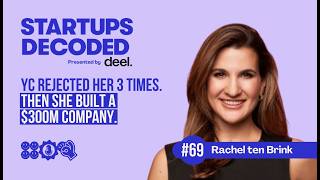
Rachel ten Brink built Scentbird to $300M after Y Combinator rejected her. She talks about enterprise sales, fundraising trade-offs, and why she started Red Bike Capital to back early-stage founders with operator experience.
Chapters
Well, you know, there's something about the founder journey and I talk to founders a lot. It's again, I had a corporate job for many years and you have your ups and downs, but the emotional journey of being a founder, the highs are so high because you freaking built this and the lows are so low because this is your baby. And so you're in this, you know, super fast speed roller coaster.
Welcome to Startups Decoded, the show that gets real about what it takes to build a successful startup. I'm Andy Walsh, 2 times exited founder. Strategist, and your host. Each week I talk with top founders, investors, and operators to unpack the plays that drive real traction, not just headlines. If you're building something bold, this is where you'll get the honest insights to scale with clarity and confidence. Let's keep growing together. Hit subscribe and share with your community. It would mean the world to me. Hello and welcome back to Startups Decoded. My name is Andy Walsh, and today we're looking at The operator mindset when you shift to become a VC. And I'm fortunate today to have Rachael Ten Brink, who's from Red Byte Capital. Rachael, welcome to the show.
Thank you. Excited to be here.
We, we met doing a panel and we got to thrash it out a little bit. And I feel like that's the point in time where you really get to know someone. Like you can meet at a social event, but then when you actually sit together on a topic and you get to learn each other's perspectives on things, it really made me curious about where you'd come from and what you're doing today. Because not all VCs are made equal.
Yeah, I, I, I remember that panel. I do have a couple of spicy takes, so I'll bring them on.
We like a bit of spice. We definitely like a bit of spice. It's important today too, because what's happening, there's been a huge shift in the last 2 years as far as startups, period. And then how VCs and even angel investors work with them and collaborate a bit more. And you started in multinationals, right? And I, I want to start there. It's fascinating for me because You've worked for some of the biggest brands in the world, and one of my biggest passions is looking at the generalist mindset for someone that has had such a breadth of experience in different categories, different size of companies, and how that informs what they're doing. Can you take us through a little bit about that entry for you?
So something that is a little bit lost in the venture ecosystem, because I think a lot of people never had that experience, is just what an amazing training ground these Fortune 500 programs are. So I started my career at Procter Gamble and then did my MBA here in New York and then worked for Estée Lauder, L'Oréal, Elizabeth Arden. So I spent about 2 decades in Fortune 500 companies. And although it's radically different to venture, and I don't think I'm employable in that world ever again, there is incredible structure and learning. Frankly, owning a P&L is a skill that so few founders and sometimes VCs of just understanding the levers of market, what is driving your revenue, what are your costs, how does that work in an organization where it's a matrix organization where you have to influence a lot of people that don't necessarily work for you. So there is a lot of managerial learning. There is a lot of just business sense, business model learning. And then there's also a part that while, you know, startups are fun and fast, there's also something really fun about working in a large organization that has resources. You have access to the best research, you have access to large budgets to do TV ads and subway ads and national ads, like really big things. And while you're probably not gonna do that in your early stage venture, just that learning of scope of how things actually work in big organizations, I think can be really helpful. I always joke that, you know, I started broad and every year I go smaller. So, there we go.
I totally agree. For me, I worked in different-sized companies before I went into startups and publicly listed companies too. And that experience is unique in itself. And so many founders really don't think about the future state as far as if you are going to a point where you want to IPO, even thinking that state. I mean, as a founder going into a CEO, like they're two very different roles if you go publicly listed. But understanding just from compliance perspective what you need to do, and then from a budget and forecasting, if you've got shareholders, there's so many things you are thinking about across that breadth. And for me, it's the most perfect grounding. And there's some weird snobbery, and I'd love to just touch on this a little bit. As far as founders where they're like pure founder, they started in high school and, or they maybe they dropped out of college and they never did that big company experience. They're missing a real opportunity.
You know, I think that there are a lot of paths to venture. There are a lot of, let's put it this way, there are a lot of paths to success in ventures, but in the end, it's really freaking hard no matter what path you take, right? So let's be real, whether it's drop outta college and, and start your company, or whether you went through a couple of years of, and I did a lot of years, you don't have to do that many, or, you know, you are a VC and then become a founder. There's a lot of ways that you see it happen. I also, and, and it's interesting because, you know, we'll talk about my fund later on, but when we think about Red Bike Capital and the value that we bring to founders, we help them land first enterprise clients. And one of the reasons we're so effective at that is because I was the client. And I find that the part that entrepreneurs miss because they dropped outta college, they were 17, they never worked for a large company, is just the politics, the logistics, the soft skills, all the intangibles that your best AI-powered CRM enriched with go-to-market Clay, you name it, is never gonna capture because there are these tiny nuances of how the political structure of large organizations works that you have to have seen it. Like, I, I don't know if there's a replacement.
I had a business here I started in 2012, and my big client that I signed within the first year was Microsoft. And I'll never forget the procurement process and onboarding. It took about 3 months. Just to get signed up where we could actually work with them because of the—
And that's lightning fast.
Yeah. And they're obviously publicly listed. So like the flow-on effect is that we need to be compliant for all the things that they need to be compliant for. So if you're a founder and you're selling to an enterprise client, there's the sales cycle of trust, engagement, and then just getting set up from an administration perspective is huge.
Well, and even things like we're, we're very friendly with a bank here in New York that helps, you know, works with a lot of our founders, but Things like their policy is a startup must have 24 months of runway before they choose to work with them because they don't wanna go through all the onboarding process, all the procurement process, and then find out that the company's out of business in 6 months, right? Because they ran out of cash. Things like that that a founder might have never thought about really matter for large enterprise.
I could have a whole conversation about that. And I say it to the portfolio that I work with is that if you're onboarding a tech stack and it's critical to your business, I do some diligence around their pipeline and how long they can be around for. 'Cause if you double down, there's a, even as a small company, let alone a large enterprise, and all your eggs are in that basket and they can disappear and that can leave you in a real spot.
You know, it's, it's the same reason that, you know, we, when we look at, talk to founders who are targeting, you know, SMBs and we were talk, talking to a founder that was doing something in finance, uh, in the finance stack, AI-powered finance stack. And he was targeting small D2C brands. And I said, that's a really terrible market. And he's like, why? D2C is great and brand. I said, those are, you know, some of them will be great and they will be huge and some of them will die. And lo and behold, he had incredibly high churn and it wasn't like he was doing anything wrong. It was just, you know, 2 or 3 years ago, D2C went out of fashion. Nobody was funding these companies and they were going out of business.
Yeah, the fragility is really interesting, but I think it's not just startups now. Industries at large, they're all looking internally right now and questioning what do they look like in a couple of years' time. So it's, let's not go too far down that. I'd love to sort of jump back in a little bit. So for you, multinational, you then decided to go out on your own and you started a company, Scentbirds. What was that step for you in looking at like opportunity that you've observed from big industry to then jump into something that was your own?
So You know, as, as I hinted at earlier, my, my dad's an entrepreneur, was an entrepreneur. I grew up in a very entrepreneurial household. We, I grew up in Costa Rica. He had a tuna fish. I am literally the daughter of a fisherman. I spent Sundays walking around supermarkets looking at tuna can shelves and asking people why they were buying that tuna fish. So I really like always assumed I would be an entrepreneur and somehow found myself you know, well into a corporate career. I had a beautiful office at the GM Building looking out into Central Park and went, oh my God, this is not what I want. So I definitely am not your typical entrepreneur. It takes a lot of guts. I decided that I wanted to not be pigeonholed in Fortune 500 for the rest of my life. I decided I wanted to be a tech entrepreneur, and the way I did it was I started, I convinced my boss that I was gonna work 4 days a week. At Elizabeth Arden, I was working for the CEO, and that one day a week I started to do consulting work for early-stage founders. Now, I will tell you this, it is a terrible business model because A, early-stage founders have no money, so they can't pay you. And B, and I think this is the most important part, the really smart founders, the founders that you actually wanna work with and be part of their journey, they for the most part already know they need to get from point A to point B. What they need is execution. They need to get it done. And so to come in once a week and tell them, well, you should be talking to this type of people, or you should be— it wasn't enough. And it wasn't enough to drive results. And I am, if there's one thing, I, I am a results-driven individual. Like I like to see the outcome. And so, but through that process, I met, I worked with close to 20 early stage companies and all sorts of projects with go-to-market, growth, revenue, PR, positioning, branding. I did a project with one woman, her company unfortunately didn't survive, but she introduced me to Maria, who is the current CEO at Scentbird and who's my co-founder. And it was an interesting, I give Maria a lot of credit of just putting together a team. We were 4 founders, which is a lot of founders, but what it enabled us to do is work really, really fast. Fast because, you know, I was sort of CMO, CRO, so I handled both the revenue side and the B2B side. So on the one hand, I always said I lived and died by CAC to LTV, was an early adopter to influencer market, affiliate marketing, you name it, we've tried it. But the other side of it was my enterprise sales hat. So I had over close to 80 enterprise partners, Coty, Macy's, Sephora, Glossier working with Scentbird, and that's how we got started. So it, it was, you know, it was very, the journey from, you know, remember the big office with the Central Park view to like, we were literally on 28th Street. We're very close to where the studio is in a tiny little office, filling little bottles of perfume at 3:00 AM.
It's amazing the contrast. And I had a guest recently talk about one of their friends who worked in big banking and then went out on their own for a year and couldn't handle the get your hands dirty execution part of it because they were used to having the team around them that did everything. They were very strategic, big thinking. And it is literally that 3 AM filling perfume bottles because you need to be able to jump in. But what I found fascinating though is the breadth of those 20 different founders that you talked about in the consulting. Rather than jump in, you definitely got an eyes wide open approach to what you were stepping into to make that. So talk us through, just curious around Scentbird, Scentbirds. What was the model? Because you ended up going into YC, which I want to talk to you. Tell us about Scentbirds.
So I do think this is a very important point because again, I have tons of friends from my, you know, time in Fortune 500, and a lot of them are like, you know, startups are so sexy, they're so cool. Yes, but they're also incredibly hard, right? And it's an emotional journey and it's a financial journey. I think it's a very different conversation when you're dropping outta college at 17 and saying, I'm gonna give this a shot for a year and see what happens to quitting, you know, a job when you have a mortgage or you have kids. Like there is a real responsibility to it. And I, I give credit to my husband who was very supportive 'cause I couldn't have done it otherwise. I have kids. But I think that there is a first principles thinking, a humbleness And, and it's very interesting because, you know, I had to, yes, I knew a lot about the industry, but I had to approach it from a first principles, from a why did we start Scentbird? We started Scentbird 'cause it's actually, you know, this is 2014, the world is blowing up. D2C is the hottest thing. We have discovered that people are willing to buy things on the internet, right? That was the overall premise. Zappos figured out shoes, Warby Parker was figuring out glasses. And when we looked at a cat— at the beauty category and we looked at fragrance, personally, I love fragrance, but it was also, it is the hardest category to sell online because if you think about it, you know, makeup has color. You can see the color payoffs, skincare. You can explain the technology. You can do a before and after. What the heck do you explain with fragrance? I mean, a bunch of pictures and you talk about Fougère, like even the language, fougère, what does fougère mean? What does a clean scent mean? Right? And so we started from a, a first principles perspective of experimenting, but there was also a piece of it that was the business model, right? And so I was talking to you about managing a P&L and understanding the business. So it was a lot of testing and iterating. First business model we did was this beautiful, like evocative think about it like cards and you would flip the card and discover what, based on what image appealed to you and what music appealed to you, flip and find out what fragrance would fit. Very pretty. But here's the kick. Nobody wants to pay for recommendations. There was no way to monetize this thing. And frankly, affiliate is a tough model. You need a lot of volume to make that work. And ultimately you're dependent on how good is Macy's at converting the sale. Or Amazon, right? So that was a tough business model. Then we tried the Warby Parker model, which was we would send you 3 bottles of perfume with 3 samples. Try the samples, find what you like, ship back the rest. Horrible business model. Terrible. First of all, people would ship us back water. Second of all, it was a ton of cash for the business to tie up cuz we had to buy the 3 bottles, ship the 3 bottles, then ship them back, and then figure out what to do with the rest. So there was a lot of cash tied up. And number 3, you're literally shipping bottles of alcohol. So flammable liquid. So you can imagine how expensive that was. So very quickly learned that was not gonna be the model. And frankly, at one point we were like ready to throw in the towel. We were gonna pivot. We started to brainstorm on completely different ideas. And one of our mentors whose name is Michael Seibel, he's He was a partner at YC. He's probably one of the smartest guys I know in person. Like really said, you guys are probably like, know a lot about fragrance, figure it out. And Maria came to the office on a Monday and said, I have an idea. Let's do travel sizes. And it's a sample, but it's special because if it's just a sample, nobody needs it. And that was it. And it was that magical moment of product market fit. I never forget, like, The first month we had 37 customers. By the second month, it was like 112, 337. And pretty soon we had 15,000 subscribers, 30,000 subscribers. And today it's close to a million.
So it's still operating now?
No, the company's doing great. Yes.
It's amazing. And the long tail part of that, you said 2014, right?
Yeah.
12 years later, any startup founder would be so, so pleased to have lasted 12 years. So that's testament to that test and learn, but that iteration is really important. And for you in that early stage, I assume bootstrapping to a point, but then you decided to go the YC path. Can you talk to us about that decision?
So YC was transformational. Full disclosure, they rejected us 3 times. And I like to talk about that because so many founders, I mean, you're gonna have to be resilient. You're gonna have to eat glass. You're gonna get a lot of nos. So I think it's really important for founders to hear that today. Scentbird is one of the top YC companies by revenue, which means we're top 2% out of the close to 6,000 companies they've invested in. But they rejected us 3 times. You know, initially it was before we had the business model when we were trying the other business models. They said no. The second time we were kind of figuring it out. We got to be flown to San Francisco. We interviewed. And I'll never forget when they rejected. It was like the saddest dinner, you know, I made pancakes in the morning. We went, we got the interview, and then we're like in this Airbnb and we're all like, got rejected. And then finally we got in. And I am a huge fan of, of YC. Don't love it so much as an investor. The valuations are nuts, but that's a whole conversation. But as a founder, it was really transformational. And I think that what they've done And there's a couple of lessons here for anybody, whether you end up at YC or not. You know, their model is sort of, you know, super competitive process to get in. So you feel like you're at the top of the world. And then I always joke, like, they pull you down and they break you up in pieces. And what it means is from week 1 to week 8, it's a 12-week program, but like the first 8 weeks, they work you hard. And there is something incredibly motivating about being in a room with people who are all growing 20% week on week. And you're in these pods and you are, everybody else is grow. It doesn't matter what their business is, that motivation, that hypercompetitive environment, that there is something very useful. And I always recommend this to founders, like you need to find your founder Ossie, people who are maybe a step ahead or like, you don't need somebody who's an exited founder who's exited 5 years ago. You want somebody who's like a step above you, a step ahead of you. What did they do? What did they try? This week I tried the, like, very, very tactical, willing to share those resources, willing to share those connections. That gets you, gets the wheel going. And so that was incredible. And then I would say, you know, there's this 8 weeks of like hyper-competitiveness. And one of the things they do, which I really respect, is they really push founders not to talk to investors during this time. Like, heads down, build your business. And I think that again, whether you're YC or not, this idea of like build traction, like traction explains a heck of a lot more than the most beautiful deck. Like if I talk to you at the beginning of the year and I come back and you've like tripled your business, like I'm listening. Right? You can show me a beautiful deck. Yeah, yeah, yeah, whatever. But like if I met a founder at an event and all of a sudden they've tripled, I'm like, I'm listening. I'm like, that's what gets you, right? Because ultimately, um, I always say like, I may be smart, but the person who's paying for the product or service, they're even smarter. So anyway, and then Demo Day and just the access of capital. So I'm, I'm a huge fan of YC. It's kind of a YC color count.
Yeah, it is.
But you know, I think that piece of just the psychological journey of, you know, pushing really hard to get in, breaking down and becoming really humble and really focused, and then going out and fundraising from a position of strength and revenue is very interesting.
Quick word from our friends at Deel. Founders, are you hiring? Whether that's your first person or your 50th, you've probably already hit the moment where the best candidate isn't even in your city, let alone your country. That used to mean so much paperwork. Deel removes all of that. One platform that lets you hire in days. They handle payroll, compliance, contracts, and benefits. Plus, they're across 150 countries. Don't lose good people because logistics were too hard. Deel solves that problem. Check it out. startupsdecoded.com/deel. That's dealstartupsdecoded.com/deal. A few things there I want to double-click on. I love that front row seat into that experience because it has such a huge brand. And there are actually probably there's three parts. The valuations thing, I feel like we could talk about for ages. Unfortunately, a lot of VCs and investors that have leverage are using lower valuations to get higher percentage ownership. and when founders are not desperate necessarily, but don't really understand the full value of their company. And that's a whole nother thread. The second one I'm interested in there, and I've had Jeff Becker from Antler, Mike Maher from Sidecar Ventures, both of them do something similar where there's a 30, 60 days of founders in a room thrashing it out. So the VCs get to see them at their best and at their worst. It's like, how do they react in certain situations? How do they collaborate? What are the decisions that they're making? How do they make decisions? And for me, there's something really powerful about that because one, you get inspiration just peer-to-peer, but two, you get a front row seat to what's actually happening before you put your money down. And it sounds like for you that was on the founder side really important for your own growth, let alone for, I assume, YC to get a sense of who you are as a founder.
Yeah, I mean, listen, um, I like Anthur and Mike very much, but I do think that The good thing and the thing about accelerators is a lot of what we're talking about, but I do think that we need to talk about dilution and we need to talk about what this accelerator is gonna do for you as a founder. Not all accelerators are created equal. And so where I do sometimes struggle now as an investor, but even as a, like I always say, like once you're a founder, you're always a founder. My brain will always function as a founder even though I'm sitting on the other side of the table. And You know, some of these accelerators take 7% equity for not a lot of cash and frankly not a lot of leverage afterwards. And so I do warn founders, like, do your home— your most valuable asset at this point is your equity. And if you're gonna— I mean, on the one hand, I would say like 100% of zero is still zero, right? So let's not forget that, right? You need to, you need to launch, you need to be in business, you need to start building trajectory for your business. But on the other hand, you know, be very thoughtful and, and talk to founders. Like the most, I mean, the most wonder— one of my favorite parts about the, the tech ecosystem, the venture, is people are very generous. People are willing to talk to you and, you know, go have a coffee and have an honest conversation with people who did the program. So I think that there are a lot of accelerator programs out there. They're not all equal.
It's a good call out. And in that early stage as a founder, you are basically on the treadmill. And you're making decisions at pace and the rhetoric that you read, you might get a sense or sentiment from what people are saying, but you do need to pause a little bit. And I love the idea of gut instinct is founded upon your own experience, things that people have said to you, conversations that you have, right? It blends a lot of these different things. So as a founder, what advice would you give? Like if you're in those moments and you're thinking there around pricing, around the company equity, all those parts there, like, how do you pause and reflect and actually think about what's the right decision?
So, I think I'm a pragmatist. I'm a very practical person. So I think that's really important is you have to ground yourself in reality. You have to ground yourself in, you know, what do you need? What does your company need? As well as what's available, what options are available to you? So I'll give you the example. I have A founder that we've been talking to for the last couple of weeks, I've known him for a couple of, for a couple of months, super smart. He's a second-time founder, but you know, he's building something new. It's very early. It's not cooked yet. It's not even, I wouldn't even say it's a business yet. And that's fine. He's, he's early, but he's getting a lot of advice. Companies at YC raise at blah, blah, blah, and blah, blah, blah. And he's trying to raise at a very high valuation when he doesn't really have a business. And, you know, last time we spoke with him, he's complaining that, you know, fundraising is taking too long and this is distracting him from building. And, and we're like, you know, maybe instead of, you know, a $20 million valuation, do a $15 million valuation, get it done, go back to building and then worry about it, right? Like there is that pragmatism of, you know, don't give away the house, right? Don't give up so much equity. I've, I, I've also seen founders where, you know, they're still at the pre-seed and have given up more than 50% of the economics. And, and those companies become uninvestible and, and that's a really terrible situation. But on the flip side, like maybe you give up a little bit of equity, get the money and run because you need to run. One of the few competitive advantages that early-stage startups have is speed. So if you're spending, I, and I think speed trajectory, You see it, you know, founders that just kind of get the round done and move on versus founders that, you know, a year and a half later are still going on the fundraising. It makes their journey so much harder.
It chews up so much time. And I see some really positive conversation now around preparedness on fundraising and really early doors when you start a company thinking about your narrative, thinking about the target pool of people that you'd want to talk to, building relationships and getting momentum before you need momentum. Ultimately, because the less time you can spend on fundraising, the better chance you have of success, right? Closing the round to get back to what you were doing. Because if you're spending 12, 18 months fundraising, that's pretty much a person 5 days a week gone.
I mean, I think there's a couple of things. One is what you said, but I think the other is, don't forget, VCs talk to each other a lot. We do a lot of events, we do a lot of coffees. And so when you meet an interesting founder that I find interesting and I call you and say, hey, I just talked to Jimmy or Jenny, and she's great and she's doing blah, blah, blah. And you're like, oh yeah, I talked to her last year. She was trying to raise a round, but she's still tough. Right? So I, I do think that, um, and I hate the fact that I used a woman as a negative example. Scratch that.
We can make it Jimmy again.
Jimmy. Let's make it Jimmy again. Yeah. Jimmy again. But the point is, you know, you gotta like be cognizant of your what's being said when you're not in the room. I think the other part of it is like, there's a balance between, you know, I think it was Reid Hoffman who said like, if you're not a little bit embarrassed of your first product, you launched too late, right? Like there is a piece of like, you just have to go for it and launch and gather information and optimize from there. But the flip side of it is sometimes waiting a week or two to have some things fall into place. It's very different to have a conversation with even at a pre-seed of like, I have an idea to like, I have two signed pilots. Maybe you won't have full revenue, but I have two signed pilots with these very, let's say you're a healthcare company with CVS and UnitedHealthcare. Oh wow. Right. Okay. They're pilots. They're not making money, but these are real companies. And so sometimes delaying just a little bit to get those pieces, those kind of sexy pieces into place is, is very beneficial for the startup.
I love that. So the first one you talked about was pragmatism, and the second one there is letting things settle just for a minute. Let the dust fall to the ground, breathe a little bit, and think about what you have up your sleeve that's actually strength. Because that, that desperation and repetition, like you talked a great example there where you can burn a relationship without even realizing, one, that relationship doesn't respect you anymore because of what you've done. And then two, the flow and effect of conversations that they're having and your own personal brand. In that. So some really sound advice.
Well, you know, I think that there's something about the founder journey and I talk to founders a lot. It's again, like I had a corporate job for many years and you have your ups and downs. You have, you know, your boss was a pain. They, they took credit for something you did, whatever, right? Like you, you have good days and bad days, but the emotional journey of being a founder, the highs are so high because you freaking built this and the lows are so low because this is your baby. And so I think you're in this, you know, super fast speed roller coaster. And I've had, you know, for example, I've had some situations with founders who have been fundraising for a while and like, you know, maybe it's a Zoom, the camera turns on and they're already like, and I'm like, dude, I just met you. Like, I have no, I understand that they're frustrated. I understand that they've talked to 25 people before me. But the truth is, this is my first conversation. And so managing your emotional state, managing to always put your best foot forward in these situations. Like if you need to take a week off and do something else, take a— I'm not saying take a week off from work 'cause you never stop when you're a founder, but go do something else in the business and then come back. Sure. If you don't put, you know, people talk about these blocks and back-to-back meetings and that works sometimes, but sometimes like Okay. Bathroom breaks in between, humanity in between, go walk around the block and get some sunshine.
Most often it's a one-time opportunity with these people. They're not going to give you a second chance.
So true. You don't get a second chance at a first impression.
100%. Okay. So let's set the scene. We've moved from Scentbirds into now what you're doing. Just give some setup there. What was that transition from your own startup as a founder into starting Red Bike Capital and becoming a GP?
So the way I describe it is very organic. I like to think things through, as you can see, like I take a long time to make shifts even though I make pretty radical shifts. And so, you know, I was at Scentbird, company's done great, still doing great. I was fully vested. 4 founders is a lot of founders. And frankly, the business was at a point where I had a little bandwidth and I was doing a lot of advisory work. I was working with a lot of early, early stage founders. I was in several advisory boards and at some point, uh, my partner in the fund came to me and was like, you have incredible deal flow. Like you're seeing, you're working with these amazing founders. We should put a little money to work. And so we started doing angel investments. We did very well with our angel investments. We, we had a $640 million exit. Everything was going very well. And then friends start to come to me and go like, Well, how do you get access to these deals? How are you finding these companies? How do you figure out what works? How do you even know these people? And that was the start of Red Bike Capital. So, you know, we, we started Red Bike, we started working on it sort of 2001, end of 2021, 2022, we launched Red Bike. We are now at the tail end of Fund 1. We've done 18 investments, primarily vertical AI as well as fintech and healthcare. And I love what I'm doing right now.
I see the passion and it's so important too. And your experience in the breadth of what you've done, it sounds like it's really allowing you to shine right now. Just from a high-level thesis perspective, you're early stage, right? What sort of check size are you writing?
So on average, our first check is $250 to $500K. You know, our thought is to build a portfolio where we have enough breadth that we have enough shots on— there's always this conversation around funds and portfolio construction and how concentrated you wanna be. Our, our thought is, you know, there needs to be a balance between enough shots on goal, but also we try to be really, really valuable investors. I work my butt off for the founders and frankly, I do it with gusto. You know, one of the things when we started Red Bike, you know, having, you know, my partner Herman is a very experienced investor. He worked He was an early fintech guy at B of A and then invested in hedge funds. So he's very experienced on the investing side, but I'm really the operator, right? And I, the beginning, I was like, well, I can help founders with, I remember like my first slide when I was pitching the fund in the beginning, I was like, I can help with team, I can help with messaging and PR, and I can help with this and that. And like, there were like literally a list of 13 things. And what I realized is yes. I, I, you know, I, I built businesses. I can give you advice on how to manage, how to structure an early stage team. I, I've fundraised, I've all of that, but where I could be the most valuable and what really, you know, going back to that conversation we were having about traction and revenue, the biggest, like if you can get that flywheel of revenue going, if you help founders land their first enterprise client, life gets so much better for everybody, right? If you, so, you know, more and more as we think about our fund, as we think like, what do we wanna be known for? How do we think about how we help founders? We help founders land first enterprise clients. And that unlock is so transformational for founders.
And it's the skills and the experience that you bring to the table. It's hard to not want to do so much and help. And the VC platform role, you look at some like Primary Ventures, they have a large team to support their large portfolio to do that, but it's a ceiling, right? You can only do so much you can do. And at the early stage where you are working to be able to actually connect them with clients, get money in the door that then allows them to focus and actually do all the right things. Because if you are trying to do 5 different things in parallel to try and elevate them, but they're still not making money, it feels like it's a big noise.
You know, look, we are a small fund. We, and so I feel like in this world of venture where there's a lot of dollars and the best, I always say the best founders get to curate their cap tables. And what I mean by that is, you know, you might have a large fund that's gonna help you, that's gonna support you for your A round or introduce you to the right investors. You might have this one that has this connection. We play a very specific role and founders want us for a very specific role. And I work my butt off for that very specific role. And I think that having that clarity, that focus really helps everybody. And for us, like, it also sort of like they cross-pollinate. I'm constantly learning, you know, what's working, what's not working, what has shifted in the environment, what are companies thinking about. For example, with AI, there's a lot of conversation about we headed to an apocalypse where everybody's trying every AI tool and then all of a sudden companies are gonna, you know, just continue to experiment and churn. So I, I keep a very close eye on that go-to-market revenue world. That's my world.
It's the ability now to get early traction feels like it's almost a new version of a moat for founders. The long build times and that separation as far as speed to market from a product side has just like absolutely catapulted.
Completely. I think that what we're seeing, I mean, AI changed the game dramatically, right? When your key competitor can look at your product and code it in a weekend, you have a very different world, right? And so product advantages alone are very limited. And so you have to think about like, what are your competitive advantages? Obviously there is proprietary data, whether you have proprietary data or because of the customers you are working with, they are generating proprietary data. That you're able to keep. There is sort of a moat around workflows and understanding really well. Like I was talking about, you know, I work for enterprise customers, so I understand like this one talks to the— this is how it actually works. This is how the flow of information really works, right? That can be a moat. But I think one of the most critical at this early stage is the distribution moat, right? Whether it's, you know, becoming the standard, whether it's that the most innovative, you know, maybe you're targeting CISOs, maybe you're targeting heads of marketing, the most innovative CMOs use this product for GEO, right? Yeah. It doesn't have to, it doesn't have to mean you're a first mover advantage. So for example, we invested in a company called Athena HQ. They're the way they think about GEO, which is generative AI search. They're really thinking at it from the perspective of engineers and how that's allowing them to win. They have some great logos. They're really scaling fast. It's a competitive space, but I really believe that idea of like those who have not only the data, not only the flows, not only the distribution, but the unique vision of where the future is going. Those are the guys that win.
It's really interesting because the, like, easy term democratization gets overused, but it, it has changed as far as the ability to become a founder has never been easier, but the ability to turn it into a sustainable business is probably harder.
You know, it's very interesting because again, when I started in 2014, you know, pre-seed used to be, you know, a guy or a gal with a deck that had an idea and they needed to raise money to hire an engineer, or maybe they had a partner who was an engineer and then they would come back and start the process of having a product and then eventually customers, et cetera. What you're seeing today is the pre-seeds, a lot of them have revenue, a lot of them have a pro— and frankly, the expectation as a VC is I expect to see a product. I expect to see a product demo because you don't need, you know, 6 months development time to show me what you're trying to build. And so the expectations have really shifted. The time to revenue has really shifted. but it hasn't made it any easier.
Absolutely. Though I was reading something that Elizabeth Yin put out from Hustle Fund and she was talking about from a founder assessment perspective, in her view, that it hasn't shifted at all with the advent of AI, which I find really interesting because a founder coming in now, like if you didn't have a technical founder in your stack, as far as the breadth of team members, then you probably wouldn't be taken seriously where now you don't necessarily need a technical founder. And I'm curious from you, from Redbike, how do you see the assessment of founders today? Has it shifted from 2 years ago and what type of person they are?
I don't know if the assessment of the team has shifted. I hear your point that there are, there's an openness. It used to be that if you were a solo founder and you weren't a technical founder, you were done. You were unfundable. I think now there's a little bit more openness to it, but the reality is, and we were just having a conversation before this about the underlying, yes, you can vibe code, but you still need somebody who understands the underlying technology, who still understands how to connect the data, how to connect the sources, how to provide security. So, I'm a little hesitant to say like, oh, you don't need the technical co-founder anymore. Maybe it's okay if you have, you know, able to recruit a team, but there's still, that part is still, I think, important. I think what, what Elisabeth is saying, and, and I still agree with, is there's a there's a lot about a founder and sort of the ethos of a founder that hasn't changed. So the way I describe it is that, you know, on the one hand you have to be sort of resilient enough, diligent enough to like bash through walls. But the flip side of it, and I think this is really important, is you also have to be smart enough sometimes to be like, yeah, you know, we can bash through walls, but that takes a lot of energy. And time, or think there's a staircase. If you go that way and that way and up, and we can get to the same place, right? And so that ability to be creative, intuitive, iterative, try things, right? That one of the biggest things that I think this is very consistent is the ability of a founder to test, iterate, absorb new information, and provide, move the business forward, provide outcomes. That is such a telling tale of which founders succeed.
Fascinating. And I look at the breadth of skills again, going back, we touched on it before. If you're building a technical product, it's the skills that you need to do that and having something that works and serves a purpose, solves a problem. But there's also the tech stack that you plug in to be able to do sales, to be able to do marketing, run your finance and everything else. You almost need to build all of these things in parallel and the workflow of some of these companies like there's still a lot of time invested to be able to get them to work appropriately. Sure, they save you time, but you have to set it up and do it in a way where you understand what's coming out. So, there's a lot of things happening at once.
Yeah. And I think that the flip side of that is I think you can have much smaller teams, which there's a lot of conversation in venture about, like, will, will the startups of tomorrow have to raise less money? Hasn't quite happened yet. Theoretically, a lot of people are talking about that, but this idea of You know, the 10x engineer now becomes 100x engineer. So I do think that it's shifted of the amount of people you need, just the productivity of those that are there, but you still need something.
And a future state, I'd love to be able to tap into this because you've got such deep experience from a multinational perspective, like 5, 10 years, the impact of team structure today in startups. How do you see that playing out in large enterprise as far as like people are talking about like reductions of teams significantly, but do they fundamentally operate the same, but there's effectiveness? Like, do you have a point of view on that?
You know, there's so much doom and gloom about, um, you know, AI is gonna destroy all our jobs. And yet I think the latest I was hearing, the latest report on college hiring is that's actually gone up. And so I think that there is, we are in a period of incredible opportunity, but dislocation. Like, this is a very— what a time to be alive. Like, that's how I feel, right? There are huge shifts. There are, you know, if you think about like the farming industrial revolution, right? We're at that type of cusp of huge shift. So will there be dislocation? Will there be shifts? Yes. Do I think the corporate workforce is going away and disappearing? Absolutely not. I think the, you know, same way that Excel appeared and bankers still have jobs, Right? And there are still teams, but guess what? Now the expectation of how much data you ingest to work on a deal or the types of models you can do, it's a lot more sophisticated. And so, I think that's what's going to happen is you're going to see teams shift, maybe the type of work shift, but jobs aren't going away.
Love that. I like a bit of positivity in the world right now as well. I mean, we need a healthy dose of that.
Yeah, always an optimist. It's funny because I always talk about this, that I, I am definitely a glass half full kind of gal, but I also, I'm very honest with myself that it's almost like glasses. Like I know I have a hell of a positive skew, so I always have to like question myself because I know, like a golfer, like I always know I'm gonna swing one way, so I kind of have to overcorrect it a little bit because I, I am very aware of it.
I like it. I respect it a lot. Rachel Tenbrink, Red Byte Capital general partner, thank you so much for joining. This has been so healthy.
Thank you. It's great.
Thanks for listening to Startups Decoded. If today's conversation helped you think differently, share it with the founder in your network. And don't forget to subscribe for real-world startup insights every week. We really value your support. If you're interested in partnering with us, email hello@startupdecoded.com. Decoated.com. I'm Andy Walsh. I'll see you next week.
More from Andy



EP#88: Why Most Founders Misread Their Own Traction. Vanessa Larco - Premise VC

EP#87: Founders Obsess Over the Raise. Investors Care About This More. — Carina Cunha






Ep#86: Early Decisions That Define Your Startup Forever. With J.P. Morgan Asset Management
