Ep#73 VIDEO David Shim
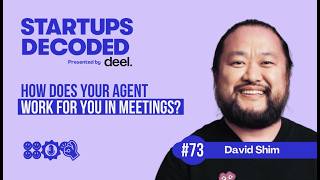
David Shim, founder of Read AI, went from teenage day-trader to stockbroker to CEO of Foursquare before building the world's fastest-growing meeting-note-taker. Read AI joins your calls on Zoom, Teams, or Google Meet to transcribe, generate notes, and surface action items. Shim describes it as a digital twin that acts as your executive assistant, scheduling meetings and coaching your speaking habits in real time.
Chapters
And I think that level of personalization is like, it's not going to be your best friend. Like, sure, some people will have AI best friends, and I think that's great over the long term where you've got someone that you can vent and talk to. But I think it's more about like, hey, you've got this personal assistant that only chimes in when you want it to, but it knows when to interrupt your day to when to insert itself. And it knows when to just let Andy run because he's on fire and I do not want to bother him.
Welcome to Startups Decoded, the show that gets real about what it takes to build a successful startup. I'm Andy Walsh, 2 times exited founder I'm an entrepreneur, strategist, and your host. Each week I talk with top founders, investors, and operators to unpack the plays that drive real traction, not just headlines. If you're building something bold, this is where you'll get the honest insights to scale with clarity and confidence. Let's keep growing together. Hit subscribe and share with your community. It would mean the world to me. Hello and welcome back to Startups Decoded. My name is Andy Walsh. Today I'm joined by special guest David Shim from Read AI, and we're going to be talking about not not only how you're using AI to improve your day-to-day from a work perspective, but also look at the future as far as how from a personal perspective we can lean into some of these tools to improve our life. David, welcome to the show.
No, thanks for having me, Andy. Excited to talk about this stuff.
I want to go into all sorts of things today, but I'll, I'll keep some structure so people can follow along. We'll kick off as far as you, I want to know your backstory a little bit. You've got some fascinating little inflection points as far as how you started, and I'd love to go through your story from you as a, a miner looking at your first step into a financial career.
Yeah. So when I was younger, I used to watch television and sometimes they would have like the stock ticker at the bottom and I was like, I always wondered what that thing was. And then I started to look at the newspaper and I was like, what are these symbols and why do they go up or down? And I, I really got into the numbers. And right around that time, internet stock trading came to fruition where you could actually trade stocks without having to talk with a broker. And so, uh, my mom created an account for me, and this is when I was probably like 14 or 15. She created an online account for me. I started trading and she didn't know what she was doing. She's more like, eh, my son wants to do this. He's probably playing some game and he needs some information. And I started to trade and I started to do pretty well. And I was day trading before day trading was a thing for the mass population. And what happened was I was trading so much that it slowed down the system, that it broke some things. Uh, because again, this is early days of website trading. Finally, I was like, this isn't working. I talked to the CEO of the brokerage. They hear a kid on the Paul talking and he's like, what are you doing? Like, how are you doing this? You're not supposed to be doing this. So I kind of got booted off the system there. And what I learned was like, there are other places where professional traders trade. And so I went to this course and I talked to these people and they said, hey, we will give you access to the system called Small Orders Execution System, SOS, where it lets you trade stocks in seconds, where if you want to buy something, the broker has to accept it or they move off of the price. And I was like, this is the coolest thing ever. And By that point, I was about 16, 17. I went through the whole program and they're like, hey, you ready to trade? I fill out the forms and they're like, oh, you're only 17 years old. You can't do this because you're not legally an adult. And I was like, what? I just did all this stuff. And they're like, all right, if you really want to do this, here's what you have to do. And I was like, okay, what do you need me to do? You have to get emancipated from your parents. And so for people who don't know, that means you have to go to court and actually say you're legally an adult and your signature is binding. So you can typically, it's for people who wanna sign an apartment lease when you're a teenager because you wanna move outta the house. So I had to do that. So I went to the judge and the judge is like, hey, what, what's going on? It's like, yeah, it's my mom and dad behind me. And it's like, hey, why do you wanna get emancipated? You usually hate your parents when you get emancipated. And they're like, I just wanna trade stocks. And he's like, what? He's like, I wanna trade stocks. And he's like, okay, so you, you're gonna still live with your parents? Everything's good? He's like, yeah, everything's fine. I just wanna trade stock. He's like, this is the easiest, like most interesting one that I've ever done. Signed off on it. But that was the easy part. So the next part was like, hey, you actually have to prove that you are financially literate. So the only way that I could do that back then was take the Series 7, 24, 63, and 65 exam. Those are exams to actually be a stockbroker. And back then there wasn't like guides on the internet that you could look at. I had to order a book. It took like 3 weeks to get to my house. I read the book, I studied it. I had to mail in this form to actually take a test, but I passed the test when I was 17 years old. So I passed the 24, 7, 65, 63, uh, that made you a stockbroker. And so now as a stockbroker, I was able to trade stocks and I was able to do it pretty well for about 2 years where I was making more money than a kid should make at my age. And it was because it was more like a game and I wasn't afraid to lose because I've never had anything. And I think that kind of got me on that startup buzz where it's like, hey, if you've got nothing to lose, there's so much more you can do because you're not afraid to lose it.
So good. I love it. Just that curiosity driving you to look at something on a screen as a ticker and think, think like, or have an element of what do I do with that? And then turn it into a way to make money. So I'm assuming, did you skip university then? You kept trading until you did your first startup?
So I traded in university for the first year, but I started to get gray hairs and I was like, this is, this doesn't seem right. Like I'm, I'm 18 years old. I'm going to college. I'm getting gray hairs. And the other part was like, I wasn't necessarily, I definitely was not the smartest person in the room. But what I saw was that there was technology that would make me smarter and that would give me more leverage compared to other people who were trading equities. And so that advantage started to become less and less and less over time as computers got faster, as internet became more available. I kind of saw those two things where it's like, hey, I want to enjoy my college life. I've made a good chunk of change and technology. I'm not, I'm not as good as I used to be, and I think I'm going to get worse over time against this. So I decided to step away and go to college. I did, I did a little bit of trading in between while I was in college. Uh, but the big thing back then was like, I a lot of IPOs. This was like 2000. No, this was '98, '99, 2000. There were a lot of IPOs and the way that you would get IPOs is you sign up on E-Trade and you would go in and say, hey, I want this IPO. And this was like the dot-com boom. So IPOs were going up like 100 points when they went out in a single day. So if you got one, you'd make like $2,000, $10,000, like, like nothing. It was just easy money. So what I did was I actually created like 50 accounts. And so I'm a kid, I buy 50 accounts. Those 50 accounts wouldn't get it. Only like 4 or 5 of them would get it, but 4 or 5 and you get $2,000 on each one. You're like, hey, I just made $10,000 this morning. This is pretty good. And so I did that for a while too, until they caught on that 50 accounts.
So fun. Love it. Okay, let's fast forward. I want to talk about your first big startup in Placed. Like, how old were you when you started that? Do you recall?
Uh, I think I was like 27, 28, somewhere around that age.
Okay.
Yeah, it, it was, it was my first startup. I lived in Seattle. I worked at startups. I went down to the Valley in San Francisco. I worked at a startup called Quantcast and I, 'cause I really wanted that experience. Like if you're a musician, you go to Nashville. If you like country, if you go to LA, if you're punk rock and you, you go to these places or New York, like if you're in tech and this is in the 2000s, like you go to San Francisco, you go to the Valley. And I wanted to experience that.
So good. Quantcast was obviously iconic back in the day. Yeah. And formidable in that sense. So Place, you started and you had a, a big exit out of that. Yeah.
So we started Place, like Quantcast was doing web analytics and that got me into analytics in the same way that stocks did where I was just diving in a little bit deeper. Android and iOS had just come out in, what was it, 2010. And so I started to fool around with it and what, what Place did was we said, People's location data is very valuable, not just from an ad targeting perspective, but where were you when you opened up Candy Crush? Where were you opened up with E-Trade? Where were you when you opened up Tinder? And that location data was something really unique because everyone tracks everything you do in the app, on the website. They didn't track where you are in the physical world. So that was the big bet. Ultimately kind of went out and said like, how do I get this location data? And I took the approach of like, I'll just give people money. Like that, that's a, I don't want to be weird and like do these SDKs that kind of trick people or do anything from an ad basis. I said, I will give you money if you let me understand where you you can go in the physical world. And people thought, hey, this is a great trade-off. I can buy like 6 apps this month if they just go in and I give my location data. And people don't go anywhere crazy. If you think about it, like, where do you and I go? Maybe we go to a bar, maybe we stayed out a little bit too late, maybe we went to the casino when we were in Vegas, but that's generally what the worst things that people do is like, oh, I went to a fast food restaurant twice this week. That's the end of the world. It isn't. But the analytics there is very interesting when you actually look at it. And so we built this kind of analytics platform. We had millions of users against it and we didn't have a really good use case. So we knew where people were going in the physical world. We could build Nielsen or Comscore for the physical world, but people were like, what do I do with this in 2012 and '13? They're like, I don't— this is really cool data, but I don't know what to do with this. Ultimately, someone came on, knocked on the door and said like, hey, we are an ad network. We are a mobile ad network. People do not click on mobile ads back then and buy things because it wasn't a very clean process, but we think there is some value with that. Can you actually tie your panel of users where they go into the physical world and see if they saw an ad exposure and say they saw an ad, they went into a McDonald's, they saw an ad, they went into a Best Buy. And for this is where it's like, I'm not a genius founder where it's like, I said no for the first year. Like I said, no, I'm pure analytics. I don't wanna do anything advertising related. And then they came along and said, hey, here's a check for $50,000. You only need to do this once. Can you go match these two things together? I was like, ah, it's $50,000. You know, you know, business is a little slow. Like we got this great technology, but we don't have product market fit. We did it and all of a sudden started to snowball into a business that Snapchat ultimately acquired in 2017. Uh, where they went out and said like, hey, we're building the location stack for the physical world. Part of that is going to be attribution in terms of where are people when they see an ad or use a Snap and where do they go? And they built, they acquired a couple other companies to build that stack out during that time.
I remember that era and contextual advertising of retargeting between physical and digital became such a, a big deal, right?
And, and it makes a lot of sense. Like if you were early in that, you kind of stood out where it's like, it's the first people that use, use GC content in their ads where it's like, oh, this is kind of kind of weird. This is not a polished ad, but it's someone that I've actually seen, and now I'm going to pay more attention to it. It's the ones that first started using AI on Meta or Instagram. Like, these things actually have a lot of pop, and then once everyone piles in, the value starts to get a little bit less and less.
So you were at Snap, or got acquired by Snap rather, pre-IPO then?
Like, that came after, uh, right after. So Snap acquired us in 2017. I think the stock was around It was higher back then, like $16. Uh, and so it was, it was an exciting time because it was, it was going in and saying like, hey, 1 1 3. Because if you think about snaps, I forget the exact number, but like 80% of snaps where you take a picture happen outside of your home. So it's going in and saying this product is designed for the physical world where they're taking pictures. And if you serve an ad to them in that physical world, can you map it back to a store visit?
Makes sense. Makes a lot of sense. Okay. I want to jump into Foursquare. My, I had a colleague that I used to work with and he was obsessed by being the mayor of our local cafe. It was like this ego-fueled thing that he just had to be that guy. And you were literally the mayor of Foursquare, period. You're the CEO of that. And there's a trend here. Again, I love this understanding human behavior part of it. Fascinated as an outside looking in at human beings. And I would have loved to study psychology to go deeper and, and that part of the behavior, physical, digital, and the connection and intersection of those. It feels like there's a theme there. Like, your experience in Foursquare feels like a natural extension of what you did with Placed.
100%. I think the Foursquare was just a different level of scale, and it was more consumer. Like, Placed was really around B2B. We gave people money, and we were able to map back to store visits. Foursquare was this global consumer brand where people were using it for different things. People were using it for exactly to be mayors, to compete with one another in different places. Companies like Uber actually used this to make sure their place databases were most up to date because because if you're a mayor of a place, you're gonna update the hours of operation, you're gonna put more notes and comments. And if they start closing on Saturday, you're gonna put a note in there that said they're closed on Saturday. So we had this rich dataset that these platforms wanted access to because they wanted to refresh their place data. And so that wasn't the original intent of Foursquare, but it kind of got into a business like, hey, people wanna utilize that. Then we started to go in and create things like automated check-ins where we can check you into a place that you forgot maybe to do, but you wanna keep track of how many times did I go to the gym? There are a lot of people that actually used it for health benefits to go and say, do I go to the gym Do I eat fast food too much? Like, you can look at that and it kind of quantifies your activity and it lets you kind of judge yourself. So not going in and saying, I want other people to look at it. Sometimes they can hide those things. We even had really interesting things where certain countries didn't allow dating apps. And so what people did was we became, we were like, why is there a huge spike in this country in the Middle East? And they're like, we don't know. We started looking at people were actually checking in and using comments and they're kind of highlighting, these are the places where I like to go. And they were starting to communicate with one another as a dating app. Application. And so it was kind of cool to work with this kind of platform where people were finding their own personalized use case for these things.
Comes the romance, people get creative.
100%. 100%. And then so that all that location, the analytics, ultimately we were kind of like, hey, core product of consumer is incredibly important, but the intelligence behind that is even more so where people want to build on top of location data. They want to understand places. They want to understand popularity of places because as you start to have algorithms that say like, hey, here are all the places nearby you. What is the best way to actually sort that order? Well, the best way is to actually say, what's the most popular place? What's the best rated place? Now that you see that by default, but in the early days, Foursquare was really powering that portion.
Happy to hand it over here to someone else who wants to pick it up, but I was toying with a, with an app idea, which is basically DoorDash, but for dining in. So if you're in a neighborhood, you'd be able to look up something that you wanted to eat and it would show you all the restaurants nearby. You could get it and you could book and get a table and have that whole local experience. So wherever you went, you'd be able to find places based upon the food that you're in. And I was toying with the idea, but then I, like, I just looked forward and I know there's so many big players that will eat this up and the Gemini integration into Google Maps basically just takes that over because you're connecting so much information at scale and I can't compete with that. But what I love though is that, that physicality of community and connection and, and the way that it comes to life. It's not the focus today, but there's a real resurgence coming back in how people actually actually take what they used to do in person and merge it with what they do from a digital perspective, because we've leaned so heavy on digital and that experience that we've— I feel like human beings have lost their way a little bit.
I would totally agree. And I think you're seeing people lean back that other way in the exact example that you gave. One of my friends, former colleagues, Antoine, he founded Zenly, which is a way where it's like you could see your friends on the map. And what happened was when you could see your friends on a map in real time, people would just go, hey, I'm nearby. I'm going to go to that bar and just stop by and say hi. Like, it created these moments where previously you might have just messaged and said like, that was a cool spot, you could actually go to. And recently he came out with a new app called Bump where it does kind of very similar but actually adds more social components. So I think bridging the digital and the physical world is kind of what we did in the first generation. I think this next generation is more like, how do you not drive more activity online, but how do you drive more interpersonal activities? And I think that multiplayer is the thing that gets really interesting, especially even with AI is like you can play single player for a really long time and we're all playing single player AI right now. But that multiplayer moment is going to give you more utility than what we're seeing today.
Huge, huge space coming up. So let's jump right into Read AI, which is your baby now, founder and CEO. Can you give us a little bit of a peek at what Read AI does?
Yeah, so we're the fastest growing meeting note-taker in the world. So what that means is if you're on Zoom, Google Meet, Microsoft Teams, we'll join the meeting. We've got a couple of ways we can join as a participant, take the notes. Everybody sees who's on the call. If you can't join that call through a kind of participant, we've got a desktop application where we have a couple of things to highlight, like, hey, I'm measuring this call, I'm recording this call because we think multiplayer is important. And in order for multiplayer to work, you have to disclose that you're measuring the call. And so we built in these features to record on desktop, to mobile and Android apps. So when you're out in the physical world, we've got insurance brokers in Southeast Asia that do not have internet connection that use our application. They interview people in different villages, they come back to an internet connection, and all of a sudden the notes go into the cloud, they start to process, and by the time they're in the office, they've They've got 14 different reports that are ready for them to start their day. And so the idea here is we will take meeting notes and we're, we're taking away jobs, but we're taking away jobs that nobody wants. Nobody wants to go on and take notes in a meeting. Generally, if you take notes in a meeting, that means you are the most junior person on the call. You are the least important person on the call. If someone says you're the meeting note taker, David, because they don't want you to participate, they don't want you to be engaged. I think this is kind of the classic example of like AI is actually doing a job that nobody wants and it's doing it better than if someone was actually assigned to it. So we're taking the notes and we like to call ourselves like the system of record for meetings. So for over 5 million users on a monthly basis, we're taking meeting notes on their behalf for tens of millions of meetings. We're doing it across 75% of the Fortune 500. Half of our customers are outside of the United States in emerging and developing markets. Markets. Like, just to give you an idea, we have like 1 to 2% of Colombia's population that uses our app every single month. And so that's not, that's not tech people. That's like everyday people. 1 to 2% of people are using Read in Colombia. We're the number one meeting note-taker in Brazil. So it is really interesting how AI's been able to go in and say like, take something as generic as meetings and democratize the ability to actually scale that out.
It's fascinating just in a really simple functional perspective is that your TAM scales significantly just by the fact that an offline version allows anyone anywhere to access that and then pull it back into a central source when they do reconnect.
Exactly. Exactly. And even better is everyone talks about agents. I'm sure your audience definitely knows about AI agents. What's really interesting is it's the most classic use of AI agents. It's probably the most popular that's out there because it joins the meeting, it takes the notes on your behalf. But 1 in 5 meetings for us, our users actually don't even go to the meeting anymore. So they send their agent to go in and say, you represent me, go give me that information and then bring that context back to me so. And when I do a search on our platform, when I ask our platform a question, it's able to go in and say, hey, you weren't even on the call. You didn't even know this call existed. This content existed. I got this. And it gives you that insight. And I think that's where we're kind of seeing a lot of kind of utility where it's like, it not just amplifies what you do in a meeting because you're paying attention, it amplifies the places where you're able to go. And if you're double booked, you've triple booked, you're able to still be there.
The async nature of that, as far as showing up when you're not there, is actually a really important note. And I give you an older school example, like having large teams work for me. I remember seeing email chains go backwards and forwards and I'd just see it happen and then I would just stop and not check it until there'd be a resolution. So I'd just read the resolution at the end and not get caught up in all the detail and my inbox became so much lighter as a result. But ultimately I had to teach folks that maybe they should stop and have a conversation rather than have have 5 people going bouncing around on the same email thread. And what you're doing now is literally closing the gap on all of that in an async way where you don't have to show up, or you do, you all get the same output. And there's the action at the end is what I'm fascinated on because obviously taking notes and having a transcription is one thing, but then having the ability to apply that across processes, SOPs, et cetera, that you roll out. How does this start to integrate into who does what, what it does next, and even further, like the next step as far as creating a future state where you know that you're going to have to do something that wasn't even talked about in that meeting. Quick word from our friends at Deel. Founders, are you hiring? Whether that's your first person or your 50th, you've probably already hit the moment where the best candidate isn't even in your city, let alone your country. That used to mean so much paperwork. Deal removes all of that. One platform that lets you hire in days. They handle payroll, compliance, contracts, and benefits. Plus they're across 150 countries. Don't lose good people because logistics were too hard. Deal solves that problem. Check it out. startupsdecoded.com/deal. That's D-E-E-L startupsdecoded.com/deal. Andy Walsh deal.
You're hitting it right on the nail on the head in terms of you can't just do meetings and just say like, that's it. Like that, that is a commodity at the end of the day. Like meeting notes, transcription commodity. You can upload it to ChatGPT, Claude, and you can just do your thing. And we actually call ourselves the best friend to ChatGPT and Claude because we give you this data and we work with them very closely. We've got an MCP server where people are loading things up their system of record for meetings into Claude and into ChatGPT, and they're running different jobs against it. But the thing that we do— did next after meetings was we said, hey, prior to the meeting, you probably send an email back and forth to say, let's schedule this call. Here's additional context. Maybe somebody wrote you a memo to say, these are the next steps. Maybe you've got a PowerPoint deck that's a, the product roadmap that you've got that you wanna talk about it. So we started to build these connectors, and these connectors go into Google Drive, they go into Microsoft SharePoint, OneDrive, Drive, they go into Gmail, Outlook. So it's bringing all that context in. And that's where you actually can go in and say, after the meeting, David and Andy talked about a follow-up where we were gonna send an insertion order or an RFP response. Now I can actually go in and say, did that RFP response actually go out? Did someone actually go in and say, hey, in an email, did that get sent out? So now Reed can go in and say, hey, you had this action item from this meeting. It actually got done yesterday because Andy followed up with the client. I never saw that email. You didn't CC me because you didn't wanna bother me. Now I don't have to bother you to say, hey Andy, what's the status of that report? Did we actually send that out? And that type of magic is kind of where we start to fill the gaps more, and that's what we're seeing with AI. And the concept that we're kind of really kind of pushing today is this concept of a digital twin. And so when you think about what are the actions, what are the next steps, a digital twin has access to all of your data. And by having access to all of your data, it can go in and start to learn from what you do. Just like if you were training a junior associate, it and you're like, hey, let me show you how to do this. Let me walk you through this. But instead of having to do that manually, you just connect all your data sources. And he goes in and says, Andy likes to respond this way. These are the people that he thinks is high priority because he responds to them in 5 minutes when they send an email, no matter what time it is, versus he waits 5 days for this person. And so it's more of a vendor. He doesn't care as much. All those things connect that the models can actually train against. And then it starts to predict what you want. Want. And it goes in and says like, hey, Andy, do you want me to follow up on this? Because it's been 2 weeks and you haven't, and you said you wanted to get this back on your radar. It's going to remember that and bring that up.
I love that. Question for you. I love to look at succession planning. If you're 16 to 18 now and you're coming into the workforce and you actually don't use email and there's no historical data to lean into and you jump straight into the tool, how does the model actually catch up to learn how you operate and who you are? Do you still have to spend some time in the trenches? On like what is literally old tools now, almost?
You don't need to spend as much time in the trenches because as long as you connect those datasets, our systems will actually go, and this is just kind of general context, is becoming cheaper and cheaper every single day. So you can look further and further back. When we first started, it was really expensive. So we looked at a month, but what happens is like, hey, if I want to go in and pull a conversation that I had with a client a year ago, because we gave them a 10% discount and I don't have any context on that, a month is not enough. So you have to go wider and wider and wider. Models have become cheaper to go and add more tokens, add more context. We're starting to pull that information in and we're able to tag things based on what's interesting. So what makes our meeting notes a little bit different is when you nod your head, when someone says something, when you're like totally distracted and you're kind of looking around, but then all of a sudden somebody else says something or topic comes up and you kind of perk up, we pick those things up. And so we're able to kind of go in and flag these kind of tags that are really interesting pieces of content that have high value to you, that you paid attention to, that you responded to faster. That you were invest— and so now I've got almost an interest graph for you. And based on that interest graph, I can identify pieces of content that I want to store a little bit more in the RAM versus going in and putting it into the hard drive. So I can access that a lot faster. So it's using those types of techniques to make that data kind of readily available. But then from a training perspective, you have to build a couple set of tools. We have this thing called folders and these folders, super basic idea. Everyone has folders. If you go to Windows, Mac, you've got folders, but these folders you can share. Again, concept that people are used to, but you put in things that were like onboarding new employees. Hey, this was a really great meeting. This is a great example of this. So now everything is up there in that folder. A new person starts, here's your knowledge, here's your entire team's knowledge, because they're contributing content into it and they're choosing to share it. And now any new person comes in, they don't have to bother the team. They don't have to go in and say like, I don't understand this, but I don't want to be annoying to Andy or David. So they kind of wait around. Now they can just go in and ask you questions. And even more so, So your digital twin there for that folder can go in and say like, hey, you might want to check in with your boss on this thing, and this is not the format that we usually do, or we don't describe the product in this way. Maybe you should reword it this way. And it's doing it in real time in the moment. And I think that's really unique and special.
I mean, I have a simple Notion wiki that is basically the leaping off point for all the things, company, brand, SOPs, templates, et cetera. And, and it does that. But the layer that you are talking about is a dynamic interactive version of the same thing. And one of the things you've talked about about is institutional memory. And people would do like desperate things to retain staff because they don't want that person to leave because they hold such intimate knowledge of things that no one else knows. So reading between the lines, it sounds like what you're doing is accessing all of that. So the IP sits on the company side and that one person doesn't have the same power.
I think it gives them a lot more power in certain ways in the sense of like they're the training data. So if you think about it, for OpenAI, for Anthropic, there's this whole ecosystem of billion-dollar companies where they're feeding training data back to those large language models, those foundational models, because based on what someone does, like they're always constantly changing. They're like, hey, all of a sudden the sales pitch didn't work very well. I'm going to tune it a little bit more this way. Or hey, people aren't talking about a product in a specific way anymore. It's less popular. They're able to pick that up. And so you're training the models longer term. Now, does that mean that IP belongs to the company? Yeah. Generally, we all sign agreements when we join technology companies, even big companies where it's like, hey, anything you create during your work belongs to the company., but it's actually a positive in the sense of like, you don't have to spend time training people as much anymore. Hey, if you're transitioning and you got a promotion to a new role, I used to remember if I ever got a promotion, I was like, dude, I gotta write and train my replacement. I gotta create a new guide. I gotta create a doc. This is a lot of work. Would you prefer to go in and say like, hey, digital twin, go in and just train this person. You gotta take my data. I really don't care because you just saved me 3 weeks of time to just only spend time against this. Now, I think the question would come up like, hey, well, if that happens, I might become easily replaceable of over time. Like, can you get, replace me? Can you fire me? And I think there is a set of truth to that where it's like, hey, if I can create someone that is 80% of you, it is going to work, but for only for a limited time. Because as new inputs come in, it's not going to be able to say like, hey, Andy would've changed it this way. He actually stopped using this approach. He started to use this terminology instead. Those things it doesn't have access to. So it's gonna be Andy from 2 years ago. At a certain point, Andy from 2 years ago is not as smart as Andy day. And so you want that training data. So, so there is kind of an ephemeral period where it is valuable, where people are going to see that benefit, where if you decide to quit, you're like, hey, I don't have to give 2 weeks notice, just use my digital twin. I'm good to go. For the person quitting, that's awesome because you got a new opportunity and you want to go to that job, but you don't have to feel bad anymore. For the company, it can feel good that it's like, hey, this tribal knowledge is not gone anymore. I actually have access to it. And what I'm most concerned about is The 3 things that Andy Walsh knows that I don't know to ask him is going to come up, and then I'm gonna have to text him 2 years from now, and he's not going to answer my text, and I'm going to be stuck. Now I've got this insurance policy against that.
It, it reminds me of the analogy that every boat rises with the tide, right? It's the ability to share success and learnings collectively across a whole unit of people and not living with one person who may or may not share some of those things as well. It gives a bit more depth and 100%.
And, and I think your personal stuff, we talked about the corporate, the value, et cetera. I think there is going to be a point in the next 6 to 12 months where people will take their own, not the IP that they've generated, but their preferences, the way that they approach problems, the way that they think through problems, the way that they research. Those things aren't necessarily IP. That's just you and how you do your work. But imagine if you can take that, it's digitized, you can take it to your next company and all of a sudden you're running, it's going out and looking for the things that you want, that you want to include in your process. And you don't have to hunt and peck, you don't have to use kind of that institutional knowledge, you can pull that in right away. That I think also lets you onboard a lot faster. It lets you kind of be the better employee to say, hey, my 1-month kind of training period, my probation period doesn't matter because I'm starting at 100% on day 1.
It's so effective. And I look at 2 things there. One is the day-to-day, how you operate, but I also love what it opens up is the knowing what you know and knowing what you don't No, if you think about a traditional corporate environment, a lot of people get promoted via longevity. They stay longer and they keep getting promoted and they may not be the best person. And I find that a lot of those people actually hold on to old values, old processes, ways of doing things, and are generally adverse to change because they feel exposed in that environment. But if you're able to do some self-learning and look at what colleagues are doing, what the company's doing, what the industry is doing, and compare yourself to a certain degree about how you respond and act in certain situations. It's like a self-coaching platform as well. Absolutely.
And for Reed, we've got this coaching platform for, there's a lot of coaching solutions that say like, hey, talk to the screen, practice your pitch. These are the things you can improve against. Uh, in a world, in the world of AI, you actually don't need to practice. You just use the meetings that you already do and it gives you feedback. Just like you're walking around, the Fitbit goes in and gives you how many steps that you take. Um, so we took this Feedit coaching thing and we said, how fast do you talk? Do you interrupt people? Do you ask enough questions? Do you go on monologues? And we have that data and people people were like, oh, this is great. At first we were like, are people going to be offended by this? Like, this AI is telling them like they're a bad speaker. People get disengaged when they talk for more than 2 minutes. People loved it because it's not your manager telling you, it's not your personal contacts telling you, it's not your colleague telling you, it's the AI. And then what we did was we then said like, hey, you know what? Let's add the video clips of when they did talk really fast because they say, hey, I don't talk at 300 words per minute. And so we played and they're like, man, that looks really bad. Like once you hear yourself in the old days where you look at your own video when you're talking like this bad, or it's like, hey, I don't swear that much. And it's like, we have this section, you could hit play. It's like, here are your most times that you said a swear word on a call. You go, buh, buh, buh, buh, buh, buh. And like, oh man, this is bad. Or I don't interrupt. This is a lot of things like managers do this a lot inadvertently. They think they interrupt people and they don't realize it. They can hit the thing and they can actually see, oh wow, I did actually interrupt someone a lot. And that was kind of rude. And it's the self-correction is something that didn't exist before. And I think that's awesome.
Awesome tale. As an Australian that moved to America in 2012, call it an immersion or induction rather of fire. Like my, my immersion here, it's like certain words that I would use and sayings that people just would look at blank face, just no idea what I was talking about. It wasn't just the accent, it was there. So that, those things for me, it was happening on the fly and I had to be pretty dynamic. And you pick up all sorts of bias historically from your life, not just where you're from, but how you think and act. So I love that thinking and the part that I want to build on there. You talked about jobs and retention of jobs and what happens in the future. The question that I always love to ask folks, and this is probably more David's point of view rather than Reid, is around curation versus creation. And it seems to be super hot in the sense of having institutional knowledge on certain topics allows you to be an authority and make informed decisions and collaborate with various agents, LLMs, et cetera, in a way where you're more effective, you're faster, but you can really have a high level of confidence based off your own personal experience. And I call that the curation model where the creation part of it is that you don't have to do the grunt work anymore. And that's the part that's been eliminated. What's your view on like the state of curation versus creation today, but in a future state, probably more importantly, how does that show up and how do even large enterprise think about their structure of their teams in those two different lanes?
No, I like the way that you put it. I consider it more like in a very similar construct. It's chat where you go and you try to get an answer to a question. It goes in and does the grunt work. It does all the searches, et cetera. On the curation side, it's really a recommendation engine. It's the AI going in and saying, based on all the information that I know about you, let me make a recommendation on these are the suggested actions that you do, and then you can decide to do that or not. And a lot of people might say like, hey, that's taking away the ability for humans to think. It's taking away their ability to critically think. But I think you are on the right path where it's like, it's actually freeing up time so so that you can think deeper because now you've gotten the 6 different options that are available and you would've spent 3 days figuring out what are the 6 options. Now they're presented to you and now you can break down, is this the right thing I want to do or not? And I think the adoption of that curation layer is gonna be so much faster than anybody expects. And I think the 2 classic examples that I have is the creation layer was MapQuest. You go in and you say, here's point A, here's point B. You go in and you put the address, you print it out in the old days, and then you follow the instructions. So it did all the work of like creating this route for you to go in and take. The curation layer, it was Waze, where it was going in and saying like, I'm gonna take all the cars on the street. I'm gonna go in and look at that in real time to see what traffic looks like. I'm gonna look at the different routes that are available, and I'm gonna give you recommendations. Like, normally you don't go on the set route, but I think you should make a right turn 'cause there's an accident up ahead. Now people are going in and taking these 2-ton vehicles and saying, that makes sense. You're gonna save me 5 minutes. So it's that curation piece where it's like, it's curating all this information and it's giving you recommendations and you can deny it if if you want to, but almost every single person in a car now uses the curation layer to drive, which didn't exist 10 years ago or 15 years ago. And then the next extension on the personal level would be dating apps that the majority of people under 30 are using these apps to meet their significant other, that the majority of marriages happen, or a big chunk of marriages happen because they've never met them. There's a photo and they swipe right or swipe left based on whatever the algorithm said, and they talk a little bit, but now they're using LLMs to talk with each other, write witty comments back and forth to each other and then they meet and they get married and they have kids. That no one would've believed it, but so much of our culture now and our relationships are from this digital entity that is giving us recommendations on who we should date. And I think if you take those two things, it only makes sense that you have a recommendation engine when it comes to work.
Andy Walsh: And I'm showing my age here, but I'm a generation where it was going out to a bar, getting a little bit of Dutch courage with some liquor and talking to strangers on the fly. That was a little bit more harrowing on an app.
100%. And then that was the creation part probably, right? Where it's like, you don't have this recommendation, you're creating art.
100%. And like, if I was to do that now, as in the in-person part, I'd be so much better. But as a kid, I would call myself back then, you just don't have the confidence. And there's something interesting in that as far as a human psychology perspective of what you're able to do across these AI tools is nurture things a little bit and give yourself more self-confidence because you don't need to know everything to make decisions. You can actually have a copilot, which is part of what you're doing as well, to take you on that journey and sense check and quality control to a certain degree your own thinking process. And that, that allows you probably, I would assume, to shine and be a better version of yourself.
Absolutely. And I, I let you be a better person if you want to be. And if you don't want to, you don't use it. It's totally fine. It's, it, it is your choice. But I think, Uh, the ability to uplevel yourself. And this is where I think with our client base, with more than half of them being from the emerging markets, it really is going in and highlighting money doesn't matter. Like people want to improve. People want to leverage technology to do more, to free up their time. And the fact that, you know, Colombia is an incredible country, but the GDP is a little bit lower than a lot of these developed markets, but they're going in and adopting it because it's giving them more time. It's giving them the ability to make more money, to spend more time with friends, more family time. And I think people want that and people want to be better. And I think it is going to be really interesting in terms of the emerging markets on how quickly we're gonna see them adopt where just like with, they never had computers, but now they have smartphones and that's a big chunk of the emerging market. That's their computer at the end of the day. I think you're gonna see something similar when it comes to AI.
I agree. And leaning on that thread, I would love to look at the personal evolution of what you're talking about. From a company perspective, it makes sense. And if you're even half curious, you probably would have used various forms of Reid or other things that are helping you do your job day to day. What I'd love to look at is from a personal perspective, how it gets to know you. Like if, if I like a certain beer or a certain t-shirt or traveling to a certain place, what does the personal version look like of a Reid AI where it starts to understand who I am and make my own personal life more effective and give me inspiration?
I think the easiest personalization is it's an executive assistant in the most basic form. So if I CC ada@read.ai, and anybody can do this, it will go in and say like, hey, you've got a Read AI account. I've got all your meetings. I got all your information. I know who's important to you. I also know that you have really bad meetings in the afternoon because I've got the scores and your engagement level. So I've kind of, I kind of know you don't like meetings in the afternoon. I also know you don't like meetings that are more than an hour long because your engagement and sentiment drops off. I do know that you have a girlfriend and you want to meet up with her So you're willing to move things around for her. So it starts to pick up these things just like a personal assistant would. And so when I'm asleep, sometimes someone might email me and Ada at the same time, and it will coordinate with that person to schedule a time to set up a meeting, to schedule a call. So if you're in Australia on vacation, it will go in and coordinate on my behalf and it understands my preferences. And then when I wake up in the morning, it's like, oh great, I've got a call with Andy Walsh at 8:00 AM and it's like 4:00 PM in Australia. That's a great time for both of us. Let's go do it. That sounds awesome. But it's doing that piece. But then what it's it does next is really interesting is like it goes in and says, how did you follow up on each call? So if you've got a recurring call, hey, I'm gonna predict what you were going to do next in that next call. And then I can see, was that prediction accurate or not? And it can then go in and say, hey, Andy, on that third call, I've got a couple things that you might wanna do. And I'm gonna give you a heads up a day, an hour beforehand and say, hey, you might wanna go double check to make sure you have this number because you committed to it. And it's gonna go in and like give you those nudges like an executive assistant. Assistant would. And I think that level of personalization is like, it's not gonna be your best friend. Like, sure, some people will have AI best friends and I think that's great over the long term where you've got someone that you can vent, talk to. But I think it's more about like, hey, you've got this personal assistant that only chimes in when you want it to, but it knows when to interrupt your day to when to insert itself. And it knows when to just let Andy run because he's on fire and I do not want to bother him.
I feel like I'm on fire this week in a good way. Last few months, I feel like I'm on fire the other way and I need someone to throw a bucket over me. But I want to look at the future stuff. I had a really interesting guest, Vanya. He's got a company called Qumo, and it's basically looking at proprietary datasets from a company perspective to ultimately predict the future. And the simple example that he gave was in a hospital environment, like discharging someone today versus 7 days, looking at a whole bunch of research, looking at the human symptoms and going like, what is the risk status and being more effective. But then he started talking about sporting results and looking at the future of who's going to win based off what different things. And I'm curious, like, from a personal perspective, building on that side of it, if it knows so much about you and it starts going, well, I know that you love this brand Palace, one of my favorite brands, and it'll know that when I see something that's blue in a certain shade, I'll spend more attention on it. And they'll start to build this profile of me and it will start putting things in my orbit where it knows me inside out. Like what sort of territory you seeing there? 'Cause I feel like that's the next natural evolution from an AI perspective is that B2B focus makes sense 'cause that's where most money is. The consumer side is fascinating from an exploration of where that can go.
Yeah, the way that I would think about it is to make sure that it isn't used for nefarious purposes, like making you spend more money than you should, making you gamble on DraftKings or Calci more than you should. It's the the idea of, like, you don't want to necessarily leave that with the social networks per se, because their incentive is to drive more activity, to drive more advertising. It's going to be something that's more designed for you. And I think you're already seeing that now where individuals are willing to pay subscriptions where there is no ads. You see that for streaming services today where it's like, hey, I get a better experience when I don't see ads. I think you're going to see something very similar to say, hey, my personalization engine, all the data that I have available, I don't want it to be monetized. I will monetize it by actually paying for a service. And this goes to the whole work thing that we talked about too, where. It's not just the IP that the work and the company creates where they've got folders and the digital twin of you when you leave the company. It's also you get that benefit. And where are you gonna put that? You're gonna put that in kind of your personal engine. And we're seeing that where it's like, I think over like a third or 40% of our users are Gmail or free accounts because they're building their own kind of system of record for their emails, their meetings, their messages, the way they respond to things. And I think that's where we are going to go when it comes to people. It's not gonna be something— people are smart enough smart enough to know, like, I'm spending way too much money. Why am I spending too much money? It's because all my data is on this single platform that their job is to monetize against me. But I will say is you are going to see something that is going to be more ad tech related when it comes to the recommendation engine. So if you look at Facebook and Google, 90% of their revenue is still from advertising. And if you look at Meta, incredible engine, you put a pixel on your site where people buy something, you put a pixel on all the creative that you do, and then it just goes in and figures out what the right way to spend the money is. And you can spend millions of dollars and make millions of dollars based on that advertising without knowing how anything works. I think you're gonna see the same thing when it comes to your individual level data to go and say, hey, Andy, he doesn't even know this, but on Tuesdays at 8:45, he gets a little bit annoyed. Might be because he gets annoyed because there's a car that comes in, it's the garbage truck and it wakes him up so he doesn't have a good start. But I know from his meetings and his interactions, it's a little bit more terse. So I'm not gonna schedule anything for the first 30 minutes of the day and it's going to just understand that. And then your meetings after that are just gonna be so feel so much better. Your interactions with your friends, your significant others, so much better. And so that kind of performance, you're going to discover things that are hidden that the algos will actually go in and just make your experience better on a personal level. And it's going to be weird because you're like, why do I feel so good? And you don't know why. It's not because you worked out. It's not because you ate well. It just somehow the algo guided you in the right way.
Love that. And anyone who knows me well will know that if I haven't eaten, don't try try and have a conversation with me that could be combative because I'll lose myself. I need to have my blood sugar up all the time. But not about me. So I would love to wrap up today with, if you're a founder, maybe you've just started from a Reid AI perspective, I assume it makes sense to start from day one. But if you're further down the track in the year in, I assume you can still plug in and do it. Can you take us through a little bit about that integration if you're a on the listing?
Yeah. So if you're a founder listening, uh, go to Read AI, go create an account. We've got a free account, so free trial, 7 days, and then it's a free account that you could connect different data sources, use it for meetings. Once you get to about 10 meetings on a monthly basis, you might wanna upgrade cuz it gives you more features and more benefits. But the idea is we wanna make it really easily accessible and you get the most benefit when you connect more data in. And then I think the most beneficial thing for a startup founder is going to be try out Ada from a digital twin perspective. Not only is it gonna make your life more productive, but it actually gives you a utility on what agents can actually do where you don't, you're not, we're not building a new website. We're not building a new coding platform or STE. We're just going and saying like email ada@reed.ai and within your existing workflow, it's going to start to work with you and give you that resource. And that should actually give you ideas on whatever you're working to say, what else could I automate? And understanding that you don't need to build something from the ground up where you need to get everybody in, work with an existing platform, solve existing problems. And I think that's where you're going to feel out of scale.
Great advice. Appreciate that. David Shin, CEO and founder of Read AI. Thank you for making the time. This has been a real treat.
No, Andy, this has been awesome. Really enjoyed the call.
Thanks for listening to Startups Decoded. If today's conversation helped you think differently, share it with a founder in your network. And don't forget to subscribe for real-world startup insights every week. We really value your your support. If you're interested in partnering with us, email hello@startupsdecoded.com. I'm Andy Walsh. I'll see you next week.
More from Andy



EP#88: Why Most Founders Misread Their Own Traction. Vanessa Larco - Premise VC

EP#87: Founders Obsess Over the Raise. Investors Care About This More. — Carina Cunha






Ep#86: Early Decisions That Define Your Startup Forever. With J.P. Morgan Asset Management
