Ep#75: The World Is Your Talent Pool. Here's How Founders Thrive. Brad Bowery - Deel
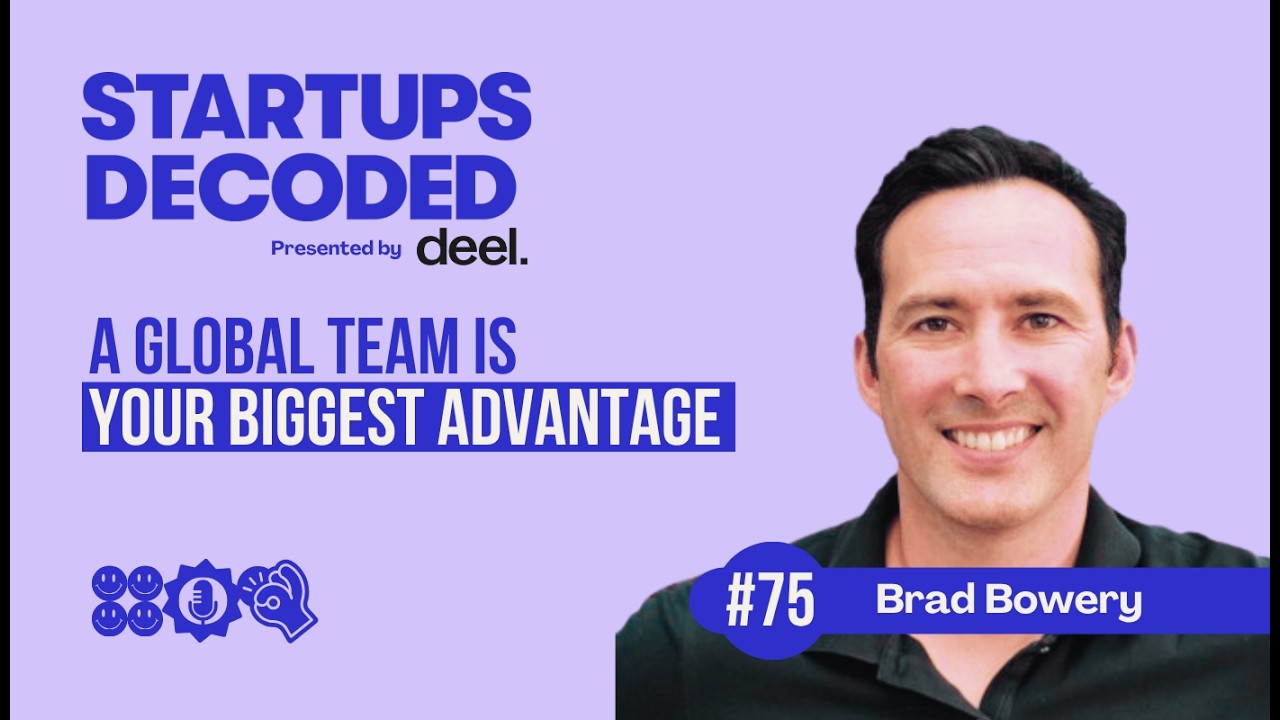
Brad Bowery, head of venture partnerships at Deel, discusses why global hiring is a competitive advantage for startups. Deel now handles hiring, payments, and compliance across 150 countries. He shares how transparent cash-flow communication preserved culture during crises and explains Deel's evolution from contractor payments to full payroll automation.
Chapters
And for startups, that's— you're not really thinking about that in early stages. You need the best talent so you can be the most successful. When you get to scale, yeah, maybe you want to figure out ways to reduce costs and find cheaper labor. But what's great about the environment we're in today is that you can think about it at the startup level right away. You can hire globally and not worry about it because teams can work remotely and it's now so much easier to get set up to hire somebody in a different country. And so It's less about cutting costs and more about that talent advantage and how you just get purely the best talent you can find anywhere in the world.
Welcome to Startups Decoded, the show that gets real about what it takes to build a successful startup. I'm Andy Walsh, 2x exited founder, strategist, and your host. Each week I talk with top founders, investors, and operators to unpack the plays that drive real traction, not just headlines. If you're building something bold, this is where you'll get the honest insights to scale with clarity and confidence. Let's keep growing together. Hit subscribe and share with your community. It would mean the world to me. Hello and welcome back to Startups Decoded. My name is Andy Walsh. Right now, hiring teams is the biggest opportunity you can have for quick growth and cost effectiveness, and the global talent pool has become significant. And today we're doubling down on that because I'm really lucky to have Deel on as a partner with Startups Decoded. And today I've got Brad Barra. Who's joining me from Deal. Welcome, mate.
Thank you. Thank you. Thanks for having me.
It's a treat. It's interesting that staff can literally shape and define your whole company. You could have some bad eggs and it can go sideways. You could have superstars that are just waiting to have their moment and it can change the trajectory of your company, right?
Yeah, yeah, definitely.
You've been like really interesting background and I want to unpack you as much as Deal and the process in the moment too. So right now your role at Deal is very VC and startup focused, right?
Yeah. Yeah. So I lead the global venture capital partnerships team at Deal, private equity as well. And I would say, you know, as a former entrepreneur finding my way into the corporate world, working at larger companies, it's probably one of the most fun jobs you can get because I get to spend my entire day working with amazing people on my team, but also networking with venture capital funds, private equity firms, and the startups that they all back. So it's a really rewarding career path.
And I want to go into that in depth, and it's fascinating that just the shift, because Deal is relatively new, like 2019, it started to be the size of what it is, and the stage is wild, and I assume just change happening every day. But for you, you touched on it there, you've been a founder yourself, you've worked for pretty large companies. You just take us back a little bit, some of the roles that you've had, companies you've worked on, what you observed, and some of the things that you carry through to what you do now at Deal.
Yeah, absolutely. So I had the opportunity to build my first startup out of business school. So got my MBA at Stanford. After graduating from Stanford, we launched this business in the solar energy markets called SREC Trade. That was in 2008. We raised a Series A back then, which was $1 million. There weren't very many VCs out there to go talk to, but, you know, built that business up over 5 years as CEO. We got it to profitability and eventually it was acquired. From there, I bounced around a few different roles. Actually had a couple opportunities to run people people operations at venture-backed startups that were 85 to 300 people, uh, companies. And so got to see that part of the world and ultimately decided that, you know, in my career, uh, you know, I grew up playing ice hockey and I was always an offensive hockey player. And when you're thinking about people operations, HR, all that stuff, that's more defensive posturing oftentimes in companies. And I realized I needed to be in the business development side of things. And after my second startup, I took a job in this venture capital partnerships world at Zendesk, and that was my first real big corporate experience. And what I really, what was interesting is that in that role and what I saw that was different between being at a startup versus being at a company, and Zendesk had been a startup, but by the time I joined, they were 5,000 employees. We were a publicly traded company and you had a lot of people who were career corporate people, you know, and they operated differently. They, they planned way far in advance and didn't move as quickly on things that you wanted to do, like in immediate future. And, uh, I also noticed on the team when I joined, um, there wasn't anyone that had ever worked at a startup and we were a team that was trying to market to and sell into startups. So, um, I think one of the things I was most proud of at, at Zendesk was the team I built. I hired, uh, people from all over the world that had backgrounds in startups and, uh, venture capital and brought them in and we were just able to operate on a different level, different pace than the rest of the org. And I think that to me was a very jarring difference. And Bringing it full circle here to Deal, what's amazing is that Deal is now a 7,000-person company, so bigger than Zendesk was when I joined, but we're only 6 years old. And just a few years ago, Deal was like a 100-person company, right? So it, it's grown so quickly. It's one of the fastest growing SaaS companies of all time. And, um, it's just incredible to be at a place that at the end of the day is a large corporation, but still very much a startup. So we get the best of both worlds.
So much good stuff to tap into in that conversation. And being in, even though it is 7,000 people, like that startup attitude does not go away in 6 years. Like as far as from a leadership perspective, executive team, founders, VCs, there's an energy that exists and you touched on it there as well is that big enterprise typically are slow to adjust and innovate.
Yeah.
And they're now doing it in a way where it can be formalized. They're acquiring innovation to a point rather than innovating. Directly themselves. Yeah. So your experience of starting your own company, fundraising, that creates a level of empathy. And I want to use that as a through line here to look at your team relationships with them directly, the investors that you have, and then how you use that to scale a team because culture is critical where people are, you're managing cash flow. I want to just tap into you and your example from back in the day with, with Solar Power. Can you remember any good examples of thinking about culture, about cash flow? What are some of the things that you were struggling with back in the day? Yeah.
Oh man, that's a great question. So I remember when I graduated from college, I talked to some alumni to do informational interviews. Like, what do I want to do with myself? I didn't want to, I didn't know. So many alumni told me, you know, Brad, go and do sales. And if you look at a lot of the leaders of large companies, the CEOs, all former salespeople. And, uh, and I never thought I'd ever do sales coming outta college. You know, I had all kinds of other things I'd rather do than, than calling people up and trying to sell them. But I did that for 2 years after school before going to business school. And it was such a rewarding experience and really set up the rest of my career. And, and the reason why is that when I went into building my first company, you learned pretty quickly that you are selling left, right, and center. Everywhere you look, you are selling to somebody. You're either selling to, you know, obviously as a founder, you're thinking about, you know, initially you gotta sell to your first customers, right? So, And maybe even before that, you're, you're like, well, I need investors before I can build a product that I'm going to go sell. So you're selling to investors on your vision and your idea and your ability to execute on it. Then you've got to go to your customers and sell them on the product, how it's going to help them, the way that you're going to execute on customer support and service them and, and, and help them solve their pain points. And then once you've done all that, you now need to hire a team. And so you find yourself selling people to come and work for you. And I can tell you, like, I bootstrapped for 2 years and I had some incredible folks come and work for me for like next to nothing. I always felt so bad how little they were getting. I was actually quite generous with equity back then too. So like, but for me it was just, you know, the amount of cash we had to pay, it was just like next to nothing. So I was so grateful for them coming and taking a risk at a point in their careers to come and do that. And of course we are mission-oriented. We're trying to really push solar energy through. It was like in, in 2008. And, uh, I felt it was very, uh, an important, uh, objective we had as a company in terms of what we were doing. And I think that attracted a certain, uh, type of person who, uh, really kind of fell in line with the mission of the business. But as a founder, and, um, one of the things I appreciate about not being the founder anymore is that you take on that responsibility for their livelihoods. It's a different kind of stress than being employee number 5, you know, or 25 or, or, or 7,000, you know, like, and, uh, and I, and I carried that a lot and we got to a point where we raised, so we raised our Series A and then shortly thereafter the market turned and everything we had projected had to be cut by like 75%. So now we're looking at a quarter of what we thought we were to be doing. And all of a sudden you started to realize that like we're going to run out of cash and investors weren't going to come in with more money based on how things had changed for us. And so it really just became a matter of like how quickly we could become profitable as a business. And I remember like, I mean, I learned so much going to business school, especially around leadership and just being true and authentic and transparent. And I remember hearing stories from leaders that had gone through tough times and how they handled it. And I was inspired by some of those stories. And what I decided to do was just do an open kimono for the team. So we assume about like 10 to 12 people at the time. And I basically, at the end of every month, I walked through the numbers with them and I said, okay, this is where we're at. This is what we need to do. This is how many months of cash we have left. And I literally showed them the bank account. And each month we'd go through that exercise and each month the cash number would drop down and we, but then like we'd still be getting closer and this is what we need to do to break even. We got down to a month, our last month where we had $8,000 left in the bank at the end of the month. When we turned the tide. And after that, every month after that, we were profitable and not a single person left the company. And I think in my 5 years there, I had like one person turn over on me. And it's one of the things I was proud of. Yeah.
It's, I love it as a story and I empathize and also resonates a lot. I bootstrapped my first company and there were sometimes months where we didn't pay ourselves, me and my other 2 co-founders prioritizing stuff. To make sure that they got their monthly wage as well. And it's one of the things you just take on as a founder is that the trust that you build with a team, 'cause you're not paying them much as you said. Yeah. You probably give them equity, which is nice. You know, look at Anthropic now. Yeah. Who just raised $65 billion at a nearly trillion-dollar valuation. And what they're forecasting now is some of those early employees will walk away with $10 million plus. Yeah. You know, that covers any gap in wage, but it's a risk. As an employee, like a founder, right? In the sense of getting paid less. If you do that 10 years and you get nothing out of it, yeah, you look back on that and go, was it good? Was it bad? And the reason I raised the budget consideration, because it's very directly related to culture and the type of team that you build and how you motivate people to be able to come and join what you are creating. And that purpose, the mission, whether it's the job itself, there are a lot of different reasons why people join company.
Yeah, there is. And I was amazed that nobody left. I, I, I, I was so nervous after that first conversation. Conversation where I was like, look, I think, you know, we've only got about 5 or 6 months left in cash with the rate we're going and we need to turn it around. And I was like, if you're gonna leave, I just want to know, you know, so we can adapt. But they all stuck it through and, you know, a lot of them, some of them all the way through to acquisition, maybe 10 years later. So it was, I'm really, really proud of that.
Yeah. And it speaks a lot to you and I would assume that the person that hired you at Deal is looking at that experience of firsthand living and breathing problems that deal with solving in some capacity, right? In the sense of how do you think about a global workforce, which is our focus on the topic today, but allows you to have skills as well in the sense of you're having conversations, you can talk very personally around what you saw, what you observed. It's not an academic learning and focusing on the sales part. For me, sales gets a bad rap. In the word, like people hear the word sales and they think of just cold calling, hustle, awkward conversations, and it's tough for some people, but I flip it the other way and reframe it as building relationships, having passion and purpose about what you're building, being proud of the story that you're telling as well. And I've had VCs on Startup Decoded say that they will not invest in a technical founder if they say that they don't know how to do sales, they won't do sales, that's someone else's job. Because it's a red flag for them in the sense that, okay, this person is not bought into the mission. They're not prepared to do what it takes to get the job done. So there's lots of different ways that you can look at some of that culture, the workflow, the structure that informs what you're doing. So stepping into Deal, I want to talk a little bit about Deal just to give structure around how they function and what they're doing. And I've probably dealt with, call it 10 people, and they've all been spread over from I had one in Bulgaria, one in Amsterdam, Austin, San Francisco, all these folks from around the world. And there's a very consistent, I would say like passion, positivity, collaboration. And for a company that is so big and growing so quickly, it's not common. And I, I've got a background in advertising agencies and I've had some awful clients and like they don't seem to want you to succeed, which feels completely counterintuitive. So what Dyl has created is a living, breathing example of the product that they've created too. So those two for me are very tightly connected. And, and it launched in 2019. And I know, like, I don't know Alex, but I'd read a lot about Alex and what he was doing. And he went from 2019 into 2020 in a pandemic. And I can't begin to imagine, like, what happened internally when the world was ultimately shut down and remote work was the norm. And then all of a sudden it made huge enterprise around the world just have this live experiment about office versus remote culture., and it certainly allowed you to do a lot of things faster.
Before I get into that, I'll just say that, you know, I had just joined Zendesk, like, you know, week 1 of the pandemic, basically. We were the first group to get onboarded remotely. And, uh, I was always impressed by the onboarding team for, for how quickly they pulled that all together. So, but for me, I joined to build out our venture capital partnerships.
Mm-hmm.
Got hired in San Francisco and the job was going to be driving down to Menlo Park, you know, onto Sand Hill Road, meeting the VCs, doing all the face-to-face time, and, uh, and that quickly shifted from, okay, we're doing it remote. I could do meetings back to back meetings all over the world without going anywhere. And I scaled up that program by myself over the first like year and a half so quickly that, you know, it enabled me to go and hire a large team to go do that around the globe afterwards. And a lot of that wouldn't have happened had not, had it not been for COVID and that change and that shift. I think similarly, you know, you know, for Deal that really enabled things for Deal, but I think the reason why Deal was so successful is that, so they got into the YC batch, Alex and Shuo, and the thing that they focused on was customer conversations. You talk about sales, right? Like, and a lot of founders are thinking about their product, right? And, but you can't build a product without talking to your customers. Yeah. You know, there, I mean, there are a few examples of like, you know, Steve Jobs, for example, in 2007 when he launched the iPhone, telling everybody that like, you don't need a keyboard on your, on your device. And so many people, like, many of his customers would have said, no, I need a keyboard. Like, this is like the craziest thing. And sometimes you have to be able to lead, lead your customer and, and, uh, and have a vision, uh, when you're trying to build something that's like an entirely new category that people just don't understand.
Yeah.
There might be instances where you're not gonna listen to your customers as much as you, you would otherwise. But, but for most businesses where you're iterating on something or you're trying to improve something for your customer, you have to have that like extreme customer obsession. And that started for them in the YC batch. They had 200 other companies in their batch and they interviewed every single one and talked to them about their pain points. And what started out initially as a crypto payments startup in YC shifted into contractor payments because they started to realize a lot of the YC companies were trying to hire contractors in different places in the US, abroad, wherever. And so, all right, let's focus on this. They focused on that. And, uh, you know, when they started to take money from other VCs, that was the thing, laser-focused on building this. And solving this one pain point. But then what's really worked for Deel over the years is that first of all, they're tackling a huge market, which is paying people, right? Today we allow you to, you know, hire, manage, and pay anyone anywhere in the world. That's kind of the simple, you know, way to describe what Deel does. But they started out with contractor payments. Then from talking to customers, okay, what else is a pain point for you? You know, you also need to be able to you know, have employees in different countries where you're hiring contractors. Sometimes you realize that, you know, it's illegal for you to pay someone as a contractor in a certain country because of the labor laws. Now you need an EOR. And so we expanded quickly into EOR and we've rinsed and repeated with that now 17 times. So there's now 17 products across the Deal product suite that's all driven by us going back to the customers and saying, okay, we're solved. We've solved this problem for you. What else can we solve for you? And I think that approach kind of permeates throughout the, organization. And, you know, I think it's, it, you hear this a lot. I think it, I think it might've been Marc Andreessen or Ben Horowitz had said that, you know, culture eats strategy, right? Like it's your culture is going when your company is growing so fast, culture matters so much more because you're not going to be able to micromanage what everybody does. You don't want to. And when you're growing really fast, if you can establish a culture, the culture is the way that people operate, the way they work, that's so much more scalable. Than trying to clearly define your set of operating procedures that everyone has to follow across 7,000 employees, right? So if you have a culture, then you can trust that people, when they are at a moment where they need to make a decision, they're now empowered to make a decision and they're gonna make a decision based on a set of ways of doing things that you've defined as an organization that's way more scalable than trying to tell them what their decision should be, you know, and giving them like a very specific set of operating procedures. So that's how I think we operate at Deal and we talk about a few things, and I think the thing you'll hear more often than not from anyone at Deal or anyone that's interacted with anyone at Deal is that Deal operates with what we call deal speed. So it means being really, really fast to action. And you see that in the way that we've pushed products out and done things. And I think that's a really important thing for us, especially when you think about the company being so large across the globe. And I think it's nice to be able to rely on other people in the company, know that they're going to turn things around quickly. As a former entrepreneur, I love it. You know, I think it's a great, it's a great one. There's another one that's default optimism. And I think that's really important is it's like sometimes, you know, when you're in the grind, it can be tough. And you said this, you know, in the way that you've interacted with folks at Deal, I think that's another one of the parts of our culture that's like really important. That's defined in our key values in our company. Every single one of our laptops has the background with our company values on it. And so everybody, it's reinforced across, across the globe on everyone's—
I love it. And I just had Eric Ries on the podcast and launching his new book, Graftable. And the whole focus of that book is very much anchored around the fact of getting mission-bound companies and how you retain that culture to like longevity, because as you grow and scale, it's really hard to maintain that focus. And more often than not, if you have PE, VC having large influence in the boardroom around decisions is typically financial-led rather than people and customers. So there's trade-offs that happen all the time and it becomes table stakes. But if you're a young founder and inexperienced, you don't know the dynamics of that relationship and how you do it. So his whole philosophy is anchored around from day one, how you structure your company, how you make decisions, and that culture permeates across. And he talks about some great examples of Patagonia, the obvious one. Costco, and they just do the basics and like they haven't changed their business model. It's very transparent, everything around it. And it sounds like what you're living and breathing is ultimately founder life, but as an employee and a sense of empowerment, trust, connectedness, and that's come through a global workforce, which is amazing too, where you're not actually sitting together in a room, you're collaborating in such a different way.
I mean, there's no way I could lead my team in an office because, you know, they're in Beijing, Berlin, Paris, Mexico City. San Francisco, New York, Austin. So like, it's not, uh, it's not something where we're ever going to be in office together. We'll get together a few times a year, of course, but for my role in particular, that's just not possible. Right. But, you know, I, I, I do. So like the first thing I do when I, when I come into a team is just as a founder would, I set my own set of like what I call guiding principles, like how we operate as a team, you know, like what's the mentality. So for example, founder empathy is a really important guiding principle. For us in the VC partnerships world. So like we want to be thinking about the experience that founders in particular are having with Deal and what that means and how we are presenting Deal and representing the brand out there in the market. So I think that's an example. And so I have these set of guiding principles and then sometimes, you know, and they may not know this, but sometimes my team will probably catch me repeating myself. You know, and they're like, well, he said that before. He said that. And, uh, but, but that's intentional, right? There are certain things where I'm like, okay, you know, I really want to like reinforce this message and I know that they've heard this before, but I'm going to pretend like I haven't said it before because I think it's important to continue when it's like a cultural thing that you're trying to drive. The more you say it and like the most rewarding thing is when you see people emulate it, you know, like 6 months, a year later, and you're in a conversation and someone's repeating some of the stuff that you've been saying, you know, and that's when you really know that like what you're doing is starting to like have an impact on, on like driving the culture forward.
Quick word from our friends at Deel. Anders, if you're hiring, whether that's your first person or your 50th, you've probably already hit the moment where the best candidate isn't even in your city, let alone your country. That used to mean so much paperwork. Deel removes all of that. One platform that lets you hire in days. They handle payroll, compliance, contracts, and benefits. Plus, they're across 150 countries. Don't lose good people because logistics were too hard. Deel solves that problem. Check it out. Startups Decoded. Deel, that's D-E-E-L, startupsdecoded.com/deel. I love it. And I don't want to go too deep on it today because it's a real light standalone episode, which is that trickle-down effect of culture and decisions that come from the top, right? You can put it down on a piece of paper. In theory, that's the easy part. Manifesting, living, breathing that component of it takes a lot of active focus and repetition is a way to do it. And it's, and it's not grooming. It's actually having purpose and passion and being proud of that. And people don't see to understand the separation between the two. So really important. And I love it in the sense of you've got customer feedback, but you also have internal teams. Like, Deel is literally a living, breathing model of its own service, right? So the feedback loop that you get with the way that people collaborate, the things that they're hearing from customers, plus their experience like internally with their own teams, ultimately goes into a big pot and allows them to continue to evolve because you separated the two, which I agree with. Like, Steve Jobs was a visionary. He was creating products for the future. Because it's like the classic analogy people talk about with horse and cart versus the car from Ford days, right? If you ask people with a horse and cart what they need, they will say a faster horse. They wouldn't say they need a car. So it's like that classy story of creating a future state where people say, okay, I need this and creating demand. And Apple have been elegant and inspiring the way that they've done that, which is why they've been so successful. But you are in the trenches with these people every day. And one of the ones that I really want to look at and like on a linear path for a founder That first hire, I remember it so well. I'm Australian, but I've been here since 2012. Yeah, I started in Sydney. I was going backwards and forwards. Our first client was London. Our second was New York. I spent half my life on a plane flying around the world, but part of it were the challenges that you're talking about. We had contractors in different cities, like looking at how much we pay them, currency exchanges, equity, local laws, all of those things. It was working it out as we go, and it was a real time-sap. So let's start on the process part of it and compliance. You talk about 150 countries plus now the deal is in and you've done the heavy lifting on behalf of everyone that uses the platform.
Correct? Yeah. Yeah. It's a, it's a really great place to be. I'd say we've, we are an infrastructure company as much as anything else. Right. And I think that that's also why, you know, in a world where I think AI is starting to permeate in a lot of places because we handle a lot of payments and compliance around local laws and all those things, we're in a position where it'll be a long time before any of that stuff gets automated or gets replaced by AI. So like, I think that that's a place that I think our investors feel very, very safe in terms of the bets they're making to deal on what we're doing. And I think that, you know, like we're in this moment where I think similar to like You know, my, the first startup I worked at was in Boston in 2004. And I remember the IT team would always like have these days where they just weren't in the office at all, 'cause they were off somewhere else at our co-location site. They knew where, like we had our servers and all that stuff, right? And the amount of money you had to spend to spin that stuff up at the time, and it had to be nearby where your IT team could travel to. And so like the, uh, you know, I use that as an example in terms of like what, you know, AWS did in terms of bringing cloud computing, you know, and, and, and making it possible for you to just do all that stuff in the cloud. In a similar way, you know, I think hiring's kind of moved in that direction where it used to be like, well, you have to hire just locally, you know, and there's a point in time when, uh, you know, when Standard Oil got started back in, uh, John D. Rockefeller's early days. You actually couldn't build a, a, a, a cross-state business at the time. And one of the amazing things that they did in the Standard Oil is they figured out this like workaround where they're able to build a multi-state corporation and, and, and really dominate the oil, oil industry. So, so much has changed since then, right? And now with hiring, it's like, it's gotten easy, obviously, to hire and, and, and manage teams remotely. But also, more importantly, I think with the technology that exists to pay people, the stuff that we're doing, particularly on compliance, side, it's just so much easier to just spin up an employee in a country. Whereas that used to be a very intimidating process. Like you had to think about like, what are all the local labor laws? Like, how do I get an entity set up? How do we do all these things? You know, and a lot of people would default to paying them as a contractor, but that comes with a lot of risks. And oftentimes, you know, as an entrepreneur, you don't appreciate those risks until it's way too late. And I think that that's an important thing that is now possible. It's like very, very easy. And so what we do is we allow you, if you need to spin up a contractor, you can hire contractors in any of 150 countries. If at some point you're like, well, you know, they're doing type of work where they really need to be employee because of the labor laws, we can get you set up on what's called an EOR, Employer of Record. And that's where you're hiring them through a deal entity in that market. So you don't have to set up your own entity. And so now you've got employees that are under our employer of record that you've now been able to hire. And let's say you get to a point where you are now like really successful in that market and you're really growing and you're like, you know what, it's, it's not cost effective for us to use the employer of record model. We're actually going to go spin up our own entity. And that's when we have like an entity setup product now. So now we can help you set up the entity in that market and make sure that you're compliant, getting everything going. And then once you're set up as an entity, we can also still handle the piping on your payments and stuff. So we can handle all the, all the payroll that you need to do in any of those markets. So this is what I mean by like you know, with our customers, we just kept asking the question, like, what's the next problem we can solve? And that's how we built up the suite of products at Deal.
And I love it too, because my induction of fire coming to New York City was finding a PEO and it was a legacy platform and it was so archaic and it was originally done around printing out payslips and mailing out payslips. And like even that, just the way that they tried to evolve. When I look at a modern example now of Salesforce and Slack where Salesforce acquisition of Slack. Slack's becoming the front end of Salesforce and they're rebuilding the whole backend where that conversation becomes part of your sales workflow at the backend. And this legacy company had the same situation, but you started from scratch, which, which allows you to be able to look at all those insights around the world and understand that because like going back in the day, you could find those people, but there were a few barriers. One was a compliance part. The other one was trust. You didn't know who you were getting. But what's happened now is the workforce is truly global. And before it was seen as a cheap way to get labor, but now it's actually gone full circle for me in the sense that there's actually really smart people. They just haven't been discovered yet. So it's not even necessarily a money conversation. It's where do you find the most skilled person? And my example, I was doing a lot of creative technology work and engineering in the arts.
Yeah.
We, our engineering team was in Brazil and we tried people from all around the world and these guys that we worked with, not only were they really talented, they were just innovating in a way that I hadn't seen before in the way that they built platforms, created art, and they were very specific. And for us, that was not even a money thing. The money difference was great, sure, but it wasn't why we hired them.
I hear you on that. Like in 2015, I, after, after I, I left my, my first startup, I, I went and joined this really exciting autonomous consumer drone company called Lily Robotics. And I don't know if you remember this, but they launched a YouTube video in 2015 and had 50 million views. They did a preorder campaign, got $34 million in preorder sales, 60,000 units for this product. And, and we were building a team around it and we actually like, you know, there's such great computer vision engineers all over the world that we were trying to, you know, specific areas that that really specialized in type of stuff. And we had to turn candidates down because they were in different countries and was not able to be with us in San Francisco. That was pre-remote work, right? And pre, uh, you know, having infrastructure set up the way that we do now where you don't have to be intimidated about hiring somebody in, in different places. And, and so that shifts the conversation now around global hiring. It used to be, and I was at Zendesk when Zendesk got taken private by a PE fund. So Zendesk was a public company from 2014 to 2022, and I was there when they were taken private by a private equity fund. And, um, it was a very large private equity acquisition, about $10 billion. So, uh, but a big part of their playbook is cost-cutting measures, right? And so we were outsourcing a lot of our backend stuff to different countries where we wanted to save money on labor. And that's the conversation around global hiring, I think, at the enterprise level. And for startups, that's— you're not really thinking about that in early stages. You need the best talent so you can be the most successful. When you get to scale, yeah, maybe you want to figure out ways to reduce costs and find cheaper labor. But what's great about the environment we're in today is that you can think about it at the startup level right away. You can hire globally and not worry about it because teams can work remotely and it's now so much easier to hire somebody, get set up to hire somebody in a different country. And so it's less about cutting costs and more about that talent advantage and how you just get purely the best talent you can find anywhere in the world.
And I look at it now and I did a piece on Substack recently looking at, it was culture but also budget and workflow around comparing return to office versus remote. And there's been a lot of research done by really big companies like McKinseys of the world, et cetera. And what they looked at was the force where 5 days a week Amazon did it. And there was like a stat, I feel like it was 91% of people like really displeased with being forced to go back to the office 5 days a week and something like 40, 50% were transparently looking for new jobs because they didn't want to be back in the office. Tobias Carlisle: And that's like an extreme example. And then now you look at young founders who are seeing it as an opportunity to actually go the other way because that flexibility allows people to be human. We all have different lives. Some are older, some are younger, some have families, some have health things, whatever it is in your personal situation. It gets to, there's a level of loyalty that you get with staff retention around having that flexibility and for you to have a chance to be part of a global corporation, but do it in a way that feels like you are a founder, like you talked about from a culture perspective. And I saw it with my own company where it was creative innovation forward in we would get ideas from other people and they have another view of the lens, right? If we all lived in New York City and we all looked at the world exactly the same, we got the same subway, ate the same food, had the same conversations, there's a ceiling on creative innovation. Whereas if you have someone that lives in India or Brazil or Japan, whatever it is, these people each have their own way of living and they see the world through a different lens. And for me, that was a really interesting melting pot.
Oh my God. I get to I get to benefit from this every day in my role.
Yeah.
Because I told you I have a global team.
Mm-hmm.
You know, and, and over the last, uh, 6 years I've worked with, I've worked with Germans, I've worked with Brazilians, you know, I've worked with Chinese, I've worked with people and they all operate differently and, you know, cultural differences and, and it's amazing to see like the different approaches that people will take based on their cultures and even like You know, what I do is very specific. We do partnerships with venture capital funds, right? But we also don't take just a global lens to it. Like in different markets, we're going to approach it differently. You know, we're going to approach VCs in Brazil differently than we're going to approach VCs in China or in the US. So I think that's, that's, that's very important. But one story I do want to tell, which is an interesting story about remote work and founders and founding teams. I have a classmate of mine from Stanford Business School. He had Dropped out after our first year to start a company, was a genetic testing company, did very, very well, had an exit eventually. And recently in the last few years started working on another startup. And during, it was during COVID and, and so he had a remote team. They were working in, in Park City. He was based in the Bay Area. And he had been very anti-remote work, right? Very much like as a founder, you got to be in the trenches with your team day in and day out and this and that. And he actually got a little frustrated with the progress that the team was making out in the market for his new startup and uprooted his life, took his wife and his two young kids to Park City and they moved out— or no, Salt Lake City. So he moved out there and I saw him recently in the airport and he told me that he learned— what he'd realized was that it wasn't the fact that they were remote that was causing the problems. I think sometimes when things aren't going well, you want to blame something like, oh, we're not all in the office every day. And so we need to bring everybody back in the office and we're going to fix this. And he realized that that wasn't the fix. That wasn't the problem. You know, they weren't listening to, actually, of all things, they weren't listening to their customers and the things that customers needed. And so it wasn't him being there that made the difference. It was some of the conversations, some of the people on his team were having with their customers and bringing that feedback back in and really getting to a point where they're incorporating that feedback and making the adjustments they needed to make. And that's really what changed the trajectory for them. And so the last time I saw him, he said he was actually planning to move back and was now at a different perspective on being a founder with a remote team, you know? So it was neat to hear that from someone who had, you know, been in the trenches, built a company successfully pre-COVID, and then during COVID had that experience, you know, going into it as a skeptic.
And quite often we have to live through those things to overcome our personal bias and whether that's a passive or very active decisions that we're making. Yeah. Having that context to be able to live through a different experience is really important. And I look at that as an example of workflow as well. And one of the big debates of office versus remote is how do you build culture, but then also how do you have an operating procedure and an async work where it's optimized through different time zones, approvals, and that's becoming much easier with a range of tools now as well. And you're riding that wave, which is like a beautiful place to be ahead of the market on how you optimize for that. But to continue on the path here, setting up the culture is one thing, workflow is another. Let's go back to like brass tacks. You're a founder, you're putting your first employee on, maybe you're looking at budget and going, we're bootstrapping, or we've got a few angel checks in the bank, we've got next to no money, and you're hiring remote. At what point do deal come in? Is it employee number one? Is it the co-founders? How early would you recommend someone starts to look at PEO-type behavior for health insurance through to workforce to compliance, et cetera?
Yeah, it's a great question. I am coming from Zendesk where, you know, really, if you're going to install customer support, you need to have customers, kind of, you know, so like, what I love about Deal is that we can talk to you at whatever stage you're at. We talk to founders in the Speedrun and A16z Speedrun cohort, in the Y Combinator cohorts that are dealing with immigration issues, right? They're trying to either come to the US or, or bring somebody to the US. So we can help with that. So we do mobility services. And then after that, so as soon as you're ready to pay somebody, whether you're going to start out as a contractor, you're going to go into in the US a PEO, which is a professional employment organization. For those that aren't aware, it's, it's, it's similar, but slightly different from an EOR, employer of record, which is common in other countries. In the US, a PEO is kind of your co-employer. So they, they take on the risk and compliance requirements and you still have an entity, but they will handle all of that stuff for your teams. In my first startup, my co-founder Andy Walsh and I, as we were thinking about this, he just had strong objections to the PEO model. He just felt like, well, there are employees, we should be the ones doing all this stuff. And, you know, fortunately we had a good experience, but I'll tell you that like we were probably naive to a lot of the risk we were taking on. And in my other startups, I saw some of those things, saw some of the things that could happen. We had, uh, at, uh, at Lily Robotics, the, the drone company I mentioned, we were on a PEO. And initially I was very skeptical of that. And we were an 85-person company and I was like, you know, uh, we, why are we using this PEO? It's very costly. But when you start to deal with tricky issues, uh, you know, bad actors, folks that, you know, uh, you need to fire somebody and go through that whole process, having the PEO by your side who's making sure that you're taking care of everything the right way, 'cause they're ultimately carrying sharing the responsibility of that was super, super helpful. And I've actually learned recently that Slack, you mentioned Slack, Slack was on a PEO up until they got acquired by Salesforce. So it's also something that startups scale up on. So I think it's very common. And I'd say in, you know, one of the things I've learned over the years and one of those like nice things about doing startups your second time around is that you, you already know the things that you're going to do differently and you save a lot of time on those things. And for me, it's just like, yeah, If I do another startup, we'll start out on a PEO until we, until we need to hire an HR team. And, and I think that that's, you know, that's an important thing that I would certainly recommend. And that way you can focus on the things that matter, right? Like, like talking to your customers and getting the product right.
There's so many things you have to juggle as a founder. And now the operating processes that you're building across the board, you can automate a lot. So you're ultimately building this tech stack. Stack of all these services and functions that you need to do. So it makes sense to have this almost part-time, always-on type platform for you to be able to scale because it gives you confidence.
Yeah. So our, our first large and our first enterprise customer, so we do have an enterprise sales team. Our first enterprise customer was The RealReal. And they came to us because somebody heard about Deal and inquired about like, hey, we need to hire a team in Brazil right now. And you know, they're an enterprise. They, they have HR, they have all this stuff. But they used us for that specific use case and they spun up Deal in Brazil and that was our first enterprise client. So we do have large companies using Deal, but I do think Deal is the largest that's using Deal across the board for all of our products. And, um, you know, we're in a huge market. Everyone needs to hire people. Everyone needs to pay people. It's a great place to be and we will do a tiny fraction of the business of large companies. And our goal is to get in there and, and, and support them in a and do it really well with whatever it is we're doing. And then over time, hope that we can convince them that it's in their best interest to continue to like grow their usage of Deal and expand into our other products. You know, and there's some really incredible stats about, and I won't share any specifics, but like one of the reasons why I'm so optimistic about the growth trajectory of Deal, and we haven't talked too much about that yet, but like it's been on an incredible growth journey. And what's amazing is that we can continue growing without adding any more customers. Like our revenue potential just within our existing 40,000 customers that we have is just huge if we just sell more and more of our own product into, into those customers.
Love in that too is by nature of the, what you're providing, you're always going to have extensions. And it's, it's a tension point I've talked about previously for a product build. If you do everything that a customer wants, you quite often create this zombie product. But for you, there's very clear lane of what you're in. And things that you can add on. And from a sales perspective and growth, I've actually got a future episode coming up with your head of sales to talk about that trajectory from going $1 million annual revenue to $1 billion revenue and how you think about just growing at that scale from a sales perspective, but then also the team, the workflow. And I feel like it's the perfect way to unpack deal and how it did it, but also how they run in parallel with the functional part of running your business versus the back to the wall. How do we actually keep our head above water right now and build a business at the same time?
You know, you've gotta be able to do both. And I, I'm just, I've been so impressed in my time at Deal at like how, how quickly we're innovating and, and, and doing things and, and stuff's just moving. Like that Deal speed is really, it's real. And we're at a point now where we are automating a lot of things around payroll processing, right? Where you used to have to collect data from your, your client that needs to run payroll. They give you the information, then you've got to like get that uploaded into government systems and, and make sure all the data is correct and formatted correctly to get into those systems. And then you got to pull it back down and then push it out to the banks to get the payroll paid. And a lot of that was manual and there are people involved and we've, we are slowly automating that in every country we operate in. So it's being run without any human interaction. And so that's allowing us to do things even as we scale on a sales basis. We're improving the product at an incredible rate and we're able to do things like, I think there might be a future, well, where you can move away from like waiting a week, 2 weeks, a month to get paid and people can just be getting paid on a daily basis because the infrastructure's there and the cost to actually make the payment and put the money in your bank, especially with, you know, crypto and other technologies coming in, you know, into play, it's just going to get so much easier. And so like, that's kind of a future we're moving towards on, on that side. That's really exciting.
Yeah, it's the empowerment piece ultimately for a founder. And when I first started, I had 3 co-founders and I was nominated the doer ultimately. So I was CSO, COO, CFO, CLO. I did all the things that were administration type piece. So for me, that would have saved so much time and energy. So I'm excited and I have a portfolio of companies now that I work with every day. And these are opportunities that allows you to focus on the thing that you're best that, and the part that you don't know anything about is done for you to a certain degree as well. So Brad Barry, this has been an absolute treat. I'm so grateful to have Deal on as a partner. And for me, what I'm doing, listening to founders every day, this is going to be such a valuable look at what Deal's doing, but also from a scaling perspective of how you build a global workforce.
Well, thank you so much for having me, Andy. I really appreciate it. It's been great.
Thanks for listening to Startups Decoded. If today's Did this conversation help you think differently? Share it with a founder in your network. And don't forget to subscribe for real-world startup insights every week. We really value your support. If you're interested in partnering with us, email hello@startupsdecoded.com. I'm Andy Walsh. I'll see you next week.
More from Andy



EP#88: Why Most Founders Misread Their Own Traction. Vanessa Larco - Premise VC

EP#87: Founders Obsess Over the Raise. Investors Care About This More. — Carina Cunha






Ep#86: Early Decisions That Define Your Startup Forever. With J.P. Morgan Asset Management
