EP#77: The People Decisions That Built a $1B+ Sales Machine — Chris Lee — Deel.
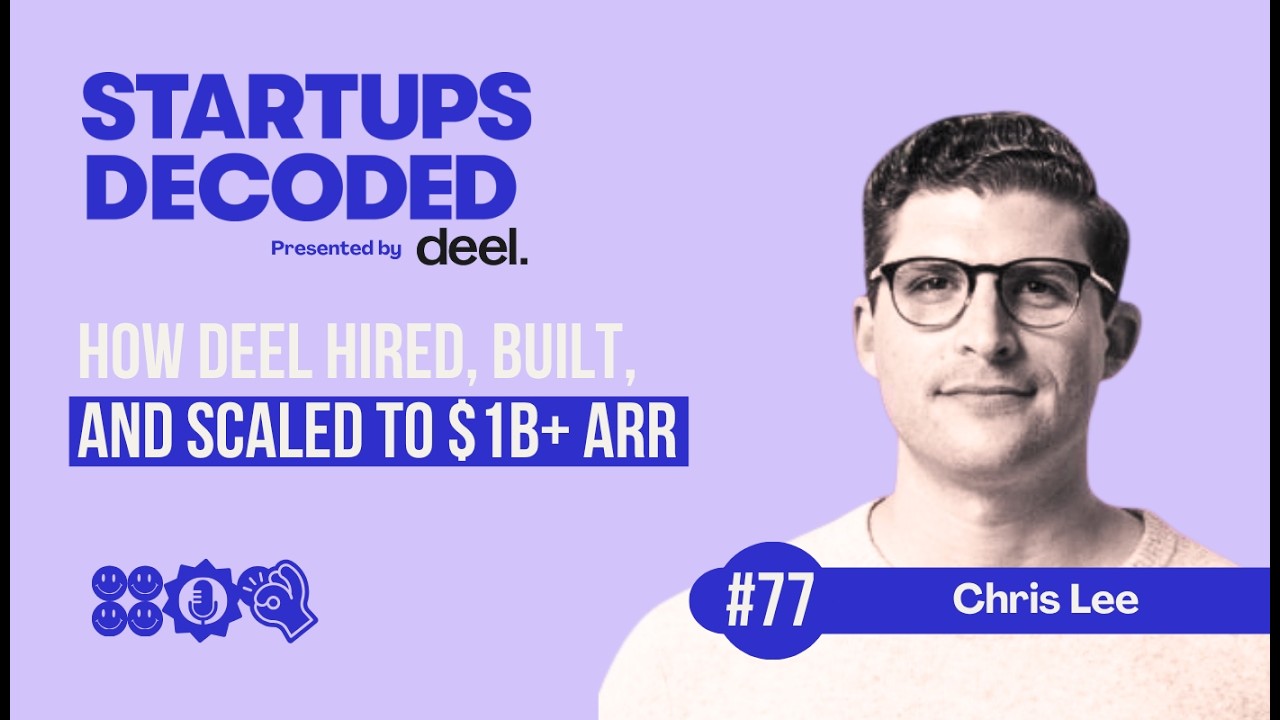
Chris Lee, head of sales at Deel, explains how the company scaled from $1 million to $1.5 billion in revenue across 150 countries. He describes the "undercover rep" approach where new sales leaders work the front line first, the 14 new product lines that turned Deel into a platform, and the "Ghostbuster" role—cross-functional fixers who use AI to eliminate bottlenecks and keep 7,000 people moving at startup speed.
Chapters
I'll also say this is controversial, but I will say that it is harder to go from, say, 1 to 10 than, say, 500 to a billion. It is a harder challenge to overcome, first of all, because you have a very small team and it's probably the founder who's really spearheading everything and they're all over everything and you don't have a lot of brand awareness in the market and you're just trying to scratch your way towards every dollar that comes your way. And so you're— you might also be in the maze of trying to find product market fit. Which is really a difficult process for many.
Welcome to Startups Decoded, the show that gets real about what it takes to build a successful startup. I'm Andy Walsh, 2x exited founder, strategist, and your host. Each week I talk with top founders, investors, and operators to unpack the plays that drive real traction, not just headlines. If you're building something bold, this is where you'll get the honest insights to scale with clarity and confidence. Let's keep growing together. Hit subscribe and share with your community. It would mean the world to me.
Hello and welcome to Startup Decoded. My name is Andy Walsh. When you join a startup as a sales member, you have dreams of growing revenue. You walk in the door at $1 million. 6 years later, you're at nearly $1.5 billion. Going through that change is pretty significant. So today we're going to unpack the sales motion, the team, the structure, and I'm really fortunate to have Chris Lee from Deal.
Welcome, Chris.
Yeah, thank you. It's an honor. And what's funny is Andy was telling me that he's had two podcasts where people have cried. And, uh, we'll, I'm excited, but we'll see how this goes.
I love it. And people say to me that being an Australian allows me to have a different kind of conversation than an American. I'm not sure if it's that or if it's just me. Vulnerability is important to my own story. And I share the things that have happened to me. And I've had two exits. I've been on paper successful, but I can promise you that I've made plenty of mistakes. And today we're going to unpack a lot around the culture of Deel and building a team. We're going to look at the way that you've grown Deel, but we'll also talk more broadly around Deel and what it is. And there's some unique things that I'm curious to unpack. So getting started, I always like to understand a bit about the person I'm sitting with. So this is where now I get to know your personal side a little bit. So Chris, going into the world of corporate, where did you start and was startup path ever something that you thought you would do?
No, it's not. So I grew up in San Diego. I grew up surfing and skateboarding and playing video games. I really didn't have any sort of career path in mind, to be honest with you. I went to community college and then I ended up transferring to University of Arizona. And in that time I met someone in San Diego who worked for UBS Wealth Management and he was looking for an intern. Somebody just hit the phones, cold call., and that was my first experience and I worked there for 2 years and that was part of what sparked my interest in sales. Also my interest in finance. I got really into the stock market after college. I was interested in working in private equity. I did work for a private equity firm for 2 years. I thought that was the path. And then I realized like, I don't know, it's boring. I'm in a cubicle, I'm working on slides and spreadsheets all day. I'm not really talking to people and I miss some of that action. And so I had friends that were in San Francisco working for startups. You have dogs in the office, people like not dressed in suits and, uh, or working in cubicles. And that was attractive to me. So I started my career as an SDR at a, what is now a random tech company. But that was the, that was the start.
I'm always interested in people's paths and I've had such a mix of folks here that have gone through multinational corporations, huge brands, and gone into VC world. I've had people that have come from really humble beginnings and just came up with an idea and built it and has turned into really large businesses like Linktree. I had the, the co-founder of Linktree and they're 60, 70 million customers now, had $150 million and they're just a couple of humble kids from Melbourne that basically built this thing for a client and then it went really well and it turned into a business. And for me, those stories are fascinating. For you, you went down the sales path and I'm fascinated by sales because I always see it having a bad rap. A lot of people get nervous or awkward around sales. They think that they have to do all of these things that aren't good. And I like to reframe it and think about sales as relationship building. And I've got an amazing network, which is part of the reason why I am sitting here today is to have these types of conversations. And I see it as an opportunity to get to know someone rather than sell. When you first joined Deal, I'd love to talk about your first week, your first month, you were roughly $1 million ARR at that point, right? And what did the team look like when you joined?
Do you mind if I just explain what Deel is first?
Yeah, yeah, yeah.
Because we have people in the room who were asking, so yeah, I'll explain it for the audience. So what is Deel? It is global HR, payroll, IT, and now AI. I'll explain that really quick. So you need a way of posting jobs online. You want to hire people. You want to scale your company. You need a way of sending them a laptop. Before their start date. And in some countries that's really difficult, but in the US it's pretty, it's easy, but we manage all of that. You need a way of paying them, managing benefits. Ultimately, Deel does that end to end from hire, manage, pay globally, not just in the US. And we have this new AI product. It's AI agent orchestration. Gonna try not to use too many buzzwords on this podcast. But that is a real, that's really an exciting frontier for the company because I can't give any, any specific details, but by like any measure, if you were to start a startup and you're looking at the metrics, you have, we have product market fit for this new AI orchestration platform that we have. So really excited about that. That's a bit about Deal and what we do. So I joined 1 Million and what, what was it like?
What did the team look like? For people that have listened or watched regularly, I break up startup growth in 3 phases. The first one being growth hacking, where you're basically just throwing stuff against the wall and seeing what sticks. The second stage is more building process, formalization of systems, et cetera. Third being understanding data, doubling down on certain signal and driving that for growth. So I assume you're in the growth hacking phase when you first joined.
So yeah, so Deal has evolved to what I just explained. Where it started was one product and it was paying contractors outside the US. Which was really, it still is a complex process. It's expensive with wire transfers. It's highly manual if you have a large team. And, you know, when I joined, it was $1 million ARR. You had the two founders who were selling and supporting clients. They had just hired two AEs and two SDRs. And, and it was, there was early indicators that it was working. So the close rate was like 50%. So for every 10 clients you met with, uh, you would close 5. That doesn't always scale forever because that's inbound leads. You get a lot of, you know, they were Andreessen Horowitz portfolio companies and YC portfolio company. So you get a lot of traction from just your network early on. You obviously, you have to build an outbound process. You have to, you have to go knock on the door of companies who don't know you but should be using your product. And that comes with its own challenges, I'm sure we'll get into. So early on, there were some early indicators, early signal that this is has product market fit. It wasn't obviously gonna be a rocket ship early on. That wasn't obvious, but it, it wasn't a dud. And I know what a dud is because the company prior to Deal I worked at called Granular, I, I started as employee number 11 and our closer, it was 10%. So we were navigating how do we find product market fit? And it, it didn't come immediately.
Interesting. And I want to double-click on something that you shared ahead of time. And I've actually got a screen grab of a message that Chris sent to Dil Recruitment. And you went for a job in my area, in the APAC region, right?
Yeah. Yeah. So, so the background there is at my previous company, we did farm management software. We did software for farmers, kind of an odd space for people in tech. But the idea was back in 2014, you know, what is the last industry to be disrupted by technology. And there was a proven disruption within construction by a company called Procore. It had become a billion-dollar company at that point. And I was looking at agriculture as like, this is the final frontier, I guess. So I, we ended up joining, it was a very successful company after the 6 years by the time I left. But through that experience, we, I led a sales team in the US and we were launching internationally. We, you want to, as a startup,, you know, you're not gonna be a $10 billion company by just be doing business in the US. Maybe there's some exceptions like insurance or real estate or something like that, but you have to expand into global markets. And we wanted to expand into Australia and a few other places because, well, the, the farm, the agriculture industry is very strong in Australia. I was cold calling farmers in Australia. I actually moved to Australia for 6 months and was, you know, driving up, uh, which was a fun experience, like in my rental car to Australian farms. And, uh, I went out there to launch the team, to go hire the team. I finally found the first sales, sales rep that I wanted to hire. After all of that, the HR team says, hold on, you actually can't hire this person. We don't have the infrastructure. We don't have a business entity in Australia. We don't have a way of paying these people in Australia. I'm sorry, but like we can't do it. And as a startup, you know, we didn't have experience going international. We didn't know what we didn't know. And it was, it came to the finish line and they realized they couldn't do it. That actually set the company back from international expansion by like 9 months. And so they couldn't scale as fast as they want simply because of compliance and stuff that's important, obviously, but you can't exactly control., and we didn't know what we didn't have in place. And so I, that, that experience sat with me. Fast forward, it is 2020, uh, Deal launches on YC, it launches publicly. I write, I, it comes across my way and I'm like, oh, this is an interesting company cuz I experienced this problem that they solve. And, and for sure it would've compressed the 9-month launch into 2 days. We could have hired this person in 2 days, had started paying them, and that would, that immediately resonated with me. And obviously if it, if it's a problem that you've experienced and you know it could solve, I'm sure there's other companies where that experience is a problem too. So that's what launched. It was one of the few companies I was interested in. I reached out to the founders, Alex and Shuo. I still have the screenshot and on the website there was not a head of sales US role., but there was a head of APAC role. I just spent time in Australia, so it's like, I'll move to Australia. I didn't have a family at the time. I'll move to Australia. I'll launch the sales team. I reached out after many interviews. They, they're like, good news, bad news, bad news. You're, we're not going to hire you for this role. And, uh, the good news was we like you, uh, and we actually want you to lead our US sales team. So I ended up joining at that point.
So good. And I, I love that a global perspective and insights and anyone who's selling, having a human conversation with folks is really important, which is why I wanted to, to get into that story to understand firsthand that the pain of what you're going through is really critical. And one of the things we're going to explore today is the tension that exists between a human relationship versus AI automation in the sales process. And I see it and hear it all the time. It's like, how do you build trust in a relationship? But also you get enough pipeline to be able to hit targets and grow at the same rate. And they have tension, upsides and downsides in both. So for you living and breathing, that was really important. When you walked into Deal in the US and you started that, did you immediately look at process or was it just purely sales focused? What were some of the first things that you were trying to solve when you went in, in the first few months there? Yeah.
So what's funny is my gut reaction to joining is like, okay, I have experience leading large sales team at my previous company. I know what to look for. I know what scaling looks like. We grew the team from nothing to 35-person team, which I thought was a lot at the time. And I come in, I'm gonna repeat the playbook. And that was the first mistake. So Alex, the CEO, this is one of my first learnings also. He's like, hey, I go to him. He's like, hey, what do you, what do you, what's the plan? I say, hey, I've, I've evaluated the team, um, our processes, everything that you just mentioned. This is what I think we should change. And he said, uh, no, you're not going to do any of that. I'm like, okay. And he, he's like, you're going to actually go spend the next couple months as a sales rep. And then you're going to, you're going to learn how to sell. You're going to learn our process. Maybe you'll learn why we do things the way we do. And, uh, you'll probably learn some other stuff too that you, you didn't uncover. Uncover immediately. And that's what I did originally. And I love this mindset that, that's been ingrained in me ever since. Any leader that we hire, you're going to come in and you're going to be the sales rep initially. What's the worst— what's the worst experience is to have a leader who comes in, who doesn't know the products, can't sell. How are you supposed to train a team? How are you supposed to build a team if you don't know how to sell yourself? You actually, in sales, there's like, you kind of need street cred. You need credibility with the sales team as a sales leader. They need to know that you can sell. And a lot of leaders don't do that early on. So everybody starts kind of like, do you ever watch this show? I don't know if it was in Australia or Tanzania, right?
Thanks.
Yeah.
I do the jokes.
All right.
Okay.
So I don't know if they have this show, but Undercover Boss.
Yeah.
They have that show?
Yeah.
Okay. I love this show. For those who never watched the show, it's like CEO dresses up in a costume, goes to a large company, goes and works as the manufacturing line worker or, you know, whatever it is, you know, Subway, you're like making sandwiches as a sandwich artist and you're learning from the experience of what it's like at the ground level. And I, that, that's a principle to be taken from that show is I want them to be undercover. I want you to go be part of the sales team. You're going to learn from how we do things and you're probably going to come up with a better playbook than if you just make a bunch of assumptions and try to apply the playbook of your last company because companies are different.. And so that, that's what I learned.
I love that. And I had Ilija Marnović on a previous episode who's a VC at Recursive and he's friends with Alex's dad, who's a, okay. And he's a big startup guy too. And I, I'm always fascinated and I'd love to have a chat with Alex one day too, in the sense of how it feeds through because I've had people on the show who have come from areas that have zero startup experience. Everything they learn is, is fresh and new. But Alex grew up in that world and from San Francisco connected into that ecosystem. And I'm always fascinated how much that played a role in his life, in what he taught you. And he was young at that stage, right? As far as what he was doing. So to have the experience and/or instinct to be able to spend time in the field and learn, because I would coach anyone in my own personal portfolio to actively talk to customers. It's really important to have that. Feedback loop. It can be an hour a week. It can be more than that, but making sure you're having like a barometer of real-time feedback is critical to make sure that one, you're retaining and servicing customers, but you're also looking for opportunities to improve internally.
That's right. Yeah. I mean, Alex, I guess I haven't talked about this. I don't know how much about this is public, but Alex, our CEO, incredible founder, started the company really young, right? But his father was a super successful entrepreneur and started one of the largest accelerators in Tel Aviv. And so I was actually talking to Philippe, his father, at one time, like, you know, I'm, I had a kid on the way and I was like, what did you learn from like raising a successful child? You know, because he has a few successful children and there's probably something to learn there. And he was saying that early on when Alex was like 12 or 13, he would bring him to meetings with executives at Microsoft and stuff like that. And early on that ingrained him with like a business mind. Also, it helps to be surrounded by a lot of tech companies and founders and things like this. But that was always interesting. So as soon as my kids are old enough, I will be inviting them on business calls.
And I knew some of that from my previous conversation. I'm always fascinated with how people learn and that immersion in that process, seeing firsthand. And I have a 12-year-old daughter and I'd say they're a sponge in the sense of information inbound and what they observe, even if they don't comment. Kids are fascinated on that stuff. But going back to internally then, so after your few months of immersing, I'd love to know, do you remember you were talking about 5 in 10 closing ratio. Do you remember how you went those first few months? Were you hitting 5 in 10?
No, of course not. Initially, it actually took me like 2 months, 3 months to really hit my stride from a sales perspective. And then after that, you know, but as you grow again, you're not going to become a $10 billion, $100 billion company off of one product or one market. You have to expand. And that is one of the reasons why Deal You know, when Deal launched, it wasn't a new category. There were companies that did payments globally. So it, it, there were, there were already vendors in this space. Yeah. And there's a reason why Deal was able to eclipse them in, in terms of growth and revenue in a very short period of time. So there were companies that were doing this for 10 or 20 years, and within 3 years we became the dominant, like, the globally largest vendor for one of our products. And how do you do that? It's a few different things that we can dive into, but for sure, if you're going to scale, you're going to grow a large business, you have to, you have to take the traction that you got with one of your products and parlay that into new product lines. And you're talking about like CloseRate and the challenges there with trying to get product-market fit. It's been fun, such a fun experience, but also a challenge that we've launched 14 different products each time. And, and these are not features, these are like business lines, multiple hundred million dollar business lines. Each time it's like it's a startup again. You start from nothing. You maybe have a new persona that you're selling to that you have to, you have to learn from. You have no brand awareness with that persona. And so you're outbound and you don't I don't have inbound leads for this thing. You are starting from scratch, but that's part of the fun of the game. That's, that's the fun of the game. So that is what kept Deal interesting a lot over, over this time is we, we launched new product lines. We parlayed that success. The more products you have, you start to build a platform. And the number one reason we win deals now is because of this idea of consolidation. Uh, this is the number one data point in terms of why we win. It's that a company can be using 5, 10 different vendors for HR, payroll, and IT, and they can consolidate everything to Deal. And there's a lot of advantages to be had from that.
And you're in 150 countries, right?
Yeah, that's right.
And for me, anyone here who's got a product that is either local to the US or scaling globally. And my first business, 2012, I started in Australia and then went to the UK and the US and was traveling and dealing with those things personally. It was challenging, but if you're growing a business, there's a real tension between capitalizing on the local market where you currently live and operate from a relationship standpoint versus global scale. Because one, each country has different compliance legalities, things that you have to navigate. So there's a bit of time invested to be able to build foundational things before you can even sell. Let alone get to a point where you have some inbound and closing deals. How did you start to navigate territories to go after first and that global expansion? Because you could completely overwhelm yourself very quickly if you try and do it all at once.
That is true. Deal was started global from the start, but I have experience working at companies where that wasn't the case. And as a founder, you have to evaluate what is— you have to do some market research, understand Like if you launch to the UK, which is a very popular launch point into Europe, do you, what's the competitive landscape? What's the market dynamic? What, uh, do I have product market fit if I were to launch today? Or do I have things that I need to build in order to confidently launch in that market? For a lot of companies, it's not so simple, but for sure, if you want to hire your first person, you can use Deal and you can do that within 2 days.
And that's a massive hurdle to overcome. And now anyone who's been building over a long period of time, the thing that I've observed is that hiring remote, it felt like a cost-saving exercise quite often and people cutting corners. But what I've observed is there's been this democratization, call it, of various platforms where you can hire people. And Deel has allowed that to be structured in a way where you can do it immediately. Because the shift that I see, it's not just cost effectiveness, it's actually a breadth of skills. And when I started my business, we had our engineering team in São Paulo in Brazil. And what we needed, they were the best by far. It wasn't just a money thing. Their skills were amazing. They were just doing work at a different level than what I could get for what I was doing at that point in time. What would you say is the motivation now of your clients as far as global expansion? Is it cost effectiveness? Is it different skill sets? Is it growth? What are some of the things that they're looking for of why they use Deel?
Yeah, so it doesn't have to be international expansion. You could just be a US company who uses us for HR and US payroll and benefits. There's, there's no other reason why not. But, but yeah, if you are going to expand internationally, there's a few different reasons. The number one reason is expand into new markets. You want to grow your business. A lot of these AI companies, there's nothing really stopping them from doing business in the US or in Europe or in APAC or LATAM. So they, market expansion is number one. I think talent is another reason. You know, it's really difficult. Deal is a remote company. It's an 8,000, no, 7,000 person remote company. And if we were to hire all 7,000 people in San Francisco, that'd be incredibly difficult. I mean, it's a math problem actually. You look at the population of qualified candidates in San Francisco, you look at how many other companies are also vying for that talent. It's a, it's a difficult challenge to overcome. But if you can hire from anywhere, anywhere in the US, you expand your talent pool, anywhere in Canada or internationally to expand your talent pool. These people are dying to work for tech companies and they don't always get that, that opportunity. But what the, what the most interesting thing is, is tenure. So, again, in San Fran— no shade on San Francisco, but when it's such a competitive market, everybody's chasing that candidate. And that's why the average tenure in San Francisco is a year and 8 months. But if you're hiring in some of these other places and you're giving them an opportunity to work for a tech company that they wouldn't have otherwise had, your tenure could be double that, uh, just, just on that alone.
Quick word from our friends at Deel. Under the— Hiring, whether that's your first person or your 50th, you've probably already hit the moment where the best candidate isn't even in your city, let alone your country. That used to mean so much paperwork. Deel removes all of that. One platform that lets you hire in days. They handle payroll, compliance, contracts, and benefits. Plus, they're across 150 countries. Don't lose good people because logistics were too hard. Deal solves that problem. Check it out. startupsdecoded.com/deal. That's D-E-E-L startupsdecoded.com/deal.
There's a report. I'm actually got an article coming out next week on Substack that I wrote. The report by a gentleman, Richard Florida, and there's a term that he came up with called metacities and what the whole research was anchored around of it was triggered by the pandemic with remote work, but how it's become a startup-focused area where people that move remote typically earn more than people that live and work in local jobs and the positive effect on the economy and then the lifestyle that they leave and that culture permeating back into startups. It's really fascinating. The report's 70 pages. It's probably too much, but my article breaks it all down. So plug, read mine instead. But what I'm interested in that though, is that remote culture. And there's been a lot of reports and I don't know anyone follows it closely, but a lot of the big and these are forcing people to go back 4 or 5 days a week, and there's been a lot of pushback. Amazon had a real issue with it. A lot of people left as a result, and you're remote first globally for obvious reasons. From a culture perspective on building team and actually connecting with each other, how have you gone about having a consistent culture where people are motivated to be part of something when you don't spend time? Quite often you're in your house 5 days a week.
To be motivated. I'm going to start there, but I have a broader topic on remote work. You know, so much of working in an office, there is this concept of like politics and does your leader like you and do you guys go grab beers after work and that sort of thing. You don't get that in a remote company as much. And, and, and it's purely like a lot of it is data-driven. So who's actually producing output and who is not? You're not sitting there next to them. You don't, you don't walk into the office and see, uh, you know, who's in the office today at, at 7:00 AM and who's not. It's purely output and we don't care about that. We don't, we don't care that you have to go pick up your kids at 2:00 because we, we trust that you're actually, uh, you know, working in the hours that you're not picking up your kids, right?. And so it becomes this culture of trust and verified output that I don't know if you have as, as extreme in an in, in-office culture. So that's on motivation. It's like you have to be self-motivated. You, if you're, if you're at a remote company, you really prove yourself through the output. From a culture perspective, remote work, I mean, I'd never go back to a in office culture. I really don't because it's so inefficient. You drive 30 minutes to an hour to your office, to and from. You go out to lunch with your coworkers. I'm, I'm, I wake up, I go to my office that's within my house. I go, go in 10 minutes, grab my lunch, and I'm back at the computer. I get to say hi to my kids. Throughout the day, it's quite a different experience. At Deal, we have many opportunities to connect in person. So for example, on the sales team, we have annual sales kickoff and it's really cool because it's a global company. We go to different places. We did Dubai, we did Barcelona, we did Mexico City. Fly 1,000, 2,000 people out to one location and I can tell you that if you worked in an office and you sat by the same coworker and you see them every day and you guys hang out, it's not that special that like, you know, today you're here and the next day you're in Mexico City. But I can tell you that if you worked with someone for a year or in some cases a couple years and you've never met in person, but you, you guys talk every day on Slack and on Google Meet, it's a special moment to meet in person for the first time. And, uh, you really connect on a different level. So I feel like you appreciate those moments more when you're a remote company than if you're in office.
That curated connection where it happens in intentional moments, because you build a friendship and a bond. So next time you deal with that same person, it's much easier and more effective as well, but it doesn't have to be 5 days a week.
Yeah.
Yeah.
And I'm not like anti-in-office.
Yeah.
Because that's important, especially when you're founding a company. It's super important to, you know, if it's a 5-person company, you gotta be in the room together and be working on problems like, you know, 18 hours a day. So that is super important. But as you expand, I think where companies make mistakes is doing a hybrid culture that was very popular over COVID. And You know, remote's either in your DNA or it's not. And it can't just be like, we require everybody come into the office 3 days a week and then you can work from home 2 days a week. People switch it up. So, you know, some, some people you actually see on those days, some people you don't. Most people are on Zoom calls most of the time. So like, what's the difference between taking a Zoom call at your house versus the office? I don't know.
Well, it's been integral to your growth. I want to look at the scale. When you went to $1 billion, that's a lot of money inbound. And you talked about 1,000+ people that go to these conferences. Are they all on your team?
I have a 600-person team. I run SDR, sales development, account executives, account management, and a few specialized sales teams.
Going through those milestones with the culture and the process and the people, Do you remember those gates of hitting $100 million, $500 million, $1 billion, and what changed through each of those moments in time?
Yeah, I'll say this is controversial, but I will say that it is harder to go from, say, $1 to $10 than, say, $500 to $1 billion. It is a harder challenge to overcome. First of all, because you have a very small team and it's probably the founder who's really spearheading everything and they're all over everything and you don't have a lot of brand awareness in the market and you're just trying to scratch your way towards every dollar that comes your way. And so you're, you might also be in the maze of trying to find product market fit, which is really a difficult process for many. Sometimes it requires a pivot. Sometimes it requires a founder to realize that you don't have product market fit and that this is not a large market of what you started with. But actually you're getting some interest in this other thing. Every time you talk to a customer, you know, they're not interested in what you sell, but they tell you this other problem that they're having and you start to pivot into that, that, that, that problem. 'Cause you're getting signal. It's hard to go from 1 to 10. And at, at the stage we're at today, you know, I used to, I was owning everything and now it's like I hire leaders who are great leaders who I know that if I were to leave, you can insert any one of them into my role. And, and they'll be, the business will be fine. And it gets easier if you're a founder who's struggling right now, it gets easier.
The humility to say that. I hear both sides where people get really nervous as founders to hire someone who might almost be better than them or think different than they are as well. But my personal experience, when we went from having 10 people to 50 people in my own company, We did it by hiring 3 specializations across the board. And one of those people was an absolute gun. And it's, it's weird, but allowed us to have the ability to maintain focus on future growth because when we had inbound and we had new projects, they could absorb the workload. So it was that injection of people and obviously investment from a salary perspective. But there is a little bit of tension and I don't get it why you would not want to hire great people. So that classic anecdote of Being a great mentor is assuming that that person is going to go on and then do something else. They're not going to stay with you forever.
I guess maybe it's an ego thing. It's a personality thing, I think. But yeah, if we're talking directors, which is one level from head of sales, you want this. And by the way, these people are running large business lines at Deal. They, they could be a head of sales at any, any other company. You want to evaluate them. As I'm not trying to hire an army of people like me. I think that would actually be a terrible idea. In fact, you know, there's probably a spectrum of leaders. There's like the empath type leader, high empathy culture, you know, the people love them, that sort of thing. And then you have the maybe more data-driven. So you have EQ and you have IQ. And it's not that people are on two extremes. But people tend to— they've— there's different personality traits and they lean towards one way or the other. You don't want an army of all like data-driven IQ binary leaders. You want, you want a mix. You want to diversify the types of talent that you bring in the door. And in some teams that I have, I have— it's beautiful because I have the high empath leader, and I have the high data-driven sort of leader, and they're both very different. It's not that one is better or worse, but they complement each other in a lot of different ways. That's something as you build a business and you build a large team, you can start to craft. Like, my job is talent allocation. That's my job at this point. It wasn't that when we started, But when you get to this scale, I need to decide, do we have the right people in the right seats? And, and that's why my number one priority is who we hire.
If anyone's read Hidden Potential, Adam Grant, he has a whole chapter on this called Social Perceptiveness. And there's lots of research that shows that having a team of high IQ people all together actually perform worse than people who collaborate better and aren't as intelligent. There's that connectedness and shared experience. And there's so much research and I love it as a, as a way to build culture within a team is understanding that. Okay. So flip it the other way. AI is obviously unavoidable right now. You talked about your own product, but I'm interested from a SalesMotion perspective to be able to scale like you have. How do you look at your SDRs and pounding the phone type mentality versus automation and finding qualified leads through automation?
Well, look, sales is not dead. I don't think it'll ever be dead. There will always be a need for someone who's going to go out and meet people, who's going to be your brand ambassador to drive awareness of your product. There will always be a need for that, if not even more in an AI-driven world. You have, um, you have a lot of companies when, when, when like AI first hit popularity in 2023, you know, a lot of companies trying to automate everything that they do. And really we're at a stage even today in 2026 where you probably can't automate the voice piece of sales, but you can automate emails and they can be custom personalized emails that are better than any sales rep could ever send. And I think that is no longer an advantage. There's like a small point in time where you can exploit that, within time. And then once everybody catches on that train, everybody's doing automated emails, everybody's sending amazing emails, people's inboxes are flooded, that becomes a commodity. It becomes something that no longer works. And you have to go to the next frontier, which is probably cold calling. It's probably events, in-person type things. I don't think that's going to go away. So that's on whether or not sales is— what we're doing in the business though, there's a big theme that I can talk about. And everybody's heard, you know, we talk about customer service. We don't talk about— sorry, customer experience. We don't talk about sales experience very often. And I was first inspired by this. You know, I've, I've been to a lot of hotels in sales. You travel a lot, you stay at the, the Marriotts or the Hyatts or, or whatever, right? Nothing special, but it, you know, it's a place. It's a place to stay and you experience what it's like checking in that hotel. How terrible of an experience is it that you fly? I flew 5 hours to get here. You fly 5 hours, you You do another 45 minutes in the Uber. You finally get to your destination and you have to wait. You have to wait in a 15-minute line so that you can give them your credit card, get your key card, so just so that you can go check into your room. That is not a 5-star experience. I've been to a 5-star hotel and that experience is quite different. And this is where I got inspired. At a 5-star hotel, You drive up to the hotel, the security guard checks you in. They already know who you are so that by the time you drive up and you arrive to the lobby, they're like, hello, Mr. Lee, welcome to our hotel. And they maybe even have a drink ready for you as you arrive. And they don't— you don't need to wait in line. They have your key card ready. They know you're arriving. They already collected your credit card upfront before you arrived. They take your bags, they have a golf cart, they shuttle you to your room. They say, hey, I'm the concierge, text me if you need anything. You don't need to like dial a number on the phone. You don't need to go down to the lobby. You can just text people. It's quite a different experience. And you can apply that same idea to sales. And a lot of companies, they just don't put intention into the sales experience. Company comes inbound, hits, hits the sales force. What happens? And if you map out the entire process from when they come inbound to ultimately when it closed won or closed lost, there's a lot of micro opportunities where you can create a delightful experience for these companies. And AI, what AI unlocks is you would Imagine you have an enterprise lead come in. You're a startup, but Amazon comes in. You get a lead from Amazon. First of all, is it fake? No, it's real. This is a real person. I looked them up on LinkedIn. How are you going to treat that? You're going to, you're going to roll out the red carpet for the Amazon lead, right? It's so important. I don't want to give too many secrets, but there's AI can unlock an enterprise style sales experience. For SMB companies. You can do it at scale now. And I think right now that's a differentiator. Nobody's doing it until the day they are. And it, I gotta find something new to work on.
I love that analogy. And it's thinking about, and I set it up at the start, is that sales has got a bad rap as a term. And having that experience being relationship-focused is going to be a necessity. I mean, it always has been, but it's not going away. I 100% agree on that. So That metaphor for me resonates a lot.
Yeah.
Okay. So I want to talk about something that's very deal. Andy Walsh, can you tell me about the Ghostbuster role?
Yes. Ghostbusters. So this is a real title. It's on LinkedIn. It's on their job profile. It's called Ghostbuster. And the background on this role, I really think we spearheaded this role. I'm not sure there were companies that hired this with a different title. I haven't seen it exist. So the premise is this. As you scale as a company, you, you get larger over time. Companies, there's like this natural decay function as a company scales, and it's not on purpose, but you start to hire, you start to scale people. It's not just the founder who's, who's solving every problem. You start to introduce process. You need to build a repeatable process because that's the only way things scale. Again, it's not just the founder who's doing the thing, it's, You have 10 people now doing that thing. So you outline SOPs and processes and SLAs. And over time, companies build process stuff that unintentionally slows down the business. And, you know, everybody's solving for their silo, their micro thing. And sometimes people aren't looking at the big picture, like to, to complete an entire process from the end to end. It might take a week, but, but for, for what's required from one department might take one day. And so nobody thinks that it's a problem because it's all, hey, I'm, I'm getting back to you within 24 hours, but actually to get back to the client, it's taking a week because we have to hit this department and this department and this department. And you all have 24-hour SLAs, right? What Ghostbuster does is you can insert them into the business cross-functionally. Big problems at companies that really slow the business down are often not something you can control within one department. Because if it's some— something that just affects sales, I can fix it. But if it's something that crosses sales and customer success and onboarding, there's a lot of coordination required. And so a ghostbuster, who are they? They're consultants, they're AI engineers, They're people who problem solve. They come in, I've realized a problem, I insert the Ghostbuster, they work cross-functionally across the teams, they remap a new process, often with AI, often with automation, and the goal is to make the business faster. Our number one culture is called, value prop is called cultural value is called deal speed. And I think this goes back to it is just because you're a large company doesn't mean you have to be a slow company. So how can you work at startup speed as a 7,000-person business? And that's what we constantly try to challenge ourselves.
It's really important, and raising it now, most founders in my community are early stage, but there are things you can put into motion early on in thinking about structure and growth and operations that allow you to not have to deal with that as much as you scale, because you're actively looking at some of those challenges. So worth a look. Okay. I want to wrap up today with The Pitch, which you've just finished and announced you invested 10 $1 million— Invasives. Invasives. Yeah. Into startups. Can you tell us about that and where that program came from and what the role it plays?
Yeah. So what is The Pitch? It is a global startup pitch competition. We had over 20,000 companies apply to be part of the pitch competition globally. We, we, we, we co-sponsored it with JP Morgan, Andreessen Horowitz, Ribbit Capital, a few others. And the whole idea is that Deal wanted to give back to the startup community, wanted to drive awareness and help startups flourish. And so we did this global pitch competition. It was cool because we did it in places that weren't so common for tech. So we actually didn't do a pitch competition in San Francisco because, you know, anybody can get funny, I guess, with if your website ends in .ai these days. So we did it in New York, we did it in Dubai, in London, and a few other places and gave an opportunity for founders in those places to be on a global stage and get exposure to Silicon Valley VCs that normally wouldn't get exposure to these companies. And what ended was it went from 20,000 applicants to 100 companies that went through the pitch, ultimately got $50,000 in funding, and then 10 of those companies got $1 million in funding. And of course, all these perks, they run their companies on Deal. Now for free, but that was the idea of the pitch.
And are you back in 2027 again with it?
I believe we're going to be doing it again. It was so successful.
So good. And I love the giving back part of living and breathing the ethos of who you are as a company as well. Matey, Chris Lee from Deal. Thank you so much for joining. It's been a real pleasure to unpack that today.
This is amazing. Thank you so much.
Thanks for listening to Startups Decoded. If today's conversation helped you think differently, share it with the founder in your network. And don't forget to subscribe for real-world startup insights every week. We really value your support. If you're interested in partnering with us, email hello@startupsdecoded.com. I'm Andy Walsh. I'll see you next week.
More from Andy



EP#88: Why Most Founders Misread Their Own Traction. Vanessa Larco - Premise VC

EP#87: Founders Obsess Over the Raise. Investors Care About This More. — Carina Cunha






Ep#86: Early Decisions That Define Your Startup Forever. With J.P. Morgan Asset Management
