Ep#78: The Real Playbook for Scaling from $1M to $50M with Jordan DiPietro - Hiring OS
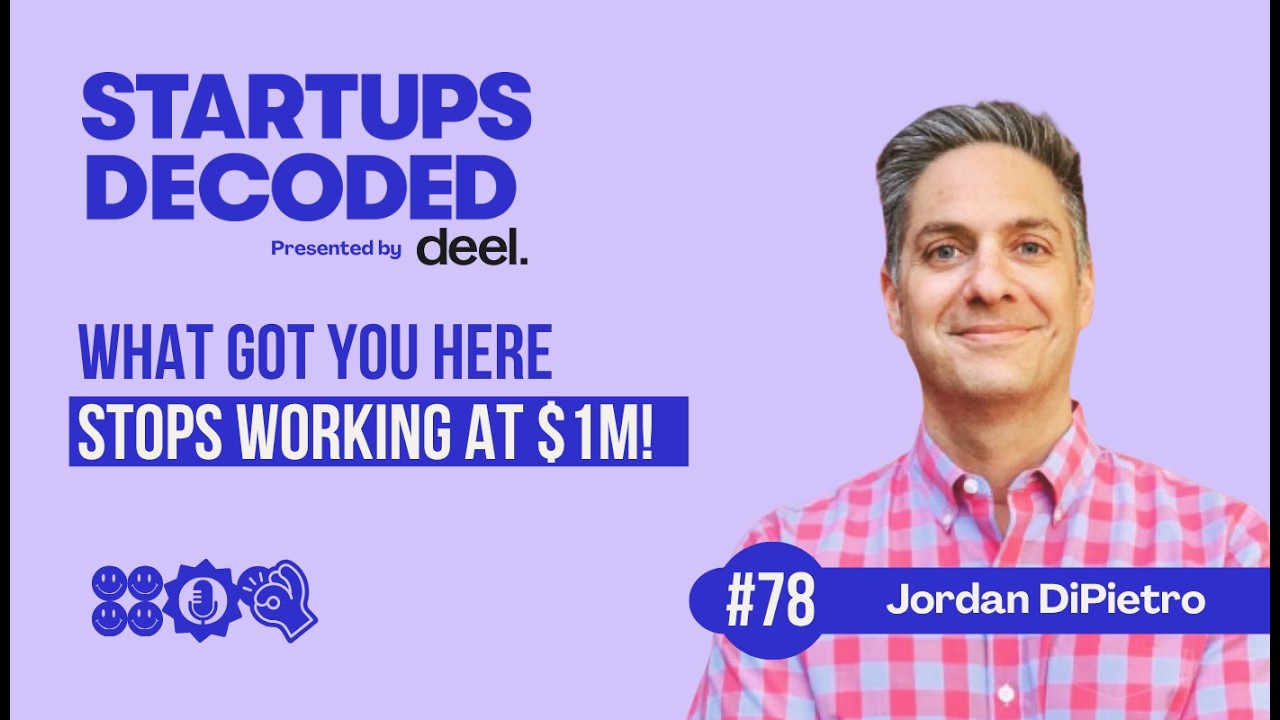
Jordan DiPietro shares his playbook for scaling startups from $1M to $50M revenue, drawn from roles at HubSpot and The Hustle. He breaks down hiring frameworks, compensation stacking, and why audience and distribution matter more than product early on. He warns against AI hype disconnected from real business outcomes.
Chapters
I'm gonna provide for you these categories, and I want you to kind of tell me which ones are most important to you. And I've now since kind of used this with many people, and, um, and I, I write about it in my content as well. I think it's a great exercise where you essentially ask your employees to stack rank these 5 things: your base salary, performance-based bonuses, equity and ownership, what I'll call like your, your skills or, or breadth of responsibility, and your life flexibility. And when you ask someone to stack rank those, it really forces you to realize, like, sure, we all care about all those things, but you have to care about some more than the others.
Welcome to Startups Decoded, the show that gets real about what it takes to build a successful startup. I'm Andy Walsh, 2x exited founder, strategist, and your host. Each week I talk with top founders, investors, and operators to unpack the plays that drive real traction, not just headlines. If you're building something bold, This is where you'll get the honest insights to scale with clarity and confidence. Let's keep growing together. Hit subscribe and share with your community. It would mean the world to me. Hello and welcome back to Startups Decoded. My name is Andy Walsh. Most founders struggle with getting to their first million of annual revenue, but getting to that next jump to $50 million takes a lot. There's a broad range of skills to deal with, and today I'm joined by Jordan DiPietro. Who has got an amazing background that I'm fascinated to explore this today. Jordan, welcome to the show.
Thanks, Andy Walsh. Goin' on, happy to be here.
I love that your story has taken you through a range of companies that all have so through growth when you seem to have been in the front seat through very significant change. A lot of people I talk to who have come through in those companies typically go in when it's already big, but I feel like your pattern from a career perspective has been pretty early doors. Solidifying what they're doing and then scaling to a pretty significant level, if that is a fair assessment.
Yeah, I think it's fair. I think I've, I've been, been really lucky that I've joined a variety of different companies, started different companies at, at different stages. So, you know, obviously you mentioned The Motley Fool, which I can't remember exactly the revenue that it was when I joined, but, you know, scaled that company and was a big part of the growth story there to several hundred million in revenue. The Hustle, pre-HubSpot, HubSpot, obviously a multi-billion dollar company, Hampton from the zero stage to about $10 million in revenue. Now, of course, doing my own smaller thing. But yeah, I think I've been just super lucky that I've seen companies on the way up, before the way up, during the way up, made many mistakes on the way down and hopefully, you know, pivoted back up afterwards. But yeah, it's been a wild journey.
The pattern that I'd love to look at today is that a lot of the work that I'm dealing with personally and the conversations I'm having is that growth stage of when you're going into launching a product or service, and you're trying to basically get to a point where you're cash positive. And there's so many different ways you can do that. In your experience, you've had roles where you've been pretty early. Any good experience pre that $1 million annual revenue mark in any of those roles?
Hampton was pre-$1 million in revenue. Obviously it was, it was still pretty accelerated growth. And I mean, we certainly, certainly hockey-sticked early, but I joined pre-$1 million in revenue. And also, I mean, my, my own thing, of course, that I'm doing now is, you know, from, from from scratch. But I think I have been, again, kind of lucky that a lot of the businesses that I've worked in started with a pretty strong audience, or we were able to generate early a pretty strong audience. And distribution is really the key of many, many businesses, but especially the ones that I have worked at. I'd say like that has been a commonality is that distribution and having audience was always something that happened first, not just kind of like, throwing a product out and hoping that people bought it or were interested. Everything starts kind of with distribution first and product second.
That makes sense. And walking into those roles that you've done, I mean, they're all different because of when they happened in time. Like the world obviously has changed dramatically in 15 years. Like when you're going in and you're looking at those businesses, what are some of the first things that you would look at as, as far as where they're at from operating procedures to audience acquisition retention? What are some of the filters that you would typically dive into to immerse yourself?
I'd say it probably changes a little bit business to business, but you look at all of the basics, you know, from just like your common, like operating P&L to, you know, your kind of acquisition funnel and, and your margin and stuff like that. But everything that I have walked into again has, has been some sort of semblance of attracting an audience, getting eyeball, getting eyeballs, and then, you know, figuring out a way to monetize those eyeballs, whether it's through an investing subscription or whether whether it's, you know, through a membership for a founder network. And different metrics might matter to different companies. You know, for instance, at The Hustle, we weren't necessarily looking at retention, but at The Motley Fool and Hampton, you know, retention was probably the north star of both of those business models. So it kind of varies a little bit business to business, but those are some of the kind of the basics.
And I'm a brand guy and I love the power of brand, and I feel very confident that this year that having us strong brand and having conviction and personality is going to be a really crucial ingredient for startups to differentiate themselves in what is starting to become quite cluttered in a lot of categories. For you in that stage, I'd love to explore your writing a little bit as well, but when you're thinking about how you bring a brand to life from an aspirational perspective in who is it, what it stands for, and how do people relate with that from a personality perspective? Through to the more brass tacks of here are the things that we do, here's how it helps you, and that more product type messaging. How do you think that's evolved in the last 15, 20 years and the importance of each?
It's a great question and a big one. I, you know, for me, I have always just relied on kind of being myself and I've always kind of cherished work, working at places that were authentically themselves. You know, when I started. 20 years ago and I was working at The Motley Fool, the big thing that attracted me to The Motley Fool was that it was kind of the one company in the investment analysis space that was not buttoned up, you know, Wall Street, Goldman, JP Morgan. It was a very irreverent, kind of silly, goofy, you know, N of 1 sort of brand. And I loved that. I loved that about The Motley Fool, and that attracted me to them. Kind of same thing with The Hustle at the time. You know, The Hustle was definitely a different sort of media company at the time. So I've always just found that like authentically being myself, has built my brand, and that authenticity is kind of what attracts people to you or deters them away from you. It's just as important to get the right sort of customers as it is to deter the wrong sort of customers. And I think sometimes people, they tend to be nervous about dissuading potential customers or future customers. Like I always joke about, I'll tell people when COVID happened, everyone started working from home. My wife would come in after a meeting and she'd be like, oh my God, you curse so much. You have got to stop cursing. 'And I'd be like, I can't. Like, that's just, it's just who I am, how I, how I talk. I really can't.' And, but for a while she was like mortifying me. I'd be like, 'How am I gonna stop cursing so much?' She's like, 'It's all day, every day.' But I'm like, 'That's just who I am. That's part of it. And you either like it or you hate it.' But that, that's a part of, I guess, my brand. And I feel like today what's different than it was 20 years ago is, um, in B2B especially, people are not afraid to kind of be themselves. Companies are not afraid to kind of building different brands. Everything from the content you see on LinkedIn to big kind of, you know, media brands and big media campaigns are embracing that a lot more. Whereas like 15, 20 years ago, that was, you know, much less relevant. I guess it was more B2C than it was B2B.
And my observation on that is the authenticity element is interesting, and we haven't had enough time yet with this new chapter of AI for businesses but the authenticity where it's actually standing for something and solving a real problem, that it feels like there's a lot of iteration and testing on products that maybe it's a little bit myopic where a founder goes, this is something that I know people need and they're doubling down on that one thing. But maybe the feedback they're getting from customers is not there and consistent with what they're actually building. And the tension that I see in that is around what you're actually delivering, but then the relationship that you have with those people as well and the power of both, and it's building on what I was saying before around the brand versus the product and the separation of the two. Separating your product from the pack. Let's go down that lane first. From a day-to-day perspective, how you actually think about go-to-market and bringing that story to life around your product and, and how it, how it becomes relatable to the masses, because that is a challenge in itself. You're not just educating on the product itself. Sometimes you're educating on the category and how it even works.
I mean, I always tell people to start narrow and not worry too much, especially in the beginning, on how you're gonna kind of educate or market yourself to the masses. And maybe that's just been born out of my own experience, but I think that the two most important things are that you have a very, very well-defined ICP and you actually aren't trying in the beginning to go incredibly wide and large, which I think is what most people try to do because they're hedging and they're, and they're anxious, you know? And so, um, you know, I'll work with a founder who's going to launch product X, Y, and Z, and they're like, and I say, who, who's the ICP? And they'll describe like 5 different avatars for me, you know? And I'm like, it can't be all, all at once. You know, you've gotta start narrow so that you're building a great product and you're solving that exact kind of client's problem up, up front. And the second thing I think it's important is just having a very unique point of view, which again, most people shy away from because they're hedging and they want to try to be a little bit of this, a little bit of that. But I find that the more narrow you start and the the more and the sharper your point of view, you know, the better you're able to do the things that you know that are important, like storytelling and having a strong brand. You know, over time you can widen a little bit if your audience kind of gives you that, has that trust in you and you kind of have that luxury. But I think in the beginning you got to stay a little bit more narrow.
It literally had a consulting client just a few days ago and basically had 4 ICPs and 4 different product features. And he had such a hard time narrowing it down to one on each side. And I knew straight away, it's like, here's your ICP and here's the product you need to go to market with. Cause that is the part that's keeping people awake at night. The other things were nice to haves. And after a few days, he came back to me and after sitting with it, he realized how much of a mountain he was creating for himself with trying to be something to everybody. And it's to your point, it's like from a mindset perspective, how do you even convince a founder? That casting a wide net is not the right approach? It's actually having something more intimate and tangible in that personal situation. Is it user feedback? How do you start to think about that validation with that one thing?
I think it kind of depends on where they are. I mean, hopefully, you know, I've got a great relationship with all my, you know, founder CEO clients. And so typically it's not necessarily like that I have to prove it to them, but it's usually coming up like organically in a conversation, whether we're talking about a potential feature or a marketing campaign, it typically is something that they realize, especially when, when you start to bring it up to them. I think one of the things that I know clients always value the most is asking them hard questions and pushing back on things, like tends to be the number one reason that people love having coaches, because a lot of us that are in the CEO or founder seat are the, you know, we're the number one at our companies, right? We've got employees, direct reports, maybe in our families and in a lot of our lives, we are the number one sort of person. And so we weren't— we're not used to pushback and hard questions as much. And so founders, I have found, typically love that when you ask them kind of hard things. But, you know, there's lots of ways. I mean, you could show somebody two different landing pages, right? Like two different varieties of a landing page, one that is speaking to a very wide audience and one that is speaking to a very specific audience. And just say, like, which one is this right? Which one do you think is going to have a higher conversion rate? You know, you could ask— you could frame it like that to a founder who maybe has a growth marketing background, you know, and that would stick with them. You could tell, you could simply like tell a story about two different customers, you know, one that's a very kind of general story about a customer, one that's a very specific story about a customer that, you know, they have and maybe that resonates. So there's different ways I think of bringing that up to your client. You kind of customize it based on who your client is and, and what they need. But yeah, I find, I find most of them love being kind of challenged and working through these sorts of problems.
Yeah, I, I would love to claim it as my own. I, I read it or heard it somewhere, which was basically a really strong behavioral activity from a founder. Is strong convictions weakly held.
Oh yeah, for sure.
And it's such a simple mantra, right? To be able to move forward with confidence and back yourself, but at the right moment, if you're having doubt, how do you not necessarily get consensus, but how do you get outside feedback and opinions to fill the tank up a little bit more with more information to give yourself more conviction to take that next step? And the pragmatism to actually take that on board and even prove yourself wrong sometimes can be too much for some founders.
I think that's great. I think that's great. We, we had a similar mantra at my last company as well. And I think it's great to have strong opinions, you know, weak egos. So be ready to be wrong frequently. And I think some of the best founders I work with are, they're hungry for feedback and for these kinds of critical conversations.
Absolutely. I want to focus on structure just a little bit to move on to where I want to go to next. And the first Part of it, I, I look at it in 3 phases. The first one is very much growth hacking where you're testing and learning on an active cycle, probably lacking process structure and ways of, of moving forward. Second stage is where you actually start to build out your SOPs. You start to get more consistency as you get more signal and more information. And the third part is a scale phase where you've got enough data and insight and information to be able to do very microtests and do things at scale that you know can drive certain levers off that insight. And I love it as a simplicity thing to empower founders in that first stage to test and learn and have that pragmatism, like I was saying, that strong convictions weekly held to be able to move at pace. When you go into the second stage about building systems and learnings, how do you go about with founders in, and I want to talk about here storytelling and go-to-market, not everything across your whole business. Once you start to get some of that signal, how do you then translate that into a really basic system that you can start to roll out across all channels from direct sales to social media, email comms, etc.? How do you formalize that into a structure?
Well, every, every company I think is a little bit different, but typically what I find, like most of the clients that I work with are some somewhere between $5 and $20 million in revenue. So they're, they're way beyond stage 1 that you articulated, and they're usually somewhere between stage 2 and 3 where they're scaling, starting to scale, and usually the business model is, is working pretty well. And the 2 areas that I find that need the most help are the founder themselves, who I call like the self. So usually they are struggling with something in that leadership transition, going from being, you know, the person that is driving the large majority of the business, making all the decisions. Maybe they had a team of 5 or 6 or 7, all early-stage hires. And trying to go from that to a much larger team where decision-making has to be decentralized a little bit, where they need to get better at doing different things. They need to focus more than they ever had before and entrust some of their team to make better decisions. That is one big category. And then the other is actually of the team building, how to hire and attract great talent, how to retain people, how to empower people and lead them. Like, those are the things that I find we spend the most time on, more so than, you know, just creating kind of the systems for, for growth hacking finding new channels. So we spend a lot of time on those two items. And I mean, I'm happy to jump into kind of more detail on any of them, but there's, you start seeing all the same patterns, you know, and again, I take a lot of it from the mistakes that I've made across the last 20 years and things that I've learned. Like what I try to tell my clients is, you know, I try to take the best things from all the different places I've been. You know, I've worked under incredible people at The Motley Fool, at HubSpot, The Hustle in Hampton. So I try to take all the things that I think are wonderful, all the things I've done not so great and mistakes I've made, you know, and try and give them to my clients in a way that helps them systematize it a little bit, you know, but it's different for every client.
And the team part, I love that you went there. Building the right team and the right culture is critical. And I go back to day one of storytelling in how you articulate who you are and what you stand for. Being a long game for investment, for customers, for staff. The way that you show up is going to open doors for you in so many different ways. When you're going through the team building exercise, how much do you coach founders on finding the right fit versus finding the right skills and the trade-offs between the two of those?
That's so much time. Yeah, so much time, man. I'm actually, right now I'm in the middle of building a product, but it's called the Hiring Operating System, Hiring OS. And I am, what I'm trying to do is basically take all of these patterns that I see, the way that founders try to attract talent, the way that, you know, the same way that we talked about hedging when it comes to your ICP, I see founders do the same thing with hedging with regards to the hiring. And it's a huge, huge problem. I'll give you a quick example. It's like, let's say there was a founder who decided that they needed a head of growth marketing. What I see will happen many times is they'll say, hey, I've got this problem in the company. I think we need to hire a head of growth marketing. All right, great. I'll try to put them through my process by which I want them to define what the actual problem is, then design the role. Then there's a couple other steps, but what'll happen is they'll quickly jump to, hey, let me just get the job description up and out. So they'll post the job description somewhere. I'll read it. It's incredibly general and vague purposely because they're like, well, but I said it was a head of growth marketing, but I also would love it if this person could do a little bit of social media and then maybe on the side they could be a part-time designer. And I'm like, what are you doing? And what happens is all the candidates that they get are all over the place, you know, and then we find ourselves in this conversation a month in where they're like, I haven't really gotten that exact unicorn I'm looking for. And I say, I'm like, it's because you have literally created a job description that is trying to attract 6 different people. And you're also praying that somebody is going to do this for $80,000 a year and work in New York. People aren't nearly as intentional enough with how they're designing their roles, what problems they're trying to solve, and the exact type of person that they want. And I, I, yeah, so I'm spending a lot, I could talk like a, a long time about hiring and attracting the right sort of talent and how to retain A-players and all this stuff because I think it's, you know, there's a quote from somebody, it says like the company that you build is the, is, or the team that you build is the company that you build, you know? And I think there's nothing more important than how to attract A-players and how to retain them. And this is usually like a footnote for most founders. They have a lot more fun building the product, right? Or building features than it is like hire. Like, hiring's a pain in the ass for most people. They don't enjoy it. It's like an annoying to-do, but it is the role. It is the role.
Quick word from our friends at Deel. Founders, are you hiring? Whether that's your first person or your 50th, you've probably already hit the moment where the best candidate isn't even in your city, let alone your country. That used to mean so much paperwork Deal removes all of that. One platform that lets you hire in days. They handle payroll, compliance, contracts, and benefits. Plus, they're across 150 countries. Don't lose good people because logistics were too hard. Deal solves that problem. Check it out. startupsdecoded.com/deal. That's D-E-E-L startupsdecoded.com/deal. Deal. And the best part about getting it right, it elevates everything. Like, I love what you said around like building the team, building builds the company because it literally does. And if, if you look at any great founder, more often than not, they've been like 2IC in a really good startup already and they, and they learn amazing skills. And as a founder and as a leader, you almost want that person to go off and do their own things, even though it hurts you when they do do it. But for me, that's a really good sign of strong culture and the ability for someone to take what they've learned and hopefully they're not going to directly compete with you, but the ability to bring on those kind of folks that challenge you in a constructive way, help you grow, have skills at the table that you don't have, and being honest and vulnerable enough, I would say, even to be able to be confident to have them sit alongside you.
Yeah, I couldn't agree more. I, the conversations that I have with my employees at different companies are always so open and transparent and they, they know that I I, beyond anything, I'm trying to help them reach whatever their goals are in their lives. And if that means taking a ride with me on a rocket ship for 2 years and then they want to go and do something else, or they want to launch their own business or their own company, they know I'm the first person that's gonna write a check, help them get a job, like do, do whatever it is for them. And so, yeah, I think having that relationship with people and people knowing that you actually do care about them, not that you're just gonna write them off as soon as they leave your company, I think is, is a total differentiator. You know, most CEOs and founders I meet do not have the employee at the forefront of their minds. I was really lucky working at The Motley Fool. We were an incredibly people-first sort of company, and that's always been really integral to me at every company I've worked for. Like, I take care of my people and they know that I care about them, you know, before the company. And I think, yeah, that's a huge differentiator. If that's core to who you are, then I'd say lean into it. If it's not and that's not who you are, then, you know, You know, don't fake it. But I do think if that feels like organic to you, at least for me, that's been a huge competitive advantage, you know, especially when it comes to hiring.
Love to talk about succession planning on that too. And what I mean is the early employees that you hire are sometimes hard to retain and even put into a specific role as you scale. Someone who is early doors is typically doing a lot of different things. And they may be a generalist and don't specialize in that one part, but as you grow, the assumption typically is that they grow and be a senior exec and build a team underneath them. And quite often they're not the right fit to do that. Have you seen examples of that where you start to plan ahead and go, well, the person I've got in now who's doing sales, marketing, content creation, and the role you described just earlier, like what does their role look like in one year, two years' time when we're doing $50 million annual revenue? And there's a team of experts that come in, where do they fit in? Are you seeing any of that play out?
Yeah, absolutely. I don't think there's one size fits all. I think there, there could be a couple different ways to, to go about it. So one is, I think there are certain scenarios where for sure the people that started with you in the early stage who were, you know, either junior or just an IC, you get to a certain point of time in which the company needs new skills or developed skills or somebody who's been there before. And I think there are moments in time where you have to bring in a person that sits above that early stage employee. If you have a great relationship with that employee, then you sit down, you have that sort of conversation with them. And 9 times outta 10, as long as that's not, you know, demoting them, making them less money, you could turn that into a real positive, especially for a young person who's say, let's say 28 years old, who's an IC. If you're bringing in an absolutely incredible VP who has scaled something or done something that they haven't, And now they get to learn from that. Like, in actuality, that's a positive. If you have a great relationship with that employee, it's not hard to have them see it in the same way that you do. If you have a shitty relationship with that employee, I think that's typically when it goes south. So that's one example. I also think there are examples where you can level up that employee depending on what the role or the function is. This is just a small example, but my EA at my last company was incredible. She's listening to this, she'll probably be texting me and giving me shit, but she was absolutely wonderful. It was the first time she was ever an EA. She worked her ass off. She was very, very smart and very skilled. But a year into her being an EA, I knew that she needed to level up, and I knew that she was willing to do it and that she had the ability to do it. And instead of just going and maybe hiring a chief of staff who would sit above her, I went out and I found an EA coach who had run an EA agency for years, and I went and basically begged her. I said, hey, I need you for 2 months to come in and level up my EA. And I, you I paid her for that. And I mean, if anything, that just created more loyalty between the EA and myself because she was like, wow, this guy's willing to invest time and money into me getting better. And so it was a great outcome for me. She became even 10 times better of an EA, and it was a great outcome for her too. So I think there's different ways of doing it, you know.
Love that as a problem-solving way too. It's like, I've not heard something like that where someone could be a flight risk, right? As far as potentially leaving if they've hit a ceiling and they've got capacity and skills if they're uninspired and it's easy to be able to upskill them and give them bigger scope and let them grow very directly is amazing.
And I mean, it's not like I knew that that was even a thing. I think I just went and found somebody on LinkedIn who ran an EA agency and started pinging them and was like, would you be open to one-on-one coaching my EA? And they were like, well, never really done that before, but you know, I threw a number at them. They were like, okay, you know, so So there's always ways to uplevel people, you know, if you, if you believe in them and you, you believe in whatever their ceiling, you know, is, and that you can keep pushing that, man, there's nothing like having people that are loyal to you that are willing to work really. 'Cause when you're running a startup, as you know, like you are going to ask people to work hard, long hours, right? There's trade-offs when you're working at a big company versus a startup, and there's tons of advantages. Advantages to working at a startup, but the disadvantages are you're gonna work a lot and you're like, we're gonna ask a lot of you, you know, because it is a startup. So you've also gotta make sure that the advantages are there, which are typically, you know, autonomy, ability to take on a lot more responsibility at an, at an earlier age with less experience. You're gonna invest in people a lot more, spend a lot more time with them as the CEO and the founder.
So you, you gotta make sure that, you know, you're balancing kind of all the things you're gonna ask of them with some of the pros to My pattern I observed, and there's two camps almost, and I'm simplifying this for conversation, but someone who's very focused on title growth, financial growth, and not on actual skill and career growth. I've never really cared at all what I was called. It's never bothered me. If I'm happy in a company and I've got a job historically, then I'm great. I don't really care. You can call me whatever you feel like. It's not going to change my life, but I feel like people are in two camps and like, I want the people who just want to grow and they're the people that I'll give mentorship to. I'll coach them. I'll make sure that they succeed because I've got an attitude where it's like, I want to keep giving more and more and more so I can get it back. And that reciprocation and two-way thing for me has always proved very successful.
Yeah. Yeah, for sure. I mean, I think with titles, I agree with, I mean, I've never, never cared about titles. And I think, um, also today, like they've become so much more less meaningful than they used to be, right? Like every single person on LinkedIn is a VP or a head of whatever their function is. So I think it's much less relevant. I mean, I do think from a financial perspective, right, like people, people need to feel like their hard work is going to be rewarded and that, you know, what you're asking of them is going to lead at some point to, right, good financial outcomes for them. Now, I think I like having the conversation with people, especially when I can control this. I like having a conversation with people about financially what what it, what matters to them, because some people will care a lot about the financial security of a base salary, right? Somebody else doing the same exact role might care entirely about equity or ownership or performance-based bonuses. Those two people might be able to do the same role, but have wildly different kind of motivations and incentives. Now, if you're at a massive company, you probably don't have control over how you incentivize your people, but you know, when I'm just working at smaller companies and startups, I, I will certainly try to customize that for my A-players, you know, because also things change where you are in your life. You know, like if you just had your first 2 kids and you're at a point in time where financial stability is important to you, then maybe your base salary is what you care about and you're not focusing a lot on equity. Maybe when you're 24 years old and you don't have a whole lot of expenses, it's like, and you, and you feel like you're an A-player, Maybe you just want to be completely incentivized on performance-based bonuses and equity. And so I think as leaders, I like as much as we can to try and customize that for A-players.
I appreciate that in the life stage and personal situation, putting that into the mix as much as what they do in the office and how they function. Ultimately, it's a really nice balance because one, you're being empathetic and understanding that each have different needs. And sometimes that can be to your favor too, particularly if someone is a high-risk person that's prepared to back you because they like your company and they like what you're doing and they think that a good ESOP program is going to pay them out long-term and they'll take a lower pay because they can afford to do that.
Yeah, for sure. Well, I remember the time that that was first presented to me was from a boss. I was at The Motley Fool and I just, I think I had just gotten a promotion. Like many young people, I probably wasn't happy with whatever it was that I was given. And I remember my boss sitting down with me and saying, hey, I'm gonna stack rank, I'm gonna provide for you these categories, and I want you to kind of tell me which ones are most important to you. And I've now since kind of used this with many people, and I write about it in my content as well. I think it's a great exercise where you essentially ask your employees to stack rank these 5 things: your base salary, performance-based bonuses, equity and ownership, what I'll call like your skills or breadth of responsibility, and your life flexibility. And when you ask someone to stack rank those, it really forces you to realize like, sure, we all care about all of those things, but you have to care about some more than the others. And at, at the time in my life where I was, and I had just gotten a big base salary, um, you know, increase, I remember my boss asking me and we realized base salary was not the thing that I cared about the most. And so we reworked it. I actually asked for less money on my base and more for my performance bonus. And that was a, that was a great conversation for him to present to me cuz it made me realize also like, yeah, you can't have everything all the time. You know, like you've, you've gotta pick and choose where you're at. So I think it's a really helpful kind of framework to talk with your employees about.
I should have a look at that. I'm curious now. My, my brain's gone off on a tangent thinking about how I'd stack rank my own life right now. It's fascinating.
It changes, right? Like that's seasons of life change. I think when my kids were, you know, 2 and 5, might have, and might have favored or prioritized flexibility a little bit more, you know, certainly a lot more than I did in my 20s when I would've put life flexibility at a zero, you know? And, and it's like things change. And I think that as leaders, I try not to have a stringent kind of like a stranglehold on how I want to motivate and reward my best employees. I like to try and adapt with the seasons that they're in. And just because one of your employees just had their first child or is going through a tough time at home or whatever it might be, like, be a great leader. Try and adapt with them, you know, try and mold how they work with you. I think that's why people, like, if you look at the best leaders, in my opinion, people follow them from company to company. Like, you can get some of your best employees to go with you to new companies and beyond. And I think that's a big reason why is like you continue to adapt with them in lives.
Powerful lesson in that for everyone in just the simplicity of what you're talking about. And it only is a few questions too. It's not like it's a 4-week project you have to do with someone. You could turn that around pretty quick.
Yeah. I mean, that's a 30-minute convo.
Yeah.
Not hard.
100%. Nice. Okay. It would be remiss of us not to double-click a little bit on the evolution of AI now in, in that role too. Let's focus still around that growth part of a company in automation and everything right now that I'm seeing is the formalization of agents, right? People have been building their own agents for a period of time with something else behind it, but now it's like off-the-shelf type agent situation is interesting and it plays into how you structure your team, how you have that hierarchy of team members, the platforms that you choose. What are some of the patterns? Because the companies you're working with are at a fascinating stage where I assume It's a massive part of how they run their business. What are some of the themes and things that you are seeing be integrated now into that sort of under $50 million annual revenue range?
I think the people that are using AI in the most productive ways at their companies are folks that are making sure that they are attached to business outcomes. For instance, you know, if you are ensuring that your go-to-market team has AI embedded in all of the processes that they're using and you are recommending that they use certain tools, tools and AI automations with their outbound program and blah, blah, blah. That is awesome, right? That is tied to a business outcome and you can make sure that your leaders feel empowered to use an AI-enabled process to achieve whatever business outcome you have kind of articulated. In the worst scenario, I think you have founders and CEOs of companies that are just basically yelling at their employees to use AI more. Throwing more and more subscriptions at them. Like everybody needs to have these 6 subscriptions. Like, are you, did you use Claude for this? Did you use, you know, like almost like maniacally just telling employees to use more and more and more versus making sure that it's tied to certain business outcomes. Like there's, there's definitely a lot of anxiety right now with how, just how quickly everything is moving, how incredibly fast the tools are improving and getting better. Like as much as excitement as there is, I also think with certain founders there's an equal parts like anxiety that can sometimes make them come off, I think, a little manic or crazy to the employees, right? I still have like a lot of employees who DM and text me all the time at large companies and companies that I used to run. So I get like both sides. I get the employee side. I get the founder CEO side. I get a little bit of everything. So it's all over the map, man. It's all over the map.
I feel like it might've been Adam Robinson, a previous episode that I had. He had a nice way, similar to what you said of framing the rather than just see something that you can use to automate or try and scale, whatever it is from an AI tech stack perspective, it was actually understand your business, see where there's opportunity to get effectiveness or growth or do things in a better way and then go out and find a solution for that rather than getting caught in the halo of everything that's coming down the pipe. Yeah. Yeah.
It's, and it, it goes back to, to like just very, very simple business mantras of like, stay focused. Focus, right? Like, just like, that's one of the hardest things I think as a founder, especially when you're having success, is it gets very, very easy to, you know, start chasing squirrels and see a million shiny things and want to do it. And it's, it couldn't be harder right now with AI. You know, there's like, there's one of my clients who I'm thinking of specifically who his business is going phenomenally well. He's a rock star. I love him. And if he listens to this, he's gonna know I'm talking about him. But he's also completely obsessed with AI and probably spends his entire weekend just like heads down building stuff with AI. And what I keep telling him is like, I don't mind that you do that and it's okay to go down a million different rabbit holes as long as like Monday through Friday you're running the team and you're focusing on the core business, then that's fine. But I think for a lot of folks it's only making harder what is already a very scattered, challenging kind of minefield to play in, which is building a business. You know, it's, I mean, it's easy. I'm sure you struggle. I struggle the same way. It's like, it's hard not to go down down a rabbit hole every time somebody posts on, you know, Twitter or LinkedIn, like, here's the problem I just solved with AI in 20 seconds. And you're like, oh, fuck, like, you know, like, how am I not going to click on that now? It's, it's hard, but I'm like, just stay focused, just stay heads down. And if you're going to go down rabbit holes, make sure that it is tied to the business outcomes that you've already articulated, you know.
I laugh because that's just my day. Like, literally before we jumped on to record this, I was in Claude work doing a little bit of hassle at the moment to try and automate some of the things I'm doing with the podcast. I was in Opus Clip at the same time doing my next episode from an output perspective. And I was also in Riverside, the platform I use, getting some transcripts, et cetera, out so I can then do the next part of my test with Claude Cowork as well. And I had 3 of them running concurrently. My internet, for whatever reason, is slow today, whether Claude is choking, it was super slow. So I was running 3 of them in parallel, which probably could have been my problem potentially. And I'm like, am I actually focusing on anything right now? I don't know.
Right. Right. Who— I mean, it, it has not to understate the power of the tools, you know, I mean, I think especially in the last couple months, I mean, what Claude, you know, especially, I mean, it is absolutely unbelievable the output and the quality of some of the output that you're able to do. And certainly I'm using it in lots of different aspects to run my business. And as a, as a marketer, like in my core, like my, my background is marketing. I couldn't be, it couldn't be more exciting to all of a sudden be CEO, founder, half VibeCoder, designer, builder. It couldn't be better. But yeah, you, you do have to make sure that it's tied to the things you actually give a shit about. Like half the times when I see people kind of slacking in different communities I'm in and they're boasting about the things they've been able to do with AI, like I'm dying to also know, like, has, has revenue gone up at all? Like, is your, is your business, like, don't forget, like your business is supposed to grow. And so yeah, it's just, it's harder and harder to stay focused, but I think that the best people are using it to accelerate to operate their businesses, to automate the things that are supposed to be automated, you know, to empower their teams and excite them. You know, one other thing I'll say real quickly is, 'cause we talked about like trust with your teams, I saw a founder Slack this morning about over the weekend he was at one of his kids' soccer game and he overheard two guys behind him talking. And one of the guys said, hey, are you using AI much at your work? And the other guy who was, I guess, in data science or something like that said, well, I'm supposed to be,, but I don't really want to 'cause I'm, I'm pretty sure it's gonna just like take over my job. So I keep telling my boss that I am, but I'm not really. And the other guy was kind of laughing. And you know, I think that goes down to like a fundamental fear that a lot of employees have is like, if they are using it, they're fearful that they're gonna get automated away or AI'd away with their job. And so it goes back to like having actual trust and great relationships with your employees, I think allows them to push aside the fear or the concerns that they might have about AI. You know, I think if you don't have that sort of relationship, I could see how sometimes employees might be more hesitant to kind of use it.
Yeah, I hear that sentiment a lot, and there's an element of curation and creation, and how do you actually start to inform and iterate a little bit with whatever you're operating with to be able to get that efficiency and stress test yourself. Like, I do a lot of iteration on it as well. But for me, if I didn't have the experience that I had, I wouldn't know what good and bad look like. I'm trusting something to give me that. So I'm pushing it and I cross sometimes 2 or 3 different LLMs as well. Like I'll do something and I'll stress test it somewhere else because as human beings we can get complacent and, and like there's a little bit of the false truth or like you almost want it to go a certain way and you can steer it a certain way too and bring your own personal bias into it. You're still driving a lot of that narrative.
For sure. For sure. I mean, I think it was this morning or yesterday, I, you know, sent my EA that I'm working with a, you know, 15-minute Loom of like me building something in Claude so that she could see like how I'm prompting, how I'm reacting to it. Because like you said, I mean, if you don't have the experience and you just put in a single prompt and you just take whatever the output is as gospel, like, All right, it is what it is. You know, you have to kind of understand how to draw on your own experience, like you said, to know where your own biases are. You know, I think teaching, just like being excited about teaching your team is an important thing. Like, I'm excited to create that 10-minute Loom so that I can share that with my EA so that she can see, like, even though it gave him this output, he still pushed on it to do X, Y, and Z differently. You know, like, you gotta be excited to teach your team, AI or not. Like, that, that's an important part of being a, a CEO and a great leader, I think.
Jordan, what a great way to wrap up today. I would love for people to be able to stay in touch with what you're doing. You've got a newsletter, you said. What are the ways that people can reach out?
Yeah, they can hit me up, email jordan@signalnoisemedia.com. Changing, changing my website right now. Right now they could also just go to jordandipietro.com.
Amazing. Well, I, I've not subscribed. I need to do it. I'm fascinated because you could—
It's messed up, man. I'm hitting cancel before Riverside uploads.
Wow, that's cold. That's cold.
I won't do it. I won't do it.
Jordan, amazing. I appreciate your time. This has been a fascinating look at what you've been doing and how you're applying that now. So thank you so much for being generous today.
Yeah, no, my pleasure, man. Great, great chat.
Thanks for listening to Startup Secrets. Decoded. If today's conversation helped you think differently, share it with the founder in your network, and don't forget to subscribe for real-world startup insights every week. We really value your support. If you're interested in partnering with us, email hello@startupsdecoded.com. I'm Andy Walsh. I'll see you next week.
More from Andy



EP#88: Why Most Founders Misread Their Own Traction. Vanessa Larco - Premise VC

EP#87: Founders Obsess Over the Raise. Investors Care About This More. — Carina Cunha






Ep#86: Early Decisions That Define Your Startup Forever. With J.P. Morgan Asset Management
