Ep#79: The Startup Dream That Wasn't Hers - Ella Cook
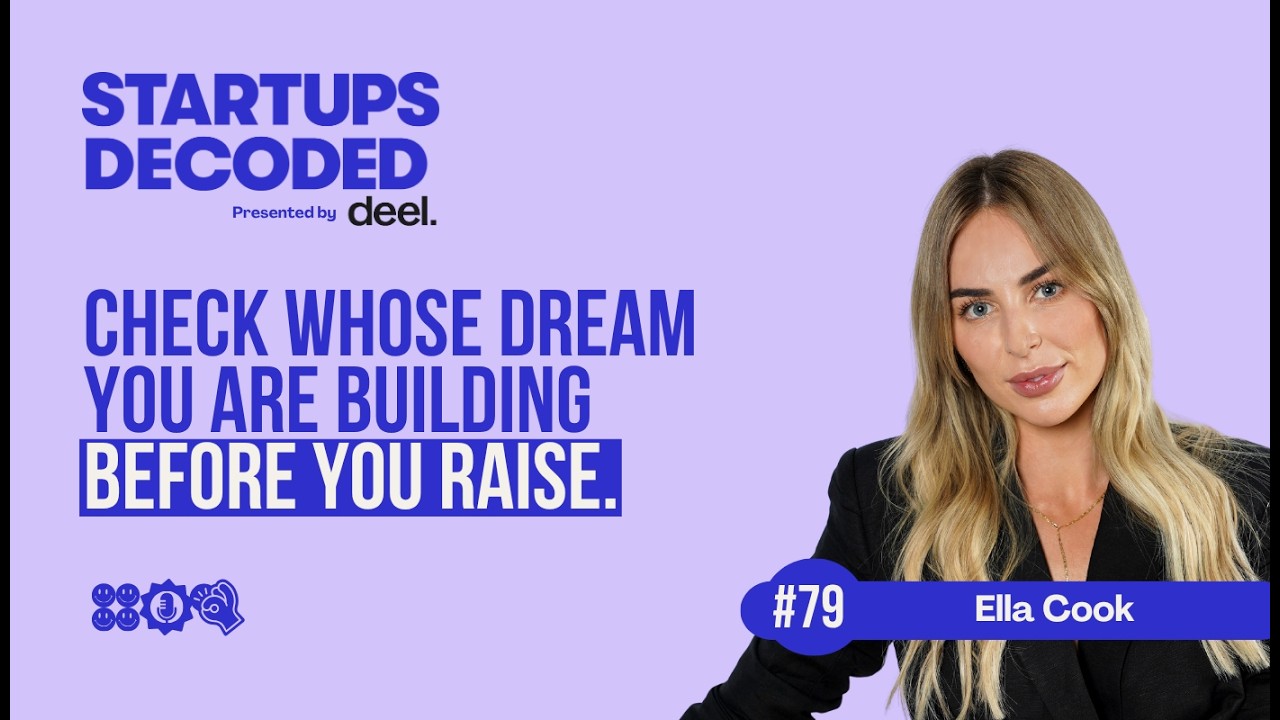
Ella Cook dropped out of high school, built and sold a fitness brand called Activate U, then burned out chasing VC funding. She argues founders don't need traditional venture capital, and shares how AI tools, health monitoring, and alternative funding sources like family offices can sustain both the business and the person running it.
Chapters
And honestly, for me, capital raising was the most punishing journey of my life. I don't wish that upon anyone, but at the same time, I'm grateful that I went through that experience because I think it's just another tool in your toolkit if and when I ever wanted to go back down that route. But I think it really does wind you into extreme burnout at times.
Welcome to Startups Decoded, the show that gets real about what it takes to build a successful startup. I'm Andy Walsh, 2x exited founder, strategist, and your host. Each week I talk with top founders, investors, and operators to unpack the plays that drive real traction, not just headlines. If you're building something bold, this is where you'll get the honest insights to scale with clarity and confidence. Let's keep growing together. Hit subscribe and share with your community. It would mean the world to me. Hello and welcome back to Startups Decoded. My name is Andy Walsh. If you're fortunate enough to go through the founder journey, come out the other side, and are brave enough to start again, there's a lot of reflection that happens, and part of that is your motivations and purpose into what you want to do. But one of the interesting ones is around architecture and what you learn, how you structure, how you grow, how you raise funds, and the people you bring in around you. And I'm really, really excited today to have a friend and fellow Australian, Ella Cook, Welcome.
Thank you.
Ella, you've been doing lots of interesting things and you are from Australia, up in Boston. Was that the first place you went to?
No, I, I flew into San Diego, LA, then I went to Arizona.
Sounds like you had RV life there for a while.
Nearly, nearly, but I feel like for me, the East Coast is a lot. And I think it was a lot easier to ease into San Diego first. Yeah. And I had a couple of friends there, but it was definitely a shift moving post-COVID. Really didn't have many people in my network when I first got here at all.
And I moved here in 2012, and even just the slow burn of getting the right people to be able to have the right conversations and open it up, and we'll talk about that as far as relationships and today more important than ever. And from my perspective, very much so. Your business that you exited, let's start with that story.
That was in Australia. So I didn't finish high school. I dropped out. I didn't go to college and I went straight into building pretty much. So I had a couple of jobs during high school and then I didn't realize that I was building a company. It just kind of dawned on us when me and my partner at the time, we loved to travel and like take workout videos.. And so we ended up getting a group of folks that one of, one of the individuals had a really big audience. And we ended up collabing with a villa in Bali. We had all of these brands pretty much activate us with products and we just love to take content, work out, have fun. Like we love to travel, but we also love to like stay in shape. Mm-hmm. And then when we started to like release all the content, everyone was like, we wanna come on the next trip. And we were like, That we just did that for fun. And then all of a sudden we decided, okay, if there's so much demand to kind of have fun, travel, you know, Australians, like we like to be able to do both. We then decided to launch a retreat business that then went into an e-commerce platform that then went into this kind of like larger affiliate structure and then partnered with another brand who's quite well-known body science, and they kind of brought their supplements in, and then we distributed like our equipment onto their platform as well. And so it kind of became— it was called Activate U, and it became really much like a movement of community being like fit as fuck and just kind of having fun and working out.
It's so fascinating, and I love talking about human purpose and things that you're passionate about driving business outcomes, and you can be quite calculated today and look at the market, look at where there's gaps, or look at a competitor and say, I can take them on directly. But to have something that you're passionate about, fuel an experience, and then it starts to grow organically, heaven forbid using that word, but to be able to then turn that into a business and multiply what you are doing. And when you're finding like-minded people, I would put money down that what you've done is by putting your passions out there, people resonate and so many people that I know that start businesses have this contrived narrative or don't even have a narrative about why they're doing their business and are missing a huge opportunity.
And I also think in this day and age, you, you really can win in so many different industries. Do something you love because you're going to have that longevity. By the time I was in my early 20s, because I started that company at 19, I was over the fitness industry and I had grown out of that phase of my life and I realized COVID happened. That sucked for us because we had just scored like our first 4 like B2B, really large corporations doing more corporate retreats. It was like, that's where the real money was. Yeah. And so going into an e-commerce platform, I really wasn't excited about it. I really didn't know as like, I didn't know anything about e-com. And it was really transactional. You're just on your laptop all the time. And I didn't even know the word community back then. It wasn't a thing in, in Australia, but I realized I really did miss that human into human connection and having the reward of something to look forward to, which was always the retreat. And so a local competitor ended up acquiring us. They were kind of like a gym slash— they had an e-commerce brand, and it was just really the right fit because they already had different distribution partners and they also had the warehousing to be able to store the equipment. And so for me, I was like, I didn't care about the exit, getting the highest multiple. I just wanted to go to a good home where they knew how to grow it. And, and at that time, like during COVID like mental health was such a real thing. And I ended up taking my passion of renovating homes, and I went into like a full renovation. Had no idea, like you really lose your identity, especially at such a young age. Like that was my whole world. And I still do that now with like, even with my last business, I realize I can't do like one foot in, one foot out. It's like either That is me. And then when you, when you kind of walk away from that, you're like, holy fuck, like, why did I put my whole identity capital, like your whole purpose into this business? It's really interesting.
And the community, it speaks to the fact that what you're doing, you cared about and you weren't having this contrived version of community, which people are trying to work out now what they do. But looking at your age as well, I'm fascinated. And for people who don't know, the Peter Thiel Fellowship started call it 10, maybe even 15 years ago now. And their philosophy was anchored around the fact that people that don't go through traditional university have a very unique perspective on the world. So they were giving out, I think, $250,000 grants to people that had ideas. And Figma came out of that and Ethereum as well came through that program. And there's a, a guy, his name's Michael Gibson. He runs a fund, 1857, and he was a person that ran it and had him on the show. And we're talking about just the attitude of people that don't go through university because the other side of that coin, which is something that I'm really skeptical about slash really dislike is this little echo chamber around Stanford and all these people that know each other and something I want to build on in our conversation today is when it comes to co-founders, VCs, who you hire, there's a culture that happens when it's so local in one pocket.
My first company was bootstrapped, obviously. Like, they're, as you know, in Australia, like, if you say you're an entrepreneur, people are like, oh, you're a drug dealer. There was no angel investor. Like, I didn't even know those terms. Yeah. And raising capital here, I was actually going to buy a boring business before I got into DFX. And so that, I went through that whole process, which was really interesting to understand, like the private equity model, the roll-up strategies. I really built kind of like an interesting network and I, I enjoyed like just learning about buying a recession-proof business. And that was a whole craze that we didn't have back in Australia. Yeah. But then on the flip side to that, it's the startup world and it's this do or die, you must raise capital from the right VCs. And I just don't believe that to be true. And I want to educate especially more women that you really don't need to go down this VC route. I think family offices, obviously angels, a lot more friendly if you're, you're first starting to like get your first check-in. But also on the other side, people are so fixated on, I must get into this accelerator program, and it's really putting external validation on. I need that stamp of approval in order to do X. It's like, just go out, sell your bloody heart out, build a business that people want to invest in, the energy matters so much more. You can feel a founder that is so fixated on wanting your approval. They're, they're, they're like, they're so malleable in being able to change their business model. That's not what an investor wants to write a check into. And honestly, for me, capital raising was the most punishing journey of my life. I don't wish that upon anyone, but at the same time, I'm grateful that I went through that experience because I think it's just another tool in your toolkit. If and when I ever wanted to go back down that route, but I think it really does wind you into extreme burnout at times.
And I see it not even just in female founders, but broadly now there's a broad understanding and awareness, public information available about people that have bootstrapped, people that have got maybe some angel investment on early and have leveraged that in a way to become cash positive and not rely on these external narratives and the people that chase headlines for fundraising. For the right VC fund to talk about as a partner, focusing on exit when an exit may not even be the right thing to do. There's all these stereotypes that exist that send people off, in my opinion, in the wrong direction.
Totally. And I also think you're so fixated on the wrong thing, which you're, you're fixated on, hey, I need this capital to be able to put the fuel on the fire when you don't even have enough gas in the pump yet on your own business. Like if you, and I think it sometimes hinders people, I give you $1 million, you go splurge that cash. Now you have no runway. And all of a sudden, if you just took more time to actually focus on the fundamentals, you actually would have been in a position to take at a better valuation with a probably more prominent investor, but you rushed the process.
And if your motivation is that, then you compromise things along the way to get to that point. And focusing on revenue, the advice is easy to give because it works and it's tried and tested. If one customer, one product. Make it easy to translate and easy to purchase and getting that early momentum because that signal alone from a comms perspective, from a product perspective, community, all the things that happen give you a robust framework that if you get to a point where you decide that capital could be important or useful to help you scale and grow, then it's such an easy layup to a certain degree from a fundraising perspective too, because you're going in with signal and not just hype around audience size, potential revenue, all of these things that are just academic in the scheme of things.
And I think there's been such a cool momentum with founder-led brands and building your audience and really leveraging your, the attention that you have to be able to build different consumer products. And I think there's so many ways now to be able to, you know, exchange equity to a celebrity, or like there's so many more creative structures that are, are now so much more open. Like I think a lot of people are saying like, yeah, I, I did give up this equity, but I'm okay with that because I didn't have to go and, and give, you know, a larger piece to a sharky investor that sits on my board and is now my boss.
The predatory behavior of a lot of those people, and I've just come out of this most amazing week of my life with Eric Ries. Where from a professional capacity, The Lean Startup is the seminal piece of reading that most people would know in the startup world. Either they know it and/or they've read it. And to have him on my show and then to do an event with him, one of the things he talked about is the ability to maintain control is obviously majority ownership, but it goes back to the core of your charter, your operating agreement, and things that you can and can't do as you go through that journey. Even if you do get fundraising and you set up the structure correctly at the start, then you can still maintain control. And to your point, the VC doesn't then become your boss. They become a value add and they're coming to you on your terms rather than their terms. It's not all about profit.
Absolutely.
So for you having come out the other side, you exited that business and you've now made the US home for the moment. And we were talking about that before. It's such an interesting market here because to be able to shake hands, be in the same room and meet people is critical. You talk about community. And for me, I started my business in Australia in 2012, and within 6 months I had my first client in London, my second one then soon after in New York, and I was on a plane all the time, and it was no fun. Bootstrapping and doing long-haul flights is no way to live. There is no life, basically. So moved here, and it did take time to build out the right people to have in my network from customer base to peers that I could just bounce ideas around. And I was fortunate that I had a really good group of advisors who were guiding me at that point. And they opened doors for network. They helped give me feedback as well. So going back to people who have been in Australia and basically built out their own narrative. And I had Joel Connolly on previously, and he's a creative director of Blackbird VC in Australia. And when he first started, his focus was on community and actually getting a bunch of founders, engineers, people that could help make the Australian startup scene buoyant. And that was, call it 10 years ago now, roughly when Blackbird started. And they were small. They've obviously had huge success now. The likes of Atlassian, Canva, Eucalyptus, some significant companies from a return perspective. But what he was saying though is that there were no angels, there were no engineers. It was really small. But what's happened with those exits All these people that invested in Fund 1 and 2 of Blackbird are now deploying capital from an angel perspective, but that's still uncommon. And like the US and Europe to a certain degree feel like one of the small places you can actually go to access that kind of capital.
It's really interesting because I want to see more women inside of those funds, inside of the pre-IPO opportunities, because I do believe like investing in Anthropic, there's no way from Australia I would have had access to that. I don't believe that to be true. It could have been, but I, I really do believe it's your area of proximity. And as you said, it's like, where are you spending your time? What is the caliber? Like, are you going to the same circles, or are you pushing yourself outside of your comfort zone? And I think that's something that luckily I'm very good at, is I can speak to anyone. And I think when you have that charisma and that energy and that excitement about being in a new sector, a new, new city, I think that's where you really gravitate, where you really gravitate towards people that if you're curious and you'll ask them questions, they'll open up. So an example is I was actually at Othership for a founder and investor event, and that's where I met my best friend, who then I got access to Anthropic. And investing in pre-IPO, like, one of the best investments I've ever made. I am gonna exit it before the IPO because I just don't be in the lockup period. But I think we need to be speaking about this more on platforms so that women can start to understand, because there is so many family offices that are about to go into a huge liquidity event. And I think right now, like family offices are great because they are producing capital into areas that are impact, passion, underrepresented. I think the VC model, yes, there are VCs that are coming out and focusing on different underrepresented communities. But at the end of the day, they have LPs that they need to— it's, it's, it's always gonna be, let's get the ROI. You, you, you know, you, you have a reputation and you're using someone else's capital. So I think it's exciting to see with these IPOs, like, what is the future of the private capital markets gonna look like? Are these, you know, is SpaceX just gonna, like, is it gonna continue to go up? Like, I'm, I'm really curious. Everyone has their own perspective. I'm curious on yours.
Quick word from our friends at Deel. Founders, if you're hiring, whether that's your first person or your 50th, you've probably already hit the moment where the best candidate isn't even in your city, let alone your country. That used to mean so much paperwork. Deel removes all of that. One platform that lets you hire in days. They handle payroll, compliance, contracts, and benefits. Plus they're across 150 countries. Don't lose good people because logistics were too hard. Deal solves that problem. Check it out. startupsdecoded.com/deal. That's D-E-E-L startupsdecoded.com/deal. Two things I want to scratch for me is that I went to an event with Forge who are publicly listed. And they created a platform. It launched, let's call it a year ago, and it's basically buying and selling on the secondary market like you would on the public market. And it's fascinating to look at pricing and what's happening from a generation of return in there. And it's really understated as far as how much volume's going through. Part of it is VCs, which they would never admit to. They're very discreetly getting capital back out of investments that aren't the same level of volume that they thought. They've still made a multiplier, but not the 50x that they needed to, to repay the LPs. So they're very quietly pulling investment back out on the secondary. The other one, I just had an episode with a guy who's in Boston, actually, funny enough. He's got a company called Fairmint, and what they've built is a blockchain product that attaches to your cap table and is ultimately designed to streamline the contractual process, the transfer of funds, the diligence, et cetera, to mobilize capital in a much more effective and in an easier manner because that complex exit that you are talking about, when I say exit, as in liquidity of shares that you purchased, is complicated. It costs time, money, expertise, people that come in to do it. So what he's doing is streamlining that. And it's fascinating to look at those two trends side by side, the Forge data, and then what he's building with his product because people want it. Exits are happening less. The public share market is in a weird place. People are IPOing less. You look at the time in the public share market, it's getting shorter and shorter. 30 years ago, it was 30 years that people would be in the share market. Now it's less than 10. I think it's down to like average of 7 or 8 years that a company lasts in the public share market.
Secondaries is something that the family office that I work with, they do some transactions in. And I was like, oh, this is interesting. Like this sounds fun. It sounds sexy. And then next minute, all it is is you're on WhatsApp 24/7, and there are fake proof of funds that you will end up in a, in the same group, group WhatsApp chat with a fake buyer and the fake seller, and they're trying to put two together. It is, it is the wild, wild west, and it's kind of scary because it's, it's— there has been so many transactions that have been happening, and I think people have 100% gotten ripped off. Like, yes, that, like, that is, I think, the good thing about these platforms coming out because it provides more structure. Because otherwise you're— it's kind of insane how many times there are bad actors that I— we have like a whole blacklist chart of people that just are bullshit artists and they want to get a deal done, but they're, they're just trying to scam their way through finding buyers and sellers.
And if you're sitting on shares, and you find it really hard to move them, having someone who seems like the golden ticket to help move it on, they're doing it for a reason, right? They're making a clip out of that.
Definitely. And Joker Broker.
Yeah. And if they're able to make money, but know that you're making money, they just need to know what number you want to get to. And then they can basically trade and make money off your money, sometimes at much higher rates. As well. And the biggest trend that I see off the back of that is ESOP programs. So for early hires that are getting equity and are sitting on all of this stock, but they can't get liquid until their founder or board decide to actually have a formal exit event. And in that timeline, they, they, their shares could be worth $10 million, $50 million. I know someone who sold his shares recently. He was mid-level employee number 4. Maybe it was $3 or $4 million that he got on a tiny allocation of shares with a pretty big exit. And those people, the ones that I'm fascinated by, because they're the ones who want to get their money out. If you're running a business for 15 years, it's like the money that you compromise on the start as far as your wage, the upside is that you get money out the other end. But if you don't know how to do it and where to start, then there's a huge gap there from an education perspective, let alone how you transact.
And I think on the education perspective, there are so many companies where the founder— we're all delusional, and so we're all going to think we're the, the hottest thing since sliced bread. And at the end of the day, you still need to make sure that you're getting good money in the bank, because there is a high likely chance that that equity, you may not ever see the liquidity of it. So I think it is really important, like, that story there, getting the $3 to $4 million. Don't walk into a job offer having the expectation that you're gonna get that, you know, you know. I think it's really important because I do love equity, I love ownership. I think in my last company, like, every single person on our team had equity. We— it was so important for us to have that culture mindset of you show up as an owner. But at the same time, I also realize that, you know, there's no value to that until there is.
Absolutely. And even if you want to sell and you find a way that you can, even at that point from a contractual element, there may be things in your employment contract. And if you are 25 and you sign up for a job and you're getting paid 50 grand a year and you get 1%, the terms that actually live behind that, as far as allocation of capital, The tax obligations as well. And there's all these things that you need to be educated on too. So you need to go in with eyes wide open on your employment contract, but also the allocation of shares, like drag and tag, all the things that ultimately input and influence what you can and can't.
And I think that's the beautiful thing about like AI and like Claude coming out with these different types of plugins to have, you know, a lawyer structure to be able to review these documents. And I think now more than ever, there's no excuse to not understand really like what are you signing up for?
Absolutely. And you can just sense check it a little bit. And even if you get a final review of someone who's an expert from a legal capacity, rather than paying them $5,000, $10,000, do the heavy lifting yourself, get together a fact sheet and just get clarity around what you're doing. And that review may take them 3 or 4 hours. So you're talking maybe $1,000 rather than $10,000. Is just for peace of mind.
Yeah, exactly.
So like we bounced around here a little bit, but what I'd love to look at now, as far as building on that story, is that you went through it in a way where you were doing something that you were passionate about. You had an exit and you've had 4 businesses that you've started now. Some of the lessons that came out of that, clearly you've had some reflection because you're talking there about moments in time in your life where you just followed something. Not really thinking about what's coming next. Is there more structure? Because today we're talking about architecture in the sense of how you think about designing, building, launching, raising, exiting through that. What are some of the foundation principles that you've now adopted? And obviously they can be fluid to a point, but what are the things that you would say are just mandatory from your perspective now?
I think I'm still dissecting from my last company and like really actually like journaling on the parts where I didn't actually listen to my intuition And I think it's really interesting, especially as women immigrants, when you're in a completely new environment, you can really get into a fight or flight state. And I think it's really important at any level to really make sure that you slow down because in a startup environment, it's so fast-paced and you're, you're sometimes just running on fumes constantly. So I've realized now I've really got to be structured and disciplined with myself on time blocking to make sure I have enough space to really come back to, is this that I— is, is what I'm doing today going to set me up in 5 to 10 years? And I'm really anchoring into that because I think there is so much beauty in building a business that has longevity. And I don't think about this from a startup approach anymore. I more think about this as like a legacy that I want to build. And I think going through the startup grind, understanding the investing side, I'm still coming back to what I've been thinking about for since my first exit, which is how do I do something that is bigger than myself? And I think when it's bigger than yourself, the foundational structure is you organically will ooze energy that is infectious. And I think it really does come back to your intention. Yes, there needs to be structure in place, but I think it— what is your intention with this business? What is the intention with this startup? What is your intention with this investment? And coming back to your values, and that's what I've realized, is I got so fixated on the, the shiny object of having, you know, this high-growth, you know, startup, and it sounds really sexy, but I realized that really wasn't my dream. That was my business partner's dream. And so I so caught up in a mask that really wasn't me. And I think that that took me a minute to realize, but once I was out of it, I was like, wow, like, looking at the— this journey, I really did lose myself. And I think all the money in the world, if you don't come back to your values and actually live a life that is on your terms and it's built in a way that isn't by society's expectations, your mom, your husband, It has, you have to do it for you. And so I think that's my biggest lesson to myself over the last decade of building companies is I really have to make sure that I'm intentional because I do spend 99% of my time building. Like I'm addicted to it and it can be very unhealthy.
And that self-awareness is interesting. And my first business was anchored around music technology. And from a very young age, I had the most amazing vinyl collection because of my mum and dad. And that just grounded me into a culture that I didn't realize would have such a large and profound impact on my life. And I started my business because I could see the small amount of money that artists would get. I, I call a pie 100% and they might get 15, 20%. By the time you have publishers, record labels, touring agents, venues, managers, everyone's getting a clip of this creative art form. It's the only art in the world where you give away the majority of what money is earned off what you're doing. So our mission was, how do we actually help artists find new revenue streams? So part of that was audio branding and having composition production with artists for big sounds and doing that in a way that had structure. And our first big client was Skype. We did the ringtones for Skype. And that was such a big project for us and put us on the map. But what it meant is it allowed us to fulfill our purpose, which was around putting more money in the hands of creative artists, which makes the world sound better. It's literally as far as what we were doing. And that always allowed me and the team to be focused on why are we doing this? And I didn't realize at the time just how much that was such a grounding moment in making decisions, in thinking about creative opportunities, strategic partners. When we exited, who that person was going to be. It wasn't a big shark that would then take it and exploit it. It was actually someone who had the same aligned mission to carry it forward and continue to support artists like we had.
And I think it's exactly right. Like, any route or business you would have chose, it's still going to be hard. Like, it's going to be so painful. And I think I lead with that vulnerability that I've had many business ventures, business relationships that have failed. And at the same time, I'm so grateful that they didn't work out because that path was not meant for me. And I think it's anchoring back in and letting go of the ego of being like Am I actually living in my truest authentic self, or am I living in a version that I believe society is going to give me more praise and more validation? Because I can tell you, in the USA, it does feel that way sometimes. It's like, you can look at an individual and be like, I know you're not fucking happy. Like, yes, you have all of the shiny things, but you don't have any kids, you don't have a partner, you're, you're still living this grind, and for what? Like life is so fucking short.
There's that classic stereotype example of the CEO that is doing 80-hour weeks and getting all the bonuses, but never sees their kids, family, has a heart attack and dies in their 50s. What are you actually doing? You might be creating a financial legacy for your family, but at what cost? Your own life. You compromise everything. So finding the right balance, but the founder game is hard. You do have to overinvest from a time and mental capacity perspective that compromises partners, with family, with friends, and you lose yourself. And I've been in and out of that for over 15 years now of doing the same journey, bouncing around. And that self-awareness that you get, and I just came through a period in the last few months, and we've talked about it before, and I've been very open actually on LinkedIn about what it was. And just too many things happening at the same time for me. I can sustain a pretty high level of stress. I'm resilient as a human, but there were multiple layers happening personally and professionally at once that just put me into a hole. And I would say I had 2 months. Where I was so ineffective and so flat and I just could not get out of it. And it took an intervention for me, which was a diet shift, lifestyle shift. I was sleeping better and I came back through it and I feel revitalized again now. It's amazing that, that light and shade of having the down moments and observing and reflecting actively on it and going, how do I not do that again proactively?
I love that. And I think it's so important. Like it's on both sides, right? Is in order to really become time rich, if you have a belief system that I don't have enough time to work out today, I don't have enough time to be able to focus on my health and wellness, that's not a priority to me, I need to be all into my business, then in a decade or two when your kids get a little bit older, you don't have that energy, you don't have that longevity, so you're paying the price. But same pot, But on the financial side, you can be a golden retriever to someone else's dream, or you can be the black cat, the CEO, the, you know, the creator of your life and, and actually own your time. And that's what I'm really focused on right now is I want to give women a community and a platform, not just to learn AI, but really flourish with AI. But I'm a multifaceted human. So we dive in inside of this community on relationships, health, business. Are you having fun? Because I forgot about that. Are you having sex? Are you going on dates? Like, we really want to show up in a way that is vulnerable, not with this mask. Like, we see a highlight reel every single day, and how can we take ownership of our time and build a life by design? And that comes with building systems, but also on the opposite side, it's actually disrupting your belief system. Because I could have all of the time in the world, be with my kids, have built an incredible, let's say, unicorn company, but if my belief system still believes I'm not worthy, then I'm going to not be present with my kids, and I'm still going to be worried about the bullshit from a decade ago.
The letting go part, active reflection is something that I wasn't good at. And I now have intentional moments where I'm doing it because you need to look at the ups and the downs, but also processing and accepting, accepting what's happened as real and facing forwards. Take lessons from it, but don't beat yourself up over it. But the other side too is actually empowering yourself to do things that are good for you. And you talked about relationships. Sex, sport, whatever it is that allows you to ground yourself and detach because that compounds. And the more you do it, the better you are from a human perspective with relationships, ideas, innovation, effectiveness. You're a better founder. And the counterintuitive thought is that I have to be all on all the time, otherwise I'm failing. And that is a sweeping statement, unfortunately, that runs rife among founders.
And I think coming back to, to the systems. I think a lot of founders are— they don't— their, their company owns their time. They don't have that even mental free time because they're at lunch and their operations manager is having to put a fire out and you're getting blown up. So it is coming back to, yes, you know, you do have to go through that season of sacrifice to build the structure, build the foundations, but right now there is no better time than to be leveraging AI to get your hands dirty, get into the terminal. Like, I don't care who you are, I'm a non-technical person and I'm in the fucking terminal. Like, I'm just doing it. And it's, it's so empowering to know that you can build anything, you can create anything. It's the lowest barrier of entry to become an entrepreneur. There is so much excitement in that, but at the same time, you can also go into a deep, dark AI hole that is very counterproductive. So, So I think it is, it's laying down the fun to be able to play and learn these tools, but then also know, okay, these are the areas that I really wanna set out structure and how can I actually leverage AI, not just within my business, but also my personal life, also my health. Like I've been diving into longevity, biohacking, and AI because you go to a doctor, they don't really give a fuck. Like, and I'm not saying AI doesn't, it's not conscious, it doesn't have emotions. And I have to constantly remind myself of like fact-checking everything, because it— you can, you can think that it cares and it doesn't. But when it comes to like data and blood work, and then them being able to understand how your body operates, doctors don't take your blood work and understand your data as much as AI can. So I think we are at a really exciting inflection point where we can really do it all and have it all because of this new technology too.
There's a level of things that people are doing, and like, if you go to a any niche founder event in New York City, you would hear the word peptides a thousand times. Founders are all about peptides right now. Yeah. But part of that comes from things that are happening in real life. And, and my partner went through a health problem and went to an integrative doctor. And for me, that was a really fascinating experience in the education that I got. I did exercise science and a minor in biomedical science, and I've went pretty deep, but the full range of testing to look at all the different things like natural levels of your minerals things that are in your body as a human individual. And ultimately what you're creating is your own passport because one size does 100% not fit all. You are one person in 8 billion people that are on this earth and you have your own thing. So understanding basic things around, you know, do you need to reduce your copper levels? 'Cause it's naturally high. And like, how do you start to copper dump into my blood oxygen levels run a little bit higher or lower? And that has an impact on me from my sleep perspective. And all of these flow-on effects. And that as a foundation is just good quality control. Yet to your point, your PCP in the US is not checking any of that. I have a separate doctor who does blood panels and is actually looking at all that information. So I understand.
So interesting that you bring up like copper and minerals. When I was in Vietnam recently, I don't get my blood work done in America. It's too expensive. I was like, coming from Australia of not having to pay.
Yeah.
I was like, absolutely not. I'm so low in magnesium, copper, and zinc because there's not enough minerals in the soil in the US. Therefore, we're not actually getting the nourishment that we need. So even you think about that, and then you layer on top being a founder in one of the hardest climates, which is, you know, like, at this time it is so cutthroat. Like, you have to be at your A-game to be raising capital right now. You then have to have relationships. You then have to like maybe have some fun. You have to look after yourself. It's like the list of us in 2026 to be a— it's fucking not easy. And so what I'm really curious about is the next generation. We grew up in a time where I'm grateful that I can relate to the older generation and really see what it was like. Like, like being a '90s baby. But then you look at these 2000 babies and you're like, holy shit, dude, like, I don't know what your future is going to look like. Therefore, I'm concerned about having kids because I just don't understand what this world is going to look like. And I hope that it does become to a place where there is human flourishing. But at the same time, I'm, I'm not gonna lie to you that there's a deep part of me that is like, wants to go into a farm grow my own vegetables and live a different life and then come into the city when you want to. But it's not— I think a lot of people, for longevity purposes, if you are a serial entrepreneur, we do have to take care of ourselves more, more than ever.
There's so many things I could unpick there, but the, the food part is interesting. Food safety is one of the biggest concerns in the world right now, and being Australian, we're fortunate in it is all self-contained. There's seasonal things that they import, but you don't need to. You can get fresh food. And I was back in Melbourne recently staying with my mum and dad, and we went to a local farmer's market and we got some carrots and I just washed a carrot, ate it. My gosh, the flavor of this carrot. I'm like, oh, that's what a carrot actually tastes like rather than this watered-down version that we have here. And let's not go too much into food, but for me, diet and health is one part of it. And New York City where we are is relentless. It's the seasons are extreme from heat and cold. The noise is a lot. There's a lot of really quirky characters here that you have to navigate. And then there's business part of it too, which is the most competitive in the world as far as what you're doing. So all of these things that you're navigating all at once, focusing on purpose and what you're doing allows you to rise above a lot of those things together. I come back to that to any of my founders that I have invested in or I mentor or advise. How do you go back to something really single-minded as a founder, as a human being that allows you to be motivated something far greater than the business itself and having that north star that you called out before that you never reach. That's not the idea of a north star. It gives you direction like any navigation and that may move a little bit and the journey may zigzag, but that ultimately gets you to a much greater place of purpose and being grounded and feeling pride in progress every day rather than an outcome. Which is the focus for so many founders, is you're fighting to get some point. And when you get there, you've had an exit and you pause and you go, doesn't actually feel as good as I thought. It's like buying a new car. New car's great for a month until you pull up at traffic lights. Someone pulls up beside you with the next model and you kind of go, ah, shit, I want the next one now. You're never fulfilled.
And I think that's why it's so important, especially in larger cities, to make sure you anchor down. Those individuals that bring you back to reality. And I, I believe that curating your network and your relationships and being like, setting your boundaries, I think that's one thing that in New York City, not drinking, like I don't have as many friends, but I'm, I'm happy about it because it is harder to lock in in these cities. But as you're saying, there is this journey that we're all going on as humans is is figuring out like what is our truest authentic self look like. And I think us as founders, we're wearing so many hats and we're so multi-dimensional that it is really important to, to understand that you don't have to do it all. You can get support and also be vulnerable because people don't want to hear about all of your wins. We also want to know that you're human too, and we want to hear like the stories that have made you stay up at night and, and really you've gone through it. Because at the end of the day, like, wounds turn into scars, scars then turn into wisdom. And I think that's the beautiful part about like all of my messiness and my journey of being an entrepreneur. I wouldn't change it for anything. But at the same time, now I'm like, okay, I do want to become time rich and I want to make sure that I focus on being able to give myself more time and more flexibility because as founders we just don't have that. And I think if you want to build a business, that's okay too. You don't have to build a startup.
And some of the threads or themes that I want to contain there. So purpose and values is definitely one of them. Prioritization is another one. You don't have to do all the things all at once. Focus on a handful of things that you can get through, and that just gives you more motivation and actually makes you progress much faster. Personal health. Health, diet, friendships, relationships, all the things that ground you. And that future-facing part is interesting too. The legacy of what you create. And I love that you touched on it before because if you're a founder, having a big exit and getting money is one thing. Leaving a positive trail behind you that continues to influence more people and change the world that we live because anyone would be naive to say that right now we're going to probably go into a much darker, deeper state in the world and we need to be resilient for that. And the human flourishing part for me is the one thing that if we band together, that can take us through and carry us out the other side of hopefully what is a more equitable and ethical and sustainable world that we live. Otherwise, it's going to be a pretty short life for all of us.
That's why I think the wealth transfer right now is so important more than ever. And that's why I love to see the rise in the supporting of underrepresented communities, the distribution to more capital in different parts of the world, because we are seeing these liquidity events. And I think that's what's really exciting is if we can make sure that this next generation of entrepreneurs, of investors, understand that we have a choice to curate this life. Like, the government doesn't know what the fuck to do. Like, let's be real. Like, we need to be able to to make sure as a community, as an ecosystem, we're taking care of one another. And I think with social media and with just media in general, the narrative is so far deep in fear that it's causing a lot of folks to just not know what to do. And I think that's why I'm excited to create more education around AI, entrepreneurship, my failures, how can we build in a sustainable way, because you're going to need your mental health for this next journey. Because it's like, it's gonna be really interesting with robots and, you know, everything that's coming into play. But then even thinking about dating, like, it is such an uphill battle with what's happening on the internet right now, and it's making us lose— like, you go out to places, even in New York, which makes me really sad, and people just aren't connecting. Like, that's why I'm glad that I am in that, the startup industry, because you're always going to events, so you're never short of meeting people. But at the same time, it's like for the people that aren't in our bubble, you kind of go to a different style of event. Like no one's talking to each other.
People have lost the art of conversation and connection and community and a whole bunch of other C words, but it's literally the ability to sit down and talk to a stranger, just be curious and asking those things because right now the, the latest research that I've read is that people 18 to 25 are spending 90% of their downtime on their cell phone. So outside of work, sleep, eating, things that you have to do, the time that you have outside of that, 90% spent on your phone, whereas it would have been meeting up with people. Drinking's a really interesting piece too. You don't actually physically have to have alcohol, but the social experience of finishing work, meeting up with friends, colleagues, having conversations, it's where you meet maybe a partner, maybe you meet your next boss, maybe you meet your co-founder. Or maybe it's just a friend who is into some random hobby that you have and you find something that you're passionate about. But if we're not having these social experiences, which gives me hope too, that a lot of these startups that I'm seeing come through now are anchored around connection and physical things that are happening rather than digital. People always have this innate urge to fight and rise above the noise of digital and actually come back to human connection. And I don't know if people would even be able to articulate that that's what they're feeling, but there's just this rising up inside not a human.
100%. And I'm actually really excited. I haven't shared this yet, but my first company was in retreats. I'm bringing back the retreats.
So good.
And it's like such a full circle moment because I do believe there are some individuals that you do get to a level of entrepreneurship and investing, and maybe you're not meeting as many people or you feel kind of swarmed. So curating experiences is something that I'm really excited about. And also doing things that are just like fun, like networking, like going around into a private capital event with, you know, you got your wine and you're just all talking about small talk. I cannot do it. Like, let's go horseback riding, let's, let's go shoot guns, like let's go surfing. Like, those are the types of experiences that you'll never forget with individuals. And I love seeing that in New York City, like the, the sauna and ice bath. I like— that's more my style. But I do agree I think that the lack of drinking culture has created us to isolate. And I think that the more we can create these niche communities that actually are built on lifestyle, I think the more— because if, if you think about it, if AI is going to be taking off a lot of our mundane work, there's going to be a large population that isn't going to find work. So maybe there's a universal income. How are we going to find purpose and like have fun in this new world if a lot of us have a lot of spare time. So it is interesting that I do think that the rise of sports, entertainment, gaming, and if we can create a movement where people do have their own niche things that they do to have fun and not spend much money, I think it's going to be— I think it could be fun, but at the same time it's very scary.
And we need the reset to happen. It's like a mass intervention and I've talked on previous episodes about genetic evolution. It takes multi-generations to have something feel native, and this digital world is 30 years maybe at the most, and that time we've not evolved yet. So it's still not native for us as human beings. So there's still a window to pull back and we have to have this reset. And I see those connected experiences being critical to be able to refind ourselves. And I'm actually looking at it now, some of the founder events that I do with Startup Decoded, literally in this space. Allows people to meet each other, but it's not over a drink. It's actually through connecting with each other, sharing of ideas, learning, growing, and having something that is community-focused where it feels like you're in it together, even though they're not your co-founder, they're part of your community. So the next stage for me is actually retreat type activity where it's a fusion, like you can do workshops that are focused around startups, but then you have things that are very intentional just to be completely random. And it doesn't have to be anything that you care about. It can just be something where you have to focus and learn because you've never done it before. You're baking a cake, playing a game of chess, going bushwalking, obvious things like yoga, which is my, my personal favorite that if I don't have yoga every week, I'm a hot mess.
I love that about you. Mine actually that I would love to do, this is on my bucket list, is I would love to do a snowboarding retreat. I think there's something about the snow, just not anywhere near New York City because it's terrible snow, but I went to Switzerland for the World Economic Forum and I squeezed in two half a days, and the smile, like, you just couldn't get it off my face. And then going back to the conference, I was like, all I could think about is going back to the snow. And I think having those where you go to the conferences and then you pick a group of your friends and be like, let's go have fun after— I'm starting to realize that I missed out on a lot of that because I was so fixated on being an entrepreneur. And now I'm like, no, I want to make sure The next generation realizes that it's, it's not all about the external. It's also like, how do you feel? And so I'm excited for us to connect on retreats because I think that's going to be a cool one.
So fun. Mike Maher from Sidecar Ventures was on a previous episode, not quite elaborate scheme, but he went to the, the mall that's in Jersey where they have the indoor slope. And it's not as glamorous, but still the energy of those people coming together and he's a very sustainable and ethical forward investor as a solo founder. Founder and I love what he's doing, but there's something about his philosophy as an investor that carried through into his portfolio and his community of people coming together over something completely random.
I love that.
Ella, we are way over time and I knew that would happen. Just put a microphone in front of us, we'll just talk about startups and we—
Two Aussies.
I know, so good. But thank you for making the time. This has been a real pleasure and we've bounced around on some really fun topics, but hopefully for folks that are listening, just think about yourself and where you're at in the world right now with your startup, with your relationships, and have a little reset. Just do a really simple audit. That's what I'd encourage people to do is pause, reflect, write some stuff down, and then see if you can recalibrate a little bit. Don't make big changes, little things, little, little snackable things. Just try it on for size. See how it fits.
I love it.
Thanks for listening to Startups Decoded. If today's conversation helped you think differently, share it with the founder in your network, and don't forget to subscribe for real-world startup insights every week. We really value your support. If you're interested in partnering with us, email hello@startupsdecoded.com. I'm Andy Walsh. I'll see you next week.
More from Andy



EP#88: Why Most Founders Misread Their Own Traction. Vanessa Larco - Premise VC

EP#87: Founders Obsess Over the Raise. Investors Care About This More. — Carina Cunha






Ep#86: Early Decisions That Define Your Startup Forever. With J.P. Morgan Asset Management
