Ep#82: AI Was Supposed to Kill the Chief of Staff. It Made Them Indispensable. With Clara Ma.
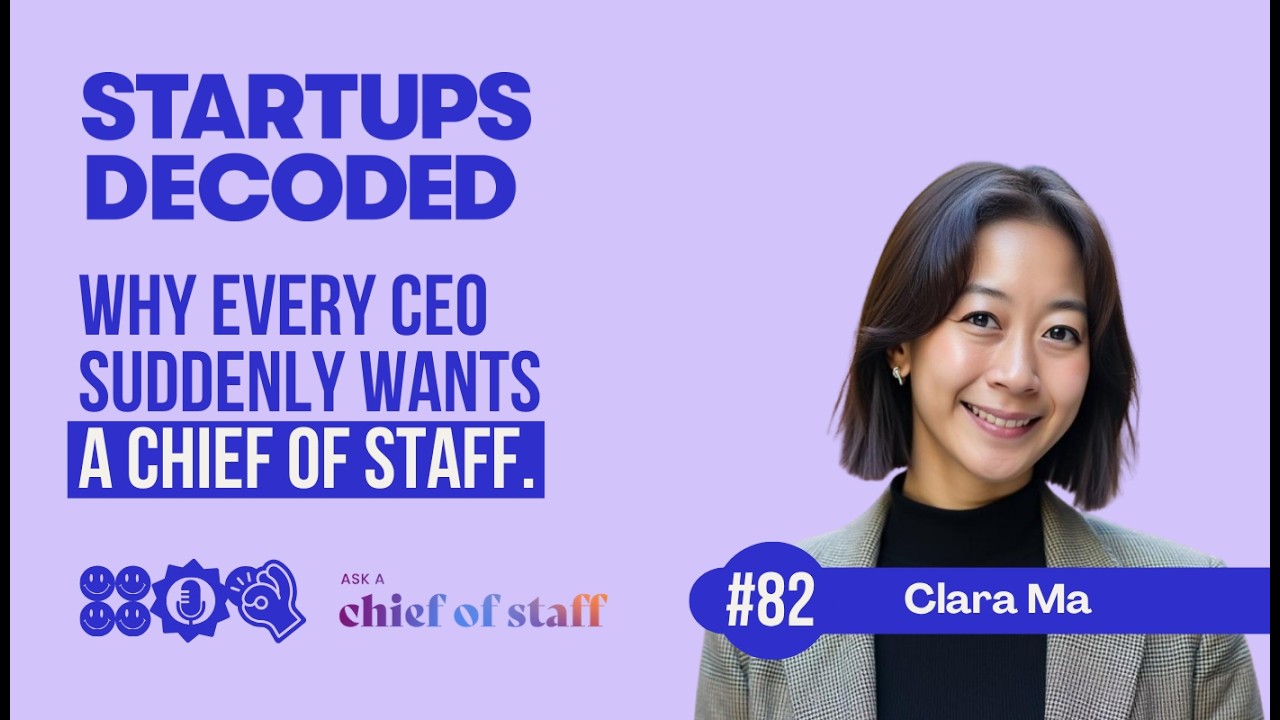
Clara Ma, founder of Ask a Chief of Staff and former chief of staff at Hugging Face, explains why AI hasn't replaced the role but made it more critical. The chief of staff is a generalist with a spike who translates CEO vision into action, and AI tools like Claude and Whisper augment rather than replace their judgment.
Chapters
I always like to say that chiefs of staff are a generalist with a spike, right? So you have to have this ability to fill in a lot of different gaps, learn a lot of things from scratch, but it really depends on when you join the specific company and what they need to optimize for in that first kind of 30, 60, 90 days of you joining the company. I've worked mostly at early-stage startups where it's plugging in a lot of gaps. And so when I was hired on as a chief of staff, there were a ton of different functions that needed to be built out, like an HR function, a more concrete finance function, things like that.
Welcome to Startups Decoded, the show that gets real about what it takes to build a successful startup. I'm Andy Walsh, 2x exited founder, advisor, and your host. Each week I talk with great founders and top investors. We unpack the plays that drive real traction. If you're building something bold, this is where you'll get earned insights to scale with confidence. Let's keep growing together. Hit subscribe and share with your community. It would mean the world to me. Hello and welcome back to Startups Decoded. My name is Andy Walsh. We touched Chief of Staff role when I first started this podcast 18 months ago. The role of AI was just starting to see an impact. But fast forward to today, we're looking at a very different world and people forecasted that potentially AI could eradicate the Chief of Staff role. But what we're actually observing now is almost the opposite and the importance of that role. And to help put some color on that, I'm really fortunate today to have Clara Ma joining me. Welcome to the show, Clara.
Thank you so much for having me.
I love this. We were just saying before the show, I read a great article when I was doing some research about our theme today, and it really summed up beautifully the intersection of what you've observed and the community you've built. But to help set up the conversation, I'd love to hear a little bit about you, and I'm fascinated with what you're doing today, but let's give some context to who you are and how you landed up in the Chief of Staff role.
Absolutely. So, my name is Clara, and I'm the founder and CEO of Ask a Chief of Staff. We're a platform that's dedicated to uplifting and demystifying the chief of staff role, and I think in today's day and age, that feels more relevant more than ever. Uh, the company really is a solution to what I wish I had had when I was a chief of staff myself. This was about 6 years ago. I was the chief of staff at Hugging Face. Back then, they were a Series A startup, very much relevant in the AI world today. I'm sure you may have seen some news about them recently as well. But, you know, during that time, the chief of staff role, I would say, was pretty much as undefined as it is today in some senses. I would say it was less popular back then, not as many people held the title. And so, I really wanted to create a community space where people could come together, share best practices. And now, as the role has evolved and it's become more and more prevalent in early-stage startups, as well as, you know, the corporate tech world as well, what we're finding is that this, this role really finds a lot of value in being this transformative, kind of chameleon throughout the organization. So, excited to be here to chat more about chief of staff stuff and what we're seeing as AI becomes more and more ubiquitous, it feels like, within every part of the organization.
The timeline is fascinating, and I'm seeing these conversations pop up more and more now where it feels the dust has settled a little bit. People are starting to observe the impact of AI on culture, on workflow, on roles, so many things. And there's a lot of people that are starting to report insights now as And the chief of staff is an interesting one because, as I set up at the start, it's one of those roles that people thought that with a really automated and organized system, that it could be one that starts to dilute and disappear almost as well. And what we're now seeing with the research is quite the opposite. To set the scene, even from small size to larger size, what are some of the bigger things that you're seeing now shift with the chief of staff role?
Yeah, I think with the nature of a chief of staff role is that it's always been kind of a glue slash like chameleon in nature, right? And this role is really dedicated to helping usually a CEO at an early stage company. We usually call that person your principal or the executive that you're supporting. And so, wherever that CEO's focus is being drawn, a chief of staff is going to come in to really be that force multiplier for them so that the founder, the CEO can be as efficient as possible. And so, because there is such a focus on AI, right? What does it mean to be an AI-forward company, an AI-native company? What does it mean to enable more of your employees to use AI? These things are, are usually kind of coming up from the top. So, an executive may decide, okay, we need to be getting on this AI trend of being more efficient, automating some of our workflows, maybe using tools that are AI-enabled. But what does that actually mean in execution? And that's where a chief of staff can really come in to help turn that into reality. Just like anything else that a CEO might be handling, they're setting the vision, they're giving you a big picture, but a chief of staff is really crucial in translating that into an actionable plan for the rest of the organization to get on board with and move forward.
The observation that I see, like this hybrid nature, particularly with CEOs, of it's an executive assistant, but then there's also that the HR component as well, and teams and process and how you are ultimately being the most effective you can be. And, and that translation element is critical, right? You need someone who can understand vision. The CEO's not gonna sit there and write out a strategic plan, of all the things that they're working on, it's like understanding the separation of roles. In that early stage, how early are startups putting in a chief of staff role? And then how does that role start to change and shift over time?
So the short answer for anything chief of staff related is it depends, right? It's so dependent on the founder, who's running the company, what the company mandate is, whether it's a services company, a SaaS company, things like that. So, the big signal that we use when we're doing recruiting for executives is when is the founder or the CEO becoming the bottleneck on the company, and they're spending too much time on like the synthesis, the coordination, the turning the strategy into execution, right? And we want executives to be focused on what we like to call their zone of genius. Like, why are you the person who's running this company and leading the charge on this particular venture? And what are all the other things that can be delegated to somebody else at sometimes and more likely than not at an executive level? You need someone who's going to be able to kind of own these things, build some of these things from scratch, 0 to 1, especially at your earlier stage startups. So, we've seen chiefs of staff as, as early as like they're essentially the first employee post-CEO, and they're kind of like helping build the, the, the company from the very ground up. And then we've seen companies that, you know, will wait until 150+ people and they're feeling like, okay, we've just raised maybe our Series B or a Series C, and like now the founder is feeling more strapped for time or, or just the amount of information that they need to synthesize is way too high for them to be spending time in all of these different department meetings. So a chief of staff can come in and help them kind of alleviate that workload. So there's no wrong answer. When I joined, our company was only 10 people. And again, I've seen a variety of different stages and sizes of companies bring in their first chief of staff.
It's interesting that the evolution of the role now and the breadth of skills that you need to have. And the time when it was very just people-focused, now there is definitely a breadth of skills. It feels like you need to be a generalist per se. There's things that you need to shine in, but you also need to have knowledge of a lot of things as well. If you were to look at the skillset of a contemporary chief of staff today and compare looking back, what are some of the things that you now have to have on that list of skills?
I always like to say that chiefs of staff are a generalist with a spike, right? So, you have to have this ability to fill in a lot of different gaps, learn a lot of things from scratch, but it really depends on like when you join the specific company and like what they need to optimize for in that first kind of 30, 60, 90 days of you joining the company. So, I can give myself as an example. I've worked mostly at mostly early-stage startups where it's plugging in a lot of gaps. I've done everything from writing marketing newsletters to like getting on sales phone calls to helping map out, you know, product roadmaps and things like that. But my background originally started in recruiting. No surprise that I'm doing some sort of recruiting now. And so when I was hired on as a chief of staff, there were a ton of different functions that needed to be built out, like an HR function, a more concrete finance function, things like that. But we had just raised our Series A, and the main thing that we were focusing on at that point was Doubling, if not tripling our team size. And so, that's where my recruiting spike really came into play because I was able to come in and take a pretty haphazard interviewing system and turn it into something that was more repeatable, scalable, applicant tracking system, take-home, all of those things that you typically see at a later stage company and just haven't been built out yet in early stage company. And so, what I generally see for the role change throughout a company continuing to grow and scale is that early on, as a chief of staff, you're doing a lot of execution work, right? You're kind of the one making these things happen simply because there aren't that many people at the company. There's a lot of projects and a lot of functions that don't have a designated owner that have kind of been kind of spread out through the organization as like you hire those early employees, but you are going to kind of be the one to help clean some of that up and then really kind of set the foundations for what's to come. Then as you move on to a Series B and C, those functions are kind of built out already and you start to hire some functional leads. You hire some specialists who are really going to be deep. And so, as a chief of staff, you no longer have to do the execution on the ground, but you need to be able to understand what's going on at different departments and see this kind of like the forest for the trees, right? People are working on different things. You need to be kind of surfacing if there are any red flags or things that are lagging up to your principal so that they don't need to be in every single department meeting, but they have a general understanding of what's going on and are only stepping in when like a crucial decision needs to be made or like a department is really falling behind for whatever reason. So, I would say early stage executive, like operations, a lot of like on-the-ground work. And then as you grow in scale, you become more of this, I like to call it like a people wrangler, right? You're getting a lot more information, you're synthesizing a lot more information, and you're helping your CEO or your executive make better decisions.
That tracks. I use a framework and I talk about a lot on this show, which is that early stage of growth hacking where you're trying to identify signal and find things that are working and landing. Second stage is where you're building process and you're starting to optimize for consistent signal. And then the third stage is when you're scaling and it sits really nicely alongside what you were saying there. It makes a lot of sense because you have this 2 sides, like a bifurcation almost, where you're happy in the administration component, but then you have the intelligence component too, right? And those 2 things need to be in perfect sync to optimize what you're doing because they feed each other to be the most effective and the most innovative and progressive as well, because you need that to shine.
Right, absolutely. I mean, like I said, you're growing alongside the executive you're serving, right? So, it's, it's very similar with what the CEO's working on in that very beginning stage. You know, you're getting your first customers, you're trying to figure out like, does this company have legs? You know, is it, is it even going to survive? And then, you're going to keep growing and scaling, and, and your chief of staff role is going to grow alongside you. And so, that's also why I see a lot of chiefs of staff, like, after a couple of years, they tend to move on because you can grow and scale, and sometimes people like Really enjoy being like, oh, I was kind of the operations person at the beginning and now I'm the product and scale person. But for me, like personally, I loved operations. Like I loved being that zero-to-one function builder. And so, for me, if I were to ever go back to a chief of staff role, like that's probably where I would be most comfortable is like, okay, I really want to kind of go back to that building phase. Whereas there are chiefs of staff who are more well-suited for that kind of like later stage Series C where like the growth and scale is something that's really in their wheelhouse. So, I always tell people it's, it's very much like dating, right? When you are finding a company or an executive you work with, like I may not, uh, even though we both might want chief of staff roles, like where I'm a chief of staff and where you're a chief of staff can be very different environments.
And I love that too. And the stage-specific nature of what it is, because the title is, can be open-ended as we've carried through so far. So understanding what stage you're at in the role that you play, and because that, that people relationship element, as in you one-on-one and being that wrangler that you talked about.
Mm-hmm.
Is a very different personality type than someone who can just look at lots of information, digest it, and turn it into some kind of organization and reduce chaos. And doing both can motivate different people for different reasons, but both equally important.
Exactly. It just depends on the stage where the company's at. And I think so much of this role is meeting people where they're at. You know, we talk to probably hundreds of candidates per month, per week, and we really try to dig into like, people, some people are like, oh, I like love to be the person who's writing the playbooks, right? Like, I like to be the person who's putting some of these functions in place and like taking a very broad set of skills and, and kind of implementing them at an early stage versus there are some folks who are like, I don't want to do so much of the execution. I wanna be sitting closer to the strategy and like kind of being that voice of reason to my CEO. And so, we try to match people up based off of where their skill sets align and the stage of the company and also where, where the executive is at.
That tracks. And for founders that are listening and thinking about that stage-specific nature, it's really important when you're going through the hiring process yourself is to think through the culture fit, obviously, the sense of, is this person the right person who can come in and amplify your own vision and maintain what you're doing as a founder and scale that and scale you ultimately. But then also the day-to-day function in what skills they bring and how early you're hiring that person. So good one to take away from a founder perspective. I want to double double-click on the, on the day-to-day side of a little bit from an AI tool perspective.
Mm-hmm.
There's so many things out there and unfortunately the market is still very fragmented and we all wrestle with that now where it feels like your tech stack is just bursting at the seams and it's hard to know which ones are necessary and which ones aren't. As far as, like I said up at the start, that we see the dust settling a little bit, are there some things you are seeing people use consistently and using it well? That helps optimize some of that management, communication, tracking, things that elevate and optimize that role?
There's a couple tools that I can name and I can give you some, some like exact names, but also just the general function of what it is. One, I think every chief of staff should have some sort of note-taking tool, right? If anyone's still doing manual note-taking, like I think you gotta move on from that. And so, you know, there's, there's plenty that sit in your Zoom, you know, you have like Zoom itself has one, has note-taking now. You have Granola, that's really popular with a lot of folks, Otter, things like that. So, I think every chief of staff, you need to be able to have some sort of note-taking tool, but beyond just the note-taking and having really great context, being able to see across, right, a bunch of different meetings at once, right? So, you know, most companies, they'll have like a quarterly business review, they'll have a weekly leadership team, things like that. So, not just each meeting kind of having a great capture, but being able to see across that and And so we're looking at things like, you know, Claude or ChatGPT to be able to synthesize across multiple meetings all at once and give you additional context. And you can even pull in like emails and prior context that really will help you give a more rich picture. And then it's up to the chief of staff to then take that and be the human in the loop, right? Like, this is giving you a lot of information, but ultimately you are making the decision. Like, I really hesitate to For anyone to truly call like a Claude or a ChatGPT a replacement for your chief of staff, because that cultural element that you had mentioned earlier, that's where your human sense is really going to come into play and be your judgment and discernment in order to understand, okay, like what does it, what is it that's important to my principal, right? The priorities that they have given me, what can be, what are the things that you are working on today versus tomorrow? What are the things that are top of mind this quarter? That's where the chief of staff judgment really comes in. And then the Last tool that I personally like— this really depends on whether you're like a more, uh, audio, like auditory thinker like I am— but I, I love Whisper, and I always recommend that chiefs of staff use Whisper for drafting any long, like, strategy docs or anything like that. And it's a voice dictation tool. So again, you could use whatever you're most comfortable with, but I find that in this world where we tend to want to, like, write a lot of things now because AI can help us write a lot better, using a dictation tool actually gives your kind of more raw thoughts more space to flow, right? The moment we start typing, we start to self-edit. And so using dictation, you're able to kind of just list out all the things that are top of mind for yourself and then again, synthesize the information post. And I have really kind of tried to encourage more and more chiefs of staff to allow their stream of consciousness to kick in a little bit more. Now that AI's giving you back time on like things that are, can be automated or are a little bit more admin-focused, taking that time to like speak through what it is that you're thinking about so that you can utilize your deep work time in a more efficient way.
I've been playing with Whisper. It's nice. It's still weird. I know some people that have gone quite heavy on voice only and limiting typing now, and it's, it's a real behavioral shift in getting used to doing it, but it's really interesting. And I'm, I have the luxury of recording a podcast for 45 minutes to an hour every week. So I have transcripts for days on How I talk, the way that I communicate, and I have a live Claude project that tracks that. But even then it still doesn't capture the essence of me and how I would talk, my verbiage. And it's just an active learning process. So Whisper is a nice way to just brain dump ultimately lots of ideas and thoughts and get structure around what you're doing. And that can happen really quickly with a, with a tool like Whisper. So I like that one too. You touched on there around the culture element and I I'm personally a big advocate for human connection and the automation in my mind, and everyone is starting to see and feel it in their own way now, is that automation is great, but it has a ceiling. That curation element of being a human being, understanding the nuance that exists in certain conversations, tone, body language, context setting for other folks. There's so many little things that you do and that comes through years of experience.
Yeah.
Like if, if you were to go the doomsday approach, you'd be like, well, I can just get some 20-year-old, pay them next to nothing, and they can just run an AI tech stack and be able to do the same job. And I promise you, if they sat beside you for 3 months, there'd be polarizingly different results of that person. Mm-hmm. Because they don't have that education and curation element to put a filter over the top that has a level of common sense and life experience.
Yeah, yeah, absolutely. I mean, I think this is the, the thing that I always kind of run into with AI. It's like, yes, of course, like everybody should be touching, learning some element of AI, of course. But there's so much context, like when it comes to running a services business or even like a SaaS business or anything else where having that kind of overall business acumen is only something that you can learn while talking to other people and, and, and understanding like the different contexts of when to use even certain vocabulary, right? Like certain Yeah. Turns of phrases and things like that. And so, you could hire a 20-year-old who's like really good at automating stuff, but what I found is that without enough context, like I'll just give a, a rough example. Like we run a recruiting service here on our company and I encourage my recruiter to use AI, but the only reason why I know that the outputs she's getting is extremely good is because she's had conversations with thousands of candidates. She's done recruiting for years and years and years, and so, Everything that she's looking at, she's kind of mentally translating into like the recruiting sense once again, and then like talking to CEOs and clientele that we're working with. If I brought someone in off the street, as good as they are at AI, if they've never had any recruiting experience, the things, the outputs that we're going to get from them are going to be extremely generic and like not at all shaped to the business and how we run things. And so, I always think of AI as like, it's a really, has a, it's a long-term memory intern, right?
Yeah.
Like you can tell this person something and they'll always remember it. But if you don't give it additional, it's, it's hard for it to pick up cultural context. Like it's a robot at the end of the day. But also like the specificity at which you need to actually tell them, tell it, I should say, like this, this is kind of the set of rules that you need to follow. It really doesn't have any human judgment outside of that. It can only follow exactly what you have told it. And again, that's why we need human judgment. Like business today is still done human to human at the end of the day. Like none of us are going to send in our AI agents as proxies for us. When negotiating a deal or a contract. And so, you know, for anybody who is looking at, I would say, hiring a younger generation that has like, is very AI native, but not necessarily business fluent, like that's one thing I would really encourage you to invest your time in to train somebody up or give them more exposure to the meetings, the context, like how things are happening in a human perspective.
Great advice. And I had Eric Ries join me for a fireside chat on his new book, and he talked about, in his view, that AI being a tool that augments and doesn't replace. And it's just a simple way to reframe the way that you use it. And it takes experience. And if you're trying to shortcut, I've seen it happen. And I advise and work with a range of founders every day, and their tech stacks are so broad and they're trying to context switch, they're trying to understand all these different things. And a lot of the time it falls flat. on its face because they don't have the depth of experience to do it. And the automation becomes so intense to manage because you always have to double-click and learn more and do what you're doing. So the shortcuts aren't as great as what people see. So I love to be able to remind people of that is think about the expertise that you have around the table and the augmenting element to it of, yeah, you become more effective, but if you're not making a decision, Because what it's doing is distilling down so much information and it's trying to have a point of view, but all it can do is glean all of these facts and then have a representative sample of what it's saying to you. And in the context of what you're doing in that moment, it's never going to have that sharp focus that you've had by living examples. It's representation. And that's the part that I see the difference. It doesn't have a sharp pencil is the way that I would describe it.
Yeah. Yeah. That's a great way of putting it.
You touched on there a little bit about collaboration. I had a really interesting episode with David Shim, who's the founder and CEO of Reed AI, and he was the former CEO of Foursquare, which was a little cult hit there for a period of time. And fascinating guy. And he was talking about digital twins and the ability for you to show up in multiple meetings at the same time and contribute depending on the context of what it was. And that's an interesting sort of take as far as how you can maximize your own time.
Yeah.
But it still requires so much information. And I had a play around on Delphi and I have a live chat version and I trained it on lots of my information. And it's interesting cuz it gives advice to people without me being in the room.
Yeah.
Obviously with a, with a few disclaimers underneath the bottom. It's like, yeah, like need my little warning there. But it, what's interesting though is I get to see what people are asking of me or my digital twin, but it still comes back to me and my expertise. And that's, and that's an active process and we all need to learn and grow together. The part that I am fascinated about, which is why I raise Reed, is they're looking at that cross-training of folks. And the example that David gave was if you're a salesperson and you're overperforming compared to everyone else, you're recording the transcripts that goes back into the engine to be able to self-optimize that across everybody. Where if you have training tools and things that people are using, how do you analyze and assess the best practices of that conversation? Why is that person— Doing better than the person sitting beside them in the same team with the same materials and being able to use that to upskill everyone concurrently. Have you seen examples where that self-optimization becomes dynamic, where you're able to glean lots of information all at once from different folks and reapply it to the way that you operate from a process structure?
Yeah, I think this is one, this one's an interesting one because I think it's, it's very dependent on what exactly, like your function, right? I think for sales, like there's probably decades of sales training. And so there's a lot of best practices that you can kind of compare across. Like even for myself, like I'm not formally trained in sales, but as every founder knows, you know, founder-led sales is a big part of the, the building process. And, and one, it's getting on more sales calls, you get more comfortable, like you're going to get better regardless. But then trying to figure out, so like the balance between, okay, these are the objections that I keep getting, right? You can look through all your sales calls transcripts and see like, these are the objections that I keep getting. How can I kind of, uh, get ahead of it when I'm, I'm doing my initial pitch? Versus, you know, what are the kind of turns of phrases that I use very often? Are those actually landing? Things like that. So from a sales perspective, I think there's definitely like a lot of self-optimization for, let's say, something that's like a chief of staff role. I think where I've seen chiefs of staff really kind of utilize something like a Claude or ChatGPT is actually through kind of almost like leadership coaching or executive coaching. And so one chief of staff I talked to, she actually created like a essentially a coaching agent for herself and was feeding it like her previous performance reviews and things that, you know, she had discussed with her CEO in their one-on-ones on specifically things that she needed to improve on and things like that. And basically had the coach help map out her career plan for her and said like, hey, you're like a, you know, let's say like Harvard-certified, like executive coach, you know, what are the things that I need to work on in order to be a better leader in the future? And then help me map out potential pathways of like where my chief of staff role can end up if I wanted to start my own company, if I wanted to head up a function, if I wanted to remain in my chief of staff role in the next 2 to 3 years. I think that's where AI can really kind of help augment that thought process. I mean, yes, you can hire an executive coach, and I say, if you can afford it, please do. For many startups, right, this is an expense that just can't be afforded just quite yet. And so, AI can be a good stand-in to help you be a little bit more of that thought partner and bounce some ideas off of so that it can help you create more of a long-term plan of your career goes. And I think that's where a lot of chiefs of staff often get stuck is like they do so many different things. It's like, what comes next after this role? Having an idea of like what to work towards and then having kind of like that concrete feedback from your executive because your executive is generally not helping you map out your career as any other manager would. That's where I've seen AI be a really helpful kind of like career optimizer for folks.
Never really thought about that. If you're at that level of the chief of staff and the CEO is ultimately your boss, it'd be rare, I would imagine, for them to sit down and start thinking about career progression and, and your own growth strategy and things that you need for yourself. So, a lot of that would be self-optimization, I assume.
Yes, exactly. I always tell people that the only person who's gonna advocate for you as a chief of staff is yourself, right? Because if you're a great chief of staff, your executives wanna keep you forever. Like, why would they want to give up someone who's like helping them, taking the workload off? You know, they have all this institutional knowledge, things like that. And so, It's a very common dilemma that we see lots of chiefs of staff run into is kind of at the 2-year mark, they're like, what am I, where am I supposed to go? Like, I would be happy staying in this role, but just making sure that the role works for you. And if you are looking to move on from this role, what comes next? What can you do? Because you've done so many different things, where do you want to optimize your career path, right? And so, again, kind of using this as a thought partner or an executive coach stand-in, I think can be really helpful, especially when it feels like, you know, you're, you don't have that same peer network within organization as well. And then, you know, any, anybody that you speak with, like you kind of have like the CEO, like aura mandate around you. And so sometimes it's hard to get like a truly honest, like personal answer from other folks around your company if they know that you are, you are the proxy for the CEO.
I just did an episode with, uh, Jordan DiPietro, who was CEO at Hampton, the exited founders club. He's had some huge jobs historically, The Hustle when it was acquired by HubSpot. And he's such an interesting character, but he talked about it An EA, which was ultimately for him a chief of staff role, hit a ceiling. And what he did, 'cause he wanted to retain her, was actually sat down and asked her some questions about things that she was inspired by, where she could grow into. And he ended up getting her a coach and mentored her to upskill her to take on a new role 'cause he wanted to retain her rather than her go out and do it somewhere else. And I love that, that human approach to acknowledging someone rather than that person feel like they have to leave to feel their next challenge. It's actually keeping them and seeing if there's something else Within that breadth of skills that they have that they can upskill and focus on one and go on another path.
That's, that's a huge part of the value of a chief of staff as well, is that most people, again, this is not all chiefs of staff, but usually it's a 2-year tenure. And then it's because it's a very high-paced, like very fast role. You're doing a lot, you're drinking through a fire hose almost every single day. It's not just your first 3 months. And so, you know, after kind of seeing the business, There's sometimes a, a specific area that you want to go in. And, you know, I think, like I said, a good chief of staff, every CEO will want to retain them in some capacity, right? Whether it's becoming the head of a new function, whether it's staying on as a chief of staff, whether it's sometimes getting promoted into a COO role. And so, I think that a chief of staff can be very vocal in advocating for themselves to create those pathways for, for them. I always recommend every chief of staff, every quarter or so, have a like mini performance review with your executive because so much happens in those 3 months of like what went well, what didn't go well. If I'm gunning for this kind of position, where do you think my skill sets are still lacking? And the, the kind of great thing about this role is that no part of the business is off limits to you. Get kind of purview into everything. And so use that to your advantage, right? Because your role as a chief of staff is kind of like filling in the gaps and you're picking up a lot of slack around the organization. You can use that to your advantage to then dig into parts of the organization that you want to explore more, and that is all still part of your Touching on that, the fact that you do have visibility everywhere, what are some of the things you're seeing in the, ultimately, the cross-collaboration between teams?
Because it's easy to get siloed, and we're seeing obviously an increase in remote teams, which is a cultural shift and an operational shift. How do you optimize to get the best across divisions with a company as you grow? Because communication and sharing tools is one thing, but if, if your left hand's not talking to the right hand internally, then again, you're missing out on so much opportunity. And now it feels like there's a real potential downside that we're starting to see play out with the remote workforce on automation, on AI tools, that there's more cracks that could open up.
Yeah, I, so a couple of different things, right? Even for fully remote teams, we always recommend like you need to meet up in person at At least once a quarter, if not more, because that in-person communication is where a lot of kind of just organic, like, camaraderie, but also brainstorming happens. It's kind of like the water cooler, what the water cooler used to be, right? Of like, oh, like, what are you working on? And just having that. If you don't have that cadence of in-person, then how do you build that into your operating cadence and your meeting cadences, right? One company we did, like, I think a lot of companies have, I don't know if this is still a tool in Slack, but it was called Donut, where it would basically match you up with somebody who's not, who's outside of your department within your company and just encourage you to do like a 30-minute virtual coffee. And again, just gives you a sense of what's happening outside of your department. Interesting thing about AI is that it's given people access to a ton of knowledge, but somehow is also like siloing people into their function a little bit more because they're like, oh, well, now I have this like wiki agent I can ask about like what marketing is doing. I don't need to like talk to marketing anymore. But in reality, like that is not always the best source of information. And again, building those connections across departments is also going to help give you a bigger picture. And so, I always try to tell people, uh, chiefs of staff at, at organizations, like, you really, as a chief of staff, your job is to make sure people understand why they're working on the things that they're working on, right? Like, if we have a target of this many, like, sales calls within the next however many months, like, what is that ultimately tracking towards that the— is the north star of our company? And every single person needs to understand, like, what they're doing, how does that contribute to the big Because if people lose sight of what that big picture is, that's when they start making bad judgment calls because they're only thinking about like their department or their team. And those, those decisions oftentimes, like, they don't translate up. It's like, oh, but we hit all of our goals, but for whatever reason, like, we haven't moved the company forward in the same way that we thought we did. Or, you know, everybody has no idea what everybody else is working on and we don't know how it all fits together. And so, as a chief of staff, we always like to say you work high-low. You kind of like see the forest for the trees, but then you're also on the ground kind of listening to the foot traffic and seeing what people are saying so that you can help surface things before they become a fire, hopefully. Otherwise, you are the one fighting the fires as well. But again, in a world of AI, like, I really encourage, like, if it's an easy, if it's a question that has a direct answer, fine, ask the agent. But if you're thinking through something with some about what you're working on or a strategy doc, if you can get a person to do it with you, I think it's beneficial for the entire organization.
Yeah. Like any good ideas, they require different points of view and different contexts, and cross-team collaboration has historically proven in research and in internal success that someone could have a different point of view that allows you to do something that you'd never even thought of because they came at it sometimes very objectively because they don't have that myopia. And I'm currently reading Hidden Potential, Adam Grant, at the moment.
Oh, good.
Yeah, I would assume that you would love it because like there's a whole thing there around hiring people and that's one of the last chapters and he talks about the things that we don't know. We try to put everyone into the same bucket and assess them on equal terms when people all have different backgrounds and how flawed the hiring interview process is that's used stereotypically across most companies, but going off on a tangent, but one of the things that I love about Adam and his book with that hidden potential element is that the best performing teams are the the ones that actually are connected more. It's not the ones that have a higher IQ, it's the ones that actually have social perceptiveness and have the ability to listen. And that collaboration is key to how you grow together because that's where you win. If you become too siloed and you're not talking to each other, they, it, you miss out on opportunity. And sometimes that's hard to measure, right? It's hard to quantify what you've lost if you haven't even begun creating it. Whereas if, if you start it and do it, and 3M have this great culture of innovation that everyone is encouraged to a portion of their time on innovation because like your failure is celebrated because it's not a failure, it's not working out, but it can create something else that then gets used for something else. And there's this element of innovation that's baked into who they are. So for me, stepping outside of optimization and for optimization's sake and actually being human, because there's so much out there to prove that it's necessary, it's not a nice to have that connection.
Yeah, absolutely. And, um, I'll add a book to, to your reading list too, if you haven't read it already, but Range by David Epstein is a great one. I mean, it just really goes to show that oftentimes, like, the solutions to the things that you are thinking about, it, when you're too close to the problem, you can't think outside of the box and bringing on extra different perspectives, people with different backgrounds, people who've solved things in different ways, like, that's actually what will give you the most innovative solution when it feels like the things that are tried and tested aren't, aren't working out. And so, yeah, those are, those are both great books.
Yeah.
books that I would, I would highly recommend to anybody who's in any capacity, doesn't matter.
David Epstein has another book coming out soon too, which I'm excited by, but I've read Range multiple times. There's so many stories they're confronting, like the firefighters who get parachuted into the Californian hills. There's a story there. It's kind of harrowing and sad, but also just how hardcore these people train on acting and behaving in a certain way and how in certain cases it's counterintuitive to your own survival, even though they tell you it's done. And they're using the law of averages ultimately in the way that they're doing based off a whole bunch of information. But I love that book. So I have that one, Stolen Focus by Johann Hari is the other one I recommend everyone reads. And then Hidden Potential is another one too. So yeah, really there's so many good books out there, but I try and narrow down on a handful if I do recommendations.
But amazing.
Um, not our book club today. Continuing on, I would love to talk about culture here in the sense of if you are thinking about hiring, how do you pair up and matchmake to a certain degree a good chief of staff to a CEO? Because a CEO is a very certain type of person, particularly in a startup. And I'm not gonna double-click on the stereotype of what a founding CEO is.
Yeah.
But they're a certain type of personality. How do you start to think about that pairing? How do you go about finding that person, how they meet each other, and how do you optimize that process to make sure that you've got the best chance of both finding the right pair? Because it is, you said up at the start, it's like dating in a way. You could find someone that's good, but you need someone that's great to make that shine.
We like to use the dating analogy quite often. And so it really starts with a very intense intake with the CEO to really understand like what it is just beyond the surface level of like, why are you hiring a chief of staff now? Which the answer almost always is like, I'm out of time. You know, I'm the bottleneck to decisions. I need more hours in a day. And then kind digging, digging past that, right? Like, why do you need more hours in the day? Where are you spending your time? What is your zone of genius? And how can— like, what are the things that you need to delegate to somebody else for you to spend more time there? And for different founders is different, right? Some founders really like being that sales, like founder-led sales, and they want to spend more time there, and they don't want to deal with the operational, like, systems and functions and building those things up from scratch. Um, others are more tech-focused, and they're very much on the product roadmap side of things and need somebody who's going to to help, you know, build up other parts of the business. And so, really understanding that 30, 60, 90 days, where's the chief of staff going to come in to make the most focus? And that's usually like the spike that we're looking for. And then forecasting ahead, right? Where do you see this role going? Do you see this as a 2-year, 10-year role, or do you see this person growing alongside you long-term? Because that's gonna look at, look like 2 different kinds of profiles and personas as well on the candidate side. And it doesn't have to be hard and fast set in stone, but the more information we have about why you're looking for a chief of staff now and what you expect of the role, the better we are going to be able to find the candidates that match that. At the end of the day, it is a chemistry check that we always kind of end up with. Like, we can find you the perfect person on paper, but if you do not wanna spend, you know, however many hours in an airport with that person, it doesn't matter like how good they are, how AI fluent they are, whatever it is. And so, at the kind of bookending it, we always say like, once we get the candidate in your pipeline, talk to them, do the 30-minute call in the beginning as just a kind of vibe check, then put them through the paces of the take-home, the working session, talking to their super Last piece, like, go out for coffee, go out for lunch, right? Like, just have a kind of like lower stakes kind of casual interaction and just see if, are you able, do you feel like you could trust this person with even your personal life, right? Because this role is so intimately tied to each other that oftentimes, like, the personal life is going to come into play. And so, how can you, that is not something that you can check off on a piece of paper. Like, we can do our best to get you there, and like, we can, we've done things like, you know, Myers-Briggs, there's like the Gallup StrengthsFinder.
Yeah.
like CliftonStrengths polls and tests and things like that. But at the end of the day, we always encourage like an in-person final meeting before any offer goes out.
So good. And reflecting back on Adam, he, he talked about when you're interviewing someone is to actually host them and actually treat them like they're someone you're giving a tour to the company, asking them questions and building personal rapport, particularly in a first interaction with someone as well, because they're It immediately breaks down that barrier of nervousness and, and anxiety and things that creep in, in that conversation. And there's some great tips in that too. So I love that. To finish up today, I'd love to just hear a bit more around Ask a Chief of Staff and what you're doing there with your community.
Absolutely. So like I mentioned earlier, we're a platform that's dedicated to both uplifting and demystifying the chief of staff role. And we do that in 2 main ways. One, we're a membership community for current chiefs of staff. So chiefs of staff can come to us, find a safe space to talk through their challenges, their obstacles. We provide them with weekly webinars where we talk about a variety of different things that you might tackle in a chief of staff role, board meetings, best practices, AI fluency, change management, all of that stuff. But we also provide mentorship as well as executive, executive group coaching and in-person events all over the US as well. So if you're a current chief of staff and you're looking for peer network, come check us out. Then the other half of our business is recruiting services for executives and CEOs who are looking for a chief of staff. So CEOs can come to us, tell us what you're looking for in a chief of staff, and we'll run the search end to end for you from screening out hopefully hundreds of applicants that you might get and you down to the top, you know, 7 to 10 for you to interview. We'll even help coach you through the interview process, the offer negotiation phase, and get that person in seat. When we hire a chief of staff for you, they get free access to our community as well. So not only are we there to help you find the right person, but we're there to help onboard and get them set up for the position as well.
Amazing. So good. Such a good service. And I will share all the relative links, et cetera, in show notes. And Clara will be tagged in any content that I push out too. Thank you so much for today. That was super insightful. And the timeline, it couldn't be more perfect on where we're at right now. So I appreciate you joining me today.
Of course. Happy to be on here. Great conversation with you, Andy, and hope that we get to chat again soon.
Thanks for listening to Startups Decoded. If today's conversation helped you think differently, share it with a founder in your network. And don't forget to subscribe for real-world startup insights every week. We really value your support. If you're interested in sponsoring the show, email hello@startupsdecoded.com. I'm Andy Walsh. I'll see you next week.
More from Andy



EP#88: Why Most Founders Misread Their Own Traction. Vanessa Larco - Premise VC

EP#87: Founders Obsess Over the Raise. Investors Care About This More. — Carina Cunha






Ep#86: Early Decisions That Define Your Startup Forever. With J.P. Morgan Asset Management
