Ep#85: The Finance Skill Most Founders Never Learn - Brett Turner, Trovata
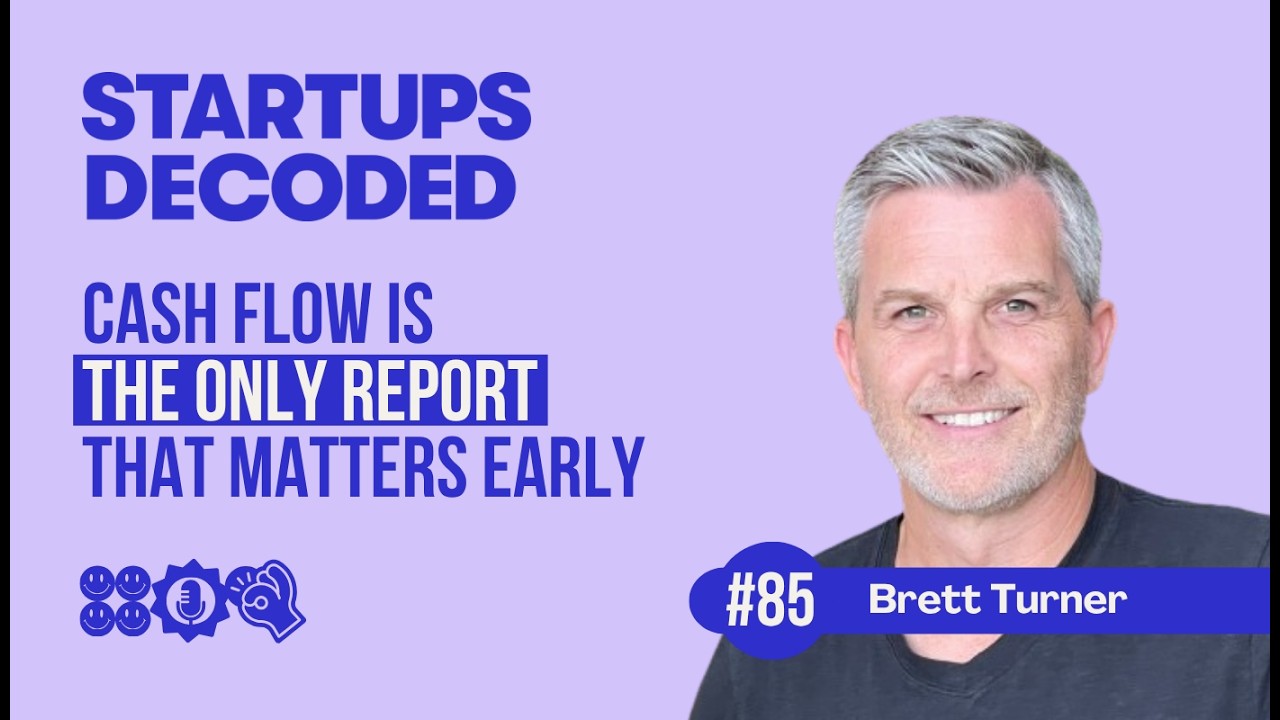
Brett Turner, CEO of Trovata and former CPA at Deloitte and Amazon, explains why founders confuse their accounting P&L with actual bank balances. He covers filing 83(b) elections, building the right finance team at each stage, and why cash-centric finance matters more than most founders realize.
Chapters
It's that rude awakening when somebody, you know, that maybe that you look at the P&L that came from your accounting system, and then you look at the bottom line and it says, okay, you're losing a certain amount of money. And then you look at the bank account and you say, hmm, it's different. Why is that? That starts the journey. Once that curiosity hits, you'll figure that out or else you'll learn the hard way.
Welcome to Startups Decoded. The show that gets real about what it takes to build a successful startup. I'm Andy Walsh, 2x exited founder, advisor, and your host. Each week I talk with great founders and top investors. We unpack the plays that drive real traction. If you're building something bold, this is where you'll get earned insights to scale with confidence. Let's keep growing together. Hit subscribe and share with your community. It would mean the world to me. Hello and welcome to Startups Decoded. My name is Andy Walsh. For a lot of founders, finance is a skill that they either don't have or don't want to touch. My guest today, Brett Turner, started as a CPA and then moved into a founder, and I'm fascinated about his story for a few reasons. One, because understanding treasury and everything that goes around it is a critical skill, but two, he's learned a lot in his shift from corporate world into being a founder himself. So let's dive in today. Brett, welcome to the show. Thanks, Andy.
Great. Thanks for having me.
I am a numbers guy. It's funny, I get typecast as the creative guy. I'm not sure if it's where I live. I, I get on calls and if I meet someone for the first time and they ask where I live and I say Brooklyn, they're like, yep, that clocks. I'm like, what does that even mean?
Is that a compliment or what?
Yeah, I'm not sure. They're saying that I look cool. I'm gonna take it as a compliment. But the thing that people don't know is that my background is in brand strategy, but I built the ops model, the finance model, everything for my My first startup, I did it from scratch and I know it inside out. And for me, I'm fascinated with the engine that you build, how it empowers you, and ultimately how it can actually save you time as well as you go through various permeations of your business as you grow. So to get started, I'd love to know some of your key beats along the way. And the leaping off point for me is always at what point and what was the motivation that allowed you to jump in and be a founder yourself?
Probably things like, you know, I've opened so many doors and gone down so many paths. At some point you say like, I kind of, I know what's going to be around that corner. So I'm just not going to go there. And part of that is just, you just do it for long enough. There's a lot of trial and error in this too. So you learn a lot. Experience is really valuable. So as you can see, I got plenty of gray hair. Trovata is my 7th startup. And so yeah, I took a little bit of a different circuit before I became a founder. I started out, I didn't think I would, I would start my career as a CPA and get into accounting. And like you said too, that if you're going to be an an entrepreneur, there's definitely a creative side. There's an aspect that's an inventor that's kind of in you. Also, you've got to run a business and you've got to build something. And there's a lot of skills that come along with that. So I've got some mentoring early, early on to develop some skills and figure out, you know, this business thing and how it works and all of that before you maybe get too aggressive or, you know, take those kinds of risks. And so, and it was good. I didn't quite know what I was going to do anyway. It's not like I had this great hot idea. I was, You know, uh, had to jump on. And so, yeah, I started as a CPA at Deloitte. Uh, I didn't last too long in, in the auditing profession. After a couple years, I, I jumped ship and, uh, and made my way into, uh, as more of a, like, controller, uh, maybe more junior executive on a smaller kind of growing team. Uh, but it was really a chance to kind of learn the business because in accounting and even taking a finance track, it was just taking on a lot of stuff. You're just— it helped me really become an operator first, learn how to run a business through the foundation of all the numbers. Cash flow, cash is king. All these things are so important. And that just helped me a ton when it came to, you know, taking that ultimate risk, you know, the crazy risk, jumping the jump-off point of becoming a founder, starting something. And it just felt like having all of that, that background was just super helpful because then it, when you're going to be an impact player in the game that you're jumping into, you want to know all the rules, how to play the game, and really how can you make some of those consequential shots in the game. And so all that was, you know, all that, the confidence and the comfort level was, was way up. You know, as much as it can be, because it's uncomfortable starting, starting a company. So that's a bit of my journey.
And I 100% agree. My first business, I'd grown someone else's startup significantly and was coming out of that standing tall, very high confidence. And then the reality of your own business and all the things that you need to do. But the conviction that you have though, as well, is anchored around experience. And if you're a first-time founder, young founder, and don't have career experience, Those decisions you are making can be just throwing stuff at a wall. And it's a tough lesson to learn across the board. And for me, as you said, cash is king. And people get focused on, for me, sometimes shortcuts, which can be fundraising. It can be a strategic partner that you might have a loss leader situation on to get capital in the bank. There's different ways you can get money in. But if you can actually do it yourself, And sell and grow your business and retain control. For me, that's always the number one choice. Number 2, strategic capital is something that's got a very intentional reason to be able to do it. So I love understanding numbers and I want to set this scene a little bit. If you're a first-time founder, which most of my audience are, actually having data consolidated, presentable so you can understand it is critical. And I won't ever forget. that I built business models in my previous businesses and then building my own, it was fine. Cash flow pipeline, looking at accruals, looking at cash, quarterly withholdings. We started as an LLC. There's all these things that you do in a business. And ultimately we went from 3 hours to probably 30 minutes with our finance meetings with my 2 co-founders because we were able to understand the beats of our business with some really high-level numbers. of revenue, COGS, OpEx, EBIT, and we would look at fluctuations. And if everything was within a percentage of where we thought it would be, we could just check it off and go back to what we were doing. We'd only double-click if there was an issue. And that took a lot of time and polish. I'd love to know from your experience, because you went from Deloitte into Amazon, these large corporations, what are some of the big lessons or what are some of the structural things that you would recommend to a first-time founder that they do at the start? Because I took a lot of time to nurture and grow and evolve what I was doing. It was very dynamic until it got to a point where I felt like I had something that was buttoned up. I trusted, my co-founders trusted, and we could make quick decisions.
And then even between Deloitte and then in corporate finance at Amazon, and then I jumped into a string of 3 enterprise startups, about a dozen years as a CFO. And all those 3 were the ones that kind of grew. The first one was sort of the first kind of, you know, maybe true success. And then that, and that put it all together. But in between Amazon and Deloitte, there were 3 startups that were complete failures. And so they were kind of like, I got, you know, 3 MBAs, like, you know, and I'm getting paid for all this education, which is fantastic. But it was also, and a couple of these were kind of high profile. There was a company that, again, I'm going to be dating myself, but there was a company that actually had the biggest one-day trading gain in IPO history at the time in November of '98, a company called theglobe.com. It was sort of the Facebook before it was Facebook. And it was one of the top internet properties, you know, top 10 in the world at the time. And they went from like $8 to $88 in their first day of trading. But those were that internet, you know, 1.0 hype period, right? So that was kind of one of my first, you know, true startups where they needed a controller to manage the e-commerce arm to kind of monetize all the eyeballs. That's what the analysts were pushing them to do. They bought this e-commerce company in Seattle. I became the And that lasted a year. But in startups, like, as you know, you kind of live in dog years. Like it was a lot in a, in a year. And, and then I'm the one that, that when it doesn't work, then the, the board's having me be the, you know, the person who's, you know, turning off the lights and packing up and, and moving on. And so, but it was like that. Another one was a high-profile startup was called Teledesic. And it was a broadband via satellite, which is basically Starlink 25 years before Starlink or 20 years. And so, uh, yeah, 25 years. And so, uh, that was a really a high-profile high-profile startup in the Seattle area. Bill Gates, Craig McCaw, who's the pioneer of mobile phones, like they came together, a lot of big companies, Boeing, Motorola. And then, but who would've thought the cost that would kill it was the cost of launching satellites is like $300 million every time you launch a rocket. Elon's doing it basically for free tied to SpaceX. But all of those were incredible learning experiences. And so it was sort of learning off the back of that failure Except I wasn't a founder. And so I wasn't, you know, sort of in the line of fire, which is, is kind of a, kind of a nice way to go. But that really allowed just a ton of learnings. So then, then when after Amazon, this company Worldwide Packets, everything sort of, you know, came together, worked with a really talented team. All the pieces were there. We kind of grew this to, you know, to a successful exit, became kind of the last true exits in telecom and just learned a ton. But it was like, for me, it was sort of the last mile, all the, Pieces that didn't quite work here, they were fundamentally there. And then it was just connecting the dots. And I also learned what those pieces were that I didn't see in the other startups that found just really talented people and working together with great chemistry and understanding what, with my finance background, all of the aspects of managing to milestones and cap tables and all of your cash flow, which is Wave, which is really where I built in Excel these precise forecasting models that became our operating model and all of our cash KPIs. It wasn't around the P&L, it was around cash. And our VCs loved it and it made the difference. And that sort of set up, you know, to starting Travata now 10 years ago, but it was all around cash. So all of these things kind of pieced together. All of them were incredible learnings and all of them stem around some of these really basic aspects of like, cash flow, cap tables, managing to Miles' people, and everything is interconnected. And as you kind of go through that, you start to learn that these things are, it's like when you start out, if you don't know what you don't know, but when you realize, I think most, what I've also learned, like most early founders, if they haven't ever run a business or they're coming out of college, it's almost like they feel like, hey, we've got a great idea, we're going to build something. And then We're going to, if luck would have it, we could be the next Google. And it's like the control board is like maybe 2 or 3 levers. These are the things I can control and I'm going to manage those because that's all I know. But what they don't realize is that control board, kind of like a mix board in a studio, it's actually really, really big. It's just, you don't even know that those levers even exist. And once you kind of learn, you never master it completely. You don't know every lever. I'm constantly learning. I'm still learning. What All of a sudden you pretty, pretty much learn that there's a, there's a pretty big mix board in front of you. There's a lot of lever. There's a lot of those pieces and it just makes it a lot more fun. Your confidence level goes up and that makes just a huge difference as an operator and navigating through, through all the knowns is one thing, let alone all the unknowns that are going to be coming at you around the corner. Just, it makes a huge difference.
The ability to be able to understand things that happen on the fly, you can only do that If you're organized to a point where you know where you're at and you can make a quick decision without literally parking everything that you're doing and dedicating time to it. So the lessons that you're talking about, there's patterns, right? There's systems and there's, and today we'll touch on it a little bit, but there's a tech stack you can plug in to be able to help optimize dashboards, visibility. It's looking at all that pattern of information. But you can have that, but it's understanding what you do with it, the impact you have, how decisions you make. So for you having success and failure in equal portion, it sounds like, I never use the word failure. It's a lesson. It doesn't work out. No one died. You can wipe your hands clean and move on to the next thing. It's part of being a startup founder is that it doesn't always work out. In fact, the majority of them actually shut down. So the ability to learn and grow and be pragmatic about it is critical. So I love the parallel of what you learned from being in the world of startups, but also then the power of numbers and data to look at what you're doing to that ultimate now, which is the milestone of 10 years ago starting the business, which is anchored all around finance in the sense of liquidity, how you manage capital, and getting more forward-facing on what the new version of that looks like, which I want to unpack today. One of the things I'm curious about for all founders to understand this, as you grow, if you are trying to mitigate where you spend money, there's some big buckets that happen. Legal is a cost that it's hard to avoid at the start, right? You need to have agreements. You need to be buttoned up with compliance. You might need trademarks, whatever it is that you're doing. That's a given. Finance is another one. You have to have an accountant. You have to do tax.
Make sure, like in the early going, make sure you file your 83. I've talked to founders, it's like, hey, did you file your 83? Like, what What is that? No, I was like, wait, now you're going to be dealing with the whole tax issue. Anyway, that's not to derail, right? There's all these little tricks.
It is. Side note, 83 will save you a whole bunch of money in the future on tax. And it's literally one page. It's so easy. There's a couple of numbers you put in there and value the stock. But today for you, the stages that you go through, how do you rationalize the right balance of investment in people in the early days of making sure that your books are up to date, you're submitting all the right tax information at the right time, you're collating the right information, CFO versus bookkeeper, everything in between. How do you start to think about building that team out in the early stage where you start to get to growth and bring people internally? Because those people typically are external, right?
I think that's honestly the biggest where things are kind of won and lost. It's, it's all about the people because you could have, you know, oftentimes early on people kind of gravitate, oh, I have a great idea. It's like, it's not about the idea, it's the execution. And at the end of the day, execution is done by people. You can have even great technology, but if you don't have the right— so this whole formula that I feel like is, you know, as much as a true formula, we're doing this, but it's, it's right people, right time in the right role. And that is a constant thing that changes from early stage all the way through later stage. You're constantly tweaking it and you're constantly changing it because at the end of the day, from a startup perspective, you have to, you're, you're raising money in chunks. And it's kind of a license to hunt. You gotta prove yourself during that. You're managing to the next milestone. If you raise like a seed round, you're sitting there, it's not like, hey, I've gotta figure out how to be Google with $3 million in seed money. It's like, no, no, no, I gotta manage to the next milestone. And what are those success metrics so I could raise my A round? And nobody's gonna invest in me unless I hit those metrics. You can shoot the moon and get too bogged down trying to boil the ocean. You're never going to get out of first gear, right? So I think those are key pieces. And at the end of the day, getting, I think this is where the mistake is made a lot where you might, whether it's like, hey, I have a friend that does this, or I have a really smart person who's a CFO to come in. If they're coming in too early, they might be too expensive. They might not be, but if their skills aren't really accretive to what you need at that stage, then it becomes a liability. And that's no knock. That's not to, you know, be mean or knock on people. It's just at the end of the day, I really feel like it's, everybody kind of has value at a different stage. Because you look at what people are good at, their wiring, some people are just like, they're just not meant for the early stage. A startup in the early stage is not a normal business. It's, as a founder, if you're listening to this, it's like, I've been doing this for a long time. And even with Cervana, there's moments where I'm, I'm looking in the mirror and it's like, like, man, what am I doing? Because you're taking incredible risks and you have to, you have to contact switch between, it might be legal. It might be your operating model on cash and finances. It might be now you're going to crack the code on great, something great that is going to go help you go viral in marketing. That's going to be a big part. Or if you don't nail your go-to-market strategy and understand distribution, you're cooked. Or you're just a field of dreams, right? So at the end of the day, like all of these things, the timing of that, the people that help you execute along the way is just, and then it's, it all comes down to then your utilization of cash as well. And so you want to make sure you allocate every dollar counts. You want to weight it in the right things. And you're kind of playing a little bit like a GM of a sports team. And it's like, you know, if you're a year away from the Super Bowl, like for football analogy, like Okay, go get that top-flight free agent and that's gonna tip you over. But if you're like, you don't, you know, you need to build a roster, you need some serious good drafts to build the roster. You're 5 years away from a Super Bowl. You gotta start to kind of build that in waves. And so if you think about it from like roster construction and really understanding the right people, right time, right role, and then if you get to the next stage, then you start to think, okay, in order to get from here, you know, from A to B, B to, to C, that next stage, then, uh, who is gonna help me get there? Do I have, because sometimes, and I would always say this in the early going, is that in the very early stage, it's like, hey, you're coming on, you're perfect for this stage. You're, this is what we're agreeing on, right? But at the end of the day, the business is going to grow at a certain stage. That's my job too. I've got to make sure the business is going to grow at a certain clip. That's what we're planning on. That's what we're driving to. And you'll get an incredible amount of opportunity to be a part of this. to grow a ton and you're going to do stuff you've never done before, but you're also going to do a lot of stuff that you're gifted and skilled toward as well. But at the end of the day, there is going to be a growth curve for all of us. And at the end of the day, if your growth, you know, you might grow faster than that curve or less fast, right? So if you're not growing at that pace and the business demands more skill in that area at a different stage, we have to, you know, We've gotta, you know, be honest with one another and realize, be candid that the business needs something, that we gotta make a change. And it doesn't mean you just may have to move into a different role. And you have those kind of candid conversations from the outset. And what makes it helpful is that I kind of tell people right outta the gate, I'm under the same thing that you are. At the end of the day, as the CAC, if I don't keep up the business, if I don't grow at the pace that the business needs me to develop, I'm in the same boat. So we're all in this together. We're all at different, different roles, but kind of under the same thing. We've gotta see that the gro— business grows at the fastest possible clip that we're planning. And then are we gonna grow at that level? And there's no shame in not being able to grow. If your business is growing fast and you're not quite getting, there's no shame in that. It just means it's really hard to kind of still grow at that pace. That just, you know, it just means that maybe there's a different role. The business is requiring some additional skills. You might have to bring people from the outside. Maybe people are growing like crazy and you can kind of promote from within, but that whole people quotient is just so key. And if, and it, it can't, it's hard because it tests loyalties. It tests, you know, relationships that you built. So there's that fine line of building a great culture, really having that good trust and transparency, but knowing like, like we're a close-knit team and we're all in this together and we're all kind of, you know, on mission. And it's all in our best interest at the end of the day, we're all shareholders. So let's focus on doing the best thing for the business and kind of have, you know, you have to kind of detach yourself, take yourself out of that equation, kind of check the ego at the door. You gotta, you know, you submit that part, which is kind of your own self-interest in some ways, which is hard. Human nature kind of holds onto that, but you have to kind of be willing. And if you can build that kind of team culture and that kind of understanding across your team, You know, that allows a certain level of humility of what you're building and allow you to focus on mission that is, you know, just so key.
I love a good sports analogy. And a couple of points I want to tackle on there is that if you build it, they will not necessarily come. I can promise you that. There's a lot of work to get them to come. But the role though is really interesting. If you're a football person, as a first-time founder at the start, you are the center, the quarterback, the running back, the wide receiver. And you are playing every role. And if you're lucky enough to get a touchdown, you're then punting as well. And everything about it is all on you and thinking about those strategic services and have a plan to be able to roll those out at the right time. I love because in my business, we had me and 2 co-founders. We had 3 interns and we were basically not making it up, but we were building literally as we were flying type situation. And for me, I got nominated the tax, finance, ops guy because apparently I was the most responsible of the 3 of us. And I feel like that they may have got in cahoots and handed that hat to me. But on reflection, it was the best thing that ever happened to me. And I knew the data inside out and I allowed us to be effective. And it was managing cash flow, it was being quick with decision-making. It empowered us and it taught me a lot of lessons. But what it also taught me is I know what each of those roles do. So when I became CEO and running my own teams, I knew very intrinsically, 'cause I'd done it myself, the nuance of the data and the little details so I could have a really informed conversation. It wasn't academic by any means. It was, okay, I knew that that one line in that one budget had an impact that was broader than what it looked like on paper because I'd done it myself for a while. So those human lessons are as equally important as understanding the data. So the growth of that team, and it's challenging though too, because if you get a good CFO who's fractional, They might charge you $250 an hour, which feels like you're staying at the Ritz-Carlton 7 nights a week because it feels like your biggest expense. So it's, it's thinking about the right skill sets. And for me, I was able to work a lot out on my own. For me, I had Google Sheets. Now it's very different. Are there any tools, if you are in an early stage, say you are just starting to make money, maybe up to $10 million revenue, any interesting tools that you've seen that are interesting for founders to help automate and be more effective?
That's a good question. I mean, the tool landscape is changing so much, so fast. And now it's probably every— all my, all my toolkit, I'd probably, you know, but, you know, you're using, you know, Excel a lot to just kind of build your budgets. And now that's even changing. Now it's like, how much can I just kind of jam in, you know, in, in, in Claude, or how much can I kind of just, you know, build models and stuff through, through AI that just helps? I think at the end of the day, like, I don't think it's necessarily the tool, but like you're saying, it's like you, There, you gotta have, you gotta be close to the business. You gotta have that vested interest so you truly care about the spend. And so, and then, and then I think there's this understanding knowing that most of your budget is going to be going to people. And so, uh, getting the right, you know, that, that people quotient right is also, uh, getting, helping you get the spend right and making sure you get the right, you know, uh, right output effectively for kind of what you're spending, uh, on the people at the time. But, uh, but I think now, of course, I, you know, I'd have to plug Terada. I have to say, like, if you're going to, you did, this is what, this is sort of born, like we're talking about all this stuff that I felt was indispensable for me as, as a CFO and then understanding the finance side and then getting in. Because for me, uh, it was almost, uh, became a little bit of this, uh, I don't know, I don't want to get too, you know, Nicole, but almost like this visualization effort a little bit because when you're building a, like you say, you're building a plan and especially a financial plan forces you to think through the business down the road. It forces you to think and it's like, well, You're not just jamming in some, you know, assumption. It's like, no, no, no, this is what our business does. This is what I think it'll do. You're making a ton of guesses, educated guesses, but you can, you can make those, you know, sort of blind, dumb guesses. Or if you just, if you're thinking through, like, you know, visualizing, okay, I'm here. This is what we're going to be doing at this. You're thinking through all that critical thinking with your team across all facets of the business. And like you said, you gotta learn every position on the field a little, you know, so when you understand what everybody needs to do, you have an appreciation for all those things cross-functionally. And you're not just over, you know, just, you can't just hire all engineers, you know, you're hiring all these other pieces and having that balance. And once you're thinking through all that aspect from a full like P&L perspective, but, you know, rooted in cash, not a GAAP-based P&L, which you could throw that out the window. It's all gotta be cash-based when you're kind of managing through this. So So that helps you just think through all that. So I would just say a lot of that is critical thinking through that roadmap of education or execution, which is really steeped in your cash flow at the end of the day, how you're going to spend capital. And again, are you doing that in Google Sheets or Excel, or you have a Travada that you're leveraging bank data to help you understand kind of where you're tagging, you know, cash flow and understanding how that sits. You're getting forecasting, all that, that's really helpful. So, but the financial tool is a big piece of it. And then there's a lot of other stuff like a cap table tool is really important. Yes, you can do it in Excel, but it also kind of helps sometimes to start to do some scenario planning even for your, on your cap table. Because ultimately everything will touch the cap table. When you raise capital, you got dilution. When you, you know, as you kind of go through it, you do hiring, you're doing You have an options pool and you're doing some grants through that pool. That's the construct of the ownership of the company and you're taking on investors and who are you going to have on your cap table? So everything kind of, and you could see in arrears, I could look at a cap table and I could kind of tell you, kind of guess pretty closely what happened in the business because it's kind of like a, maybe a little bit like a credit report or it's a little bit like the trail of tears oftentimes can be seen right in the cap table. And it's like, yeah, you kind of made You could have missed up here or you had to pivot here. But all these things are interconnected. All that ultimately comes down to cash. But again, like I said, I think it's a little, I think you can get enamored sometimes of like, hey, I got the killer toolset and I'm going to manage. But at the end of the day, what do they say? All that works, the plan works until you get punched in the mouth. It feels like you get punched in the mouth daily, sometimes every hour. So you got to be pretty nimble and pretty savvy. And you gotta, you gotta really work off a lot of that, you know, contact switching between all those things, including all the things that you're gonna, you're gonna be faced with as you do, as you navigate.
And I'm glad that you went there. We were first and goal for Team Trovato there. I wanted to throw you in for the TD. So what you're doing now, let's go into that a little bit as far as your business today and the service you're providing. It's fascinating. Because if you think about finance and treasury, a lot of it is traditional. And I feel like that you are much more open in the way that businesses will transact into the future. And that's an interesting space for founders to be thinking about today.
Yeah. So with Travata, it's again, a lot of these tools that were steeped in Excel and we got really good at like managing, you know, forecasting cash precisely. What the, the, when I left Amazon and this You know, going back, what, in 2005 to start this, uh, you know, this journey with World— this company Worldwide Packets. Um, again, all my background in that 8, 9 years up leading up to that point was really steeped in, you know, finance, GAAP financial statements. I would, the first thing I would do is get all the data out of the ERP into a, a data lake and then being able to just run all my reporting off that. And then I kind of built out pretty crazy reporting tools to all the analytics, all the statistics. This is pre-Tableau, right?
Yeah.
There's Tableau exists because of doing that. Everybody's, I'm not the only one, everybody's doing that. But then what I started experimenting is that because this particular startup, it was an enterprise startup and it was, it was, it had a lot of complexities. So, and then revenue recognition was a key part because you're going to be graded on that. Cash flow is different and you've got, you know, we had offshore manufacturing in China. We had all the logistics. We're selling to big carriers like AT&T and Comcast. We're going through big resale partners like Lucent Alcatel or Telabs were big in, in at that time. And then all the logistics, it can't be revenue recognition until you ship the product. And then we had multiple classes of product, some legacy stuff and some new ones, because it was a bit of a turnaround. When I left Amazon to join the company, it was all pivoting the business around business services at the time. It was a pretty big, you know, it was a 50 to 1 reverse stock split, you know, hard to join. So it was a a big cram down. They wrote off like $65, $70 million kind of before my time. Uh, you know, joining it, you know, on the right side of that obviously was key. But really that then it was because of that, all, there was all this heightened focus from all the investors. There were some early investors who, who, who now kind of had to pay to play to kind of stay in. Uh, there were new investors. And so therefore everybody, we had no independents around the, around the table in the boardroom. And, and that was my first stint as CFO. So my introduction of like, You know, coming into the boardroom, talking through the finances, and every question was more of a hard-hitting question around cash utilization. And so I'm like, you know, it was a little bit of, you know, how, you know, you're kind of navigating through that because you didn't have all these cash-specific questions on the business at the time. And so that's where I ended up digging in. I experimented with bank data and I started to look at bank data and map that back to all of our ERP, reconcile all that back. So I could almost have like this cash-based P&L as an operator. And that became the kind of the ultimate wave of kind of getting insights to the entire kind of quote-to-cash system. So that became kind of the— it practically killed me to build that tool because I kind of moonlighted on the side of an already crazy schedule. Don't ask my wife about, you know, some of the wounds of me working till probably 3 in the morning at times. But that kind of became a key aspect of how to get the right insights. And that was sort of the early days of starting Trovata. But later, you know, fast forward a couple other startups that I was a founder of. One was in the energy space, one was in cloud computing. So that was the other aspect of just understanding cloud-native infrastructure. And so all those pieces, kind of everything along the way was sort of all gearing up to starting Trovata. But where Trovata is, the trove of data, the whole premise of what we have is really steeped around bank data, but then automation of all the workflows to make it really easy to understand where your cash is going, help you forecast accurately. And then what we've also done, because if you're a company that's maybe $5 to $10 million in annual revenue, all the way up to the largest companies in the world, the personas change. So until you get to about $200 to $300 million in revenue, that's when a company's typically gonna, and you might already be a public company at that point, you'll bring in your first hire on the treasury side. That treasury department starts to form. But obviously most companies aren't that big. So is cash still important for all those companies? Well, of course. Do you have a treasurer doing that? Of course not. But you have a CFO, you have a VP of finance, you have even a controller or somebody. You might have a business owner who's doing it even at that level. So at the end of the day, like cash is still crucial. You have to manage that. That's kind of your fuel or Kind of gold in the business, you know, the blood running through the, the, you know, the body, whatever analogy you want to, you know, put, but being able to understand that is so key. And the tools to manage that were basically, and still are, you know, is, is like bank portals, spreadsheets. And then if you're a company that maybe is $1 to $2 billion in revenue, not, you know, not million, billion, that's typically the demarcator where companies are getting a treasury management system. And all those systems are terribly antiquated. You know, 35, 40, nobody's built a new TMS in almost 30 years. So that was the space that we were getting into, but it wasn't like, it's not like we're not gonna focus on the application layer, even though we feel like we've got, you know, the best application in the world. It's all gonna be built on data and cloud-native infrastructure, now AI-native infrastructure, and it's all gonna be automating all the workflows on top to make that easy to kind of do that work and consume that through the application layer. And that's what Travata's become. And, you know, obviously we kept moving up market because it was so clear the needs in kind of mid-market were the kind of the biggest bang from an ROI perspective where we focused on. But very quickly on, if you kind of look at the whole treasury space, they're just starving for good technology. Most of them don't even understand. If you polled maybe 100 treasurers, you might be lucky to get 3 that could actually describe and explain what cloud native means because it's sort of cloud washed and they don't quite understand kind of the infrastructure dynamics of it. And then why the system sucks and it sucks and it's legacy and it's a monolithic application. And why can't they do all these cool things that they could do cool things in other applications they can't do, you know, in their treasury application. So Travata is, we're moving up market really fast now and we're disrupting those as really the first new TMS because now we have all that functionality. So it's been a fascinating journey. But at the end of the day, my roots still are, and passion is for companies that again, aren't going to spend, you know, hundreds of thousands of dollars on all this complexity from a treasury. We have that, but also like we're making Travata now accessible for smaller companies and all of that. You know, now that we've gotten so good at data and infrastructure, our marginal cost to serve that market has come, you know, way, way down or almost nothing. Right. So now we can do that in a way to really help folks navigate. And that's why a big part, we're kind of as much focused on the bank portal as we are forecasting or even disrupting the whole treasury management landscape. So at the end of the day, like we all know, everybody struggles with cash, even people who are good at it. It's really hard. And it's, but it stems from, can I get really good quality datasets? And I kind of refresh those datasets easily. Because you're otherwise, you're having to build a ton of assumptions, timing differences off what you might have in the ERP. So if you just work in cash on cash, get your transaction data from the bank, kind of level that up with more metadata and more insights into what those transactions really mean, categorize that data in meaningful ways. Now you've got something that can really give you a good blueprint of where you're at and where you're going to help solve some of those things. It just gives you so much more confidence to manage the business, make better decisions, manage risk, I feel like a lot of those for me as an entrepreneur was built around that kind of confidence because we all know if you're making, you gotta make really key decisions oftentimes on the fly, or there's a big decision vector, you and your founders are like, this could make or break us, right? Like you don't want to be going in there not understanding. And what usually happens is like, hey, before we make that decision, let's just stay up all night you know, through lots of coffee and make sure the numbers are all going to support it, right? It's just like that scenario planning, all that stuff. We're trying to take that away and just make that a lot easier so you could focus on the business, manage with confidence, and which is obviously where you want to spend your time.
And we may have to have a little bit of a definition dump in this episode for those of you playing at home. I just learned one, which is Trovata is trove of data from a naming convention. Quickly, can you tell folks what an ERP is?
The acronym? Yeah. Uh, enterprise resource planning. It's your, basically your accounting system. Uh, so you think maybe just like, I think even QuickBooks would say they're an ERP, but once you have your accounting system, which is like your general ledger, then you start adding accounts payable, receivable. So you're billing, you're paying bills, you're billing and invoicing. Now a lot of that is done even And if you're using, uh, you know, debt management or expense management tool, whether, you know, through credit cards is, is, is what's kind of taken over a lot in terms of your spend management and all of that, which makes it easier because there's a lot of, but that typically for a business sits on the retail core of the bank. So as you get a little bit bigger, you'll kind of have to look at, okay, you're probably on a different, on the corporate side of the bank. Like an example would be for Travata, there are a lot of retail solutions, small business, but retail banking is consumer and small business. Once you get to about $10 million in annual revenue, you start to move on the the corporate side of the bank. And it's really a different core system because the banks will have their retail core and then what's called wholesale banking, which is corporate banking. And all of that data is completely disparate from the retail side. And that's why often deals, those 2 different bank portals, there's like the small business bank portal and then there's, and then there's the corporate, the corporate portal, JP Morgan, Bank of America, they all have that and it's just different. And so your data is in a different core system. So what we've done is that kind of like Plaid has helped you aggregate and give you insights to data on the retail side and small business, we've basically, we kind of had to build for our business. It's a very different business. It's not a, you know, the same, you know, similar business to Plaid, but we had to focus on like this industrial aggregation of data on the corporate side, like a Plaid of corporates, except it's very industrial. It's focused on all the SLAs, The data can never be wrong. You have to build all this self-healing and built-in reconciliation, all of that messy stuff that's, you know, old SFTP drops of, you know, crummy bank statements that's been around for 30, 40 years. So we, we basically get, do all that, all of that dirty work to get all the data normalized so that we could build on top of it and automate on top of it and, and have that reliance. And that's kind of a big part of kind of our moat or our, you know, uh, secret sauce of getting that right. But it allows us now to kind of just stack all the value, you know, through application layer and other things on top of that. So that's kind of the, I don't know if I was going too much in the weeds on a little bit of how that works. If you kind of think of this whole business as you grow a startup, you might start out with a local bank or a small business bank, or maybe using Mercury or used to be SVB or whatever. You're starting to kind of move off of that. And pretty soon when you get big enough, you'll kind of move on to whether it's JP Morgan or Bank of America, whoever. You're now on a different core, a different banking core. And so I think at the end of the day, Like we all know it's challenging, can be challenging to work with banks because the digital experience layer of banking is just terrible. Their forte isn't building good products and great design, and they're not tech companies. And so that was sort of our thesis is like, well, all these things matter. It's a much more productized journey than like a bank portal, which is kind of like a website with hyperlinks to check your balance. So So if we can make it more product-oriented, sit on the stack, integrate with all the banks, we built the largest library of APIs to corporate banking in order to kind of get to that data layer. Then we could kind of build all these compelling things on top that what you care about. And I think that, that whole digital experience layer, user experience layer, that product layer is basically what we've, you know, kind of defined in the space.
And as much as we went into the weeds, I like the weeds because There's so many things in there that founders categorically don't understand. And I've been in rooms and I'll just get a show of hands and I do a lot of podcast events live with an audience. And something as basic, and you talked about when you actually recognize revenue, something as simple as cash and accruals, which I touched on before, and thinking about cash flow is a big, big thing in the sense of understanding your business. And it impacts tax, it impacts decisions you're making. And that's just one small example in a myriad.
Yeah.
of lots of things that you're doing. So centralizing and consolidating all of that flow of information and cap table's another one as well. So if you think about as a founder that your cap table is basically like a diary of your business, and I've seen cap tables that are a hot mess and say they've got rolling SAFE notes that have been going for 3 years or even worse if there's a convertible or there's things where you're trying to calculate future revenue, previous revenue, equity share. I've seen cap tables that don't have an SPV that have 50 angels it and my brain melts immediately. I'm like, how are you managing those things? So the lesson that I'm taking from what you're saying is all this information that you're compiling has been done by millions of companies before, millions of times over. And what you've done is centralize it in a way where you're looking at patterns, you're looking at all the things you need to surface at the right time, and it's teaching you as you go about the things you need to pay attention to. And proactively being able to make decisions. I'm literally working on a model right now and we should chat after the call. And I've got a 10-tab Google Sheet, which is all around different models of investment, equity share, dilution, cash flow, path to revenue, and then trying to future predict where we'll be in the next round to get to a Series A after a seed round. And you talked about milestones in there as well. So Planning for a future state is a commitment that you make when you close off a funding round. So you need to be buttoned up on not only how you close a round, but then how you use the money, how you report it, and how you get to the next stage because you are on a whole other path then in parallel. You don't just run a business then, you are managing expectations and a whole different team of stakeholders in your business. So lots of juicy stuff in there. We are at time, Brett. We— Had a healthy chat. And what I'm realizing is that I have not scratched the surface anywhere near enough for finance on this podcast. I want to do a tax one. If you know a really, really smart tax person that would be good to have on here, if anyone does, I'd love to hear someone actually.
Yeah.
I don't have anyone that springs to mind, but maybe we could even do a part 2 here because there's a lot to deep dive on. But Brett Turner, I love what you're doing with Trovada. This has been a fascinating look and any founders, if you're If you're not scribing notes or at least getting the transcript and consolidating a lot of the stuff that Brett said, you are missing out on an opportunity today.
Thank you. I appreciate it.
It's always a treat. I love finance. Not many people do, but they need to learn very quickly.
It's a crash course. It's that rude awakening when you look at the P&L that came from your accounting system and then you look at the bottom line and it says, okay, losing a certain amount of money. And then you look at the bank account and you say, hmm, it's different. Why is that? So that starts the journey. Once that curiosity hits, you'll figure that out or else you'll learn the hard way. So.
Hello, insomnia. All right, Brett, we must go. Thanks very much again.
All right. Thank you. See ya.
Thanks for listening to Startups Decoded. If today's conversation helped you think differently, share it with founder in your network. And don't forget to subscribe for real-world startup insights every week. We really value your support. If you're interested in sponsoring the show, email hello@startupsdecoded.com. I'm Andy Walsh. I'll see you next week.
More from Andy



EP#88: Why Most Founders Misread Their Own Traction. Vanessa Larco - Premise VC

EP#87: Founders Obsess Over the Raise. Investors Care About This More. — Carina Cunha






Ep#86: Early Decisions That Define Your Startup Forever. With J.P. Morgan Asset Management
