S2E12: There Is No Perfect Pitch Deck - What You Need with Robert Harary, CEO and VC - Decko
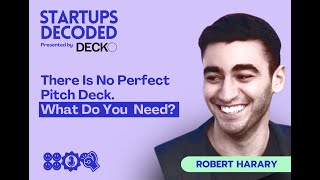
Robert Harary, CEO of DECO and VC partner, argues the old 10-slide pitch deck template is dead because the investor landscape exploded from thousands to hundreds of thousands of firms. He pitches "investor marketing": target specific investors, use anchor content like a custom deck and website, focus on traction and team, and send 500 to 1,000 cold emails daily with systematic follow-ups.
Chapters
There is an art to marketing, and so much of raising money is investor marketing. And so think of it like a funnel as you have to identify who your target audience is. For investors, you know, am I predominantly trying to raise from angels, from strategics? Am I trying to raise mainly from venture capital funds? Who is my target cap table on a high level? Right. It doesn't have to be an exact list of names, just on a high level. What kind of investors do I want around the table? Great. Now, what are the channels to reach them? Well, I see that they're all reposting on Twitter, on X, they're all talking on LinkedIn. They all check they all go to these conferences, they all read these blog posts, etc., right? Next is the materials that you need to reach them, right? You need a few pieces of anchor content like your pitch deck, right? But also similarly is like your website, right? Investors are looking at your website as a proxy for how you interact with customers.
Welcome to Startups Decoded, the show that gets real about what it takes to build a successful startup. I'm Andy Walsh, 2x exited founder, strategist, and your host. Each week I talk with top founders, investors, and operators to unpack the plays that drive real traction, not just headlines. If you're building something bold, this is where you'll get the honest insights to scale with clarity and confidence. Let's keep growing together. Hit subscribe and share with your community. It would mean the world to me. Startup Seedcoded is brought to you by DECO. Are you raising capital? Deco builds pitch decks investors say yes to, designed by expert VCs. Create the deck that gets you funded. Getdeco.com. Hello and welcome back to Startups Decoded. Today we're looking at the utopian world for all founders, creating a pitch deck, getting money in the bank, and what that looks like. And today to help me, I've got Robert, who is the CEO and founder of Deco, but also a VC with Evolution. So Bringing two sides of the table. Welcome to the show, Robert.
Hey, what's going on, Andy? Thank you for having me.
I love this topic. We were laughing before the show that every second person on LinkedIn has got the perfect deck for fundraising. They've got 10 slides that guarantees you fundraising. And I'm always curious to know how many of those people have actually closed money and if they have, what their success rate is. So to set that up a little bit, I'd love to hear your story because you've got this really unique approach where you're working with founders directly. At Deco on helping craft decks, but also think about how you use that story to approach investors and build that into money in the bank ultimately. But also as a VC, an investor, you're then looking at deals and assessing them for your own portfolio. So you've got these unique positions. How did you end up being in that spot?
Totally. Yeah. And, and, and great question. And, uh, there is, it hopefully this will actually answer kind of both questions at once. I mean, one, we've, I think we've all seen like that 10-slide template that's existed all over LinkedIn or you go on to any startup-related website has a lead magnet that's like, here's the perfect, you know, pitch deck template or something like that. And it's always that same kind of 10-slide thing that Y Combinator put together in 2015 and things like that. And to understand that, maybe it might be helpful quickly on my background. I've been a VC since I was 17 years old. I found my first venture deal while I was sitting in detention in high school and I got the bug. I ended up becoming that company's largest investor over the course of a summer of raising just under $1 million for that company. It was like an early-stage connected home company based out of San Francisco, and I ended up falling in love with venture. I won't bore you with the 10 years of history, uh, since then. Fast forward to today, second in command out of Evolution VC Partners, where we're investors in about 300 companies ranging from pre-seed all the way through Series E and beyond into what we call culture tech. So think technology, product, services we interact with every day. Some of the hits are companies like Sweetgreen, Via, Carta, and a number of others. We have about 300-something portfolio companies, 48 unicorns, 13 decacorns, 30-some-odd exits, and are hopefully continuing to grow on that side. On top of that, I'm an angel investor into a number of different things. My biggest hits being OpenAI, Figure AI, which makes humanoid robots, and one called Colossal, which is bringing back the woolly mammoth and other extinct species. The single closest thing to— if you're wondering how that business works, just think Jurassic Park. It's truly the plot to Jurassic Park. But all this to say, I've been in VC for my entire professional career and, and, and got a head start in my professional career on the startup capital raising side of things. And over the course of the last 10 years, I've noticed a few massive changes, right? Like when I started in VC, there was 1,200 venture capital firms in the country. That was it. Now there are literally hundreds of thousands of investors that invest into private companies. And so that's totally reshaped the landscape. And this is back to that pitch deck template. When you look back at that pitch deck template, that's That's from 2015, right? That's from that kind of like what I would call the startup school era, right? Where it felt like there was this almost factory of startups popping up. You would go to school, then you'd go to an accelerator, right? And that accelerator would be like a Y Combinator or a Techstars, et cetera. And those are all great accelerators, don't get me wrong. But there was this feeling that companies were being pushed through kind of an escalator that took them from this like brand new idea to a billion dollar company. And venture capital was this big game of kingmakers, right? Who, who picked out companies outta nowhere and gave them the funding and the resources and the everything to go launch a billion-dollar business. And it felt automatic, it felt like a ladder. And so that turned into that 10-slide template, right? Because that was like the easiest way to apply to all these different things. You know what that looks like? The title slide, problem, solution, market, how it works, traction, team, competitor, yada, yada, yada. All right. What's happened since then candidly, is that a lot of billionaires have been made in venture capital, right? And so what started to happen is everyone wanted in on venture capital, right? And so venture capital evolved from this, you know, like tiny kind of somewhat cottage industry that was just minting billionaires left and right to this massive wide open marketplace. But it wasn't just Y Combinator or Andreessen Horowitz or Sequoia anymore. It's that like family office out of Utah that you've never heard of and that like angel investor out of Berlin and that, you know, corporate and strategic Asia, got to Chicago. It became this totally different marketplace than the marketplace it used to be. And as more and more and more people entered into venture, each one brought their own different flavor of looking at deals. Early stage used to be this like asset class, right? I trusted Andreessen or I trusted Y Combinator to find me early stage deals, right? Now we have an industry that is filled with specialists. So there is some VC out there that just knows everything there is to know about like AI and supply chain logistics or something just way hyper-specific, right? There is a VC that knows each and every one of these things. And so what's happening is the way you pitch them has to change, right? They don't want to shoehorn— they don't want you to shoehorn your business into that 10-slide template. It probably doesn't even do your business much justice to do that. They know what they need to see. They know what matters to them, and you probably know what matters to them. Chances are your instinct as like the founder of a company is probably right in terms of what matters to the investors that are looking at your company because they probably came from your industry or at the very least have pattern matched across hundreds, if not thousands of other companies in your industry. So it's like a really long-winded way of saying that the template doesn't work anymore, right? It's, it's not for the new modern VC landscape.
A few things there to unpack. Which I love. First one being the irony of you being in detention and looking at your first deal. I can just see the report card for Robert coming home to your parents going, Robert is smart, but he needs to apply himself some more. And then teachers saying you'll never make it. And then in detention, you're looking at your first deal. And I, for me, sets up a real insight into you as far as your behavior and how you see the world and that you're not seeing it through the lens of what everyone else is doing, seeing opportunity in new ways. And what you just described there is a really great history lesson, not just in yourself, but how ventures evolved. I've had two solo GPs on the podcast so far who specialize in very, very different topics, but to your point, a real niche that they know inside out and they feel so much confidence in investing in. And people on LinkedIn are talking about like the Kawasaki format of deck and they talk about Airbnb and Uber of how they fundraised. That was so long ago. It's like, how can it be relevant in the field today? So to extend on that topic of what you were just saying, if you're looking at a founder, they're coming to you, they have a business, can you take us through a little bit of that process of the conversation that you have with them and then how you extrapolate that into the foundations of a deck that you have high level of confidence in?
Totally. Yeah, absolutely. Good question. The first thing that we do, rather than ask about the problem, the this, that, the other thing, the first thing we do is identify what we call the key excitement factors and then the investor objections, right? And these are basically the two different things that investors are trying to cut to when they're looking at your deck, right? The key excitement factors, these are things like what makes the company most exciting to an investor? Usually that comes down to traction, team, or product as the 3 that I notice have the most consistency across companies. Who gets the most meetings? Who gets the— who gets deals done? Traction, team, and product usually drive those things. But key excitement factors can mean anything. That can mean I'm growing the business, you know, 2x month over month. This is a business that's crushing. Do you want to know the story of how this business is crushing? And if that's happening, then we're telling the story through the context of the company's traction, because what better proof that this thing works and the fact that it's doubling revenues month over month or something crazy like that, right? Or it could be this is an exceptional team, right? Who comes, you know, who's former Apple or former OpenAI or former this or former that, who built and exited companies in the space. They're going to know a lot more about this market than your average person who's just done a bunch of research into the market. And so I just want to know that founder's insight, right, into this market. Then there's, you know, then there's the objections. This could be a super crowded market, right, where there's been a lot of people that have tried and a lot of people that have failed. Maybe this is the kind of company that's raising a lot of venture money at seed, but there's no breakout winner yet who is leading the market, who is raising that Series A or that Series B and so on and so forth, right? There's all sorts of different things that get investors excited and then things that investors can object to. What we try to do with every single company is we try to think, well, what are the things that I like about the company the most? Let's lean into that in the story. Let's not be shy about it. Let's not be coy about it. Let's not put it in there implicitly. Let's get explicit about these things that are exciting. And then let's think about all the reasons that if this deal crossed my desk, that I would say no to this deal, right? And then overcome those objections within the pitch deck. Those are, you know, one of the best ones, I think this was Jack Dorsey's deck for Square. It basically just listed out all the reasons Square was going to fail, right? Every single reason you could imagine why Square was going to fail. And now this is Jack fucking Dorsey, right? Like he's, he's built and launched, you know, a ridiculous amount of multi-billion dollar companies, the least of which being Twitter. And so of course I'm gonna trust his opinion on building a business. His approach to that also helped investors understand that he is deeply conscious about the fact that this can more likely than not go wrong, but here's my plan to overcome some of those objections. And so I really like the way that, that a founder like that is thinking about their business because they're not trying to oversell their business. They're actually just giving you an insight into how they're thinking about the business and what they're thinking about. A good pitch deck. I personally, I think pitch deck as a word kind of fucks with the meaning of it a little bit because it implies that the purpose of this deck is to convince you, right? VCs have seen so many deals. It is their job. They wake up every single morning and see a bunch of deals. Every single one of those deals, every single one of those founders, right, thinks that they've put together the perfect combination of words that is going to get them a check and that they know the exact way to do this. And You're probably right. It probably sounds very convincing what you've put together as a founder, but VCs are so jaded. They've seen it all. They've met companies that they've fallen in love with, and then they've watched them grow and grow and grow and collapse, right? There is no magic collection of words that you could really give to an investor. So what I do is I tell founders, your deck's purpose is not to pitch, right? It is to educate these investors on what you see in this company that other people may not. I call it the jumping off point. If you believe in X, you believe in this company. If you believe that people are going to be willing to get into strangers' cars off the internet and that company can be bigger than Mercedes and Ford and all these other legacy auto manufacturers, then you probably believe in Uber, right? If you believe that people want a space online to talk to their friends, that isn't Instant Messenger, that isn't email, but still feel— but is less public than a website, then you probably believe in Facebook, right? There's all these different jumping off points that you need to get investors to. You probably had a jumping off point yourself for why you started your company. Walk investors into that, 'cause if they could get to there with you, one, they're gonna be your best friends as you're continuing to grow the business. Now, if they feel oversold to and then they did the deal, that, I mean, that's not the kind of person you want involved. You want someone who's aligned with you completely in your company's vision, in your company's mission, who's growing this thing with you. So walk them through what you're seeing in the market. It, uh, and why you decide to launch this. Like, these guys are just cutting a check, right? You're the one who's waking up every single morning stressing out about this thing, probably giving up your plans, probably making sacrifices of your own personal cash, your own personal time, your own personal social life, et cetera. You're 100% of the time committing more to your company than any of your investors are. So walk them through what you see in this company that made you want to take that leap yourself and probably leave your other more stable to go launch this.
We're not even 15 minutes in and I reckon we could end the episode right now and founders could walk away with a whole bag of gold. What you've just summarized there for me is so powerful because what you're acknowledging, first and foremost, I want to touch on this part and I had Dr. Anca Pătaș, who's at London Real out of Canada, an amazing syndicate of investors, and he called out the fact that VCs are humans. And something really simple that, that founders forget about, right, is that, that VCs also wake up in the morning, they have breakfast, they go to work, they have emotions, they have feelings, they have knowledge. And it's, people forget who they're even talking to. So if you walk in understanding that you're dealing with a human being, everything that you set up at the start there around where are you at in your business? What are the insights that are happening in your category? Where are there blockages? Where's there opportunity? And you need to immerse people in your journey, right? Having a structured 10-slide format that you repeat and assume it's going to be working for your business to a specific VC or an angel to be able to get capital out of that is naive. So thinking about who you are as a founder, your leaping off point, as you said, what What keeps you awake at night? How do you solve that problem? How do you make an investor feel like that they're on that journey with you? Tell that emotional story. And what it comes back to, and I love that what you're talking about with evolution is around creative and culture in the sense of founders, is that think about human beings. If we were to simplify it into the fact of you are a human being creating a company, selling something to another human being. What are the things that people worry about? What are the things people are excited about? What does the future look like? And I love Mark Maples, and he talks about seeing around the corner, and you talked about Facebook and Uber there. I think about future states and what are you creating. Let people into your world and share that story. And if you can relate with passions, supported with data and opportunity, then you're creating a story that resonates with anyone that you're talking to.
I'm so happy you said that. That's exactly That's exactly it, right? I think like, okay, so I, one of the ways that I do diligence on companies is I play Fortnite with my younger cousin, right? This kid is like 14. He's awesome at Fortnite. I think he's 15 now, but he's awesome at Fortnite and we've been playing Fortnite together for a couple years. And what I do is I talk to him about the deals I'm doing, right? This guy, he has a better hit rate than me because like I'll tell him a deal, right? I'll tell him about the company. And if he doesn't go like, that's so fucking sick, what? Then like, I don't do the deal. Because like, I could, you know, my job every single day is to do deals. And so I could analyze myself, like I could analyze the crap out of a deal and probably find conviction about something, right? But like this guy, he doesn't give a shit about whether or not my firm does a deal, right? He's a 15-year-old playing Fortnite. Like, like if he could get excited about that, then I know that this is something that's like truly on a human level exciting. And like, then there's been other times where he's like, that business sounds so boring. And I'm like, well, you just don't get insurtech. And it's like, of course, of course not. You know, no one, no one gives a crap whether or not that company continues to exist or not. And so that's there. Then at Evolution, Greg, Greg is the founder of Evolution VC Partners. He always says, he's like, my investment committee is my two kids, right? And he just talks to his two kids. And he's really taught me this of like, like, look around, right? Go out on the street, go for a walk, right? And just see what products people are using, right? How— what they're talking about, what things matter to them. We, as VCs, there's this like kind of— it's 100% ego. This like, I could see the future, and if I don't see it, I'm the one personally investing. It's like, dude, you are cutting a check into an early-stage company. That is like— like, that is what you're doing, right? You are not like— you're not Thomas Edison, you're not Nikola Tesla. Like, you're cutting a check. Right? And so think of it like that. Like, are you making something that you would want to use personally? Right? And I, by the way, I made this mistake, right? There was this one company we had invested in. They were like a plant-based food company, and they created this like sick new process for creating plant-based protein, right? It used like a fundamentally new process of doing it. It was awesome, right? It was so scientifically cool. I posted about it on my Instagram story and my buddy texted me. He's like, dude, that looks like Play-Doh. I'm like, dude, you don't get it. Like, this is going to be the future. Future. This is like a whole new way of extracting proteins from plants. He's like, dude, I'm not fucking eating that. Like, that looks disgusting. And that company went under, right? Like, sometimes it's just that simple. People forget about this because we're so busy trying to like outsmart the other VC that we like try to get conviction about things or so busy trying to be contrarian that we forget that like we're supposed to be investing in stuff that people want to use and that people will use in their homes or at work, etc., every single day. Zooming out of that, out a little bit. I'm a really big fan of Yuval Noah Harari. I'm not related to him. We spell our last names differently, but you know, he wrote Sapiens, incredible book. He actually has 4 books. I'm on his 4th one right now, but his 2nd book, Deus, is super interesting to me because it talks about what's called the new human agenda. And the idea is these are the things that humans are gonna be spending their next 10,000 years on as a species. And you know, spoilers. So if you guys really want, you could skip past this in the podcast, the, but it comes down to 3 things: quality of life, longevity/immortality, and divinity, right? These are like the 3 big things that humans are going to spend their time on. 1, improving the quality of life for every single person. 2, helping us live longer, be healthier, etc. And then 3, creating new forms of life, right? And so I've been doing all my investing across those 3 buckets because what I've noticed is that on a fundamental level, people want these things to exist. So when the market goes to shit, right, and funding starts drying up, these companies are still raising money, right? They're finding it in places that other companies that are more traditional and boring probably won't find it because just on a human level, people think it's cool. People want it to exist. And so they'll find a way to keep it existing. Right now, maybe they raise at a down round, but when everyone else is going under and these guys are raising at a slight valuation discount, that counts as a win, but they will always find a way to keep going. And so that's a long-winded way of saying, like, just think about whether or not this thing is cool to you as a person on a human level, and it'll probably be cool to a VC on a human level.
Startups Decoded is brought to you by DECO. Are you raising capital? DECO builds pitch decks investors say yes to, designed by expert VCs. It's like having a venture capital firm in your back pocket. From pre-seed to Series D, we know what works. Create the deck that gets you funded. Getdecko.com. What I hear in that is that both founders and investors get in their own way. In a world of information overload, it's so easy to read something, hear something, and then take it verbatim as the truth. And It's amazing the bias that we all bring into conversations, decision-making, and within that process, if you're a founder, if you're just, if you're oversaturated with inbound and you think that you're crafting something that is perfection, which you set up at the start, more often than not, you're not thinking about the fact that you're telling a story to another human and that they're going to want to understand your passion and the opportunity, and you need to take them to the place that you're going to be at. And then for the investor side, I love what you touched on there too, is is that it's so easy as an investor to look at reasons to not invest in them rather than find something to invest in. And I think they're two very different behaviors, right? If you're a conservative person, you go, well, there's a couple of things there that don't feel right. I'm going to tap out. If you're a glass half full, you go, okay, what is their opportunity? What can they create? I love that they're doing this. There's some things they need to solve for, but they've identified what those things are. There is an opportunity here and you chase the positive rather than the negative. And in the VC behavior, you talked a little bit before, but I'd love for you on a first glance of a deal from someone, there's, there's two parts to this question. So let's do the first cold outreach to you. Is there anything that you've seen that just stood out on a first touch from a founder that you didn't know? That got your attention? It could be a combination of things, how they approached it to set the scene as far as who they are and what their business does.
Totally. I'm so happy you brought up cold outreach actually specifically, because I actually think that's a lot of where venture is going. If you look at how much more dispersed venture has gotten as an industry, like the fact that it doesn't just exist in Silicon Valley anymore, right? It's become this massive, wide open industry. There's really only one thing that follows a VC everywhere they go, and that's their email, right? That is everywhere, right? And they are constantly checking their email. So your deal, if you're cold emailing a VC, it is getting to that VC, right? The difference will be, will they respond to it, right? More often than not, they won't respond to it, but when they do, right, they— and I should note that part of what I do includes scaling investor outreach for founders, and I have tracked thousands and thousands and thousands of interactions between founders and investors via cold email. Not only have I personally led rounds off of cold emails that have come to me, that's actually hit the impetus for how a lot of this started. But on top of that, my platform is probably setting up somewhere between 1,500 to 2,000 connections to interested investors every single month. That's about once every 8 minutes during the workday that a founder is meeting a VC and the VC is saying, I'm interested in what you're doing. I'd love to set up a call, I'd love to see a deck, and so on and so forth. And so I'd like to think that I have a pretty solid understanding of what it takes to get a cold email to actually turn into a meeting for investors. The first thing I'll tell you is back to what I had said earlier, traction, team, and product. Those are the 3 hooks I notice work the best out of anything. So lean into any one of those 3 things. Your business probably has one of those 3 things. You don't have to have all 3, but any one of those 3 things are gonna be really, really helpful for getting you in front of a VC. If you have excellent traction, people are gonna wanna know the people behind that traction. Heartstop. Those numbers speak for themselves. No one's going to deny that that company is crushing it. They just want to know how is this working, right? Next up is team. I, my, my girlfriend and I angel invested into this one company together. They are building semiconductors in space. They have no traction yet because they got to get to fucking space and build a semiconductor factory there, right? They have no product yet because again, they have to get to space and build a semiconductor factory there. But the founder is like one of the people who had built ChatGPT. Deep, right? She a genius. If anyone's gonna do it, it's gonna be her, right? And so there's, then there's team, right? You just have that full, you know, belief in the team. Last is product. I always tell this to founders is like, if you have 1,000 users on your site, you actually probably have like 7 to 10 investors sitting in your site, right? And these are people that understand what you do. They use it every single day. They love it, they understand it, and they'd probably love to know the people behind the curtain of this thing. Because they've been using it, right? And so, you know, I, I, I actually just spoke to one. We, we, we, we made a deck for this one company. They're like a consumer brand. They, they make, um, like really cool and innovative thermals and shirts and hoodies and pants, et cetera. He has a few thousand customers. I think they have like 7,000 customers or something like that in total. Now their price point for their stuff is not cheap. You know, it's, it's not $20 hoodies, right? $100 to $250, $300 hoodies. So I told him like, dude, your, your investors are sitting in there. Like, this is a group of people. There's 7,000 people who could afford that kind of thing for an online purchase, right? Who are repeat orders buying from you, love what you're doing. Like, they are your biggest believers and they're sitting in your site right now. So don't, don't, don't negate even like your own product, your own community and things like that. Now here's some don'ts that might be useful also for like a cold email outreach. Investors know that your cold email is probably automated, right? So don't waste your time, right? Don't spend the whole day trying to write 30 really good cold emails. That's a waste of your day, right? From the numbers that I see, you really do have to send out like 540 to 1,000 emails every single day to really get responses from investors at a good enough scale. Right? And you have to do the follow-ups and things like that. Like, there's just no real easy solution to do that if you're trying to do it yourself, right? That should be automated, right? You're trying to hit a massive community. So similarly, don't do the bullshit research thing. The, hey, I noticed you're an investor in this company and this company. Here's why my company fits into that portfolio really well. I know that you're just running a script that does like investor in XYZ and then plug my company and find a way to, you know, tie it all together. You're probably plugging it into ChatGPT or something, which is fine. I love ChatGPT. I'm an investor in OpenAI, but you get the idea, right? Is like, you don't, you don't need to do that, right? Investors know what they're looking for. Instead, think of your cold email as an ad in their inbox, right? It is a, like, it is just a short snapshot of your company. You'll probably have to hit them a few times, just like an ad has to hit customers a few times, right? So instead, think of it as an ad in their inbox. Keep it short, lean into those traction, team, and product. The purpose of that email is not to get you an investment. It is to get you a meeting. So similarly, do not put, you know, rule number 2, do not put massive blocks of text in paragraphs. Think about how short your attention span is nowadays, right? A VC's attention span is probably even shorter, right? And so instead, what we've noticed is our most successful emails are like 2 sentences, 3 to 4 bullet points, and then a call to action, right? Biggest hook at the top. We're a team of former, you know, OpenAI and Apple engineers who are launching XYZ to do this. Here's some bullet points on what we're doing. Would love to set up a call. Are you around this week? Super fast, right? It's a short email. It could probably all be seen without scrolling once on your email app. That's the best, right? Would you read an ad that was like filled with paragraphs? Of course not, right? Like, that's why ad copy is so short. So think about your cold email to investors in the same way.
Again, another really, really good but simple tactic you can employ. And I've got an advertising background and it's something really contextual. If you're driving down a freeway and there's a billboard, it shouldn't have more than 5 to 10 words on it because you've got a limited window. You see it, you need to be able to understand what it is, and it needs to be provocative to a point to be able to get your attention. And that repetition through billboards, email campaigns, et cetera. They combine across the board. So thinking like you're an advertising moment to get the VC's attention is, is really simple but smart advice. And I tell the same thing to my portfolio is think about it like A/B testing with subject lines, with different content in the email and play around and see what sticks. And you've got to do repetition because everyone's doing the same thing. A VC is used to getting inbounds at scale. And there's going to be certain triggers for them that makes them click or open. And half the time, probably more, I'd say 95% of the time, they're not even going to open your email. So don't get disparaged if you've sent 10 and you've got nothing back. There's a repetition game you need to play. But the counter to that, which I'd love to be able to unpack with you, is that in the pitch deck process, you talked earlier around your process with founders and how you're finding those hooks. Talk me through a little bit around storytelling, you as a founder, you as a company, and what's the long game version that you can play to get on the radar of investors at scale that means that your cold outreach is not so cold, that there's a little bit of attention and awareness on what you're doing. Because I coach founders on their own personal brand strategy and that you start fundraising from day zero of your company by the story that you tell, the networks that you build, the community that you have. So if you're parallel pathing on your side with DECO, a story through a pitch deck, how do you coach founders on that outreach as far as how they're thinking about telling their own story to get some more attention?
That is such a good question. And, and by the way, just, just before I answer that, I am curious, like you come from a marketing background. You specifically talked about billboards. I always wonder this, like if I'm going like 65 on a freeway or something and I see like, how much time do you really have? On a billboard hitting a customer's eye? Do you know?
Yeah, it's less than a second typically.
Yeah, right? Like it's just like a glance, 'cause I am very much going like 65, like I'm go, I'm driving like a multiple-ton machine at like full speed on like a freeway. Okay, so that makes sense. So it's like a super fast, like, yeah.
And it's typically a brand message. It's about repetition. So having front of mind, Airbnb is amazing at building brand awareness and with no call to actions. It's emotive. And it puts you into a certain headspace. So when you get the very specific longer form piece of content that follows up after that high impact, short, quick brand story, you're more inclined to purchase. So you got to think in that lens of your brand, which can be the founder or the portfolio company itself, or rather the company itself. Like that is high level. And then you can get into the details of follow-up. So thinking like that, That will open doors for you, I guarantee.
You ever see like Buc-ee's ads on billboards? You know Buc-ee's? They crush it at that. Because they'll be like, they'll start like 1,286 miles away and be like, happiness 1,286 miles this way. And then like every like 100 miles they'll get you with another one because they know you're on just this road trip. And so that makes total sense on the repetition side because there are these like super short 1-second ads with like the logo and like a quick thing on their values and then they just hit you with that ad over over and over again. By the time you get there and it's like, oh man, I'm only like 15 miles away from this thing. What is this thing? I gotta go check it out. And then you land at Buc-ee's and you're like, they were right. This is awesome. The, uh, but what's it called? Okay, so that makes sense. Um, all right, now back to the venture side. Well, this actually kind of dovetails pretty nicely into it. So remember how I said that venture has become this like massive wide open market now that has like hundreds of thousands of people in it? That means that more and more every single day, it's becoming like traditional marketing. Right? So it used to be, right, when it was this like tiny, like, you know, this tiny old boys club in one part of the country, right? It was very much a game of who you know, right? But like, you wouldn't— one, you wouldn't market to your customers once every 18 months. So why are you only marketing to your investors once every 18 months? That's like one thing that I've always wondered with founders. And then two is like, you wouldn't market to customers by like hitting up 4 of your friends and being like, yo, do you know any customers? Right? You turn it into this repeatable process that is outbound, that is driven by not only the right channels, but the right messaging, the right messenger, right? The right combination of repetition without feeling like you're over, you know, pushing the same thing to people. There is an art to marketing and so much of venture now and raising money is investor marketing, right? And so think of it like a funnel, right? And so if you think about it, it as you have to identify who your target audience is right now. For customers, that can mean anything. For investors, that's, you know, am I predominantly trying to raise from angels, from strategics? Am I trying to raise mainly from venture capital funds who specialize in supply chain, AI, logistics? Or like, who am I trying to raise from? Who is my target cap table on a high level, right? It doesn't have to be an exact list of names, but just on a high level, what kind of investors do I want around the table? Great. Now what are the channels to reach them? Right? Well, I see that they're all reposting on Twitter, on X, they're all talking on LinkedIn, they all check their email, they all go to these conferences, they all read these blog posts, et cetera, right? These are the channels to reach them. Next is the materials that you need to reach them, right? You probably need a few pieces of anchor content like your pitch deck, right? But also similarly is like your website, right? Investors are looking at your website as a proxy for how you interact with customers, and they see that as like the the, the best look at your company because it's how you are positioning yourself to the people that are gonna drive value for these investors, right? Which are customers who spend money on you, right? So one, what are the channels? Two, what is the audience? Two, what is the channel? Three, what is the materials that you're using? Then from there is where you really start the customer process, right? You've now gotten in front of this customer, this investor for the first time, right? Now what happens? Well, you can't expect them to transact right away, right? Venture is very much a relationship-driven game. And so what that means for founders is do not over-transactionalize your raise. If a founder— if an investor wanted to invest into a company that was overly transactionalized and impersonal, they'd go to the fucking stock market where these companies are way more stable. They could also sell their shares if it starts to go under just a little bit, right? Whereas like startups are completely binary, they either hit or they go to zero, right? There's very little in between. Mean in this market for that, right? So they either hit or they go to zero. So investors are not investing in your company because they think your company is perfect or that they want an impersonal relationship with you. They are pricing all that in. That's why they're investing into like a pre-seed or seed stage company that is very much like 4 to 10 people or sometimes even less, just trying to figure out something is 'cause they wanna build with you and generate that value with you, right? They're pricing that into your company's valuation. So similarly, like don't expect or don't try to have everything buttoned up. There's nothing a VC hates more than when a founder has an answer for everything. It's like, well, if you're so perfect as a company, why are you not a multi-billion dollar company? Right? The amount of times that I've heard like, everything's great, everything's great, everything's great, and we're outta cash. It's like, well, what, what, what, what happened in between those two things? Right? And so the— be very candid with investors about what works and what doesn't work. Build these relationships. So now, Now let's say we are at that customer warming stage. You're at that relationship development stage. What happens next, right, is you start to then qualify your customers, right? You start to see, okay, I've got my leads in, I have a bunch of investors that I'm talking to. Who is actually worth my time? Well, let's talk about the deal now in terms of numbers. This is the target valuation that I'm going for, right? This is what I'm, this is what my expectations are to the investors that I'm working with. This is how I run my company. Remember, it is your company. It is not someone else's company. Company, right? And so this is how I am running my company. Do you agree with my method of doing this? Now that happens not just through, you know, sending an investor a term sheet or telling them the numbers, but through constant conversations and push and pull with investors, inviting them to build with you, asking them questions about what to do. Building on that, investors love helping, right? And so one of the best pieces of advice I have there is don't try to tell them everything is perfect. Instead, tell them, hey, this is what we're specifically challenged with. Can you help? Right? We're looking for an awesome senior backend developer. Do you know any good candidates? Or we're really trying to land this partnership with Amazon. I noticed you're connected on LinkedIn with one of their partnerships managers. Could you— can you line up an intro? VCs love doing that. And the best way to get someone to do a lot for you is to get them to do a little for you. And so the best way to get them to invest into your company is to have them feel like they're building the company with you, right? Start to invite them to do this. And plus it'll also show you like who you actually want on your cap table, who you want to have equity in your company. Like their cash is gonna get spent probably faster than you think it's gonna get spent, right? Their equity is gonna be there forever. They are on your cap table forever. So who do you want there? This is your opportunity to qualify who's good, who's not, who understands what you're building, who could agree to it, et cetera. Et cetera, right? Then from there is of course closing, getting them to actually transact, and then activation and onboarding, starting to get them to understand your business. Now from this side of the aisle, you are now a part of it. What could we do to activate you and create a K-factor between your company, between you as an investor and other investors? Can this investor make intros to other investors? Can this investor make intros to other customers, et cetera? The best way to do that is to share investor updates. Share them so consistently, send your investors fucking updates. I can't stress this enough as a final point on this, which is it could be a short email that happens like once a month that just like, here's what we have in the bank, here's what, you know, here's some good things that are happening. Here are some of the challenges that we have, right? Keep them apprised of these things. They want to build with you, right? That is why they're investing into an early-stage company in general, right? Instead of just putting all their money in the stock market or somewhere else that's safe. Safe. Instead, have them build with you. That's why they're doing this deal. I know that was a super long-winded way of answering that question, but really at its core, investor marketing is a combination of like the traditional marketing you're used to for your customers, plus this added relationship layer with these, you know, almost enterprise customers who can give you these, you know, who can transact with larger checks with your company.
It's a great answer, and I would summarize it as capital network work and skills as three of the things there that investors bring to your table. And thinking about that's really important about how you approach it. And I'd love to be able to share with you an example of a major brand in McDonald's. And if you go around the world, I don't know if they're number one, but McDonald's would be in the top couple of brands that people would know in an unprompted question. Like if you showed the majority of people around the world would be able to answer who they are. And the reason that that exists is that they look at their brand and they've done a lot of research on this as 4 different buckets. They look at brand, which is the McDonald's itself. They look at product and product is around like the Big Mac or the Quarter Pounder. The third one they look at is price and price is around $2 specials that they offer and that just gets trial happening again. And then they have specialty. And the reason that they do that is that they found that that in a 12 to 18 month window, if you're not investing in brand, sales drop off. So if you're just selling all the time, trying to get people to buy, you actually have a decline in sales over a period of time. So if you're a founder, you talked on it there earlier on, is that you can't do an email out every 18 months. You need to build your brand every day, have it pushing out every day, and then the product that you're selling It's very much around, okay, who are you? What do you do? What problem do you solve? And then you go into price in the McDonald's example, and this is your fundraising moments, and this is where you get people to trial. And it's like, we've been doing this, you know about us, now we want you to invest in us. So thinking about that framework is tried and tested at a global scale of McDonald's, who are one of the best marketers in the world as far as what they're doing and their growth growth and their continued growth and evolution of what they're doing. So I love what you shared there. And today to finish up, DECO is joining Startups Decoded as an official partner, which I'm stoked about, really pleased to have you join us. For anyone who wants to get in touch with DECO, um, I'd love for you to be able to share a little bit about that because I feel like we've got such a good feel now for DECO and Robert and what you do. And there's so much gold in this episode. This is not to call favorites, but this has been one of my favorites. I think what you've shared and your insights is absolutely invaluable for founders. So yeah, talk to me about DECO and how we get in touch.
Yeah. Well, one, dude, this has been a ton of fun. Like, thank you for having me on. What a, what a cool way to start my Monday here, uh, with you. This has been, this has been awesome. Yeah. To, to, to founders that are interested in working with DECO. We'd love to work with you. I mean, we've worked with over 300 different companies. These are different from my portfolio. These are actually— I started DECO in 2020 as a way to work with companies outside of my portfolio. So we've worked with 300-something different companies. They've raised about $1.2 billion. That's just from what we can see online or from founders reaching out, being like, thank you so much, I closed $200 million with this and so on and so forth. So we estimate they've raised about $1.2 billion from, you name the big VCs. Right? Andreessen, Sequoia, Accel, Village Global, right? You, you name the big one, they've, they've raised. And so we've worked with a bunch of these different companies. We have packages for basically every price point for founders. Uh, we try to make it really easy to get started and hopefully grow with you and become a central part of your team as you continue to grow your business. The big thing to know about Deco is we have zero templates as a company. It's one of our founding principles as a company. Company. Every single deck starts with a blank sheet because we really try to get to the core of what makes your company specifically exciting and attractive for investors, help you put your best foot forward. Now, the other thing I'll tell you here is that I will never claim to know more about your business or your industry than you do, right? You are the expert at what you're doing. Similarly, by the way, all of your investors should feel the same way. There is nothing more fucking annoying than an investor that like claims to know everything about your industry, claims to be strategic, and then is just sending you like articles from your competitors and stuff like that, right? And so like, that's useless. So we're never going to know more than you about the details of running your company. What our job is, is to zoom out with you and help you understand which parts of your company matter the most to investors. As a founder, your job is to know everything about this company, right? And so a side effect of that is that you may not know what investors don't know about your business, that they need to be caught up on about your business, etc. So we really make the effort to zoom out help understand what matters the most to investors about your company, and then build a completely custom story around your business. I'd love to show you all some samples of these. I think the first thing that everyone will notice is that no two samples look the same, right? Every single company is telling a different story and there's different methods to tell these things and get these things exciting for investors. And so the short answer is I'd love to work with you guys. One, check out our website, gedeco.com, that's g-e-d-e-c-k-o.com, gedeco.com, or shoot me an email at robert@gedeco.com or shoot Andy an email and have Andy introduce us, right? And every founder that comes from this podcast will get a discount as well. So, you know, any friend of Andy's and any friends of Startup Decoded is, Startup Decoded is gonna be a friend of mine. And so the short answer is we'd love to work with you and please reach reach out. Uh, it would be a ton of fun.
Perfect. And it, it literally took the line away from me at the end then, because we are gonna run a special offer for this whole month and I'll share details on my channels and anyone who's coming through, um, our channels to get access to Deco will get a discount and we'll announce more about that separately. Um, and also we're going to be sharing some work that we do with one of my portfolio companies to see how we can elevate their journey for fundraising through DECO. So that's going to be super fun too. So you can get a bit of a peek as far as what that process looks like and how we go at the end of that.
Hell yeah. You heard it from him.
Well, I know that we're over time for today, but Robert, appreciate your time. This has been so valuable and I can't wait for everyone to get their ears around this one.
Me too. This has been so much fun. And thank you so much for having me. And yeah, I'll, I'll talk to you soon.
Thanks for listening to Startups Decoded. If today's conversation helped you think differently, share it with a founder in your network. And don't forget to subscribe for real-world startup insights every week. We really value your support. If you're interested in partnering with us, email hello@startupsdecoded.com. I'm Andy Walsh. I'll see you next week.
More from Andy



EP#88: Why Most Founders Misread Their Own Traction. Vanessa Larco - Premise VC

EP#87: Founders Obsess Over the Raise. Investors Care About This More. — Carina Cunha






Ep#86: Early Decisions That Define Your Startup Forever. With J.P. Morgan Asset Management
