S2E13: From Fundraise to Exit: What Every Founder Wants to Know, Jennifer Lewis, Exited Founder, Lex
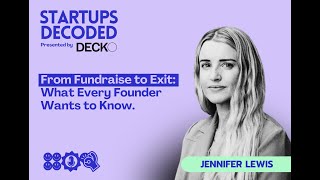
Jennifer Lewis left a 17-year marketing career to found Lex, an LGBTQ+ social app, after recognizing that 1 in 5 Gen Z identifies as queer. She spent months perfecting fundraising decks before learning investors care more about depth than polish, then sold Lex to Nine Count over unexpected alignment on safety and moderation.
Chapters
My sense of standards was so much higher than I needed to be. My sense of perfection, you know, the amount of time I spent getting my data room perfect and my deck perfect and making sure I knew every single number of my business and every single thing in my financial model had to be really, really solid. Maybe it was insecurity on my side that I needed to be so on top of my game and have everything so perfect. And actually a lot of the feedback I got from VCs was, wow, this is the most comprehensive data room I've ever seen, or you know your numbers in the business like no one else I've ever met. And it was great to hear that, those compliments, but also it made me realize that I didn't need to hit that level of perfection that I was holding myself to. And actually, you know, I could have taken that stress level and that investment level off me a bit and just been more— I don't know how to say it— um, not to care less, but to understand that it's okay not to be perfect.
Welcome to Startups Decoded, the show that gets real about what it takes to build a successful startup. I'm Andy Walsh, 2x exited founder, strategist, and your host. Each week I I talk with top founders, investors, and operators to unpack the plays that drive real traction, not just headlines. If you're building something bold, this is where you'll get the honest insights to scale with clarity and confidence. Let's keep growing together. Hit subscribe and share with your community. It would mean the world to me. Startup Seedcoded is brought to you by DECO. Are you raising capital? DECO builds pitch decks investors say yes to. Designed by expert VCs. Create the deck that gets you funded. Getdecko.com. Hello and welcome back to Startups Decoded. Today we've got another big episode and I'm pretty sure that this is the maybe first or second guest that I've had that's had an exit. So today we're going to be exploring fundraising, company exits, what that looks like, and then where founders go to next. And to help bring that to light, I've got a really fantastic guest in Jennifer Lewis who is the, I guess, former CEO now of Lex, an amazing platform, which is for LGBTQ+, a social app to connect with like-minded folks, but I'll let her explain that. But first, Jen, welcome to the show.
Thanks. I'm happy to be here, Andy, and congrats on all your success with this podcast.
Thank you. I'm not sure how we got connected, but it's been at least a year, I would say, if not longer, that we first met. And I remember so vividly, you were busy like every founder, but you were at a really good growth stage as far as learning enough from historical data and trends and things that you were looking at in depth and going, okay, like, where are we getting traction? How do we scale the business? And to fast forward now where you've come out of an exit, it feels surreal to see that happen and manifest and come out of it. So to give some color, I always like to get a bit of a feel for your background and how you got into the world of startups and ultimately with Lex?
Yeah, so I guess we'll start at the beginning. So I'm British, I've been in New York for 10 years, and I really, I guess I've spent 17 years in kind of growth marketing startups. And the first half of my career actually began in advertising agencies. So in London, in Shanghai, working for clients like Nike, Procter Gamble, Unilever, where I really learned how do you how do you build brands and how do you build products that will meet a future consumer? So really understanding where is culture going and which are good, what are the companies going to be that are going to, to really be successful in the future. Uh, so I did that for 10 years. I moved to New York and then I really got the itch to start building. I'm someone who, I love strategy and I love ideas and research and insight, but I also love to take action and I wanted to start building products. And so, I moved into the startup space originally as head of marketing and head of growth for a couple of wellness and health startups. Had some really great experience there, you know, building teams from scratch, you know, working at companies that grew from 30 people to 300 within a year. So, really saw a lot of hypergrowth with these healthcare startups. And then that really, the journey to Lex really was very much a personal one in that during that time period, I went through a big kind of personal I guess crisis, I would call it, if I'm being honest, where I realized I was queer. And I left a marriage as a result, I quit my job as a result, and I really took everything to basics and said, what do I want to do with my life? And what do I want to put into the world? And, you know, I had these skills in kind of product building, innovation, marketing, uh, and I saw a problem, which was that there was no there simply wasn't a space for LGBTQ people to find community. And I thought about my earlier self, and if I'd had that when I was growing up, my story might have been very different and much smoother. So really building Lex, which is a social app for LGBTQ community, was really the product that I wish I'd had, you know, when I was 19. And I met Kel, my co-founder, who had a similar kind of later stage coming out story. She was actually the original— she had the original idea for Lex. I joined her a little later, but really that, that's where it kicked off, you know. My journey into Lex really solving a problem that I really, really wanted to have solved in the world because of my personal story, but also because I saw the opportunity. And I think that's where my advertising marketing research background really came in, is I also looked at the data and I saw that there was a huge cultural shift happening. And when we look at the numbers, as 1 in 5 Gen Z are LGBTQ+, which is, you know, a huge number. If you look at Gen Alpha, well, you know, that's looking to be 1 in 4, even, even more. And when we look across the US population currently, depending on which statistic you look at, either 9 or 10% of the American population identifies LGBTQ compared to 2012, which was only 2.7%. So we've had a 3x growth in just over a decade, which is the fastest growth of any demographic in the US. And so, you know, looking at those two things together, this huge growth opportunity, and then, um, and then my personal story, really, that was the journey to Lex.
And it's fascinating for me, there's a really organic, I would call it, way of founding others living and breathing something that they see as a problem, or it's an opportunity where they can change. And for you, it was very personal in what was a major life moment inspiring you to go, okay, where do I find my people? How do I connect and have conversations? And as humans, we all want connection, right? In all shapes and forms, as far as someone you can turn to through the bad times, someone you can share major successes with, and everything in between. So being that passionate about something, I would assume that it's been a real driver for you through the tough days of starting a business and building. There's times when it becomes completely overwhelming, and I think having that resilience, knowing the outcome and the impact you can have on so many people would be very rewarding.
Yeah, definitely. It's funny, on reflection, the passion is a great thing because it keeps you motivated. It means you also intrinsically can make good decisions, I think, because you've got, you know, the audience, you know the problem, so you can move fast. I think that's also why passion can help you. But so there definitely— I will say there definitely were moments where I wish I was building a B2B SaaS that I cared less about, because with passion becomes also a sense of like real care and responsibility. And so when you get things wrong or you can't deliver on what you wanted to do, it also can carry a really heavy weight as well. So I think it's an interesting dynamic as a founder to really care about the audience you're building for because you inevitably, things are never perfect. So you do have to experience some disappointment. And when you're having to do that with a cause that you really, really want to see solved, it's an interesting thing that I've had to kind of navigate as I've been going through this.
It's been a really hot topic across many episodes, which is the gut instinct versus the data validation. And there's tension that exists between that. And you'll get some founders that don't want to hear data because it goes against what their instinct is and they'll ignore it. Sometimes that works, sometimes it doesn't, particularly early stage when it's, you know, you don't have many markers to be able to reference against. And, and I think to your point though, being very passionate about something also means that you want it to be perfect because you want that experience for everyone else to be the best that it can be. So sometimes you're probably creating a benchmark that is unattainable and you feel like you're letting yourself down. So that resonates a lot. And that was my background. I, as you know, worked in music culture, and I couldn't do a half-baked job of— when you're working with artists like Brian Eno and Childish Gambino, it's— you just can't rest on your laurels. Their expectation is perfection, and perfection doesn't exist, but you need to get as close as you can to the best creative art form to support their vision and what they're trying to achieve as well.
Yeah, I love that. And on the data piece, I had a boss very early in my career when I was working in advertising that said something to me that really stuck with me, which was Data is an opinion in the room. It's not the answer. And I just love to think about it like that. Data can be so powerful and it can help you make decisions, but it also, there is a subjectiveness in data, even in the data that we think is the most like quantitatively collected, the most objective, actually, there are, there are always flaws in how things are collected. There's, you know, anyone who runs startups know that the numbers on two different platforms for your downloads will give you two different answers. Like there are, there is you know, fluidity in data, even the stuff that we think is really factual. So, I think it's really good to have, you know, I love data, I love telling stories with it, and it helps me make decisions, but I think it's really good to understand that you need to make the decision based on your strategy, where you are going, and the data can help you get there. But if you're just making decisions based on data, you're gonna be flip-flopping around and you are not gonna have any direction, and I think it can trip you up. So, I think it's an interesting thing to navigate. I think being really firm on where you're going and using the data as a as another way to help you get there versus being the only thing that you rely on.
I love that sentiment of data is another opinion in the room. And the thing that you need to flush out if you've got a few people making decisions is how do you bring objectivity to someone's decision-making process? And my, my opinion is that a lot of people carry historical bias. It could be something that they learned 10 years ago that isn't valid today, that has changed a lot. But a lot of that comes to them not being vulnerable enough to acknowledge that they're not up to date with where it stands and will quite often fight a fight just because it's hard for them to admit that versus actually adding value to the conversation. So culture of how you create a space to have a very healthy conversation is important to one, make the right decision or the best decision in the moment. You never know what the right decision is until afterwards, but Also the ability to be quick and decisive and not get stuck on making decisions, which can really hold you back as a startup founder.
I, I would say that making decisions fast and acting on them is the biggest way of driving success because even if you get that decision wrong, the faster you learn that it's wrong, the quicker you can pivot. And even learning that something is wrong or didn't work gives you information that allows you to make a next choice. And this is I was speaking with another early-stage founder last week about this, about they were trying to get the perfect data in order to make their decision about which audience to choose. And I remember just saying to her, I was like, it's no, you're, you, you have to deal with imperfect data and imperfect opinion. The only thing that will be perfect is if you take an action, even if it's wrong, it doesn't matter. You've, you've moved, moved forward. And I think one of the most dangerous things I think for anyone running a startup, I mean, probably many businesses, but startup because speed is so important, is being stuck in the swirl of indecision and strategy and trying to get everything in neat lines or to make sense or everyone being aligned, that I think is a really dangerous place because if you're in that indecision phase or in the strategy phase, you can't learn and learning is the only way that you get success.
One of my favorite structures that I use with my portfolio is thinking like a scientist where you have a hypothesis, you test and you learn. And if it doesn't go the way that you thought or proposed in your hypothesis, then you've learned that that's not right. It's not a failure. It's progress because you're eliminating things that don't work, getting closer to the thing that does. And I think that mindset helps be more decisive and allows you to move at pace. And the time that you put in designing the hypothesis and potential outcomes also allows you to react quickly as well. So you've got a sense of where it could go if it doesn't go where you anticipated. So you're thinking ahead and being quite pragmatic to be able to accept the fact that, okay, we've made a decision, we're backing ourselves, we're moving forward. That's a great lesson for any founder is to think about what are the inputs you have, how you make a decision to move forward, and then how you learn from that and then have that as a cycle that never stops.
Yeah, it's the classic move fast and break things, which I guess is the, you know, early startup ethos. I think it's interesting just hearing what you were saying before about building the best creative product, especially when you're working with artists and musicians and where creative quality is so important. My background, I came from creative agencies, you know, came from Wieden and Kennedy where creative craft was so important. And that was something you spent time on and you made sure everything was perfect. And so it definitely was a learning curve for me for being, being comfortable with things not being perfect. And you still have to have creative taste, a creative vision. And, you know, I think building the brand and the output that you have is, is still really important, but being more comfortable with the imperfections was a big learning curve for me at the beginning of my startup journey.
I'm a massive believer in airing imperfections as well. Being honest as a human being. The people that I love most in my life are people that aren't shy of sharing their insecurities, sharing things that haven't worked out for them, but also being confident enough to share the things they're proud of in their life. And from a brand perspective, if you act and behave in that way, people start to trust you. They're curious about what you're doing, and the brand relationship builds exponentially alongside the product and what the actual functional elements are of what problem you're solving or what you're able to create. So I I always encourage people to think like a human being and be imperfect. We are all imperfect and a business is too. So don't try and do smoke and mirrors and mislead people or not acknowledge a failure. It's okay. It's actually quite human and people connect with mistakes, right? They're totally comfortable because it makes them feel like that they're not the only person who's doing that.
It's funny, on Lex, people assumed, I think, we were this like huge corporate machine and when we would make mistakes, you know, we would get bugs in our products, or there would be errors in features we shipped. We would often get people being really angry at us and writing us customer service reviews, or being really frustrated, or they wanted features to be built, we hadn't built them yet. My experience would be that as soon as you reply to them as a person, or sometimes I would get in the product and DM them and say, hey, I'm like, you know, I'm the co-founder, we're working on this, or I'm really sorry that this bug had this impact on you. And as soon as I showed up as a person and like heard them and understood that this thing that was really frustrating for them, all of a sudden, all of that anger and frustration would dissipate, and they'd say, "Thank you for building this," and, "Don't worry, it's not a big problem," and, "Get to it when you get to it." And really, that lesson of being human in the face of mistakes was definitely, I would say, like, helped build that relationship. So, then suddenly, those people that had a complaint, because I'd spoken with them and been human and been like, "I'm sorry, we just like have just made a mistake," then suddenly that person felt better about the app than they did even before they had the problem. So I think that insight about vulnerability is a really good one. It's really hard though, as a founder, especially when you, you know, so much about being, especially when you're fundraising, so much is around like the hype and being successful and like looking like you know everything. I think to admit that there's problems or things aren't working can, at least for me, it was also hard because it felt like it went against the narrative of success that I felt like I needed to paint in order to have people trust me.
And something that I am really adamant about too is that for a founder who seemed to be so focused on generating a TechCrunch headline for a fundraise and that vanity metric, it's ultimately a capital raise in any way, shape, or form is allowing you to shortcut growth ultimately is why you're doing it to escalate things that you've learned, get more people and get to the finish line faster. And there's trade-offs, which is dilution and other stakeholders, but it's not a milestone. A good salesperson can fundraise. It doesn't mean they have a good product or they're going to succeed. So I think stepping back from the ability to go, okay, this is a task that I need to do. How do I do it? How do I articulate my story? How do I find the right people to talk to? And being quite methodical about that allows you to have the best chance. And I'm, I just, I did an episode previously with David Homan, who Andy Walsh makes his living being a professional networker, and he, I think, could probably connect you with more people than anyone else I've ever met. And he's very humble about it, but he plays a long game with relationships. And I think that's part of it too, is who do you need to have in your orbit to succeed? How do you build relationships and trust? So when you do need something along the way, or you want to form partnerships or even offer them something, it's easy to get on the phone and call them up and be able to do that. For you, I'm— it's a great setup for us to then go into the fundraising. As far as at that time, from memory too, which we probably should tackle first, is that your co-founder you mentioned before actually left the business at that time when you were starting fundraising. So let's explore that a little bit because it does happen more these days. It's tough if you're a co-founder. Sometimes money, personal situation, things can mean that you have to tap out and that's tough on a business. Setting up a framework for that, like what, for you, when that happened, how did you regroup and think about how you rebuild structure of your company?
Mm-hmm. Yeah. So our co-founder relationship was really interesting that we, uh, initially she had the original idea for the business and I came in, I actually overheard her talking about the business in a, in a coworking space. And as I said, this was at the moment where I was thinking about What do I want to do? What do I want to create in the world? And I'd had this thought around, you know, something in queer community. Then I heard her talking about this idea and I, like, a light bulb went off and I was like, oh, this is it. And really that's how our relationship began. And, you know, we really started as friends and in a much more informal way. And going back to your idea about building, you know, playing the long game, at the beginning, you know, we weren't co-founders. At the beginning, I was just someone helping her with her idea. And I think that authenticity and that connection and that trust built, you know, years over years. So I really I really do believe that, you know, following your instincts about where you want to be, you, you're— rather than worrying about having immediate payoff, I really feel like in the long run does, does come back to you in those relationships. But just coming back to the, um, her leaving, yeah, her decision to leave was that she was a very personal one. She, as you said, you know, she'll talk about this herself. She felt— she just felt burnt out and kind of needed to take some time out and kind of move on to the next thing for her. And I had, I guess, my kind of feelings about it were really mixed. One side, I was really proud of her and really excited that she was doing what she wanted to do for her and that she was listening to her own needs and she was putting herself first. So one part of me was so happy for her, and then the other part of me was so sad because I was losing this person that I had built this business alongside, and I was losing the support and the experience. And, you know, it was a really, um, kind of interesting moment to have both of those realities sitting together. And as you say, I was about to go into a fundraise, so there was also the things about like, how am I going to navigate this with the investors? What does that mean for the cap table? You know, just the very practical realities of having to navigate that happening too. So I guess really how I handled that was just thinking about it as a real pivot moment in the business, and I did with a team too. So I think actually in the end it gave me a lot of freedom to almost say, okay, there was Lex Part 1, and now there's Lex Part 2. And I used that moment to have a, you know, an all-hands with everyone in the team and saying, okay, like, things are changing now, and this is what it's going to look like. And because I was about to go into the fundraise, and, you know, we had metrics to hit, it actually gave me a really good moment to, like, reset culture in terms of how we were going to operate. You know, there's discomfort in that for people as you're making change, but it really— I think that moment of really setting a new culture, and I did a lot of work with the team around around connecting mission to metrics and why that, why those things are so important. But I would really say like making that change in the culture of how we operated and then changing our focus on metrics and our speed and our iteration was really what allowed us to grow, um, that year and which allowed us to fundraise. So, you know, I, I'd say kind of my lesson there is in every— there's al— there's always an opportunity in every kind of ending, there's always an opportunity for a new beginning and trying to work out what kind of beginning do you want to have and then being really clear and direct about it. It.
I love that. And I think that it's easy to panic and think about, okay, how do we move forward? What do we need to do short term? Who's picking up what? And you go into, I guess, fluttering headspaces where it's hard to ground yourself. And what I heard there is that transparency and being open with team members, people who are part of your journey, and explaining like, this is not a bad thing. It's, you know, it's obviously sad to lose such a passionate co-founder, but respecting and supporting their decision to do what they're doing and going, okay, now with a restructure, what does that look like? How do we move forward? And then let's grab hold of this opportunity with fresh eyes to be able to do it. And I don't know how you did this, but what I would imagine too is having team members contribute as far as ideas, solutions also puts a lot more into the pot to be able to succeed and probably even potentially reinvest invigorate team members as well to feel like they've actually got more of a role from a culture and output perspective? Startups Decoded is brought to you by DECO. Are you raising capital? DECO builds pitch decks investors say yes to, designed by expert VCs. It's like having a venture capital firm in your back pocket. From pre-seed to Series D, we know what works. Create the deck that gets you funded. getdecko.com.
Yeah, there was a really interesting example where, because I'd lost my partner, I suddenly took on a lot more work and my instinct, rightly or wrongly, is just to take it on, not to complain, just get it done. This is my job. And there was one moment where I was in a meeting with my head of product at the time, a woman called Mayan, who was incredible, had been with the leg since day one. She, uh, she essentially said like, how can I help you? And I was like, well, nothing, you know, your job is to do product, my job is to do fundraising and everything else. And then I remember the words she said now, I wish I could remember, but essentially she gave me permission to ask her to do stuff that was beyond the remit of her job. She was like, I don't care that I'm a product person, if you— if the business needs help with fundraising, then I'm going to help you with fundraising. And just, she gave me, she gave me that permission permission to put these tasks upon other people in the company that wasn't on their job spec. And because it wasn't on their job spec, you know, I felt like I needed to take care of it. And she said, no, it's, it's, if it's a problem of the company, I work at the company, so I'm helping you solve it. And then at that moment, actually, then some of the fundraising tasks I ended up doing like a mini sprint and sprint, you know, separating out across 6 different team members and getting everyone to help me find VCs. And it became a whole kind of learning experience for everyone else and for me in realizing that to be a good leader, I have to ask for help and have to be comfortable receiving it. And I think I'd felt like being a good leader was actually taking responsibility, not sharing the stress with other people, taking problems off their plate, and like, you know, kind of protecting my team from the reality. And actually, you know, I really learned this lesson from, from Layan that actually being a good leader is actually sharing that. And the reason that's good leadership is, one, because you get more people to solve the problem, but two, it allows everyone else in the company to feel really invested, to feel like you trust them, to learn new things. And yeah, that was another really kind of pivotal moment, I would say, in that changeover season.
Yeah, and in the moment it can feel, like I said, overwhelming, but it sounds like that a combination of how you approached it and then how your team received it allow you to regain confidence to be able to do what you're doing. And it must be humbling to have a team member be so open and forthright to be able to help spread the load because they believe in the mission. And that comes from having strong culture and, and passion as far as why you're doing what you're doing, which I think a lot of people gloss over from a founder perspective. They're so focused on growth that they forget about the strength of the team and the value that they add.
Yeah, I mean, you, you have to have that trust with the team and you have to have a strong team, I think, because in order to get that focus on growth, you have to work together and it, and it can be tough at times. And I think you need to know that you have that emotional space as well to be really real with each other, or as you say, to ask for help or for her to speak up to me and say no, like I think you need to listen to me actually this time. So I do think building that trust and culture is really important, and that's actually something that Kell, my co-founder, right from day one was a wizard at. She wrote, you know, it's something that was so important to her, and it's important to me too. But I think having— you know, she wrote some really beautiful values that we used as we, as we kind of went through and we hired. And having those values is like kind of mantras for how we operated was a really pivotal part, I think, of getting everyone on to be going in the same direction.
Awesome. And then fast forward, you go from the rebuild into fundraising, or probably in parallel, it sounds like. Looking back, what are the things that you learned through that time from an effectiveness point of view that if you knew at the start of the fundraise that ultimately would have probably shortcut some of the time that you invested there?
Good question. I think I, my sense of standards was so much higher than I needed to be. My sense of perfection, you know, the amount of time I spent getting my data room perfect and my deck perfect and making sure I knew every single number of my business and every single thing in my financial model had to be really, really solid. And, you know, I just, maybe it was insecurity on my side that I needed to be so on top of my game and have everything so perfect. And actually a lot of the feedback I got, you know, from VCs was like, wow, this is the most comprehensive data room I've ever seen, or, you know your numbers in the business like no one else I've ever met. And it was great to hear that, those compliments, but also it made me realize that I didn't actually need to— I didn't need to hit that level of perfection that I was holding myself to. And actually, you know, I could have taken that stress level and that investment level off me a bit and just been more— I don't know how to say it, um, not to care less, but to understand that and that it's okay not to be perfect. And yeah, that's, that's something that I had to kind of learn, learn the hard way by realizing, oh, actually it's okay. I can give myself a break. It's okay if I don't have this number right now, I can come back tomorrow and give it to someone. Or yeah, just being kinder to myself in it's okay to not have everything perfect.
And I hear it from founders and investors on both sides. And as an industry, we move at pace and everything happens in the moment. There's things that you just don't get to, but progress and momentum and data allow you to tell a story and you can spend a lot of time massaging that narrative to get it perfect or feel like that that's what they need. But if you have the big things done and people can see that you've got depth and rigor behind it, you don't need to be the dictionary or encyclopedia of, of your business, like top to bottom. That's a pretty big burden to take on. So I think that's really interesting as far as being confident in your business, not going too far with being overprepared. And that's a fine line though, too, right? Doesn't mean you can be sloppy and not have things, but the time that you invest, just being really pragmatic and understand like, what are the big ticket items that are going to be, I guess, most resonate with an investor that wants to talk to you.
And the reality is that people raise millions of dollars without having had a product. People raise millions of dollars without having a financial model in place. And sometimes I found that frustrating because I was like, but I've got all of this stuff and I'm finding it hard, so how has this person got nothing and they've done it? But that is the reality, that often if someone really believes in you as a founder and they believe in your— the thing that you're building, and you have enough confidence and maybe arrogance, you actually You don't need to have everything perfect. Actually, people will be willing to take a gamble on you. And so I think some, like, on reflection, when I think about my fundraising journey, I think actually being more willing to be, being more willing to be kind of messy, I think also signals a confidence in what you're doing. So again, I think that's kind of an interesting balance of, uh, you know, the energy that you bring to these spaces.
And I also want to pause and acknowledge that the data speaks a horrific picture for female founders to get fundraising. And I don't know the most recent data, but it's less than 2% last time I, I looked. Want to fundraise and have basically a 1% chance of doing that in what is a tough market is huge. So congratulations on getting through that. And then to continue through, less than 5% of startups actually exit. Exit. Some maintain a sustainable business and don't exit, sometimes deliberately, but you managed to do both. So it's huge. And the exit itself, how long ago was the exit now? What date was that roughly?
It was in September. So I guess just under a year, just under a year ago, September last year.
Okay. So at that point in my own business, we had a plan for exit to a certain degree, as much as you can, which was ultimately around where do we want to get to from a revenue point and valuation and had a target where me and the two co-founders felt like that we'd be content with if we got to that level. And the second part were who are the types of people that would acquire us and thinking about that and networking, playing the long game again, having the right relationships. Your plan as far as an exit, my instinct is from talking to you previously that it it came probably to you at a time that you weren't seeking it. Would that be a fair assessment?
Yeah, it is exactly that assessment. And even the person who, it's funny, I'd been building, as you say, I'd been playing, you know, I'd been, obviously you always have to think about an exit. So I had been building relationships with many of the top tier tech firms for kind of years before. And actually this acquirer that came in, came out, came in so quickly and so out of nowhere. And as you say, it was, it was something that I wasn't predicting. And, you know, it was something that I was prepared for because I had all the work that had come before. But it was a real— I don't know what the word is— it was a real, like, reminder for me in that you just, you think you can be prepared for everything, you think you can predict everything, you know all the outcomes, but suddenly you can't. And the person who acquired us, the company, the team who acquired us was a company called Nine Count, and the co-founder of that, Alex, had previously worked at ByteDance, worked on Musical.ly, was the president of Musical.ly in the US, then got sold to ByteDance, which became TikTok. So, he had a huge, he had a really, really great experience. And I remember there being the team that the engineers are actually based in, in, oh my goodness, sorry, give me a second. I ended up going to meet the team in Vietnam, and I remember having this moment of sitting there with these engineers in Vietnam and thinking, wow, you know, 3 months ago, if you told me I'm briefing these engineers in Vietnam on a, they're based in Taiwan, but we met there in Vietnam. I'm briefing these Taiwanese engineers on LGBTQ culture and helping them understand what it's like to be queer. If you told me that that was gonna be my reality 2, 3 months earlier, I would've laughed in your face. I'd have thought there's no way that's happening. It just seemed so implausible. So I just, you know, I think it was a really great lesson for me personally in just trusting in how things happen and like leaning into when stuff was easy. And actually the acquisition itself in the end, obviously there's tough things, but actually went through very, very easily. And I think that was because we were so aligned together in what we were building and that the trust between us and the Aquarium Company was so strong and we really had the same mission. And it was a really good lesson for me in kind of trusting, trusting in what's easy and not fighting, fighting things that are just uphill battles.
I've got a few questions there, but from a culture perspective and the legacy of Lex, obviously your passion for this was a key reason for your success and you had a very clear How much of that sustaining carrying on factored into your exit as far as how do you set it up in the best way to make sure that it's not diluted and goes down a path that doesn't add value to the community?
So really, actually the reason that I ended up making the decision to go with this acquisition offer was because of Alex and Joe and the team at Nine Count and Ethan, who was the head of engineering based in Taiwan, what they had built in their previous previous products and what I needed for Lex. And actually, one of the reasons I— as one of the reasons I had been fundraising and looking for capital was to build out, one, our engineering team, and two, to build out our trust and safety. And when you're building for, you know, a marginalized audience, when you're building for LGBTQ, your moderation, your trust and safety, how you protect your community in an online space is one of the most important things that you can do, even more so than growth. Because if people aren't safe, then then nothing you do matters, in my opinion. And so, that was a really, really big thing that I was thinking about and wanted to build the right expertise around. And then when I met the team at Nine Count, they had spent years internally building their own custom models, building their own custom moderation. They had a lot of the problems that I was facing in our very first conversation. They already had 5 solutions because they'd built them and they'd made the errors and they'd found the solutions. And really that, for me, their commitment protecting their users, and they'd done it because they had done some products with, um, under 18s. So again, when you are dealing with children, you have to be very careful with safety. But that shared commitment to building a product that really is a safe space, and that was the thing that really helped me go, oh, this is the answer. This is what I've been looking for, and there's someone here that's already built this. And so I think right from the very beginning, having that like shared value in how you build products, even though up until that point we'd been building for different audiences. Businesses.
That's critical. And for me, having businesses that I started being sold, it's easy to sort of keep an eye on it and sometimes feel like that your, your baby has been taken in a different direction. It's something that you have to reconcile. You know, a year after the acquisition, do you still feel like 100% confident it was the right move? Was there any inkling to go, well, if I've got this interest now, 'Can I grow it and get a bigger price in the future?' Because that's a really tough call, is to know, like, is this the only time you'll get someone interested, or can I go bigger in the future and double down? It's a tough decision to make because no one has a crystal ball. You don't have any idea. It's a gut instinct ultimately on, on what's right.
Yeah, good question. No, I've never doubted it was the wrong choice because as I say, it came in it so clearly solved a problem that I was facing, and it— and that I was so convinced that the team were the right team to work with me. And, you know, my experience of working with the team since, and I'm still involved with the team, you know, has been so great, and I've learned so much from them, and hopefully they've learned from me too. I'm a really strong believer in things happen how they're supposed to happen, that, yeah, there is— don't get me wrong, there is always a version of me that thinks, should I have taken it all the way through to IPO? And there was a big part of me that, you know, when I first made the acquisition, everyone was sending me congratulations messages, and I was getting all these, you know, people I haven't spoken to for a long time sending me congratulations. And there was a big part of me that felt, well, why are you giving me congratulations? Because I haven't IPO'd, and IPOing is the only version of success in startup world. So I felt like a failure because I hadn't taken the company all the way through to IPO, even though, as you say, the fact that I'd taken it through to acquisition, which is less than, I think what you said, 4% But again, I was still holding myself to the standard of if it's not a publicly traded company, then I haven't, you know, it's a failure. So there's always, you know, there's always doubts in that and there's always things that you wish you could have done, but ultimately you have to deal with the cards that are in front of you and make the decisions at the time based on what you know. And based on what I knew at the time, that was the, it just felt like the right move. And then after you make the decision, then it becomes the right move.
And I know you as a humble person and in the moment you need to think about, okay, the money that I get out of this, whether it's life-changing, whether it just helps take pressure off for a few years, it doesn't matter. It's the achievement of an exit. And I've heard it go the other way. I had a guest on here previously, Mike McCombie, and he talked about someone he knew who turned down a $920 million acquisition because they wanted to be a unicorn. It was the only reason. He wanted the headline to be a unicorn. And that type of money is life-changing. Like, it's whatever you're doing, just to get a unicorn headline. And my mind melted when I heard that. It's like, like from an ego perspective, it's ultimately all it is. $20 million versus $1 billion in the scheme of things is basically no different financially. I just couldn't process it. So I think that you should be proud of fundraising, creating a company in what is a tough market broadly. And then for you in a, in a group of people that typically are underserved. And so immediately you have barriers there and to fundraise and then exit is huge. So I want to just, yeah, pause again and say big congratulations. It's amazing, Jennifer.
Thanks. Even though I didn't IPO, but that's okay. Next one.
Yeah, next one. You're still young.
I have to learn to not hold myself to such hard standards, but that's, I think when you're a startup founder, you do, you know, like part of being a founder is you have to believe that the most impossible thing is possible. It's possible. And that's the only way I think that you can build and survive is like you have to do that and you have to really believe in what you're doing. Doing. Yeah, it's, it's funny.
Amazing. So to finish up today, I'm curious on what's next for you. We were laughing before the show that founders are founders for life, whether you exit, whatever you're doing, you find yourself right back in the heart of that world. And, and you're now doing some consulting. You're still involved with Lex a little bit, but what, what does the next few years for you look like as far as what you want to be doing and stuff that you're passionate about?
Yeah, good question. And something that I'm still letting the pieces fall in place. I think for me, part of the reason I built Lex was because it was mission-based. It was like what I wanted to do. And so really, I've been really trying to listen to like, what do I wanna do now? And one of the things that I have really enjoyed in my process through Lex and beyond is helping other founders and helping them solve the problems that, you know, just one piece of advice might help unlock a whole new solution for them, just in the way that other people that helped me unlocked so much for me. So that's what took me to what I'm doing now, which is a lot of kind of founder coaching, which I was doing anyway in my business, you know, when I was at Lex. But now I'm doing that more systematically because I feel like I've learned so much in my journey. So I'm helping people with fundraising or product, you know, product-market fit, or how to operationalize the business. So I've been really, really enjoying doing that. The other thing that I'm doing right now is trying to also tap into the other parts of my identity that got, I guess, demotivated while I was so busy on Lex. So part of that for me is like writing, painting, kind of being more creative. And actually it's been really fun for me starting to think about, okay, if I'm going to make a business out of my painting or I'm going to make a business out of my writing, what does that look like? And can I apply those same business lenses that I put into building this startup, this app-based business, into this other side of things that I find really interesting. And of course, everything is the same lesson. So, a lot of the stuff that I'm writing around is lessons from, you know, lessons learned building the business and again, kind of how that can help other people and what they're doing. So, yeah, I'm really trying to take some time in not just jumping into another business, which could be very easy to do, but take some time in exploring the other parts of my identity. And again, just like trusting that that will go where it goes. Yeah, I'm excited. I've also been— nothing that I can share right now, but also been kind of having, of course, like conversations with people about what I would kind of join or do or start next. So when I'm ready to share that, I will do. Yeah, it's exciting to feel like there is some space opened up to make that decision, and that can feel scary. But I remember that the reason that I started Lex was because I had that space to kind of find out what was next. So trusting that that is the way that I'll get to the next big project.
Beautiful. And I know from a lot of friends who are artists, and I'm creative, but I wouldn't never call myself an artist. I think having that dedicated time where you're being present, you're putting a lot of feelings, emotions, history, inspiration down on words or on, on a canvas is a really grounding exercise and typically opens up the mind to new ideas. You're building new neural pathways. So I'm sure through that time you'll find inspiration and conviction in something new. So I look forward to seeing where that goes to next.
Thanks.
Awesome. Thank you so much for joining today, Jennifer. You're a humble star and I've loved to watch, and it's for me a real treat to be able to hear your story and your success that you've had with Lex.
Awesome. Thank you, Andy Walsh. It's been great to connect with you again.
Thanks for listening to Startups Decoded. If If today's conversation helped you think differently, share it with a founder in your network. And don't forget to subscribe for real-world startup insights every week. We really value your support. If you're interested in partnering with us, email hello@startupsdecoded.com. I'm Andy Walsh. I'll see you next week.
More from Andy



EP#88: Why Most Founders Misread Their Own Traction. Vanessa Larco - Premise VC

EP#87: Founders Obsess Over the Raise. Investors Care About This More. — Carina Cunha






Ep#86: Early Decisions That Define Your Startup Forever. With J.P. Morgan Asset Management
