S2E16: Angel Money Isn’t ‘Play Money’. It’s a Major Advantage - with Katie Dunn.
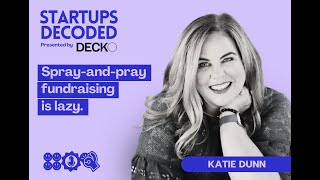
In this episode of Startups Decoded, host Andy Walsh interviews angel investor Katie Dunn about her journey from a 25‑year career in commercial real‑estate finance to becoming a focused early‑stage angel. Dunn explains how she flipped her investment thesis after noticing the scarcity of capital for women, people of color, LGBTQ+ and other under‑represented founders, arguing that the capital‑efficiency and higher returns of women‑led startups make this a strategic, not merely altruistic, play. She shares data on missed opportunities when founders lack funding, and discusses the broader ecosystem, including community groups, regional accelerators, and the higher success rates of immigrant founders. Dunn outlines her portfolio of 29 investments—mostly consumer packaged goods and B2B SaaS—emphasizing non‑competing collaborations (e.g., spirit and syrup brands) and her hands‑on approach: regular check‑ins, problem‑solving, and leveraging her network. Communication preferences are highlighted; she prefers concise, bullet‑point outreach that aligns with her thesis and dislikes long “trauma‑dump” messages. Social‑media behavior is a key screening signal, and she warns against founders who appear distracted. The conversation turns to modern tools: Hubble, digital twins, Delphi.ai, and a simple fundraising scoring tool that filters deals by category, stage, region, and portfolio overlap. Dunn walks through her first‑pass assessment—gut check on category, market size, founder passion, and check size—followed by a “vibe” interview. Pitch‑deck advice centers on brevity (5‑slide core), clear fonts, credible market data, and a strong one‑liner. Finally, she provides contact channels (LinkedIn, katie‑dunn.com, themastheadstrategy.com) and encourages founders to use her digital twins for feedback. The episode blends personal anecdotes, practical advice, and emerging AI‑driven workflows for angel investors and founders alike.
Chapters
And so when I looked back and like looked at all of these white men that I made richer than they already are, I flipped my angel investment thesis to be the exact opposite, to focus on people of color, women, LGBTQ, people that are notoriously discriminated against when it comes to funding of all types, to be able to support them in their journey. When you look at the stats on women and how they use their money in startups, there's tons of data out there about how much more capital efficient they are, their return on the funds that they get, like all of those things. So it's not just an altruistic thing. It's actually a, like, an investment strategy.
Welcome to Startups Decoded, the show that gets real about what it takes to build a successful startup. I'm Andy Walsh, 2x exited founder, strategist, and your host. Each week I talk with top founders, investors, and operators to unpack the plays that drive real traction, not just headlines. If you're building something bold, this is where you'll get the honest insights to scale with clarity and confidence. Let's keep growing together. Hit subscribe and share with your community. It would mean the world to me. Startup Seedcoded is brought to you by DECO. Are you raising capital? DECO builds pitch decks investors say yes to, designed by expert VCs. Create the deck that gets you funded. Getdeco.com. Hello and welcome back to Startups Decoded. Today we go into early stage investment, in particular angel, and, and we're looking at that process of assessment and how founders find angels. And so much goes into connecting with people and there are so many barriers. And to help explore that today, I've got Katie Dunn. Welcome, Katie.
Hi, Andy. Thank you so much for having me.
I have been talking about this a lot recently, and maybe it's just a product of my own portfolio, the events I'm going to as well, but there's a lot that goes into building your community as a founder. And I talk about that from investors to customers to partners, employees. You need to be able to be tapped in. And we're going to go into that today as far as how that relates to what you're doing with your own investments. But to help people understand a bit about you, I'd love to go back to your career in finance and observations that you made to take you into the path that you now tread?
Yeah, that's, that's a good one. And it definitely, you know, I, I'm a big believer in everything happens for a reason. You're on a certain path and, you know, you learn along the way. But yeah, I was in commercial real estate finance for almost 25 years. So that means I was making loans for buildings, not for houses, for buildings. And I did that all over the country. And so I really loved it. I loved, Being able to travel to the buildings, looking to see what tenants are in those buildings, learning about those businesses and what they did to make money, to look at their financials because I had to make sure that they were making enough money to pay their rent so that the building owner could pay their mortgage. So that was the, the fun part. I like doing the deals, but when I look back on who I did deals with, the people that were, so my clients were the building owners. I can name one woman that I did a deal with in 25 years, one. And she was a woman of color, which was amazing. She actually owned a bunch of, she made her money on owning Wendy's franchises. She went to the McDonald's School of Franchises and learned the McDonald's way and then applied it to Wendy's, which is kind of interesting. And then I, she bought two little buildings and, you know, rather small buildings, I shouldn't them little, smaller commercial buildings in Atlanta. And, uh, that was the, I, I remember her because she stood out. She was the only one. And so when I looked back and like looked at all of these white men that I made richer than they already are, I flipped my angel investment thesis to be the exact opposite, to focus on people of color, women, LGBTQ, people that are notoriously discriminated against is when it comes to funding of all types. Uh, and when you look at the stats on women and how they use their money and in startups about how much more capital efficient they are, their return on the funds that they get, it's not just an altruistic thing. It's actually a, like a investment strategy.
And we were talking before the show and I was, had the privilege of chatting to Ashley Bell from Redemption Bank and we were talking about some of the data and, and Their mission is to open capital up to minorities in simple form, and it's much bigger than that. But when you start to look at the data and the history, there's two sides to it. There's the huge gap, which everyone knows about, but only a few are trying to make any difference. And the thing that bothers me about that, apart from the obvious bias, is the missed opportunity. And I know that when we were chatting last time, you told me some stats around the success rate of female founders versus male founders. And that as a standalone piece, if investors are looking for the maximum chance to drive returns and they're not looking at that data, then there's something bigger going on behind the scenes there, whether that's active or passive. And, and we need to work together to overcome that.
Yeah, that's, that's so true. And, you know, and the other thing, you probably know this too, one of the main reasons that startups fail, it's not because they didn't have customers or because they didn't have product-market fit, a lot of times they don't have the funding to continue to go forward. They can't scale at the level that at which to grow. So they're just sort of stuck. They get tired and they shut down. And it's, if you can't, if you don't have access to certain forms of capital, it can be a real problem in growing your business. It's really, yeah, it's, it's pathetic, honestly. So. Yeah, it, it, it is missed opportunities. It's products that could live in the world. It's services that could live in the world that can make people's lives better and easier that aren't because they just don't have the access.
And I was fortunate to have Michael Gibson on the show from 1517 Fund, and he worked alongside Peter Thiel on the Thiel Fellowship, and their whole thesis was around renegades in, in investing in founders with $100,000 grants for people that hadn't gone to university and the whole anti-Ivy League piece. And what they're able to do is find all these obscure folks from random places with interesting backgrounds and invested based upon the merit of them and their business rather than any superficial labels that people use for funding. And that echo chamber that exists with investors at large is a real problem. It's actually holding back a, a world that can make such faster and healthy and human, I would say too, change in to get back a lot of the things that we've lost.
Yeah, it's those kinds of things are really interesting to me. And like the, the groups that are doing things in not the coast, you know, not San Francisco, not New York. Obviously you and I are very in, in the New York ecosystem, but like I was talking to a founder this morning and she is actually from New York, but she got sent down to Oklahoma to, as a part of an accelerator program and she's working with people down there and like there's because all of these other places that have thriving ecosystems and people with good ideas are everywhere. It, you know, it's not just the college you went to, the city you live in, you know, who you grew up with. It's not those things. Like, you can— there's so many— it makes it possible, right, to do things, to communicate, and to find and network with people anywhere. So I think there's a lot of opportunity to to look at those smaller places and look at the people that have good ideas coming out of those other, other different backgrounds that aren't the typical thing.
And that's, it's factual that immigrants in the US have a higher success rate in startups than people born in this country.
Oh, I didn't know that.
There was, someone said it to me, so I'm going to fact check it myself, but I heard it on a presentation at a conference I went to. That for me is, is fascinating. And what I see in that is quite a view on the world that is not traditional. If you were to go down a linear path of the right elementary, middle school, high school, college, and you get networked with all the right people, you've been taught in the same system quite often with the same ways of thinking, and you're not able to problem solve and look at things with the same lens. So if you come from somewhere where everything is that bit harder to get to the same point, there's, there's more to overcome, but you've got a more neutral perspective as well. And bias is one of the things that I see in founders that can be helpful sometimes, but sometimes can be the worst thing you can do if you're not able to understand what you know and what you don't know.
Totally. Yeah, that's, that's so true. And I think, I think immigrants kind of by nature have a grit and resilience to them that Like you, you did not grow up in the US, obviously, you know, so just, just the fact that you came to a new country and at least you knew the language, but it's still so different, right? You, you have, you've tried something new. You have made a community here. You know, I can't imagine you knew 1,000 people when you showed up here and now look at your network. Like there's a lot of, of grit and resilience in that when you come from another place and start. Brand new.
Absolutely. And I don't want to go too deep on my own story, but there's things that you learn through that experience. And it can be as simple as visas, getting your social number, to just, just basic administration things can be more challenging in a system that's foreign to you. But then there's communication and food and all the things that go around it. And I've been able to sort of accept it and almost lean into it and be curious for me is is the superpower that I've learned because I ask more questions than I talk. You know, it makes sense doing a podcast for me because I just love to extrapolate all the goodness of the people that I get to talk to. And for you, you're literally putting your money where your mouth is and you're actually with your own capital helping people drive change. And businesses that can be profitable and drive returns for founders and for investors is no mean feat. And if you can drive cultural change, alongside that, as far as who those people are that drive success and how that money flows down to future generations, that's where you drive real human change and an impact on the world that is positive and has a net-net effect as far as I see it.
Yeah, I can't tell you how many women that I speak to and invested in, frankly, too, that say to me, I'm doing this to make a ton of money so then I can be like you and invest in other women and help them. And, you know, this is something that, like you said, looking at it generationally, like how can we make it better for the women that are coming up after us and give them access to resources? And so it's not so hard for them to start a business or to try something new or to, to be an investor or whatever they want to be is just provide the resources out there. I mean, I look at what, you know, when I was working in finance, 20+ years ago, there was no communities and no women. Like, first of all, there weren't a lot of women that I was working with 'cause I worked in a very male-dominated field. The, the, they weren't inviting me to investment opportunities. They weren't doing that. I learned about how to invest my money from my dad and from my own studying. And I, 'cause I was a finance major in college, so I, definitely did a lot of stocks and real estate. Those were things I knew and then got into startups later. But it's the, you know, the access to things now. There's so many resources out there, so many people doing with communities and online learning that you can do and even trying to figure stuff out with, with AI and ChatGPT or Claude or whatever. You've got so much more opportunity to learn something that you really want to learn. Than ever before. So I hope more people are taking advantage of those things.
Definitely. And, and we've met through various community groups, and there's 3 that spring to mind that are driving that, one being Theanna, The Fourth Effect, another great one, and Cherub, which is a new AI-focused one. And those platforms, um, are focused really heavily on driving the change for females, but also doing something which is which is greater than that, which is community. So it's like, how do you find people that you can just have an ear and have a conversation with? How do you find advisors that can help change the trajectory of your business and give you insight that you'll never have through their lived experience? And I think that formalization is driving a real shift as well, because we need to bring more angels into the ecosystem and drive the shift that we're talking about. And for you personally, um, to look at your approach, because I know that founders would be just getting a little bit uneasy sitting on their seats, wanting to know the, the inside word from yourself as far as how you can help them on their approach to finding that really early stage angel investor into their business. So to give some context, how many companies do you currently have in your portfolio?
I've made 29 investments. There are about 4 that are dead or dying. Um, and a couple of them are real estate deals as well. So it's, you know, it's, I've invested mostly in consumer packaged goods, mostly in the beverage space, and then some tech. So it's when the tech stuff is mostly B2B SaaS. One company that actually just launched last week is Goodword. That's actually B2C. It's a networking tool. We gotta get you on there, by the way. I gotta give you a code for early access. And so it's, there are things that like my thesis is, or a big part of my thesis is I don't wanna invest in things that directly compete with each other because I am only one person and I don't wanna ever have the founders think that I'm sharing information across companies. But my beverage companies have done a lot of collabs together, so that works out well. Like I've got a, a, a spirits company that has collabed. We've done collabs with The Cheeky— so we have Blood Monkey Gin and Cheeky Cocktails, and Cheeky Cocktails makes juices and syrups that go in cocktails. So we use their products to make cocktails at festivals and events and stuff like that. So like that kind of stuff is awesome and perfect to work together, but they're not gonna ever compete because Cheeky's never gonna make a spirit and Outcast Brands, the parent company of Blood Monkey, is never gonna make syrups and juices. So it works out well cuz they— I, I still am within the industry, but I, and I can be helpful and put them together, but it's not competing.
And collaboration is obviously a really interesting business strategy these days. And if you look at major brands, sporting brands with athletes, but even now cross brands where you've got like Emily Dior working with New Balance on a pair of shoes. And it's really common and it drives that appetite and curiosity for consumers. And to do it with your own portfolio is a massive upside. And I think a lot of founders forget that angels come from various backgrounds and have really interesting skills that you can leverage. And in that early stage can become an angel advisor, which is more common these days where they're putting in capital, but also their knowledge and network. How do you function day to day with your portfolio company?
That's something that's really important to me, that I am more than just a check. I, and I know you're the same way. Like, I don't, I'm not going to just write a check and go away. That's not how I operate. Like, I want. People to tell me what's going on and to ask me for help, to, you know, tell me the good news so I can celebrate it with you and share it. I wanna be a part of that stuff. One of my skills is that I'm a problem— I've, you know, I think of myself as a problem solver. So I, if I don't know someone that can help, I, I will find someone that can help, or I'll ask someone that can help. I like, I don't care about reaching out to somebody randomly on LinkedIn and saying, hey, can you help this person? And see, 'cause a lot, 9 outta 10 times they say yes. So why not make that ask? Uh, but I will say when things get hard, it's really common for founders to go dark. Like there's one founder that I went from talking to once a week, texting all the time, you know, being super active in what they were doing, that they have now not spoken to me in 2 years. And I know that they're alive because I see them in other things, but they literally will not respond to me. And I brought in other investors to this company and all, all these things. So yes, things went bad at some point, but I don't even know exactly what went bad. You know, it, it's so that I'm not the enemy in this situation. Like I've, I want the founder to succeed. I have put my money and my reputation on the line for these people and I'm behind them saying like, I put my name on this, like, and my brand and my reputation and my network, all of that is all I have at the end of the day. That's what's gonna make me money and make me successful is preserving that. So if somebody else— like, I just want people to remember that the angels are going to be there. And there's so many people, so many founders have said to me, I thought that BC was going to do so much for me, but you've done way more than they ever have. And I've never, you know, or that, you know, I want to be accessible. I want to be there to help.
And I hear it all the time. And it's, it's amazing that the lure of a VC and what people think they're getting versus what they do. And there's obviously some genuine exceptions. And I'm part of Primary Ventures as an expert in their team. And they have a huge platform team and go above and beyond to help their portfolio companies succeed because ultimately the VC is investing on behalf of a range of LPs. Into people that need to drive returns. And giving that a better chance feels like a strong investment to change the data a little bit. But that advice from an angel as well is really important. A lot of founders, and I'd love to hear your perspective on this, do you think that a lot of founders see angel money as free money and they don't understand the accountability and opportunity as well that comes from that relationship as far as they get a check and they just spend it? Or do you think that people are actually more respectful and are just natively giving you updates and asking for help.
I don't know if I would go so far as free money, but I do think that they value or they look at the VCs like they're the rock stars. Like the VCs are playing the, you know, the arenas and the stadiums and the angel investors are like in the club and they've got a little bit of a following. You know what I mean? It's like that they're cool, but they're not as cool. Like, so they're not as big. So it's a— I do feel like they're probably scared, more scared of the VCs. They're more, maybe more respectful, maybe more, you know, worried about letting them down. But frankly, they should be, but they should be with everybody. One thing I coach founders on when I first start working with them is I say, you know, your earliest investors are your best investors when you go out to raise the next round. You have to go to them first and say, I'm raising my next round. Would you like to keep your pro rata share? Here's the amount. Like I have one founder that's really good about doing this. I invested in her probably 4 or 5 years ago at this point, maybe 6 years ago at this point. No, 5 years ago. And she's done a few rounds and she is so— she writes a really tight email. We're raising again. Here's your pro rata share. Here's the information. Let me know if you have any questions. The presentation's this, but you know, like right away she value— I know she values me. She's already done the math for me. She makes it super easy to just do the follow-on round if I, if I want to. So that, that's going to be your best bet. And even though if I, even if I'm a small check in that, it's still, I'm still keeping up my rounds, my, my not getting diluted, which is important too. So I think keeping the investors that you know warm, they're also gonna make more connections for you. They're gonna talk about you. They're gonna, like, I found out from one of my, from a friend of mine who's another angel, that another founder that I've already invested in is raising and I didn't know. They never told me. I was like, what is happening here? So that, that, that's like the worst thing you can do to an investor because then you just, they, I feel totally not valued, not respected, not important and unhelpful. So it leads me to be like, well, you don't think you need me? I guess I'm not going to help you. You know that I don't want to be like that, but I can only do what you're telling me. I can only respond to the information you're giving me.
And if you do some simple math and if you had 10 angels around your table and each of those 10 angels knew 10 other people, there's 100 hot leads. That you can engage immediately without really lifting your finger other than doing a little update email, maybe with some numbers that you should have available anyway, as far as cap table and dilution and opportunity for the next stage.
Yep. Yeah, that's a great way to put it. It's pretty simple. Yeah.
Okay. So the relationship's important, but to get that relationship, you, you need to build it and networking, digital relationships, et cetera. For angels, it's pretty unique. There's some more formal groups like Gainjil, band of angels, but with, with you, you follow the scene very closely, but I assume that you're getting more inbound than you're reaching out.
Yes. Yes. That would be a fair assumption. It's a lot. It's a lot of, it's a lot of inbound in my LinkedIn DMs, especially. Yes. And then there's some other angels that I have invested alongside a lot. So anything that they're doing and share, I take a close look at because they're, we have similar DCCs and, you know, can share, like if I know I'm getting a deal from them, they've looked into it, they've done the work, they've done the due diligence. And so it's a little bit like a, oh, okay, if I wanna write a small check into this, I don't have to do that much work 'cause I trust them and I know their, the quality of their work. But yeah, the LinkedIn DMs are bad. And I, do you wanna hear my biggest pet peeve?
I would love to.
They don't look at my thesis. So it's, I, I say no 99.9% of the time because they don't fit my thesis. And my thesis is the first thing that's in my LinkedIn bio. It's the— if you click my, my website on my LinkedIn, my LinkedIn profile, it's the first thing that shows up there. If you Google what is Katie Dunn's angel investment thesis, comes up in the AI. It's so easy to find. It's just everywhere. It's on, it's right on my website. It's right, like it's everywhere. Like my my big personal website. So I talk about it, I post about it. So it's, it just drives me crazy that like, I hate having to say no, I hate it. It sucks. And I don't want to, you know, I don't want to tell, I know how many nos these people get. So it's, it's not fun to have to be able to, to have to say no over and over again. And I, I do respond to everybody because I feel like that's something that, you know, founders get ghosted. They complain about getting ghosted all the time. So I don't want to do that, but I also need to say, no, you don't fit my thesis. So I have like this canned response that I send back.
And if you want that information, KatieDunn.com, I'll share it at the end. It's, it's such basic 101 fundraising to a point where I see it all the time too. And I've actually built a fundraising tool and I've got 4 simple variables. It's a yes, no question that looks at. The category, the stage, the region, and portfolio as far as competitors in portfolio. And it does a weighting per piece and gives you a score out of 100. And if it's under 75, don't bother. If it's over 75, that's your shortlist. And it's really simple exercise to do rather than the spray and pray component. It's just be hyper-targeted, find people that are interested, that match. And it's an easier on-ramp because to your point, the thing that sends me wild there too is that one, it gives them negative feedback, which is not necessary. It's like getting in trouble for something that you didn't do. And then the other side of it too is you're wasting the investor's time. So if you flip it around the other way, that only 0.1% of your time responding is actually a good use of time and 99.9% is education on people to do 5 minutes of homework, then it's not a good use of your time. And, and I know though that, and this is a great place to continue, is that the automation of Katie Dunn, uh, we were talking a little bit around Delphi, um, and we're also both on Hubl, which is another great way to connect. And there's tools like this happening and on Hubl, shout out to Kevin and Timo. Uh, I love Hubl and they're doing some amazing work. Katie and I are both available on that platform for bookings. But for you, being able to give 15 minutes, 30 minutes, 45 minutes on Hubble to people, they— sure, there's a small cost, but they're hyper-targeted. They know that you're bang on in the category, right stage, right level of investment, and they want to be able to engage you. Is Hubble a platform to do that first before you formally pitch? How would you recommend founders approach that opportunity where they can book you, but they can also pitch you?
So I actually have it clear on my Hubble platform too. I don't want people to pay me to pitch me. Like if I, like, I don't, that's unethical to me. So I say right on there, if you want to talk to me and pitch me for investment, then please reach out in the DMs of LinkedIn and tell me with 3 bullets how you meet my thesis, you know, a little bit about your problem you're solving and your solution and about you. So I don't, cause I don't want people to think that I'm, I'm on there to get, like it costs money to pitch me. And there's some people that do that. It's not, not what I want to do. So I have that front and center. And so I have the, most of the people that I've talked to on Hubble, they really want my advice or they're, they're thinking about fundraising. Should they fundraise? It's sort of that question or it's, can I practice my pitch? Can you look at my deck? Things like that. But I have to tell you, Andy, I'm sure you've had the same experience. The quality of founders and the people that I've talked to on there are amazing. Like, I, I like, I'm blown away every time I have a conversation through Hubble. I'm like, this is so cool. And it's people from all over the world too, which I love. So that's been really great. And then, but yeah, and then the people that wanna do a pick my brain call that can't afford me, I give 'em my digital twins. That's, and that's been great too. And that it's been, So fun to see the use cases for them. And there's one founder who's won over $50,000 in pitch competitions using MyTwin to help her hone her pitches. There's another founder that just won another one. I think, I think that was $10,000. So like they're using it so well and getting my feedback and getting, they're doing it probably better than I could do personally because it's so well trained, you know, to be so direct and to be so specific and hone in on the issues. I even use her, use them myself. Myself, use the twins myself. Are you using the twins, your twin yourself?
It's fascinating. And I, I get really amazing content ideas from it. And we're both on Delphi, which is delphi.ai. And my experience with it, and I can train it on my RSS feed for my podcast and any decks that I've done, and it just ingests volumes of content. So what I'm able to do is share my experience and even guests' experience. And so what I do, I've got this pool of knowledge and I'll just have just use it like ChatGPT and type in simple. But then I also, on the backend, then I see all the chats that people are having with it too. So I can look at their questions and what my virtual twin is saying on my behalf to these people. And I've obviously got a lot of legal disclaimers there that it is an AI twin and it's, it's not me, it's some code. But it's fascinating because I start to see patterns of the typical things people start to ask. How I can help deliver that content. And that comes across in my Substack, in my podcast episodes. So there's this beautiful passive training on both sides for me and for people who reach that platform.
Yeah. Yeah, I, I, I totally agree with you. It's a lot of people that want their decks reviewed and you can do that. It has to be a PDF though, by the way, it can't be a DocSend link. And in like the, should I raise money or I even get people saying like, would Katie, do you think the real Katie would invest in me? And I, that always, like, I always message those people when they say that because I want them to get, because it'll be like, the real Katie, her thesis is this. And you know, it's not, I want to give them a real answer. But yeah, it's, it's funny. It's really funny.
So I'd call that kind of cute, but also smart. Like, because it feels like a very humble thing to say. It's clever because you're getting a sense of how you act and think. And you're able to overcome a lot of hurdles on your own time rather than feeling like you're in the moment and all hope in the future rests on that one meeting that they're having with you. So it's a great way to scale you. And you said before, like, you work by yourself, so there's only so many hours in the week that you can help folks alongside your 29 companies that you have too. So those kind of tools are super valuable for founders to stress test and learn and come to the table engaged and feeling confident that they've actually got something that starts the right conversation and allows you to assess on the right merit as far as like the person themselves and how much you believe in them through to the product, their stage, et cetera, and what they're doing. In that approach, if they get that right and they reach out to you on your website and they're sending it through, talk to me a little bit about your assessment process, making sure they're obviously in that 0.1% and they're actually aligned to your thesis. So when you do look at the right ones, what things are you looking at in your first pass?
So the first thing, yeah, assuming they meet my thesis, it's a, it's sort of a gut check for me a little bit of do I think, do I like this category? Do I like what they're building in? Do I think there's opportunity? What does the market look like? Is this a problem big enough that they're solving? And is this something that I think I can be helpful with? Like, is this an area that I have connections in? Or, you know, is this something that I would actually use? It doesn't necessarily need to be the case that I'm a customer of the company, but there's sort of a bunch of things I go through. Last question I ask is their check size, because that sometimes that is a gatekeeping thing. If they're, you know, only taking $100,000 checks, I don't write checks that big, so I'm not gonna be on your cap table. But if you're raising a syndicate, maybe I will be, you know, that kind of thing. So it's a, the first test is sort of a, do I like this? Do I think that, Do I think this person on paper looks like somebody I should spend time with and talk to them? And then the next step is really having that conversation, whether it's over Zoom or one-on-one in real life, and getting to know the person, like doing that vibe check. You know, how does this person come across? Do I think they're going to be a good leader? Do I think they understand the problem? Are they obsessed with the problem? You know, are they gonna be able to attract other investors and other, uh, people to come work with them and partners and all of that kind of stuff. So because I invest so early, it's really a lot about the founder themselves. I'm like, the founder market fit, the founder investor fit. Do I like them? I'm sure, you know, we've all met founders that maybe have a good idea, but they're maybe not our cup of tea. Not going to spend time there, right?
Absolutely. And I got into a LinkedIn back and forth the other day on someone else's post, and she was talking about her investment thesis and she's an angel as well. And she talked about looking at someone's social media feed and getting a sense of, and you may have seen this post as well.
I think, you know, I think I saw the post. I didn't see your, I know exactly where you're, wait, so what I didn't hear, see your part though. Tell me.
Yeah. So there was someone who was talking about how it was such a bad way to assess a founder and this person's not going to be necessarily polished on social media and they were thinking about it as a presentation of who they are. And if I went to a social media feed of a founder that I was going to invest in and I saw that they were involved in something that was like super extreme in ways that I see as high risk as far as my investment and association through to any legal action. There's so many things you can glean from someone's social media feed, and it, and that's their public view of themselves. And people need to be aware of who they are and where they share because it's, it reflects a lot. And, and I'm like you, I, I don't have time for idiots anymore. I just, I've been surrounded by them and over time have managed to find a way to avoid most of them. And I'm very deliberate with people I get to know and spend time with. And if I'm going to be involved in your business, then I'm going to be in and I wanna be part of it and help you succeed. Otherwise it's just a waste of my time.
Yeah, I totally agree. I'll have to go back and see if it was exactly the same post, but the person that I saw post and said, I decided not to invest in somebody because of their social media. And I wholeheartedly agree with that. Like you're, you're spot on when you say this is that person's view of themselves that they're putting out in the world. And if that. If you are, you know, shotgunning beers 7 nights a week, do I think you're going to be responsible for my money? No. You know, I'm sorry. Like, it's— it— you— I am trusting you. I want to see people— I mean, I, I, I see this too a lot. Even just, you know, take apart like somebody doing silly things or risky things, as you put it. But even people that are talking about like a thousand different things on their social media rather than what they're building and the problem they're solving. If there's confusion, if you're talking constantly about other things, that I look at that and say, okay, there's some distraction going on here. You don't appear to be all in on this. And I want you to— if you're going in all these different directions, why not just go back and focus on what you're actually the problem that you're solving. Like, what— why are you getting pulled? Why are you moving? And if you're not, maybe it's a pivot. Maybe it requires a pivot because there's something else happening, but you've got to assess that.
Yeah, and if someone has got lots of things that they're doing on social, then there's a high dilution of time, passion, knowledge, energy, etc. And the reality is you need to be all in to succeed in a startup. And I'm all about balance and mental health because I've had a negative experience myself myself, and I'm hyper-aware of it for me and also anyone that I work with and always doing mental health check-ins with people that I know. And it's one of the first questions I ask on, on those meetings is like, how are they doing? And I can tell with people that I know, and it's, and it's balancing your life, but hyperfocus and hyper-specialization in those early stages that we're both involved in is critical.
Yeah. Yeah. There's just, unfortunately with, especially with AI and every business needs to be using AI today, but things People can move so fast right now. If you've got a good idea and you're ready to build it, you gotta go build it as fast as possible and be totally focused on it.
Yeah. Yeah, absolutely. Okay. Love to get into some table stakes conversations, the approach, what someone shares with you and the pitch deck. But as far as if someone's writing to you, what are some of the things that get your attention in that first touch? Are they showing up in your LinkedIn first? Are they adding value and building a little bit of awareness of themselves first? Are they hitting you cold but with something impactful? How does that work for you?
I think that, that varies. I mean, I, I do, I do like the people that are like, that say, I'm not raising right now, but I, you know, I just want to be connected or follow you, or if it's over LinkedIn, because That makes you feel a little bit like, oh, I'm a human. They think of me as a human, not just as a check. So the people that hit you up cold with the, just the asking for money, you, it feels very transactional at times. I'm sure you, you can agree to that. I do really want it short and sweet, like really, really, really bullets as short as possible because I get these huge long DMs that are like entire life stories. I mean, there was I had one guy kind of recently that literally the sob story that came out, I just don't even know what to do with that information. Like, I can't solve all of your health problems and your bankruptcies and your family issues and your all, I, you know, there's nothing I can do with that. And frankly, that is not a good bet to take on a founder if they're in such dire straits, they need to figure out other things first. So it gets, it gets to be a lot. And like that, that kind of trauma dump, which is what I call it, that's never an effective way to reach out to somebody. It's more about like showing the, a respect for my time that you know that you fit my thesis, you know that you are, tell me why you're a fit, tell me why you're the right person to be. Running this, but like in a very short and sweet way, that'll get the most engagement.
And the empathy line is, is good. And I would look at it in a way though, where if someone had a lived experience and it was relevant to why they were doing what they were doing, and there was a one line that basically said, my sister suffered through this for 10 years and it's become my sole focus, then I would support that. But being able to understand someone's motivation is good if they're that vulnerable. I'm a vulnerable person and I encourage it, but that's just not going to open a door. Like, it actually unfortunately is a red flag as far as what they're doing and transparently putting out there who they are. And I always hope that those people are okay and they get through it, but it's not the right way to start an investment conversation.
I totally agree. If it's relevant to the business, Tell me. And I, I, that's one of the first things I always ask founders. What, what was your aha moment? Like, what's your connection? Because I think a strong connection to the problem is required because you, when things get hard and you're, you're having a down day, the motivation for solving the problem is what's gonna get you through. So it's got, you've gotta have passion and obsession around the problem. And if it's a sad situation which many, many, many businesses are born out of something traumatic happening to them or their family or somebody they love or know, which is unfortunate, but you're hopefully saving other people's lives in that, those situations.
But yeah, absolutely. Okay. The, the big one, and this is around pitch decks. I hate the LinkedIn content about the perfect pitch and people quoting Airbnb and Uber and all these historical things has become just so diluted and derivative. It's lost any value. And I'm a big, big, big fan of short and sweet. 5 slides is all I want to see. And there's key things that I look at and there's stuff in the appendix. That's fine. I can read if I want, but in storytelling, I'm looking at founder. I'm looking at product. I'm looking at category. Ultimately, the 3 things, and there's a lot of stuff that goes behind each of those. I'd love to hear from you, like some of the great things that you've seen in a deck that help you really understand the business. Who the people were that gave you confidence that this is a conversation worth having?
That's a good question. The— I'm trying to think. A lot of times, I mean, I've invested in a couple companies without seeing a deck, and so it's— that's to your point, like, the deck gets so much airtime and so much— it consumes so much of a founder's time revising it, working on it hours and hours and hours before they send it out for the first time, and then they realize that I wasn't dotted, and then they freak out. Like, there's so much pressure put on the deck. So it's a, it is, it is a necessary evil, I think. But I like, I like a very simple deck. I like something that doesn't, that's not overly technical. I, you know, this is the, the intro, right? This is like the coffee date. Like, this is just the, let me tell you a little bit about me and see if we want to go out for dinner, right? So you, it doesn't need to have every single detail, but it also shouldn't make me feel stupid. It also, you know, I don't want to have paragraphs and sentences long of things to read. There's so many stats on this, but, and I think DocSend has the best one. It's like people look at decks for less than 2 minutes. So you've got to grab the attention quick. So it's got to be simple, clear, big font. I have, I wear, I have reading glasses. So if I'm looking at it on my phone, big font is good. Yeah. But I agree. It's like. Its founder. It's like, I, I wanna understand that, that why are they building this? Like, I wanna get that first. Tell me, tell me what a little bit about the aha moment first, problem, solution, so that I get it right away. Back up the problem with real stats. That's a big pet peeve of mine is that people, the market is huge. Like, what does that, what does that mean? Like, there's What is huge? I don't even know. Or like, back it up. Tell me what the sources are. You have to build your credibility with me. That's what the deck should be doing. That's the, I think that would be the biggest thing. If I had to sum it up, it's use it as a credibility builder.
100% agree. And it's, it's how do you get someone's attention in the shortest way possible? It's like Advertising 101 as far as thinking about your story. Like, less is definitely more. And being able to show who you are and your personality also goes a long way in your story of demonstrating who you are. If it's too, if it's too deep and has so much information, then like, if that's reflective on who you are, then I'd look at that too in a negative fashion in the sense of like, if you can't focus and, and know what actually is important in context of the conversation that you're having, then again, it's going to be a struggle for that person.
Yeah, it's— I tell every founder, like, you have to have a really good one-liner. And it's not just for the in-person thing, it's for using it at the bottom of an email or using it at the end of a LinkedIn post. Like, having that one-liner that describes you and what you're doing, it will get repetitive for people. And, oh, I know, you know, Andy has the Startups Decoded podcast. Like, I know that about you because you talk about it all the time, and that's like ingrained in me. And that's great because I know exactly who you are and what you do, like what your podcast is. So that's, that's a good thing that reinforce that positive and continual reinforcement in a simple way.
Yeah. And people forget that as human beings, we're natural storytellers. That's, it's our DNA and it's, you know, 50 million years old as a form of communication and telling history over time. So we're hardwired for it and put emotion, have some passion about it. As far as today, you're like, what you're actually doing and, and how it makes you feel and the excitement you get from solving that problem and demonstrate who you are. Otherwise you're just another, another person with another over-polished pitch deck and you don't know who you are. So differentiate yourself through being human.
Totally. And that's, that's such a good reminder because everybody, like I want people to show me they're unique without saying I'm unique. You know, you don't need to use that word, but the, There, there was a founder that I spoke to today, earlier today, a different founder than I mentioned before, that she, I was giving her a critique of her pitch and deck and her energy was so low, like so low. I was like, you don't, do you not care about this at all? Like what's going on? And I, she could tell she was reading her script, which was okay for the thing that we were doing. But I said, you've got to get your energy up. Because people are investing in you. You've got to show, you've got to be able to talk about yourself, what you're building with such passion that people are— it's that it's infectious, that it's— they, they love it and they want to be a part of this so much because it's so exciting that you are so passionate about it and you're the expert and you're the one to lead this. So they're going to want to back you.
Great advice to finish on. And I'm conscious of time. We could keep talking forever like usual, but I need to let you get back to what you're doing in supporting amazing young founders. To finish up today, Katie, I'd love to hear from you as far as how people can reach out and what you're looking at at the moment.
So people can reach out via LinkedIn DMs or on my website. I have ways that you can contact me. So I have katie-dunn.com, talks all about my angel investment thesis and my angel investments. And I also advise founders on their fundraising strategy. You can find more stuff about that on my business website, which is themastheadstrategy.com. And you can also check out my digital twins. They live there as well, or links to them live there as well. If you want to chat with them, they're very fun and interesting to talk to.
Great little experiment. I haven't tried yours. I've been meaning to, so I'll definitely get on and might even get some of my portco in there to give it a little bit of a spin and test themselves out as well. Katie, thanks for your time. It's very generous and love having these conversations and founders. I think there's so much gold in what Katie shared. So thank you.
Thank you so much. It's a pleasure to be on here. I'm such a fan. So thank you for having me.
Thanks for listening to Startups Decoded. If today's conversation helped you think differently, share it with the founder in your network. And don't forget to subscribe for real-world startup insights every week. We really value your support. If you're interested in partnering with us, email hello@startupsdecoded.com. I'm Andy Walsh. I'll see you next week.
More from Andy



EP#88: Why Most Founders Misread Their Own Traction. Vanessa Larco - Premise VC

EP#87: Founders Obsess Over the Raise. Investors Care About This More. — Carina Cunha






Ep#86: Early Decisions That Define Your Startup Forever. With J.P. Morgan Asset Management
