S2E18: Stop Running Your Startup Like a Hobby. Build It to Sell. With Luke Tobin
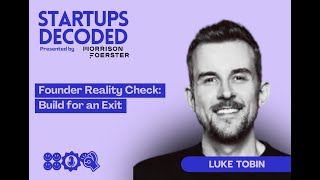
Serial entrepreneur Luke Tobin shares lessons from three exits across hospitality, e-commerce, and agencies. Most founders ignore exit planning from day one, but building a sellable business requires early buyer identification, financial discipline, succession planning, and treating your company like a real business, not a hobby.
Chapters
I definitely didn't think I would sell it. This whole world of exiting businesses was a bit alien to me. Had absolutely no idea about the exit. All I was focusing on was the revenue generation more than anything else and trying to make profit day to day, week to week. So no, it was a very different perspective to what I have now. So these days when I evaluate or decide what I'm gonna focus on, it always has an exit route or an exit plan. But back then I would be lying if I said I did. I was winging it like I think most young entrepreneurs are early on. But, you know, from, uh, understanding that now, being able to reflect, it's really easy to dissect what worked, what didn't work, and put that into a framework, into a methodology that I know helps the exit readiness.
Welcome to Startups Decoded, the show that gets real about what it takes to build a successful startup. I'm Andy Walsh, two-time exited founder, strategist, and your host. Each week I talk with top founders, investors, and operators to unpack the plays that drive real traction, not just headlines. If you're building something bold, this is where you'll get the honest insights to scale with clarity and confidence. Let's keep growing together. Hit subscribe and share with your community. It would mean the world to me. Morrison Foster is the legal edge behind the world's boldest innovators. They go by MoFo and are the team behind Startups Decoded. For decades, MoFo has helped startups turn complexity into freedom. Learn more at mofo.com.
Hello and welcome back to Startups Decoded. Today we're looking at building, scaling, and exiting a business, but what happens next and how you take those lessons and apply it to create a new business. And to help me unpack today, I've got Luke Tobin. Luke, welcome to the show.
Andy, thanks for having me.
We've literally connected for the first time today, and I love jumping on to these conversations and feeling like you're two peas in a pod. We've trodden very similar paths as far as our experience in building an agency, bootstrapping, and then scaling that, but also what you now do in helping other people do the same. Can you just give us a little bit of context on yourself as far as your background, where you came from, and then we'll start to explore a bit deeper on what you're doing today?
Yeah, of course, of course. So I've been in this crazy thing we call entrepreneurship for about 20-something years, 22 years. I've had 3 kind of separate lives. So 3 exits, one was in hospitality, then later in e-commerce. And then I've spent the last 10, 12 years in and around the agency world. So first of all, working within creative-led businesses, and then later forming my own. I built a full-service marketing agency up over 6 years. At one point was the fastest growing agency in the UK, expanded into Toronto and into Germany, and then later sold that in an 8-figure deal.
Fascinating. When you went through university, university, did you think that entrepreneurship was a career or was it something that other people did? I always love to understand about that leap of faith versus was it completely naive? You just had self-confidence to move forward and have a go.
I mean, I was definitely naive, but first and foremost, I didn't go to uni. So I, I left home at 16 and went to college, went to a drama college, enjoyed it, realized it wasn't for me, you know, jumping around on stage and whatever, as much as I enjoyed it whilst I was a bit younger, wasn't where I I wanted to be. But what it did teach me was some pretty good kind of confidence and sales skills. So I went out into the world of work at 18, started doing different sales jobs, direct selling, you know, learning to quite a few commission-only jobs, which taught me very quickly how to hone your skills and how to kind of win over people, influence, etc. So yeah, sales was my lifeline, excuse me, was my lifeline, and very much gave me the ability to make enough money to live initially. And I think the entrepreneurial drive has always been in me from a, from a very young age. My dad was very entrepreneurial. Having gone out into the world, you know, at a young point, I'd realized I needed to try and make it for myself. I think I've always been quite, quite curious in nature. So I've always wanted to try and solve problems and entrepreneurship gives you the ability to do that.
And I, for me, the ability to look at the world through a different lens is definitely a standard founder quality and going through a non-traditional path. And you look at one end where you have your Stanford alumni that basically go through and they're crafted into founders and they have a network and everything that goes around that. And the other end, you have people like yourself just going through what is a pretty standard upbringing and then having a life journey inform what you do next. And I had Michael Gibson from the 1517 Fund.
Oh yes.
He worked with Peter Thiel to launch the Thiel Fellowship and listening to some of those stories and their whole thesis is backing founders that didn't go to university.
Yeah.
It's the people that see the world very differently. And two of their alumni are Ethereum and Figma.
Mm-hmm.
And two names that speak for themselves that didn't have an education, have created something significant now. And, and that experience for me is almost more valuable than a traditional education because you can be very focused and myopic on learning the same way as everyone else. Rather than being a creative thinker.
Absolutely. I mean, you've only got to think about some of the most famous entrepreneurs of our generation, our era, you know, Richard Branson, etc. All of them, you know, skipped, well, a lot of them skipped university. And you're right, there is a tried and tested route now through Stanford and Harvard and whatever, which does produce excellent business founders. But I think, yeah, there's certainly a place for going your own way and going your own way and making, you know, making the mistakes. What I would say is those early years of entrepreneurship. My first business was an import business, importing wines and selling them to trade. I also had a bar hire business on the side of that where we were doing all the major festivals in the UK, did a few in Europe as well. And it was amazing. We're winning these contracts with pretty much no background or history, just a bit of sales nous. And, you know, we managed to get into some amazing concerts, but I made so many mistakes from not stocking correctly, not staffing correctly, not— but that kind of learning journey was what I needed. It's the way that I prefer to learn. And actually, had I gone to university and tried to do a business course to teach me all of that, I feel like I would have had to go out and have those mistakes anyway. So I would have been 3 years behind where I was in many ways. So yeah, it worked well for me. And, you know, I'm sure for a lot of others as well.
I need to do an episode on the word failure. I have a real issue with the word fail and failure in the sense of how it's used in startups, the whole notion of fail fast. For me, it sets the wrong tone. That I repeat a lot is around thinking like a scientist, which is the hypothesis focused on here's what I want to do. Here are some options. I'm choosing option B. You go forward and it works or it doesn't work and you learn and then you keep going again, right? Failure feels finite and it sounds like for you, you learned some tough lessons, but obviously by your success, what you did was take those lessons, put it back into a system that you then evolved and adapted over time to be better next time round. And you have to be pretty pragmatic and thick-skinned to be able to be in the trenches and navigate those really intense emotional and stressful situations. But if you don't look at it as a lesson, then you're perpetually going to be stressed and you're going to be really hard on yourself.
Absolutely. I think that would be a really good episode to do, by the way. And you're right, there is a strange framing in society about failing, but actually what we're talking about is just learning. You know, it's all learning. When I look back on some of those experiences now, even experiences I'm having in my current business as well, where we're making mistakes on the daily and we're still figuring things out and we're thinking about what does our ideal customer look like. And I had two pitches earlier this week on Monday, which I wasn't happy with. And I thought I've fumbled them, I've ruined them, you know, so you're always learning, you're always iterating. It's not failure, it's, it's kind of stepping forward, isn't it? So yeah.
And people are more human than we give them credit for. And what I mean is like, say in a pitch situation, if you're fundraising, you treat a VC like it's the hand of God, so to speak, as far as if you don't do a perfect job and close this money, that life's over in its current form. And it's easy to get caught up in that. But if you step outside and think about that person, they have LPs that are on their backs to make money for them. They have their own pressure and process and changes that they're going through. And trying to build a human relationship ultimately is what you're doing. If you can build trust and you can build openness and vulnerability, then things will go wrong, sure. And you've got 22 years and you're openly talking about mistakes you're still making. But for me, they're the important lessons that you put back into the system and learn and get better next time with.
And everybody has those periods of self-doubt, right? And there's different forms of self-doubt, different ways that you kind of second-guess yourself. And I think on those types of calls where there is a strange dynamic of almost like a power shift where the VC or the investor comes in and they're like, well, I've got something you want, so you need to work really, really hard. The irony is if you go into that and you level that playing field, bring that equilibrium in as quickly as possible by being bullish, being confident, you know, you actually get more interest from that. Investor anyway. So there is a, yeah, it's about flipping the script quite often on these things and trying to ground yourself before going into those calls because actually they're looking for confidence. They're looking for people that can take this business all the way. And that's, you know, that's not going to happen if you go in saying, please, sir, can I have some more?
It's the line that I assume that they're used to hearing consistently from people that they're either desperate for real or they just feel like that the power balance is against them. So they go in and like, like a beaten dog in a way. And don't have the confidence that they typically would have.
Definitely. Yeah, definitely. It's all about framing, you know. Um, I'm in the process of writing a book at the moment with Pam McMillan, actually, and it's about framing in high-pressure situations. And a lot of it is really looking at kind of like how we leverage doubt in a way that is not the archetypal way of doing it, which is, you know, letting it compress us, letting it get on top of us. It's about reframing the situation and visualizing the outcome before you go into it.
So good. Look forward to that one. When's that due to come out?
It'll be on the bookshelves 2027. I'm in the process of finishing the manuscript at the moment. And then there's, I never realized this till you get into this kind of strange publisher world, but everything's like a year lead time at least. So they start selling the books for '27 in June '26. So, you know, it's kind of like always at least a year out, 18 months out, but, um, Yeah, it's exciting. I'm enjoying writing it. It's really good.
Yeah, I'm in the process myself and it's, it's much more work than I ever anticipated and trying to find the right headspace and time to do it and do a good job of it is a whole thing in itself.
Yeah, it is. Yeah, it is. It's, um, it's a full-time job on top of the full-time jobs. Yeah.
100%. Well, when that comes out in 2027, let's book in an episode so we can talk about the book. And give people some insights as what to expect. But we're not here to talk about the book today. I would love to go back to the systems and for you, when you started a business, let's start with this question. I'm always fascinated with people's future planning. When you started your first business, did you think it would be something that you would sell or were you doing it because you wanted to do something, you needed to earn money? What was the first step into that for you?
I definitely didn't think I would sell it. I mean, this whole world of like exiting businesses was kind of a bit alien to me then. And yeah, I had absolutely no idea about the exit. All I was focusing on was the revenue generation more than anything else and like trying to, you know, make profit day to day, week to week. So no, it was a very different perspective to what I have now. So, you know, these days when I evaluate or decide what I'm going to focus on, it always has an exit route or an exit plan. But back then, I would be lying if I said I did. I was winging it like I think most young entrepreneurs are early on. But, you know, from understanding that now and being able to reflect, it's really easy to dissect what worked, what didn't work, and put that into a framework, into a methodology that I know helps to stack for exit readiness. So all of those kind of trials have helped lead to what I now use as a method.
Let's talk about that a little more. Can you talk us through what are the type of things that you would encourage others to to do and what you look at for yourself in being exit ready, if that's the path you want to choose.
Yeah, I think one of the very first things, if we're talking like pre-startup stages, figure out who your potential buyer could be for what the thing is, the product, the service, the whatever it is you're trying to do. If it's a tried and tested product or service that's been on the market before, there's competitors for which most of the time there is these days, let's be honest, you can benchmark and you can try and look at what buyers could, could be and how then to make it attractive to them. One thing I've been doing quite prolifically in my current business is going out and talking to private equity, because they will be potentially the buyers, or certainly I hope so, of my current business. And I spent time before I even launched, you know, in rooms with them, paid for their time, sat and digested and said, look, how do I stack this thing in a way that would be attractive to you and why? And then you reverse engineer backwards. But, you know, if you can't do that and you're already in a business, one of the best things you can do is start thinking about, okay, If I was going out to market today to buy my business or buy a similar lookalike business, what would de-risk it for me? What would make me feel comfortable? And normally, if you're astute enough, it's a good place to start. So like, you need to make sure you're not the only person doing everything because there needs to be succession planning. You need to make sure you've got all of your accounts in good order, you're making profit, you're doing all these— some stuff that you would expect a savvy business person would just want as basics is a pretty good place to start. And then from there, you can start to stack on. But I mean, we could do hours just based on that one topic.
We have a portfolio of 7 companies and they're at different stages and the ones that are pre-launch, pre-revenue, um, for me, I say to them, even it feels a little bit too late if you've not in your experience in life and career thinking about your plan broadly, like as far as a strategy, there's a lot of founders now that are actually quite focused on just creating a very cash-positive sustainable business and exit is not even on the horizon because the stereotype is that you create a business, you get funded, you exit at some point, and then you go on to do whatever you choose next. But I think a lot of people are realizing that if it's something you're passionate about, exiting and having a lock-in and working with a new owner and then coming out the other end and working out what you do next is not something that is an easy path to travel. And there's a lot of, for me, I found it with my exit, I had a bit of baggage around having to let go and then what I did next and then finding my next passion. And there's more that goes behind it. So from day one, even day minus one, I'll call it, thinking about who you are, what you want to do in the future is very important to making some of those decisions for when you do start.
Andy Walsh: 100%. I think it's something that we're all charging towards a financial outcome typically and some sort of you know, level up, life level up. And we sometimes forget the emotional and the kind of spiritual piece that goes with all of that, because there is a huge shift and a huge change. You know, I found in my last business, I was running a team of just under 100 people at one point, you know, felt like I was kind of the center of all of that, the energy that was revolving that. And then one day that was gone. And then no one's calling you or slacking you or checking in with you and all of that kind of pressure and that that energy that you've been thriving off just disappears. And, uh, you know, it does take a bit of adjustment. And I think, you know, prepping yourself and doing— there is stuff you can do to support yourself with that. But yeah, the more pre-planning, the better.
I have a standard question that I ask a lot of people who are particularly on the VC side about folks I've known that have had big exits and what they're doing now. And 90% of them have gone back into creating another startup because they just can't be away from it. And the idea of being at a house on the beach and having perpetual days for a lot of people just wears thin and actually is not the way they want to live their life forever.
It's hard, isn't it? I mean, I've got a house on the beach, but I am still doing a startup and I'm still working. So I've gone for the middle ground. I've gone for the nice setup, but I'm still sat in this space a lot of the day working and doing what I love to do, which is problem solve. And I think, again, if it's something you love and it's passion, then why would you deny yourself of that? You know, if it feels like a grind and it feels like hard work, then it's probably time to get out of it.
And my background was in music culture and that was the businesses that I started. And in the time it felt like I was, you know, at the fire hose drinking a whole bunch of water, but I look back at it now and it was the best time of my life as far as the people I worked with, the projects I created. And I don't talk about it a lot these days, but when I do in private conversation about my experience that I had with some of those projects and what I created, I have a sense of pride, but people are always fascinated. They're like, you did what? And it's easy to get caught up in the fact of you actually do have something that you love and being able to enjoy it rather than feel stressed by it because you don't know what's going to happen in the future.
You never know. And look, you know, it's so easy to find our identities and our only purpose from what we do and we forget to be. And I think that's a, that's a big trap for most entrepreneurs and founders. You know, we, we become Yeah, we become what we do rather than who we are, and I think it's an important thing to always reflect on and try and ground yourself.
I love, love what you just said. There's a guy, Ben Crowe, who's a— I'd say he's a mental health coach but not a therapist. He's Australian, but he's worked with some of the best athletes in the world. He started at Nike, likes of Pete Sampras, Andre Agassi, household names. But he talks about human being and human doing, which I love as an expression, and being able to clearly articulate both is very important because if you define define yourself by what you do, life becomes so much more stressful. Whereas as a human being, if you have passion and purpose and hobbies and things that you love outside of work, you can separate the two. And I think it creates a much better dynamic for mental health.
100%. You know, I know a lot of founders that have exited now, and I'm in quite a few of these, these kind of exited founder groups. And it's fascinating when you go to events and you talk to them, you know, they've had great exits. On the surface, they should be really comfortable, happy, sort of, you know, but a lot of them are still just searching for that real reason for life, because they literally had their identities for so long wrapped up in their businesses. And don't get me wrong, I'm sure some people listening will go, that's a good problem to have. I want that. But it's still a problem in some shape or form. So if you can find something you love and genuinely enjoy doing it, it doesn't feel like work. What's the expression? I think it's find a job you love and you never work a day in your life. I love that. It's so true. But for most of us, I think there's a survey done by Harvard Business School. It's like nearly 90% of people day to day do not feel fulfilled in what they do. And that just seems completely bonkers to me.
The amount of people that just assume and accept that what they're doing is all they can do.
Yeah.
And it takes a leap of faith to be able to career change, start a business, whatever it is you want to do that you're passionate about. So it's very much a psychological base. I think either it's genetic or something that you've seen and been inspired by in a community of people. But I love that world. And to jump back in, I'd love to go a little bit more practical as far as that process. And we talked about exits and planning from them from day one. What are the types of things that you either coach or you work with some of your own portfolio on and your own business on thinking about structure frameworks and how you build a business that has a sense of control when things get chaotic you want to have something to fall back on. How do you start to think about like un-auditing or thinking about those elements, but then actually rolling that out?
Yeah, it's interesting. If I take my current business, Unusual Group, so we're working with creative-led service businesses and I think it's a beauty and a curse when it comes to service businesses. There are similar challenges. They might present at different times, they in different phases and guides, but typically they are similar problems. So you can create structure around challenge and solution for that. So more often than not, it's things like, actually, most of the smaller agencies you talk to, they don't understand where their money's coming from. They might have 6 service lines. And one of them is probably the one that's carrying the other 5, for example, but it's like actually understanding billable versus non-billable. So going in and actually deep diving into, hey, where's the money coming from? Where's the profit?
Why?
How are your team resourced? Like just small little understandings of those sorts of things can make a massive difference. Because teams in service-based businesses will always feel busy. And they'll always feel like they need more staff because you can fill your time, anybody can fill their time, whether you're filling it smart or not is the real thing. So we do a lot of work around that understanding of like the inner workings and the cogs that are turning the business. I think for most small companies and small business owners as well, sales is always an issue. And sales in this day and age can be trickier. There's all new platforms and LLMs and lots of stuff you need to think about. But typically, it comes always back down to relationships and how you position yourself, how you find a, you know, some way of carving out from the noise. So we do a lot of work around that as well. And we've created an 84-point framework methodology for scaling to sale an agency model. And I can't talk too much about it because it's proprietary, but effectively it's got 8 sections to it. And some of them I just touched on: sales and marketing, operations. We've got AI and tech enablement because We believe right now that agencies of the future will be a blend of technology and service, best of both worlds, which we're already seeing a growing trend in, and other aspects around kind of IP generation, asset creation, like in these service businesses. And in a lot of people that will be listening to this, you have got IP and you've got things that are protectable, defendable, but you don't know that you do. So just the way that you're operating as a business, often if you were just to document that and look for ways that you could create something that was unique or have a different method or a different approach to it becomes IP. And people don't think like that. And that actually has innate value when it comes to exits. So we do a lot of that stacking and a lot of those workshops to really unearth all of those different value multipliers. And everything we're working on is always like, how do we identify these issues or opportunities? Explore them and grow them together so that we can add additional value later for exit.
A couple of points there I want to double-click on. So the first one around, it's easy to be busy and I see it all the time and human nature is to probably avoid the bigger, harder challenges and do all the things around that, that are easier, maybe more fun, but avoiding the big ticket item. But it's all around outcome and I use the Pareto rule, as far as the 20% of your time drives 80% of your outcome. And if you can prioritize effectively and look at the thing that drives the most impact, and that is tangible, like it's either quantifiable or qualifiable in outcome and what you're doing, because it drives a psychology of how you work day in, day out, right? It allows you to think about what you do, the outcome of that testing, learning, growing, and being really effective with your time. Because in a service-based business, to your point, You're at the hands of the person that you're dealing with as a client quite often, depending on if they're happy, they're angry, deadlines, they have external things that are dictating what they do, and you need to sort of fall in line around that. So it's, it's a real balancing act, but being able to be forthright is one skill, but actually be effective is really important.
It's massive. And also I think I see mass, I see a lot in startups where they are not not very good at channeling into swim lanes the resources that they have. So there's a lot of overlap and a lot of doubling up on tasks, a lot of people involved in similar conversations, a lot of duplication of work. Whereas actually just thinking about streamlining— and in a small business when you're trying to get going, your people are so critical. And actually, if you're flooding people with the same topics, it's not always the smartest thing to do. So really thinking about swim lanes, focuses, Clear accountability makes a massive difference as well.
If you're building the future, you deserve a legal partner built for it. Morrison Foster, the legal edge behind the world's boldest innovators. They go by Mofo and are the team behind Startups Decoded. For decades, Mofo has helped startups turn complexity into freedom. They combine deep market insight Talented legal strategy and a Mofo passion. Discover how Mofo can support you. mofo.com.
And the second part there you talked about is around IP and IP today is really important and there's a combination of, of human intelligence and earned and learned skills, but also AI fusing those together. But for a service-based business, it's even more important, which is the point that you're making there because you've got ways of working that are unique to you. And you see agencies pitch their own proprietary process. Sometimes it can just be a posture to be able to stand out and differentiate, but other times there actually are things that they're doing in a way that's unique. And I think that intersection of AI and human skills is something that we're seeing come to life now, literally of all-in AI content, which is obvious still versus human-created content and the fusion of both and how that sticks and the effectiveness of that. But from a systems point of view. I'd love to understand in that tension that you have of systems versus automation and how you balance looking at and assessing where you use humans, where a tech stack can actually do a role.
It's a great question. You know, there was a survey done recently, wasn't there? I think a lot of people would have seen it where 95% of trying to add automation or AI into businesses at the moment is just completely falling over. It's wasted money. And I think a lot of that is people are going, oh, I've got a problem. I could just automate this, or I could just triage it and put a plaster on with AI. That's not actually the way to do it. It needs to start first with like, actually, do I have a capability or human problem? And how can I fix that? And then where can we, with AI or technology, create efficiency? And I think at the moment, certainly, you know, from most businesses' perspectives, you should be adding it into places that increase margin. And the way that you do that is by getting more from your employees or your current resources. So, you know, can you take what used to be, you know, two people's job and now do it with one person's job? And how do you do that efficiently? Even if it's like a 5 or 10% incremental gain in time makes a massive difference. You know, we've done simple things in some of the agencies we're working with from putting in, you know, good AI email solutions, which basically draft responses, help read the responses, create like a database so you can go back in and search for that conversation. All this, I mean, you've, we would have seen lots of these types of tools popping up, but that in itself will save 2 or 3 hours. And then you move on to, okay, well, how do I automate an individual department's process? Let's have a look at what the bottlenecks are at the moment. Can we put some automation into invoicing? Can we put some automation into, and you solve it problem by problem. And when you then go back and look at the overall impact of that, it can be profound. So I think that's the way to, to approach it for most businesses.
I see the same thing and that the wedge analogy of just jamming in an AI product because it exists rather than actually understanding what the problem is, trying to solve the problem and seeing if there's a solution that matches. And I had Adam Robinson on from RB2B and he had a, it could seem like a publicity stunt, but it was actually a genuine test and he let agents run his business for for 7 days while he went to Burning Man. And it sounds like the classic TechCrunch headline as far as like a clickbaity thing, but he did it for real. He went to Burning Man and he did it as a test and he learned a lot and nothing went sideways. But literally the day he came back, he had a major issue that he had to fix, not as a result of the agents, but if he hadn't have been there, then he wouldn't have been able to solve it. But he talked about his philosophy, which is exactly as I said, What he's done is rather than do AI for AI's sake, it's actually building a business, testing a little bit, see if it works, and searching for a solution, not just grabbing a tool because it exists.
It's 100% the way to, you need to do it, need to start. Yeah. Yeah. So much wasted time and money going into trying to do it backwards.
100%. So now looking at stages of a company and systems. I've had some actually really hot conversations around this, which surprised me. There seemed to be a lot of different philosophies on how much you build a process for doing things versus let people do things their own way. And the framework that I really like and resonated came from Crystal Desnoyer, who's a friend and been a guest on the podcast. And she talked about 3 stages to help think about structure. And one was that growth hacking phase. Which is testing, learning, iterating, just throwing stuff at a wall and trying to get forward momentum. The second stage is where you're building the systems based upon lessons learned, things that you know you need to do to be able to get structure around what you're doing. And then the third skate stage is very much around scaling, having the systems been running, understanding your data, and then focusing on growth and understanding on data and having informed decisions to really focus off direct insights. And I love it as a framework to think about how you build systems. In your experience of those three stages, what's your view on at what point you put systems in place and where they become systems for systems' sake versus actually having some benefit on how you run your business and operate?
I think one of the beauties of a startup is that you can be more agile and scrappy at the start. And actually that you can test and you can iterate quickly. And then later, once you've gone through that trial and error period and that ability to be agile and move quickly, to start then building in processes like a phase 2 has always been, has been arguably what I've done. When I think about my current business now, probably tried to over-engineer certain aspects of it. And we, because we've got our methodology and we've got certain workshops and ways that we like to do things. That then can quite often slow people down. So they need to follow the steps, they need to follow the stages. And it's good for new people coming in because it's easier to train. But you do lose a bit of that kind of startup flair of like people bringing their energy and feeling like they're creating and bringing problem solving and bringing the real energy to that, that, that kind of startup challenge. So I can see both sides. I mean, I think in my businesses early on, it would have definitely been kind of scrappy, iterate, you know, much more. Now I'd probably start somewhere between stage 1 and 2 of what you just described. And, you know, I think as you mature as a business, having defined processes is essential. As your team gets bigger and bigger, you need ways of pulling people back to SOPs and having like, you know, really defined ways of working. The last agency group that I sold my agency into was 1,300 people, 9 offices, different languages, loads of acquisitions going on. We did 8 acquisitions in the time I was on the board as co-CEO. Without structure, we'd have been been completely lost at sea. So, you know, at that point, but one thing I would say, you know, there was lots of positives there, lots of negatives as well, in the sense that some of that rigidity that comes with those processes makes things really slow and really painful. So actually, from a startup perspective, I always think it's better to stay a little bit more agile and build those processes once you've really figured out the thing.
I would lean on that too. And it's, it's interesting on reflection at the time I was all for systems and process. Part of it was my desire to have control and not in a way of micromanagement, but as I grew, if something was being done by somebody else and I wasn't involved at all, I wanted to have a layer of visibility on that. And that's, it's a real maturity piece that comes with being a founder and scaling of letting go of responsibility. Delegating and letting people own and grow and make their own mistakes and learn. And that, from a culture perspective, is a really big challenge.
It's massive. Look, if you're a founder that is hands-on, and as a founder, you are kind of the center of the whirlwind, right? You're building all that initial energy, and over time, the whirlwind starts to get bigger, and you pull people in, and they become part of your energy and insight. But you need to let them spin off and start having their own energy buckets and different ways of working, because otherwise, if it all sits with you, one, it's not sustainable. And two, you actually end up hindering the growth. So, you know, you look at these huge, well-known CEOs of the world like Elon Musk. You cannot tell me he's in each of his businesses every day with a finger on every process. He's not. He's got a very clear vision, every role. That's what he does. He dips in, probably makes one or two key decisions a month for each of those businesses and gets back out of the way and lets people do it, you know, and lead from the front. Obviously on a much smaller scale that can be done within startups and scale-up businesses as well. Find great people, enable them, trust them, and give them responsibility. And I tend to find that people thrive much better in that type of environment than anything that's too rigid.
And the ability to feel like you're empowered to make decisions, add new ideas, evolve systems and process gives you a sense of purpose and pride. Like you don't want to just be a cog in the wheel and be a doer. Like I don't think many people enjoy enjoy that. Maybe there's some that are nervous about making mistakes or not backing themselves or not having that self-confidence, but in a startup environment, people typically come in because they want to feel like they can innovate and push and have a role in that system.
Yeah, it's really key. Really key.
Okay, going further on that from a culture perspective, again, if you go from, you talked about 100 people in your business there at one point, if you go from your first 10 employees to your last 10, and the different types of personality types. In those early stages, recruiting people can be challenging based upon generally a lack of funds and what you can pay them. And then two, for some folks, there's a, there's a fear of joining a business that is so young, even though there may be opportunity and maybe there's shares involved, but there's still a risk inherent of jumping on board with that business. And that person at that stage is a very much one type of mindset of growth hacking. The last 10 employees are probably coming in because they love the idea of a startup, but it's got more maturity, it's safer. So at opposite ends of the scale there, you've got two very different types of personalities. Did you see that just happen naturally in your companies? And then how do you think about having those two different personality types become one in the same culture?
I think it's interesting. So it's happened slightly differently in each of the businesses, but I think that's because of the different sectors. So if we take the agency, because it was the most recent, the team that we started with is not the team we ended with. And 2 of them were. So if we think about the first 10, 2 of them finished the journey with me to exit. The other 8 didn't, and probably arguably maybe the first 20 didn't, but bar a couple, because you bring people in again, it's a lot of affordability. Obviously you also want people that believe what you believe. And what I believed at the start evolved as it went on, as well as the business got bigger and our ambitions got greater and our ability to deliver for bigger and bigger brands was more defined. Like some of the people we brought in were really good at serving SMEs, but they weren't great or professional enough necessarily to service the tier 1 Unilever, Samsungs, whatever that we ended up working with. So that wasn't on them, that was on the evolution of the company, but they just weren't the right people. For that final part of the race. Things evolve, things change. I think the, um, the blending of different people in the team is actually one of the most fascinating, um, jobs as a CEO. You know, I think probably the key job of a, of a leader or a founder is to just find great people and match them together, but don't match them as in like all the same personalities. Find, you know, people that can pull the best out and have healthy arguments, healthy discussion points out of each other. It's the part I probably initially undervalued, but love now. I love building great people, like just finding really good people that can do a better job than me, showing them what I want, and then just letting them get on with it. It's, it's, it's magic. And yes, things will change as things evolve, and that's okay. But I think just kind of going with that change as it happens as well.
Do you think that it's, as a founder, you have to be able to accept that hiring someone who's smarter, better, different than you is critical to success. There's a lot of ego that goes into hiring and maybe it's passive, maybe it's very intentional, but the success part of a staff, most people typically go through some kind of career progression and then spin out to a startup. I'd say that would be the norm. And within that, you're working through a process. And then if you're a good CEO, you want your team members to to go out on their own and you wish them every success as long as they're not coming to directly target you when they walk out the door. But for that succession planning and what you're doing, do you think a founder has to be pretty pragmatic and open the door to really smart people and let them shine?
I do. I do. I think that is the— and a lot of founders don't, by the way. I would say the majority, certainly early on, find that really hard to do. I think that only really comes with either experience, maturity, or if got, if you just got an edge for it early on and you realize that actually being surrounded by people that, that are smarter than you at certain functions in the business is actually freedom. Because otherwise you're constantly scrambling to try and do an average job of something that needs an excellent job. And why not just find somebody excellent to do it perfectly from the beginning? Yeah. The smarter, the better is the key and just let them just get on with it. You know, this whole— there's a lot of, um, people talk about, you know, being a founder is wearing multiple hats and spinning lots of plates and dropping some of those plates. And all of that's true, but you can mitigate some of those mistakes or issues by bringing in good people for those different functions and those, those different needs.
It's such a fascinating tension in that as a CEO, you need to be a leader on all fronts as far facing forwards, thinking about what's coming, but also from a culture perspective, empower people as well. But to do that, you have to eat a little bit of humble pie. You need to be confident leader, but you also need to empower others, and there's tension in that.
There is, there is, there is. Yeah, there is. But I think, you know, being eyes open to it and having humility is absolutely key, isn't it, to success? So, you know, it's, um, without good people, you can't, you can't be successful. Simple as is that.
And I look to yourself and you've had exits and you've come through the other side and now you are an investor yourself as well as still creating businesses. When you are looking and assessing your own personal portfolio and you're getting companies come through, are you consistently looking at a certain stage of business, type of industry where it's your passion? What sort of things are you looking for at a high level?
Yeah, so I've got 3 different platforms which have different ICPs, different targets. So under Tobin Capital, it's a family office, my funds, nobody else's funds, but we've deployed into 15, 16 companies over the last few years. A whole mix from early stage through to Series B. So real, real range of companies. You know, the biggest well-known one on there is SpaceX. I was buying shares in SpaceX for under $100 and now they're, you know, close to $300. So that's good. I'm looking forward to that listing at some point.
When's that? Next year, the IPO they're talking about, right?
That's what they're touting. Yeah. Yeah. Well, yeah. But look, you know, there's been some interesting ones in there from Honest Mobile that I invested in just under a year ago. That's actually just gone kind of mainstream now because it was on the Dragon's Den and Deborah Meaden and Stephen Bartlett invested in it. So a whole range of businesses from startup to late stage. Then I've got A-Frame Venture Studio where I'm a partner, a three-way partner in a business that we're incubating some of our own consumer goods brands in the US. And we're also working with some, some partners there. So that's very focused on early-stage consumer goods brands that have got potential to kind of shake up an industry or a market. And we'll either invest and work with them to help develop that for our network, or we'll incubate some of them ourselves. And then I've got Unusual Group now, which is purely creative service business-led, very much kind of to my core over the last 10 years, but really trying to help those founders and find good founders that are like motivated, that know they've got some challenges. They need to figure out AI, they need to figure out what the future of agencies looks like. And we're able to then go in and add capital, but also ancillary services to help them break through. So very different targets and different segments, but all of them start with like really good founders that are ambitious, that show something and have something that gives them a bit of an edge. And that's really the focus point for me.
It's interesting. That there's different schools of thought. You'll get your investors that are very numbers-based.
Yeah.
And they want the data to speak for itself. And then there's others that believe purely in the founder, even if their idea is maybe only half-baked, is that there's something about them that's unique and particularly in the early stages, of course. And for me, I love just having those conversations and I do a lot in the podcast. I do it a lot with my own portfolio, but that tension around data versus humans, again, not from an AI perspective, but it's understanding your business, but then also understanding knowing the person that's leading that business.
That's the key. I mean, early stage, that's all you've got to go on, right? You know, you've got a back of the fag packet valuation that like, you know, nobody can determine whether it's, you know, possible or not. And you're dealing with the founder and what they've done and what they're about and trying to get a feel for them. I mean, a lot of the work we do at Unusual, we incubate and we spend 2, 3 months working with these founders before we offer them a chance to come into the collective. So it's very prescribe, but deliberately. And there's a lot of stepping stones. We really understand those businesses. Unfortunately, you don't always get the chance to do that with early-stage investors. I wish it was the case, but that's been a fascinating exploration of like taking the learnings I've had from doing those early-stage ones and actually now being able to incubate through before making the decision whether to invest or not. So yeah, it's an interesting space. I mean, the investment world is not for the faint-hearted, but it's a lot of fun. It's a lot of fun.
Absolutely. Well, Luke, it's been so fascinating to unpack your journey. Sounds like there you've, you've three hats, three different approaches. What's the best way for people to reach out and what sort of things are you looking for now actively?
Yeah. So always interested in investments. So if anybody's raising or looking to raise, always willing to receive a pitch deck and that can go through tobincapital.com. Co.uk, my team there and I can, can pick it up. Alternatively, to, to stay attuned with the book and the other businesses, everything that I'm up to, I have a newsletter called The Success Method. We publish weekly on a Sunday and we share frameworks, you know, actual methods to help move the needle forward in a business, but also in life. So, uh, feel free to, to check that out and you can go to LukeTobin.com in order to access the newsletter and, and see everything everything else that I'm up to from events to book to whatever else.
And I'll make sure that I share all those details in show notes on my social content so you'll be able to reach out to Luke. Again, this has been so interesting and I'm glad you were able to make the time to speak today.
Thanks, Andy. Really enjoyed it. Thank you.
Thanks for listening to Startups Decoded. If today's conversation helped you think differently, share it with the founder in your network. And don't forget to subscribe for real-world startup insights every week. We really value your support. If you're interested in partnering with us, email hello@startupsdecoded.com. I'm Andy Walsh. I'll see you next week.
More from Andy



EP#88: Why Most Founders Misread Their Own Traction. Vanessa Larco - Premise VC

EP#87: Founders Obsess Over the Raise. Investors Care About This More. — Carina Cunha






Ep#86: Early Decisions That Define Your Startup Forever. With J.P. Morgan Asset Management
