S2E19: Advice Before Money: The VC Model Founders Want — With Mike Ma
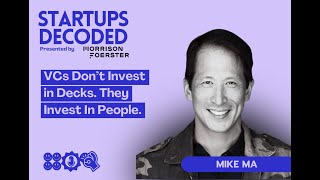
Mike Ma of Sidecut Ventures backs founders who are coachable and impact-driven. Before investing, he spends 30 days co-operating with founders for free, assessing how they work. He argues impact investing can hit 5-10x returns and shares portfolio examples like Stag, which makes electric construction vehicles.
Chapters
Why the fuck did you start this company? Because this is a dumbass way to make money. It doesn't matter what the business is. And I ask it with the profanity just to jar them. If you just want to optimize for income, get a job, go work at Vanguard, go work at Bank of America. On a risk-adjusted basis, you will make more money once you factor in survivorship probability of exit, da da da da da. And I want to understand that. Like, you can argue, you can talk about how you're special, etc., but I always joke with people. Yes, you are special and unique, just like every other statistic in this report. And I want to know why. And when you have a why, and it is the universe and you are made for it. That is how I get conviction on what makes you a founder.
Welcome to Startups Decoded, the show that gets real about what it takes to build a successful startup. I'm Andy Walsh, 2x exited founder, strategist, and your host. Each week I talk with top founders, investors, and operators to unpack the plays that drive real traction, not just headlines. If you're building something bold, this is where you'll get the honest insights to scale with clarity and confidence. Let's keep growing together. Hit subscribe and share with your community. It would mean the world to me. Morrison Foster is the legal edge behind the world's boldest innovators. They go by MoFo and are the team behind Startups Decoded. For decades, MoFo has helped startups turn complexity into freedom. Learn more at mofo.com. Hello and welcome back to Startups Decoded. My name is Andy Walsh. In today's episode, we're looking at a solar GP, but also something quite specific, which is in the lane of impact, which for my mind gets overlooked too easily. And I'd love to hear a bit more from Mike about that, who was our guest today. Welcome, Mike Maher.
Thank you. It's an honor to be here. We've been, we've been working on a long time, so I'm glad, uh, we're kicking 2026 off right and finally checking things off the list. So thanks so much for having me on.
Of course. And I can tell you though, you're not the person who has the longest lead time of meeting, saying we're going to do a podcast and then recording. There's still some folks that haven't jumped in yet. So you're not at the top of the naughty list.
Good, good. Well, hey, I'm trying to, as long as I'm not the last one, I'm good.
Nice. So I appreciate you joining. We met through a mutual friend, Mike McCombie, a fellow solo GP and fascinating human in his own right, as far as what he invests in. Your thesis is a little different to Mike's, but I would love to be able to hear from you on what you've been working on and a little bit around why you do what you do.
Yeah. So thanks for the time. Sidecut Ventures, we call our thesis, the shorthand is we back coachable superheroes. And those two, those two words put together make people their heads turn a little bit. So to unpack that, what we do, coachable refers to the way we deploy capital and we're a little different. Most VCs say, hey, take our money, we give you all this advice and value add. We flip it. We give all our advice upfront in a 30-day co-operating consulting role. We don't take anything for it. No cash, no common, just, just your time. You like us, we like you, we'll give you, you know, we'll, we'll, we'll back you. The superheroes refers to the, the impact part. And we are generalists in impact. We've made investments across climate, education, healthcare, economic mobility, and then accessibility when we have a disability startup in our portfolio. So we're looking for people who are warriors for good in the world, and that's what we we want to back. It isn't hugely favorable right now in the context of 7 January 2026, but we're here for it. We expect that while everyone is chasing, you know, a lot of West Coast hot dot type of things, we're really focused on solving intractable human problems. A lot of those do involve AI, but we view that as a, as a how, not a what. And we think if we keep our eye on the ball about big societal problems, there are going to be more than enough returns for everyone to make plenty of money and DPI through the process. So that's what— that's the thesis of the fund. We are 1 year old. We've done— we did 11 deals for 10 companies in 2025. So we had a very busy year as a solo GP, but I definitely did not do that alone in conjunction with my team and also partners like Mike McCombie, who is, you know, that as you probably have talked about in your pod, that the early pre-seed ecosystem is very much a family and none of us could do it alone.
Yeah, absolutely. And Straight out of the bat, why do you think that impact investing is typically overlooked by most investors?
I think two things. Like, one, I think people misunderstand what impact is in terms of, like, at the end of the day, people just think it's lower returns, right? And let's just call a spade— it's not even a spade, let's just call a spade a stinking shovel. And that's what people think. And I do think that there's some responsibility borne from all three parts of the ecosystem: founders, GPs and LPs. We are, we are returns business. And there's a lot of people who have dual, I mean, sort of dual missions where they have different bottom lines. Like, make no mistake, we're in the camp of we expect to not 3x our fund, but 5 to 10x and be a top decile fund. So I think that from the GP perspective, I think that there is, there are some who are not returns-based and they're very open about it. And I think the market, both founders and LPs conflate those two together and don't have— it's hard to discern or not as clear. So I do think there's a different spectrum of impact investors for a variety of good reasons, right? Some are family foundations, which, you know, the returns aren't as important. Like, you know, for us, we are returns-oriented, make no mistake about that. And we try and use— we try and fit impact as an accelerant, not a detractor to what we think is going to generate DPI for our investors. I think— and I think this is the same thing that that goes down into what happens in the rest of the ecosystem, right? And when I talk to founders, like being impact does not obviate you from being very tight on your traction and your pitch and your competitive moat. And I think that there's sometimes like, oh, they're gonna get a pass. You will, I mean, at least for me, you will not get a pass from me because your mission, your mission is an admission ticket to an arena, but you need to perform. And then I think when you watch this ecosystem play out between GP and founder, if you're an LP watching it, it's hard to understand the nuance between all those. And I think that's, I think that's what is, is missing in that, like, look, there are, there are different flavors of impact. And I hope to find the time in the ecosystem that the people who are interested in that nuance, and I don't think nuance is too small of a word. I think it's a differentiation. And that's, that's why I think it's missing, like just understanding what people's motivations are. I'm of the school venture is a a great tool for a certain set of impact problems, not all of them. And that, that's probably another part too. It's that I think there's a lot of stuff that's impact that is best handled by public-private partnerships or even just like a configuration of large lifestyle businesses working together in concert. I think it's just understanding what the role is and spending some time with that nuance.
I had Helena Wasserman on episode 1, season 1 of the podcast. She runs a climate syndicate here in New in New York, and the topic we discussed was, does climate need a rebrand? Because of some of the things that you touched on there is that a lot of investors have preconceived ideas, and whether that's lazy, whether it's real, it's probably somewhere in the middle a little bit as far as the ins and outs of that data. So taking the category aside, looking at a business and going, they're making good revenue, they're making good margin, I can see the multiplier, I like the founder, I can see the category opportunity. And if you assessed it with neutrality and not with that bias, all of a sudden you're looking at a business model that can work. But if you've got any morals inside of you and you can get a double or triple bottom line, meaning that there's not just revenue, there's actually a betterment for people on this earth, then for the right person, like that's a double win, a triple win, right?
Yeah, I, I agree. I mean, you can look at the last two climate deal. I mean, we've done actually, we've only done two climate deals out of our fund. But you know, the way I would use it, even if you don't care at all about climate, here's an argument, right? So we invested in this company called Stag. They make electrified construction vehicles. So you don't have to believe anything about climate. Basically, they're 1,000-pound skid steers. They sell like EVs, like your driving EVs, car EVs, at 20% premium. You don't have to believe anything about climate. And there's something for you in this one. If you believe in urbanization and indoor construction and the lack of housing, there's your market. So if you're going to reconstruct 40 Wall Street, right, which was reconfigured from res— from commercial residential, you can't use diesel materials in there and diesel, diesel. And so what are you going to use? You move stuff by hand or use electrification. You don't have to believe anything. And it's like, you know what? If these founders actually are warriors, like there's plenty of market space. And, and I do believe in urbanization. I do believe a lack in housing. You may decry the particular societal or geopolitical reasons or around it, but these are just facts, right? There's just, like we say in New York, right? The guy, the rent is too damn high. There's a reason why the housing is a problem in New York and, and all urbanization areas. Even if you don't believe in anything in climate, like there's a, there's an argument that's going to generate outsized returns if they can execute. We invest in this company called Elastic Energy, which does distributed energy orchestration. Long story short, they do the last mile logistics to make your house or any resident— a residential area— all the little smart devices talk in a unified pattern back to the grid. Now, you don't have to believe any of this stuff, but you could believe that the energy demands on AI from AI are going to put massive constraints on our grid. And we're just going to have to get— regardless, you don't have to believe what energy is going to win, be it existing from fossil, wind, solar, hydro, whatever. There's just not enough electrons out there. And we talk about this. So you have to be incumbent. All of our residences have to be incumbent to actually talk more intelligent to the grid. The problem is everything is different, right? Your Tesla Powerwall and your Nest, they all work in different APIs. So without getting too far in a rat hole, I think the best part about thinking about climate in the rerun is even if you believe nothing about it philosophically or morally, there is a complete capital reason to look at the sector of climate we look at with passion and honestly investment earnestness. So that's how we think about it. We are unapologetic unapologetic capitalists who want to do good. And, and those are the arguments that we have. And if you believe all the things philosophically, morally, ethically, socially, et cetera, we also have space for you as well.
And I look at the juxtaposition, uh, traditional VCs are investing in companies that are causing a whole bunch of problems, right? That, that then other companies say there's an opportunity here to course correct the mess that someone else has made. So you've got big corporations invested by big VCs that are creating this wake of noise and mess. And I think now we're at a point in the world where things have gone sideways so dramatically that the opportunity to course correct and come back is not only needed, but actually is commercially not just viable, but huge opportunity as well. So those two things living side by side, I find almost hilarious that those two worlds live in parallel where one feeds the other, one picks up the mess and the other one creates more mess. And it's like having two children. You got one good one and one bad one. And as parents, you look at that and go, well, how do I focus my attention?
Right. It reminds me of, there's an old Native proverb. If I muck it up and anyone wants to correct me in the comments, please, please do. I don't mean to appropriate, misappropriate this, but I think the gist of it is something what you talked about. I think a child asks his mother or the grandmother, or, you know, I feel these good and evil forces inside of me and it's like two wolves fighting and one is good, one is bad. And then, you know, the child asks the grandmother, which one wins? And the answer is whichever one you feed. And I do think there's something to that in the venture aspect of it. Most literally, if you use the notion of feeding as capital, I'd like to think there is not necessarily— sometimes they're diametrically opposed, but I'd like to think that the best ones are more symbiotic than, let's say, antagonistic. Like I am all for the proliferation of AI and I think there is, I'm so happy that people are on the frontier working on these large horizontal models, way smarter. I am not smart enough to underwrite that part of it. However, I think I am smart enough, or at least interested enough to think through how we can make space for that from a climate perspective. And I think that's a symbiosis, not an antagonism, so that as we look at energy demands of that, that we can find a way to do that sustainably. And so it's, it becomes an and versus an or, or versus. But I also think that there are some things that are antagonistic. For instance, we invest in this company called Money Stack, which is financial counseling for people with mental health problems. They're starting with gambling addiction. So I do think a lot of the gambling owner-operators are antagonistic in that. And there's some of these good versus evil aspects of it. But I think there's also space for this symbiosis as some people are on the frontier or as climate is pushing or healthcare is pushing different innovations to occur, you know, in the overall healthcare space. I do think there's a lot to be learned from the bottom of the pyramid for larger goods as well, right? So, you know, I, one of the big things talking about Money Stack, and I've spent my previous career in financial services, that every mental health problem is a financial services problem, and it is something that has plagued every single financial advisor that I've worked with in 20 years and working the asset and wealth space. And I think through the crucible of understanding people at their most vulnerable moments, I actually think the financial industry writ large, down to your investment advisor at your local Chase Bank to your UBS private wealth advisor, I think there's something to be gained by looking at this problem for the larger industry. So I think there's a directionality of how impact and let's say non-impact startups and investments can work together.
And I look at it like the term ethical capitalism as a term that we are going to see a lot more of in 2026.
Man, I sure hope so.
And, and I don't know how long it will take to switch, but we've gone down this modern form of capitalism now, which is reaching such an extreme point of wealth generation and wealth creation and where money and having more money can become such a single-minded focus. And if you've got a lot of capital, and there was a really famous moment recently where Billie Eilish, in front of a room of billionaires, called them out for the lack of distribution of capitals. And she was doing it live, giving away a whole bunch of her money. And the contrast of how you can share your wealth is something that's very topical. And I don't know what it will take for people who have so much money to rethink how they allocate their wealth. And you look at famous case studies like Patagonia, and you could be critical of some of the ways that he handed his company over. He obviously made a lot of money along the way, but if you step back from that, sure, he made money, but he also has created a legacy in so many ways that has a butterfly effect that impacts a lot of people positively. So you can have both. And I don't think people are thinking that way. And it takes people like you and the companies that you support to, one, actually create models that can be commercially viable and successful, but two, have the flow-on effect of that double bottom line. So we need both, and I don't know what it's gonna take as a tipping point, but it feels like that there's enough bubbling around right now where people actually do want change and they're starting to think about that.
Yeah. And, and, you know, a lot of it, a lot of the examples you cite are like afterthoughts, like, hey, I've made a lot of money and then we'll, you know, we've built the business this way and then we've sold it and then there's philanthropy and, and it's very separate. I think Patagonia and what Yves has done with that is, is, is a little bit different, but I think, I mean, The part that I, that I'm attracted to in what you talked about is all those principles about ethics are in from day one. They're not, and this is a hard thing that people sometimes can't get their head around, that that is an accelerant, not a detractor. Like that focus on mission is a feature, not a bug. That it actually makes you go forward and faster with clarity and purpose versus getting caught up in, and, and I really do think it, it is that, right? One of the big things out of, and we can maybe, maybe this is a good jumping point talking about the pre-seed, seed area is I think a lot of these founders don't know what to do. Hey, go B2B, or hey, don't, you know, SaaS is dead. Don't do SaaS, do PLG. Like, you know, there's all these things that swirl around founders' heads and they don't know what to do. But you know what's really great when you have a founder who's focused on the mission is the hard left-brain benefit as an investor is when they do this right, it, it cuts through all the crap of figuring out what to do. It's like, well, what moves the mission faster? Obviously it needs to make money, but there's a lot of questions like, do we do B2C PLG or do we do B2B SaaS and try to build up an enterprise sales team? Like, these are like common questions that I think a lot of people sometimes die, to be very frank, between that pre-seed and seed spec because they don't get that right. What's really great about the impact area is that they have a tool to disambiguate that wedge very quickly. And it sounds Pollyannaish, blah, blah, but often people spend 3 to 6 months going through a test. And if you're, if you're backing a pre-seed round, which is 12 to 18 months of runway, that's a quarter of the time that could be wasted and kill your survivorship and, and your up-round, um, you know, your marks on a TVPI basis to hear next round. So I really think it's a feature, not a bug when you do it right and you pick the right founder on that. And I think those are very material things that you see in the market dynamics between, between rounds, at least what I saw in 2025.
I look at that as the culture internally of a company and how it can drive the right people basically coming to you like a magnet in a world where, let's use B2B SaaS that you touched on there, lookalike businesses being spun out every day to literally mimic, copy website design, product. People get unlovable. And within a few days they're in market competing with someone else who's been doing it for a lot longer. So building a moat is getting harder in that specific category. If you flip that the other way and look internally and think about a mission, vision, purpose, if you stand for something and have a point of view, not only do you attract the right people who buy into what you're doing, and we all know as founders that getting early stage employees is really challenging. Quite often you don't have much money to pay them. Equity seems like a long way away to be able to cash out. So you need something something else to bring them in. And getting the right people who believe in your mission creates a groundswell just organically without having to do anything else. You can bring in partners, customers, investors, because you're starting to tell a story that's way bigger than the product. And I use the term brand as a catch-all for that. Brand is not a logo. Brand is how you live and breathe and communicate the things that you do. And that differentiates you from someone else who's just building a lookalike product but has no moral compass.
Right. And, and, um, as a recovering retired CMO, and I've got to run a lot of and work with a lot of big agencies, I think this idea of brand in the world of AI is so important. We talked about this before I got on the air about coming up with the right prompts. And there's a direct line if you've worked in the creative world. One of the best executive creative directors I've worked with, a guy named Izzy DeBellis, when he was at Kirschenbaum, was pushing me as, as a client when I was running advertising at Vanguard. He said, Mike, your job, even though my team will fight it, his creative team is like, is to make the box small. The best work happens for my creative team when you push, push us to make the box small. Fast forward to prompts and GPT or any AI. What's the biggest problem? The biggest problem is coming up with the right— it's not finding the right answers, it's asking the right questions. And what's great about, I think, Impact Founders as an accelerant and a very real basis when you sit down on the keyboard or talk to, uh, the AI platform of your choice. I believe wholeheartedly, and with this fund and just my own purpose, is that impact founders will ask better questions. They will get to more precise creative answers faster. And this is going to be an accelerant, not a detractor in the world of AI. This is why I'm excited to be an impact investor in the world of AI. They are functionally making the box smaller. And I do think in the world of AI, they're going to get better work and that better work is going to generate better returns.
If you're building the future, you deserve a legal partner built for it. Morrison Foster, the legal edge behind the world's boldest innovators. They go by MoFo and are the team behind Startups Decoded. For decades, Mofo has helped startups turn complexity into freedom. They combine deep market insight, tailored legal strategy, and a Mofo passion. Discover how Mofo can support you. mofo.com. And if you think about the superficial nature of someone that sees a business and they can create a lookalike, they're never going to really truly understand the problem that they're solving, their audience challenges, and it's all around bottom line versus any other broader impact or understanding. And it's hard as a founder and as an employee to buy into something that is purely money driven. So that separation of the pack to be able to have a moral compass and that type of person. I was chatting to a friend yesterday actually, and they're looking at ways to assess the, not necessarily the behavior as in the personality type rather, but more the behavior of a founder. Who are they? How do they operate under pressure? And how do you understand that element of that person? And I think having genuine purpose having integrity, but also being commercially strong and know how to build and grow a business. Like for me, they're the two things that go together as a superpower. And you talk about coaching superheroes. In your experience in that stage that you're investing, how do you separate a founder from the pack as far as their business obviously has to be strong in an interesting category, but the founder is majority of the story in that pre-seed stage because the business is so young. That who the founder is, how they operate, how they think about solving the problem overrides most of the product build.
100%. Uh, uh, 100%. And then my, my, my question and why I started this, this firm, what data do we use to discern that? And I was always broken up or, or had questions about it. It's all on past signal, right? Oh, you went to Harvard. Oh, you're an OpenAI alum. Or, oh, you're, you know, you're an exited founder. I think all that is okay, but not that, that is, uh, I thought there was better signal, right? And, and this is why the way we deploy, so our first two meetings at Sidecut are, are very similar like every other GP, uh, you know, you know, first meeting is a broad overview, your, your team problem. The second meeting is a really deep dive in your product and GTM. But then after that, we say, what do you need help with other than money? And we work together for 30 days. You like us, we like you. And in those course of the 30 days, and we've only historically invested— it's a big investment on our firm part as a firm. We've invested historically just a little north of 1 and 2, a little over 50%. So we work together for 30 days and I tell them, you can leave any time you want. I don't want anything. And the idea is this. It's to watch the actual process. You can fake your way through 2 meetings, a deck, a pro forma, and a bunch of customer references you planted from your kid's lacrosse coach from LinkedIn that I can't track back. But you know what's really hard to fake your way through? 30 days of running your business on something accretive. And for me, that's the only, you know, if I'm gonna invest my LP's money, I need asymmetry. I need to know more. Not just in the market, but frankly, I want to know more than everyone else on the cap table about this particular founder. And there is nothing like watching them get between the sidelines, go into the trench warfare. I was on— I was on the pitch show with Josh and Lisa Muccio, and they call it the foxhole. So we get in the foxhole with our founders and pardon the war metaphor, but we go to battle for 30 days and you learn a lot about people. And I don't care where you came from. I think there are exited founders who often don't have it for the second, you know, third go around, or sometimes have false signal, right? Like they think what worked in their last startup will work in this one, even though it's cross-sector and 5 years later, uh, you know, for me, I, I, there's nothing like watching them work on this startup at this time. And that is, you know, the exchange is very easy. I help you. Hopefully I'm helpful to your business, and now you know why you want to spend time with me and have me on your cap table. The benefit I get is I get insight to both you and the business. The average marriage in the US is 8.6 years. The average time on someone's cap table is 10 to 12 years. So I don't understand how people do West Coast deals like, yeah, I'm in. I know from media, it's like, I, you know, for me, maybe I'm old-fashioned. But I want to date just for a month, not forever, but just a month. And, and then, then we can know whether we want to be here looking at each other in 2036 and say, I'm really glad we did that. I think that is a sacred— having been a founder, it's something I, I take very seriously in the relationship I have with all my founders is close to that of a marriage. And I treat it that way. And if I don't put the work in, just like we mean with my, my, my, my life partner, my wife, I don't feel like I'm doing a service to the founder. And so a common statement for what we say inside my team at Sidecut is, you want to be a good partner? Go first. And we go first. Don't like working with us? That's great. Don't take our money. And then we've both relieved ourselves from a decade of pain.
I love that so much. What you made me think of then is the investment model in Silicon Valley of like Tinder style. You meet someone and you go out for a drink that night and you might get it on with that stranger. And you're playing the numbers game and it's like, I don't think it equates to the partner analogy directly, but it's like having multiple partners all at the same time and hoping that maybe 5% of those 100 people thinking about conversion and return on investment of your portfolio, if 5 of those investments pay out of the 100 that you put money down, there's so much lost efficiency in that and it impacts the LPs, it impacts the GPs, it impacts the portfolio companies as well. And you've got a whole bunch of people's lives in your hands at that point, right? Even the customer base. I've heard of so many amazing products that have gone out of business that the people using them are left high and dry with no alternative. So the flow-on effect is infinite. But I also understand from a GP perspective is that they need to take that chance to be able to drive returns. But there's a much more ethical way to do that. So taking those 30 days to get to know the founder, understand who they are, how they operate, when they're at their best, when they're at their worst, and how they behave in both of those scenarios. It gives you confidence not only in them but also how you can collaborate with that person.
Yeah, I mean, you nailed it. And that is when, um, when I started this firm, I thought to myself, this is, this is what I want to put out. This is the energy I want to put out in the world. What you hit on Having been, I mean, I've, I've had small exits. I've had huge dumpster fires, right? This idea, the one, the one population I think you skipped talking about was the wreckage we create with founders and the actual innovation economy. The amount of wreckage that the power law creates is, you know, I don't know what the, everyone talks about the returns of the power law aspect of it, but I'm curious at least about what the, what the consequence is to the innovation economy where we look at that is the only way to actually generate returns, the only way to actually have a startup. And I think that mythology is one, it's rampant, right? And two, I do think it creates— I'm not saying it's an outweighing harm, but it creates a fair amount of harm. Now, I don't mean to say that all high-volume algorithmic pre-seed investors are bad, nor do I think there's not a space for that. I'm really glad there's a lot of amazing companies that we we both probably both use that would not be here if it were not for access to that capital. But when you start your own firm, the question you have to ask is, what am I good at and what do I believe and what do I want to— what's the energy and my statement for the venture community? I think that there's a space for this more disciplined, nuanced part of capital. And yes, we're very disciplined. I mean, and I still want to generate returns. I'm not like here to generate— like, I'm not here to give away money or— and the way we control that is with underwriting. Right? So we're very disciplined about entry price. All of our pre-seed investments, the median pre-seed valuation we were in was like $6 million for post-product, post-traction companies. And what that does for us from a pure investment standpoint is be able to have optionality to generate returns without unicorn venture scale power law dynamics, right? You know, a, a $100 million, $200 million exit. Even on a secondary where you take a steep discount, if we wanted to get there, we have the flexibility to do that because of our entry price and the way we've underwritten the market traction at that time. I'm not saying every VC firm should do that. God no, I would not wish that on my compatriots because what we do is really freaking hard. But I do think that there are, there needs to be a space for founders and other GPs to understand what we do and other LPs to understand there's differences between us and I I think this is what makes a community and ecosystem work. It's just the time to understand the nuance of it.
It's fascinating insight into that mechanic of money and how it flows and where it comes from. It makes me think, and I say this out loud quite often, and I find it fascinating. If you look at the world of startups, ultimately startups, like a lot of them who get investment, are funded by people of high net worth, whether it's family office, PE, VC, angel investors, people that have capital to deploy. Basically underwrite a whole economy of founders who then can create products, who then sell those products to other people, quite often to other founders who are using their tech stack to be able to build their own business. And they're all using it in a way to, to make money. And the workhorses in the startups feeding ultimately high net worth people. And it's a, it's kind of make-believe in a way and not to undermine what the startup world is, but it's like a, be someone funding your ability to learn on the fly, innovate, test and learn, and have this real-life school. And it's an alternative of going to university, say, where you're actually teaching yourself, you're finding solutions, you're learning, you become more adaptable. But I want to really double down on what you said because it stuck with me before. As far as the flow-on effect on founders that don't make it out the other side, and whether it's mental health, whether it's bankruptcy, all the things that can impact you and the people around you in your life, is there going to be a drop-off of innovation in a world where innovation, you can ask a bunch of questions to an LLM and get ideas and build something. Where does innovation come from? And then how do we support founders in that world that they can come through this process out the other side? And if they're not one of the top 5% that make it and get large exits, that they're able to continue with their life and innovate again.
Yeah, I mean, there is, uh, a huge— well, a couple things. Like, so one, I actually think that the prerequisite to be a founder has never changed. To have the grit and determination to, you know, like Mike Tyson said, get punched in the mouth. And when your plan goes wrong and then figure out a way, it's like, I know what I'm gonna do next. I actually think the human aspect of it has never, has never changed. It doesn't matter what business you're starting. We could start Mike and Andy's Haberdashery and and in Greenpoint, and it's hard. We can decide to build a, you know, mental health startup, and it's hard. I don't think the metal of being an entrepreneur has changed at all. I do think the problem, the actual bar for it, the problem is there's been a romanticization of the lionization of the founder and the mythology of it that anyone can do it. I think there's been miscategorization of what it is. Ginning throwing up, you know, a business plan on, you know, on ChatGPT, throwing it lovable, and then like putting into Shopify, like it may make you a business, but it doesn't make you a founder. Not the way I think about it. You may be an entrepreneur, but it's not, it's, you know, a founder will tackle big problems and have to slog their way through it. They're there to make a dent in the universe. And it's funny, right? I was listening to Wade Foster, founder of Zapier, on Pattern Breakers with Maples, and he said something that's great. It's like, it's this constant tension. One, you want to make a dent in the universe, have this big thing. But the thing that they talked about at Zapier is, how did they grow so quick with only raising a small amount of capital? This has stuck with me. He said, like, we just never have a constant contact with reality. And I think in this world of like TechCrunch, AI, buzzy thing, like it's so easy to lose grip with reality real quick. And you started hinting at some of the funding circles which have been decried as a little circular and insular and networks becoming insular as well. I think that's the problem. And the founders I'm I think as impact founders, like you, that's one of the other benefits, not a feature, not a bug, is like you just can't lose grip with reality. You know, there are people going to jail. We're going to run out of energy. You know, we're underfunded as a, as a, as a retirement state here in the States and have a poverty, like, you know, it's Gini inefficient. Social inequity is happening. Like, you just can't argue with these things. And people, like, they just never lose grip. Well, not never. It's harder for them to lose grip with reality than some of the other businesses that other VCs fund, which again, I'm very happy that these parts invest in the ecosystem. But this, I think you touched on something very important about keeping a constant contact with reality while still trying to find impregnable and, you know, impenetrable problems for society. The conflation of those two theses, what you kind of hinted at, is like how I ended up being one of the many reasons how I ended up on an impact thesis.
The separation of founders is important too. And trying to put some qualification around what a founder actually is, is important. If you're genuinely trying to drive change, make an impact in a way that actually helps people rather than interrupts or just is more noise in the marketplace is a clear founder journey. If you're trying to find a way to hack and shortcut to make money quickly, you're just more noise and you're not a founder. It's just shortcutting what is a solution. Like the founder journey for me is very pure and I've been on it, you've been on it, and coming out the other side of it, I still reflect on it every day. And I exited, what, 6 years ago now? And for me, that experience, there were so many little micro lessons in that that I learned of foundational things of like, how do you treat someone else in a way that is decent when you've got the fire hose in your mouth and you can't see like the light in front of you? It's really hard sometimes to do the right thing. And some of those human lessons business lessons, product lessons, all of that combined. If you're shortcutting, you don't get any of that. It's basically like A to B. I'm using tools just to modernize what is ultimately a simple consultancy.
And by the way, I think you can make money doing that. In fact, if any founder's listening to this and you pitch me, one of the first few questions I ask every single founder that I take a meeting with, and it works itself in and forgive the profanity, but it works itself verbatim like this. Why the fuck did you start this company? Because this is a dumbass way to make money. It doesn't matter what the business is. And I ask it with the profanity just to jar them. Like on a risk-adjusted, I can cite, and if you want, we can set up all the studies done on risk-adjusted basis. If you just want to optimize for income, like get a job, like go work at Vanguard, go work at Bank of America, go work like on a risk-adjusted basis. You will make more money once you factor in survivorship probability of it, da da da da da. And I want to understand that, like, why, why, why? Because this, this, you can argue, you could talk about how you're special, etc., but you know, I always joke with people, yes, you are special and unique, just like every other statistic in this report. And I want to know why. And when you have a why, and it is the universe and you are made for it, like, that, that is, that is how I conviction on what makes you a founder and potentially my founder that I want to work with and partner with for a decade.
I want to grow.
And the way I view it is like, do I want to grow old with this founder? And it's a very different parameter when you look at things that way versus like, oh, I'm just going to treat them as a, you know, they have a 2% probability to make a unicorn. Like, it's just a different relationship that I want to have with my founders.
Amazing. And We had Jeff Becker, GP at Antler, who I know you know, and they'd have a similar approach. I think theirs is 60 to 90 days immersion in the office so they can get a frontline view of how this founder acts and behaves. And you get a real insight into who they are. And I'd love to scratch that itch with you. You talked a little bit there as far as what you're looking at with a founder, but most of my audience are early stage founders, some of them pre-idea. That have aspirations to be one. Some of them are up to Series A, Series B, but on that journey, like if they were to come to you and they've got a company that is driving the impact and they've got something unique, what are some of the signals for you that you look at with the company and the, and the person as well to be able to get them to the top of the pile, front of the queue, I guess for you?
Sure. What I would say, uh, some of the hard left brain parameters, you know, our, our sweet spot is post-product, post-traction, sub-$10 million cap. And, and the reason is, is that we underwrite market risk. And I always joke, I'm not smart enough. I, I went to school with a, with a bio, with a biology degree intent. I finished with a philosophy degree. I'm not smart enough to underwrite any of this stuff. However, I always say, like, for instance, in distributed energy, I don't know the requirements, but I know your customers do. And I'm pretty darn good about figuring out, and my team is pretty darn good about figuring out, do you know your customers? Do you have the right operation or model? About working through that. So those are the parameters, you know, with regard to impact sector. So that we underwrite market risks, not technical risk. And those are, those are sweet spots with regard to impact sectors. You know, the 4 areas, 4 or 5 areas we've looked at have been climate, education, healthcare, economic mobility. But to be honest, on our intake form, one of the questions we ask is, describe in your own words what evil you're fighting in the world. And we read every entry, and I'm always interested in a good story. We started going down the look at justice tech and democracy tech and a whole bunch of other areas as well. So we're, we're an open book from that perspective. With regard to, um, the 30 days, and it's been a really interesting evolution. I mean, this was seeded by 2 years of angel investing, me, and now 1 year in market as an institutional fund. I would classify what has differentiated those who've made it and those who haven't has been action-oriented self-awareness. And so people always want to know what we do in these 30 days. We work on a problem that is relevant to you. If you want to know how to sell, which is usually something that most people do, and we've written up all these in our public memos, we go through this process. We do a deeper dive in our first meeting and during the 30 days of whatever your pipeline or your sales lead, and we quickly provide In meeting 2, we meet twice a week. Some best practices. And then meetings 3 through 8, do you know what we do? I don't do anything. You organize the time. You're on our Slack. We record every email. We have the time booked. You tell me what you want. If you can't organize the time, only one of two things is true. One, you just don't know how to marshal resources and people who are there to help you and you need to do it. Or two, you don't think we can add value. Which is also both reasons why we shouldn't be on your cap table. So this idea of action-oriented self-awareness, I think there were certain investments I, uh, when I was starting this process where I was just amazed, I was testing this as an angel, I was writing small $5,000, $10,000 checks where people like gave me tons of access and they had the self-awareness, oh, we have this problem, this problem, that problem, this, this, the other. But then you gotta do something with it. Okay, you say you need to build go-to-market for your next product and Okay, looks like you got some time. Let me know what you find out. And to me, that is what makes a founder a founder, right? Um, you're willing to put in the work and get in, not fall into some like myth that you read on whatever the information or TechCrunch, like, oh my God, I can do that too. It's like, you know, I always tell them, stop reading that crap. This is not, this is not, I mean, the other 99% is like, go back to the salt mines, go talk to your customers. Let me know what they're like. Fall in love with that process. That's, you know, those that can make it through that process and take feedback along the way, you know, and it's not like I— when we do this, by the way, and that's the decision we come to, I don't tell you what to do, you know, like, you know, we just ask the right questions like, well, why are you waiting 6 months? You know, we looked at your pro forma. You said you're launching this new product and the revenue is 0, 0, 0, 150. My question— this is your pro forma. Why? Why isn't it $10,000, $20,000, $50,000, $75,000, and test your way into it? And also, you have it 6 months from now. Is there a re— why aren't you doing this now? You have no supply constraints. Like, go-to-market is not wine. It doesn't get better with age. And I just ask these questions, and based on the response and what they need help with based on these questions— and I didn't make these. I was like, this is your pro forma. Yeah, I didn't come up with it. Um, and that this is the type of relationship we have. And then we decided with one of the companies we invested in, this is, this is what we're gonna work on. Okay, you're right. After some hand-wringing, like I should be pre-selling. Okay, cool. What do you need help with? And then they pre-sold and then, you know, it worked and they got conviction on it and we invested, right? So this is, you know, and I, I didn't say like, oh, you should talk to customer A or, Geography B or use collateral C. I don't know. I'm just asking the question to see if you can take the feedback on, on just like the broad heuristics about being like we talked about, let's call it a capital F founder.
I'm thinking there, as far as what you've just said, there's so much profound information on what you're talking about. People get so lost in their own world based around noise and hype that lives in the industry. And you can get all the wrong information all the time. You need to be able to find your own signal, things that stand out to you. But today, Mike, this has been, for me, super insightful and really debunking some of the norms that exist out there around investment companies that are creating impact and being such a positive force. So a really interesting peek. And for founders who want to reach out to Sidecut and think that they align to what you're doing, what's the best way to reach out to you?
Sure. Believe it or not, I'm not avoidant. The best way to— if you want to get on our radar and fit these criteria and we publish everything like here's our criteria, here's our decision criteria, all the way down to the categorization of the matrix of how we score startups. Go through our website, www.sidecut.vc/pitch-us. I think also just /pitchworks. All of our flow, warm and cold, goes through this process. So you could, Andy, you could cite you as this, how you heard us. And my team, it's not just me. I do have an amazing team that, that reviews these with me. So we look at that. It doesn't hurt to send me an email as well. If you want to hit me up at michaelma@psycho.vc, you can hit me up there. I'm on LinkedIn, but I'm also like, like sometimes I go through fits and spats of that. So apologies for that. But, but absolutely the best front door is in, is in that way. And if you're an investor, same, the same channels exist. You know, if you are an investor who really wants to make an impact, who really believes that venture should be doing something different, or at least has a different space for it. And if you're interested in like this whole process of going to, going to battle with founders as a way of, of testing whether they have it or not versus like decks and algorithms and AI scanning, of GPs. Like, that's, that's what we're about. We are an old school, organic, uh, log type of investor in a, in a, in a kind of a digital AI blingy world. Uh, and we're, we're, we're proud of it. You know, I'm a kid from Cleveland and that's, that's, uh, a lot of that Midwestern ethos comes through in how we, we want to work and grind with, uh, both our founders and, and our LPs.
Makes a lot of sense that the intake for form is what it is and you look at that based upon how you describe what you're doing. And I might need to invite myself down for 30 days in the office to be put through my paces as I build out my own business and not for investment, but just to start to sense check what I'm doing and get that advice and insight.
Yeah, man, let's chop it up for sure.
Nice. Well, Mike, thank you so much for making the time. This has been a treat for me and look forward to putting this one out there for everyone to hear.
Likewise, likewise. Thanks for making the time.
Thanks for listening to Startups Decoded. If today's conversation helped you think differently, share it with a founder in your network, and don't forget to subscribe for real-world startup insights every week. We really value your support. If you're interested in partnering with us, email hello@startupsdecoded.com. I'm Andy Walsh. I'll see you next week.
More from Andy



EP#88: Why Most Founders Misread Their Own Traction. Vanessa Larco - Premise VC

EP#87: Founders Obsess Over the Raise. Investors Care About This More. — Carina Cunha






Ep#86: Early Decisions That Define Your Startup Forever. With J.P. Morgan Asset Management
