S2E22: Built, Sold, Burned Out. What Comes After a $60M Exit? With Xaver Lehmann.
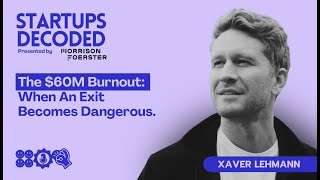
Xaver Lehmann sold his European AI startup for $60 million, then crashed into severe burnout and depression. He spent a year recovering in Sri Lanka and Africa before finding purpose coaching other founders and writing about the messy reality of exits that nobody talks about.
Chapters
And I realized that a lot of founders go through these phases, perhaps not as crazy as my phase, having this personal loss as well. But a lot of founders go into this depression phase after they sold their company because all of a sudden you sold your baby. You had worked for that company for years, day and night, and almost overnight you sold it. And then you're kind of, what now, right? Like, now I've got money on the bank account, but it's not a good exchange for everything that you've built. So, um, yeah, it is crazy. It was a pretty crazy time and took me a lot of time to get back.
Welcome to Startups Decoded, the show that gets real about what it takes to build a successful startup. I'm Andy Walsh, 2x exited founder, strategist, and your host. Each week I talk with top founders, investors, and operators to unpack the plays that drive real traction. Not just headlines. If you're building something bold, this is where you'll get the honest insights to scale with clarity and confidence. Let's keep growing together. Hit subscribe and share with your community. It would mean the world to me. Morrison Foster is the legal edge behind the world's boldest innovators. They go by Mofo and are the team behind Startups Decoded. For decades, Mofo has helped startups turn complexity into freedom. Learn more at mofo.com. Hello and welcome back to Startups Decoded. My name is Andy Walsh. Imagine you had $60 million in your bank account after a lot of hard work. What happens next? What do you reflect on and what do you do? Today I've got Zava Lehmann joining me. Zava, welcome to the show.
Thanks for having me, Andy. I'm super excited what we're going to talk about and I hope I can add some value to your audience.
Absolutely. And when we first met, we bonded over the fact that being through the startup journey, exiting, it feels like the holy grail of the startup world, but it's all not what it seems. And both of our reflections were very similar and we bonded over the fact that you come out of it the other side and there's a lot of heavy reflection having stepped out of something you've created. There's the toll on your mental health, there's the what do you do next and how you find purpose. And today that's gonna set the tone of what we're talking about. It's a really fascinating conversation because most founders are on this journey to exit, but most of them don't know what that means as far as practically, mentally, and then what you do afterwards. It's gonna be a fascinating look inside of what your experience was like. And what founders can take away from that. So to get started, my love to be understand is a little bit about Zalber. So how did you begin into ultimately what you created within your own business?
So it wasn't like that I wanted to always be a founder, to be honest. So at the age of 14, 15, I was really interested in the capital markets. So I also read a lot of Warren Buffett books and actually I wanted to be an investment banker because of that. you know, bought and sold some shares with my little bit of pocket money, like €100 or something. I think it was like in 2006 or '07 or something where I bought the Amazon stock. I made actually some money, but of course I sold way too early and spent it on a holiday. But that was kind of the beginning. So I kind of aligned my whole background, university, school, towards becoming an investment banker. And then I did actually some internships in a mergers and acquisitions, and I found it quite fascinating. Fascinating, but at the same time, I looked around the table when I was doing the internship and thought, okay, I actually don't want to end like these guys. So they were 40, 50, still partying every week, doing drugs on a Thursday, and you know, kind of what you would expect in an investment banking environment. And that was definitely not something that I wanted in life. And, but still, I thought, you know, that was kind of between my bachelor's and master's, and I thought, okay, let's, you know, just continuing going down this road. And so I did my master's in finance in the Netherlands, and I already applied for a job because it was a 1-year master's program, and they had offered me to work as an investment banker in London after my studies. So I accepted the offer, I signed the job, and at the same time, it must have been, you know, after, I would say, whenever, like, when I was 50% already done in, in the studies, in my master's studies, that I coincidentally met my old best friend, I would say, right? Because he was studying at the same university. We had gone to school 15 years ago, you know, during high school years, but he moved to London when he was 14. I moved to Italy when I was 15, and then we kind of came back to Maastricht as a coincidence. And then we both felt like there must be something else to do in life, right? Like we both had done internships. I was doing investment banking. He was doing more marketing and sales stuff at Adobe and Red Bull. And we both felt like that can't be it. Like, we don't want to end at a corporate and working our asses off, especially like asses off, you know, is fine, but not for someone else, right? I love to work a lot, but not for someone else. That's been always my problem. And so that was when, you know, the first idea came up. Hey, we wanted to actually do something else. What about founding a company? And on the way to Amsterdam, so in Amsterdam, you have to imagine, like, every year there's like a big King's Day party, so they celebrate the king, so the whole town goes crazy. So we went there, you know, drank a lot. Of course, we're pretty, uh, you know, busy, and also a little bit, um, how do you say that, alcohol. We, we drank, of course, a little bit, not too less and not too little. And so we drove back from Amsterdam to Maastricht, and then we kind of sat next to each other. Um, we were still a little bit drunk, and so we swiped through his phone and then we saw a Facebook developer conference where they essentially said, hey, you can actually now implement external technologies into Facebook Messenger. And we thought, that's actually a great idea because as a company, you want to be on the platforms where your customers are. And we thought that could be a nice way to move your customer service from hotlines and emails to actually messaging. It would be cool if you just could message O2 Germany or Telekom via WhatsApp and just just could say like, hey, when does my contract end? So that was kind of the initial idea. And then we started the company honestly one day later and we just gave it a chance. I know like back in the days we kind of wanted to see if that was actually a company worth pursuing. So we drafted 10 emails and sent it to companies like Domino's Pizza, MyTaxi, how it was called back in the days, like an Uber now. You know, I think out of like 10 emails, 3 positive replies actually came back. And so that was kind of, and they were actually saying, hey, that's a great technology. And, you know, we would like to have a call, but we kind of just pretended that we had the technology. So we just drafted these emails without having anything. But that was kind of the first kind of proof of market that we saw, okay, that's actually a cool technology that we can work on. So these were kind of the beginnings. Of course, we pivoted 3 or 4 times along the way and like needed to find our real product market fit. But that was kind of the initial founding idea story about the first company that we built.
What I take from that is that you're in a job, you're reflecting like any person does, right? You're thinking about what you want to do, you're learning. And if you're a young adult and you're in that time of your life, it feels like you've got forever. You're not thinking about the future. So you're very much in the moment. But I love for you that in that moment, having a conversation with a friend, you were just spitballing on some ideas. And it turned into a business. And, and for a lot of people that today, it feels like it's much more calculated. It's almost like there's an algorithm for humans to go look at a market or look at a business and go, we can copy them. We can do our own version. Or here's an idea factory type approach where we'll just solve one problem for one person in one piece where you're creating something where it was a living, breathing experience that one, you hadn't even created yet. And you were selling probably ahead of time, but two, you were thinking about a future where people who are spending time in one platform will evolve. So you're having to peek around the corner. And Mike Maples, who I love and adore, he talks about seeing around the corner, and it's a special few in the founder world who can actually see that future state. Do you think that that's something that you inherently had to be able to look at something and go, okay, this is something which is now building momentum, What does it look like in a few years' time and how do we get there? Because it sounds like it happened pretty organically, but once you started, did you start to think about that future state?
Honestly, I think at that point in time, we didn't think about anything. It's almost like you have to be a little bit naive in that phase to just build something no matter what and no matter where it's going, right? So we had this idea that this could be, you know, worth to actually, actually build. I mean, back in the days we were 23 and 24. We had never really properly worked in a company except for internships, and we wanted to build an artificial intelligence to actually automate customer service requests. We had no idea about AI, no idea about software, no idea about customer service. So it was quite a lucky or like a shot into the blue or how you say in English. Like we didn't have any plan if that's gonna be kind of a good company to build. But as I said, sometimes you just have to try it out. And what kind of gave us a little bit of a push was, first of all, these 3 emails that came in saying, hey, that's a great technology. That was actually, you know, by the way, that was 2006, way earlier than ChatGPT or anything like that. So we were quite ahead of the AI curve, I would say, without even acknowledging, without even knowing what's going on, right? It was just how it is. And the second market proof was that we got that that's an idea worth pursuing was that So we had an invite from a Swiss company to talk about AI the whole day on their premises because we kind of pretended to be kind of the thought leaders in the space. We pushed out content every day on Facebook Messenger and Facebook and stuff like that, and they saw us and like posting content about AI and chatbots and all these kind of things and how you can automate customer service and requests. From that, actually, the first invite to talking about AI came in, and so we went to Switzerland. We were pitching in front of pharmaceutical companies. It was like 30 or 40 people in the room and we talked about AI and customer service the whole day. And at the end, we did some group discussions and we just asked some questions. Hey, how does your customer service work? And would this be something, you know, worth to build? Is this kind of, you know, the technology that you could implement? How long does it take? So we kind of asked all the questions that you, that we needed in order to get to, to a specific point with the company. So And then throughout the day and throughout these conversations, we actually had an idea of what to build. And we took that concept of actually doing workshops in different cities. We brought it to Germany and we spend a lot of time doing workshops. So almost like a consultancy company to actually do the same. Like we went to Cologne, we went to Hamburg, we went to Berlin, to Munich, to any kind of company in Germany. And we made these workshops and The cool thing was that they explained us everything what they did and how customer service worked, but also they paid for the tickets so we could actually hire the first employees by just having this consultancy. And so this was kind of the next stage of product market fit, that this is something that's actually worthwhile to build. And the third one I would say was we got through a mutual contact, we got into contact, we got into touch with an investor, more like an incubator from Munich. It was an incubator of O2 Germany, which is one of the biggest telecommunication providers in Europe, and they were scouting for similar technologies. And so like when we founded the company, it was almost like, I think like a couple of weeks later, they reached out to us and said, hey, don't you want to pitch in front of O2 Germany and like 20 or 30 investors? And so we went there, you know, created the pitch. On the train and we presented everything that we had. We didn't have anything, to be honest, but just a vision and like this thought leadership. We said we have the biggest news network for chatbots in Europe and stuff like that. And like almost everyone hated the idea, but except for the main incubator CEO and some of the O2 people, they actually liked the idea. And then they decided to actually invest, like this incubator program, they invested like 40K or something, it was nothing, plus 30K in services. And O2 Germany said, hey, we want they wanted to actually work together with these guys. So that was kind of the ultimate proof for us that, you know, technology that we wanted to build was actually worthwhile.
Quite the story. And the ability to handle yourself on the fly in what is a large corporate world with people that are a big deal, right? They're big corporations that you're talking about to stand in front of and, and hold your own. Fast forwarding to a few years later, at what point do you feel like that you started feeling like it was a legitimate business and that growth happened, let's call it the scale phase to give it a name, where you were growing quickly and you were seeing the structure built around you of a company. Did you ever have a moment where you stopped and paused and realized that what was kind of making things up as you go had legitimized and become a fully fledged business?
Good question. I think there's a couple of moments where you think, okay, that, that's going in the right direction. You know, signing your first customer contract or getting the first real funding and not just incubator leader funding, but actually from venture capital. I think that was a big milestone to get the first funding in because it gave us runway, it gave us a little bit of power to actually hire people and buy some software that we needed. So there are specific points in time where you think like, okay, it's going the right direction, but it's never like a moment where you say, okay, now we've kind of made it, or this is kind of the thing that we always wanted or something like it. It's always progress, right? It's always you're going into that direction and this just proves a little bit that you're going in the right direction, but it doesn't prove that it's a great company that you're building somehow. And I think in most of the times you are still not anxious, but you actually don't know what you're doing the whole time. You're very naive. It's your first time building something. You've never done it before. At that point in time, in the beginning, nobody said it's going to be successful. Like everyone said, it's not going to be successful. Microsoft, IBM were our competitors, so we still had this feeling of, you know, we are kind of, it could be a lucky shot, but there's a lot of things that go actually against us. So that was kind of my feeling. At any point in time, it could go bankrupt. At any point in time, we would have to kind of work for corporate again or something. You never had the security that this is something that this is something great that you're currently building, if that makes sense. Like, it's just super hard. It's more like a process. And in hindsight, if you look back, I can tell you exactly these moments where I said like, now, okay, that was kind of an important moment. But when you're, you're not really realizing it in that moment, right? So that's kind of the issue.
Yeah, it's, it's noisy and you're moving at pace and you don't feel like you have a moment to stop. And even reflect on where you're at and where things are. And, and I would imagine then I would know the answer to this question, but have to ask, is there any point up until the exit where you actually had money in the bank that you felt safe? Or is there a moment when you went, actually, we've got momentum now, pipeline's healthy, we've got a, a business? Was it, was there a moment? Is that a yes or a no?
Yeah, I mean, um, whenever we did investment rounds, we felt safe for a couple of months in, right? Because, you know, in the first one we raised 700K and then 2 million and then 5.5 million. So whenever that happened for the next 6 to 12 months, we felt quite safe because you knew kind of there's enough capital on the account to actually just keep moving. But you still had the feeling, you know, like anytime a big customer could churn or like anytime an investor could could be angry at us or something like this. You never feel completely safe in a founder environment, I would say.
And it's amazing that it doesn't matter what your bank balance is. And I've had other episodes where people have felt the same. I had Luke Tobin on recently, who's English, and he had an 8-figure exit. And even for him, who had offices around the world, was doing really strong AR, he never thought, one, he would even exit, or two, that he was safe. So you're perpetually in this state of flight where you don't know what's happening and you don't know what's going to happen next. And to be able to get to that point is significant. In the exit itself, again, Luke talked about this, like he never planned for an exit in his first company. It happened and he had to navigate it on the fly. Was there a conversation that happened where you thought, we want to sell this, or did you have someone come to you wanting your business and wanting to acquire that? What was the sequence of events?
The first, I would say, 3, 4 years, it was all about being very creative as a founder, right? So you're the CEO, you're hiring sales, you're almost doing everything in the company. And that was a fun time for me. But there was a time when we had around 30 or 40 employees where that kind of shifted a little bit because at the end of the day, once you have more people, you have to solve more people problems and you're not creative anymore in the business. Also because like you're hiring exactly those people who would do the job for you, but like for me, it was actually fun to do all the different things in the company. And so at the end of the day, after 30, 40 people, you're just handling, you know, like big things that land at your desk because all the other people couldn't handle them. So it's mostly big stuff, right? Like a big customer churning or like the best employee wants to leave or like something like that, or investor's mad or something, you know? And so there was there was kind of a point where I said, okay, do I actually want that for the next couple of years? Because it's not gonna get better. And at the end, we had 130 employees and 6 offices in— or 5 or 6 offices in Europe. So it was getting much more complicated. Many more people were in the company and you're kind of the people manager at some point. I would say that like a year before the acquisition then actually happened, I already had some thoughts. Do I actually want to do that for the next few years, or would it be better to actually sell at some point? So the acquisition was never kind of the main goal at that point in time, but I already had doubts that I would continue for a much longer time. Let's say it that way. And the acquisition, then the first conversations happened out of nowhere. We just like it was a contact which we had gotten to know in, so there was a guy who is actually organizing chatbot conferences in Europe and this guy, apparently he worked at the Acquire company like a few years ago and apparently, so the company at the end bought us, they reached out to him because he was organizing these conferences and asked him who's the main player, who's the best one in Europe. And then he apparently dropped our name. And so the CEO of the company that acquired us reached out to us. So it was a coincidence. And I realized that you never know, like you always see people twice, you say in Germany, you know, like if we didn't have a good relationship with the guy that was organizing the conferences, if we didn't talk to him a lot of the times when we are there, probably this would have never happened. And so it was completely out of nothing, to be honest.
I think most acquisitions are like, you could have a plan and you you could think about where you're gonna go. And even a simple detail, I had an M&A lawyer as a first board member and he joined and did our operator agreement and baked some language into our contract for me and my two co-founders about minimum thresholds for exit and drag and tag and functional things that made us think about that point. And at that stage, we were just an idea really. We had a start of a client. We weren't really doing much at all, but to even have that person around that table to get us thinking about when we, when we arrived at that point to exit, that there were things that were already worked through. And even some of the due diligence that you go through, we had a really buttoned up data room because of him again, driving board meetings and taking minutes and strategic decisions and things that gave people confidence that our business was buttoned up. But that was just coincidence. I had no idea that that was even a thing when I first started. If it wasn't for him sitting around the table. That wouldn't have been anywhere near as smoothly as it was. And it's impossible to know, but I'm sure that that pushed valuation up as well. When someone opened the books and looked at what we were doing and the history of what we created. If you're building the future, you deserve a legal partner built for it. Morrison Foster, the legal edge behind the world's boldest innovators. They go by MoFo. And are the team behind Startups Decoded. For decades, Mofo has helped startups turn complexity into freedom. They combine deep market insight, tailored legal strategy, and a Mofo passion. Discover how Mofo can support you. mofo.com.
Yeah, for sure. These things, I think having someone who has experience is very valuable, especially when it comes to contracting and, you know, the first funding round. You have no idea what a lic prof actually does, right? No idea what dilution works like. You have it in the contract, you read about it, you kind of theoretically understand the impact, but you don't know what happens when there's an exit scenario, what actually happens if it's not a cash deal, but actually a share deal or earn-out clauses and stuff like that. So a lot of the things that you realize actually when it happens and not, you know, at the point where you're drafting or signing the contract. So having someone there is definitely valuable.
I want to look at the exit briefly only because I'm fascinated by what you're doing now. And part of what we set up at the start is we want to understand that transition from being in the trenches to then all of a sudden handing the keys to the house over to someone else. And I totally resonate with what you were saying when I started my business, which was in music technology and looking at how you use technology to evolve music and entertainment. And I did it because I loved it. And I got to work with Childish Gambino, Brian Eno, Grimes, like seminal artists to create art. And it's what I loved. But as the business grew, same thing for me. I was managing people, putting out fires, angry clients, budget issues, tax issues, things where it's like, hang on, this is not what I, what I signed up for. This is not my passion in just being that fallback person that has to deal with all the things. And it's an interesting reflection point. And we'll go into that. A little bit later, but through that process, did you ever think about leaving the company, what it meant, what the future might look like, or were you just 100% focused on getting the contract signed and getting money in the bank and not even thinking about what happens next?
Yeah, you do think a little bit about the future and your dreams. And at that point in time, of course, I think almost every founder out there You know, has this financial freedom in their head. That's the thing that, of course, a lot of people strive for. At that point in time, when I actually thought about it, we were about to fundraise another round of Series B, and we had, after months and months of looking for investors, we had found an investor from the US who wanted to put in $25 million. But at the same time, an offer came in from New York, from this Nasdaq company. And so it was kind of a quite difficult decision what we want to do with that, right? Like we had two offers on the table. We kind of grew quite well. So the company was in a, in a good shape, but at the same time, we somehow had the gut feeling that there's a little bit of pressure in the market when it comes to pricing. We had a lot of competitors and at the end of the day, we also had a little bit of a gut feeling that it might be also cool to work on something else at some point because back then we had grown the company for 5 years. It's always the same technology, always the same product, always the same customers, kind of repeating itself, right? And of course it was a lot of fun, but as I said before, managing 130 people, flying to all these offices every week was quite an exhaustion. And like, I could feel that my body was just was like drowning and going down a little bit. So at the end of the day, we decided to go with the acquisition, with the, the other offer which was on the table, and we told the investor, hey, thanks for the offer. We had actually almost signed the term sheet with him, so of course he was a little bit pissed, um, you know, canceling the deal in the last minute. But, and the only problem was that he actually said, yeah, I can of course understand you guys, you want to sell, but you just have to know that I'm out now. So we had to put the whole risk into like, you know, this acquisition needs to happen now. Only problem was we had money for another 3 or 4 months. And as you can say, as you know, probably an M&A process takes quite a long time to actually finish. And so we had put everything at risk and for the next couple of months, we were like super like anxious and frightened and uncertain and what might happen, right? What if they just pulled out of the deal? Because our investors didn't want to sell and we had to almost convince them that that's a good deal and that we should actually take it. And so it was quite a stressful period, to be honest, because also, you know, a couple of months before we were fundraising. So, you know, fundraising processes are quite stressful, exhausting. And once you have an investor, you finally can breathe, but then we took the M&A process. So the M&A process, started right at the end of the fundraising process. So you don't spend a lot of time in your business anymore because you're just handling legal things and making sure that the M&A process works well and goes in the right direction. And then at some point they actually dropped out and they, you know, we were left with almost nothing for a couple of days because apparently the CRO dropped out and the CRO actually was the one guy that wanted us in the first place. And then once he was kicked out, they didn't want to deal anymore. And so for a couple of days, we were almost like saying, oh shit, we have like a month of runway still in the bank account. We have 130 people. So that was the time where really like stuff was not in a good way. And then also I had some family things that needed to be taken care of. So I was like taking care of my mother because she got sick as well during that time. And she actually like when they actually pulled out of the deal, a couple of days later my mom died. So I had, I was there with like almost losing, you know, like losing my mother, almost losing the company and, you know, all this work and everything, like everything was just in a very depressed state, I would say, to say it in a good way, to be honest. Yeah, so it took a lot of time to actually process that, of course, On the company side, we were, you know, lucky because after, it must have been like a week or so, they had another CRO who joined the company, checked the deal, and he actually wanted to deal. But then the table, the offer was on the table again, and then we kind of made it happen at the end. But at Notary, we were almost bankrupt. We had like $60K on the bank account or something and a burn rate of $700,000, $800,000 a month. So the whole deal was at the end pretty lucky that, you know, that we actually made it happen. But along the way, I experienced a lot of personal things as well. So that was kind of the big, big challenge. And that's also the reason why people were asking me when I sold the company, why aren't you happy? And you, you know, you've built this company up, you've sold it for $60 million, you're financially free, that was always the goal and stuff like that. But at the end of the day, I was in the worst state you can ever imagine. Like my mother had died. I sold the company, but it didn't, I didn't feel anything. I was more like a machine just working and working. And I, you know, honestly, like there was a, I saw it as a number on the bank account, but it didn't give me any pleasure or any, anything. I was just in the worst mental state I could have ever been. And so that was kind of the acquisition phase. It was quite tough to be honest. And I was in a burnout stayed for a couple of months then, so I couldn't properly work anymore. I tried, but sometimes I had to prepare myself for a call the whole day just to be able to do the call. And so that was kind of a pretty crazy time for me where I couldn't get out of bed. And yeah, just a really depressed state, to be honest. And I realized that a lot of founders go through these phases, perhaps not as crazy as my phase, having this personal loss as well, but a lot of founders go into this depression phase after they sold their company because all of a sudden you sold your baby. You had worked for that company for years, day and night, and almost overnight you sold it and then you're kind of, what now, right? Like now I've got money on the bank account, but it's kind of not a good exchange for everything that you've built. So, um, yeah, it is crazy. It was a pretty crazy time and took me a lot of time to get back.
Thank you for being so vulnerable. That is something that I respect in human beings a lot, and I feel emotional hearing that story. And I don't know your business. I don't— didn't know your mom, but I feel like that in the short time that we've known each other, that is something that really hits me as well. What is the strained period for a long time of fundraising into an exit And to have that happen at a personal level too is not any human could handle that. And it makes sense that what happened afterwards was complete shock and breakdown because you carried that for so long. And I don't think many founders or really any founders talk enough about that exit experience and how stressful it is because it does consume you. The process to be able to go through M&A legally, planning-wise, plus you need to keep your business going because as you demonstrated, if all of a sudden you have a cash flow issue in the middle of an exit, it can implode and collapse everything that you're doing. All of a sudden the load doubles, triples on what you're already doing. So it's really important to have these conversations and to move on to the next phase. I was gonna ask you a question about what that feeling was like when you saw your bank balance, but you, tucked it in there as part of your story. I, it, in context of what you were dealing with, it wouldn't have even mattered. It wouldn't have felt real. It was, you were still coming to terms with your own mental health and being completely overwhelmed. So to the point when you felt like you were coming up for air, you talked about 2 months. It sounds awful what you went through. And I say that in a genuine fashion and people may be naysayers and go, yeah, but he's got lots of money in the bank. I don't think money ever overrides mental health and family and connection. And knowing you— yeah, and knowing you now and doing what you do, you've taken that experience and turned it into something that you've packaged up to be able to help other founders not go through the same experience, or at least set them up in a way that can help them do that. So on your reflections, how long did it take you to realize that what you went through was a pretty extreme experience, but is common and standard for a lot of founders as well. How did that turn into what you're doing today?
Yeah, so, um, it didn't turn into what I do today straight away. As you know, like, of course, when you sell your company, they want you to stay for 2 years. But the problem was, like, we sold the company, I was in such a bad state that I told the CEO that bought us, hey, I need to get out of here. Like, and then I booked a flight to Sri Lanka and did some Ayurvedic treatment. Treatment and went to monastery and tried everything to get better. But at the end of the day, it was just time. My body, my brain just had to process everything. So it wasn't specifically one thing that helped along the way. It was more like, you know, you needed to spend a lot of time to actually process and spend time with family and friends to, to get better. After, I would say, a year or so, I, I got good again and I could actually work again. Of course, it was a kind of different setup, different scenario, and different kind working mode, not day and night, but more like, you know, being in the corporate all of a sudden and working for someone above you. I definitely didn't like that. So after 2 years, I left the company after my Arnold actually passed. After 2 years, I left it. And as a founder, you're crazy, right? And the first thing that came to my mind is, how about I create a new company? Because perhaps that gives me meaning and perhaps it does make me feel better. And perhaps that's kind of the last step that is missing towards getting at 100% to 100% again, right? So, you know, went to notary with my co-founder, founding the next company, and we kind of founded VidLab7, which is more an automation in the video space. But after a year, so we got like, we got funding again after a couple of weeks, we built the company, we built the product, hired some people, but it felt like for me, it didn't do the thing that I thought it would do. Give me meaning, give me purpose, give me like a North Star that I want to, you know, work towards. It was the complete opposite. So it was completely draining from day one. I didn't want to take any calls. I was definitely not in the, in a working mode that you should, that, that you should have when, when building a new company. I tried, I tried to get back and I thought, why is it not working as before. But then I realized that my body just didn't want to do that anymore. Like, my, my head wanted to do that again because I thought that's part of me, that's my identity, to build companies and to be successful. And but somehow my body and my brain were not linked to each other anymore. So my body was just super drained, exhausted. It wanted to get out as soon as possible. And what it did give me is symptoms again. Burnout symptoms like headaches every day, which were so heavy that you couldn't do any calls anymore. I got really like fever and stuff like all the symptoms that actually stop you from working. And so after a couple of months, I listened to my body and of course I tried it with holidays and do some breaks and stuff like that. But then I kind of left the company. It was a big decision, of course, leaving my co-founder who I've worked together with like for 7, 8 years, leaving the investors who invested a couple of million of euros a couple of months earlier and just leaving everything. And so I went to Africa and spent a lot of time there just doing literally manual work, just helping people on the ground, working for NGOs and spending some time in Africa, enjoying the sun and just being free. Then I came back and I thought, okay, um, I can't build a new company. It's not aligned with what my body can do and wanted, wants to do. So I thought about, you know, helping founders along the way and started with the goal of wanting to write a book, but then I thought writing a book is, can be quite boring over the next 1.5 years. So I started writing newsletters, which is pretty good because you can get feedback along the way. I can put down my thoughts, which also helped me in recovering even more, and I can help founders along the way through these quick snippets that I post. And that led into helping founders along the way and coaching them and, you know, having some sponsorship opportunities. Then I created some digital products like fundraising courses and frameworks. And so now I'm building this community of founders to help them along the way to start the company, to scale a company. And that's what kind of, that's what my North Star is. And I can really feel that it gives me a lot of meaning, a lot of purpose. I'm waking up every day and I want to work. It's not like a hassle, like it's not something I have to do or something, but I want to work. And the only thing I need to do is actually whenever I have passion for something like The Honest Founder, I work too much. So now I have to do breaks, I have to do holidays, but that's what my girlfriend is doing quite well. She's, you know, pulling me out of this regularly. So now I'm, I think like I found like a good mode, working mode that fits to me, but also, you know, also to my body. And everything around me.
And for those of you who've seen Tsava's girlfriend's Australian, so I'm a big fan already.
It's funny because, so she grew up in Stuttgart actually, which is the Swabia country, like in Germany. I'm also half Swabian. She just moved to Australia when she was 5, so she's proper kind of Australian because she's lived there for 25 years now. But then she moved back a year ago and then we met in, in Munich when I was actually coming back from South Africa. And so it's, it was a big coincidence, but we, but we are kind of both half Swabian. She's half Swabian Australian. I'm half Swabian German, I would say. So it's quite funny actually.
Amazing connection. And just rewinding a little bit there, my experience is very similar. I had undiagnosed depression, but I look back at that time in the, probably the last year of my company. Before exit and I couldn't get out of bed. I wasn't socializing. All I did was work. I was a ghost. And when I exited, there was no grandiose moment or celebration. I was cooked. It literally chewed me up and spat me out. And I, that was at end of 2019 and I went into the pandemic in 2020 and thankfully I had a bit of a sabbatical and wasn't really working. But what I was able to do is focus on me. When I got back into mountain biking, there's a beautiful national park where I was. I was in the ocean surfing, body surfing, and nature grounded me back into it. But it took a long time. And, and now fast forward 6 years later, I've finally found purpose in what I'm doing, which is giving back, which is where you and I first aligned, is the ability to share what you've learned and give it back to more people. Let them be able to have a peek behind the curtain. And this is really focused on mental health right now where we're landing. Meaning, but there's lessons practically in what we've talked about today as well. Because if you don't take care of yourself, all the money in the world, all the success means nothing. Like your experience showed, it's like, sure, there's money in the bank, I can breathe, but at what cost? So to be able to reflect on that so vulnerably, I respect that. I appreciate that, Xaver. That's really special.
Thank you. Yeah, it's honestly not easy to talk about it because it brings up a lot of emotions, of course. But I think it's important also for the audience to understand that being a founder doesn't mean it's always nice and always successful. And you see on LinkedIn, you know, you see all these success stories and fundraising here and M&A here and, you know, sold his company for $500 million. But what is behind it is actually the things that are important for me at least, like to actually tell the story how it really was, the honesty behind it, like, you know, the thing that the bad things that you also experienced. And so So that's what I kind of wanted to do through The Honest Founder, to tell honest stories about how the founder life really is and all the ups and downs that you experienced. Yeah, I hope I can, you know, kind of give out, give my knowledge out to people that need it and hope I can be somehow valuable by telling my story because I think like telling a story is always more impactful, powerful than just listening to like a random factual, you know, thing that you just read. Do this and that. Hearing a story is always, I think, better. So that's what I've been doing. And I hope I can, you know, do some good.
You already have done so much good. And just by taking an hour today and the people that we talk to, there's a lot of lessons in that. And again, appreciate the The Honors Founder is what Xaver's working on right now. I'll share details in show notes, but Xaver, thank you so much for one, joining, but two, sharing such a personal story.
Thank you, Andy Walsh. It was a pleasure to talk about all this stuff with you. As I said, it's not easy. It's definitely, you know, important to share these things and I hope your audience appreciates it. That's mad. Thank you.
Thanks for listening to Startups Decoded. If today's conversation helped you think differently, share it with the founder in your network. And don't forget to subscribe for real-world startup insights every week. We really value your support. If you're interested in partnering with us, email hello@startupsdecoded.com. I'm Andy Walsh. I'll see you next week.
More from Andy



EP#88: Why Most Founders Misread Their Own Traction. Vanessa Larco - Premise VC

EP#87: Founders Obsess Over the Raise. Investors Care About This More. — Carina Cunha






Ep#86: Early Decisions That Define Your Startup Forever. With J.P. Morgan Asset Management
