S2E24: AI Without the Lawsuits - How to Build Without Burning Your IP.
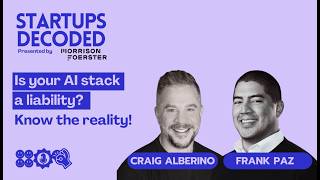
Craig from Langsmart and Frank Paz from Morrison & Foerster discuss how startups can deploy AI without legal risk. Langsmart's tools audit AI usage and cut token costs by 60-80% while maintaining compliance logs. The key: IP assignment, privacy-law compliance, and open-source licensing before you scale.
Chapters
So things like ClaudeBot or OpenClav, installing that sort of technology on your local machine and giving it full access to your life. I'm not worried about Skynet and about them taking over the world, not just yet. Now, that's probably coming, and it's probably not as— it's probably not as far out as people think it is. But that being said, that's not my primary concern. My primary concern is you're giving it access to your banking data and to communicate with your spouse and your children, and it knows everything about you. You don't know where you're Your data's being piped.
Welcome to Startups Decoded, the show that gets real about what it takes to build a successful startup. I'm Andy Walsh, 2x executive founder, strategist, and your host. Each week I talk with top founders, investors, and operators to unpack the plays that drive real traction, not just headlines. If you're building something bold, this is where you'll get the honest insights to scale with clarity and confidence. Let's keep growing together. Hit subscribe and share with your community. It would mean the Morrison Foster is the legal edge behind the world's boldest innovators. They go by MoFo and are the team behind Startups Decoded. For decades, MoFo has helped startups turn complexity into freedom. Learn more at mofo.com. Hello and welcome back to Startups Decoded. My name is Andy Walsh. If you're a founder and you're looking at your business, you right now are looking at AI as a way to drive effectiveness, to scale, but at what risk? A really important question. How do you build a defensible business with AI? And today I'm lucky to have two guests, not one but two, and I'm in the new studio as well, which is exciting. Frank Paz from Morrison Foster, officially known as MoFo. Welcome.
Thank you. Thank you.
Morrison Foster are our official legal firm. We're getting in cahoots on everything that we do from basic contracts to more elaborate work throughout the year. So fortunate to have them on board and one of their clients, in Langsmart. Craig, welcome to the show.
Thanks, Andy. Great to be here.
To have two people for me is fun because we've got two very different perspectives. Like Craig, deep in the world of tech as an operator, building, growing businesses. And then Frank, from your side, the ability to be alongside these people for the ride. Like you're getting a front row seat to experiences. If you were to, let's, let's look back a little bit because I think this is important. It's like 10 years ago, AI existed, but it wasn't anywhere near as accessible as it was now, right? AI is probably 30-year-old technology, give or take. Like 10 years ago when you were working, was anyone even having conversations about how AI could help their business? Obviously not at the scale now, but where did that sort of start to pick up, do you think?
Well, I think it's definitely accelerated, you know, obviously in the last 5 years. You know, back in 2015, I was working in ML and that came out of my prior work in data. And so if you were working with large datasets and I was working in the philanthropy space with data. We're working in consumer targeting with data. That had a natural evolution with things like Hadoop and Spark, pre-big data, but then eventually what they were calling big data from a marketing term. And then that dovetailed very nicely into ML.
Yeah. So the intention was always there. It's just how it was utilized and processed wasn't anywhere near as evolved as it was now.
That's right. You know, it's— we were always looking for— I've always been very solution-focused. So looking at problems and seeing ways that you can solve them. And so if we could storytell around data and around how we can make disparate datasets more effective for clients in consumer targeting or what they were doing for B2B, that was like kind of a natural evolution. And I would like to think I'm kind of doing the same thing today.
Yeah, absolutely. And we'll go into LangSmart and what you're working on a little later. But Frank, from your side, as far as like Morrison Foster well known for being really progressive on AI and one, understanding how it works, of course, but also any legal risk associated and how you plan for it, but then also how you deal with it in case things go sideways a little bit. Back then, can you think of time, like 2015, like same timeline, what was happening from a legal perspective then? Was machine learning and access to data, was it being scrutinized in the same way? Was it even coming up in legal agreements?
So yes, and AI companies were being built. There was definitely like a whole, you know, boom and excitement around it. Of course it died down and now we're seeing like the whole revitalization of it. But certainly at least on the legal side, we're not seeing the same issues pop up that we're seeing now. And I think it kind of pops up in two sort of situations. I think if I can paint with a very broad brush here, the first being like how folks are building their companies, you know, the classic examples like Vibe Coding now, right? And like folks are more likely to moonlight in their current jobs while they build their startup on the side because AI makes it so much easier now, right? That's a classic example we encounter now that probably didn't exist, you know, 10, 15 years ago that folks were able to do so easily as they can now. And I would say the second part is data and how folks are ingesting data. So the very classic example of that is privacy health information. So when we are working with the latest healthcare tech-focused startup that's using AI to ingest a lot of medical privacy information, the way that that's being conducted now is at such a grander scale and so much more data is being used than back then, how the concerns were being popped up of, do you have the right privacy policy in place? Are you securing that data in place? You just see it so much more often nowadays. So I think that's a big difference between the two, I would say.
In my observation now, we're also seeing new precedents come into play, right? It takes one moment of someone having a breach or not doing the right thing to all of a sudden change the landscape. Just one court case, one precedent, which means that it changes the industry at large and everyone has to be aware of that. For, again, Craig, great way to start looking at Langsmart. Just, just for a quick setup, can you give us just a little bit around what Langsmart's doing and how it's looking to approach this problem?
Yeah, so the evolution of the business is actually kind of interesting. So I was working in the space about 3 years ago with another startup and we saw this exuberance around the investment from shareholders, board members, and executives. We need to do this now for competitive advantage. And so people started investing in the space rapidly, and we're seeing Fortune 500 companies with 40 to 100 different line of business applications that pipe out to OpenAI and, and everybody else. And when you ask them, where, where's your compliance? Where's your audit log? And they can't answer that question. And so that's where we come into play. So we help customers with compliance, centralized compliance for the CISO and CFO, and cost control around AI development and AI usage.
It's fascinating because even at a really simple level, and we mentioned vibe coding before, if you're building and creating something on a third party, you're assuming that they're doing the right thing. Ultimately, you use it, you push something out, you may be capturing data, maybe there's some payments that are happening. Understanding that as a young founder, you don't know what you don't know. And having the right legal advice is obviously important, but two, having the understanding about how you do internal compliance and track that. So can you just give us a bit of an example of the type of thing that you would do with a client to give some color around that?
Sure. So generally what we do is we would go in and we would scope or perform an assessment of what's happening in the environment. And we have tools, one of them's called SmartFlow, that we bring in and it helps to assess the environment. We watch all the network traffic for about 2 weeks. Weeks, and then we come back with an assessment for the executives and we tell them what could be improved on a cost basis. So generally we find 60 to 80% cost savings on tokens. So if you think about a company, we have a Fortune 500 client that we're talking to that's spending in excess of $10 million a month on various LLMs, primarily OpenAI, and they're looking to reduce their costs. And when we tell them we can reduce their costs by 60 to 80%, they obviously invite conversation. And, and then the secondary proof point would be around compliance. We could say, hey, you know, there were some PII concerns and not only are we going to report after the fact, we could stop it before it happens. So if somebody makes a request in an application or directly through a chat, we can stop it before it goes to the outside. And then we can advise the appropriate HR or CISO personnel that something has happened. The other benefit is, is that we have an immutable log which allows an auditor to come in every quarter and to report on how much have you saved, how much, how many compliance violations have you had. And that stuff rolls into annual reports, shareholder value, and all the ESG value points that every single Fortune 500 company is investing in.
Yeah, the risk from a publicly listed company and anyone who's worked in a company like that, just the team alone that works on compliance and reporting for shareholders and the transparency that goes around that, having AI as another layer. It's also understanding, like, from the backend side of things, being compliant is one thing, but understanding the tech stack you're using and their compliance. Do you go that deep into looking at partner as well, as far as, again, we use Lovable or Descript, where you're putting your own information into these third-party platforms? Does your compliance audit also look at what these partners are doing?
So, you know, it's, it's a crude way to put it, but we consider ourselves to be the one throat to choke when it comes to compliance. So we live at point of egress, and when configured properly, it doesn't matter what agent stack, what applications, or what backend LLM. It could be a commercial one, or it could be open source that you're hosting internally. We can be the single point for all AI traffic, and it's super powerful for CIO, CISO, and CFO, who are our primary partners when we, when we talk to companies. And so when we're invited in, it's typically through security and compliance it's the finance first, and then surprisingly, I thought it was going to be the CFO, but it's been the CIO. And we find, and oddly enough, insurance partners who we thought would've been behind in their investments, they're actually doing really well and they're, they're super innovative. And we had a great conversation with an insurance company last week and they're just, they're deploying, but now just being insurance, they're looking for some controls.
Interesting.
Sorry, if I can, like, out of curiosity. So for us, for example, we use a handful of different models, right? So some of them are clients of ours, but like, uh, it's very helpful. We get a lot of pressure. Clients always ask us, so like, what sort of efficiencies are you creating using AI? And so of course we're neck deep using it for our services. And so I'm thinking my personal daily life when I'm using one to help me summarize an email or draft an email or draft the first take of a document, for example, I have all these apps or sites I'm using on my laptop. I can just use sort of LangSmart to help me, and, or I guess really in the general compliance team also can make sure we're not using like my personal ChatGPT app on my phone, but instead we're using, you know, compliant models to help me do my work, basically. Yeah.
And there's, and, and listen, that's a great point, Frank. And we are talking to law firms as well. So SmartFlow, our primary product, is more akin to like a Zscaler or like a Cisco firewall for the enterprise. But now we're launching next week, actually, a new product called SafeChat. And what SafeChat does is it allows you to take all of your employees and instead of being on ChatGPT or Claude or Gemini, you would give them a sanctioned corporate-approved chat. And that has all of the goodness that we've already built in around compliance, auditing, being able to block and have controls in place. Brand guidelines, and also the cost savings involved with the caching and compression. So great question, and I hope we can have a conversation about it.
Yeah. Frank, I'm curious then for you as a law firm now with the rapid rate of change that we're seeing, have you got people internally that are keeping up with those partners? Because in theory, one, you have to be a legal partner and look at the risk of your clients, but then you also have to have a level of understanding and knowledge to be able to be confident on decisions that they're making too. Do. So are you auditing in the sense of understanding who are most compliant right now in the startup world as partners that your clients use?
Yes. We represent some of the largest AI companies and their models, both on like their commercial side, but also on any litigation that may be going on. So we are very like involved in that process. I personally, just as the corporate partner, like I'm not too deep in there. There are people that are way smarter than me that, that, uh, figure that stuff out. But yes, and the same is true even if we're not representing the company. For example, if we're doing like an investor side deal where we're diligencing, diligencing the company, that'll be a case where we're sort of trying to understand the product. Is it actually compliant? Is it just a wrapper or what is actually happening with the, with the model itself? How is it learning? Where is it pulling the data from? All that stuff is stuff that we do on our deals and our, on our day to day when we're helping scale the company on the commercial side as well.
It makes sense. And I assume too that the two of you have a pretty unique relationship because as a legal counsel for Langsmart, you have to do all the standard things that you would do for any company. But as far as what you're doing as a service with Langsmart too, you're actually looking at corporate risk and of really high-profile publicly listed companies. How do the two of you collaborate as far as assessing legally what Langsmart needs to do and then how Mofo can actually plug it into that to complement what you're doing?
Well, you know, just having done this for a while, um, I have a pretty good understanding of what my boundaries are on the legal side. But, you know, I can't emphasize enough for founders, especially first-time founders, how important having strong legal counsel is. Um, you know, Frank is a true partner and his colleagues have been true partners. And if I have any question on anything, even if I'm I'm 90% sure. I, I need that assurance sometimes. And you just don't know what you don't know. And Frank has just been a partner along the way for like the last 2 years since we've been in operations. And so, you know, I'll just, I'll ping him or just call him and, you know, if he doesn't pick up, he calls back right away and we get the answers that we need.
I couldn't agree more. I feel like that should be just the standard relationship you should be having with your counsel where it's like, just that gut check that hey, I'm 90% there. I think I know what the answer is but can you just sanity-check me? Just in case I'm not thinking about something. And then it's sort of like go forth and prosper. Yeah, my friend—
So not to argue with you, but I think, you know, just for first-time founders and I know this is super important to Andy Walsh's audience. A lot of people don't know what's available to them. And as many events as we all do when we get out there and we try to mentor young founders, you know, just knowing that you have such a powerful law firm available to you and that you don't have to necessarily worry about taking cash out of pocket when you're pre-seed and when you're just out there with a deck, you know, talk to the people at Morrison Foerster. And there's other great law firms that do similar things, but don't wait to get legal counsel. Yeah, like it's so important, like right from the beginning that you build it into your DNA because that's what's going to get you funded. That's what's going to produce revenue for you is when you're buttoned up like that and you're showing, you're demonstrating already that you're professional by associating yourself with a law firm like MoFo.
I tell folks constantly in those conversations, especially early on, is it is so much easier, more cost efficient, and faster for us to just get it right the first time than we have to fix it later. It can become a disaster. And I try to always position it where it's like, look, I'm not trying to be difficult and like, you know, throw the book at you of what you can and cannot do. But the reality is, if this is— if what we're hoping is this is going to be a multibillion-dollar company, you're going to be successful, right? You're going to have a lot of investors and very sophisticated counsel. They're going to look at what you did and ask the same questions. And I'd rather you be ready to do it now and have it all cleaned so that these questions are more just check the box sort of situation than they actually found something and now it's like an, uh-oh, what do we do about it? Right? And I couldn't agree more. Like, ask those questions. If you're working with the right counsel, you're not be afraid about the bill. Like, that is the least of the concern. It is about getting it right and helping you scale. I tend to tell people that we operate more like a VC firm than anything else, which is we see the greater success for you if you're successful. I don't get anything out of it, it just killing you when you're trying to build your product on day one, right? It's much more important that you get to that OpenAI or whatever scale, because that's where everybody's enjoying from, from the cake, if you will, right?
And for those of you watching and listening, Come and speak to me. I can get you some good rates. My friends over here are my fellas as well. So come and talk to me. But in all seriousness, no, it is really important. And I was fortunate and it was by accident rather than by design. My first company I started in 2012, and I've shared this story a few times on the podcast. My first director on the board was from global M&A background and the formalities and compliance he put into place for us single-handedly put us on a trajectory for all the tiniest things from board meetings and board notes, strategic decisions, tracking details, and going through an exit and doing DD. That was really clean and easy because the history was there. And it speaks a lot to the brand. And I say the brand in the sense of how people associate who you are by the people that you work with. And to your point, Craig, having someone that can set you up at the foundational level from day one, it's so much cheaper than having to try and then get legal support to fix a problem that you could have proactively corrected at the start. So being buttoned up on that is really important. Frank, your role is very much at that point. You're doing a lot of early stage work with founders. What are some of the things just at a base level and focusing on AI here as far as when you're thinking about your business, setting up tech stack, it's very fragmented at the moment as far as who you use. What are some of the things that you would recommend to founders to think about from just basic like C-Corp or LLC with operating agreements into the tools that you're using to then grow your business to be proactive and not have a problem down the road?
Yeah, I would say the very, the most important thing on the IP AI side of things when you're just starting out, you're building your company, you're trying to scale really fast is making sure that you have your IP assignment in place. At the end of the day, I, I, this conversation comes up all the time. It's, I appreciate that you are the founder. I appreciate that this is your baby and that we are going to help you grow it. But at the end of the day, the company needs to own the IP, whether that's the source code or patents or trademarks, whatever the case may be, domain names, the company needs to own it. And there's so many times where, especially now, you know, going back to VibeCoding, such a good example where folks are happy to sort of do it at like midnight, they're building all this source code, but they're working a job. during the day, or they're even source coding on a second laptop while they're in the office at their current job. Understanding the importance of having that IP assigned to your company that you're scaling and growing and making sure that a university or a bank or some other institution that you work for doesn't own it by accident is so important. Uh, it is very difficult to sort of get back that IP if you didn't get it right the first time, but it's so easy to get it done in the beginning if you do it right, right? I think the second part of using, especially if you are creating sort of an AI model that's learning on a lot of data, is making sure that you are not either ingesting data that should be protected. So health, I gave the example before, like healthcare information is a perfect example for that. There are so many rules that immediately get triggered if you start collecting people's, you know, medical records, for example, right? Credit card information is another example. Folks that are building fintech companies that are collecting this information or payment solutions that are collecting this information, making sure that you understand at what point of you building this model or your software platform, you are automatically triggering all these different regulations is super critical. That's when, to Craig's point, where like a simple conversation can help you guide so, so far along, right? If it'll take 5 minutes and we'll make sure that you're on the right path in terms of not tripping up those, those sort of steps. So I would say just to summarize, make sure you, the IP is being assigned to the company. You're not accidentally assigning it to your current employer if you are, you know, moonlighting as you're building your company, and that the data that you're model is ingesting, that you're very careful not triggering some regulation that can put you in some pretty, you know, big trouble.
It's smart to think about that. And Craig, from your side, working with early-stage companies, it sounds like you're, a lot of the stuff you're doing is enterprise, larger companies, but your solution, what sort of things could it help young founders do? And I say young founders as in first-time founders. It sounds like one, what Frank's doing is identifying the things that you need to think about from the start. And it sounds like you're focused on the day-to-day. Is like proactively thinking about things that you need to do, but also understanding what you're doing and what comes out the back end with reporting, compliance, and everything that you would need to be able to do it. Like, how do you set up what you do with an early stage business?
That's a great question. And, you know, we've, we've looked at a couple of different models because, you know, in my heart of hearts, I want to be able to help everybody. And, you know, and I think that if we could provide the platform to early stage, it would be a good thing. We are primarily an on-premise product, so we don't do SaaS or PaaS. We put the code in either Kubernetes or in like a Docker container, and it could be configured in a number of different ways. Typically, the engineering involved to get it to run properly is a larger company infrastructure. Now, that being said, we've looked at platform as a service, and that'll probably be, you know, in, in '27, it's not going to be this year. And then that would provide made an API available to earlier stage, and I probably would just give it away for smaller companies because it is so important. But, you know, as a startup, as you know, Andy Walsh, you have to focus. And so our focus is on-premise solution scaling for large organizations. And once we can solve the problem at the enterprise level, it'll be easier to roll it out for platform as a service for small, medium business and others that need it. What we are doing now for small, medium businesses, we are solving the chat issue. Everybody has a chat issue. The law firms have it, everybody has it. So even if they have a policy, I guarantee you people are putting ChatGPT on their credit card. Teams, or even if you scale up to enterprise, it's $60 a seat. We are launching soft, uh, SafeChat for $10 per user, and it requires you to bring your own OpenAI key or Anthropic key or whomever. That generally, if you priced us against what ChatGPT Teams is, which is about $30 a month, we would run about $20 including API usage. And that gets you all the compliance that you're not getting, and it gets you your intellectual property living locally in your network and not at OpenAI. We feel like that we're making that available to groups of 100 and 250 initially. We may scale down and scale up, but we have to test the market first and see. But beginning next week, we will have SafeChat available at landsmart.ai.
There you go. And I want to get into that a little bit more, but we're just going to take a quick break. We'll be back after this message. If you're building the future, you deserve a legal partner built for it. Morrison Foster, the legal edge behind the world's boldest innovators. They go by MoFo and are the team behind Startups Decoded. For decades, MoFo has helped startups turn complexity into Freedom. They combine deep market insight, tailored legal strategy, and a Mofo passion. Discover how Mofo can support you. mofo.com. Welcome back. We were talking before around the ability to just do the basics right, and I want to go into that a little bit deeper. Right, you just touched on the ability there as far as your LLM of choice and getting better compliance, and you were focusing on there around where your personal data is stored. Board and internally versus with, with the platforms. In that, have you seen some things, and I don't know if there's a story that springs to mind, some of the things that people don't even realize are happening with the tech stack that they're using as far as how deep and broad the access goes and the things that people need to watch out for? Because as founders, we all move at pace. You're making quick decisions, you're in the moment, you're assuming that the, the partner you're using is doing all the right things. Is that a pretty naive way to start that conversation, even when you are trying to get things done quickly?
I feel like you should operate under the assumption that somebody's there to steal your stuff at any given point. And so things like ClaudeBot or OpenClaw or whatever that whole situation is, installing that sort of technology on your local machine and giving it full access to your life. I'm not worried about Skynet and about them taking over the world, not just yet. Now that's probably coming and it's probably not as, it's probably not as far out as people think it is. But that being said, that's not my primary concern. My primary concern is you're giving it access to your banking data and to communicate with your spouse and your children, and it knows everything about you. You don't know where your data's being piped. So I think, you know, we, we have to use more discretion and maybe not trust as much. And I think that that also goes for some of the larger players that are out out there today, some of which are probably clients. And I think, you know, and that's Facebook and it's Apple, it's everybody who we trust today. And things are changing in the way Silicon Valley is aligning now. It's concerning. And a lot of people are looking for ways to move their personal technology stacks off of US-based companies. I think just because of the political environment.
Yeah, it's interesting. And I don't want to go into the politics on here. Yeah, me either. We'll lose ourselves. Exactly. But Frank, on your side As far as legal responsibility, if you're a founder and you, you see something that fits the bill that actually does a job that's going to save you time, it's got a monthly subscription that costs you $15 a month, it feels easy just to turn it on and activate it. There's some things that you can do in that process to understand what it accesses because when you're moving at pace, and I'm guilty of this too, it's easy to check the boxes and say, we give you access to this, this, and this, and you just want to get it done and move through. When should you pause and stop and what are the questions you need to ask?
I would say you should, you should always be pausing and thinking about these things. Then this is, this is true. Like, of course it comes up with AI, but it's, it's also true even if you're not using an AI model, use something like an open source code or something and you're plugging, you're embedding it into your code. Understanding exactly what you're plugging into your IP is critical. It comes up all the time, whether it's on the commercial side or it's on an investment side, you're doing your first Series C financing. You're super excited, you're about to get a $5 million check. One of the questions that are going to be asked are, do you use open source? How did you use AI? Are you compliant? Uh, and you have to have good answers for that. Um, the way to do that is understanding what exactly you are plugging into your, uh, IP, uh, your source code. And, you know, it's tough to say you should read the licenses because the license, some licenses can be hundreds and hundreds of pages, right? Of course. But you should at a minimum know what exactly they do. So I'll give probably a more traditional example of open source where a lot of times some of those, they're depending on how you embed them and, and how it's incorporated into your product may mean that you can't commercialize your IP. That's why the investors invest in your company. So, uh, it is so important to understand that. And you sometimes will be asked to provide an entire list of all the open source you use and how do you use it. So you should always be thinking about this as you are scaling, as you are building, as you are coding. If you ever, if if you feel like you don't understand exactly what it is that that AI model does, how it incorporates into all your devices and takes your information and learns on it, ask us, right? Let's talk about it. Let's see how you are using it, what it really means, and we'll try to help you figure out how to protect and seal your IP from something like that.
Yeah, and I've got a portfolio myself, and the advice I give all my founders, whether they're fundraising or not, is to build a data room and think about DD being an always-on process. Is that if you have strategic decisions, compliance, et cetera, buttoned up, it allows you from a legal standpoint to have lots of information to draw upon about decisions. If that worst case scenario, something happened, but then when you are going to investment, that what you just identified, they're the questions that people are going to ask immediately because they want to know about future risk and there's assessing the company and the chance of success, but they're also looking at what's the risk.
Yeah.
Like the founder themselves, what's their history? What are the things that the business hasn't even considered? Considered and looked at. So that's really important and that's how I teach. Do you get involved at all in that investment process backend, like things that go on the data room and helping founders prep to be able to put themselves in a better stage? 'Cause investment is hard on a good day.
Yeah. So if, if, um, when you get to that point and you are excited, you have your investor coming in, they, what'll always happen is they will give you this, this due diligence request list. Um, and it'll be very long. It'll be 5 to 10 pages, somewhere around there, and you'll see that the IP section in particular is one of the longest sections of this request list. And it basically asks for anything you could have ever signed or filed or thought of at some point. And we help you build that data room. Andy Walsh, your example is perfect, and it is often what we tell people, which is you shouldn't just wait until that moment to start gathering that information and being, you know, proactive about how you're making sure you're compliant. That should be something you should always be thinking about and doing. but helping you think through what you need to disclose, what is actually responsive to the, to these sorts of requests. And, you know, not uncommonly is sometimes the response is not exactly what we, you know, is the perfect A+ answer an investor is looking to see, but that's okay. Let's talk about how we get there, right? What have you done so far? How can we fix it? Or maybe, you know, going back to the IP example, you know, I didn't, I should have gotten everybody to sign an IP assignment, but I forgot one person because they were only here for one day and, and they didn't actually do anything. Let's talk about all those issues and how to sort of present that data room perfectly to an investor so they can feel comfortable investing in this company, that they're not taking on risk. You actually own the IP. But yes, absolutely. And, and that's, as frustrating as it may be sometimes, is one of the longer processes of part of an investment. Oftentimes we'll be on a call with you and walk through the due diligence request list. What are they asking for? What does it mean? Your disclosure schedules. What are you actually disclosing to the investor? All those conversations are a big part of this process. And then on top of that, when you are going through this, the investment financing process, you have to negotiate all these stockholders agreements and governance rights and parata rights and all this other stuff. So it is a big piece to it, but it is arguably probably one of the most important parts of it. Yeah.
It's a steep learning curve.
Yeah.
And if you haven't done it before, running a business is hard. The legal part of it is even harder. And if you have to deal with something, fortunately I've never been in that position where anything major has happened, but there's so many public examples where, where that has already happened, right? And it's changing the landscape dramatically. I guess, Craig, from an enterprise level with large companies, you're seeing this at scale. So the good parts and the bad parts of money spent, risk that's been opened up. Are there ways as an earlier stage founder to start to learn from some of those things in a way that feels like it's digestible? Because we can't cover it all today, but if you're thinking about what you do as a service and the conversations that you're having, how do you start to immerse yourself to start to learn about the things that need to consider today?
I think it's an interesting line of question, Andy, but you know, what I would say, if you are exploring getting into enterprise as a founder, you need to consider how do you sell that to the customer? And so if you have a publicly traded company and they're going to test your software, is there an agreement that's going to govern that test process? And then is there an agreement that is going to govern the commercial relationship and understanding that those sorts of relationships relationships can take 6 to 8 months to go through procurement and legal. That being said, you know, having a strong legal partner is a good place to start because you want to have your agreements lined up. And when you're working with Fortune 500 companies, it is going to be a one-off. Even if I go to them with a standard agreement, Frank's going to have to work with them for 6 weeks to make sure that it's customized to what their constraints are and what they want it to be. Because ultimately, if somebody's going to pay a substantial sum of money in the enterprise space, they can kind of dictate the terms, especially with earlier stage. What I would say is as a risk mitigator for a young company is look for partnerships, look for partnerships with mid-size consulting companies, larger consulting companies like an Accenture, where they might already have an MSA in place with an enterprise company. And in fact, we do that. Um, you know, so we have a lot of partnerships that we've explored with larger name brand software companies and larger consulting companies. Companies so that we could ride on their MSA initially, and that as we're going through our own paperwork process. So I think partnerships and understanding your sales process, are you selling directly to the customer or is it possible to sell through a partner like an Accenture, like an E&Y or somebody like this?
Sales angle I wanted to touch on today. So I'm glad you've raised it because that one-to-many approach, if you're growing a business, has that multiplier effect and it can hit a lot of rubber on the road very quickly.
Yeah.
In that sales cycle, are the customers quite often dictating what you need to do internally alongside the legalities? And what I mean is that for them to sign a deal with you as a business, do they like to know that you are checking boxes and doing all the right things internally from a protocol and compliance perspective before they'll even sign on?
Yeah, I think that's fair. Good, good question. I, I, I have an example and can't name names, but it a large consulting organization that has more than 900 clients, 400 of which are into AI compliance and they're looking for solutions like what we offer. And, you know, they just slowly— so one of the things that I did recently is I gave them an unsolicited proposal and I showed them what the revenue line item could look like if they were to sell our product and wrap their consulting services around it. And, you know, it was, it was a large figure. And that got them to move very quickly. But I am dealing at the C-level, and I think it's just different. You have to identify the appropriate sponsor within the organization, and obviously the higher you call, the better off you're gonna be. So just like you would with investment or anything else, look for sponsors that can bring you into the organization at the highest level. Start the conversations at the highest level because you have to have budget authority, sign-off authority, and you have to be solving a problem for multiple stakeholders within an organization. It's enterprise sales are complicated.
Can I just chime in on that for a hot second? Because we see it on both ends. So we, yes, we represent a lot of startups, but we also represent many of the largest institutions in the world. We not only hear from our startup clients about how annoying it is, how slow the large companies are moving, but we also see on the, you know, when we represent those large enterprises, what it actually requires for them to get there and why it's taken so long. I cannot emphasize what you just said, uh, anymore, which is it is not just one person that's making decision there as much as you would like it to be. They have their own internal legal team, their own internal finance team, their own internal compliance team, et cetera, et cetera, that it's gotta pass through all the checks and that takes time. That's relevant as a startup in particular where I see it so many times is when they're thinking about runway, it comes up so often when they're saying, uh, I have a client that says I'm about to get funding, but I can put it off. It's okay because I'm about to get this customer and I'll get better. I'll get a better safe term. Term if I get this customer now, and but their cash is running out. And that customer, you may thought, you may have thought it's going to land this month, and the reality is it doesn't come until the summer. And now you are in a cash crunch, and now it's even worse to say—
I have no idea what you're talking about. Not that I— not that, not that Kevin, my COO, is going to be watching this and laughing.
That— yeah, but it happens all the time. And so I tell people, like, I'm so glad you hit on this Craig, because it's— think about this, like when you are planning your runway, when you're planning your funding, your sales cycle, think about this, especially it is, of course, nice to have very splashy names on your customers list, of course. But there's so much more that goes to your business that that applies to, runway being the most critical part of it. So just always have that in mind and plan accordingly. You know, don't get too excited if you, you know, you hear a lot of yes, yes, yeses with the one person you know at the institution. There's a lot more yeses you're going to need to get to get there.
I want to just pick up on one thing that he's saying. So 100%, everything you're saying, Frank, with large organizations, which is why it's also important to have a revenue mix, which is one of the reasons why we're launching SafeChat, is we want to have small, medium customers that can act faster on credit cards versus going through 6 to 8 months of procurement.
And touching on what you just said, like an LOI or lots of yeses is one thing going through the MSA process for large companies. Companies, procurement is a pain in the ass. And like my business was service-focused and being able to just check boxes of all the things we needed to do, it's lengthy. And if you're a smart operator, you should also think about that process and be buttoned up on that just like you do for a data room and doing DD. What are the documents that you need, the steps that you need to have? And the irony going full circle here is a lot of it comes back to data privacy. If you're working as a supplier of a company that has high risk or already within their own category that they need to do. They need to make sure that you are following the same protocols and process. So as an early stage startup, you may not even be prepared for that. You may have built a business model thinking that you're gonna make 80% margin on something, but just by being compliant to your customer, you have to eat a whole bunch of more money.
Yeah.
Just to be able to do it. And it's, it's really buyer beware, but you have to stress test it, which I think going back to your example before, Craig, is really pertinent because you talked about having a middleman ultimately to be able to help you be opening doors for clients, but take the edge off a little bit on those first steps of scaling and having that caliber of company on board.
Yeah.
And it's worth it to give up a substantial piece of your margin to get to revenue faster because that's what's gonna speak to the investors and that's what's gonna give you the runway. So I think partnerships are, are a key thing to look for.
There's a VC here in New York, Workbench, and their whole specialty is is around enterprise and they pride themselves on connecting you to customers. And quite often that can be someone who's in the middle and not your end user from a customer base. But the whole path to revenue is the secret to success, particularly today when it's easy for competitors to build lookalikes, get to market quickly and eat market share off you as well. So that multiplier effect is first mover advantage very much so, right?
100%.
Okay. We're at a point here running out of time, which I always I always hate, we can just sit here for the rest of the afternoon. Our first time in the studio, which is nice. We actually cracked a beer, which is good to have too on a Friday afternoon. But Craig, Frank, this has been such a treat. And Mofo, who are our legal firm, as I said, Craig from Langsmart, putting the time out today is so valuable. And if you're listening, if you're watching, really take note because these are things that are probably in the sound hard basket. Basket. And as an operator of a startup myself, I was the responsible one apparently. You gave the analogy before around a drummer keeping things in time— legal, HR, all the stuff that's not fun and sexy but ultimately is going to be critical. And if you get it buttoned up early on, then it saves you so many headaches down the road and you'll be able to move much faster. Anything to add before we finish up, Craig?
Well, congrats on the new studio and thanks for having us in.
Feels like a perfect way to kick yourself, looking at what we're doing in the future. But we should wrap. Thank you very much, and, uh, we'll see you next week. Thanks for listening to Startups Decoded. If today's conversation helped you think differently, share it with the founder in your network. And don't forget to subscribe for real-world startup insights every week. We really value your support. If you're interested in partnering with us, email email hello@startupsdecoded.com. I'm Andy Walsh. I'll see you next week.
More from Andy



EP#88: Why Most Founders Misread Their Own Traction. Vanessa Larco - Premise VC

EP#87: Founders Obsess Over the Raise. Investors Care About This More. — Carina Cunha






Ep#86: Early Decisions That Define Your Startup Forever. With J.P. Morgan Asset Management
