S2E5: How AI Agents Ran Our Business, While I Went To Burning Man (with Adam Robinson)
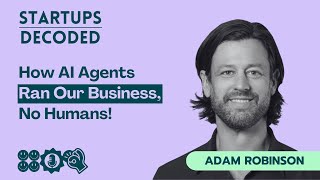
Adam Robinson, founder of RB2B, left his three-person SaaS company entirely to AI agents for a week at Burning Man. An AI clone handled 1,000 chats and Intercom's Finn resolved 500-600 support tickets, costing just $1 per resolution, with no crises while the team was offline.
Chapters
And I'm like, it doesn't benefit them, you know, but I think it benefits the world because other founders get to see that this is possible and that, you know, if you're making decisions about how to build your business every day, right? So if I can get in front of hundreds of thousands of people with this idea that you might be able to operate radically more efficiently at a much larger scale than you ever thought possible, it's at least expanding what you might be considering in these micro decisions that you're making every day. And look, every business is different. Nothing is prescriptive, right? Like social media content wants to make you believe like it's all about a checklist and like whatever else. But like, and like this combination of magic is working, right? Like, and I'm just sharing it.
Welcome to Startups Decoded, the show that gets real about what it takes to build a successful startup. I'm Andy Walsh, 2x exited founder, strategist, and your host. Each week I talk with top founders, investors, and operators to unpack the plays that drive real traction. Not just headlines. If you're building something bold, this is where you'll get the honest insights to scale with clarity and confidence. Let's keep growing together. Hit subscribe and share with your community. It would mean the world to me. Hello and welcome back to Startups Decoded. My name is Andy Walsh, and today we're doing something very contextual, and there's a lot of conversation happening around agents and the role of agents in business. And to help me explore this, I've got Adam Robinson, who is from RB2B. Adam, welcome, man. What's up, Andy?
Andy, thanks for reaching out to me. I love the topic.
It's hot. And I love that today we're talking just fresh out of the OpenAI announcement where they talk about it as the, as the Zapier killer in the sense of how you can automate workflow through OpenAI or ChatGPT more specifically. And it's an interesting inflection point as far as the evolution of where we're at currently. And what got my attention with you is that you recently ran an experiment with your own business using agents, which is, we'll get into in more detail today. I'm fascinated and it just, just really stood out to me. There's so much wasted content, I'll call it to be nice, on LinkedIn. And it's a treat to see someone who actually did something interesting, reported on all the actual facts and shared their experience from their own life.
Yeah. Rather than just a picture of a screen grab of an N8N workflow with 92 steps.
Yeah, exactly.
It doesn't actually do anything. It works. It doesn't actually do anything, but it works.
Yeah. I think it's a reflection on humans that we still buy into things that we know are not real.
Yeah. Well, that's just part of it.
It is. It is. And I think that's actually a really important part now, as far as human beings' trust in AI at large, as far as who they're talking to, how it works, where their data is. There's a lot that goes behind it and consumer trust is a massive part of how people work. But before I go off on, on a tangent looking at, at human psychology, I'd love for you to set the scene for us as far as where you came from in the world and, and how you ended up doing what you're doing now.
Yeah, so I was a Wall Street trader. I worked at a bank called Lehman Brothers for 10 years. I showed up there outta university. My first roommates started Vimeo, the video sharing website, in my apartment. So I watched that happen for 10 years and decided I wanted to do the same thing. So in the same apartment, I decided I wanted to get into tech, having no idea how to do that. I ended up— it's quite a long story, but falling into the email newsletter space, which is incredibly difficult. We had like a MailChimp competitor and they got bought for $12 billion. Mine only got to $3 million in revenue. But in an effort to try to figure out how to grow my email newsletter app, um, You know, we figured out how to de-anonymize web traffic. So first it was for e-commerce stores. Somebody could hit an e-commerce store website, not fill out a form, and we could get a deliverable email address for that person and add it to their list. And then we moved on to abandoned carts, abandoned product, abandoned whatever else. And then 18 months ago, kind of by happenstance, in trying to grow my business of selling to e-commerce stores, I started creating content on LinkedIn. And the content that did the best was not when I was trying to talk about the e-commerce stores' problems. It was when I was talking about my own problems in SaaS. And when I say it did the best, it was like I'd get 30 likes when I would talk about email for e-commerce and like 3,000 when I would talk about how I hired a bunch of BDRs and none of them booked demos, you know, because it was like the pain that everybody's feeling at the time. So, you know, after really like 4 or 5 viral posts in a row, um, about my B2B tumultuous experience, I realized that I was just willing, A, I was coming from an incredibly credible position because I was, you know, I bootstrapped like $22 million ARR or something in 3.5 years. And nobody else from that position was disclosing the type of detail about their business that I was willing to disclose. Furthermore, I felt like I had a really good sense of what made great B2B content. So We decided to make a product to sell to these people. So we just took the e-com product, built a totally new website. Instead of resolving to a deliverable personal email address, we resolved it to a LinkedIn URL, push it into Slack. And it's like a lead source for sales teams. I mean, bigger companies use it in a much more sophisticated way with Clay and everything. But if you're just getting started, it's totally free. You can, you know, get signed up, put the script on your website and push it into Slack and like start seeing these people visit your site in minutes, literally. And it's like totally free forever. So that business is called RB2B, launched it 18 months ago. We have 3 employees. It's at $6.4 million ARR. And what we're talking about today is I did this big stunt at the end of August. I tried to figure out if AI was good enough so all 3 of us could go off the grid for 7 days, unreachable by cell, let AI handle all of the customer interaction and see what happened.
Thinking about it, I mean, obviously people are building their own versions and that process is getting more automated now as some of these platforms release new features. But at the time, was it curiosity? Was it a future thinking as far as a state that you want to get to where you can make money and not have to work as much? Like what ultimately led to the experiment?
Well, I love working. You know, I just think this game is so fun, right? If I'm being completely honest, the stunt was about trying to attach an AI narrative to my company because AI content was sucking up all of the air on LinkedIn, which was my primary marketing channel. I was getting my ass handed to me by somebody who did something similar to us, launched later, positioned himself and his product as like an AI native thing. And like, I had no AI expertise. Uh, and that kind of started me on a journey of like, what am I going to do? Go build all of these agents and innate in and say that I have this stack of whatever. And I was like, you know what? I think it's actually a better— so that was kind of their narrative. It was like, oh, we're going to like be really small and we're going to get really far, but they weren't sharing as much, nearly as much detail as me and not as credible, but they're like, you know, it's, it's the, the 3 founders and we're building all of these workflows with all these workflow apps that are, that are agents. Right. And you read the content and you're like, that's pretty cool. But like, I don't know if I can build and manage 35 AI agents. I just don't even know where to start. Right? Like, and that's kind of not, this is what I, this is how I think my view differs from a lot of other people. I now make business decisions to make my business fit the AI tools that are available to me. Rather than the other way around, rather than looking at what everyone's doing and saying, we can have AI automate that. I literally am like, how do I maintain, how do I develop my product in a way that is conducive to AI handling everything? So no one else that does it. So there's been a really strange development. We were the first to market with this person-level website visitor identity. We had a massive uptake. Then like 4 months later, I had 10 competitors that were saying the exact same words on their website as mine. Now, a year later, none of them have the same words on their website as mine. And I'm the only one saying we do website identity still. There's an interesting part of our market where like, it's just really hard to book demos from website visitors without combining other signals. And it's really hard to do it unless your business is of a certain scale. So all of those other businesses are venture-backed and they have really successful customers who are much larger than my average customer. Right. So all, all that is to say, I'm keeping this product. I will not go do what they do because then AI won't be able to handle all my customer interaction. Does that make sense? Like, it's a stupid simple to understand value proposition. You know, you really don't need to be sold. It's like you show up at the website, you're like, yes, I do. I want to identify people on my website. Yes, I do. Uh, you know, how is this legal? Like, does it work overseas? You know, if you're a bigger company, it's like, can I see your SOC 2 docs? Like, how does pricing work? That's it. Right? So you get those questions answered, which AI can handle really, really well. And then they sign up and then it's like, how do I put a script on my Webflow site? You know, like the, the technical aspect of implementing this now in 2025 can be handled very well by AI also. So. I want to restate this main point. I know exactly what I should do to make my product much better in quotes. RB2B should be handling the entire website visitor workflow, right? Filtering, account research, giving additional contacts, creating copy for LinkedIn and email and like sending that. If I add that. I will have two problems. Number one, the sophistication, the onboarding problems that we're going to have. I'm not sure that AI is ready for that yet. You know, like I'm not sure that AI is ready to handle a deliverability problem or someone's like domain crashing or whatever. And a sort of unrelated to AI problem is if I do all that, then I'm now fighting all these other people that just left the market to do that. And the reality is that workflow doesn't really work, which is why they started doing all this other shit. Like, but from, from, from like a first principle perspective, I want to have a business that is simple enough to have all of the customer interact or the majority of the customer interaction handled by AI. And, you know, like what RBDB is, it's like, it's like this organic social founder-led sales motion, um, that brings people into a massive freemium offer. You know, we have a 12.5% conversion rate to paid. So it's like 200 free signups a month, 250 paying customers, 1,000 people talk to my AI clone that's on the homepage before they sign up, 1,000 people talk to Intercom Finn trying to get their pixel on or whatever after the account's set up. And the AI clone handles, I don't even look at that anymore, by the way, I don't log in. I know what it's going to answer wrong. Everything else it answers right. And the majority of people, the vast majority of people that are unsatisfied with it are just dicks. So I don't really care. Finn takes a lot more management because it's like after people have signed up, you know, tickets actually get escalated because, you know, something, some strange edge case happens. But still, you know, for that throughput, Rob spends 2 hours a day answering these tickets max, you know, and that's just an incredible thing. Like I think about, in my first company on volume that was nowhere near this, we had 4 customer support reps and didn't have coverage at night. So a service came along, uh, it was called Parrot. It was a chatbot and they had people who knew nothing about your business who would get the question, put it in your knowledge base, and then take the answer in your knowledge base and put it back in the chat so that you could— it was $1 an hour so that you could, so you could say, you had coverage, right? And it was horrible. We stopped using it after weeks. And this all is happening. My AI clone is $99 a month for 1,000 chats per month. Totally fine with the resolution satisfaction, everything. And then, uh, Intercom is priced at $1 per positive resolution. So we get about 500 or 600 positive resolutions a month. Um, which is just incredible. You know, it's, it's, it's just unbelievable. Uh, but it starts with, you know, how I looked at it was like, what can I do that fits into what works today? Right? Like, because I think it's such an intriguing idea, this idea that like, you really can have this business that's kind of running by itself, you know, at that kind of scale. It's wild. Uh, and I think it's a great story, which I'm always looking for as being a founder. Thought leader, you know, led business. And I think the relative attractiveness of running a business like this, now that you can run it like this versus taking the VC path and, you know, having to go mid-market and enterprise and like always do bigger deals and more complex products and all that stuff. It is much more relatively attractive today than it was a few years ago before these tools existed to go this way. You know, so I'm trying to like selfishly, I'm looking for the story, you know, the giving part of this is like, I just want more for people to know that this is possible and to think about it this way. It's like, you might want to consider a low price, high churn, freemium product that can still get to $10 million if you have this like alignment between, you know, social, between like the author-audience-platform fit and you can like really make that inexpensive channel work and the freemium thing work and like, whatever. Like I think, and it all goes back, like I'm kind of like a hopeless bootstrapper at heart. Like I believe that like, The most beautiful business is a high revenue, high gross margin, low employee count business. It's totally lost on almost everybody else who does what I do, but like, that's what I think a beautiful business is. So I'm going for that. And I think that tech companies are the best position to actually do that. It's just when an investor comes in, you cannot run a business that way. That was a lot that I just, you know, a ton of rants right there.
It's good and it's important. And the reason why you're getting such engagement from my side is just that complete transparency and vulnerability to a point as well in being able to share the things that you're doing. And what I've seen and observed is the ability to be very transparent around revenue and targets and how you're working. And there's so many founders that I know personally, or I've heard stories of, where it's all around headlines and just chasing bigger and bigger revenue numbers. And I had my Mike McCombie on here in one of my early episodes. He's a solo GP here in New York and he talked about someone that he knows that had an offer to buy their business for $900 million and they turned it down because he wanted to be a unicorn in his headline. And like, I still, I tell that story all the time and it's not my story to tell, but I love it because it just goes to show that some people's motivation is clearly vanity. Like $900 million is multi-generational life-changing for someone, right?
I mean, you know, if you asked me, whether I would, you know, a billion dollar, a $100 million revenue company with 1,500 employees or a 3-person company with $15 million in revenue. I'm taking the 3-person company with $15 million in revenue all day long. Like there's just no question about it. It is so much more attractive to me for so many reasons. And I think that now it's possible in a way that it never has been before. Right. So, So yeah, and I think I have the added— there's problems with small businesses in terms of like your own ego and social status and all that stuff. And I think I've kind of gotten far enough, you know, like my combined companies are like approaching $30 million ARR, right? So it's like, and they're bootstrapped and I talk about all the time, they're super profitable. So like pretty much everybody in the SaaS ecosystem. They're like, okay, fine. Like respect, right? Like, you know, you were at a level where you're crushing it and whether or not it's like a founder who's not there yet or, you know, like a, a CRO or hired gun of some multi-hundred million ARR company, they would still rather be a founder of a hugely profitable, you know, $28 million ARR company with no investors, right? Like it's just an enviable place to be in. So. I think I have the luxury. I have a few luxuries that I, that I really, you know, I have this platform that allowed me to launch RB2B in the first place. Right. I'm paying a LinkedIn consultant. Like I never would have, if it were starting from zero, I could have never afforded to pay. I would have never done it. I wouldn't have paid this guy to get me so good at LinkedIn, you know, just cause like I have all these resources from the other companies. Um, you know, I have a platform, uh, it's easy for me to say small is great when the combination of everything I got going on is actually big. Uh, but I still want to evangelize it because, you know, lifestyle business is such a dirty word. But again, this technology has presented itself in a way to where if you use it to amplify its strengths, you can create businesses that were, that were unable to exist, you know, only years ago, which is the point of what we're talking about.
And, and I think the, if you were to ask any founder that's got 1,500 staff, did they intend to manage 1,500 people when they started the business? I, my guess is it would be a resounding no. And it's, it's the things that you don't think about at the start is, is what your role will be. And I went from me and 2 co-founders to 35, and, and that felt like a lot. It was just perpetually managing people. Rather than doing what I'm passionate about, which is brand and creative strategy. And for you to be able to find a way to do it and transition and being ahead of where people are at and being able to use technology to your advantage. And I'd love to explore a little bit something you mentioned in there around looking at what you're doing. And I'm going to describe it as an inside-out approach rather than outside-in. As far as how you think about your product. And if you're doing something and you want to, and you see repetition or scale opportunities, et cetera, you're going out trying to find a solution. If I interpreted what you said right, rather than looking at the market and going, hey, you can do this with this platform, let's plug it in. Is that the right way to describe it?
Yeah. Well, so it's like, it's kind of like, I think it's like a chicken and egg dilemma, right? And it's really, for existing businesses, it's incredibly difficult. Because, you know, you need to look at your own business as though you're willing to dismantle the entire thing and change it. And like, you know, maybe there, you, you would have to be open to the idea that, okay, like, so let's take retention.com, for example, like what I am proposing, and we're not actually doing this is that my low $20 million ARR business might actually be better being a $13 million ARR business, but with like 2 people because of the way that we could run it. If we stopped doing a lot of things and only did a few things that could be wildly amplified by out-of-the-box AI technology out there today.
Right.
I don't think it can be run with 2 people. That's just like a very sort of extreme example. It's like, you know, my $6 million ARR business has caused so much damage to Sixth Sense's $200 million ARR business. It's not even funny. But like, what am I trying to say? It's like, like, I think it's a better, so like, I think it's a better business than just in that example, they're shrinking their, you know, burn is basically equivalent to like their yearly revenue. It's, it's just an insane situation over there. Like, and it's because a new entrant popped up doing something in a completely different way that was tangential to the primary driver of their business, right? This is kind of what I'm suggesting. It's like the alarm bell for me was I was listening to this AI consultant talk and she, as a thought experiment, she's like, what is the 2027 AI version of your business? Because if you don't go build it, somebody's building it right now and they're going to eat your lunch. Right. And it may not be like for the retention.com example, it may not be a retention.com that's $50 million ARR instead of $20 million. It may be a $3 million ARR version of retention.com that just flattens the entire market, but like it can be run by one guy or girl, you know, in a few hours a day.
And that's ultimately what you did with your test. It's, it's a great exercise in where we're at as a benchmark in technology and automation. But also it allows you to analyze your business model and think about margins. And I saw it with the growth of my team. The revenue might grow, but if you hire more people to do certain roles, then your bottom line may actually go down. So you're playing around and impacting a lot the bottom line, which is ultimately the money you take out. And we bootstrapped as well. So for us, we had 100% control over everything we were doing. Any money made went into our pockets. But I think looking at that business model today with what you've created, you're able to analyze it and go, look at your competitor set, look at the market, what's happening, where do I own this, and be able to test out things that enhance what you're doing internally rather than get caught up in the hype, which I think a lot of people are doing, trying to jam in tools that seem to make life easier, but ultimately make it harder because of how they're trying to maintain and stay on top of something that is not 100% Sofiette?
Yeah. I mean, I am trying to be as extreme as possible on one end of that because I just see it. Everyone gets forced the other way, you know? So it's like, yeah, it's like, I think I said it before, it's like the thing that I'm, will always be till the end of time afraid of about RBD is that I will create a better product that is a worse business. Because of this world that exists. So can I talk about, so one fundamental principle is like, you know, instead of going down like a rabbit hole of like an N course and like trying to like really understand how an LLM works or whatever, the first fundamental principle is like, well, what does this do really well? And are there any out of the box tools that just are awesome? You know, they have great reputations in the market. Right. And then how would I bend my business processes to the point where they fit those tools rather than the other way around? And then the other fundamental principle is for any tool that works really well, part of it is sort of like the tools that are given to you to assist in the prompting that this thing does. And I'll give an example of what I mean later, but most of it and I'm talking like 85%, is how good your documentation is that ultimately ends up feeding this thing, right? Like that is the most important part, full stop. Like the reason that we were able to do what we were able to do is because for the last year and a half, this guy Rob, who I hired, who is a superstar, uh, he used to be an engineer, but he took on this project of trying to create a fully automated support for our system, for our freemium app, he, from day one, started answering repetitive questions with a document rather than a ticket. Right. And then he, and then now there's, you know, 400 documents that cover the 90% of the things that can happen when you evaluate and onboard our product. Uh, someone who, you know, I would, his other skillset was super valuable when we started doing this because Fin wasn't as good yet. But now that these AI agents are, are, are really good, somebody who can just create absolutely killer support docs for you are what makes this magical. And by the way, it's not like nothing ever goes wrong. Another thing that I think is compelling about these businesses that I'm describing, which is like Target's SMB, it's PLG, doesn't really need real sales. It's low price point, it's high churn or whatever. When you have thousands of customers paying you $220 a month, the cost of being wrong is not high, right? Like it doesn't really matter, like what happens to the individual, right? Like, as long as like most of the people are getting what they need and they think it's pretty cool. And by the way, I'm advertising that the whole thing is AI. So like they're coming in expecting that, right? So like, as long as it's working, you know, very well, but not perfectly, like it, it, it's, it's, it's very different than if you were trying to like get AI to like materially help you close some type of $100,000 deal and like it fucks up and like what it, you know, interacts with that customer.
And a couple of things there I'd love to unpack a little further. I, it makes sense that what you're saying as far as full transparency to customers on what they're getting, but the risk factor. And it's interesting that most founders, I would say, would look at their business and the thought of losing a customer would give them anxiety and they'd be up all night, right? And you've, you've not been nonchalant in a, in an arrogant way where you're like, I don't care if they fail. It's pragmatism to identify that right now on the stage that we're at for the cost that you're charging those people on the upside on their business. They're going to expect some bugs, but it's not going to be game-changing in the sense of they're not going to be put out to a degree where they drop off. Because I would assume based on what you're doing, which is literally driving revenue for these people, that your retention rates would be high by default because of the opportunity that you've created.
Well, here's the issue. No matter what, when you sell, there are, there are categories of software, like certain software categories have very low churn. Certain software categories have very high churn. A very low churn category is like a system of record, like a CRM, right? If you're ripping that CRM out, either your business went away or you're switching CRMs, right? Like there's only two reasons. Um, email marketing on the e-commerce side is the same way. Like that's what, where their database is held. If they're ripping out their email tool, it's such a driver of revenue that they're replacing it or going somewhere else. On the complete other end, whenever you're selling leads, as a SaaS, that is about the highest churn product category that there is because A, there is so much that happens between receiving a lead and that lead producing value that you don't have control over that eventually people just throw their hands up in the air, right? And B, nothing changes about their business except they're not getting those leads anymore, right? That's just the reality of it. So sadly, we are in that high churn product category. And also sadly, because of the freemium nature of the business, SMBs are always higher churn than enterprise because they buy quickly, they quit quickly, and enterprise might evaluate something for a year. Like they might do a 2-year pilot to see if they'll stick for 10 years, right? So we have a high churn product category and a high churn buyer persona. That being said, there's always ways to make it better, but I think The biggest reason people quit is because they can't get these leads to book demos. And then you ask them if they have an outbound motion and they say, we haven't figured it out yet. But like, if you don't know how to like write a message to somebody that will create an interaction, then you're not going to be able to write a message to a website visitor that will create an interaction. You know, these are just like better leads than your targeted lead list, but it's still the same It's only going to work for you if you have some sort of outbound motion. And if you like figure you have message market fit and like, so that's, that's the biggest issue that leads to the most churn. And unfortunately, not, you know, I will never be in the business of trying to solve that problem for people. It's just too hard.
And I had an interesting conversation today with a friend who's the founder of a company called Versy and they do agent compliance. And mostly for big enterprise. So if they're integrating agents, they create simulations to test out the agents to understand where it falls over, where there may be much more serious risk involved, where the consequences, it's not a $220 a month subscription that they're losing. It could be millions. It could be legal exposure. There's things for those types of businesses. So it makes sense that kind of platform exists now, but for you, the risk isn't as high and you've done it yourself as far as what you've just explained. The process to extrapolate that information from you. You talked about Rob as far as his ability to write out all of the flows, the information to be able to train, to be able to have high capability with its knowledge. To take that one step further, to do the full experiment for 7 days from a workflow perspective, if I'm a customer coming to RB2B, what stages was each agent deployed for Yeah.
So most of it, and this gets back to a really amazing feature that Intercom has with Finn, which is the support chatbot agent that we use. So what I think pisses people off more than anything else is when you send them in a loop back to the same AI. So it's like they're talking to a chatbot and then it's like, oh, we can't resolve that, email support@rbdb.com. And that's the same. You know, it's giving them the same answers, like whatever else. So setting up, they have this feature called Guidance and you can, it's basically like these very high-level principles of how you want the AI to handle certain situations. A very common problem dealing with chatbots is people are not asking the question clearly enough. Believe it or not, that's like a huge source of unresolved tickets. So you can set up guidance where if it's like, if the question is vague, ask them to be much more specific, right? And it actually really helps, for example. Um, and, and, you know, that, that would be an example of like eliminating like a huge pocket of potential frustration. Escalating certain issues that we don't want the AI to solve and then having the response to the escalation be like, We're doing this stunt and we'll be back on next Monday.
Right.
So like a billing issue, it's like, you know, I canceled, you know, 24 hours after I got billed, I want to get refunded. Right. Like we don't want, it's like, we actually want a person to do that. So, you know, identifying situations like that, having, it would have normally gotten escalated, but like having the escalation response be, you know, we'll be back next Monday. This is the trick we're doing. If you want to like read about it and here's Adam's post or whatever. So, and then outside of Fin, We were looking for issues that were coming up very regularly that were very annoying to people and that could be solved through some sort of agentic workflow. A great example is like oftentimes people add multiple users and they typo the email and they're like, Timmy can't log in. You guys suck. You know? And so Rob built this workflow that like would go look at SendGrid sending Timmy the email. A, was it sent? B, was it successfully delivered? C, was it a hard bounce? So it was a typo. And then it would give one of, one of four responses based upon what, what it was. And then that completely eliminated that entire category of tickets. Between guidance and then a few things like that, uh, it got it to the point where we were gone for a week and, and, you know, there were no, like, people were not, they did not have their pitchforks at our door, you know, uh, when we came back. The funny thing was on Monday when we came back, there was a bug with login, which was a complete shit show, but like, they were there for it, you know what I mean? Like, it did— thank God it didn't happen on like Wednesday when we were gone, because that would have been like a huge, huge problem. But like, yeah, some weird 404 thing was happening when people were trying to log in, and it was, it was a total nightmare. Thank God it was after the experiment.
I'm fascinated, as far as communication with existing customers, do you have a group that you use for panel feedback, any research, etc., and closer relationships ultimately, because I'd love to know if you set up in advance what you were doing with those people and then if you checked in after the fact to see if your customers had feedback around that too.
Well, this was, um, I think people kind of understand the nature of my content. You know, like the reason people sign up for RBDB is because they've been reading my posts for a while and they just want to see if it'll work for them. So, you know, some of the pushback that I get when I talk about this is like, well, how does it benefit your customers doing this? And I'm like, it doesn't benefit them, you know, but like, I think it benefits the world because other founders get to see that this is possible and that, you know, if you're making decisions about how to build your business every day, right? So if I can get in front of hundreds of thousands of people with this idea that you might be able to operate radically more efficiently at a much larger scale than you ever thought possible. It's at least expanding what you might be considering in these micro decisions that you're making every day. And look, every business is different. Nothing is prescriptive, right? Like social media content wants to make you believe that like, it's all about a checklist and like whatever else, but like I've tried 10 more things than have 10 times more things than have ever worked for me. And like this combination of magic is working, right? Like, and I'm just sharing it. And people love to call me out. They're like, this thing isn't really selling your SMB PLG. You know, this, if everybody, if anybody in a different segment selling to different personas tried this, then it wouldn't work for them. And I'm like, look, like that is true, but like, it's not my job to give a paragraph of qualifiers before I tell you what I've done that's never been done before. If you can't discern what you should and shouldn't do about what I'm saying, then you shouldn't be in this game in the first place. It should be immediately clear to you that I have a PLG product that sells to SMB. Therefore, I'm able to do this and you might not be able to, but you might be able to take certain parts of it, you know, like maybe you could like pre-qualify your demos and then that could radically enhance the efficiency of some part of the funnel. So, um, so that was a very long-winded answer. I don't believe that it, I sort of agree with these people. It doesn't really help my customers. What I do do to speak to customers is I email everyone after they've been their paying customer for a month. And I say, will you talk to me for 15 minutes about our product? And it's got like a, it's a Calendly thing. It asks them 4 questions about their satisfaction, how they're using it, what kind of business they are, whatever. And then from 1 to 4 PM Central, On Wednesdays, I stack 15-minute Zoom calls and I get to talk to all these people. So I'm very aware of what people are frustrated by, and I know exactly how to solve the problems. However, I'm afraid to build it because it's almost like, yeah, I'm afraid to build it because, uh, you know, it's very, it's very clearly working in its current stupid, simple form. Which is very annoying in some ways, but very magical in others. Anyway, this is the dilemma I find myself in.
I listened to that and one, I think we have a healthy ven around sharing all the things that you're doing because putting it out in the world, like innovation happens when people come together, right? And it actually drives change at scale. And you've done a really interesting experiment. And I read the whole story from start to finish from when you announced it till the results afterwards. And it wasn't like people saying that you had some revolutionary thing that would change the world. It's like, here's what we did, here's the output, and then building on that. It's like the, the old school sort of GitHub days of building something, sharing it with community, and having people evolve and collaborate in a very async fashion, which is what the philosophy was behind that. And letting people be privy to that, I think, is really helpful and it elevates everyone. And the classic analogy of every boat rises in the tide, is that that knowledge base sets a new step as far as where you can go. So I think that's really important and tip my hat to that, which is what brought me here today to have a conversation with you. The other part there, just continue on, which I love, love as well, is that customer relationship. And it's interesting in a world of agents and AI, the fact that you're having those active conversations. I've got portfolio companies, and I tell all of my founders, whatever stage they're at, you need a quorum of customers that just give you a nice barometer of where your business is at. Having those personal relationships, I mean, you're not like a Sam Altman CEO rockstar that everyone knows, right? But people still love to talk to the founder of the business and know that they're talking to the person who is, they're paying their money to. And it doesn't matter what scale that's at, that personal relationship is everything. So For you, with the philosophy that you have around human connection versus agent connection, where do you see yourself now? And then will that change in the next 5, 10 years as all of the new technology comes to life much more automated?
Well, so a place where I think I will try to seem, you know, it's just an interesting question as it pertains to our whole thing we have going on because the content that I'm writing, I want it to feel as human as possible. I want there to be typos. I want it to look totally different than all this like Claude and ChatGPT created. So basically what I observe happening now is like Justin Welch taught everyone how to write on LinkedIn. And now that's most of the LinkedIn posts in the world. So now everyone goes in and asks Claude to write a LinkedIn post and it's in Justin Welch's format and like, You know, when, when you see one, it's like blah, blah, blah, you know, there's some taper and then it's like, it isn't blah. It isn't blah. It isn't blah. It is, you know, so I'm trying to make stuff that looks nothing like that. That feels nothing like that. And, um, you know, I was really leaning into this like talking head video stuff, kind of like this, uh, a year ago.
I ha—
I feel like it's adverse. I, it had been adversely affecting my reach for I thought, but then like, I don't know, my last few posts haven't really hit and I thought a couple of them should. And like now I'm looking at my feed and everything has some sort of asset attached, whether it's like a photo or a video or something. I don't know. The algorithm is a funny thing. Right. But I believe that readers have a way of feeling when something feels like everything else and they get bored of that very quickly. So I'm trying to maximize the humanity to the extent that I can. Right. And like, it's like, how do you do that? It's like, well, you write stuff that doesn't feel like everything else. And then you say things that no one else can say, which is basically your experience. And I think you really nail it when you're good enough to where your post can be like a mini hero's journey in itself, where it's like, you kind of create this world is broken thing. You agitate that pain and then you sort of let people out at the end with like some type of lesson and like a dopamine hit. And, and, you know, whenever I can, I really try to lean into the emotional experience of what it is like to be me, because ultimately that's what everyone wants to know. Right. And when they find out that it's not perfect all the time, your stuff does really well. You know, like that is the thing that like almost no one else is able to do, like just share. The emotional pain that they are going through as a result of this, you know, position they are in, right? Like, so yeah, that's my two cents on the top of funnel content side. With the actual product, I want to try to go as AI as possible just because I think the story is so good for all of the reasons that I've talked about. Like, I just want people to know that this is possible. I want us to hit $10 million ARR with 3 people. Maybe we'll take a month off, right? Maybe that'll be my stunt. Like the day we hit $10 million ARR, none of us are going to log into anything related to RB2B for one month and we're going to see what happens. Are we going to be at $9 or $11 after that month? My guess is it'll be $12. It'll start growing faster than it ever will, ever has, because the story is feeding it. Right. So yeah, that's my two cents on both sides of it.
I think that'll be a conversation that will just continue to happen as people test and learn. And, and the best thing about human beings is that we're imperfect as much as people strive strive for perfection. There's no such thing in human beings. And it's that part that I see now where any LLM, it feels like it's on a pursuit to be perfect and please you and golden retriever is what I call it. And it feels generic and you can feel that. And like the imperfection of what we're doing with tonality of our voice, our voice breaks, there's things that we mess up or we stutter and that kind of part our brain knows in conversation, storytelling goes back back 50, 60 million years as far as human beings. So for me, that makes a lot of sense. And you talked on something there, which I have to ask. If you hit 10 million and you took a month off, that's a long time for you. You've got other businesses, but what did you do on those 7 days if you weren't logging in and checking our B2B? Did you manage to down tools and just hit the Caribbean for 7 days?
I went to Burning Man.
Perfect.
That was really the reason why I did it. I'm like, I'm like, I just went to Aspen for 6 weeks. I'm back for a week. And I'm gonna go to Burning Man. This is absurd. I at least need to like make this seem like it's work somehow, really to my employees and everything. So yeah, I was gonna be off the grid. So I'm like, guys, just take the week off and go do something where no one can reach you.
Yeah. And so, yeah, what a place to escape from the technology is literally like the, the opposite ends of the scale of those two experiences side by side. There's a huge void there.
Yeah. Burning Man's great. I highly recommend checking it out. It is not what you think it is.
Yeah, I agree.
Leave it at that.
Nice. Adam, we could talk about this for ages, but I really appreciate you making the time today to be able to explore what, what you've done and where you're going, and particularly philosophically about how do you create a business that serves yourself and not a whole bunch of other people, which I think is something that's really pertinent today. So thank you. For making the time.
Hey, thanks for having me on, man. I appreciate it.
Thanks for listening to Startups Decoded. If today's conversation helped you think differently, share it with the founder in your network. And don't forget to subscribe for real-world startup insights every week. We really value your support. If you're interested in partnering with us, email hello@startupsdecoded.com. I'm Andy Walsh. I'll see you next week.
More from Andy



EP#88: Why Most Founders Misread Their Own Traction. Vanessa Larco - Premise VC

EP#87: Founders Obsess Over the Raise. Investors Care About This More. — Carina Cunha






Ep#86: Early Decisions That Define Your Startup Forever. With J.P. Morgan Asset Management
