S2E8: Founders: The Easy Way to Land Angels, Fast - Jaclyn Johnson, CEO - Cherub
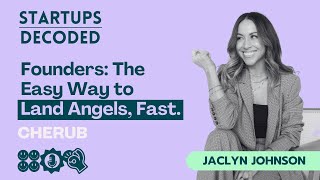
Jaclyn Johnson, CEO of Cherub, explains how founders can land angel investment faster. She notes that 97% of angels stay inactive due to lack of deal flow, so Cherub built curated email pitches, AI matching, and auto-generated fundraising pages to connect them. Johnson emphasizes storytelling, repetition, and maintaining investor relationships as key to closing deals.
Chapters
So I think when you're pitching an angel, you have to consider a few different things. For most angel investors, the two strongest factors for them are going to be the founder, the grit, the determination, the background, why they're the right person to be building this company, and how, uh, invested they are in getting this to the finish line. And the second is the product. Do I actually like this product? Is this a product I use? Most people will write checks into businesses that they love, care about, have some investment in, understand, or use the product, frankly. How can you really tell a compelling story of why you're the best person to build this business and also be able to talk about long-term planning. What is your vision for the business in 5 years?
Welcome to Startups Decoded, the show that gets real about what it takes to build a successful startup. I'm Andy Walsh, 2x exited founder, strategist, and your host. Each week I talk with top founders, investors, and operators to unpack the plays that drive real traction, not just headlines. If you're building something bold, this is where you'll get the honest insights to scale with clarity and confidence. Let's keep growing together. Hit subscribe and share with your community. It would mean the world to me. This podcast is brought to you by Cherub. Cherub connects founders and angel investors. Find the tools to fundraise seamlessly. The future of fundraising is here. Invest with cherub.com. Hello and welcome back to Startups Decoded. As an early stage startup, angel investments can be your absolute lifeline to allow you to grow. So we're going to dive into that a lot deeper and with our first formal partner for Startups Decoded in Cherub. And I've got the CEO and founder, Jacqueline. Welcome.
Yay! Thanks for having me. Excited to be here.
I remember those early days and getting momentum on revenue, building teams, building products. It can feel all very overwhelming. And angels, like literally what they say, they can come down from heaven and give you capital and feel like that $10,000 is like you've won $100 million in lottery. We'll go into this a lot today, but what you've observed is that there's still a major gap between angels who have capital and founders who need that capital and how they actually find each other, which is going to be our focus. But to set up, I'd love to know about your story as far as how you ended up launching Cherub and your journey as a founder previously into your own angel investments.
Yeah, absolutely. It's been interesting. I've had this unique journey of being a bootstrap founder, a venture-backed founder, venture capitalist, and an angel investor. So I've been on every side of the table, uh, you can imagine. But I've been a founder for a very long time. I bootstrapped and built two different companies prior to Cherub, one being a marketing and events agency that was sold to a strategic, and then the second company being Create and Cultivate, uh, which is the largest media and events company for ambitious women, and that was sold to private equity. In 2021, recently bought that back with a partner, um, which has been a unique experience. But along the way, have also been angel investing for a very long time. I wrote my first check, I wanna say in 2011 or 2012. Since then, have 25 different portfolio companies that I advise or am invested in as well. And it's been a great experience. But what I've kind of learned along the way being on both sides of the table is that one, not every founder has a pipeline into the, uh, VC, you know, family office, rich uncle world of getting people to write checks into your company. And a lot of angel investors who have capital and strategic value aren't getting deal flow into really amazing companies and opportunities just because everyone's missing each other. And so where this kind of came from was Angelina and I, my co-founder, um, who was one of those quiet angels not getting deal flow, was saying, I think there's something that we can solve here. And one of the things we found out, which I was kind of shocking, was that 97% of accredited angel investors don't invest. So only 3% are actually writing checks. And our big bet around that was that we don't think they're not investing because they're not interested. We think they're not investing because they're not getting access to good deal flow and the ability to do deals. And we've been able to kind of prove out that concept, um, especially even with Angeline who's made 7 angel investments since we've launched Cherub. So it's been exciting to see the journey and obviously to get founders funded.
So important. And I would love to double-click there a little bit on just some classification. If you're a brand new founder in the world and you hear all these investment terms and it can feel overwhelming, an angel is a bit of an anomaly in there. Typically one person working by themselves. Sometimes they can be a collective that's more formal with how they put their money through. But as a rule, they, they need to be an accredited investor. Can you talk to us a little bit about what an accredited investor is and just get some foundations for people to understand what an angel actually is.
Yeah. So I, I think that one of the big questions that we get is around the difference between an angel investor and a venture capitalist. And really the deal, the difference is angel investors, I think some people think that they're just giving you money and expecting no return, which actually isn't the case. They're giving you money with hopes of a return, but not an expectation of return. Whereas VCs are giving you money with the expectation of a return. So there is a bit bit of difference there. There's a little bit more flexibility with angels typically. They're also usually not hyper-involved in the company unless that's something you want or is discussed, and usually they're smaller check sizes. But so it's a little bit of a, of a nuanced kind of difference there, but usually they're a little bit more lenient on their investments with expectations. To be an accredited angel investor, it's essentially a loose set of guidelines dictated by the government, but it usually is meaning you have a net worth over $1 million. So that, that's usually excluding your primary residence, but obviously with your investments Or you're exceeding $200,000 a year on your income, or if you have a joint income, it's $300,000. So this is just basically rules to dictate that you are aware that if you lose this money, you're, you're not going to be destitute, right? Like it is your, it's a willing risk in that way.
And I think that's really important to think about the role that they play and the mentality of an investor in any category, whether they're in public share market or in private companies, whether they're buying gold. That the idea of investment is that you drive returns. It's money while you sleep. Ultimately, you're playing a very small role. In startups, it can be different, of course, but the ability to drive returns over a period of time, and you can be conservative or you can be hyper-aggressive and take a lot of risk to do that, but ultimately you want to get something back out of it. So, and we would all know headlines and the likes of Facebook and then Snapchat. There's people that put in $10,000 that got out $100 million.
It's crazy.
It's wild, the multiplier effect that can happen, particularly when it goes through to an IPO as well. If you hold on to that equity at an early stage, and I just saw a headline the other day that there are a bunch of early-stage employees and early investors in OpenAI that just took their shares out through the private market, and I feel like there was $9 billion worth of capital moved off the back of OpenAI, and that's just a portion of that company.
Crazy. Yeah, it, it is true. It's interesting. Like I had something similar happen with my first investment where I was, got a tender offer before they went public and I took it and, you know, was able to exit in the 7 figures from a $10,000 investment, which is unbelievable. So I think it's important to note that a lot of these investments are 5 to 10 years, right? Like that's sort of the timeline that you're looking at for an exit, which is why I think angel investing has two different reasons for existing. To your point, returns being one of them, but the second being social capital and network. So angel investing has become more and more mainstream. You know, I think previously it was for the few. Now it's becoming for the many in many ways. There's more and more accredited investors now due to inflation, you know, so thanks for that. But also at the same time, for investors, building your network as you kind of are building your own business or obviously growing at a corporate company, it's a great way to kind of invest. And that was my strategy early on. I would say I was writing checks into female-founded companies that I believed in, was excited about, but also wanted to expand my network in as I was building Crate and Cultivate. And in effect was extremely helpful down the line. Now I've had some great exits from those as well, not set to the tune of 7 figures, but I've also made returns on those in, in ways that are also outside of capital, if that makes sense.
Yeah, for sure. That's really important for founders to understand as well in the sense of timeline, what a return looks like. And the other part is, of course, the role of what that person can do for you. But then what you just called out is the upside for that person who may be building their career. They could have a job that pays them well. They want to have a multiplier effect, but maybe they're looking to pivot into the startup world, take a VC role, whatever that looks like. So there's a network effect that happens around that. To give it some clarity, also, one of the new terms that's popped up in the last year or two is an angel advisor. And I don't want to go too much into advisors, but I think it's important for founders to understand that an early check from an angel can also mean a lot of upsides in network, in skills, etc. I'd, I'd love to hear from you, your experience with your own personal portfolio, the role that you played either actively or passively across those investments.
Absolutely. The angel advisor role is probably the most valuable role that's going to be on your cap table in the early stage. And so what that really looks like is taking both capital, but also advisory shares. For going into an investment and what that can look like. For me personally, when I take on an advisor role, it's because I can be strategic and helpful to the founder in some way, shape, or form. So that comes in the, in the, you know, kind of to put it into context, introductions to investors, introductions to other angels, inclusion in Create and Cultivate events, introing them to influencers that I know. For some of my CPG products that I'm invested in, I do an influencer mailing on behalf of the company. Like once a year where I'll be like, hey, I want to send it to these 15 influencers and say, hey, I'm, you know, an investor in this product. I would love for you guys to check it out. And they get a ton of posts, a ton of free marketing around that. Last night, actually, I hosted a dinner for a new portfolio company that's for creators specifically, and I hosted 9 creator friends of mine and the founder to get a feedback session on the product. So those are examples of advisory capacities that are really important and that you can obviously factor in when you are taking investment or advisory shares. Another good example of this is I actually knew someone who was like the Whole Foods buyer for 15+ years, and now all she does is take advisory roles within, uh, food and bev startups. But imagine having the head ex-buyer of Whole Foods on your cap table. I mean, that's an unbelievable unlock for a lot of different founders.
Absolutely. I've got a good friend, Andy Miller, who's got a non-ARC beer company called Heaps Normal. They're Australian and they're now in Whole Foods in California. And we did an episode together and listen into his experience about, one, taking his beer globally and doing distribution in other markets, but two, the whole process for getting into Whole Foods and how lengthy it was, the steps, the quality control. And he's a certified B Corp, so he already checked a lot of boxes as far as Whole Foods and what they're doing. So he had a leg up, but that process is lengthy. And that's just one small example of the upside you can get knowing your category, knowing the people to bring on, and finding those people. So to turn that into a strategy for founders, if you're early stage, I always tell my portfolio that fundraising starts on day zero, sometimes into the minuses, that if you're even thinking about starting a business way ahead of time, who are the people that you need to know and who are the people that you do know that may have capital, that may have network, and start to build out your own story and your own connections in a way that gives you energy and momentum beforehand. For you with with people that you've come across either personally or with Cherub, have you seen founders do a, a great job of building their own profile and any examples that stand out about how you get the attention of investors broadly?
Yeah, I would say a good example was my first investment I made through Cherub to a, I would say a stranger. So like a lot of my investments previous to this have been people I've known in my life. But Chiro was an investment I made that was completely through Cherub. And I would say Chiro is an aloe-based liqueur. Based out of Santa Barbara. There's a male-female co-founder team, and they really used Cherub to the max. They completely did their entire round on Cherub. They were at every single event we did. They sent me a product mailer that was absolutely beautiful and amazing. They were like really transparent about their growth, hopping on calls with me. Like they wanted this so bad and they were so hungry in a way that didn't feel thirsty, I guess is a good way to put it. I loved the product. I thought it was amazing. I loved their strategy and what they were doing. They were doing a really, really strong push into to the hotel market. And what ended up happening is I started to go to hotels and just see them on the menu. And so I was at the Edition in Miami and I saw the Aloe Margarita on the menu and I was like, oh, sure. Oh, I was out in Napa at a bar at the, the, um, in, in the Valley and saw the bottle on the bar and I said, oh, what do you guys use for that? And he's like, we make the Aloe Margarita. And they had really captured this cocktail and this moment by creating such a unique brand, um, around this like aloe liqueur that I invest— I wrote a check, you know, to them, was very excited about it. And within weeks they were in every single Whole Foods and I knew they would be because the founders had such passion for the business and such a vision that I knew that they would end up being successful. And so I would say like they really stood out to me in a way, especially if you're a product, like you gotta get the product in the hands of the investor. Like that's table stakes at this point. And the package they sent was so thoughtful and so cool and like really walked me through how to make the Ella Margarita, why it was so impactful, so special. The branding was so strong and I was like, this is something I can definitely get behind and put my name on and feel proud of.
I talk a lot about brand fame and brand fame is not something that's vanity metric. It's actually something that can drive a much larger impact beyond any marketing effort you could ever do. And brand fame operates in that early consumer as far as how do you drive connection? How do you drive influence? It goes through investors, it goes through distributors. It's how do you be bigger than what you actually are based upon the stage of your business? And it's creating that intrigue and excitement about the product. And what it is. So it sounds like that was a perfect example of how you drive brand fame and be bigger than just what the product is that you're selling.
Totally. I mean, I think momentum is your best friend in the early stages. If you can showcase momentum on social, at events, in person, at all these different things, like that is truly, it, it's like the same thing as marketing. It's like, what's that rule? If you see something 7 times, you'll actually end up buying it. It's the same thing with investing. You start to see something popping up everywhere. You're like, I want a piece of that. I actually do want to be a part of that story. And so it's, it's very similar. In that way.
One of the biggest mistakes founders make that I see is they're nervous about repetition. They feel like they're just selling too hard and thinking too much about it in the sense of assuming just because they put something out in the world that everybody's going to see it. And I can promise you that maybe 1% of the people you know might see it. And the 7 times means that you get to the tipping point where you have the data behind you where it's like 10% of the people you push it out to might trial and buy your product. So it's a numbers game and repetition is key across everything from partnerships to investors to customers.
It's so true. I talk a lot about this with Create and Cultivate because, um, our CEO thinks that a lot too. She's like, I think we're promoting too much. And I said, a great example of this is my sister. My sister follows Create and Cultivate, is subscribed to our email, is like a super fan by all accounts, right? Follows me, follows the brand. And I remember I was like, she called me and she's like, where are you? And I was like, oh, I'm doing our event in Texas. And she's like, oh, you had an event in Texas? And I was like, that's the perfect example. She is fully subscribed to us as a consumer and yet missed that we were hosting this event in Texas, which is crazy cuz I felt like we were spamming everyone with this event. But the reality is, is to your point, only 1% is really breaking through. And so you have to be repetitious without being annoying.
And it's understanding what people want too. Your brand fame and your storytelling comes from your passion and your purpose. If you can create a human connection either through yourself or through your brand, repetition isn't a problem. It's not like you get sick of your friends unless they're jerks, but you want to hang out with them all the time, right? And you might be, there might be some repetition as far as the things you talk about, but you build this deep connection and people overthink it. And that repetition drives connection. And as long as you're being authentic and you have passion and purpose, then it's always going to be a positive result. I've never seen that go wrong.
I agree.
Nice. Okay. So we've set the foundation now a little bit around your history. And where you're at and some of the trends that we're now seeing, I would love to look at Cherub. And you said you got with Angelique, you looked at it, you went, there's something bigger here. So day one of Cherub, what was the mission that you went, okay, there's an opportunity here? What did success look like for you on day zero?
So it was interesting. So day zero, what we were solving for has— it's definitely changed over time, but what we were solving in that moment was creating good deal flow, right? Being in the business of warm interest, investors being interested in companies, companies getting excited about connecting with investors. So we launched what we called Raya for deal flow. So really curated deal flow in your inbox as an accredited angel investor and giving founders the chance to put their best foot forward. Um, and that's how we really started, which was with 1,500 people on a, on a mailing list that we kind of just said, hey, are you interested in getting deal flow? We were able to launch that and, and sort of spin that up quickly, put some deals in the email to kind of see and, and get like a taste of would this be interesting? And then within 3 months of the 40 companies that were featured, 50% had been funded, um, in, in 30 days or less.
And anyone who's a founder and has started any form of investment, 30 days, it is like the time to get a coffee. It feels like in investment terms, it's, that's quick.
And.
And to be able to do that is, is no mean feat. And if you're building out your own pipeline and doing it with no connections and zero start, then you're in a situation where like you're actually way behind. So being able to use a tool like Cherub, one, you're able to get your brand out to a whole bunch of people that you wouldn't otherwise, but two, there's, there's the effectiveness because you're coming onto a trusted platform. So To build on the, the trust there, as far as angels and recruiting angels, that's a very different strategy. Like recruiting founders by the chance to get investment into their company is one thing, but recruiting angels is a whole other challenge. So how do you go about that?
Yeah, it's been interesting. You know, I was lucky I had a network of angels kind of built into my existing kind of database and what I was building, obviously through Create and Cultivate, but it's actually quite an easy sell because I think angels in the same way I like to say intro was able to solve the problem of like like, can I pick your brain? And you feeling bad to be like, no, because I charge for that. Or like, I just don't respond because I don't want to be like awkward. Cherub is solving for like, do you want to invest in my company? Which again, I would get a lot of these emails that I was like, one, you don't fit my thesis. Two, I'm not interested. But now three, I feel bad because I want to help you in some way, shape, or form. So I would start to like forward off these emails. And so what we're really solving for on the investor side is like, let's see if we're a match on Cherub. Because Cherub is really going to be providing the data and analytics to the investor to see if it's a good fit for them or not. Further down the line in our product roadmap, we are launching diligence as part of that, and that diligence will take into consideration you as an angel investor, your entire portfolio, what you're looking for, and your risk appetite. It'll take into account the founder's page, obviously all the information on their business, but also all the information across our entire site in terms of products in that category. Then it takes third-party information, the markets, the market size, the M&A activity. Then we'll be able to create a diligence report for you based specifically on you and this business. So longer term, what we're excited about is getting investors to yes or no faster with more information. And that's really where the AI plays a big role in what we're kind of building out. So long-term for investors, we're getting rid of like bad deal flow in your inbox too. We're giving you like the optionality to have really incredible diligence that, you know, supplements what you're already probably doing. And 3, it lets you wear your investments like a badge, right? So people can see what you're investing in and how you're promoting and helping these companies. And so it eliminates some of that back and forth.
Yeah, that standardization of terminology, data, et cetera, is really important. And I would assume, and I've not done a survey, but the angels, that one of the barriers is one, access to the right deal flow, and two, maybe just pure lack of experience in an appetite to be a part of it, having capital to invest, but not knowing how they do diligence, rather, and how they're actually thinking about assessment and not risking their money. That standardization is critical. So are you doing education then for Angels as far as like, here are the things that we've seen and heard, here are success stories. What type of information goes into that?
Yeah, so we're doing a ton of education because one of our, um, sort of mandates and what we're excited about is getting the 97% off the sidelines, right? So we are helping accredited angel investors learn more about making investments, how they can do it, how you can do it out of your IRA. You know, there's definitely different ways to be investing and diversifying. And so we'll definitely be doing education on that, both online, offline, obviously at events and things of that nature. We do a workshop called An Angel Gets Its swings, and it's really about writing that first check and kind of getting you again off the sidelines in an exciting way. But to your point, like, the standardization is important because when you're looking at these decks and you're seeing a CAC number or a margins number, like, you don't know if a 30% margin is a good margin on this specific product in this specific category. And what we'll be able to do is really standardize that because we have all the information that is proprietary to the Chair platform, but also third-party information as well. And so we're able to give you that real-time data and diligence of like, this actually isn't a good CAC, you know, considering where they're at and what they're doing and how they're spending. But so it provides this like layer of diligence because like obviously as an independent angel investor, you don't have a team of analysts, right? Typically. So this kind of becomes that, that team of analysts for you in a way.
This podcast is brought to you by Cherub. Cherub is an AI-powered investment platform matching founders and angel investors. The future of fundraising is here. Delightful data rooms, diligence, and deal flow. Founders, get your application fast-tracked. Use the word decoded. Invest with cherub.com. The standardization means that you start to build a history of benchmarks, and you talked about category data there. If you're going into a CPG brand and it's a drink, easy, obvious example, then that information is so publicly available the more volume that goes through Cherub, the more proprietary insights that you have as well. So you're able to serve up information to both sides as far as angel investments in the certain categories, but also from the founder side, like where investment's going, where they're seeing cut-through, some of the success stories and what they've done to get to that point. So you're fueling people with real information in real time, which is the power of AI, but also the power of volume, which which your typical angel and your typical founder is not exposed to any of that information.
Exactly. Yeah, it really is opening up a completely new element for both founders and funders. So on the founder side, you're getting obviously, hey, here's how you're performing in comparison to the other companies on the platform in your space. Hey, you should really add this to your profile. It's something that's typically missing in this, or like typically included in a category like yours. One thing we want to get to further down the line, and one of the things we're known for, is our Squarespace-style data rooms, really, that are fundraising pages that are spun up through your deck currently. Um, you put in your deck, we spin up the page, AI enhances it, you can publish it. It looks and feels exactly like your brand, and it obviously gets in front of these investors. What's exciting is further down the line, we're going to be rolling out templatized, um, pages. So if you're an AI brand, if you're a tech brand, if you're a CPG brand, if you're a food and bev brand, um, and giving you these templates that are specific to those categories and what's expected to be seen in a data room or a deck of that kind.
That's so powerful because there's a thousand experts out there, many more probably, who'll tell you how to build the perfect pitch deck. And a lot of them, I can guarantee you, have not raised money before. They're taking information they're reading. Some of them may be VCs and they're talking about their own subjective approach to what they look for.
Totally.
So having a pool of data is so valuable because you know success rate based on certain information and you can really drive a hierarchy of presentation into those angels to give you a better chance of closing. Because sometimes you just don't know what to put in there and you can feel like you have to tell everyone everything.
Totally. And like, what's exciting for us is that these data rooms were investor-tested. We said, what do you want to see from these investors? And so that's how we built the first iteration of them. And what's interesting to your point is like, we like, bullishly kind of want to get rid of decks for early-stage fundraising. So we believe like you probably won't need a deck in the early stages, uh, to kind of get going. You would start with Cherub and have a fundraising end-to-end platform from building out your, you know, fundraising page and data room and obviously being able to update that. That's the other thing with DEX, it's really hard to update in real time what's happening. Fundraising on average takes 26 months. So much in your business can change over 26 months. So you wanna be providing real-time updates to investors as you're going out and, and giving them information. Cherub allows you to do that. So your fundraising page can constantly be updated and created in different ways, and you're getting all the same analytics you would get from something like a DocSend, right? So you're getting the analytics on the backend, you're able to change and iterate quickly, especially in this environment. Um, and it looks really good. It tells your story in a more compelling way that you wouldn't be able to just through an email and linking your deck.
26 months, to give some context for founders, if you can imagine what you could do in 26 months. And, and I did, I've done an interview that's coming out shortly with a founder and she exited and she ended up dedicating, I'd say, 12, 15 months full-time to fundraising. And you think about the sunk cost of time that that person could be used to grow the business and, and going to the 30-day example that you talked about, like that's a polarizing difference and like the, it'd be impossible to calculate. You could look at a dollar value of that one person paying them $200,000 a year. So like that alone is a significant amount of money for a startup.
Exactly. It's like you can send 1,000 cold emails and maybe get a few responses, or you can get one really good warm intro and close that deal quickly. And that's really what we're aiming to do. To do.
Yeah, and the, and I think the analytics part, to unpack that a little bit more, I know firms now that have already built their agents and their analysis tools, so they don't actually have the junior associate going through and shortlisting decks to get in through to their GPs. They're actually using analytics, creating scores, just like you do now if you're applying for a job and you send in your resume. You've got a bunch of agents, like, giving you a score out of 100 it based upon your suitability on keywords, et cetera. So there's gatekeepers. So to give yourself the best chance of that, you need to be talking the same language and playing the same game. Otherwise you're not even going to get a foot in the door.
Exactly. And really that's what we're trying to showcase is putting your best foot forward and doing this more storytelling approach to pitching. Like, you know, it's so challenging to even get 15 minutes of someone's time. And so we're able to give you this beautiful page where you can upload your video, upload your product, and obviously have all those metrics on there, it gives you just a better chance to be able to even convert, you know, to a conversation.
Yeah. Yeah. 100%. And I, and I see it like the process of actually one finding it is one piece, but the second one is actually closing. So let's go through that process. You talked about diligence for an angel. If they've got some standardization, we talked about, they've got benchmarks, they're already a long way down the path to shorten that cycle of actually getting money in bank, which is, which is. And to close it out though, as far as managing contracts and cap tables, how far are you going through the line on that process?
So for us currently, like the way we're sort of thinking about it is we long-term, like, you know, once we get the product to the place we want, we want to open and work with different APIs. So some of those APIs include Sidecar, Karta, Mantle, things of that nature, where again, that cap table organization is a plug and play to a partner of that kind. So we wouldn't organize the cap table in that strategic way, but what we would do is be the CRM and the messaging service for your investor comms. Meaning instead of sending your email out to like copy paste all your angel investors in one thing and sending out your quarterly email, you can send a group message on Cherub long-term or individual messages to your angels as well. So it becomes the comms after the fact, and then we plug and play into the cap table management And again, just efficiencies for time.
If all your data is centralized in one point where the deal was transacted, then you've got a one-stop shop for all your information and API plugins. That linear path becomes really easy and fundraising is hard enough, let alone the administration of fundraising. So being able to centralize that feels like a real opportunity.
Totally. And you can toggle on and toggle off, meaning if I'm actively fundraising, I'm toggled on and I'm in the algorithm and doing all these things. If I'm toggled off, I'm updating my page just for the angel investors that I currently have. So I'm not fundraising. So you're able to have that flexibility, um, you know, along the way, because obviously there's times where you're not raising, times where you are raising. And so we wanted to be able to be, go beyond fund and done and really be that always-on platform for you.
And I'm on Cherub as an angel investor. I've got my investments listed on there and I'm getting deal flow in my inbox. It's been fascinating just to see different people's approaches and I've I've had two that have been really diligent in not just assuming I'm reading the email, they're following up on my social accounts, on LinkedIn, and making sure that I'm seen. And I've got a meeting, I think early next week with someone to have a chat, which is great. So like having that flow. Um, but to go from the founder side, I'd love to go through an example of the onboarding process, what you'd see, how you leverage Cherub itself, but then also some complementary best practices increasing your chance of getting in front of that angel.
Totally. So you're a founder, you're starting your fundraise or you're mid-fundraise and you're looking to diversify out. You join Cherub, um, you upload your deck. This is the first thing you're gonna do. Our AI is going to scrape it and build out your fundraising page. From there, you obviously can edit it, make sure you like everything is lining up. You can, um, also create it so that it looks and feels like your brand, like the colors, your logo, all that good stuff. So think of it as like a Squarespace style fundraising page. The pages that perform the best have a few things. One, it's a fully completed profile, meaning you have all the different sections filled out, and that typically includes top stats, who's on your current cap table, how much you're raising, a link to your deck if you wanna add additional information, or a link to the website, whatever it is that you kind of wanna link out to. That's also, uh, part of it. Who's on the team? So there's a LinkedIn section where you can create your own, like, LinkedIn of like who's on the team. Um, and then all the details around the raise, the valuation, how much you're raising, what you're looking for, all of that good stuff. Stuff. The fully completed profiles tend to do better on the platform. So if you're like, oh, I don't have all my stuff ready to go, I would wait to like launch your raise into it because you kind of get that one shot, right, in the directory and then obviously being featured. So that's like the first step. Then from there, it's like I would browse the directory, but also look at your matches and request intros to investors who fit your thesis, right? Like that also fit into what you're doing. So investors will list what their check size is. So if your minimum check size is $25K and they typically invest $10K, they might not be the best fit, right? But maybe there's some strategic value there. Then I would say we offer a lot of marketing boosts for, uh, different fundraisers. So if you're just kicking off, you know, you might wanna test the waters a little bit and see how it goes. But if you're kind of in this crunch phase where you really need that visibility and conversion, we offer boost packages, which include social amplification, email amplification, or even hosting a dinner. So we just actually wrapped up a few first look dinners, and those first look dinners are where we invite funders, angel investors, sometimes VCs that fit your specific category, and then you're able to pitch in front of a room of 25 different angel investors and VCs. And we've seen great conversion for that as well. And so it's typically 3 founders that are pitching there. So those would be like the kind of like ways I would say you wanna kind of jump in and get involved. We also have Heidi, who's our amazing VP of community. She's been awesome. And so she can kind of help guide you along the way too, to ensure that you are putting your best foot forward with your chair of fundraising page.
And I've had the pleasure of collaborating with Heidi on our partnership, and I can attest to her being a really great human first and foremost, but super helpful skills as well for, for your team. And I'm always fascinated on this. Um, we touched it a little bit before as far as creative storytelling, but as a founder, if you're at the angel stage, you're pretty green. You may be a first-time founder, not done it before. Your ability to sit in the room with an angel angel, they're very different to a VC, as you said. It's their, their own money. They're not investing money on behalf of LPs who have a very set thesis. They're doing it sometimes for personal passion, for commercial return, of course, but sometimes for other reasons. What are some of the things that you see work well for founders in connecting with an angel and understanding who they're talking to in the room?
Totally. So I think when you're pitching an angel, you have to consider a few different things. I think for most angel investors, the two strongest factors for them are going to be the founder, the grit, the determination, the background, why they're the right person to be building this company and how invested they are in getting this to the finish line. I would say that's first and foremost, at least for me, what I look for. And the second is the product. Do I actually like this product? Is this a product I use? So sometimes people write checks into things they don't really understand, but most people will write checks into businesses that they love, care about, have some investment in, understand, or use the product. And so I think that's something to think about too. So how can you relate this product back to them? What's their connection to it and why are they taking the call? There has to be a reason. How can you really tell a compelling story of why you're the best person to build this business? And also be able to talk about long-term planning, like what is your vision for the business in 5 years? And so being able to speak eloquently about that I think is extremely important. And also what is your style with the angels? I think this is also an important part of this. So with Cherub, we raised over a million dollars from angel investors. And you know, what I said is like, they're actually our marketing team in many ways. These angels are now on, on the platform using it, telling other angels about it. And so for me, it's important to keep them updated on our progress and our success. And so we do these quarterly emails, we get them out to our events and dinners. Like we have a very kind of communal, um, angel investing cap table. Some founders never wanna talk to their angels again, or maybe won't like, we'll never update them. And that's kind of your style. And so you wanna be clear about the type of cadence and communication you'd be having with the angels, um, and how you sort of see them play playing a role in the company. And so I think that would be some of the things I would definitely cover on your first pitch.
There's some great advice in there, and the community element is really interesting. I came to one of your dinners, and it's great to be able to support partners, investors, and founders on the platform and actually connect in real life. Like, digital connection's one thing. In real life connection creates a more human relationship rather than transactional, and that, that can't be lost. Respecting these people, and I tell my founders with angels, angels is to treat them almost like you're getting a check from someone who's a family member or family friend that you want to do the right thing by. And it doesn't mean that you need to compromise and go out of your way for them in any particular way, but the level of respect that you show, it's like it's their money they're putting into your business. They believe in you, but there's a two-sided responsibility for the angel to be able to leverage their network and skills to help you, but also for you to do the right thing by them. Building a relationship and rapport is just foundational to me as far as table stakes on building a trusted relationship.
Totally agree. Yeah, it's all about trust at the beginning and respect.
Definitely. Okay, so building on that theme, one of the problems that has been like very obvious historically is this echo chamber of high net worth individuals that play golf, tennis, have coffee in the morning, whatever they're doing, and they find angel opportunities through their network, which means that it's very insular and it's the same people. And we all know about the tech bubble network in, in San Fran. There's a Stanford alumni. There's a lot of patterns that need to be broken. For you, representation is really important in getting a breadth of both angels but also founders. How do you go about that and what are some of the strategies that you put into place already to make sure that that's key?
Yeah, absolutely. So obviously we all know the stat, less than 2% of VC funding goes to female founders, even less so for women of color and BIPOC founders. I is under 10%. And the reality of that is like exactly like you said, capital is flow— flows through social standing, right? Like where did you go to school? What job did you get? Did you, did you get your MBA somewhere? All those things are how the capital networks currently work. So there's not a democratization in terms of the types of companies that get funded. It really is who you know and what's the network that you play in. And so because of that, you know, most people who are in the minority are are not going to those schools or getting those jobs or things like that. And we've seen this like kind of like play out over time. And the reality is, is to get to be a venture-backed company, you usually need capital to start, right? So it's like this kind of vicious cycle of like you're not getting early-stage funding and therefore you can't build your business to get to a place to get VC funding. And it's like this constant cycle that we found ourselves in. So early-stage investing, friends and family rounds, early, early, early is so crucial to innovation and long-term democratization of where funds are flowing in terms of diversity. And so what's exciting in the first stat that I kind of found, uh, last week is that for the first time ever, angel investing and VC investing at the earliest stage is now equal in terms of the amount of capital getting deployed. And so while VCs are investing lots of money into a few companies, angel investors are investing a little money into a lot of companies, creating more innovation and more enablement around starting companies that could eventually become VC-backed. So there's a few different things. One is like, I'm very bullish on all the stats that are out there. You know, women-owned companies for the most part tend to perform better, right? People with diverse leadership at the top in the C-suite tend to perform better. And so, you know, obviously we've seen a lot of these funds be created around diversity initiatives and things like that. But the reality is, is like, it's just good business. And so for us, you know, with Cherub, it's been interesting because a lot of the founders you'll find on the platform are women or BIPOC founders. Just because they are not getting access to these early stage investments in the way other people are. And so one of the things that we do on the platform is you are able to search by interest as an investor. So for instance, you want to invest in female founders, you tag female founders. You wanna invest in BIPOC founders, you tag BIPOC founders, and we'll surface up the best deals for you based on those specific tags. And the reality is, is like we need to be diversifying out cap tables at the earliest stage. When you're seeing these IPOs and a lot of these like FAANG type companies, you know, the Facebook, Amazon, you know, all these Netflix, like Google, we're all seeing these companies IPO for lots of money. When you do the digging and you look at who's at the cap table, it's typically a lot of white men. And so being able to diversify and get that the earliest stage, a more diversified cap table is gonna make your business better, first of all. And second of all, create more wealth generation further down the line so that we can see more diverse companies getting funded by venture.
So important. And I've got 3 of my portfolio companies on Arab, and we're working together to help drive that. And all of those founders are female founders, and I've done that intentionally for the same reason, in the sense of history speaks for itself. There's so much data that female founders are more successful. And I was at an event just the other day, and there's a speaker, his name's Michael Gibson, really, really fascinating guy, and he's got a fund called 1517, but he launched the Till Foundation with Peter And obviously huge exit with PayPal, really successful businessman. But for him, what he's done is create a fund to invest in people that hadn't gone to university. So that, that barrier of, like, you go to Stanford or Harvard, Yale, like all these Ivy League universities, like that is not a filter for a successful founder. And he shared some data and I don't remember the statistics, but But there was so much research and another one was immigrants. Immigrants historically have been much more successful founders because typically they're overcoming so many more things than your average white tablecloth Ivy League graduate who comes through a world where the rules generally don't apply.
I, I totally agree. And it's been, it was fascinating running the family office for a while with the, the $20 million fund and being able to get pitched by both men and women. Women pitch conservatively. We tend to be very like risk averse in the sense of like, here's what I know I can I can deliver you a million dollars of revenue in a couple years. I know I can do this. Whereas men approach and they said, I'm gonna do a billion dollars in a couple years. And they're like, because this is a huge opportunity and there's endless money and I can make this all happen. It's a different mindset, right? Because there is less of a cushion or a safety net for women or immigrants or people of color when they're building these businesses. So we have to be more conservative in our approach. Fortunately, that is not a mentality and attitude that plays well with Facebook. Venture. They want the moonshot business and they want you to be able to visualize this, visualize this as a billion-dollar business. But it's happened to so few of us that it's almost impossible to visualize that and be able to talk about it without feeling like this feels impossible to do because there is a cap to the amount of money that you can get. So it is a, also a mentality shift that we have to be making.
And to be able to create a two-sided marketplace is one thing. Thing, but to use it as a rocket to be able to change the way that investment world works, like period, is, is so important. So I tip my hat to the fact that that's what you're building. And obviously it's a win-win for both sides of the table with what you're doing. But to drive cultural change is so important in this world because that's where innovation comes from. People who see the world through a different lens, not coming through the same system, taught the same classes from the same professors, successes all the way through. And I'm a skeptic, clearly, because I've seen it happen. And one of the great examples I'll talk to that came through the Till Foundation were Figma. They were one of the early investments for that fund, and they obviously recently IPO'd. Founders who didn't go to university, founders who just saw an opportunity, built something, and have now had a huge exit and are taking over the world as far as creative design. So it goes to show that you don't need that path. There are really successful founders who haven't pros in that.
Yeah, absolutely. And like, they are out there, and like, those stories need to be told even more. Like, even with Create and Cultivate, when I exited that company for $22 million, that was a bootstrap business, um, and I felt like it was so important to share that story because also sometimes you don't need to take capital on. You can bring on, you know, more strategic partners and build from the ground up. And like, we've been taught this narrative of like where it's like everyone needs to go raise money and build a business. Like, you can build a really good business with a little bit of money as well, you know. So I think there is like, again, a million different ways to go.
This has been so insightful, and to be able to, one, put a spotlight on Cherub has been so good. But I think for founders, some real gold in what you're talking about. So hopefully everyone got a lot out of this. For all of November, we're going to do some special offers for people that come through Startups Decoded to get onto the Cherub platform. So founders, follow us and dig deep on the details. I'll be sharing across my channels, but Jacqueline's, for November, we want to be able to help all the founders. What are some of the, the special treats that people would get? I know you have a white glove service, right? As far as getting started, what are some of the little bonus things that people can expect rather than just signing up and hoping for the best?
Yeah, totally. So obviously going to investwithchirp.com, we are going to be giving you the white glove service with Heidi, who will help you onboard and get set up to have the best possible experience. We also have a bunch of events coming up that you guys will get first access to. These are dinners with investors, fellow founders, things of that nature. We're also having a specialized open house where you can come and just get a tour of the product and learn more as well.
Amazing. And all of these little things go such a long way we've just talked about. So it's really important to act and take advantage of these opportunities. And I'll also independently be talking about my 3 portfolio companies that are on Cherub and their success. So I'm excited to see how they go and fundraising driven through that. But Jacqueline, we're out of time and I'd love, love to thank you so much for joining today. This has been a pleasure for me.
Andy, it's so fun chatting with you. I feel like I could just talk to you all day. So thanks so much for having me.
So good. Thanks for listening to Startups Decoded. If today's conversation helped you think differently, share it with a founder in your network and don't forget to subscribe for real-world startup insights every week. We really value your support. If you're interested in partnering with us, Email hello@startupsdecoded.com. I'm Andy Walsh. I'll see you next week.
More from Andy



EP#88: Why Most Founders Misread Their Own Traction. Vanessa Larco - Premise VC

EP#87: Founders Obsess Over the Raise. Investors Care About This More. — Carina Cunha






Ep#86: Early Decisions That Define Your Startup Forever. With J.P. Morgan Asset Management
