S2E9: From Peter Thiel’s Fellowship to 1517 Fund — The VC Who Funds Rebels (Michael Gibson)
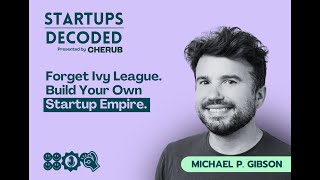
Michael Gibson, founder of 1517 Fund, talks about launching the Thiel Fellowship, which gave $100K to 20-year-olds who didn't go to college, and how that shaped his bet on unconventional founders. He backed Vitalik Buterin's Ethereum and Dylan Field's Figma, and looks for curiosity and courage over credentials.
Chapters
We're calling it the anti-Rhodes Scholarship. I mentioned I was at Oxford. I knew Rhodes Scholars. I thought they were insufferable status hounds. So I was like, whatever the anti-Rhodes Scholarship is, I'm in, on board. Then we go to Peter's house, we get in a car, and we're off to TechCrunch Disrupt, big conference. Peter decided he wanted to announce this fellowship, I think strategically because The Social Network movie was coming out later that week, give the press something different to talk about. but we're in the car and we're just coming up with what this thing is that we settled on calling it. And this was before the Forbes 30 Under 30. We called it 20 Under 20 Thiel Fellowship. The idea was to take 20 people under the age of 20 and we'd give them $100K grants. Peter announced it that day, my first day of work.
Welcome to Startups Decoded, the show that gets real about what it takes to build a successful startup. I'm Andy Walsh, 2x exited founder, strategist, and your host. Each week I talk with top founders, investors, and operators to unpack the plays that drive real traction, not just headlines. If you're building something bold, this is where you'll get the honest insights to scale with clarity and confidence. Let's keep growing together. Hit subscribe and share with your community. It would mean the world to me. This podcast is brought to you by Cherub. Cherub connects founders and angel investors. Find the tools to fundraise seamlessly. The future of fundraising is here. Investwithcherub.com. Hello and welcome back to Startups Decoded. My name is Andy Walsh. Today we're going into VC land and specifically early stage. And to help us bring this to life, I've got Michael Gibson, who's the founder and GP at 1517 Fund. Uh, Michael, welcome.
Thanks for having me on.
I had the pleasure of seeing you speak at an event the other week, and your story grabbed me in the sense I see it a lot, probably in the founder world, but people that go into certain careers and then find themselves pivoting and not just in a small way, in quite a significant way. And your story starting off as a researcher and journalist to become a GP and a VC is not probably a linear path that people would traditionally see. So to set up today's topic, which is looking at your thesis around backing renegades and what that means for a founder and for, for their companies. But to set the scene, to look back a little bit as far as how you went from that journalist role into now having your own fund.
Yeah, sure. I visit a lot of campuses and naturally enough, a lot of the students will ask me how, how to establish a career in VC. And I tell them there are like 3 main ways. The first way is that you were in Silicon Valley in the 1970s and you're still there now. You know, it was very much an insider business. You know, firms, famous firms like Sequoia and others were founded in the '70s. First investments in companies like Atari and Apple and so on. You know, some of the main players, most of them have retired, but there's been some turnover from within. The second main way to get a job, and this is probably the more likely, is Oftentimes it's former founders or early operators at a company who decide they've had enough of the hustle and they want to sit on the other side of the table and make investments. There's also some sense in which they think it takes one to know one. So founders have a certain personality archetype and former founders think they're good at that, but they do for sure have a network that maybe they can exploit to make investments, although maybe exploit's the wrong word. And then third is the way, the idiosyncratic way that doesn't make any sense whatsoever. The path I took, as you mentioned, was a try— at first I was becoming a professor of philosophy. I was working towards a doctorate at Oxford. I studied ancient and moral philosophy. I, I loved the subject matter. I still read widely in it, but at that time in 2007, I realized I didn't want to be a teacher. I, I really wanted to write, so I dropped out and became a journalist. Writing across my 20s in different publications and so on, but went full-time, dropped out, ended up at MIT's Technology Review. That was their alumni magazine that they've turned into a magazine now with national distribution, a little bit like Wired, but closer to the lab bench. And it was a baptism by fire for me into science and tech because I just told you I did not study those things, but it was a lot of fun. Uh, ended up writing a story about Max Levchin, one of the founders of PayPal, CTO, and, uh, he had gone on to do other things. He had basically eBay bought PayPal for like $1.5 billion. And this is 2007. So I'm interviewing Max Levchin and I ask him, I was like, hey, what would you do differently to your younger self when you sold the company? Is there any advice you'd give that younger person? And he said, yeah, after we sold the company, I took the year off. I traveled, I lived on a beach for a time and it was the worst year of my life. I was like, what? It's like, you know, suddenly staring at the phone, I'm like, what's, what do you mean by that? And he says, well, all my friends were out there making things and starting companies and I was just consuming. I wasn't producing. And so when I came back, I felt like I was, you know, behind and wanted to get on my way, something to that effect. And I was like, oh geez, who are your friends? And that was, it's a little, it's hard to believe, but 2007, these people weren't as widely known as they are now. So the PayPal Mafia, these people who the diaspora after the company was bought, these people created the next generation of tech companies. Steve Chen started YouTube, Reid Hoffman LinkedIn, David Sacks Yammer, Elon Musk, SpaceX, Tesla. And then they mentioned this weird, quirky, somewhat of a public intellectual, but hedge fund investor named Peter Thiel. You know, he stood out researching him. He just kind of intrigued me with his libertarian streak. And sure enough, a couple years after that, I managed to meet some people who worked for him. And they said there was an opening at his hedge fund and they needed a researcher writer. I had gone freelance by then on the journalism side. And so I interviewed, I end up in an interview with Peter. We talk philosophy for about an hour. And at the end of it, he asked me if I want to help him teach a class at Stanford Law School on philosophy and technology. So I was like, okay, this is just too cool an opportunity to pass up. I thought maybe I'll do it for a year, get some material, write something cool, and then I'll retreat, hightail it back to my apartment in the attic, in the garret where I'm, you know, scribbling away as the unknown writer. But when I showed up to work the first day, a colleague came to get me and he is like, hey, we had this idea to pay people to drop outta school and work on stuff. We're calling it the anti-Rhodes Scholarship. I mentioned I was at Oxford. I knew Rhodes Scholars. I thought they were insufferable status hounds. So I was like, whatever the anti-Rhodes Scholarship is, I'm in, on board. Then we go to Peter's house, we get in a car and we're off to TechCrunch Disrupt, big conference. Peter decided he wanted to announce this fellowship, I think strategically because The Social Network movie was coming out later that week, give the press something different to talk about. Uh, but we're in the car and we're just coming up with what this thing is. Uh, we settled on calling it, and this was before the Forbes 30 Under 30, we called it 20 Under 20 Thiel Fellowship. Uh, the idea was to take 20 people under the age of 20. You had to be 19 to apply, 19 or younger to apply. And we'd give them $100K grants, uh, for 2 years. And Peter announced it that day, my first day of work. I could tell you the exact day, September 27th, 2010. Yeah, I was just a part of it at the, at the ground floor and, and helped build the program and run it for 5 years. So that sequence of events. A little bit rambling and long. It doesn't make sense. So if I'm talking to undergraduates, that's probably not good career advice in terms of finding your way into venture capital. You know, I was like Tarzan swinging vine to vine. I found my way to the other side and have been working in, call it startups and venture now for 15 years.
It's funny you say that it doesn't make sense. But for me, I look at it as far as a, a process. And if, and if you are studying in any degree, particularly doing a doctorate, you would look at a whole bunch of research, doing a literary review of some kind, gleaning a whole bunch of patterns and information, et cetera. Which means that you're actively looking backwards and looking forwards, probably concurrently. And I think there's a, a healthy crossover there as far as how you're thinking about deal flow in your current role. But yeah, I just love the connection though, that you being an academic and tapping out to a certain degree, but that being a doorway into a career through a meeting in that research phase of interviewing for your role as a journalist. And tap in a little bit. There's so many things I'd love to be able to unpack, but I want to get to 1517 as well, your fund now. But with Peter, obviously he's an institution. Anyone would say his name along the sides of Elon Musk. You mentioned there as well, Reid Hoffman, another icon as far as legacy founders. People would just roll those names off instantly. And Peter, from what I can see, is still very, very active. And you talked there about an exit, and I had Mike Jones on from Scions, and they were behind Dollar Shave Club and Liquid Death. Again, two massive names. And we talked a little bit about how hard is it for a founder to stop. And I want to go into that question a little bit because if you all love that energy and you have that enthusiasm and you're building with ideas, the thought of sitting still and doing nothing feels like it's a worst nightmare. And people assume that they're putting their feet up, but I asked Mike the same question and his feedback was he doesn't know many people that have actually stopped. They always go back and do something else.
Yeah, the Levchin story. Was inspiring to me. I remember, and then learning about these people just taking their wins and rolling them into the next thing, putting money back on the table. That was just really inspiring. Very admirable. I think, yeah, I think when you, you love the game, it's like the, I guess there's a mastery component where people are trying to hone their craft and just attain greater and greater skill and, and maybe just becoming a virtuoso. In the same way that someone might do that with a guitar or violin. I think that, you know, that can be part of the motivation. Some people just love to win. They're deeply competitive, almost monomaniacally so. And then maybe there's just the vision and the dream, which is— I take Musk at his word when he says he wants to get to Mars and all the reasons behind that. You know, it truly is astonishing to see people keep going. I can't imagine retiring. The thought of like just quitting and like chilling out for a long time doesn't, doesn't make sense to me because quite simply it's not fun. So yeah, to meet people, I think it's not just that they go back into it, but in the case of Musk, aggressively so, is the guy just like doubled down. You know, when he sold his, or when PayPal was bought, I think, I think these numbers might be approximate, but it was something like he earned $150, $160 million. And he rolled $100 million into SpaceX, something like $30, $40 million into Tesla, and the rest into SolarCity. And apparently he was still sleeping on his brother's couch. It's like, oh my God, this guy didn't even buy a house or something. You know, he's just pushing the money in to achieve even greater things. And maybe this is one of the true legacies of Silicon Valley. I mean, I guess you see it to some degree in sports where people want to keep pursuing as long as they can. They want to win the championships. But in Silicon Valley, to have a big win like PayPal and then to do the next thing and, and try to, you know, best that previous achievement is quite impressive and really one of the engines of dynamism in America.
And looking back at that time, because Elon wasn't one of the original co-founders, right? He had X as a bank and no one really knows that history as far as Elon, because the original PayPal was different. And then when they pivoted, their focus emerged ultimately from what I understand with Elon.
Yeah, there were two sides of the, the story at the beginning. Two companies. One was called Confinity that was founded by Peter and Max. And then, you know, down the street was X.com founded by Elon. And in time they were just, they became bitter rivals, competitors, and they're just spending a ton of money trying to outcompete each other. And one day there's a famous meeting where they, they met on University Ave and Peter and Elon are like, why are we competing? We should join forces. So they ended up merging and, and it was like one of these, these tensions, polarities, and I think this is something Peter and others in the PayPal Mafia carried with them, is, is that because there were two halves of the company culturally, it created some hot friction. In fact, it led to Musk being ousted as a CEO because of his disagreements with Levchin over the code base. But on the other hand, I think it, it was one of the fuel, it was some of the fuel to the fire that pushed that team harder. So it was like you had Peter and Max recruited people from the University of Illinois and Stanford, and Musk had his, his Motley Crüe and, and I, I don't think those, those two sides ever completely melted into one.
My brain went immediately to like a Montague and Capulet situation of star-crossed lovers, but not quite in the romantic sense.
Yeah.
So good. And I always love to ask this question of a VC. I get such interesting responses, but you talked there about as an exited founder going into VC was one of those routes that you could choose.
Hmm.
Comparing the pair, do you think to be a good VC, you have to have operator/founder experience to be able to give good advice? I mean, obviously you can be a strong investor, but now the role of a VC has evolved and there's probably higher expectations. There's formal platform teams, but GPs now quite often actively support. To unpack that a little bit, I'd be curious on your view as far as how you think about a partnership with your portfolio.
Yeah, I think a couple things come to mind and I'll start maybe with the advantages. I think as, you know, a former operator or founder, someone has developed a wide range of contacts, everything from potential hires, co-investors, uh, geez, you name it, and a subject matter expert who might have insight into an issue. So I, I think they bring that to the table. In terms of like the lessons of the, of the battlefield, I'm of two minds of that. I, I think on the one hand it can be extremely valuable when it comes to high-level matters, like, you know, let's say the composition of the board and, you know, the sorts of things that you want to think about in a board meeting. Where I think it's less successful is sometimes, you know, if you've been trained up in one landscape and have developed your instincts and intuitions in that landscape, those are only good so long as the map matches the territory. But in tech, the territory's constantly changing. So you do have to be careful sometimes. Like, that's, I think one of the, that's why there are so many books books out there about how to run startups, how to be a great founder, how to be a manager, how to sell. And it's like, I, you know, I think people are getting better at the startup game, but given the amount of effort and time spent trying to pass the lessons on, I can only believe that we don't have more billion-dollar companies from reading books because the territory is always shifting and changing and every startup is unique, at least in many ways. Yeah.
Yeah, 100%. And I've seen it with my own portfolio and friends that are founders is that quite often there's a passive bias that VCs bring in. If they had experience that was 10 years old, to your point, it, it dates. And if they're forthright with their opinion on something historically, it may not be current and it can give a founder the wrong direction. So knowing what you don't know in context there is critical to be a good partner. Yeah.
And then therefore to be a good founder, it's like you always have to weigh advice, even if it's, uh, You know, Elon Musk telling you something, you always have to, you know, use your own judgment, I think, because you might get smoked if you just follow someone's advice and they have no idea about the context truly.
It'd be hard to find a founder that didn't have some kind of dead end or moment where everything was on the line. But there's no tried and tested way. If there was, it'd be a lot more successful companies out there. It's a collective of information and being pragmatic around data, your own instincts that you've learned, but also partners around the table that can help you. Have a well-rounded perspective on decisions.
Yeah. Now when it comes to temperament, I think, I think if they're later in their careers, let's say they're in their forties and fifties, maybe they have a family and they're more settled. I think former entrepreneurs get into the VC mode. I think the ones who have more ambition tend to get frustrated with it because it's very, you make decisions and the feedback cycle is years. It really takes a long time for things to mature. It's a lot of, like, people underestimate how physical the job is. And that, by that, I mean, you gotta get outta the building. You gotta go talk to a ton of people. You gotta go to a lot of events. You gotta sift your way through a lot of these conversations. And I think, you know, entrepreneurs are used to making decisions and seeing feedback immediately, having tight, like that feedback loop of like taking an action, getting the feedback, making changes. Like, I think they're used to that and better at that. And so the slow investor cycle, I think just sometimes doesn't fit founders temperamentally.
Yeah, that's interesting. That cultural difference as far as a mentality of how you operate instinctively day to day can play a role in being impatient or being hugely successful. There's quite the scale across that.
Yeah, totally.
So within that time to step into 1517, you worked alongside Peter Thiel. Who's successful in so many lanes and is part of the Thiel Foundation. That was a pretty unique experience at the time to look at investing in founders that were so young. And you see headlines now of 15-year-old kids creating companies, making money, and how blown up those stories are. I'm not going to say that they're all exactly true, but the world of startups has become so different, right? In the time when PayPal first started, really wasn't the breadth of companies, nothing near what you have now. And founders have become famous. They're rock stars in their own right. Kids look up to them as a way to, to build their own career path. So those young kids that were part of the Thiel Foundation allowed you to, I assume, to sit beside some really interesting founders. In your time with the Thiel Foundation, can you talk to any big successes that we would know that came out of that?
Yeah, uh, just this last summer, big news when Dylan Field led Figma through their IPO, $20 billion. Dylan was one of our 2012 fellows. We awarded him a $100K grant and helped him get started. So that was quite extraordinary. And geez, it's— I have the mix of emotions I think about when I consider like the whole arc from $100K grant to IPO, you know, 13, 14 years later, because it's just on the one hand, it's like magical and wonderful. You just see something, nothing turn into something. It's just truly extraordinary. It has a surreal edge to it. Because it just doesn't seem plausible. On the other hand, it's also like, hey, I just feel an enormous amount of pride and gratitude, a pride that like, oh my God, you know, this program helped him get started and gratitude that, you know, he, he loved working with us and, you know, was so kind over the years. So, you know, just really happy for him. And, and that's one of the big successes. Probably the biggest though in those early years was we helped launch Ethereum, the cryptocurrency in 2014. Vitalik Buterin is this quirky, has like a playful love of internet culture. Shirts and wears unicorn tees and weird things. But he, we met him in 2013. I knew what Bitcoin was and had heard of a blockchain, had never really examined or thought about what other potential applications there were. And Vitalik came and had lunch with us at the Teal Foundation in the Presidio in San Francisco and just, yeah, kind of really blew our minds. And he was so obviously a genius that we awarded him a fellowship and now here we are. I think Ethereum, is very much an open question about its, its future. But it's incredible to see how far it's come. As far as cryptocurrencies go, Bitcoin's gold, Ethereum is probably silver. And so to be a part of that same sort of thing, you know, Vitalik has an ethereal distant quality to him in the opposite of Dylan, who's more like a teddy bear. But on the other hand, it's like just again, surreal, wondrous to see something go from ideas in a white paper and now into hundreds of billions of value created. So yeah, really extraordinary to be a part of that.
I missed out. I got some advice, I'm going to say it was 2014, early about Bitcoin and I can't remember what the price was. It was obviously insanely cheap. And I look back at that moment, but when Ethereum came around, I was much quicker to jump on that, particularly pre-NFTs as well. Changed that significantly and that's obviously flatlined a bit, but—
Well, yeah, I had the, I had social media posts where I was pumping up the first sale of Ether and 'cause I, I was running point on the team with Vitalik, you know, I had calls with him and so on. And then yet I never bought a single Ether because the, you know, the IRS doesn't look kindly on nonprofits benefiting from, from their activities. And I didn't have a ton of, of money to to make investments anyway, but my friends did and a lot of them did quite well. But it was, it was something like, you know, this was one of the main reasons that we decided to start 1517 because we just saw enormous investment potential. The Thiel Fellowship is a grant, you know, it's limited by Peter's generosity and it continues to this day. But we saw a real investment opportunity that no one else out there was systematically looking at uncredentialed young talent, talent that never went to college or dropped out, there were these stories that everyone knew about Jobs, Gates, Zuckerberg, and so on, but no one had really used that as a, as a way to pursue investment opportunities. So we launched 1517. We're called that because it's the Protestant Reformation. That's the, the year Martin Luther nailed his theses to the church door. And what he was protesting against was the sale of a piece of paper, the indulgence. Buy this thing. Church told you you'd spend less time in purgatory or hell. So we thought that the diploma is the modern indulgence. We still think that. And to us that, you know, you don't need a piece of paper to save your soul. Nowadays, you know, there's this monolithic path to success in the minds of most parents and now their kids where they think they have to go to college to have an extraordinary or even just a happy, rewarding career. And so we, you know, the Thiel Fellowship and now with 1517, what our mission is to show that's not true. You know, we're going to deliver great returns to our investors, of course, but we're gonna do it by backing people without college degrees. And yeah, we've been at this 10 years. We've had it, we've had success. Our first fund has returned 4.5x to our investors. We raised a $20 million fund. We returned somewhere north of $80 million to our investors out of that fund. We set up side vehicles along the way. This was through Luminar, a company that went public in 2020. So that company returned something like $200 million to our investors. Another company called Loom backed, you know, those were people, 3 guys, no college degrees in an apartment in San Mateo. They were bought by Atlassian for nearly a billion, again, returning more money to our investors. So we're on our way. We're now in our 4th fund. Most of our investments are, yeah, as I said, in people who don't have degrees. The one exception we make every so often is we'll back some mad scientists, renegade scientists who have some unorthodox view within science. Um, and, and I don't know, we, we find that the personality types bear strong resemblance and that's why we feel like, you know, we're good at that too.
I love the word renegade and I think it's interesting at a time when people are building products and then you see a whole bunch of lookalikes come through soon after and it gets really diluted. And for me, a renegade founder is someone who can see around corners. They're not solving a problem that's there right now. They're thinking years ahead to be able to look at future state and forecast and try and speculate to a certain degree about where we will go in certain areas and create a future opportunity. And that's for a special few. And, and I think we need that for innovation where innovation has become democratized. I hate using the word, but it's the easiest way to describe it right now. It's never been easier to become a founder. And there's a lot of conversation happening about that. But as far as the renegade, in your mind, you're obviously with the Foundation, saw the behavior of some of these people. And I assume from a philosophical perspective, you can look at someone with a different light as far as how they think about an idea, where they come from. And not every VC would be able to listen to that and be in the same lane if they can't see data and support and, and have something that's translatable. It takes a certain kind of mind. Can you take me into that process a little bit as far as what a renegade is to you today? And, and yeah, how you spot those people.
Yeah, a couple things occurred to me. One is just the, the whole pyramid climbing challenge to get into an elite university. I mean, I'm sure you know people, your listeners know people, where the parents are worried about the preschool or the kindergarten that their kid is going to get into because that's going to set them up for success to get into the, the high school, which will then set them up for success to get into the college, which will then set set them up for success to get into the professional degree program, law, medicine, who knows. So that whole pyramid climbing race, it has this element, and this is, you know, Peter is a big fan of the French literary theorist anthropologist René Girard. Girard had this idea that humans were motivated by rivalrous envy and in the act of competing, according to Girard, the more we compete, the more we become alike. He's very interested in, in this idea of imitation and especially over some scarce good. So it's like the more you compete, the more alike you become and the fiercer the battle is. And we see this at play in that competition to get into elite schools. There are only so many chairs at each school and each round, you know, there are fewer and fewer chairs in this game of musical chairs. So what we see is like the more these young people are competing, the more alike they become. I mean, there's a superficial diversity to some of these people, but when you look at the types of things they believe or the types of things they think they have to express to an admissions committee to get in, you know, it's quite homogenous. So by stripping people of their uniqueness, we strip them of their ability to think of new things, unorthodox things. And so that, you know, in part is one of the strategies is like, okay, if we can get people off that track, if we get them interested in their own curiosity, you know, that's what the type of person we want to back. We see it at the, also at the grad school level and among like postdoc researchers where, you know, that set of incentives is just all the, you know, harsher, uh, the higher you go. So it's like, you know, you can't just claim you want to test some bold new idea. You have to, you know, in your applications, it's more like, hey, I, this professor who's already in the department, I love his work and I'm going to, you know, do my best to add the 10th decimal place to help him in his lab. And it won't be until maybe I'm 30 or 35 where I get to apply for my own grant. And by then I'm already stripped of any kind of, you know, bold original ideas I might have had. So we're very, you know, a lot of our things we do are meant to try to pull people away from that. You know, hopefully they're already off on their own. That's partly the, you know, the dropout thesis. But it's our job then to understand what are the consensus views across a lot of fields, science and technology, what, what's going on at the frontiers of science and technology. And if we have a sense, we don't have to have an expert's understanding, but we just have to have a familiarity with the consensus views. Then when we meet someone, it's our job, and we might have some idea too of like the top 1 or 2 unconventional views in that field. Then it's our job to determine, okay, we know this isn't the consensus view. Now we have to understand, is this person credible in what they're proposing on the unorthodox side? So we might meet, you know, let's take fusion energy. People have been working on different approaches since the hydrogen bomb in, in the early '50s. There are two main research programs. One involves using magnets to contain a ferocious hot plasma. The other is to shoot lasers at a pellet so it implodes. And so when we meet someone, we met this guy, Jake Levitt, he's a quantum physicist working on a company called Cortex Fusion. His proposal was neither of those things. So immediately we were like, okay, this is interesting. He's a PhD dropout. He was frustrated with the bureaucracy of science in the academy and, you know, the incrementalism. And so he proposed this idea based on his work in quantum mechanics and lasers to use lasers in a different way than they've been used before to spark a fusion reaction, and we, we were excited to back him. So it's our job to understand that landscape, and then it becomes about who is Jake, who are, who is this scientist beyond the scientific theory that they're proposing? Like what motivates them? What's their character? Do they have what it takes to, to push something through in, in the most unforgiving circumstances year after year? How do you sustain that? And, and it takes a special type of character. So, you know, a lot of our time is spent trying to evaluate that. More than what school this person went to, who else is investing, what's our view of the scientific theory. Now it's like, it's more about, you know, finding those, those people who are unconventional and then seeing, you know, are they crazy or are they crazy awesome? And sometimes it takes time to distinguish between the two. And we'll, we'll sometimes make smaller investments too. It's like maybe we can give $100K, try something out over 3 months, run an experiment. And if you hit that milestone, then we can follow on with more. And there's no better way to see if someone can play the game than seeing them out on the field. I like running the Thiel Fellowship. We started with applications and it's just, you know, as I said, they start off like fresh and then they rot pretty quickly because the information changes and you don't really, it's such a snapshot. You don't really get the essence of who someone is.
This podcast is brought to you by Cherub. Cherub is an AI-powered investment platform. Matching founders and angel investors. The future of fundraising is here. Delightful data rooms, diligence, and deal flow. Founders, get your application fast-tracked. Use the word decoded. Invest with cherub.com. And the whole focus on the traditional academic path and Ivy League, I had a neighbor and they literally had a consultant that helped them go through the path from when their kids were born about the right lessons, the right schools. And they actually ended up moving house because the street they moved to helped them increase their chance by whatever percentile to get their kid in like the right piano teacher, the right feeder activities, et cetera. And you get to a point and my daughter wants to go to a performing arts high school and I've done my own review on various LLMs. To be able to look at the questions that they ask, how they assess it, the feeder activities. And it's so easy for me. That was probably like 10, 15 minutes of research.
Yeah.
To have that information. So all of a sudden, you're right, we're creating these clones because they all have to come into it thinking the same way to a certain degree, following the same path. So how is that driving innovation? It's not, right? It's almost feels like the opposite. And then for you, I would love to know, like, are there any patterns about the person? You talked about how you assess them as far as where they've come from. Are there special things about them that you could put onto a sheet of paper, almost like a checkbox?
One is an intrinsic curiosity, but this is not just like one standard deviation or two. It's like 3 or 4 out there. I think of Vitalik, you know, his, his just like this guy was constantly learning. I saw him learning Mandarin. On his phone so he could communicate with Ether developers in China. You know, it's like LeBron James. If you saw him at 18, the guy looked like a grown man. He was just like tree trunk muscular legs. And, you know, I forget how tall he is, 6'7" or whatever. People are like, wow, that guy can play in the NBA. And moreover, he's nothing like my 18-year-old cousin who just started college. Think of it that's the same way when it comes to like this attribute of curiosity, intrinsic curiosity. The person has just like been an autodidact. Running 2-minute miles, learning the subject on their own, independently of trying to impress a committee or win some prize. So that's something we look for. It can come out in different ways. Obviously the stories about what they're interested in, but we also hear it in the voice. This is a very in-person quality where we call it hyperfluency, where someone can speak fluently forward and backwards about their domain. Of expertise. They can talk about why past efforts fail. They can talk about what they're going to do differently and why it's different now. They know the idea maze is a phrase that's out there, which is like just the history of the subject. And then what's more is they just have a breadth and level of detail that is so impressive and they can scaffold everything so that they can talk. Great communicators, clear, concise. They can speak to people laypeople, non-experts, or they can, you know, rise up the scaffold and, and go head to head with someone who's a 20-year pro in that field. And we hear it in the voice because there's an excitement. There's a, uh, just like a clear passion that's burning underneath it, bubbles up in certain ways. Um, and, and the only thing I can compare it to maybe is like the way a fastball hits the mitt and a, and a baseball scout might be able to, you know, they know that there's some zip on that fastball. Even without here, you know, needing the speedometer to measure the speed. So we look for that. I wrote a book called Paper Belt on Fire. I take a whole chapter where I try to distill some of these character traits of founders. I mean, one of, some of them are just straightforward. One is just like l'audace, l'audace, toujours l'audace. You have to be courageous and daring. And you know, you can't demonstrate courage on an application. So if we can see people in action or, and we love to meet people early, even before we invest and if they're executing out out there taking risks and doing really impressive things. And that builds our confidence that we're in a position to make the investment. Peter used to say courage is in shorter supply than genius. I think that's true. And so to meet someone who, and maybe it's the vision, maybe it's because they're excited to do something with their friends, the adventure of it. I don't care whatever it is, you know, someone, some people just have a courage to do things. And I wish we knew how to cultivate that because if I think of it, it's so funny. It's like, I can't imagine courage being taught in school. So hard. It's like, what would you do if, you know, if you have a class on disobedience, it's like you fail if you show up.
That's so good. It's so good. I, I think trying to spot that person is fascinating, right? Because they need to see the world through a unique lens. And I've heard stories of people that even challenge their own process of thinking, study something completely random that doesn't actually help them. but just allows them to look at frameworks and process and knowledge base. And it could be even Eastern versus Western thinking. Like there's things that instinctively help you to reframe your own thinking and that kind of person who is actively challenging themselves and that curiosity in a different form that has such a direct flow and effect to what they're doing.
Yeah, that's part of that curiosity. It takes them into other branches of knowledge that may have no bearing. On what they're working on. So like, you know, people, they're often some kind of polymath and, and it can, it could be odd. It could be really odd. And, and that's part of that, like the uniqueness of people too. It's like I find that college admissions process, grad school admission process, you get punished severely for having bad views. It's like you could, let's say someone had 10 views on 10 different things. You better be within the normal range of all 10. To get through that filter. But the interesting thinkers out there, they might have really unusual views across all 10, but like 3 of them are in subjects and about things that actually might get them tossed from the application pool. But that's not the ones we're concerned about. We're concerned about the 2 or 3 that are right. So it's like you get this weird snowflake thing shape where it's like, if your filter isn't accepting those weird shapes, you're not not in the service of science. And so yeah, we, we, we see these people, they're polymaths, they have strange views across different subjects. And, and I think it, it does fuel the creativity. You know, every so often a lot of great ideas appear because it's like you're taking two sources of knowledge and, and seeing where they can combine in interesting ways.
There's the famous story, and I don't recall his name, of the Indian mathematician that hadn't studied at all right through school, and then somehow came across some really like deep mathematics and saw it in a way. Yeah.
Ramanujan.
Yeah.
Incredible story. I mean, he reinvented the wheel, which is kind of wild. It's like there was, you know, he, he derived proofs, proofs that like, you know, Western mathematicians had come up with, but he didn't know cuz he wasn't in touch with them. And then on his own, he also had other things that were quite novel.
Yeah.
Really fascinating figure. Operating alone and, um, and, and made his way to Cambridge for, for a period of time.
And I think it was David Epstein, whether it was his research or someone else's, there was the whole notion around 10,000 hours to become an expert, which has now been disproven. The way that the research was presented actually kind of skewed the results because the people that they were testing were already semi-experts anyway, and the sample wasn't balanced. But, but I think those kind of people Well, David Epstein.
Yeah. His book. Oh God. What is it called?
Range.
Not range. Range is great. I love range.
Oh, the first one.
Yeah. The first one is something called like The Sports Gene. And one of, one of the things he explodes is the 10,000-hour myth, because there are just some people who are born perfectly made for the sport that they're operating in. There's a Scandinavian cross-country skier who miraculously had this ability to process oxygen in his blood at higher rates. You look at at, you know, former basketball players becoming high jumpers. It's like these, these people did not have the 10,000 hours. It wasn't the same thing. And then I, you know, this idea of like the 2-minute mile, I feel like we haven't had a breakthrough in education where learning is defined as, you know, improving on some dimension that matters to you until recently. I think, you know, we saw like, it's wild. The history of education is like the dark ages is like, you know, all these ways they think people learn in fact aren't were quite good at transmitting knowledge. But one study that was always tantalizing was this guy Benjamin Bloom conducted a study of one-on-one tutoring and it just far surpassed the ability of other methods like lectures or seminar rooms, you know, to improve student performance. But the issue was how do we get a tutor for every person? We don't have enough tutors. It's very expensive. But now with AI, we're starting to see some breakthroughs in this area. It's very tantalizing. And promising. There's something called the Alpha School, which evidently, apparently some of these students are learning at, you know, 3x to 5x the rate of the typical student their age. And what this involves is not a teacher, but a guide matched with AI self-testing and help. And apparently they spend like 2, 3 hours a day on a subject and that's it. It's not like a 6, 7-hour day of school. So, you know, someone called that the 2-minute mile. And I think we're going to start to see more of this, which would definitely blow up the 10,000-hour rule. You know, that's K through 12. God, I see it a little bit in the, in the university and grad school setting, but it's really going to be wild once we start seeing people mastering some, some of the most difficult subject matter in their teens. And then they're ready to innovate in their 20s. Like this was one of the big problems of the last century. A lot of great research. Benjamin Jones at Northwestern showing just like this delayed start to scientific careers got stretched in, in the 20th century. Like people got their PhDs at 23, 24 in the early 20th century. Now it takes like 7, 8 years and you're 30 by the time you get it. And that would be fine, but it's like we have a window in our lives where we just seem to have more creative potential than, than later on. Sadly, you see this in like rock stars. It could be life. It's like, you know, maybe you just get rich famous and have kids and so on. So you're not as ambitious as you used to be. But people just don't maintain the same level of productivity into their 50s and 60s as they had when they were like 20 and 30 with the name to, you know, trying to stake their fortune and make their name. So because of that later start, we just saw, you know, part of the reason there's fewer innovations is because those scientists were starting their careers so late. So now with this new AI-enabled one-on-one tutoring, call it what you will, mastery learning, competence learning. I think it's really exciting to see what comes out of that.
For me, I look at, I've mentioned my daughter's in middle school and there's also the social norms as well, right? I feel like it's got younger is you become aware of what's happening around the world and you start to normalize to a certain degree depending on strength of character to fit what's around you. So that homogenous thinking as well can squash people. So having an environment that's unique as a child growing up, up, I would assume goes a long way. And there's a, actually an interesting story I know of a guy, he's actually Australian as well, and his parents were anthropologists and they lived with a headhunter tribe in Borneo for a few years. And just his perspective in the world is wild, right? Because you grew up with people that were literally living off the land and they would have turf wars of sorts with other tribes and his experience of education with his parents. And it's just fascinating, but he's such a unique individual and you just see it in the way that he looks at the world. And he's a guy that actively leans into failure because he's like, I'm gonna try because if I fail, it's gonna be funny as hell. But if, if I pull it off, it's gonna be so amazing. And I just love it as an attitude.
That's another trait we look for is just, do you have comfort in discomfort? And that could be like, are you comfortable worrying about a puzzle over years at a time or being in the hot seat or having deadlines? It takes a, there's a certain type of personality that can take that. I think we can learn, but, but yeah, that's really special. And then the other thing that stands out to me, it's like the Galápagos Islands. Why did Darwin see the differentiation in species? It's because there was some isolation across the islands to allow these things to develop. I think of this, we started our conversation talking about music, and one of the worries I have is just how homogenous music is now, popular music. It's like, could reggae come about anymore? Even like grunge out of Seattle. Seattle. I feel like in an era when everything is just broadcast immediately on the internet, everything just gets copied at once. There's not a lot of time for local taste to develop and, and seek its own thing. I, I don't know, maybe it's like in the old days, it's like I learned guitar from my neighbor and he learned from his neighbor. And so there's like a vernacular and style that develops concentrated there. Whereas now it's like everyone's probably learning the same stuff on the internet. So it all sounds the same and it's soulless. And I think that applies to science. People, you know, science is objective, theories are universal. So it seems to be the case that, that nations don't matter. But yet scientists will tell you like there are styles to science. Like Italian physicists are very different from German physicists. They just have different styles of thought and that gives them a different set of techniques and tools to try to crack open the secrets of the universe. And I think we gotta go back to that and maybe we will with, like you're saying, is like, you know, maybe if you're not exposing yourself to, you know, the mass thought in different ways, you'll have the space to cultivate your own views on things.
I think the world needs a lot of that thinking more than ever. And so what you're doing, I guess the people that you're investing in rather, high-risk companies but a high reward. For you, you ultimately have to be in the same boat to be— the VC game is obviously high risk already and the returns are a very small percentage make it and drive the bulk of the fund returns to the LPs. So you've got a lot of people's capital and expectations at stake, but you are taking high risks. For you managing those expectations, how do you build confidence in your investors into the fund?
It helped that we had that track record of the Thiel Fellowship. Like in, if I had tried to raise a VC fund in 2010, No one would've given me money with good reason. So it's like we had that practice of working with founders, developing our pattern matching abilities, and that really gave us that credibility to those first wave of investors in our first fund. As we've matured and grown as a fund, then it's just performance-based over time. And investors above all want to see you drive returns. You need to perform. They want to be in line with the mission. They want to understand what separates from other VCs, but also what, you know, how are you gonna outperform all the other ways this person could invest their dollar? That could be in public markets and bonds, even buying real estate or gold. You know, you gotta show that you're gonna drive a return. And so over time it becomes less about that story and just more about like, okay, are you guys doing a good job?
Yeah, it makes sense. And to finish up today, it would be very remiss of me if I didn't ask you, for people that feel like they're there running navigates in there playing in a different lane than everybody else, how do they reach out? How do they get their deck and get a meeting with yourself?
So I, we have a website with a form you can submit. We read it, Danielle, me, and a couple other full-time employees. So that's just 15centfund.com. I'm on X as @WilliamBlake because when I was a tech journalist in 2007 and Twitter was started, I was like, what is this thing for haikus? So I, I, I started, I, I had my handle as the poet and my name is so generic. Was eventually taken. So I, I've just kept with that. But you can find me, I think, Michael P. Gibson as well. And, and I interact with people on socials all the time. So find me there or just out in the world. I, I go to different conferences and so on. We, we try to be as accessible as possible. And do check out my book, Paper Builds on Fire, if you're at all interested in, in more color of what I've touched on. It's a behind behind the scenes account of what we do and working with Peter Thiel and running the Thiel Fellowship.
And I'll put all those links into show notes and on my content and website as well. So that will be easily accessible. But Michael, this has been such an insightful chat. I so appreciate the front row seat.
Okay, cool. Thanks for having me on.
Thanks for listening to Startups Decoded. If today's conversation helped you think differently, share it with a founder in your network, and don't forget to subscribe for real-world startup insights every week. We really value your support. If you're interested in partnering with us, email hello@startupsdecoded.com. I'm Andy Walsh. I'll see you next week.
More from Andy



EP#88: Why Most Founders Misread Their Own Traction. Vanessa Larco - Premise VC

EP#87: Founders Obsess Over the Raise. Investors Care About This More. — Carina Cunha






Ep#86: Early Decisions That Define Your Startup Forever. With J.P. Morgan Asset Management
