Literati Book Club | Greyboy: ATA w/ Cole Brown and Lynae Bogues
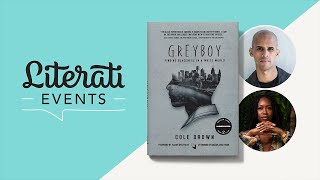
In this Literati Book Club livestream, host Lynae Bogues interviews author and political commentator Cole Brown about his essay collection Gray Boy, which Stephen Curry selected as the April 2021 pick. The conversation weaves through the book’s origins, its central themes of Black tokenism, the "gray" identity, double consciousness, and navigating white‑dominant spaces. Brown explains how a college entrepreneurship class prompted him to write the book, the four‑year development process, and the importance of community (the "Black Table") for Black youth in predominantly white schools. They discuss practical advice for multiracial families raising children, guidance for younger Black readers seeking belonging, and the painful label “not really Black.” The dialogue moves to the post‑Trump era, reflecting on learned lessons, hope, and how Brown maintains friendships across political divides. They examine the chapter on interracial dating, the challenges of representing Black women’s perspectives, and the backlash over a passage about benevolent racism. Brown shares the upcoming TV adaptation with Yara Shahidi’s Seventh Sun production company. The conversation also revisits a pivotal personal incident (“The Reveal”) when Brown was called the N‑word on a soccer field, how his response has evolved, and broader reflections on systemic racism, policing, and the emotional toll of being a token Black person. Throughout, Bogues and Brown exchange personal anecdotes, critique societal expectations, and highlight the need for broader conversations about Blackness, identity, and community.
Chapters
Hey, everybody. Thanks so much for joining us here on today. I'm so excited to be sitting here with Cole Brown. Thank you for everyone who is joining us today, especially from my channels, Cole's channels, but specifically the members of Stephen's Literati Book Club. I'm going to be stumbling over that all evening. So sorry. My name is Lenevony. I'm a poet. I'm a content creator, and I'm an influencer. And most folks know me from my Friday IGTV series, which is called Parking Lot Pimpin', where I pull the world into my parking lot every Friday, and I spill the tea about Black history and Black progression and social issues. I've got a master's in African American studies, and the people just kind of like the way that I relay the information. And this awesome human being on the other side of the screen is Cole Brown. He's an author and he's an amazing guy. I met Cole a couple of months back when we got the opportunity to do a panel for HBO's Exterminate All the Brutes. And there, he moderated as myself and another talent kind of went over the themes of the film. But today, I'm so glad that we get to focus on Cole and his genius and his amazingness and his creativity and specifically go into the themes of his book, "Gray Boy." So Stephen selected "Gray Boy" as his April pick, and the people loved it. So we're so glad that Cole was able to join us today and get deep into the questions. He's answered a lot on the Literati app, but we're going to allow him to expand on some of those thoughts that he's had. "Gray Boy" is a collection of essays, some strictly about Cole, some about Cole's friends, kind of navigating this Black purgatory. He's giving voice to the Oreos, the tokens. He uses the word token a lot through this book, and he's giving such a perspective that me as a Black woman who is, I would say, unmistakably Black, but Blackness is not a monolith, but who doesn't really get challenged in these ways, a new perspective. I'm very aware of this issue. A lot of mixed people talk about tokenism. They talk about being in the gray area, not really being able to fit in any different space, but reading Cole's book really gave me a perspective that really challenged my own thoughts about how, how even Black people can play into this space that makes it really difficult. You know, I feel like after reading his book, there was another layer of intersectionality thrown in that we get to see and view and really dig into from his gaze, and I just thought it was such an exemplary representation of Du Bois' theory of double consciousness. And I think people can go look that up if they want to, but I want to give you an opportunity to introduce yourself and we can hop into these questions. So take it away.
Thank you so much. What an incredible introduction. First, I should say, just the first thing that struck me about all of that is that I am, as you know, a big fan of yours. And I think that you are incredibly insightful in all of your parking lot pimpins. So to say that anything that I wrote challenged you is a meaningful bit of feedback, so thank you for that.
Yeah, no problem.
I also, just as you did, need to thank, one, obviously Stephen Curry, and then two, Literati. This has been an incredible journey, one, Gray Boy, but then just my involvement with Literati and Stephen has been remarkable. So I so appreciate the support that they've shown. I am Cole Brown, as you mentioned. I'm a writer. I'm also a political commentator. I wrote Gray Boy beginning when I was a junior at Georgetown University. Took me 4 years to complete, published it September 2020. And you used the term Black purgatory, which is one that I have never used before, but am absolutely going to steal from this day going forward.
Absolutely.
But I think that you encapsulated it perfectly. It's the experience of growing up Black in white spaces and negotiating with what a Black identity means when you don't see it reflected in your sort of immediate surroundings and environment. It was a deeply personal book, as you saw, but then also mentioned several of my friends and some of the struggles that they've had as well, trying to create a cohesive narrative around this experience of being a token Black kid. So I'm excited to jump into it.
Yeah, yeah, and I think you did an excellent job of that, and what I really enjoyed— I don't want to say enjoyed, but what I thought was so cool about it is that it was coming from a Black kid. I think most people focus this plight on the mixed individuals or racially ambiguous individuals, but no, this is a Black kid and we Black kids from the suburbs definitely experience this type of banter from our social groups, from our parents on a regular basis, but obviously it's on varied levels. So I'm gonna hop into the questions. The first one is about the writing process.
Yeah.
And we have, and to my people who I am shouting out, I want you to know I'm reading your questions, but if I pronounce your tag wrong, I'm so sorry. Marllana789. She wants to know what made you want to write this book?
That's a good question. So I mentioned that I started it when I was at Georgetown. It was actually— it's not that I wanted to write it, it was sort of thrust upon me. I was in an entrepreneurship class, and the teacher was sort of disenchanted with teaching and decided for his last semester he was going to have everybody write a book. His version was sort of half or really a third of what "Bray Boy" ended up being. And it was supposed to be about a business. But the second that he told me just the number of words we had to write, I knew it had to be about this topic. This was one that I had been, in one way or another, kind of writing about and certainly thinking about for much of my life. And it felt like this was a story I just needed to get out in a more formal way. So I spent first semester junior year writing, you know, what would end up being kind of the seedling of "Grayboy." I signed to an agent, second semester junior year thinking that I'd be a published author by the time I graduated. And then anybody that has ever written a book knows that that is just not how things often work out.
Yeah.
I had to develop, one, as a writer, but then two, the story needed time to develop and sort of deepen as well. So 4 years later, I was finally able to bring this thing out.
Mm-hmm, yeah. And I don't know where your skills started or where they finished. I was like, man, I believe I read half of the book just reading because I read some of it on the flight. Went to audiobook and even listening to the narrator, I was like, man, like, the prose, the amount of prose that you put into these descriptions just made everything come to life, and it was just amazing. As someone who I think stopped, right, stopped writing because I didn't want to do all the writing that it entailed, um, yeah, yeah, I just, I'd have such an appreciation for your talent and your skill set.
Thank you, thank you.
So getting into identity, belonging, and the gray, Sindac would like to know, what advice would you give to a multiracial couple who are raising children in the current environment?
Man, that's tough. One, I think that I should say, you know, as you mentioned, I'm not multiracial. So I'm sure that that comes with its own bag of challenges that I am not privy to. I can speak to the experience, obviously, of growing up Black in a dissimilar space. I'm also not a parent. But I think that that comes with a few things. One, what was incredibly important to me was finding a sense of community. There's a chapter in the book called "The Black Table." And the Black table was my community. It was the literal lunch table in the lunchroom where all the Black kids sat. I floated through much of high school largely unmoored until I found those guys. And we could commiserate over— operating in that space in similar ways. So I think community is important. And as a parent, you can hopefully foster that for your child.
Yeah.
Two, and I was just talking to somebody about this recently, actually, is that like not everybody, not every environment is for everybody. You know, I was placed in a private school environment that I think was aspirational for my parents and for most parents. But I also witnessed, children that probably didn't belong in that environment go through it. And it can, if you grow up around dissimilarity, it can be damaging to your self-confidence. It can be damaging to your morale. So I think that the advice there is only that every child is an individual, and that needs to be taken into consideration, you know, when making major decisions.
Yeah.
Again, it almost sounds grandiose for me to be giving parenting advice, but that's what I have from the kid perspective.
Yeah, no, like, I mean, and that's dope. And I think our next question actually allows you to, I guess, get a better hold on answering that.
Yeah.
Because you'd be talking to a younger you. Aviator said, what advice would you give to those who have yet to experience belonging? What would the today you say to a child you in regards to identity and finding a sense of belonging?
Yeah, another good question. I think that when I look back at the child me, and obviously I, in writing this, I thought about that stuff a lot. You know, like, we don't often, You get to a certain age and you just stop thinking about high school. Life moves on. I was able to spend some real time with my formative years and think on them. Number one is just that high school is temporary. I don't think I realized that when I was in 9th, 10th grade.
Yeah.
You know, there's a chapter in the book called "Bad, Bad, Not Good" where I talk about depression and some of the more difficult moments in my life. I think in that moment, I would have— it would have been important for me to hear that this too shall pass. And I think about that in middle school. I think about that in high school. I think that you just lose sight of the fact that life moves on and it does get better. But then, too, exactly what I was saying a moment ago is that finding community. And how do you find community? I think there— it requires some intentionality, right? Like, it requires— One, on the part of my parents putting me in situations where I could find people that, you know, looked like me. I talk about groups like Jack and Jill, which for all of the many criticisms, and several of them valid, about groups like that, put me in contact with people that were like me in many ways.
Mm-hmm.
Same with the Black table at school. So I think that that's important, just being intentional about seeking out people that are similar and seeing if there's something there worth, you know, worth bonding over.
You know, I'm listening to you answer the question. I'm thinking of some of the thoughts. I'm kind of usurping this from the book club for a second.
Yes, please.
But I was thinking about some of my thoughts listening to you navigate your high school years. And even when you talked about how hard it might have been in certain conversations at the Black table, even then when it came down to relationships, the trump card, you said, is that they could always talk about you liking white girls.
Yeah.
Even when it came to Jack and Jill, not necessarily wanting to be around your parents' friends, but those still being kids you can find commonality with.
Yeah.
So— and I'm just thinking back to my years as a teenager. People could say anything to me. They could tell me, "This too shall pass," but I wouldn't have really been able to digest that. And just so— how— maybe you weren't, maybe it was just— something you just had to continue to push through. But what would you think that you could say to a younger Cole that would allow him to absorb where he was in that moment? Even if it doesn't feel like it's going to pass anytime soon, like, what tools do you think you could give him to still push through with some type of optimism?
Um, man, that's hard. I—
I know.
I think that I— and this is not a uniquely token or certainly not a uniquely me phenomenon. I mean, like, you're at that age and you struggle with self-confidence, with self-image, with understanding self-worth. What I think deepens that struggle, though, is just not seeing yourself reflected. Is, you know, Blackness was not a beautiful thing in the minds of many that I grew up near. So, I mean, if there— I don't know how best to communicate to this— to someone so that they sort of take it to heart. But if there is a message worth communicating, it's that it is beautiful. It's that it's a beautiful experience and one that is— and just like physically beautiful. Like, you know, like, I think that that's something I would have needed to hear, that I was, you know, not just sort of by virtue of my heritage, but I am physically beautiful. Yeah. I think that that's something that a lot of Black kids don't hear.
Yeah.
So I think that would have been important to take to heart. I think that that's so much of my self-esteem and many others' struggles on that front alone. You mentioned the word usurping. I'm now going to usurp for a moment.
Okay.
Because I have a question, and it just occurred to me, but this is important to me. I have a question that I need to ask you. You mentioned the chapter on relationships.
Okay.
And for those that haven't read the book yet, the book is several essays dealing with different topics. One is on relationships and dating. And you will have seen, Lene, that I endeavor to include the Black female perspective in every chapter. Mm-hmm. Yeah. I try to create a cohesive token narrative. That is not the case in dating. In dating, it's largely my experience and the experience of one— a friend of mine. And that was intentional. I tried to figure out how to include it, and I just couldn't. It didn't feel authentic to include something that I am in some ways diametrically opposed to in that chapter. I guess two questions. One, what, if anything, did I miss? How did I screw up on that, on the discussion of dating? And two, if you were to write that chapter, what would it look like?
[SPEAKING SPANISH] You know, I thought about this and I, I had my, my— I had my first, um, you know, obvious inclinations of how I thought about the subject matter. But as soon as I got into the chapter, I kind of took all of that off and I listened to you speak about it because I think it's very important. There are valid criticisms— there are valid concerns, I should say, about interracial dating that I think you pull a couple of those to the forefront that Black women have, and for myriad reasons, we're not here to talk about systemic oppression today.
Yeah, yeah.
But I think that— I think there is also something to be said about love being love and allowing that to have room in conversation as long as it does not overshadow the valid criticisms and/or concerns. So I didn't think that you got anything wrong, per se. I just— I listened to you, and I was like, OK, understandable. But just me knowing the things that I know about life, and you even speak to it about the one moment— I'm not going to say the one moment because I don't know of all the relationships that you have. But the one that you did speak of with the Black woman and how there was— or maybe that was the friend. There was a juxtaposition of a relationship with a white woman and a relationship with a Black woman. Yeah. I think her name was Kara, was the Black woman, and she was just making—
Yep, that was me and another friend, yep, yep.
Okay, okay, but just there was a sense of home you found in her. There were so many different things that you could breathe easier in. You didn't have to have conversations about, you didn't have to have these roundabout dialogues to get to a point with this person, and it's not just about conversation, it's not about dialogue, it's about community.
Yeah.
Within romantic relationships. So, you know, I think you offer great perspective in the realm of you love who you love at the end of the day. But I also think you gave the counterargument without necessarily bashing people over the head with it by saying, like, this is the reason I find this problematic, or these are the two different types of experiences I will have as a Black man loving a Black woman, or— white woman, you know, so I didn't really have too many negative opinions on it, and that was intentional, you know, that was a moment for me to open up and think.
So, so a bit of context, and, and I, I don't know whether I mentioned this a moment ago, but obviously the chapter is about largely interracial dating and, and the complex politics of interracial dating. And, um, and I struggled in part because that is so different for— from the male perspective than it is from the female perspective on that particular topic. I got to tell you, Lenee, I wrestled with that chapter longer than any other chapter in the book. So I'm happy to hear you say you don't feel like I failed on it, because I really—
Mm-hmm.
I think that there were— communicating that love for Black women while simultaneously, as you said, having genuine emotion for women that aren't of the same race at times was a difficult thing.
Yeah, and I think what's also real about that is how you grew up. Like, the people you're gonna be exposed to to develop romantic attraction for are gonna be people that you are developing with, you know? And if you happen to be around a fairly diverse or largely white space, like, it's gonna happen, and you have to give people room for that. Like I say— like I said at the beginning, Blackness is not a monolith, and neither are Black experiences, and neither are the way Black people engage. Their experiences, and their surroundings.
Absolutely.
So I think representation is key, you know? So that's how I went into it. And I think also, like you said, you do your best to put a Black woman's perspective in it. Even when you were speaking about the friend of yours whose mother knew prior to him finding out, prior to him making these revelations, she already knew what he would find in a Black woman. That he wouldn't find in a white woman. And while she might have had a less open perspective on it than I do reading, or I did reading your chapter, I think you did a good job as far as giving context to the Black mother, given the, hmm, or the questions of—
Yes, yes.
There's not a Black woman you can find. I think you did great giving context to those things as well.
Thank you.
So yeah, no problem.
So I'll give it back over to you. This is your show, sorry.
Okay, okay, no, all good, all good. So I'm going to go to a more general question from the book club. It says, in regard to this idea of not being Black enough that you and many of your friends and characters in the book face, what do you think of that label and what does it say about the people who use it?
Yeah, I hate that label. There's a chapter in the book called Not Really Black. And, um, it's about that phrase, "Not really Black," and hearing it so often in youth, uh, that for one reason or another, I was not really Black. Um, I talk about in the book that I grew up in Philly in the early 2000s. If you grow up in Philly in the early 2000s, the biggest person on the planet was Allen Iverson.
Mm-hmm.
And he was a god for us. You know, I was at an all-boys school in, like, '05. Um, and he's a big deal. And, um, and I'm at an all-boys school where I am, you know, one of, if not the only Black person in all my classes. All of these white people have one point of reference for blackness. It's Allen Iverson. I loved Allen Iverson, but I was totally dissimilar, my experience was totally dissimilar from Allen Iverson. And I think that their immediate reaction, therefore, was to say, "Oh, you know, you're not like, you're not that black, and therefore you're not really black." It goes to exactly what you're saying in terms of blackness being understood as a monolith. I think as you get older, what really frustrates me is that so often people will pick out traits that they see as positive in me, the way I speak, the way I dress, the way I eat, whatever it might be, and say because I contain that positive trait, I am not really Black. Well, if you're saying that, then you are saying that Blackness must therefore necessarily be the negative traits. Mm-hmm. And I think that people say that reflexively and have so adopted, you know, this monolithic understanding of blackness that they don't even understand what they're really saying when they use those words. So it frustrates me. And the book was in so many ways an attempt to add a layer to our understanding of blackness, that this too is blackness and it's just as authentic as any other.
Yeah.
So yeah.
I think just a funny story, my— this question I wanted to ask you because it did make me take a look at myself because I've never— I think I've gotten that phrase, you know, just being one of those kids that was in the advanced classes, you always have the friends like, "Why are you talking so white?" Or that, "There you go being Sididi," or, "She's going to the AP classroom," or whatever, what have you, have those things. But I myself had a similar experience where I was on the other end of that When I started my master's program at BU, and I was the only student in the master's program, but there were students in a minor program in undergrad that were always around. They were kind of like my community because I was there by myself. That's usually not how a cohort works.
Right.
But I just remember sitting in an office with them one day, and we were talking about something, and I said, well, you win some, you lose some, but you live. You live to fight another day. And I could tell By their reaction, they had no clue what I was referencing. Did you catch the reference?
Yes, I did. I did, damn it.
I could just tell, I was like, do you know what I just said? They were like, um, no. I said it was from Friday. They said, oh, I've heard of that movie. And I was like, you've heard of it? What kind of blasphemy is this? What kind of blasphemy is this? But I took it upon myself to like breathe for a moment and be like, wow, so this is what they mean when they say there are so many different kinds of Black people. Being at HBCU, I met people from all over the globe, but there was still sort of like a down-homeness that we could connect on. But I'd never met Black people that I couldn't connect with in that way. And so, you know, instead of allowing it to disconnect us, I actually had a moment where I said, well, guys, you're going to come to my house, we're going to watch Friday, we're going to watch Set It Off, we're going to watch The Wood, and you guys are going to get a lesson.
Yes.
But yeah, yeah, I think we should— I think we should take inventory and make more room for there to be bigger conversations about blackness and all that it can entail.
So true.
So hopping back into the questions, these are about like the ending of the book and your thoughts of the future. Deckon Books wants to— wants you to reflect on the post-Trump election years. Do you think we learned anything? Did anything give us hope? Did you find a way to talk to and connect with his supporters? That was interesting.
But— Yeah. I am, of course, interested in your answer to this question. I can give mine first. I— Post-Trump years, did we learn anything? I certainly think we did. I don't know that this is connected to the question of hope, though. I think that many of the things we learned were negative things about our country, you know? I think that I learned the depth of bigotry and anti-democratic sentiment that still exists. In this country, and not only exists but is in many corners of the country thriving, you know, is the dominant culture. So that— and that's something we're still wrestling with and will. But I think that, you know, particularly in the post-Obama years and the myth of post-racialism, there might have been a lull where we believed that we had overcome so many of our worst instincts. That is clearly not the case. Mm-hmm. Cause for hope, I wrestle with that, because I— and I think I write this in the book, that the election in 2016 taught me not to hope for hope's sake, that hope needs to be rooted in something other than just hot air.
Mm-hmm.
And, you know, if I look for, you know, evidence that there is something to be hopeful of, I think that, you know, the multiracial, multiethnic, hordes that were spilling out into the street last summer in response to the murder of George Floyd. I think that that's a cause for hope. But I will be honest, my hope is tempered by, you know, so particularly just the anti-democratic moves we see. I mean, you know, voting restrictions and just rhetoric around people that look like you and I. That's deeply concerning to me.
I—
And then have I found a way to befriend people on the other side of the aisle? I am actually one of probably the rare people in this country for whom the answer is yes. Believe it or not. Withhold judgment for a second.
OK.
I, you know, I grew in an environment, as we've discussed, where, like, where, you know, people were largely dissimilar to me. Many, many, I mean, people that I held dear, you know, once we grew into an age where we developed our own independent political opinions, several fell on the other side of the aisle. I wasn't prepared to disband all of those relationships for that reason. What I will say, though, and this is a major caveat to that, is that, and I write about this in the book, there is an extent to which support of Trump, but also his rhetoric, speaks to your view of me, speaks to your view of diverse peoples. Mm-hmm. And to the extent that that is true, those relationships have suffered. I haven't cut friendships off, but I am not as close with people who I feel must necessarily view me differently because they are so quick to support someone who is ready to cast aspersions upon me and people that look like me. So that's my full long-winded answer. I'd be interested to hear yours. Yeah.
Before I get into mine, I'm not surprised to hear your answer because I do, I think you mentioned more than once in the book that the people who voted for Trump were people that you grew up with, people that were your friends at some point in time, whether they stuck with you or not. So I can imagine that you would have had more integrated circles in that way to have to navigate after this. Me, however, I didn't really grow, I didn't, I'm not even going to say I didn't grow up in those circles, but for whatever strange reason, because I say this to anyone who will talk to me about it, my parents did not ingrain racial awareness into me. They did not speak to me about it. It was literally something that I picked up on and I figured it out.
I was going to say, I would not have known that.
Yeah, no. And they all say, well, girl, I don't know where you got it from.
Right.
And I don't either. But it's just something that I— had a very discerning eye for, and I would separate myself from it. I would pinpoint it, pick it out. I might speak to someone about it. I might say, I might, um, what's the word, confront a behavior that I thought was racist and/or discriminatory. But I could choose not to put myself in those circles because fortunately I was able to have largely Black ones and to have had a quintessentially Black upbringing in the South. where a lot of Black people have very similar upbringings. So I didn't really have to do that. And so for me, I did let the people that I— I believe the only white friends I had were people that I worked with as a teacher. And because we worked at schools that were predominantly Black, I rarely had to have conversations about, you know, supporting Trump being an endgame type of thing for me.
Mm-hmm.
I didn't have to have conversations about that. But I will say, that one thing that I was able to do post-Trump, summer of 2020, was to be more vocal about it in my adulthood and professional spaces. I used to bite my tongue about those things. If I felt like if someone didn't invite the conversation, I wouldn't bring it. But when my white counterparts asked me if I was okay, I would say, "No, I'm not okay, and this is why." Yeah. "What can I do to help?" "You can send money, you can open your pockets, you can get on the front lines." And I would be very vocal about those things. And I also got hope from the summer of 2020. My kids used to ask me often in classrooms, did I think that there could be another civil rights movement? And I would say no. I would say I didn't think there would be anything that could pull us all together like that. So I was awestruck to see the things that I saw go down the summer of 2020. And, but I'm with you, you know, my hope is tempered as well. Unfortunately for a lot of Black people, hope cannot be— Mm-hmm.— a long game. It has to have its ups and downs, its dips and dells, because of what we're seeing now, not just with anti-voter legislation, but also with the bans on critical race theory, also with your storms of the Capitol.
Yes.
But I do think there was this other shift, and it might just be me, and I wanted to ask your opinion on it. Now, when I think of outright racism and experiencing it, it's laughable. It's comical. There's an air to it that doesn't allow it to sink in because I think for once Black people were validated by the world in saying that racism is not okay, and people who exhibit this type of behavior should not have— should not be in places of power, you know?
Mm-hmm. Yeah.
And as I was listening to the encounter at the soccer game and reading the visceral response, I wonder, do you think you would react the same way today if someone called you the N-word with a hard R?
Yeah. So obviously what you're referring to is a chapter in the book where it's called "The Reveal," and in a moment I'll actually read from it. And it's about this concept that when you grow up as a token Black person, you're able to hold on to your naivete longer in life than most, so that when you are finally confronted by bigotry, and that confrontation is in many ways inevitable, it is disruptive. And I talk about my reveal, my reveal on a soccer field when, as you said, I was called the N-word, and I was in an all-white context. Would I react the same way today? I think you're right. I think there's something to what you're saying, that, that— Yeah. The validation of the last year was so important. You know, you talk about how you feel comfortable speaking up in professional spaces. That's certainly the case for me. You know, like, I—
Mm-hmm.
And I write a lot about in the book that when things happen, particularly when you're young, you feel, for fear of ostracization, you need to quiet yourself, to conform, you know, not to disrupt. That's no longer the case. You know, like, I think that what we saw happen, what it did for me personally, and it sounds like you as well, is affirm for me that I am on the side of right when speaking up for myself and when speaking up for these issues that are important to me. And now that I know I'm on the side of right, and it is publicly understood that I'm on the side of right, I can feel much more comfortable speaking up about those issues.
Mm-hmm.
So no, I probably wouldn't react the same way today as I did then. One, 'cause I'm less quick to anger. That just comes with growing up.
Yeah.
But two, because I have the facilities, the faculties to convert that anger into, to diagnose the real issue, which is not just being called an N-word on the soccer field, but so much deeper than that.
Yeah.
In a way that I couldn't have when I was, you know, whatever, 17, 18 years old.
Yeah, I think what's important to know about those interactions, the older you get, or at least today, because it doesn't carry the same type of weight that it once did, I think we recognize that the use of the word has nothing to do with us personally versus younger versions of us don't know that. Like, we feel— I think you even said it in the book, like, you didn't— have to— it wasn't that, or no, someone had been mentioned, had been called the N-word, and they said, "I felt like one. I felt like one because they called me that." And now we see it as something completely having to do with the person using the term. And something else that I wanted to just point out for folks reading the book, because I know a lot of white people are reading the book, is that it's so important to recognize that even if you wouldn't respond the same way today, even if you did, that unfortunately Black people respond adequately, but we're painted out to be seen as aggressive or irresponsible or immature, quick to anger. But these are equal and opposite responses to what we are given.
Yeah, yeah.
But we are expected to exercise an inhuman and superhuman restraint and strength even at younger ages.
Yeah.
And we're still blamed for it, because you still got— you still got carded for that interaction.
Yeah, yeah, yeah.
You know, you still got punished for that. And so, you know, I think it's so important to have that representation so people can see the consequences of punishing Black people for our own, you know—
Yeah. And that— and, you know, before we move on, that's something that I, um— I think you're right, and I know that you've talked about this, and it's perhaps slightly different for Black women, but of the same ilk, which is that You know, we are denied engaging with that very human emotion, anger, certainly publicly, in a way that white people are able to. Like, we're just not afforded that.
Yeah.
And it so often involves biting your tongue and swallowing your pride and saying, "Okay," and moving on, you know? And I'm not saying that 2020 gave me permission to lash out. I still can't engage with that emotion in the way that—
Yeah.
Many of my peers would. But what it did give me the ability to do is know that when I say why I'm angry, people will— I can at least understand that people will be perhaps empathetic to that plight. That's a small victory, but a victory nonetheless.
Yeah. Yeah. I agree. So a lot of the questions from the book club, they tend to, they've been dipping in and out of the conversation that we've been having freely. And before we get into this last question and a couple of quotes, I wanna ask you, 'cause no one else asked, just the section of the book that talked about white kids speaking to their parents. Like I'm telling you, was listening, cooking, and was just shocked myself. I wasn't even in the situation, was like, oh my gosh.
Yes.
Like, my reflex, like, oh my God. Yeah. You know, I've never personally heard a white friend, because I didn't have too many, speak out of turn to their parents, but just what do you think there is to be said about that? Because I was just watching an episode of In Treatment, the latest season, and the therapist mentioned that, yeah, white kids may not get spanked, but they experience a freedom, an intellectual freedom that Black kids could not. But like, what do you think about the give and take that is in that? Mm-hmm. —sort of corollary, the demanding respect and the freedom. What are your thoughts?
So many thoughts. So that chapter ended up being, you know, when I published this book, there were a few chapters that I thought might garner me some blowback, whether it be like within the specific community I'm from or sort of more broadly. That one was not really on my radar, and perhaps it shouldn't have been, because that one got me a few emails.
Mm-hmm.
And I think that the one that was sort of the overriding prevailing sentiment with a lot of that feedback was that, you know, we are not all parented that way. You know, like, I'm a white man and I was parented strictly. And, you know, stop painting us with a broad brush. Which is ironic in some obvious ways, but— 2, like, that wasn't the point. Like, I'm not— I'm certainly not suggesting that all white people are parented similarly.
Yeah.
The point I'm trying to make is that the stakes were higher for us as Black kids. The benefit of the doubt was something that I was not going to be afforded lightly. And I think I write in the book, that benefit of the doubt could be the difference between, you know, acceptance or rejection from a university. Or myriad other things. So my parents were stricter than many of my peers because they understood that. They understood that that benefit of the doubt could be the difference between police violence and survival. You know, like, they understood that I needed to exhibit respect in traditional ways. And I didn't see that same— Mm-hmm. I don't know that— I think that the choices in parenting in many of my white peers, whether they be strict or non-strict, seem to be individual choices made by individuals about their individual children, rather than engaging with the much deeper struggle of a feeling of being imperiled.
Yeah.
And that's what I tried to get at there, perhaps imperfectly.
Yeah, I mean, I think as artists, as creators, no one is gonna be— everyone is not gonna be happy with what we create, but what we create is often a product of our reality. And there's a difference between truth and there's a difference between fact, you know? And you wrote what your truth was, and I think, sure, you might have gotten a couple of emails that might have offended some folks, but The bigger picture was showing how, you know, it's not gonna be my kid by any means. My kid is gonna have the tools to make sure that they don't step out of line because, I mean, as we've seen, even if my kid doesn't step out of line, that could be it.
Right.
But I'm not gonna give additional reasons for that. And still problematic, you know, that's been passed down from generation to generation. For very specific reasons, and Black American kids, and it's just a cultural difference. But I appreciated that, and I think, you know, I think it also just spoke to the fact that you're a Black boy writing from this perspective that is, you know, dissimilar to mine as a Black woman, but still having that uniform throughout.
Yeah.
Every Black parent having to worry about this for their Black kid, and this is how we manifested in our parenting. So I appreciate it. It gave me a couple laughs and a couple of moments of being shook, so I just wanted to ask you about it. So we've heard that the story does not just stop with the book. Can you tell us a bit more about what's next with "Ray Boy" and the TV series?
Yes, super excited. That's been announced at this point, so I can talk about it.
Yeah.
Shortly before the book came out, Yara Shahidi of "Black-ish" and "Grown-ish" and soon-to-be "Peter Pan" fame reached out. She has a production company called Seventh Sun. And she was interested in optioning it with her production company to become a TV series. I think Yara's incredible. She's a multi-hyphenate and a creative that I'm a huge fan of. So we agreed to move forward with that.
Yeah.
Her deal is with ABC Signature. So myself and Yara's team and ABC Signature are all in the kitchen right now, hopefully developing a TV series that is one, sort of authentic to the story and the narrative of being a token Black person, but, uh, too just creative and fun and, and, uh, something we can all be proud of, hopefully.
Yeah, I think that's going to be a good time. I love, I love all of the— I think we're in the middle of another renaissance. Um, other Black creatives and leaders will say that we're not, but just on the creative side, I definitely believe that we are. And seeing all the different types of stories that are being represented on film and TV, I'm so excited, and I'm just I'm ecstatic for you to have your creation be pulled out into this longer story because there's no way you could fit everything into this book, you know?
Yeah, yeah.
I'm just so excited to see what you can bring to screen and other small iterations of stories that you might have had in your back pocket that didn't make it into here.
Thank you so much.
So, yeah, no problem. There are a couple of quotes. I think I'm just gonna pick— one or two, because I know you have a reading and I don't want to take up your entire evening. Um, here's one from page 21. It says, my white counterparts bestowed "not really Black" as a term of endearment, a service of sorts. It was a stamp of approval, an acknowledgement of civility that was their birthright to bequeath. I was to wear it around my chest like a good Boy Scout and point to it when the uniform— when the ununiformed— the uninformed, I'm sorry, claimed otherwise. So this is the type of racism, benevolent racism, if you will. So experiencing this as a Black man who did a lot of code-switching growing up in a predominantly white world, what would you make of this now? And do you think such a sentiment could be changed going forward?
Yeah, so this is exactly what we were talking about earlier, that not really Black as was said there, was a compliment, you know? It's like, "You're not really Black. You're one of us." And that's incredibly damaging. And I don't think it takes a lot of analysis of that sentiment to understand that it's incredibly damaging. That's just not analysis that many of my peers were willing to do. What does it mean now? It just bothers me less. This also goes back to what we were talking about. You know, I get more infrequently, but I get versions of that statement from time to time these days. Mm-hmm. And I think— and we talked about this— like, you get to a certain age and you know who you are. And you know that a statement like "not really Black" says much more about the ignorance of the person bestowing it than it does about your individuality.
Yeah.
So it just bothers me less. Sometimes I confront it, sometimes I don't, but never out of sort of a sense of identity jeopardy. And then how can it be changed going forward? I don't see any other connotation for that sentiment, to be honest. I'm proudly Black and don't want to be anything else. So there you go. So like, you know, to be labeled anything else is to be incorrect.
Yeah, I feel you. I feel you 100%. This last question I want to ask, this lens, or it's a quote leading into a question, but it lends to what I said in the very beginning about adding a lens of intersectionality. I just want to know your thoughts on putting together this story and your feelings and your thoughts during this moment. But the quote is from page 74. It says, "My difference could be perceived and pointed to, defined even. My DNA was the problem." My otherness was fact-based, scientific. So you made a few references to the science behind your otherness in the book, and it's a source of a lot of pain that was inflicted onto you as a young man. You also said it dragged you to a confused place during an already confusing time, puberty.
Mm.
And I'm just gonna stop there. Can you talk a little bit more about how this Oreo identity added on to the confusion that was your puberty?
Yeah. Yeah, I think that, you know, I just— and you know this— I just moved from Australia recently. I moved back from Australia. And I'm often asked to compare sort of race relations and racism in Australia versus here. And the first realization that one comes to when they move there is that— is how local sort of white-Black racism is., in the US, how it's not a universal quality. Um, the reason I use, and I think I even capitalize the word scientific often throughout the book to talk about sort of how I was viewed, is because there's this misunderstanding that, um, our conception of race is somehow biological. Like, it's like, like it is, you know, so deeply ingrained and woven into the fabric of this nation that we think that we're trading on anything other than, um, you know, sociological bullshit. Mm-hmm. Which we're not. So you asked why did it sort of drag me to a confused place in middle school. This goes back to actually what we were saying a moment ago about being on the side of right.
Mm-hmm.
When you're calling me not really black in the environment that I grew up in, you're on the side of right. Like, you're like, that's commonly understood logic. You know, that is trading on science to call Cole not really black. And it's hard for a black kid that is the only of his kind in that environment to dispute it. Because I was dealing— operating on the same facts as they were.
Yes.
So as a result, you end up, you know, more insular. You end up isolated. And that was the struggle. And I paint that struggle in pretty explicit terms in a few points in the book because it was really difficult.
Yeah.
Education pulls you out of that. Community pulls you out of that. Maturity pulls you out of that. But it took some time.
Yeah, yeah. Whew. Yeah, it was definitely a tough part of the book, which really— which is what made me— this is what challenged me, you know, because I didn't understand it to be that big of a deal, because like I said to you, I was the smart Black girl. I was one of the two Black girls in the quest classes and the advanced classes in middle school, and there was just kind of like a league of us that translated to high school, and we never really— I'm not going to say associated with, but our classes stratified us. So I got those comments about being an Oreo. I got those, "You're not down enough," but it was still tempered. I never really experienced that in a full white space, and to— for my home community to know me to be a person that operated most of my day in a fully white space, to experience that.
Yeah.
So to see how privileged I was to not really have to. And I'm gonna— I'm sorry, I'm gonna make sure I'm on do not disturb.
Okay.
No one interrupts. I'm sorry.
All good.
Um, I just kept getting notifications. Technology. But, but it challenged me and made me aware of my privilege.
Yeah.
In being fully Black versus what And I don't even want to say that because you're fully Black. You're a whole Black man I'm looking at. But it makes us think twice about the language that we use and how pervasive it can be for younger people. And so I'm grateful for the questions at the beginning of this talking about raising children in these spaces, talking about speaking to a younger self. Because I don't know how many people our age are going through some type of inner child therapy where we are reaffirming the younger person in us that was hit by a lot of words that we couldn't make sense of, but they were making sense of our reality for us. You know, the sticks and stones will break my bones, but words will never hurt me. I don't know who came up with that, but they're alive. You know?
Yes.
So I just think it's so important for you to have shared your story and also to have that letter from your mother right after it. I feel like you gave us a hit and then you gave us all a hug. Like your mother's words gave everyone a hug right after that, so I think that was so beautiful.
Thank you.
So I think that's it for the questions I'm going to ask you. I'd love for you to share a passage with us and then, you know, lead any discussion you'd like to.
Yes, I'll share a quick passage. So we talked about the reveal, and, you know, as I said, that's the concept of sort of confronting bigotry for the first time, and I try to put in the context police shootings and how they are oftentimes a reveal for young ones, um, and just the numerous that happened to Black boys that were my age as I aged. Um, so this talks about one, not a shooting, but a case of police brutality that didn't get as much shine, where a, um, a Black kid my age, who I think might have been the year ahead of me at UVA when I was at Georgetown, um, was severely beaten by the cops. Yeah. Because he had a fake ID at a bar, as damn near every college kid does. So this is about sort of the response to that. Video of the altercation went viral. Martese yells, "I go to UVA, you effing racist," while pinned to the pavement, arms twisted and cuffed behind his back, his face barely recognizable with glistening red tributaries zigzagging here and there. All the tokens I know are disturbed by the broad canon of Black brutalization, But the Martí's fiasco was of a different order than the others. Jackson, who first brought this story to my attention, thought the difference was a question of relevance. The fates of those others were tragedies, but distance rendered them foreign and somewhat generic, not unlike the impersonal cloud of tragedy that, for Americans, hovers above my ancestral home of Ethiopia. Images of ashy children with cleft lips and hotlines to dial. Their suffering can be felt deeply. It can trigger sorrow and empathy even. Mm-hmm. But never fear. Watching those other cases play out, our different worlds meant that we didn't feel the same primal fear. Jackson told me, "I was less afraid for my life because I knew I wouldn't move in those spaces. In the spaces where I am, I'm around enough white people that a cop isn't going to do that to me." That was until Jackson watched a UVA honor student pour blood on the concrete. Then he said, "That is the moment when I was like, 'I am not safe.'" Thank you. It's obvious why the Martese episode bothered them so. He was one of us. He was bloodied on sacred soil, a site where the famous mononyms first wove America's mythology. When earth shakes beneath the harbors of the South, tremors are felt in the harbors of the North. The legacy of prideful self-affirmation in those bubbles makes it easy to believe, "I'm around enough white people that a cop isn't going to do that to me." But can it be that simple? Consider the following. Tamir was 12. John Crawford was shopping. Tamir was 12. Jordan Davis liked rap. Trayvon Martin was in a gated community. Renisha McBride needed help. Tamir was 12. The sheer randomness of their unnatural ends seems a boast on the measure of death's wingspan, that it can reach out and touch us at will. But somehow this relentless accumulation of tragedy diminishes our fear and anger instead of compounding it. Why? I'm reminded of a shameful impulse that rushed me on the occasion of Michael Brown's slaying days after our rumblings in the district. If only it were me. The longing first entrenched itself inside me with the surveillance video of Michael shoving a store clerk shortly before his death. The outlets played it on loop, over and over and over, as if it were relevant, as if it were a capital crime, as if it justified putrid scent wafting from his skull, made porous and left to sizzle in the Missouri sun. And each time they showed those images, I heard a hushed whisper in my mind: If only it were my last breaths. Then the world would learn. Then the politicians would mourn Black loss, and even Fox News would proclaim injustice for another Black boy perish. Mommy and Daddy know people, and those people know people. They'd make it so. Plus, I am a Georgetown student, I thought. My move to prestige coupled my fate with those white folks. I carried their name. It wasn't logic I heard. It was hubris, and the lure of martyrdom, and the privilege of growing up in circumstances that have explained my difference, and the facile impulse to embrace that difference. And my defense mechanisms ringing, ensuring that self-deception in order to shield me from what our likeness would entail, that I am as vulnerable as he was. So that is from The Reveal, and it wrestles with, you know, so much of what we're discussing these days about police brutality, but also the personal impact of police brutality. And I deal, you know, I talk about Michael Brown's killer was acquitted when I was a sophomore in college. Trayvon Martin was killed when I was a 10th grader. And every year of my life, there has been a Black boy my age that died. Jordan Davis was one that comes to mind. So I wrestle with that on the page and what it means for me personally, which I thought was important for a book like this.
Yeah, and I think what you did so well at, whether it was your goal or not, was showing that regardless of all the names I can be called, all the categories I can be put into, or regardless of what my surroundings may look like, there's virtually no type of escapism from the things that haunt young Black kids.
Yeah.
Or just Black people, you know, like even into adulthood, they continue to chase us, they continue to haunt us. And regardless of my grayness, based on whoever's perspective, I'm gonna experience these things, you know? And I think there's also something to be said, and we don't have to get into this full conversation, but I was just having a conversation with my girlfriends about even those who are mixed race, because it does become a, sensitive topic of conversation amongst groups of Black people about what we, what titles we reward specific people who are fair-skinned, who have a different upbringing, who are mixed. But, you know, there are those of us who choose to ascribe to whiteness and who choose to ascribe to Blackness, and I think there's a lot to be said about those of us who are choosing our Blackness no matter how much—
Yeah. I'm out of the baggage.
Yeah. Yeah.
Yeah. Yeah.
I totally agree. So I loved it, and I'm so honored to have sat here with you today. I want to thank you so much for your time and your insight and just your conversation. This is an amazing person. He's already been in the app answering questions. If you guys have any more questions, feel free to go into the app and he can answer more. I want to thank the book club members for joining us today and everyone else who got to witness this platform for the first time, make sure you subscribe. You will not get a— [FOREIGN LANGUAGE] —just by subscribing, so you have to really be into the club. I want to thank Stephen for asking me to host this, you know, and be on the lookout for his August book choice by Devin Franklin. It's called Live Free, and I'm so excited to read it, you know, and— Yeah, man, I think that's it for us today, Cole. You know, this won't be the last time that we speak, but this has been an amazing conversation, you know.
Thank you, Lanay. Thank you so much for doing this. This was wonderful. And I too, like you did, I just want to say thank you to Literati, Stephen Curry. This family has embraced me and this work that I worked on for so long, and I so greatly appreciate it all. Thank you to everybody that participated in the app. It was an incredible time. Hope to be back soon.
Absolutely. The Underrated Book Club has great things in store, especially if they've got you on the bill, so.
All right. Talk to you soon.
All right. All right. Have a good one.
More from Stephen



Just touched down in Beijing. See yall tomorrow! #stephencurry #currybrand #lining