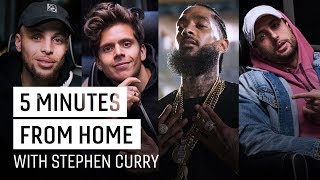
In this 5‑minute Overtime segment, Stephen Curry sits down with creator Rudy Mancuso, internet personality King Bach, and the late rapper Nipsey Hussle to explore how creativity flows across sports, music, film and digital content. The participants discuss the DIY mindset of handling every stage of production, the ease of collaboration when you have a network of like‑minded creators, and the importance of giving back through workshops and community‑center programs. Curry draws parallels between performing before thousands of fans and creating for an online audience, noting that pressure and “the lights are bright” reveal who can thrive. Nipsey shares how free studio access and mentorship let him own his sound, while King Bach talks about moving from on‑camera comedy to behind‑camera directing and teaching kids filmmaking. Throughout, the conversation highlights the shared hustle, ownership of one’s art, and the way creative work can serve as a platform for personal expression and community impact.
Chapters
When you're good at something, you just keep doing it. It just comes natural. You can sing, you can act, you got comedy, you got— I'm sure you can dance. You can do pretty much a little of everything.
Just want to do everything myself. It's always how it's been, from writing the idea to actually shooting it to editing it.
There's a lot of synergies and similarities between the creative world— Yeah. In basketball and sports in general.
When creating content for the internet, it seems like the audience that watches internet content loves to feel very relatable to it. So they wanna watch it and go, "Oh, I could make that." Right. If I wanted to do that, I could do that.
Being from LA in the '90s, you gotta think Tupac was shooting videos on Crenshaw.
Yeah, yeah.
You know what I'm saying? Yeah, so it wasn't out of reach. It wasn't like something that I felt I couldn't do.
You just called up like, "Hey, King Batch, I got an idea," or like, "Hey, whatever, I got an idea. You wanna come over and shoot it?" and he's doing the same thing? How does that whole process work?
Kind of, man. It's really usually that simple. I mean, I work with a network of creators and musicians. We have a lot of friends in the family, like Batsch, and I mean, many, many people. But it's that easy. Being able to collaborate and meet and sit down with people like you, where I mean, we come from very different worlds.
Yeah.
And we got to make something together, and we're making something together again right now, and hopefully keep making stuff together in the future. Like, that's been crazy too. The people, amazing people I've met along the way. Who would've thought?
Yeah.
You were doing front of camera and behind the camera, everything. So it's just—
I mean, I still am, but the goal was to get behind, direct some films, write a film. Made on YouTube, I realized, like, damn, I really have an knack for filmmaking. So I'm like, I'm gonna take this skill and try and move to the next level. Now I'm in the band with Stephen Curry.
Wow!
A lot of kids are inspired by my filmmaking skills. So I was thinking of, like, maybe putting on, like, a workshop just for fun to see if any kids want to come out and learn some filmmaking.
You're giving them real-life skills, like, at that point. That's stuff that they can't really— sometimes they might never get to do. Go learn a school and develop their passion for 'em. That's dope, man. My dad, when I was growing up, we always did computer learning centers for at-risk youth in Charlotte. Me and my brother would volunteer there all the time, so that set the foundation. Finding any type of way to better somebody else's life with what you get to do on a daily basis is huge.
My mom found out that I was really into the music thing, and she found a community center that had a free studio every Saturday. And it was like a classical pianist at, I guess he was doing his, you know, philanthropy or whatnot. He was really successful. And so he trained us on how to play the piano, how to work the equipment. I fell in love with the process of making music. I wasn't good at first. I just—
But you did.
I got to hear my voice on record. And then I got to, like, bring samples in and just express an idea through the equipment.
I feel like it gave you ownership of your own sound, your own music, right? Like, now you don't have to rely on anybody else at that point.
100%.
It's like, I can take an idea, a song, an inspiration, whatever it is, and make something.
100%.
You know, when I'm out there playing, there's like a different type of, you know, swag and mannerisms and flow to what I do, 'cause that's when I'm in my element. There's no better feeling than when you do it, you know, in that live action.
For real.
It's funny how many similarities there are to making music and playing a professional sport.
Yeah.
Like, talking to you, I start to realize just how similar it is. I guess it's like anything that you're very passionate about or that you have a strong skill—
Yeah. —that you pursue professionally, When the lights are bright, the pressure's on or whatever, there's certain guys that can handle it a little bit better and everything seems to click.
I think you have it or you don't, man.
Yeah, 100%.
I play better in front of a crowd.
That's crazy.
Yeah.
Playing in front of 20,000, 40,000, whatever it is, like you just—
That's my home.
That's your happy place.
Yeah, I'd say so.
I got into music just writing first, just like listening to rap and then like I'll write over a Snoop Dogg song and just change the words. Use the same flow and just change the words. Respect.
The hustle and how you kind of have brought a new perspective to the game.
You know, I was dropping mixtapes every year since I came in the game. I came in the game like '09, for real. My thing was I learned a lot off the mixtape runs that I was doing. And what I realized about an album is that it should be a collection of great songs. It should be, you know what I mean? So like, you know, I wanted to be a rapper. I wanted to be able to, you know, speak on a platform. And then I would assume as an athlete, you deal with injuries, you deal with just like, you know, politics of sports. But when you get to where you're going and then take a moment to think back, that's what I look at the album as, you know, like the reflection.
Being able to combine all those different skills into creating that content and stuff that people love to watch, make people laugh, make people cry, make people, you know, and just evoke whatever emotion you want out of them.