Stacy Abrams Breaks Down the Importance of Voting | State of Inspiration w/ Stephen Curry
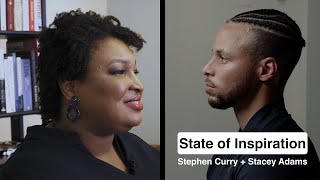
Stacey Abrams talks voting rights and the 2020 Census with Stephen Curry. The census determines federal funding for schools and disaster response, but communities of color have been systematically undercounted. Abrams explains mail voting, early voting, and how to check registration at vote.org or 866-OUR-VOTE.
Chapters
Voting can change the future of where we're going.
Get voting done and out of the way because we don't know what else is happening. It's 2020.
Thank you so much for joining me today. We've got a lot of amazing, important things to talk about. For those who you should know, Stacey Abrams, amazing, amazing voice for the people, really has been instrumental in fighting for voter rights, against voter suppression, founded Fair Count, talking about the census, Fair Fight to continue to increase engagement around voting, to again fight voter suppression, continue to build engagement in our Get Out the Vote campaign. And I know good product placement when I see it, so over your right shoulder I see that that fine book right there, Our Time Is Now, written by yourself. Amazing, amazing work. Thank you so much for sitting down and having this conversation. I think this is very timely in terms of, you know, the reality that we're all living in and how important, you know, this election is, but also just our civic engagement overall. So we got a lot of good things to talk about, but I want to have a little fun at the beginning. For those that might not know, I heard that you wrote— Yes. 8 romantic super suspense novels, I'm sorry, under the pen name of Selena Montgomery. Is that accurate?
That is indeed true. From 2000 to 2010, I was a very prolific romantic suspense writer, published 8 novels, but then I got promoted to minority leader of the state house and started a financial services business. So Selena has been on hiatus for the last 10 years.
Last 10 years. So she's got a lot of work underneath her, accredited to the name. So it's pretty awesome. How did you start that? I just gotta like, just in terms of, is this a passion? Did you always knew you were talented in that space? Like, how did that work?
I've always loved writing and I grew up watching General Hospital and James Bond movies. And so my very first novel was a romantic suspense spy novel. I tried to publish it in espionage, but at the time publishers really weren't publishing women who wrote spy novels. So I figured I'd write the exact same novel. I'd just make my spies fall in love, kill the same number of people. I wrote that one, they liked it, and then my publisher bought a couple more. And then a new publisher called me and said, "What would you wanna write that you don't think you can write?" And I had a serial killer romance novel called "Never Tell" that I wanted to write. So they bought that one. And then I did action adventure. Mm-hmm. For the last 4.
Pretty amazing. So I don't know, my dad is one of the biggest advocates and readers of your kind of suspense novels, so that'd be right up his alley. I used to sneak downstairs and watch General Hospital with him too, so all those things check all the boxes. I might have to get some of that work to him.
Sounds good. Well, there actually used to be a group of men who read my books. They called themselves The Paper Bag Club because they didn't want anyone to see the covers because they're really very romantic covers. But they were like, but you're right, suspense. I'm like, yeah, I just make the spy, you know, spies fall in love. The murderers really don't get to fall in love very often, but you don't, you don't really know who the murderer is till you get through the book.
So yeah. That's it. Well, we'll keep that on the radar for sure. But let's, let's jump into some of the issues in front of us as a country, as a society. I know you do a lot of work work and advocacy around the census. As we stand right now, you know, leading up to this election, obviously the census has been out encouraging people to participate, to fill out the forms, whether it's online, you know, paper sent in through mail, answering the door if somebody comes and knocks to ask those questions. Can you talk about the just overall the importance of the census and why should we participate? I don't know if that's a conversation we have enough in terms of how important it is. I've learned a lot over this past year, what it truly means and, and the resources that are at stake to go to the right places. Can you talk about just the census in general and why should we participate?
The census seems like a once-in-a-decade intrusion, invasion of privacy. So people get irritated once every 10 years that somebody's asking them all their business. But the way we should think about it is if you have a cell phone or utility bill, they already know how to find you. The census is how we learn what you need. And when I say we, I mean, as someone who used to work for the government and may do so again, it's how the federal government gathers all the information it needs to allocate $1.5 trillion. So whether it's how many kids are gonna need to be in your schools over the next 10 years, or how many roads and bridges in your neighborhood need to be fixed, or how much PPE you need in your hospitals, how much money you need for disasters if there's gonna be a nat— if there's a natural disaster. If you live in California with the fires or on the Gulf Coast with hurricanes, if you live in the Midwest with tornadoes, the way the federal government divvies up that money is based on how many people are here. It's like the budget that you make in your household. You make your budget based on how many people you've got and what you know you need.
Mm-hmm.
And this is how the federal government makes its budget. But the problem is, if people don't get counted, if you've got folks living with you that you didn't expect to show up and they stay longer than you intended, you usually don't have enough resources. And when we don't get counted in the census, it's as though some of us showed up, but they didn't plan for us to be here, so they don't feel any obligation to care for us. And unfortunately for communities of color, for young children, for immigrants, for the homeless, there are populations— and rural communities— there are populations that often get ignored. And when they get ignored, the resources we need never show up. Mm-hmm. That's one of the reasons we've seen a disproportionate effect of COVID-19 on communities of color, because we are typically undercounted in the census. So when it comes time to actually respond to emergencies, they didn't count on us. And right now, communities of color are being dramatically undercounted in the census. And the problem is, in your family, you might be able to go out and get a second job if you need to. You may be able to make up the difference. But when it comes to the census, once it's done, it's done for a decade. So we get left behind for 10 years. Mm-hmm. Your children get left behind. School lunches get left behind. Pell Grants for college get left behind. Money to start your business. And so the census is so important because it's how we plan for the next 10 years, both economically, also in terms of political power. So I say fill out the census so you can get your money and you can get your political power.
And speaking about the history of the census, right? I, I was doing some homework just in terms of how certain states approach the support for the census, right? I know cert— cert— like, over half the states actually spend material money and work that into the state's budget to get this— the census out and get the right engagement participation. Some states spend $0 on it. And can you kind of talk about, like, the history of the census and how there's been kind of intentional discrepancies in how certain states support it and others don't?
The census has been part of our nation since the beginning. It is one of two functions mentioned in the Constitution. We have a census and we have the Constitution mentioning that we should have a post office. So we can talk about that if you want.
Yeah, yeah.
But when it comes to the census, let's remember that the original intent of the census was to count everyone. But when we hear about the Three-Fifths Compromise when it comes to Black people who were enslaved, the whole point was that you only counted— for every 5 Black people who were held in slavery, only 3 of them were counted in the census. And it wasn't until we had the 13th, 14th, and 15th Amendments that we actually started counting whole persons. So it was the 14th Amendment that said that you had to count every single person in the United States regardless of status. If you fast forward to today, we find ourselves still in this battle to count the communities of color that are often discarded or discounted. California, for example, has spent hundreds of millions of dollars on the census because they understand that it is critical to count every person. In contrast, my state of Georgia has spent very little, and we have states across the South that have spent zero dollars. But what we have to remember is that 58% of Black people in America live in the South, and yet most Southern states are not spending a dollar on the census. We know that in Native American communities, they are woefully undercounted, in part because they have to have someone who comes to the reservation because of how they use addresses. And so we have all of these systems that are designed not for our benefit, but unfortunately are being manipulated by this administration to our detriment. The other example I'll give you, we have had a lot of conversation in recent years about returning citizens, but also about mass incarceration.
Right.
We know that in a lot of states, particularly southern and western states, people are counted not where they are— they're counted where they're incarcerated, not where they come from. And the pro— it's called prison gerrymandering. And the problem with that is, if the resources that help build solid communities, that invest in schools, that invest in community organizations, that invest in helping build stronger, healthier people, if those dollars never show up because everyone who didn't get what they needed is in prison, you have white rural communities that benefit from the incarceration of communities of color, but those resources never make it back to where those people come from, so their communities never get the support they need. We have to fix the census, but the first step is making sure that we actually have a census that's accurate this year so we can get the resources we need to work on building the political power to improve the census going forward.
And we're obviously in the middle of a pandemic right now, and I know that can impact, you know, the participation engagement with the census, knowing it's been, it's since April, right? I guess April is the date that you're supposed to count your current, you know, living situation, your family members and all that type of things, but we're, you know, pushing towards October. Can you kind of give us a breakdown of like where the Census Bureau is on the extenuation through the end of October? I saw a recent report about it getting shortened so that we can kind of curb the impact of COVID-19 and, and get as much participation as possible down the stretch here.
Typically, the census is a nonpartisan activity. It doesn't matter whether you're a Democrat, Republican. It doesn't matter what race you are. Republicans and Democrats have always been very intentional about counting everyone because usually our presidents understand we're all in this together. Unfortunately, this year we have a president who has been very intentional about not telling the truth in the census. It began by trying to impose the citizenship question based on analysis that was done by some folks who support him, consultants, who said that if you don't count everyone, if you put this question in place, the citizenship question, then we will have a census that looks whiter and more Republican.
Mm-hmm.
Luckily, the Supreme Court, the conservative Supreme Court, struck that question down, but that didn't mean they stopped. So the next piece was that they underfunded the census. And unfortunately, recently they've attempted to end it early. So to your point, when COVID hit, the census was supposed to run through basically May 14th. And then on May 14th, they were gonna send out the people who knock on your door, the enumerators or census takers. That was supposed to happen from May 14th until July 31st.
Mm-hmm.
But because of COVID everything got delayed. And the people of the Census Bureau who are nonpartisan, They said, "Okay, we need to adjust. We need to do the census taking from August 11th through October 31st." But on August 3rd, the President of the United States announced that he was going to end the census early because what he wants is flawed data to be delivered to him before the end of this year so he can put into cement the lie about who we are because he knows that the numbers aren't accurate. He knows that we have communities that haven't been counted. We have Native American communities that are behind by up to 25% behind white communities in terms of being counted. And the reason this matters, the census not only allocates dollars, it allocates political power.
Mm-hmm.
So we have 435 members of Congress, but based on the populations, some states will get more leadership and some states will lose representation. But if you turn in the numbers, when the numbers get turned in, to the president and the president sends it to Congress, that's it. There is no do-over, even if we know the numbers are wrong. And so what we're hearing about the census extension, meaning that it was supposed to end today, but Judge Koh out of California put a stay on the ending of the census and demanded that they continue it through October 31st, that's designed to give the census more time to do their jobs. The professionals say they need through October 31st. Unfortunately, the Trump administration is now trying to end it on October 5th, but we hope that the judge will continue her stay. The judge will continue the injunction against ending the census because we need as much time as possible to get as many people as possible to fill out the census. This is a once-in-a-decade opportunity to tell America who you are and what you need, and we need all the time we can get to get it done right. Especially now. Especially in COVID, because billions of dollars will be allocated for COVID recovery. And if these communities are not included, the money doesn't disappear, it just never gets to the people who need it.
I think that's a good segue in terms of, you talked about the impact of the census and getting the resources where they need to go, but also, you know, how we vote and getting the right people in positions of leadership and power that will be able to unlock those resources in the right way. I kinda wanna ask some more tactical questions on voting so that we can kinda break down some of the either misconceptions or questions that everybody wants to know the answer to, and then some big ideas too. So I kinda just wanna start on voting with just the basics of, I think there's 3 ways that everybody can participate. You can vote in person early, you can vote on election day, or do mail-in voting. I'm pretty sure that's the only 3 ways to get it done. Can you walk us through just the process of How you would encourage or recommend somebody, either if they're voting for the first time or, you know, they're really advising other people in terms of the power of voting, how they should approach, you know, now and November 3rd?
Don't panic. This is a very fraught and tense election year. You've just listened to the television, read the news, or been on, you know, any social media. You've gotten a lot of good and bad information about the elections. Let's be clear. The elections are happening now. We have an election season, not an election day, because we do have 3 ways of voting. Now, it's not universal, but it's pretty close. 45 states allow you to vote by mail. 41 of those states let you do it with no excuse at all, and 4 of those states will allow you to say that COVID-19 is your excuse. We still have 5 states that unfortunately require that you have either a disability, be aged— over the age of 65, or be out of town. And you need to know what the rules are in your state. So if you go to vote.org, your state— you can look up your state and it can tell you what the rules are for voting by mail. Voting by mail is safe. Voting by mail is accessible. And voting by mail is successful. There are states where you have to be a little more diligent about what the process is. So we've heard about what's happening in Pennsylvania. In Pennsylvania, you have to use two envelopes, a secrecy envelope where you put your ballot inside, and then your mailing envelope, which is where you put your secrecy envelope. But the rules are designed to help make sure that your vote gets counted. So make sure you go to vote.org and learn the rules for how you fill out your ballot. But it is a safe, accessible thing. And despite all of the histrionics we've heard about what was happening at the post office, most of those things have been fixed. We've had courts that have made changes. We had Congress step in. And so it is safe to vote by mail. And in most communities, you can even go and drop off your mail-in ballot if you don't want to put it in the post office box. So that's number 1.
Mm-hmm.
Number 2, you can vote early in person. That's true in 41 states. Again, if you go to vote.org, it can tell you which states allow you to vote early in person. We know that voting early has already started in some states. Some states start 60 days out. Many states start about 45 days out. Georgia actually starts on October 12th. Some states start October 4th. So just look up the, the date in your state and where you can go to vote early. That means that you show up in person. It's just like voting on Election Day, only it's safer because there are gonna be fewer people in line. You're usually gonna go to a satellite location. You're gonna go not to your normal precinct, but you're gonna go to a place that's listed as one of the spaces where you can vote early. Okay. It's a good way to vote, and it means that you get it done, you get it out of the way. Third way to vote, of course, is Election Day. But we should treat Election Day as last call.
Mm-hmm.
That's the last day to cast your ballot. You can do it, and it is reasonably safe if the polling places are open, if we have enough poll workers. But the reason we're encouraging people to vote early is that we're in a pandemic. We've never done it like this before in modern times. The last time we had something like this, was the Spanish flu of 1918. We also voted during a civil war. But we have so many people voting this year, we know that we need to actually vote as early as possible for two reasons. One, you want to vote early because if there's any mistake, if there's any problem, if there are any barriers like voter suppression, the earlier you try, the earlier you find out what the problem is, and you have time to fix it. If you wait until Election Day, It's gonna be hard to solve whatever the problem is. But number 2, we need folks to get voting done and out of the way because we don't know what else is happening. It's 2020.
Absolutely.
Get it done early because that means that you have had the opportunity to take care of it and you can focus on helping your family. You can focus on helping other people vote. We need people to vote early because we need our votes and our voices to be heard. Voting is not magic. It is not going to solve every problem. But it is the only way in a democracy we can make our voices heard when we decide who's going to be making the decisions on our behalf. Because that's what representation is. We live in a representative democracy. I'm not gonna spend every day of my life thinking about what's happening at the city council level. But I should know who's making decisions for me on the city council level. I'm not always gonna know what's happening in the school board. I don't have children.
Mm-hmm.
But I want to make sure that the schools are serving our children well, so I vote in school board elections. If you care about criminal justice reform, you should vote on DAs. And as we recently learned based on what's happening in Kentucky—
Yeah.
You want to make sure you know who your attorney general is. I know I care about the secretary of state because that's who controls our elections. And so we have to remember that these votes that we cast, whether we're voting for the president or for a school board member or a state legislator. Those votes matter because the power to set the future comes from this election. So do not let anyone panic you. If it didn't matter, they wouldn't be working so hard to convince you that you shouldn't vote.
I'm gonna be honest, I'm so glad that you led with don't panic, 'cause if you said everything you just said about halfway through, I'd be thinking really overwhelmed about, you know, the process. But it is, if you think about it, very tactic, Tactically, as you kind of laid out, and if you go to the right places to get the right information, I know you said vote.org is a great way for people to get the right information to form a plan and be proactive in terms of how they see their participation with all the different circumstances that they have to juggle, which kind of leads me to my next question in terms of, you know, say we're, you're talking to a family, a man, woman that has, you know, day job that they can't take off, or they have to make certain decisions whether, you know, if I'm gonna go to the polling place and stand in line, you know, on November 3rd and cast my ballot. What do you say to those people who, let's say, tactically speaking, they're in a long line and the polls are closing? Like, what should they do in that situation, and what resources do they have available to make sure that they can, you know, vote, that their vote's gonna, you know, get counted, and that they can participate the way that they want to.
The reason I say don't panic, yes, this is complicated. We're deciding who's going to run our country, who's gonna run our cities, who's gonna run our states. Yes, there is voter suppression. There are people who wanna stop us, but the best way to defeat an enemy is to know that the enemy exists. The best way to navigate challenges is to know what those challenges are. Make sure that you know the information, that you know the obstacles, but don't let them convince you that those obstacles should stop you from acting. And to your point about being in line on Election Day, if you've made a plan to vote early and it doesn't matter, you still ended up in the line on Election Day, here are the rules. If you are in line before the line shut down, before Election Day ends in your state, so let's say it's 7:00 PM or 8:00 PM, if you're in line by that time, they have to let you vote. Mm-hmm. Number 2, under federal law, if there's any mistake, if you don't have— if you're eligible to vote but you forgot a piece of paper, you didn't have your ID, ask for a provisional ballot because that means they have to let you at least cast your ballot on Election Day, but then you have usually 3 days to come back and give them whatever information they didn't have at the time you were trying to vote. Number 3, there is a phone number you need to memorize. It's 866-VOTE. 866-VOTE.
866-OUR-VOTE.
866-OUR-VOTE. That phone number will connect you to lawyers across the country who will know what the rules are where you live. So if you're standing in line and someone's trying to intimidate you, someone's saying that you shouldn't vote, that you don't have the right to vote, that you're in the wrong line, if you call that number, they can make sure you have the right information. No matter what happens, don't get out of line. Across this country, you've got good organizations and good people who are gonna be coming down those lines, making sure people have water, have PPE, have information. They can't do anything campaigning because campaigns are done by then. When you're in line, you're just there to vote. But make certain you don't let anyone steal from you your right to vote. And in every single state, if you call 866-OUR-VOTE, we will connect you to the right person to make sure your vote gets counted.
When we go to the elections and we're talking about, we're looking at the candidates, we're trying to compare, contrast, look at how they, you know, show up in different conversations and pressing matters. If I'm a voter, I've done some homework and I look at, you know, from the presidency all the way down, you know, through the Senate, through our local elections. Sometimes it feels like you're voting for the lesser of two evils in terms of the optimism around how a candidate is going to step into that role and fight for the people and come with some actual solutions that we can see change. And whether that's in short-term or long-term, we know that, kind of to your point, it's not magic, but we're trying to always push the ball down the line. How do you speak to that voter and instill confidence that whether they don't see eye-to-eye with every single policy, um, with the candidate that they're actually making a decision that's going to either better, you know, something for themselves, their community, or the country at large.
I don't believe in lesser of two evils. I believe that if there is evil, there's no such thing as less evil. There might be people who aren't as good as we want them to be. They may not be as smart or as courageous. But when people intend you harm, that's very different than people who just aren't as good as they should be at doing you good. Figure out for your life what is actual harm and what is help. And that's the first metric. The second is to remember we're voting for humans. We don't vote for saviors.
Mm-hmm.
We don't vote for magicians. We vote for regular people who've decided that they wanna step forward and do something to make community better. That's why, that's why people run for office. Now, it turns out some people are good at it and some people aren't. And that's why we have elections. It's a hiring process. This is the most public job interview in the world, because when people run for office, they're saying, "Hire me to do this job for you, whether you're hiring me as a DA to make certain that we administer justice fairly, or you're hiring me as a state representative to make sure that your family gets its fair share of tax dollars, or you're voting for the President of the United States to make sure we're not going to war on a Thursday." We don't elect saviors. We elect regular people who just seem to be better at talking about things or reading things. And so we should measure who we're voting for not based on whether they excite us or not. I don't need to be excited about you as a person. I need to be excited about what you can do for me as a representative, as a politician. And when the difference is not trying to be excited about the person, but being excited by their values, then I have a better sense of what's possible. Stephen Curry. Possible. And so I encourage people, you know, there's a lot of conversation about, oh, I'm not enthusiastic. I don't need to be enthusiastic about you if you're going to do the right thing for me, if you're going to make certain that my community gets the resources it needs, if you're going to fight for me and make sure that my community gets served the way it needs to be served. But the way we make those choices is by being really introspective and understanding what we need. That means you should think about what pain do you have in your life? What are the things you need help with that by yourself you cannot fix, that your community by itself it cannot fix. We elect leaders to help us fix those problems. And so the, the rubric we should use is not whether they are evil or less evil, but do they intend me good? Can they tell me how they can make good happen? And can I commit myself to helping make sure they get it done? I don't want to spend every day of my life doing their job for them, But I don't know of any job in the world other than politics where you get hired and then the people who hire you disappear for 2 to 4 years and assume you're going to just do what you're supposed to. I wouldn't let you do that in my store. I wouldn't let you do that in my business. Why would I let you do that with my life? And that's why the responsibility is to protest in the streets to demand what we want, protest at the ballot box to hire the people we need, and then protest in the halls of power to make sure they do their jobs. Because fundamentally, that's what we're doing. We're hiring people to do a job, and we want them to do the best job possible. But sometimes people need encouragement.
Absolutely. And to that point, you said you get somebody in office and you're expecting that they put their best foot forward and their intentions are solid. We know the powers that be, when you get to Washington, it's a lot of just— the chessboard is always, always pieces moving and aligning and disaligning. Type of things. But what's the best way to keep people accountable, you know, in those positions? Like you said, you can wait till the next election and vote them out if you didn't like, you know, their track record. But in the interim, you talked about protesting, you talked about using whatever platform you have to speak on certain issues. But what's the best way to keep, you know, our leaders accountable while they're interim and while they're in those seats as decisions are happening, as our world is changing, you know, every single day?
I get in trouble sometimes when I say this, but having been one myself, I think it's a good analogy. Politicians are like 15-year-old girls, and I used to be one. They respond to money, peer pressure, and attention. So money. Invest in candidates that you think are gonna do a good job. And even if it's a dollar, if it's $5, if it's $500, when we invest in candidates We are sending the people that we need to positions of power. And sometimes we don't think, "Well, I'm not the kind of person who puts money into a campaign." You don't give money to a politician. You're giving money to their vision. You're investing in the campaigns. And if we want more people who come from community and remember what it was like to need, then we need to invest more often in the candidates who need us the most. Not the ones who have all the money they need, but the ones for whom that $10 or $15 or $500 can change the way they are heard and seen, and we get them into office. So that's number one. Number two, peer pressure. We need to make sure that we are calling, emailing to politicians once they're in office. But don't just send it to the one who represents you. Send it to all of the people who represent you. Because we need more and more people to feel that you are watching what they're doing, and they're watching your friend, their allies. We need more and more politicians to be comparing themselves to one another and trying to be better.
Mm-hmm.
But the third is just bringing attention to the issues that matter. And that's what protest does, but that's also what communicating with politicians does. When you send your information, when you call your city council member and say, "This is happening on my street," and they don't call you back, call 'em again. But then also call other people in your neighborhood and say, "We need to call this person, we need to email them, we need to text them, and we need to tell them what we need." The same thing is true whether you're talking about someone in Congress in DC or someone in your state legislature or your school board. But remember that money, peer pressure, and attention make people behave better. That's true in almost every facet of life, but it's completely true when it comes to politics. You don't have to talk about every issue and you don't have to be upset about every issue. You may not care about that bond referendum that's happening, but you do care about whether or not they're going to redistribute resources from one school in your district to another school that already has enough. Those are the kind of conversations we've got to show up for. But you don't have to show up for everything. If you show up for some things, they start to pay attention, and things do start to get better.
Is there a way, um, and this is something I've been thinking about even, you know, these past, you know, 6 months in terms of leading up to this election, we know that certain swing states, we're talking Pennsylvania, Florida, Florida, Wisconsin, Michigan, North Carolina, Georgia, where they're hotbed races. And if you're not living in those states, you might seem, feel a little powerless in terms of impacting those elections. And for your everyday citizen to understand, what's the best way to approach those type of conversations in terms of lending awareness, just participating in those those extremely sensitive kind of elections that for us can change the future of where we're going as a country. It's even for somebody who's voted every single year.
Swing states are swing states because we have this racist, classist Electoral College. And as long as the Electoral College continues, we're gonna have states that get more attention than others because if Democrats know they'll win or Republicans know they'll win, They don't really fight about it. And so we only fight over the states where we really have to work hard to get one side or the other elected. That shouldn't be the way it is, but it is for now. So let's assume that we will have swing states for a while. If you want to support a swing state, you could go to fairfight2020.org. We are gathering lists of volunteers and we're deploying them. We recently did a week of action where we did more than 1 million phone calls and text messages. The reason that matters is a lot of folks, they don't have time in their day to figure out all the rules and all the laws and all the issues. And so by supporting fairfight2020.org, we can connect you to the communities that need your help, especially in those swing states, 'cause we're operating in 18 swing states. I would also recognize that while your state may not have a presidential election where your vote is going to swing the Electoral College, You do have other races. And for those of us who care about the environment, who care about a woman's right to choose, who care about criminal justice reform, who care about education, we've gotta remember that most of those decisions don't happen at the federal level. They happen at the state and local level. So your state representative, who you may or may not know, has more power over your daily life than the President of the United States, because that's the person who decides how much your state taxes are. They decide whether or not the rules in your state, the laws in your state permit you to make a mistake and actually get redemption once you've served your time, or whether you're going to lose all of your rights from now on. That's what happened in Florida. The people of Florida said, "We want returning citizens to have the right to vote," but the state legislature and the governor took those rights away. And so we can't focus so exclusively on the federal level that we forget that most of what happens to us happens at the state and local level. So yes, help out through fairfight2020.org, help out with folks across the country in swing states, but don't forget that you can swing the future of your state by being involved down ballot.
You've given us so much good information, and I would go back and watch this entire thing and make sure I got my plan put together, calculator, formulator, make sure make sure I'm ready to go. It's always funny just thinking about where we are, again, as a society right now, how important, you know, this election season, as you, you know, put it, for sure is important. I watched the debate, the first debate, and there's a sense of like outrage and confusion over, you know, how we're being represented at that level. But in terms of like for you and everything that you do on a daily basis to fight for people, and the quality of life in the future. Like, what gives you hope? What gives you optimism? What gives you a sense of confidence that if we, you know, take advantage of this election, our awareness over issues that matter and that are gonna affect our daily lives and our kids' lives and their kids' lives, like, what's the thing that gives you the most hope and optimism, you know, for our country?
I grew up in southern Mississippi, the daughter of working-class parents who were working poor most of the time. And I'm one of 6 children. My parents were both first-generation college. My mom was the first person in her family to finish high school. In a generation, they helped us move forward in a dramatic way, not by themselves, but because of the fact that I come from a long line of folks who are determined. My great-great-great-grandparents were slaves. My great-great-grandparents sharecroppers. My great-grandparents, they were domestic workers and cooks. My grandparents were cooks, and my parents did everything they were supposed to, and they still struggled. And yet I became the first Black woman in American history to be the nominee for governor for a major party. I'm not optimistic or pessimistic. I'm determined. I'm determined to make their legacy worth something. I'm determined to make sure other young girls don't have to grow up thinking they can't do something because they've never seen it. I'm determined to make certain that my brother who struggles with mental health and with drug addiction, that when he can get his life together, that there is a place for him in our society. I do this work because I believe that more is possible because I've seen it happen. Because I'm not a slave. I'm not a sharecropper. I hold a law degree. I get to do every day the work of fighting fighting for people. And the thing is, I'm one of millions of people doing this work. I happen to get a little more attention for it, but I'm determined because I know that every single day I'm helping make progress. I get to talk to folks like you who could be doing anything else, and instead you're using your power and your platform to let people know what's possible. I'm surrounded by young people who've been told that they don't care and that they are— that they're agnostic or they're apathetic. Empathetic, and I watch them spend every single day on phones and on Zoom calls trying to make life better. I'm in this because I know we can win. I know that we have hit an inflection point in the numbers of who we are where we can actually change the outcomes of decisions. And so I'm in this because I know that we can get it done. And that's what I'm working on.
You just dropped the mic on us. Nothing to follow up on that determination, consistency, perseverance, and leadership. So I thank you so much for your leadership, for your boldness and courage to be out on the front lines and be as passionate as you are about your work. I hope to have that same energy about anything that I do, whether it's on the court or off the court. So I appreciate your time. I appreciate your leadership. Again, thank you for all that you're doing and your entire team. And you've given us a real— Thank you. A real nice toolkit to, to go into this election season. So I really appreciate you and make sure anybody who's watching this, our time is now. I'm gonna plug it again. I'm gonna plug it again. Appreciate you, Stacey Abrams. Thank you so much. And we'll be following your lead.
Thank you, sir. It's always a pleasure.
I appreciate it.
More from Stephen



Just touched down in Beijing. See yall tomorrow! #stephencurry #currybrand #lining