Stephen Curry's Basketball Workout During The Off-Season
Brandon Payne, Stephen Curry's skills coach since 2011, breaks down a September off-season session with reactive ball-handling drills, leverage-release work under simulated contact, and fatigue-based games like a 60 free-throw challenge. The focus is on body control, balance, and using missed shots as feedback rather than repeating the same patterns.
Chapters
This is Brandon Payne. I've been Stephen Curry's personal skills coach since 2011, and we've worked very long at creating a great partnership in terms of what he works on during the offseason. Today we'll take a look at a video from a workout we had in early September 2025 and just go over some of the drills that we were doing that day and go over what we were trying to accomplish. Pretty much anytime we getting started with a workout, we're going to do some things where we're challenging his ball handling and his decision-making. We're going to try to get him activated, so we're going to provide him with a lot of information and decisions to make. So in this particular drill where I've got my assistant Alec flashing numbers at Steph while he's going through 2-ball drills, we're actually giving him information to the drill that he's got to execute. So if there's a, a zero, it's behind the back. If it's an even number, it's between the legs. If it's an odd number, it's, it's a crossover. So he has to react to the information, and that's something that's very important for players when they're going through workouts, is to not just go through set patterns. And it's something we definitely do with Steph. We stay away from patterns. We constantly put them in situations where he's reading and reacting. In this particular drill, now we've taken one of the basketballs away and he's getting two numbers. The number in front of each hand is, is giving him the information he needs to execute the drill. So he's got that same odds, evens, zeros, um, assignment pattern, but now he's got two decisions to make. So each hand is telling him what to do. So you'll notice he's reacting to the numbers, not necessarily calling the numbers, he's reacting to the numbers. Now we're moving on to get them activated from a shooting standpoint. This drill is what we call 2-ball shooting. It's about more than ball handling. It's about more than just shooting the ball. It's about learning how to get yourself grounded to start the day and get yourself balanced and get your core engaged. Then we move on to what we call pickup shooting. And what pickup shooting is, is what you're looking at right here. Getting the ball off the ground up into the shot pocket. So it's just a hard dribble into the shot. And this is something we drill the most basic form of because it's always the finishing move of any shot he takes off the move. So anything that he's doing off the dribble, we want to make sure that that pickup is nice and smooth. And so we try to work out the kinks at the start of every workout to make sure he's picking up the basketball cleanly and in a straight line off the ground up into his shot pocket. Even the greatest shooter of all time has to work on very small details, and that's something we do at the start of the workout so we can get more more difficult as the workout goes. The misses here are actually important to us. You know, we want to see where the ball is flying, and we want to make sure that he's adjusting his base and he's adjusting his core to account for the flight of the basketball.
2, 3.
What we're doing here is called leverage release. So in games, a lot of times he'll be leveraged against a defender when he's driving, and he has to be able to release and do it in a very balanced way. So I'm simply providing leverage to him, and then we contrast that leverage release with just a non-leverage release. So now he's just sidestepping with no leverage. And it's, it's just, you know, we're providing a little bit of load, and then we contrast back to nothing, and then we come back to the load again. So now he's leveraged and released laterally for a shot. Big things here with him is he's working on making sure that the line between his nose and his belly button is staying in the rim. So we want to make sure we're as balanced as we can be and as strong as we can be at the same time.
Right, right.
You know, and then we take that same movement and we move out to the 3-point line. So now he's just working on sidesteps. Again, our focus is balance, our center of mass. You'll see him doing things like that where he feels like he's rotating. Uh, in this particular case, he thought, um, that he was rotating a little bit to the left. So in a minute, you're going to see us kind of stop here, have him put his fists together. I'm going to try to give him some rotational force, and he's going to work on anti-rotation, so work against rotating the way he thought he was. Then he'll make the correction. Now we'll go back to leverage release. He misses one or two here as he's just kind of coming off of that, that anti-rotation we just worked through. But you'll see, you know, we're very intentional about his feet. About his balance, about, you know, where his shot line is coming off of that leverage. And once he gets grooved in here, he looks pretty good.
Pretty good.
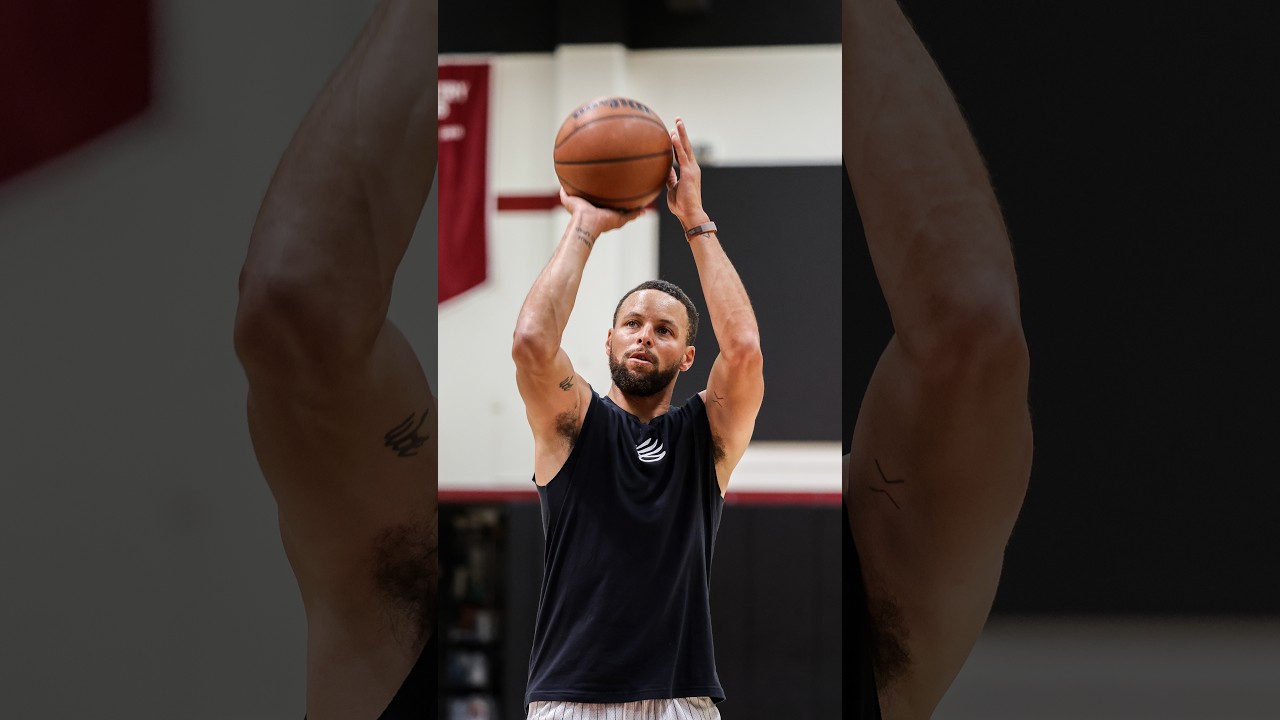
So again, we'll go no leverage here, just free release, just to work on that lateral movement. One thing he's kind of working on here as well is, is not allowing any lateral flexion in his core, which we talk about quite a bit as he's somebody that spaces laterally a lot during the games. So, you know, you'll see making little core movements, little core adjustments as he's going through after each shot. That's just him self-correcting. And now we go back to the leverage release. So he's leveraging against me, he's pushing against me, I'm pushing against him. He's got to get away, be balanced, be smooth. create space and get the shot off. He makes a lot of these things look very easy, um, and they're in fact very difficult. So we're going to take that same leverage release concept that we just worked on laterally, and now we're going to work on spacing, uh, straight away back— straight back away from the defense. So now we'll provide some leverage in front of him, so he'll be in a drive position and he's got to space away straight back. Again, not the easiest thing to do when you've got to be strong and be leveraged and then release immediately and be balanced. [FOREIGN] One of the things that can be difficult for players to do, uh, when they're spacing straight away from a defender is not allowing their chest to get too far out in front of their toes, because when they do that, they'll overcorrect when they go back to shoot. So you're actually going to see a couple of reps here as he goes through it where he is overcorrecting correcting a little bit so the ball flies a little long. We just cue him, we give him the correction of, hey, just make sure your ears are over your shoulders, your shoulders are over your hips, don't get too far out in front of your toes. It'll be a little bit of a quicker, easier shot, more controlled shot. He gets back there, I think you'll see us, uh, kind of correct it here. We're talking about being too far out in front of your toes, he makes the correction, now the ball starts to go in. So even the greatest of all time just have to be kind of, you know, just mention it to him and he'll make the correction on his own. Again, we go back to leverage release straight away. So working on being in a high position, getting your shoulder into a defender, and then getting straight away from that defender. Now we're going to work on body control. So he's going through a drill where he's working on curling. So he goes through a full curl, then he'll go to what we call a half curl. So his, his right foot is going to stop halfway in between after the full curl. So there's a full curl. Now he'll go to a half curl. So the right foot's further back, and then he'll go through a full rotation. So no step, just leave the ground, rotate, hit the shot. So we're working on body control, which is something we do quite often with him just because of the nature of the shot selection that he has to utilize. Guys in terms of he's, he's got to get a lot of things off the dribble, he's got to get a lot of things at odd angles. So we have to put positions and workouts to where he's working with a high level of variability, but he's also got to work on a lot of body control. So you go in full curl, half curl, no step curl, and then we work on what we call mirrored movements. So anything we do one side of the floor, we have to work to the other side of the floor, even if it's very uncomfortable. , we always have to have these things, uh, in our bag if we need to get to it, uh, in game. So once again, it was a full curl, half curl, then no movement. And you'll see he's going to struggle. These are very difficult shots. They don't look— as you're just watching the film, it doesn't really hit you how difficult this is until you actually start to go out there and try to go through these things and feel all the variables that he's feeling shot to shot. And especially when we limit your movement at your feet, limiting footwork makes it very uncomfortable for shooters, which That's what we're trying to do in the workouts. With a guy like Stephen, who's just an incredible shooter, if we let them stand there, catch and shoot all day, the level of difficulty just isn't going to be high enough for him to get anything out of it. So we're constantly putting him in uncomfortable positions, positions where he's got to work on body control, controlling the center of mass, because those are the things that are the most valuable for him during games to be able to get out of situations where he's engaged with a defender. Be able to release away from it and be controlled and balanced when he's getting that shot off. Um, so there's a lot of thought that goes into it. There's a lot of talking, a lot of planning that he and I do together, uh, to make sure we're hitting all the different things in the offseason that we need to hit, uh, that he's going to utilize during the season. And he might only use these things 3 or 4 times in a year, but it's still something that we have to work on, uh, sporadically throughout. So same thing now, we're going to work on, you know, just spinning. Not that we— not that we really want to use a lot of spinning movements, but this really more the focus here is more body control. You know, you can't look at every move that a player works on in a workout and think, well, you know, how does that apply to a game, or when would you use that in a game? Sometimes it's not the move that we're working on as much as it is the body control. We're trying to put him in dynamic situations where he's got to control the center of mass and get the shot off in a balanced way. So I think that's something that a lot of players and even some fans make the mistake of when they're seeing videos like this. They're thinking that we're rehearsing moves for the game, and that's not necessarily the case. We're really working on body control and shooting mechanics, dynamic moves. That's our focus here. We don't work on choreography. That's not something we do. We don't try to plan moves or pre-plan anything. So much of basketball is just reading, reacting, and make the appropriate move based off the information you have in front of you. And that requires some really off-balance shots from time to time, especially when you're dealing with, um, some size limitations or if you're playing against a bigger, stronger defender. Um, so that's what we're doing here. And again, the misses are valuable to us because the misses give us the information we need to make the adjustments to get better. So he's, you know, he doesn't ever get really frustrated with the misses. He's not have them, but he uses the misses appropriately, and he uses the information the misses give him to make the adjustments we need to make shot to shot, which is something that's very important for shooters because, you know, it's, you know, in games, the greatest shooters of all time, you know, make 4 out of 10, right? You make 4 out of 10, that means you missed 6 out of the 10 you just took. So you want to try to be as focused as you can, uh, on making the adjustment shot to shot to make sure the next one does have a chance to go in.
Yep.
You'll notice how quickly he gets his eyes turned and gets his eyes on the rim. That's something we talk about a lot too. We want to pick out a very small spot on the rim that's our target. Uh, we talk about aim small, miss small. Uh, and we, we kind of live by that. So instead of shooting at the rim as a whole, we're shooting a very specific spot on the rim based on the angle that we're at, uh, with each shot. So here we're working on a, just a variable shooting drill, uh, where he's going to be changing angles, changing directions, shooting side to side, front to back, as much as we can in a small area. Uh, we want to provide as many variables as we can without moving too much. So You know, we're kind of working wing slot area here, uh, and we want to make sure we're staying in that area so we're not putting a lot of miles on his body. Now we're going to go, uh, very shooting. So we go from, uh, pretty variable off the dribble, and now we're going to a 3-range, uh, variable ladder. We're basically going from deep mid, uh, 3, and deeper 3. That's the terminology we use here. So he'll shoot a deep 2, now he'll shoot a 3, and then a deeper 3. I'll go to the other side and we'll repeat the same thing. Whatever we do to one side, we have to do to the other side. It's called mirrored footwork. We're also going in the order that we're going in very intentionally. We don't want to work the same side of the floor consecutive times. We don't— so he'll go wing to wing, corner to corner, then go to the top. So we're, we're kind of changing, um, the, the, the sight line that he has side to side, uh, just like he would in the game. Very rarely do you get the same shot two times in a row in the game. I always want to have a couple variables involved from every And again, he's making this look incredibly easy, but when you change ranges on every shot, um, it takes the difficulty level of the drill up quite a bit. Same thing. So he's working the corner ladder now. Now he's up. So we're in a 2-in-a-row game. So he's got to hit 2 in a row from each spot now.
Go.
Something that's very important to us in, in our workouts, the only time we're really shooting from the stage is when we're doing some volume game, where we have consecutive, uh, limits that we put on it, meaning he can't from one spot to the next until he makes a number of shots. So that was 2 in a row. Now he goes to the 1 make at each spot. Now he's going in a star pattern. So again, variable, goes high. We're not really stopping moving. You know, it mimics what he has to do in game situations. This looks incredibly easy for him, but it is— they're difficult drills to go through.
3, 2, 1. 3.
So this is an example now where you're seeing, uh, the consecutive makes drill. So he's got to make, I believe we're 3 or 4 in a row here at this time, uh, at each spot. Yeah, I think we're at 4 in a row here. And, uh, so in order for him to move from spot to spot, he has to make 4 consecutive shots. Then in between each round of consecutive makes at 5 spots, he's going to end up playing a game we call 21. And the 21-game is incredibly taxing, incredibly difficult when you're doing multiple round shooting in between. Um, on this day, we were getting a little bit closer to training camp, so we had to do some things that were a little bit longer, uh, in duration, uh, as we're trying to, uh, to build him up to a peak right before training camp. Um, so, you know, some of these drills are a little bit— it would be, earlier in the offseason. So again, we're 4 consecutive 1s. I think we're 3 here. Um, he's, he's gonna run straight to half court. When he gets half court, now we're getting into the 21-game. So the way this game works is drive in, he's going to pull up, he's going to shoot 3. That's worth 3 points. Then he's going to drive, he's going to pull up around the elbow, free throw line. That's worth 2 points if it goes in. Now he's got to get all the way to the rim and he's got to finish with a layup, and that's worth 1 point. So he has to stay in that pattern until he achieves 21 points. Okay, after he gets to the 21-point mark, now we're going to go back to the consecutive makes game that he was doing in the half court. When he gets back to that consecutive makes game, now he's at 3 on consecutive makes. So we go from 4 to 3 to 2 to 1, but in between each round of consecutive makes, he's got to go back and play this 21 game, which again—
Stephen Curry.
You know, much more difficult than it looks considering you're moving, you've got to run in transition, you've got to shoot the ball in a pull-up, which is, is much more difficult than catching and shooting in the half court, uh, and then you've got to get all the way to the rim. He's covering a lot of ground, changing directions, um, you can't see it because he's got a shirt on, but his heart rate monitor's on, so we're tracking his heart rate. We get a chance to see what that looks like, not only what it looks like during the drill, but of course what it looks like down after the drill, which is something that's important to us. Um, There's another reason that we're good with these shots being from the consecutive range here for Steph is because we know he's in an elevated heart rate range, which for us is important because we don't like to shoot easy shots like this at low heart rates. It's just, it doesn't translate very well to game conditions with inside your body. So we want to make sure we're constantly keeping him in an elevated heart rate if we're just doing catching and shooting. So again, this is incredible because how winded he really is right now, but he's battling through. Uh, I don't remember if he missed a shot during this, this particular round on these 5 spots. It was 3 in a row, uh, to move to the next spot, and then he has to run right back to half court, uh, and get right back into that 21 game we just played. And then he'll go through, uh, the, the 5 spots. Now 2 makes in a row. So now you'll see him again, he runs right back to half court, and he's kind of excited because I don't think he missed in that, uh, or he might have 1 if he missed any. And now we're right back to the transition shooting. So again, it's worth 3. Uh, gets the free throw line, gets to the elbow, that's worth 2. Uh, we're fine with him, uh, making moves like that right before the shot. Again, he uses that for deceleration, not necessarily to create separation, but the move actually helps him decelerate into really balanced shots, uh, in transition. Um, You know, even watching this, you know, after 16 years of being with him, you know, there's a point in every workout where even I still get kind of amazed about what I'm seeing. He does something each day that just, it blows you away. And I'm trying to come up with things that are borderline, you know, borderline impossible to achieve. Do that, he seems to not only match what I'm asking to do but far surpass it. So it's a, it's a difficult challenge every day to try to stay ahead of him, um, but, uh, you know, we try. But he's so competitive, he's so good, uh, that he finds a way to finish it, um, every day. So again, we're at 2 in a row here, and then he'll run back up and play a variation of what we call 21. I can't remember if we 11 this day or or whatever we did, we gave him something to work through here. But again, he goes back transition, so it's worth 3, worth 2, worth 1. Then he'll have to go down and finish by making 5 consecutive shots, one from each spot. Just an incredibly, incredibly difficult drill. One that takes a lot of, a lot of desire to get through. We have had players that have come into things like this and kind of tapped out or, you know, wanted to slow down This pace, this pace is really high up there. A lot of change of direction. Playing in the NBA is, you know, guys that even stuff like that, I mean, you can see the fatigue starting to set in now. So he's gotta kind of remind himself, hey, we got this, we got a couple more shots. And he does it. Playing in the NBA is basically watching guys make the impossible look routine on a nightly basis. And Stephen certainly does that. Even in his workouts, there are things that he's doing that are just— they're not normal. And he does it with a smile on his face most of the time. You have to enjoy this work to get through it. See, I mean, human nature takes over. He wants to walk to the spot, but then he just finds himself, gotta run to the next spot.
Run, gotta be run. And we're gonna go into a free throw game this time.
That we call 60. All right, what we're doing there, we're checking the time. We had a time that he needed to be done with that drill. He actually beat that time, I think, by about 30 seconds, which is very impressive. But the workout's not done. So now we go to free throw games, and this is a game we call 60. And what 60 is, is when Stephen has to hit 6 free throws in a row. Okay, but the key is 6 of them cannot touch the rim.
1, 2, 3, 4, 5, 6.
And once he does that, okay, he likes to finish the workout, um, get a dunk, and then we give him the last 5, 10 minutes to kind of do what he wants to do. If he wants some consecutive makes from some spots, wants to go through some more movement shooting, we kind of let him take control of the journey at that point, uh, and let him do something to finish each workout that he enjoys. The last free throw, and then he'll always want to make sure he gets himself in a position to where he can do something explosive at the rim. Just to work out, he's a big fan of throwing himself lobs now because he does a pretty good job of it, uh, but the only way he gets to throw the lob is he has to swish the last shot. So you'll see him take the shot over and over and over again until he gets it just right, until it feels right, and at that point he decides, you know, okay, now it's time to finish. Not all makes are valuable makes to us. You know, some of the makes are, we call them the misses that just went in. You know, you want to make sure that you're getting the shots and you're hitting the spots on the rim.
You want to—
Again, there's some excitement there. Now this is his time at this point. Once the dunk is finished, now he's deciding what he wants to do. So this day he decided he wanted to get 3 or 4 different spots of 5 consecutive makes. Before he got into his movement finisher. That's— so that's what he's doing here.
You can actually kind of see him making some slight body corrections here.
As you see, the ball was flying to the right lights out a little bit, you know, and, and that's why you get into this at the end of workouts. You're a little bit fatigued, so we don't want to be moving too, too much. So we want to make sure we're getting high, high quality mechanic shots up, uh, to finish the workouts. Your body always remembers the last 20, 30 shots you take, so we want those last 20 or 30 shots to be really high quality shots. There are times in these workouts you could definitely get lost in the rhythm of the shot. You can get lost in the rhythm of the ball the basket because it just looks so effortless, looks so smooth. You know, even being around him for as long as I have, it's just— I'm just incredibly thankful to get to be in the building with the guy when he's working because you see, uh, the desire and you see what makes greatness great. Somebody that's accomplished as much as he's accomplished in the game, and we're still, you know, in the middle of the summertime working on really small details and working on it with the same level of intensity and the same level of desire that we had 10+ years ago, and, um, to me, it's incredible. Again, most normal people at this point, you can even see in his body language right now, he's a little bit tired, but he's got some things that he likes to do on his own finish.
Nice to see you.
He gets into the transition shooting drill that he likes to do where he shoots in transition. He's gotta make it all. He doesn't make it all, he starts over again. And to me, this is the incredible part. This isn't me telling him to do this. This isn't any coaches telling him to do this. This is him on his own, just wanting to finish what's difficult. [FOREIGN LANGUAGE] We get a corner reload 3. Gotta be perfect. Done for the day. And now he can relax. And he still puts it up. Even on a shot like that, if he didn't like it, he's gonna shoot it again until it goes in. And now he's done. Yeah, this is Brandon Payne, and this was just a part of a workout we did. You know, we normally spend about an hour to an hour and a half each day working on different things. And this was just the part of workout we felt like would be the easiest to understand and digest by most people. You can find more about Stephen's workouts at Coach Brandon Payne on Instagram and on YouTube, and hopefully you go there and learn more about why Stephen is the greatest shooter that's ever played.
More from Stephen



Just touched down in Beijing. See yall tomorrow! #stephencurry #currybrand #lining