Sequoia's Zhan on San Francisco's Future, AI Investing
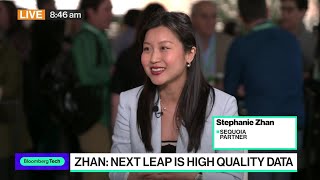
Sequoia partner Stephanie Zhan says 2024 will be a breakthrough year for AI video, agents, and robotics. Sequoia has already backed ten new AI companies in four months. Startups can compete against tech giants by using domain-specific data and better products, while open-source models like Llama 3 are lowering the cost to build.
Chapters
You are writing lots of checks, but the new companies being founded in AI are not the same as they were one year ago and certainly not 18 months or two years ago. Just give us a sort of timeline of where we are now in this industry way.
First of all, thank you so much for having me and Caroline, it's an absolute joy to be here. We're at a really interesting time in AI today. Seven years from the advent of the transformer, four years since the advent of the GPT3 moment. I think 2024 is going to be a monumental year for AI and here's why. I think this year is going to be a step function leap in digital intelligence. Everything from video to AI agents to robotics. I also think that this year is going to be the year we see a shift in the ecosystem to a thriving ecosystem with many winners in the models area across closed source, open source, large models, small models. And third, I also think this is the year we start to see AI commercialization at scale. And at Sequoia we've been really busy. As you noted, we're highly selective about the companies that we partner with. But this year, in just the first four months alone, we've invested in 10 new AI companies. Everything from new foundation models to new AI native applications.
I love that you went through the history like seven years ago since the transmission model. I mean it was 20 years ago, just over that Sequoia wrote the first check into Nvidia and now we think is still that company really owning really the oxygen in the room and they.
Become right they writing checks of their own. As a strategic investor and I'm interested.
Therefore exactly to Ed's point, how competitive is it out there to get those first checks in? Who are you seeing come? Is it the corporates that are wanting to write checks? Is it VCs wanted to write checks?
It's an incredible ecosystem right now with everyone pouring money into the ecosystem. I think it's very much reflective of the opportunity that we see in AI, the large market opportunity that is to come. I actually think that we're still in the very early innings of all of this. Well, you know, it's the classic saying of we overestimate in the short run, but we really underestimate in the long run. Nvidia's done a wonderful job of being such a critical hold in the ecosystem with hardware driving computer, but also now with so many software tools and the entire developer ecosystem they built around them. So I think that we're just in the early innings and there's A lot more to come.
We were just speaking with Clem from hugging face and indeed may have been who highlight the fact that it's really expensive to do this and Nvidia chips are a pretty penny. How are you seeing the companies that you back able to sustain the investment they need to make? How do you make sure the checks you write are going in the right direction and not just sort of going into the pool of training money?
Yeah, well I think that the classic conventional wisdom is that incumbents with scale, data, capital and distribution have a natural advantage and that's absolutely correct. It also costs a lot to build these models because of compute and for AI talent. But I also think that there are so many nimble ways for a startup to compete. Specifically I think the next leap is really around 1 high quality data specifically high quality labels of data and targeted domain specific data. Second, it's really about what you do with that data. Reinforcement learning with human feedback I think will really shine in this next era. It's an idea derived from reinforcement learning, but here an agent actually also learns on the fly with human feedback and that's what's so brilliant about ChatGPT for example. And finally I think that you really differentiate not just on model performance which is where all the capital goes into, but it's also around product distribution and the entire product experience that you offer to the end customer.
You use the word incumbent. I think we should probably talk about who those incumbents are because the point that may have even writer made and to a certain extent Clem from hugging face is that big tech and I think we're talking about Alphabet Microsoft in the first instance are sucking the oxygen out of the room from a capital perspective, a talent perspective. You invest at the pre seed and seed stage. Do you find that to be true?
Well, I think that incumbents absolutely have an advantage as we just outlined. But I also think that new startups have a shot scale that I actually recently released a survey last week where they interviewed thousands of developers on their most popular models and the ones that actually came into light were GPT4, GPT 3.5 and Gemini as the most popular models used. But we're also starting to see new players come into play with models that are just as competitive in performance. I'm really excited about the open source model ecosystem enabling many more new players to come into play. Llama 3 for instance is so powerful. The new 8 billion parameter model is a longer trained small model that I think will become a really powerful building block for new developers to build new applications on top of and to build new models around it. It's going to drastically reduce the cost of what it takes to build new experiences.
We are increasingly talking about matter and its competence in building large language models. You speak highly of them. Where do you see them? I think Zuckerberg said on the call last week, we want to be the world's leading AI company. Where are they in that journey?
I think that they have an incredible advantage, not just because of the capital that they're willing to pour into play, but also because of the entire treasure trove of data that they hold, all this proprietary UGC content that they can really use to train their models. One of the things I'm really excited to see them enter the scene with this year is a new Generative Video foundation model, similar to what we saw with Sora and OpenAI. To me the most powerful thing that unlocked was that the methodology we take for building large language models and digital intelligence works for video as well. You take a diffusion transformer model and you just scale it with enough video data and compute. And meta has a wonderful advantage given the entire treasure trove of content they have to compete in the ecosystem. And then what they're doing with llama 3, I think is game changing entirely. It opens the playing field for everyone themselves, new startups lowering the cost for a thriving ecosystem with many winners.
More from Stephanie
How to pitch Sequoia & Angel Investors w/ WorkLife VC, Stride.VC, Chapter One Ventures, and Sequoia