The Truth About Publishing a Photography Book (With Mary Virginia Swanson) | SC Picture
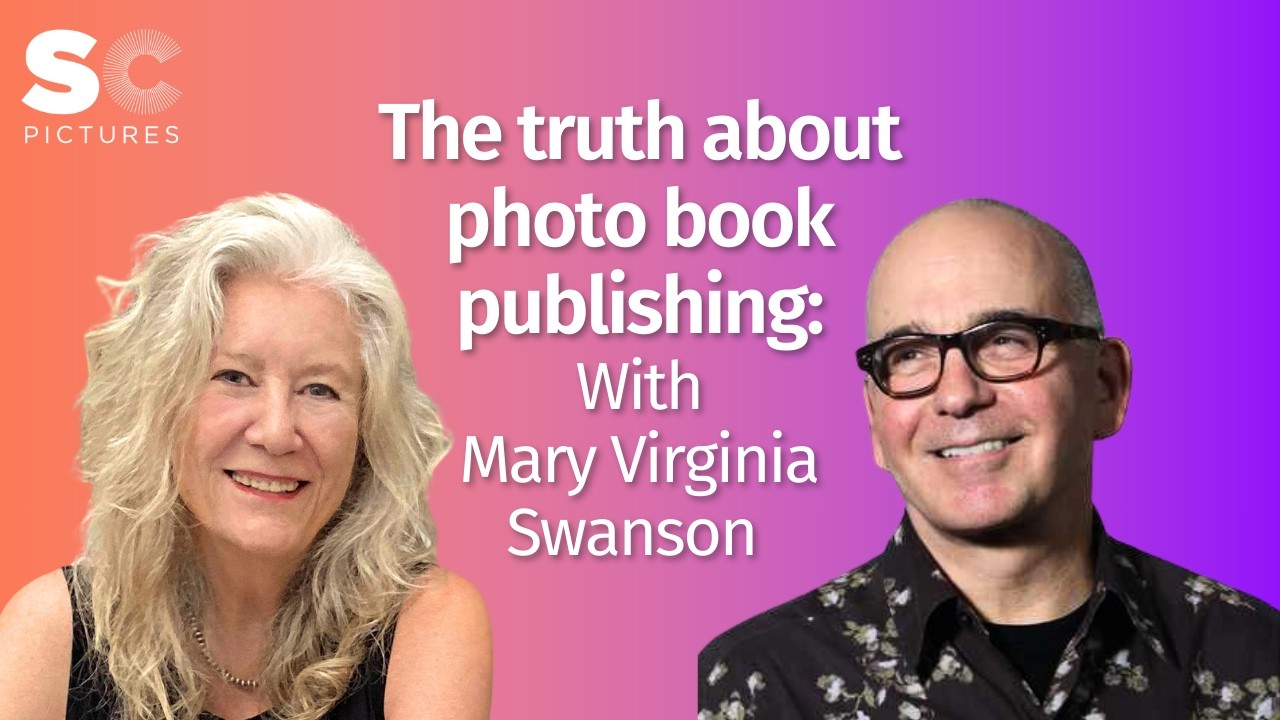
In this extensive interview, host Stewart Cohen talks with Mary Virginia Swanson—curator, educator, publisher, and long‑time advocate for photographers—about every facet of creating, publishing, and marketing fine‑art photography books. They trace the origins of Swanson’s seminal column that became the book Publish Your Photography Book (now in its third edition), discuss how platforms like Blurb and the rise of collectible photo‑book markets opened new self‑publishing avenues, and examine whether fine‑art photo books remain relevant in a world of fragmented images. Swanson emphasizes the power of the book to tell a complete story, the importance of material choices (papers, sizes, gatefolds, bindings), and the role of design collaboration. The conversation moves through publishing pathways—from small presses and limited editions to self‑publishing—highlighting economics, pricing, and the challenges of recouping costs. They explore specialty presses and book fairs (Codex, Datz Press, Dust Collective, Pons Press), small‑run promotional books, and the strategic use of limited editions. Licensing is revisited through Swanson’s experience with Swanstock, showing its continued relevance. Social media tactics, especially purposeful hashtag use and evolving Instagram search, are presented as tools for audience discovery. The interview also covers archiving, subject‑based placement in institutions, and the importance of aligning a photographer’s career goals with the right format (book, exhibition, installation). Swanson promotes educational resources—a downloadable workbook, workshops, and online classes—designed to guide photographers through decision‑making, production, and marketing. Throughout, she offers practical, experience‑based advice, underscoring the need for artists to understand their audience, manage their brand, and leverage both traditional and digital channels to sustain a viable career.
Chapters
Hey all, this is Stewart. I'm here for a little conversation with one of my all-time heroes, Mary Virginia Swanson, who we call Swanee. Let me just say, we're talking about fine art books, photography books. We're talking about publishing, we're talking about licensing, and she is kind of the expert in the country. And so I think this is gonna be really cool. I mean, Swanee has, and you could fill us in, but you're a curator, you're a lecturer, you're an educator, You're a publisher, you're an advocate for photographers everywhere. And I think that's what— that's how I first met you. And that's what has kept me— you in my hero category.
Thank you. And it's been a pleasure to work with you all these years and watch your work evolve and the beautiful books that you've done.
And well, I've tried, I've tried, but it's, as you know, it's a challenge. And actually, This book, and I'm not jumping ahead of ourselves, but, but Swanee has published a book called— is it called Publishing Your—
It's always been Publish Your Photography Book. There you go. The 3rd edition. It started as a column for the Photo Eye Bookstore, which I love, 30 years and growing. And when my co-author, Darius Himes, was working at Photo Eye during his graduate years in Santa Fe. They decided to do a magazine, and he called and he said, hey, Swanee, let's do a column together about publishing your photography book. And this was in the early 2000s, and the column ran for 3 years. It was a quarterly.
Wow.
We did 12 episodes, so to speak, in print, only in print, and it ended with case studies. So it was like Having people understand what your— the possibilities were. We knew that we were kind of writing an outline for a book. In the meantime, Darius went to work founding Radius, and our lives were busy. I was in New York, but we kind of knew one day it would be a book. And 2 important things happened that made us go, okay, now's the time. Number one, Blurb was founded.
All right.
All of a sudden, everybody could make a book. And number 2, the collectible book market was totally on the rise. Andrew Roth's Book of 101 Books, the Martin Parr Jerry Badger series was starting, really looking in a kind of academic and curatorial way at photo books. So we're like, okay, this is the time. We took our column, we updated the case studies, we updated everything. Of course, we added interviews with Eileen Gittens, who was the founder of Blurb, Dan Milner, who who was a complete advocate and still is for self-publishing your books.
Right.
An interview with Dale Kaplan from Swann Galleries in New York, which was the big auction house, the first to do— it's the first place I ever held Robert Frank's Les Américains in my hand.
Right, right.
They were the place for all of that. So we did our first edition with Princeton Architectural Press, a great design publisher. 2011. They sold out. They called and said, let's update, we'll reprint. So our second edition was 2014. Then by then, Darius was working at Frankel. Now he's at Christie's running the international program for photography there. And so busy, busy, busy. Time goes by. The photo book world explodes.
Okay, whoa, whoa. You're getting way ahead of us. I mean, I know you could, you could just go on and talk about like with a straight monologue, but I'm going to, I'm going to temper the conversation a bit. So, um, okay, 2 things. One, I've known you since, I think, around 2007, 2008, somewhere back there.
Yes.
The first time. And I, I think we, we— you consulted for me on my first book, and I knew about you before that. Um, that's before even your, your fame totally exploded. But, um, so, um, the thing that Oh, oh. And then, even 2 weeks ago when we first talked, you kind of blew my mind again when you sent me a link to your podcast, which we will include here, that you did with Rick Smolin about A Day in the Life series.
Yeah.
And, I got to tell you, my brain was about to explode knowing when those books came out and what they did back then even. And, I thought all those trends were kind of More O Quran, but no, that goes way back.
Oh my gosh! And Rick really, he birthed those and really was not a publisher, but he built this model of support right that we talk about in the podcast. That is a great model for everyone.
Oh, totally! It's a must. It's a must listen to.
Yeah, it's.
I'm just gonna say that.
Yeah, yeah. It's all about subject.
Right, right.
And who's interested in your subject? That's the secret to everything, really.
Okay, so now—
That's the book sticker that I want to make. Think subject.
Okay, so my first question for you and why I reached out to you a couple of weeks ago is your— where you sit and where I sit are a little bit different in our day-to-day lives. And my question was, are fine art photo books still relevant? And you answer.
Yes. Yes. I think in today's world where so much is kind of piecemeal, we see an image here. Someone buys one print from a series. It leaves the nest.
Right.
All of that is a challenge to me to really telling the whole story. And that's the beauty of photo books, is that you can tell the whole story. Not only that, but what we've learned over the years and, you know, looking back at classic artist books truly as the sort of origin story.
Right.
We first could print on different materials. Things changed for us in how we think about bookmaking, I think.
Right.
You know, we weren't folding gelatin silver prints in half and stitching a seam. You know, it wasn't happening. Books weren't being made like that. Now, when we look at books, there's multiple papers, there's multiple sizes within. The designers of today's photo books have the opportunity, I believe, to really amplify your story in the size and how it feels and what the materials are. And are we opening things up? Are we physically involved in the choices that we make to open a gatefold, for example?
Right.
Or an elm giving a hint of something ahead or a sense of memory and I just think that telling your story in your, in your full story in the book form is the greatest achievement that you can have to put in someone's hand, the entire story.
I agree. Now, is there going, jumping way ahead to, to, to the commerce side, is, are people still buying books though?
People are buying books. The cultural side of books— horses, dogs, gardens, the works, celebrities— that world is very big. That's the Feiden and Taschen and all, right? Are we going to be able to tell our story to those publishers? Probably not. It's more personality-based.
Okay.
And subject-based. I was looking hard at the transition of Monticelli that lovely brand Monticelli had been acquired by Feiden. And watching that transition carefully, and the way that they've been branding the brilliant Sig Harvey— she's done 2 books with Monticelli, but the second one was completely in kind of the, the Feiden mode now.
Okay.
Published, it says, it says Feiden. And she's branded with Annie Leibovitz in that Within the House of Phaidon as individual artists that are, that are making amazing things in the book form.
So in your, in your quick description, how would you define the Phaidon approach?
I think they refer to themselves as, as culture and lifestyle I wish I had that on the website. I'll, I'll add that link.
Okay.
Our link list, so all of you can see the, you know, how a brand speaks to the public. What's their tagline?
Right, right.
Very interesting. And it's, it's very different. And Feiden actually now sells the, the regular edition, the limited edition. There's even a, what's called a luxury edition of the New England Prints book. It's a whole different thing. The Sig Harvey had prints With the first one, Blue Island, and with this one. So it's a very interesting thing to look at that high end, right? How that's being positioned for their audience versus the small press and the art book world that we're engaged in.
I got you.
Now, who do they speak to? Pardon me. And who do— how do they sell and where do they sell?
Right.
So that's a different path.
And one thing you were talking about, different papers and different, you know, sizes and so on and so forth. I mean, how much of that traditionally is, is with the artist versus, say, the designer that you decide to work with on it?
Well, I always feel people should seek professional help in the design department.
Exactly. Exactly.
Without any question. I mean, I love that, for example, on the Periphoto Aperture Shortlist Awards, they list the designer. Not every— not everybody does, but they should. Again, of course, it's something again that helps you learn. which brand is the right variant for you.
Right, right.
We have this amazing network of photo book fairs and art book fairs too, I should say, you know, very kind of different and now a kind of merging of the photo book and art book fairs depending upon the brand. I'm about to go to the Codex Fair in Oakland, which is the Codex Foundation's— it's the 10th year of their fair that is fine books, rare books, the handmade— they call it Yeah, a book art fair. And there's 3 brands that will be there, if I can remember this correctly, that we know from the photo book world that they're, they're finely crafted, in many cases handmade or limited. It's Datz Press, of course, from Korea.
Right.
Who did the Korean language edition of our book, which is stunning. There's Dust Collective out of Massachusetts, and they have done all handmade until about 2 years ago and started doing Smaller editions. Their new Imani Willett book is getting a ton of press and they did 300. That's it.
Okay. Wow. That's it.
300. That's it. And then the third is a publisher that's been with that fair for years because it's more of the fine art press. It's called Pons Press. And they've done exquisite volumes with 2 volumes with Sig, 40 copies each total done.
Geez.
And they're in libraries and they're in private collections that will go to libraries. We can talk about that too.
Yeah, because I definitely want to talk about when you think about a book, say, with 40 copies, especially done through a publisher, like who's funding that and how are they even recouping their investment, or are they?
Well, they're uniquely beautiful and strategically created volumes. So for example, Sig's most recent book for Two Ponds Press is called Cake. And what they decided to do was give the book block, to 4 different binders.
Okay.
Who designed and built the binding for the same book block.
Wow.
And they're generationally different. And it's a stunning set of 10, 10, 10, and 10.
Oh, that's cool. That's really cool.
Very cool. So, and the book before that that they did was an all-women's team. Woman designer, woman typographer, Woman printer, woman binder. The afterword was by Kat Stefko, who's the art librarian curator of the collection at Bowdoin College in their special collections library.
Oh, wow.
So, I mean, they're strategic as can be, Two Ponds Press.
Yeah.
And they're just about to release a piece with the Caponegros.
Okay.
Paul and his dad's work.
Right, right.
Ennisson just released a piece. So they're starting to focus more on photography. They all live in the Rockport area in Rockport, Maine. Near Mainframe Workshops. But that's a really interesting world, and that's the world that I'm going to learn more about at Codex this year.
Okay, how so?
Well, because the exhibitors are primarily either artists at their tables with books that they've made themselves.
Oh, wow.
Okay. Yeah. Binders, paper manufacturers, and people like Toupont that create these objects By bringing in the experts that are related to that, either that topic or that piece of literature that they're making.
Okay.
It's going to be— for me, that's the learning piece that I want right now, because I've been, you know, partly because of being friends since college with Susan K. Grant, a mutual friend of ours, who's been making handmade books for years and years.
Right.
And learning about this other world and going with her. To special collections library. My favorite visits was actually to the curatorial library at Amon Carter. That was an amazing experience.
Oh, I bet. Next time you go, can I come? I want to come.
Yeah. I mean, we got to see, like, the book dummies for, and the maquettes for, like, The Enduring Navajo, Laura Gilpin. I mean, amazing pieces that we're able to see. So I'm very interested in the evolution of an idea in the book form.
Right.
And how artists choose to manifest their ideas in the book form. Okay.
So on that note, so you— so, so far we've kind of touched on, you have an idea, you have a body of work, right? A graphic designer is important. A publisher is important. Or so many times I hear somebody taking their body of work to multiple publishers. And even if they get some success in somebody saying they're interested in doing their book, you know, sometimes they say, okay, yeah, we could do it in 6 years, or we could do it and it's going to cost you X amount of dollars. And so what is the viability of like a self-published book even?
So one of the questions I ask everybody is, what's the role of the book in your career right now? Like, what do you really need? And one of my favorite examples I show in my lectures are pieces that were created in the book form. There might be pamphlets, might be a handmade, handbound small sampler, if you will.
Right, right.
For a promo piece for a place like PhotoFest. Begin to put the work together, edit sequences you choose, and have something. Like, start now to start making books.
Yeah.
So often people— another favorite kind of thing of mine is don't rush to the monograph. You will learn so much about yourself, about the work, most importantly, if you slow down and make some smaller pieces first and then feel like you, you know the work, you know how you want to sequence it, then step forward into it. But a lot of the publishers are doing really small runs. So let's talk about the small run. small run of 300, for example.
Right, right.
That is something that if you're just getting your work out and you can afford to even self-publish 300, how many go to curators? How many would go to photo editors? You know, many people like— I've watched Matt Eich over the years make small books printed by Conveyor, printed by the firm in Chaska, Minnesota, Smart Press, Linco in New York for newsprint, you know, the Newspaper Club in England, every size of newsprint you can imagine now. Well, those pieces, depending on how lavish you want it, you can probably afford, if you think about it for your marketing budget and something that you're going to send out to people, is more of it.
Right.
So maybe 25% of what you make goes out as a promo piece. And the other 75% can land on your website for sale. Possibly Rixon might take it at PhotoEye, but anytime you add another person to the mix, they're taking a piece of the pie. So a lot of people that really do want to have some of their books in, in a bookstore, get in their online catalog, et cetera, for the beginning of building the brand.
Gotcha. Which brings me to what I should have asked first. What, what role does a book play in an artist's career?
That's the, that's the whole question, you know. Is it— and I kind of equate it to, is it a promo piece? Is it— or all the way through to like, is the body of work complete and it's time to put it out? There's a lot in between that you could do.
Sure, sure.
And the more of that you fuss with and the more— I mean, take workshops on building building a book and binding and just get to get your hands on the material.
Well, like your workshop was great, so it'll be in the link though. If you want an all-encompassing workshop, it's the one you put on.
Well, and I have to say, with my own work, I took my first bookmaking class with a body of work with Susan K. Grant and learned so much. And we ended up with our first dummy in the end. You know, it's, and it's a very rough thing, but it changes your experience and your relationship to your work.
Right.
When you start to think about the writing and all, and how to edit in sequence, and what's the audience going to expect? How does it feel in your hands? You know, all of that.
Sure, sure.
It's really, it's, if you're really interested in it, I think it's, it's a great experience. You can do a lot of that online as well. In-person course is great 'cause you have someone right there to help you.
Right. Um, I think what, you know, one thing I will add, when, um, when I worked with Helmut Newton, he stressed, he said, you have to do books, but you will make no money ever doing books. Is that true?
Well, you know, that's what I've—
that's my experience.
If your subject is culturally of interest, You'll have a bigger publisher and there may actually be some royalties.
Gotcha. Gotcha.
One of the big things in revenue that's changed is that publishers used to look at the net— or sorry, used to look at the gross price, like of the sticker price, get a certain percent of what the sales price was. Now, most publishers Vast majority work off of net. They take all of the expenses first. They take all the returns, which is a terrible problem in publishing. Books get manhandled at the bookstore and then they can't sell them. So they— the bookstore sends them back.
Right.
Who also can't sell them. So they're, they're wasted essentially. It's a problem. So all of those expenses come up with generally almost nothing.
Sure, sure.
You know, are you, are you going to get a royalty and is it based on gross or net is a huge thing. Second thing that really changed is materials are more expensive. Printing is more expensive. Shipping goes up constantly. We have the tariff challenges.
Right.
Making money in the tangible form from this object is very different than you realizing I've been able to sell some prints. I'm going to have an exhibition. All because of the book. I've sent it to the editors at Bloomberg or the New York Times Magazine. I'm getting assignments that's getting licensed. I mean, it's part of the ecosystem.
Sure.
Of getting your work out, if you look at it that way. I mean, when someone comes to me and says, I just printed 1,000 copies of my book, what do I do now? That's not my favorite challenge. You know, I wish that had been thought about long before. Not just really to amplify the work in the book form, but also thinking about who the audience is and getting scheduled to speak at a conference where people, you know, one of the things I ask in the workbook for this book is like, who is the audience for your work? Do they gather? Do they, is there a conference annually with that group of people that are interested in climate change or whatever your subject is?
Right. Well, I think that's why, why your book— like, so many people, including myself, are very impetuous, and, and why reading your book in advance, which it wasn't out when I did my first book, is so important. Because these are questions that one needs to ask. And then you need to show me your coffee mug here. Here, lift up your coffee mug.
Oh, yeah, yeah. This is from the deadbeat publishers in LA that I—
Here, hold it closer. There. Oh. Yeah. And let's see the— what does it say? There you go.
No money.
But, but, yeah, but what it does for your career is exponential. You can't even—
Yes. That also begs the concept that you have a sense of what you want in your career, that you're on a path.
Good point.
And not everybody's thinking about what path they wanna be on. I mean, generally speaking, I think people that work more conceptually in their work want the fine art market. Generally speaking, the people that are doing extraordinary storytelling on subjects from social justice to climate change, you name it, they are on a path to tell as many people as possible that's an issue that's urgent.
Right.
Okay. So they tend to wish to have the work in as many broad platforms as possible.
Right.
That's where we see on Instagram someone's posting and that this was, this was commissioned by Bloomberg or this ran in The Washington Post or this, this.
Right.
So I think that begs always understanding your audience and what's—
Well, also, I mean, and the rare book— I'm not— it's not rare, but, but the books that address a multitude of these things at the same time, like, you know, your artistic endeavor, your, your message you're trying to get across. I mean, those are the ones that really score, right?
Yes. And I have to say, for myself, I'm most interested and I find myself buying more books that I learn about their— the work deeply. presented in an interesting and compelling way and the writing that goes with it, but that I also learn a bit about the practice of that artist. And that doesn't always happen. And I don't mean just literally like an essay in the back by the artist or an illustrated chronology of their work up to this time, or, you know, or an exhibition catalog, which should have those pieces in it.
Yeah.
But I love to learn more about the individual that made the book. And that might be, I mean, I'm gonna pull a book right now.
So, okay, you go, go pull a book. Okay, go for it, Tony.
So I wanna show you a book that's a bit of a beast. It's giant. And it's by Victoria Samionaris. And this is her second book of this scale and of this 10— each one was a 10-year journey through the landscape with her 5x7.
camera. Wow.
The book block. Can you see how this is bound?
I do see it. Yeah.
It's different, right? It doesn't look like what we normally see. This is by Radius Books, by the way. This is this year. So if you look at it, there's the book block taped. So the construction is sturdy. And then we have 3 different books that are in a pocket folder. Wow. So this is where we really— and I should say, let me just show you.
So that is, in essence, that's a piece of art in and of itself.
Well, it's, it's celebrating the grand landscapes that are being made in a classic kind of way.
Sure.
But in the back, we have 3 other pieces.
Okay.
So the first one is A pamphlet that is actually a facsimile inside.
Okay.
A full facsimile. And what it says on the back is, this copy of Herman Diaz's In the Distance contains Victoria Sambionaris's notes, passages she highlighted, and her personal responses to the text. She read the book while on a recent trip and found herself connecting with many parts of the story in real time while on the road. So we get it. We literally, like, we're stepping into her desk and into her studio and seeing her notes and highlights.
Oh, wow. That's really cool.
So it's really cool. And there's a postcard that was stuck in. Then this second piece is contact sheets, doubled up both sides, like 10 or 12 of them. It's a big, big beast.
Okay. So, so she and whomever published it and paid for it. I mean, there's a huge investment in these multitude of pieces in that book. So what, what does that book retail for?
$70, I think, signed.
Okay.
Might be $75 signed. Okay. And, and then there's a third book of— she's organized things that she was drawn to in different parts of the trip. Like these were ships. So she also kind of did a little bit of an index.
Wow.
A subject search, if you will, which we— you and I talk about a lot.
Right. Yeah.
Shifts, and then some catalogs of other things that she found related. An essay is in here with someone writing about the work. And then this is another— this says 18-page booklet published by ASMR4, edition of 200. This was an earlier piece that she found. So it's again, elements that influence her work.
And what she put into the book.
What she's put into the book. Another way that, that Radius has been able to bring us into a practice. This is a book by Stephanie Sihuko, who is in archives. Okay. David, this is like we're looking at a box. It's a facsimile.
Oh, yeah.
Cool. Yeah.
Yeah.
Yeah. Right. And we're in the, in the archive with the index. The top says, Artwork, and the second says texts.
Nice.
Because it's in archives, this is the way it's built. And each of these—
Cool.
File tab. Like, you're in the archive, and there are sections in the book where literally we are— let me show you one. Bear with me, everybody. Okay. So we're— so this is a— we're in this file. And here's the front of the file with like the worn and torn cover.
Right, right.
And the way that, that Radius printed it, we see we're like in the file. There's smaller sizes of things.
Oh, wow.
It really has crazy experience of being in the file.
That's pretty cool. Now, is, is the designer— is David Chicky, is that his name?
Yeah, he's one of the 4 founders and he continues on as the creative director and, and does all the design work. But I mean—
Oh, he does do the design. Yes.
Does all the design.
Super talented.
Super talented. But I love that we are in the artist's practice.
Right. Okay. So bringing it again back to reality a little bit, because there's the— that's, that's a piece of art, no question. You know, is there a sweet spot for an artist? Like, what— like, when you're— when do economics come into play when you're talking to somebody about how much a book will cost? Does it matter? Do people care if it's an $80 book or a $40 book? Like, is there—
$20 newsprint piece.
Okay, or $20 newsprint. Is there a price— is there a price point where, like, a sweet spot if somebody is Trying to think ahead to say, oh, it would be great if we could sell some of these. Is there a sweet spot for, for, for prices?
You know, I don't buy many books that are $70 every year.
Exactly. Exactly.
So oftentimes people will come to me and they'll say, this is the work and this is how I see it in the book form. And they're describing everything. And I want foil stamping on the COVID and I want gold headbands and I want You know, the endpapers to be this and that. And the cash register is kind of going in my head and I look at them and I go, you know, that is probably a $125 book. How many books this year have you bought that are $125 books?
And that's fair.
That's totally fair. But that's a problem. You know, for a lot of people, their first books that they're doing are newsprint and it doesn't have to be, you know, super thin and folded.
Right.
Newsprint on a heavier white stock. That's still affordable but reads more like a magazine. You know, no fold.
Yeah.
Louis Palu on his website, which I'll put this link in again, has this section called Concept Newspapers, and he strategically creates these newspapers. People like David Alan Harvey have been doing the same kind of thing where they're unbound and they can come apart and become stories on the wall. Right.
Oh, cool.
Or we, or we pasted on the sides of buildings. Or you just— one of my favorites of Louis's is Mira Mexico, and he has a section on the concept newspapers again about installations, how people have used them.
Oh, interesting.
Yeah, very interesting.
That's cool.
Those are cheap. Those are cheap. And they, you know, and for Louis, he wanted the most amount of people to see it. This is a— these are like career moments.
Right.
Okay, fair. Bigger pieces that I showed you.
Sure.
And some of the pieces that Matt Eich, for example, has been doing for years are just, are, you know, $25, $35. And, okay. And he makes them often. So we're following his practice.
So there's a gamut. Okay. I got you. Okay. Now I wanna ask you something. And now for, for those of you listening who don't know, like way back in the day, there was a, a licensing agency called Swanstock, which was the Envy of every photographer to be in Swansdock. And you're looking at the swan right here. And the picture is right over her—
Yeah.
At least the camera, right shoulder.
I was so excited that Keith Carter let me use that.
So I understand. I mean, I understand how that all kind of transpired and you moved on from that. Is licensing still viable for a photographer, whether in the commercial sense or, and/or in the fine arts sense, more importantly? Does that play— does that play a role, say, in the fine art, in the whole process? Can it play a role?
Of course. My feeling has always been there's a tip of the iceberg. The best designers at the top will want the best work, and they're willing to pay for it. And that's what we did for all those years, was we worked with the best designers who respected the work, who loved that the artists were involved in making the decisions. And it was not stock, right? Generations had come to know it. Work that was just created as a chance for people to kind of peruse a catalog.
Right, right.
As, as the world, you know, searches now online for images. I—
the content did get licensed, right?
Totally.
Yeah.
You know, for me it was, if I can step back a bit, for me it was my aha moment was being, having a background in museum and fine art and gallery and being hired by Magnum to come into their New York office and develop books and exhibition projects from their archive. So my version of an archive in my head was very different than what I walked into. And I went into kind of a loft-like building where there was a sea of 4-drawer filing cabinets around a central area with big tables. And the photo editors would come in, the art directors would come in, the graphic designers would come in and work with one of the library people to go through the files to find what they were looking for.
Oh, wow. Okay.
So when the first time I opened up a file drawer there and there were standard tabs, this is analog era, of course. And the tabs were like, you know, South of France or dogs or sibling rivalry, you know, metaphors. Not a single name of a photographer. And Bruce, Bruce Davidson came over. I'll never forget this. He said, Swanee, this is how we've been making a living all these years. You know, we make our work, we give it to the librarians, they, they order prints and they go in all these different files. and hopefully get used. And that's how we continue to do what we do. Another thing in that, in that era was whenever a photographer had an assignment anywhere, they always came in to talk to Liz Gallen, who was the library director, and said, I've got a job in Singapore. What do you need? And she'd say, we need an updated skyline. We need this. We need the presence of American-made products there.
Yeah, yeah.
Whatever it was that she knew what we weren't able to sell because we didn't have the pictures for it.
Got it.
So that was a successful kind of combination. The photographers that were more mindful of asking before they went somewhere likely made more money from it. But the example I used to you earlier this morning was you would find Elliott Erwitt in the dogs file. But he was not a brand of his own stature at that point to know that. So the clients weren't saying, We are looking for an Elliott Erwitt. But I promise you, by the end of Swanstock, people— I would go and have meetings with people and bring amazing fine prints and the whole nine yards to show them. And people— I remember clients looking at each other around the board table that we were meeting at, and they go, you know, this feels like maybe a Linda Connor or a Mark Klett picture. And it just warmed my heart because we always sent the submissions by artist. We emphasize our files were by artist always, because we knew the bodies of work that were going on for years. Sure. We're working on their deep passion projects.
Yeah.
And that's what we were trying to place, you know?
Right.
So it was a, it was a beautiful thing.
Interesting.
And, and so it's true that many of the clients have smaller budgets today. We can understand that when we, all we have to do is like Turn on a sporting match on TV or an NBA game or whatever, you know, and they're blasting pictures on the floors and they're— I mean, budgets for— it's long gone are the days of a really predictable set of magazines that that kind of product would be listed in and print ads.
Right.
The number of different platforms that that same budget has to be spent on is completely different in today's world. So the budgets are less. They have less time unless it's a passion project of, you know, maybe it's a nonprofit project of an ad agency or one of their clients that supports, you know, Boys and Girls Clubs or whatever. And they'll even hire a photographer to make pictures.
Right.
Overall, it's a faster world. It's a lower budget world. But I still think the top of the pyramid want better work and will look for it. and wait for it and work with it closely with the artist. It's not as, it's not as frequent as in advertising boom years when, you know, which—
Right.
There were years in the '60s and '70s when annual reports were incredibly creative. And that's a lot of the Magnum photographers really made their, their money, a lot of the founding and next gen at that time.
But, you know, like Magnum is still around and they, so they've They, if you look at them and you look at the changes we've all seen with the photo agencies and publishers and magazines and stuff like that, they have evolved whatever they've done. And I'm not totally, uh, inside on everything they've done, but whatever they've done, they've continued to evolve and they've survived. So what is the word? Survive and thrive, right?
Well, exactly. Every company, whatever your product or your services, you've had to. You've had to, to stay alive. You have to always stay a step ahead.
Right.
No question about it. The thing that I think is important for photographers to realize is some of the basics in your practices, some of your business principles, your archive storage, all of those things have to be maintained.
Right.
As the access and the usage is changing. And the biggest thing of all that's changed to me is search.
Right.
How we think about, you know, when I would first teach social media and Instagram, for me, it's like understanding that hashtags are keywords in the earlier search generation.
Right.
And hashtags should be about drawing the subject to you. You know, for me, it's never been about just being followed. It's been about being found. And that to me is dependent upon you also from the very beginning thinking about the audience for that project.
And okay, so now, but are hashtags still relevant? Are they still—
I think they're incredibly relevant. And for example, when you have a deeper body of work, a project or a series or book, or it becomes an exhibition, I really believe that having that defining form, if you will, at the end of the hashtag On the project tells a photo researcher, this has depth. It's not really—
Their defining form, like what, like, what do you mean?
Like, like, like it's an exhibition or it's a book?
Oh, I got you.
I got you. Some people use series until it's more completed and then they call it a project, whatever.
I got you. I got you.
Whatever thing is that you're working on. But there's an audience for everything. So if you, if it's climate change, if it's social justice, as I mentioned those 2 before, giant categories. Well, if you just hashtag climate change or social justice, there'll be millions and millions of pictures in that.
Right.
The chances of being found are really slim.
So what's the, what's the, what's the key?
Well, to me, when you add that, that ending vocabulary, series, project, book, exhibition, and then accordingly, every hashtag, every image that you post from that series, project exhibition book. Sure, it's that hashtag. You're building a collection of images in your Instagram.
Okay.
Oh, I'm always excited when I see an image that I love and I see that there's a hashtag for that project and I click on it and it might be everything from out making the work to editing and sequencing to ultimately being on press or hanging. Okay. I mean, it's like a behind-the-scenes collection.
So, so to our people listening, is it possible to go back to what had been previously posted and to add hashtags?
Yes.
And you do that in the comments, right?
Well, I like it right in the post personally, because you don't know that people are going to click in the comments. The problem that we have, the unknown that we have right now, is, as all of you I'm sure know, in the last couple of weeks especially, Instagram is changing their search and the number of hashtags that you're allowed to do. And my understanding is that they're doing that to make way for AI to come in and do the search, to not have human search. I think the last— well, we'll have to double-check at the time of this posting, but, you know, it's under— it was under 10 that they were going to allow you to use.
Right.
Probably get it down to 3 before we know it. Those have to be very strategic. If your post is about your gratitude for someone that gave you an assignment, They need to be tagged, you know, but the hashtag for you and the projects can still be real and still be building a collection inside your Instagram. So I really hate it when there's no human search and it's all— yeah, but that's, that's letting AI interpret your project, which, as we all know, you know.
Well, that, that's a, that's a whole other—
yeah, yeah, that's a whole other thing. Yeah, that's my That's my concern. The capabilities for search are huge. And when I sit and watch photo editors do this and look at thousands of images because they've pulled up a certain tag that's very specific, right? You know, and good work rises to the top. But it's— I love watching people work using search on Instagram. It's very informative.
Interesting. That's real. That's fascinating. That's something I didn't think we'd get to today, but that's great. But hey, listen, I could, I could talk to you all day, as you know. But I'm just looking at the time and I'm thinking one thing I definitely want to get in before we wrap up is pretty much what do you have coming up and where can people find you? And because honestly, just if I had never heard of you and I was watching this, my brain would be exploding. And I'm like, okay, I need a month to research this woman. So—
Well, you know, for me, I'm dedicated to helping people find their audience, find the right people that are most likely to respond to the work, and present it in a professional manner. So a lot of what I try to teach is research-based in knowing yourself, knowing your project, and who the audience is going to be, because that's the gateway. If you, if you know that, you can set some goals. You can know that a university art museum where they— that university has like a center for environmental studies, and that's what your work's about. Ding, ding, ding. You know, that makes sense.
Right.
So I try to do that, and I, I put myself out there in, uh, online space. I'm doing a, a 5-week online marketing class for Maine, but at the same time, later in the summer, I'm gonna do an in-person for 12 people for 5 days with Santa Fe. It's a very different kind of experience. I do a lot of one-offs. I do a lot of things like this, talking with you. I love to be able to share the information for people at whatever stage they are and whatever they can access. You know, during the pandemic, we developed amazing classes with Laluz where we had 100 students from, you know, 30 countries, and it was incredibly gratifying for everybody and to meet each other and the whole 9 yards with that.
Sure.
So I love all these different places. I'm super proud of the book. One of the things that I want all of you to know, um, in our 3rd edition— it's a Radius book now. In the beginning of Radius, they were more of a monograph publisher. They agreed that now our audience is their audience. There's a detachable workbook.
Okay.
Inside each one, because we really feel that people are self-publishing and considering it. And so it divides it into the decision process, the production process, and the marketing process. But The great thing that we did, I'm really super proud of. This is a 16-page version that comes in everybody's book.
Right.
And you can write on it. You can fill it in. I ask tough questions all the way through. Good. Point you to testing papers and everything. But on our website, which is publisherphotographybook.com, everyone can download the 32-page version of the same booklet.
Oh, wow.
Free for anyone.
Okay.
It really— and people come to lectures of mine and they show me their binder and they've got, you know, all their paper samples are right there. Their list— they've added paper, added blank pages and listed the favorite books, you know, of the fall, of the spring, and, and what it was about them. It was the paper and this was the paper, or it was— they didn't use, uh, any page numbers, but they had a list of plates at the back. You know, so you have all your resources, all your research in one place. And so I really urge all of you, even if you have— even if you're a ways from it, that decision process in the beginning is going to force you to think about who's the audience. Also, it asks things like, you know, of course, why is it— why a book? Why not an exhibition? Why an installation? Why book form?
Right.
Yeah. What steps remain in order to complete your project? So we don't assume anybody's done. And you, the more you know about what you need, the more you're likely to have someone sitting next to you on a plane or a train or whatever, or somebody's cousin that works for a rental car company. And that's what you need for next summer is a rental.
Right.
Hit all the national parks, whatever your project is. Um, write the 1-paragraph description, write the 1-line summary. In the marketing section, I ask, you know, who's the audience? Do they gather, as I mentioned earlier? You know, what are the associations that, that are interested in this subject? What are the hashtag vocabulary for your project? And then what, what, who should you be following that is interested in the— it's like just to drive. Okay.
Yeah, no, this is great.
It's a checklist, really. But understand that the book in all of its editions has never been a how-to. It's about what's possible. Okay. It's really— and there's incredible roundtable discussions. The most important change for those of you that have the first and second edition, the third edition, the hardbound Radius, $40, free shipping on their site. We always want to promote our publishers.
Yeah.
There is a new chapter that is all about the limited edition and the artist-made book.
Oh, cool.
And understanding that audience. And Susan K. Grant wrote a great piece about presenting your work to that community, how to network, what's the vocabulary, what is a prospectus. That's the piece, the marketing piece that they need at the public libraries, academic libraries, curatorial libraries that collect small press, artists, unique things. So it's very interesting. Of course, it's robust in the self-publishing part. My contract collection is really ramped up, the marketing section ramped up, all— but it's really, ultimately, it's about what's possible so that you make the right choices. And that's why, for me, going to book fairs, looking at all the shortlists— there's so many competitions now— look at all the shortlists and see what books and why you think.
And why. Yeah.
Okay. Why are they being chosen? I look every year at how many are self-published?
Okay.
Arie Photo, for example. How many are university presses? Because, you know, we ramped up university presses in here also. I love Alan Thomas at the University of Chicago Press, and he wrote a great piece for us about that. We have pieces—
Oh, good.
About the state of the state, so to speak.
Right.
It's really— it's, um, I, I— it warms my heart when I hear publishers telling me that when, when proposals come in from artists, they write them back and say, Go read this book and then come back.
Then call me. Okay. Well, on that note, so the thing that I think was so great about this conversation is I think especially still photographers today feel like they're being assaulted from all ends, whether it's, you know, AI, whether it's downward price pressure. I mean, it seems like it's everything that we've had is slowly being You know, eroded. And I think what you've presented here is just such a statement of empowerment on how we can control our destiny and our career paths. And what I'm going to mention here is we're going to— Swani is going to be nice enough to give us a list of links of everything she talked about. So, stick around to watch at the end because I think that's something you're going to have to go through and then you could relisten to the whole conversation. Yeah.
Yeah. Can I, can I talk about one thing that is later in one's career? You know, part of the reason I think it's really important to think subject now and be mindful of the audience for your subject is that a lot of, a lot of our friends are, are trying to place their archives somewhere.
Oh, okay.
Right. And the Center for Creative Photography is 50 years old this year. It was one of the earliest really photography-based archives with now nearly 300 archives and, you know, founded by—
Oh, wow.
And just, it's amazing, you know, for artists, as Ansel wanted, was for artists to have a window on what it is to have a life in the arts.
Right.
Okay. Correspondence, it's their libraries, it's everything. So most of those places are full. Physically, like, they have a capital campaign to add a couple, you know, if the building was retrofitted in the beginning to be able to add a couple of floors.
Right.
They go to offsite storage. Most of the, like, for example, at the Center for Creative Photography, many of the objects that came in were old then. Now they're 50 years older. They've put in some incredible cold storage facilities. So just care and feeding of the archives that you wish to be a part of. Has been challenging. So archives are being much more selective about what they can take. And what I'm seeing is people having greater success and a broader audience, which equals gratification to me, of placing their work of a certain subject in a repository that makes sense because of the subject. Might be—
Oh, I see.
City archives, might be a museum of natural history.
Gotcha.
It depends on what you've been engaged with.
Sure.
So, so that's kind of a shocker for people that all of their life their career was based on them being the subject. The artist is a subject, when in fact a lot of dealers for years now have been able to take those pieces and place them in a repository that's all about that, that puts you with other writers, thinkers, scientists, You're the art part of a topic.
Interesting. So basically, in essence, it would be like, like subdividing up your archive based on subject, which goes back to the whole Magnum conversation you were—
That's right. That's the first, the first for me exposure to that broad search by subject. But in fact, when we think about where things are, you know, they're by subject.
Yeah.
Unless you are the subject. And there's— it's like, how many, how many street kids playing basketball become NBA players?
Exactly. No, it's pretty hard to become the subject.
Yeah. It's hard to become the subject. And that's why when I look at Fiden and it's Annie Leibovitz and Sig Harvey, I mean, we're thrilled that Sig is there. And I think it's great for photography for both of them to be That, you know, pillars in their aspect of their career. And— Right.
It's interesting.
Okay.
I'm going to ask you, just since we're going on, I'm going to ask you one last question that we kind of talked about earlier, and I just want your quick answer. So does the fact that, say, okay, Getty owns Slim Aarons' archive.
Okay.
So does the fact that you could license a print on demand of, of Slim Aarons for $35 and put it on your wall, does that diminish his value of the artist because it was available at that price?
Well, a couple of things. One is it's not a vintage print.
Right.
You know, if it's a vintage print and there's a gallery that's built that market and has a rarefied audience for that, and maybe it's a, it's a, maybe it's They see something that was even printed in platinum that hadn't been on the market before. Those have bigger values to a different market.
Of course.
The market, the print on demand, essentially what this is, Library of Congress, same thing. You know, back in the day, you could order Walker Evans and it would be printed in their darkroom from the— because those, that project was part of the public domain. So that, I think that makes for great joy for people to live with work. that they appreciate. But I'm going to share a story, if I may. When I had started Swanstock in the '90s, after being inspired by Magnum and calling my friends that owned galleries going, listen, you're missing this market. The artists have all this work that they've exhibited and it's in boxes on the top shelf of their darkroom. It could be book jackets. It could be this.
Right.
And so I was on a panel at the San Francisco Museum of Modern Art in the '90s.
Okay.
I think it was an ASMP panel on art and commerce. And a question came to me, you know, the same thing. Is it diminished when you at Swannstock license things? Is that diminished to the gallery market? And I said, well, let's ask Sandy Phillips, who was in the audience, the curator of photography at MoMA for years. And I said, Sandy, let's say you just raised the money to buy a portfolio of Linda Conner's work from India. And on your way home, you walk by a bookstore and you see a book jacket that I placed one of those pictures on that, you know, carefully licensed, appropriately licensed, that for which Linda will make some revenue. But it's the same picture that you just paid money for the fine print in the portfolio. Does that— how do you feel about that? Is that a problem? What she said, if that check from Swanstock can help Linda get back to India and continue that project, I'm all for it. So we don't see those as apples and apples at all. It's apples and oranges. And David Travers from the Art Institute of Chicago happened to be in the audience too, and I threw it out to David, you know, curator. He said, if it keeps the photographer working, that's what we want. And that's what I—
Great.
You know, so it was—
And it also makes it makes it an image that the general public has seen. Like you think about, and I forget the title of it, but that famous Robert Doisneau picture of the couple kissing by the Eiffel Tower. I mean, it's everywhere, right? But yet you go into a gallery that still has an original print of it. I mean, and it's an expensive print.
Yeah. Well, and that's their job is to protect that part of the brand. Like, for example, Edward Weston's archives here at the Center for Creative Photography. And many of the photographers there have the center handle licensing. Why? To make sure that they are included in the academic textbooks and all, but that the licensing is appropriate. Like, no one's allowing putting Pepper #30 on a coffee can at this stage.
Right.
You know, back when Ansel had a picture of Yosemite on a coffee can, those were in the days when, You did— your career was broad. You brought revenue in at any time. Now, of course, those are very collectible when that happened. But my point being, you're protecting your brand.
Okay.
Yeah. They're protecting your brand. You're protecting your brand. You know, you don't want things licensed, you know, and maybe you choose not to give the same work that you are selling in the galleries At available as stock until after the show has had its run. I know with us, that's what Olivia Parker did. We couldn't have her newest work, but after it had been shown, then we could license it. And so you'll all—
Yeah.
And you'll all find a way to figure out what your ultimate career goals are, how you can generate revenue along the way. I'm amazed at how few artists on their, on their contact page have even You know, for inquiries, you know, or I welcome whatever your tone is. Yeah, welcome. I welcome your questions about exhibiting the work, acquiring fine prints, and appropriate commercial licensing.
Sure.
That triggers to the art directors and designers they can't make a Mac mess of that picture, you know.
Right, right.
You're kind of qualifying it. at the get-go, but you're open.
Just listen, at the same time, as an artist, right? I mean, we're looking for what— like what you were saying with the Magnum guys back in the day is, you know, we all need to make income to continue to be able to hone our craft.
Right, right. Um, so you'll all— you know, I encourage people to, to understand what drives them creatively what values they place on the work that they're making and kind of control things. And you set the tone on your website, you set the tone on any social media, you certainly set your tone in a newsletter or a Substack. We're first person, you're talking to us.
Right, right.
And that's where you can really amplify what's important to you. And I think too few people do that. Like, let us know who you are in a, in a first-person way.
Gotcha. I think that's great. I think that's great. Yeah.
Okay. I think I try to help people with, you know, and I think it's really fantastic.
Yeah.
So I appreciate that. And I hope that I'll see some of you in my online or in-person classes.
Right. And I got a lot out of that. So thank you for, for all, all that information. And anytime talking to you, even if it's stuff we've discussed previously, Or I've heard you talk about previously. Every time I hear it, it's always like a knock on the side of the head.
It's like, oh, wake up. We have to stay on top of not just our subject audience, but also the markets that we're interested in having the work in. You've got to go there. If you can get to the book fairs, do. If you can get to APAD, do. Both very different, but recognize here's one common thing. They're there to sell the books that they've published, or at APAD, they're there to sell prints. At neither of those public arenas are they there to look for new talent. So don't be the ones that we talk about who would not give up with forcing the book dummy in the face of the publisher. They don't remember the work. They remember the rude person that didn't recognize that that's not what they're there for.
Ouch. Yeah. Ouch.
Be polite.
What do you think, everybody? That was great, right? Swanee is the bomb. Links will be listed below. Listen again, tell your friends, like and share. Asta.