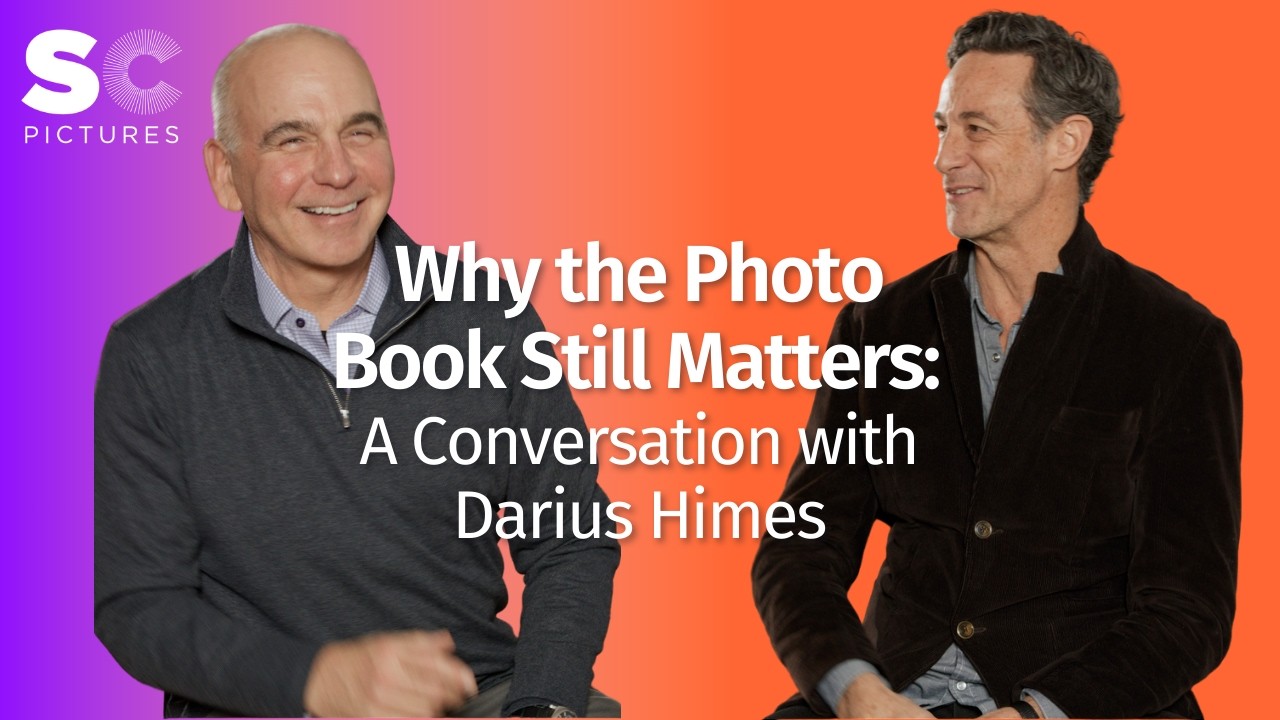
In this conversational interview, host Stewart Cohen and photographer/industry veteran Darius Himes discuss the continued relevance of photography books. Himes explains that since the early 2000s, e‑commerce and the digitisation of used‑book inventories sparked a renaissance in independent, art‑house photo‑book publishing, exemplified by initiatives like the Aperture Perry Photo Book Prize. He co‑authored a practical guide for photographers that walks creators through defining their goals, understanding the high manufacturing costs of quality photo books, and recognizing that books rarely generate profit but serve as powerful marketing tools. Himes advises photographers to treat a book as an extended promotional campaign—printing limited runs, leveraging the book to secure gallery shows, press coverage, and collector interest. He also addresses licensing, arguing that widespread image distribution does not devalue fine‑art work and that social media is a marketing amplifier. The conversation moves to editioning and pricing, emphasizing rarity, audience‑specific strategies, and the need for a solid business plan that treats the photographer as a manufacturer. Overall, Himes frames the photo book as a strategic, reputation‑building asset rather than a revenue source.
Chapters
Welcome.
Today we have Darius Himes, and we're going to talk about photography and books and stuff.
Thanks for having me. Happy to be here.
Absolutely. Biggest question on every photographer's mind: are books, coffee table books, are they still relevant?
Oh yeah, absolutely. I mean, since, in my opinion, since the early 2000s, which is when we all began e-commerce, there's been this huge sort of renaissance in in photography books, and that's partly been driven by the fact that all of the content of used bookstores around the world suddenly came online, and there was this whole interest in the history of the photo book and the history of illustrated books in general. That's kind of like faded off, and there's like a whole boom around small independent art house publishing.
Oh, really?
That's, that's really a global phenomenon. I mean, things like particularly the Aperture Perry Photo book Prize is like the biggest example of that.
Right. So now, books, like the concept of going down the path to do a book is somewhat daunting.
Yeah.
Are there any aids out there, anything you could do to help get your head around what it takes to get a book done?
Well, I wrote a book about that.
Okay.
Which I co-authored with my friend Mary Virginia Swanson, who I know you know. And it was really a book that was written For photographers aimed at a photography audience. Every photographer that I talked to always was like, how do I publish a photo book? So this book is a guide to how does that industry work. And we always start with the question in the book and also in our workshops about like, what do you have to say as the photographer? What do you want to do? What's your goal here?
Right.
And I think that's a healthy place to start.
Once it's printed, everybody thinks about getting to the publication part.
Right.
And that seems like always the biggest step. What's in the book? How do I find a publisher? How do I get it printed? Then it's published.
Right.
From my experience, the work starts when it's published.
Absolutely, yeah. And you should be thinking about that well before you even go to the printer.
But you don't. Nobody does.
No, but you should. So if you're, if you're working on a book, start thinking about that now. I mean, it's really about And this ties into what are the goals. Like, first of all, just to dispel the big myth, nobody's making money as an artist or a photographer or even the publisher by publishing photo books. There's just no money.
Okay, so then that's key.
That's super key. If you're an author writing a novel, it's just black ink on cheap paper. That's the cost. If you're doing a photography book, we're talking about nice paper, 4-color, maybe 5-color, 6-color printing, beautiful binding, large trim size, like all of those things add up.
Right.
And so the manufacturing cost is so high that you then really can't recoup the costs, which then raises the question, why am I doing this book, right?
And what I have heard—
Yes.
Is you never make money in photo books.
Right.
But what it does for your reputation Yeah. You can't put a price on.
No. So if you go into this whole process thinking about a book as essentially an extended marketing campaign, and that can be, you know, first of all, you don't have to print a lot. You could print 50 copies of something. It can be very fun and low-key and like just make a handful of them.
Right.
But the idea of a book that is marketing, Which means it enhances your reputation. It's something that you can share with either collectors or curators or people who you want to hire you if you're looking for that kind of work. I mean, it can be used to facilitate other elements of your career. That's really the best way to think of it.
Perfect. And then also with the books, do we try to do shows? Do we—
Absolutely, yeah. You should use it as the vehicle for all sorts of things. So you may— it may be The work in the book may be something that you're approaching a gallery about, or you may even approach a gallery and say, I have a book concept, would you be willing to partner with me on this?
Oh, interesting. Okay.
A book doesn't have to have 100 photographs. Your first book doesn't have to be a career retrospective. It could be, it could be 25 pictures that don't fit in other bodies of work. It could be one small body of work. It could be whatever you want it to be.
Okay.
Right? So there's lots of different ways. It should absolutely be a reason to call up your local magazines and newspapers and say, hey, I just had a book come out. Can I send you a copy? Maybe they'll want to do an interview with you. I mean, depending on where you live, all of this could be reasons for activity that gets your name out there.
Those are great ideas.
Yeah.
Another thing we've talked about since you've been here, we've been looking at a lot of old archives also.
Yeah.
And we also started talking about the concept of licensing.
Yeah.
And how does that fit into one's career? And is it a viable option in these days?
Yeah, well, you're the expert on licensing.
Well.
And I think it is. I mean—
But I mean, in terms of the value of, say, a body of work, say a photographer has shows.
Right.
Right? And he's in the fine art world, or he or she. Does it diminish the value of the quote-unquote art if one licenses it also, in your perspective?
I mean, in my view, there's so many outlets and ways to get images out there that most— I mean, most people are not able to track all of those outlets at the same time. So if I'm seeing artwork in a gallery or in an art book, I guarantee you I'm not seeing it if it's being licensed somewhere out in the world. So I really don't think it's—
And the truth is, sometimes I think if you, if your work is out there in the world, it actually makes it more enviable.
Yeah, yeah, yeah.
You know, because it's like, hey, I've seen that before. Yeah, yeah.
There's, there's like old-school photographers that I've worked with where they're, they get upset if they see their work on the internet or on Instagram, and I'm like, why? Like, all press is good press, and it's like, just get your work out there, right? Like, sometimes photographers ask ask me, well, I don't want to put all of this body of work on Instagram at this moment because I don't want to— and I'm like, you don't want to what? Like, you don't want people to know about it? I mean, it's not— you're not giving it away. You're, you know, Instagram and social media is really just a marketing amplification. You want to drive people, right? Like, you want to drive people to do something, whether that's on— go to your website or go to your Go to your galleries and buy things, but that fear of just putting work out there in different ways should really not stop you.
Okay. Well, here's the last thing I want to talk about, and this is something I learned since you've been here. And, you know, the perceived value of a photograph, right? And the perceived value of an archive, right? You know, we all think our work is worth so much money, and we've been talking about what the prices that well-known photographers get at auction. Yeah. And I was really surprised how, you know, if somebody floods the market with their work in a variety of sizes and formats and so on and so forth, it actually devalues it.
The history of the photographic print market is long and varied, and there was a period through the '70s, '80s, and '90s where, as we talked about, a lot of photographers were producing things in multiple sizes and Edition sizes were such that it now looks like a lot, and edition sizes have definitely come down. And essentially, the primary market is where living photographers should be most concerned, meaning working with galleries, putting work out there.
Got it.
There's no way to really control the secondary market, but in today's contemporary art environment, Smaller editions are gonna do better than, as you talked about, like a flooded market of lots of edition sizes.
So that's key. Smaller editions will do better.
Absolutely.
Long-term.
Yes. Yeah.
Supply and demand.
Yeah. Yeah, you got to keep things rare.
Okay, there you go. That's fair.
From where I sit now, having worked, you know, in a major gallery and worked with a lot of photographers and now in the auction space, which is secondary market, It's very interesting to me to watch how the rest of the larger art market operates, and this question of sort of how do you position— a lot of young photographers will come and say, I don't know how to position myself. How many prints should be in my edition? What size should I do? What do I charge? All of this is— these are all fair questions, and in a way they're They're unanswerable by any kind of formula. But I would encourage you to think about your pricing and your editioning should match the audience that you're trying to reach.
Okay.
So if the audience you want to reach are the people that go to the coffee— local coffee shop and want to spend $50 on a photograph they see hanging there, that's going to be— that's one kind of an audience.
Yeah.
But if they're— if it's a sort of more high-end gallery that is spending— the cheapest things they have are in the thousands of dollars, you may want to think about exactly that, where it's not about who do you know that can necessarily spend money, but who does the gallery know and what is the market that you want to be part of. That's a big way— that's a big sort of—
So there's a lot of thinking we need to do in advance of any of this stuff.
Yes, absolutely.
Got you.
It's about strategy. It's business strategy. I mean, at the Baseline, as a photographer or an artist, you are also just a manufacturer. You're manufacturing goods for a marketplace.
Okay.
So think about that. That is a business plan you need to have to think about. How much am I spending on manufacturing? What do I— what is my market? Who is my audience? And what's the target price?
So one of the things we have to think about is even though people call themselves artists, feel like they're artists, they have to have a business hat also.
You have— and either yourself or get advice from somebody who is a business owner.
Right. Okay, that's great.
Yeah.
So on that note, because we gotta go, so it's Stewart saying thank you, and Darius—