AI Advantage Webinar Series: Kyle Norton, Planning your 2025 AI Strategy
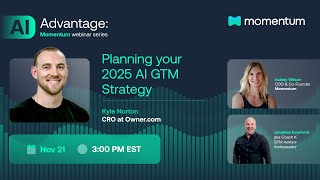
Kyle Norton, CRO at owner.com, walks through building an AI strategy for sales teams in 2025. Start with clean data and CRM hygiene. Pick narrow use cases to avoid hallucinations. Use AI to automate low-value work so reps spend time selling. At owner, they've deployed Momentum for call transcription, custom GPTs for content, and lead scoring that lifted BDR productivity.
Chapters
We are so excited to have you all here. My name is Jonathan Carford. Some people call me a coach. I'm really excited to be the host for the series, the AI Advantage Momentum webinar series. Just we're here with Ashley, the co founder with Kyle. We'll get into some intros in a second. Before we do, I want to get into some stuff around this webinar series. We'll be holding these at least monthly, maybe twice a month after the new year. And the whole point is to do with this particular series is to showcase just different leaders in the field like Kyle, to showcase how they're thinking about AI and how they're approaching AI from a strategic viewpoint. And I think in the spring, actually we're talking about doing more of a practical series around prompting and maybe some other different types of topics, which would be a lot of fun. But this series with the AI Advantage will be happening once a month with different leaders. So our next one is up on December 11th at 5pm Eastern. If you have registered for this, I will be sending you an invite to us if you want to join us in talking with Toby Carrington of Seismic. It'll be a lot of fun to talk about AI at scale from his viewpoint. And that will be. That'll be a fun, fun chat. But for now and today we have here's our basic agenda. I want to go over and give. I'm going to hand the mic over here in a second to Ashley to introduce Kyle. But we want to go over what's the strategy of 2025 from Kyle's point of view as the CRO at owner. And then I had Ashley prep some things as well from her ViewPoint as an AI native startup, literally from our from the technology of momentum all the way up to all parts of the operations. Then lastly, if we have any questions that are unanswered, we'll get to those. And please, during this, bring in your questions. This is might feel almost like a podcast cause I might be interrupting Kyle as we go or actually to get some thoughts on different parts of it. So it's not just gonna be a presentation. I'll probably be bugging in through this, so I'll try not to ruin your flow too much Kyle as we go. But it'll. It'll be a lot of fun to dive into some topics that you have planned for us. All right now I'm gonna hand the mic over for a second to Ashley. Let you introduce Kyle.
Yeah, I'm super excited to have Kyle as our first guest we feel like we got to know Kyle. I think, gosh, almost two years ago now, I think it was like spring of last year, 2023. And I think what's been great about working closely with him and the owner team is that I feel like they're really on the forefront of where the world is heading. And I think that they've helped us both from us founders and within our product think about maybe where the puck is going to when it comes to bringing practical AI use cases into kind of go to market workflow. That's what we thought about with this kind of kickoff of this webinar series which as Jennifer mentioned, we really want to make it more of a conversation is to really just say when it comes to AI strategic planning, a lot of the teams we're talking to are still, they haven't jumped into actually implementing AI at scale. So I'd love for Kyle, I think we can talk about that. Some of the kind of Q and A question, but just very excited to introduce him and I'll let you take it away.
Hey everybody, thanks for having me.
Welcome.
Do you want me to do an intro like background thing?
Please.
Yeah, okay. Yeah, please.
I'm currently the CRO@owner.com, been here for two and a half years. We're a vertical SaaS startup in the restaurant tech space. So you can think of us as Shopify+HubSpot for the little tiny takeout restaurants that you order from on Friday night. And so we deliver to them website online ordering, email, text message marketing, custom branded app, a whole bunch of other stuff wrapped up into one package and done for them. And we're about a 25, 25 million ARR business, very sales driven. So our sales team's about 50 folks with a implementation team that's got a lot of manpower in it as well. And previous to this I was at Shopify for a bunch of years. I ran a quarter billion dollar business unit there was across sales all the way through CS and then I was a VP of sales at another startup before that in the health tech space. So that's me.
Kyle, quick question with a sero. Cause I know it changes based on industry. Are you over like marketing CS the entire journey or what's your purview right now?
So I have demand gen but not brand sales. So BDR, AE RevOps enablement partnerships in BD, new customer onboarding. So our launch team but not CS and support today.
Got it. Awesome. I give that some context. I'm ready when you are, my man.
All right, so these are some of my thoughts on where AI is going and how we should be thinking about this investment and how this has shaped like what we're doing. And so this first point here really informs why Momentum was one of the first AI tools that we implemented. Because it is my opinion that to get the right impact of any of these investments, you need high quality data that underpins it. Because either if you are tuning a large language model or the large language model is taking in a bunch of data into its context window, all of those things, the outcomes, the quality of the outcomes is really determined by the quality of the input. You hear this all the time, garbage in, garbage out. And if you want an, an AI tool to tell you what deals are at risk, what you need to do as next steps, et cetera, et cetera, like all the things that are promised out there, all the way back to Insight Squared was doing this like years and years ago. It really, it is really incumbent on the quality of data that you have in your CRM and in your database being solid. And there's two vectors here. There's two things that are going to get you to good data. One is having good prospect data in there and finding a way to keep that hygienic. So finding a way with good sentiments and disposition, good CRM hygiene by your reps, that good information is flowing into your CRM. And also you're finding you're using tools to improve the quality of data on mass that are going, that's going into your CRM. And so this is one of the Arbeg Momentum use cases. We scrape in call data. We've written a bunch of prompts that write into specific salesforce fields across a number of different objects, account person, opportunity case objects, so that we are pushing as much data into our CRM as possible. And the trick there for us, and the reason that Momentum was an early choice for us, is we are able to en masse, take unstructured data from call transcripts, emails, data that doesn't have a very discrete home in a field, and find that, find a way for that to go into discrete places in your CRM. And so a specific field with a specific value so that I can understand the competitors that people are using or the reasons that they were uncomfortable moving forward with us, or churn reasons that all lives in the ether, basically that all lives in your call data, your email data. And we made the decision that the first thing we were going to do is leverage AI to make the foundational data that is Going to power everything else, propensity models and any use of AI tools, it was going to give us the right foundation. So this is my number one thing that I suggest to folks as they think about their AI strategy. Is the quality of your data good enough to really like now make decisions on top of and if it is not, try to go, go find a solution to make that true for us. It's momentum, there's options out there. But I would say start here. The second thing I will say about AI and the solutions that I have demoed or piloted that are cool demos and bad production use cases is really around specificity. And so if the tool you're evaluating is says we'll write all your emails and pick the customers and send it out and tell you what to do next. And that's what the, that's what you're trying to buy a tool to do. There's way too much surface area for a language model to do that maybe a solution if you had individual agents doing each part of the, each part of that production line, maybe you can get there. But the wider the surface area that you give an AI solution, the more hallucinations, the worse the outcome is going to be. And so I try to think in very discrete components. I'm trying to apply AI in places where it can pattern match very closely, where there's a pattern of what good looks like previous I can point the AI just at that and then give it an outcome. So think narrow in your applications of AI is number two. And my last sort of strategic principle that I will encourage people to think through is it is my opinion, and this is a speculation, this is a judgment of the future, so it very well could be wrong is that I believe that the best applications of AI will enhance and augment the rep as opposed to replacing it. Related to point two here, the more surface area you give to a model, the more it's going to hallucinate and give do weird things. And if you're not in a huge market, you maybe can't take that brand risk. And so I'm really thinking about using AI in ways that can supplement, improve, enhance the productivity of my sales reps rather than replace a bunch of stuff that they're doing. I, I, I'm really focused on what are the lowest value things that the rep can do that are rote tasks that are basic and an AI model could pattern match and do for them. That's where I'm really focused on and I'm not as focused on replacing my bdr team with AI Like I'm not a yet a believer in that question.
For you on that one. If I can ask, how do you position when you look at the lower level, lower value tasks that AI can do for someone we augment or help with, how do you look at that in comparison to what they could then do better with their time as far as value with any AI tool like how do you as a CRO look at that and say okay there's here's the real value is not the necessarily the work it's cutting out, but the stuff they're getting back in productivity or better use of time make sense.
RGA's over everything. Revenue generating activities over everything. It's like a thing we say internally all the time. The more I can take out of the reps workflow that is low value, the more that they can do that is high value. And like an example, we've built an internal tool that takes the specific lead. So there's a scoring, we built a scoring algorithm that tells us the potential size of that deal plus their potential win rate. We call it E Win and so it matches their EGMV with their E win and that gives you an IROUT score. And then based on that IROUT score, we put that lead into the specific cadence for the BDR to call. So instead of a BDR sitting down and combing through leads and building their list and clicking import to sales loft and doing a bunch of stuff, they just, they sit down at the beginning of the day and they know exactly who to call and they just bang through their calls. And so my bdrs can make a high volume of calls on a daily basis and they want to make money. I want them to make money because that means they're producing results for the business and you're really trying to find anything that doesn't drive specific business value, that doesn't require judgment, skill or ability to be done through automations or AI.
I love that. I love your formula too. You did for things. It just means you're being more productive with better quality time. Which is awesome.
Yeah, yeah. My our BDRs have gone from our BDRs produce today probably three times the closed one ARR that they did 12 or 18 months ago. It is a significant competitive advantage for us.
Yeah, that's amazing.
All right, so I've touched on a little bit of this but it's just a helpful slide to think about the juxtaposition AI is good at pattern recognition, filling in the blanks, not good with tons of ambiguity. I've already talked about that. I think it's really good for data enrichment and analysis because it's fairly discreet, the answers are quite clear and you can model. I not as much a believer in like big promises like AI bdr. I think it's good at drafting things and operating as the world's best intern, but I don't think it. I'm comfortable with an AI model writing a bunch of content that can be blindly sent out. Yeah, the hardest working intern thing is a great like frame of reference. Would you let your intern write a blog post that's going to go to thousands of customers or you're going to spend tens of thousands of dollars of demand, gen demand gen spend against? Probably not. You would not let that intern do it. And I think that's the quality of models that we have today is like world's best intern, hardest working, super smart. But not as good as your sales rep, not as good at discernment and judgment as your sales rep. And I do think that there is a massive risk of just carpet bombing a market with like fairly generic bland messaging that we scorch the inbox and that becomes a channel that's unusable. What's happened to the LinkedIn inbox? Like when, when I was an early sales leader, we and we discovered you could send People messages on LinkedIn. It was like magic. Every single person responded to those messages. And now like I get 50, 50 LinkedIn messages a day. That's a channel that's gone now. You can't use that. I'm, I am hesitant to long term put a lot of my eggs in the send bland messages, thousands of people repeatedly. Like, I don't want to be reliant on that to drive growth.
Awesome. Actually, I would talk about this before because I saw this because I saw your thoughts on Intern and my thought is being a deep AI nerd is the question of do you think that when you think about AI as an intern, does that limit what you think could be possible? Because of my world, I'm thinking, okay, I want to access the brain of a, of an expert on whatever level to draft a blog post, like an expert blog writer. I still want to read it, but I know it's going to be good quality stuff. So do you feel like how do you balance between pushing the AI to a better output level that would be considered over an intern versus just an intern level stuff? What do you think?
Is that for me or Ashley?
For you?
Yeah, like I'm always going to want, I'M always going to want to have eyes on something that a model has written. But like lots of my content, I start with ChatGPT, like the content I'm personally writing. I'll like frame out what I want, I'll have it, write it and then I'll go do a pretty fulsome edit to make sure it's in my voice again. It's like it's enabling me. It's not replacing stuff I'm doing, but it's enabling. And this is some of the places that we're using AI today. I'll spend more time on momentum here. So the our main use case is essentially taking all of the unstructured data in sales calls and being able to answer questions en masse about those calls so that my sales team doesn't have to do it. And so this could be after a demo filling in fields for the competitors mentioned their current the tools that they're using currently for different parts of their tech stack. It could be how they reacted to pricing, any anything you could dream up a prompt to do. You can create a custom salesforce field to catch that information and I can run those prompts across calls as they're happening to do two things. One is give me way more information about what's happening in sales calls than you could ever ask a sales rep to fill in. So I get a much more fulsome deeper understanding of what's happening in my business. And also you now don't have to have your sales reps doing a bunch of this stuff again, like making them more efficient, making them more efficient and more productive. We're also using an AI solution for lead enrichment which is really productive for us. We use custom GPTs throughout our process. We've built a product that is an AI based website grader. So it's. And we're using AI in a bunch of parts of our product to write website content, to write emails, to do a bunch of stuff on our behalf. So internally we're using both ChatGPT off the shelf and custom GPTs to do some of that work. Then you go to the next slide. Then we're also using it now to go one slide back. Sorry, we're using it. We've replaced our entire tier 1 BPO. So this is our offshore support agents who are answering basic questions from customers. We've replaced that with Crescendo AI which is a blend of AI, chat support and humans in the loop. So that has been a big success. Guru is another which guru is not an AI native solution for many of you who have used it. But they have an AI solution to identify, enrich, curate content, give people answers. This is. We've just gone live with this a couple weeks ago, and it's been a really big win. And then the other thing that's not on here is we're using this solution called Avara for AI sims. So anytime I'm rolling out new coaching or training, or when we have new hires that start at owner, they go through in like an SDR. I think one of our SDRs, one of our newbies, did 200 Sims before the first time they hit the phones. So just getting way more repetitions of practice. And because it's constrained, just emulate the common patterns that we see in our cold calls and we break it down into component parts so they can just practice the beginning of the call, their value prop there you can practice objection handling. That's one of the other big tools. And then we've built some internal stuff as well for analysis. So those are our current applications. I think that's the last slide. Oh, and then the momentum. So this is a view of how we use momentum. You can see all of the fields that get filled in. We do some cool stuff. We use momentum to also audit and understand how our reps are working. So one of these fields, I don't know when the last time I screenshotted this was but one, whether or not they waived our implementation fee. Did they mention our 5% service fee to the guest? How many times did they ask for the business? Yeah, close attempts. It's in the middle column there. What was the close attempt that was used on this call and how many different times did they ask for the business? Because then I can get an understanding. When reps ask for the close multiple times, are their win rates higher? Who's. Who's asking that question? More or less. I can't ask a rep to fill in that field every time, but I can definitely ask AI to do it. And so we can identify signals across, like a bunch of different stuff, even little things. Like if somebody mentioned, if somebody mentions on any call that they're working with this marquee national partner that we're working with, if they mention that, then it automatically gets flagged to that team managing that partnership so that they can ensure that customer gets that partner experience. And we can then go engage the person on the partner side who might be there. We've now, we're now doing spiced notes. We like winning by design, so we've updated some of this to fill in notes based on the Spiced framework. Our approval processes are all momentum powered. So if something happens on a call like we don't want to sign up a customer that is under construction and so every time somebody mentions oh we're renovating, we're almost open, like any of those keywords related to to like the restaurant not being ready to take orders, that gets flagged to a channel, the manager gets tagged, who that rep reports to, they can go listen to the call clip. And so there's a bunch of these like automations and workflows that weren't possible before because I can't listen to the thousand calls that happen on my team every week. But I can craft these specific prompts to then push me or the managers that information.
Yeah, I was going to ask you, I know Ashley probably knows this number but from you how many calls your team does and curious on just the sheer amount. If it's literally thousand calls a week, thousands. You as a CRO, what are you an honest, genuine question. What are you getting from momentum that gives you like a summary or signals like what do you look for in those amount of calls?
Yeah, the biggest thing for me is I know that I know what the signals and triggers are that I want the managers to be alerted on. So if we're deploying it could even tell it can even give us information on script adherence. So like I really want people to be asking for the close in a specific way the setup and tie down methodology that I've developed. So we're like rolling this out across the team. We're coaching it and so every so I want to be able to see across the board in a salesforce report when was the setup and tie down used and when was it not used. And so we can have a report, we can automate that being pushed to us but we can capture that information on calls in a way that's more scalable. Then we get executive summaries. So at the end of each week I can get a summary of all the calls that have taken place across some key themes that we've identified. What competitor stuff was mentioned, that's pretty valuable as well. But the specifics, like the specific things that I'm trying to move the needle on in my business, that is where the value is tremendous because like we're trying to do something, I'm trying to change the way we do business in some specific way that our positioning or the way we're asking a specific question. I can have a field ready to push that information into and then I can have a report that I revisit on a daily basis. That, that that is a capability that feels like a superpower for me as a CRO. That's the big, that's the number one.
Biggest love that just got the results back from the poll and they pretty much everyone agrees with you on your use of AI or not, which is awesome. And then the question was asked of how are you feeling with readiness for AI? And then 67% of people joining on say that they're not definitely need some help. So if anyone is listening, if the Q and A box is on, please ask your questions on anything that Kyle has covered. Love to make sure we have some time to let him answer any questions that may have popped up during this. So until then, one thing I like.
That you're talking about with signals because I think that so much of the focus of signals is in top of funnel the bdr like signals on job change and signal on this which is important too. But the ability for the AI, for AI to impact. Okay. Once you've got an opportunity created and the signals within the conversations that you're having and that data to kind of impact not just how you're running your sales cycle or how you're closing your customers, but how you're doing your business strategy and forecasting. I think I hope like this next year and we should do this too more ourselves is like talking more about like the signals that are happening within the conversations that can actually impact your business.
Love it. We got five minutes left, Ashley. So I want to actually show the screen in case someone wants to get in touch with Kyle. I'm hoping, Kyle, you don't mind someone emailing you because it's here for everyone to see. So.
Yeah, no problem.
Yeah. But yeah, you've been awesome to do this, Kyle. And in the last five minutes before we wrap up, I actually want to dive in real quick. Okay.
Yeah, I just wanted to show a couple things that we're doing ourselves or how we're thinking about. I think we're an AI native startup ourselves. And so we're building in this new age of thinking about our team and our processes and of course using our own product. So I want to just share if you want to go to the next slide, some of kind of our philosophies as a company. I would say that we're really focused on embedding AI into our own go to market workflows. Of course we're lucky to use momentum to do this. We've Got some other tooling that we use. I think dog coding, momentum, getting to use our product to, of course we want to make it better, but also it lets us push the boundaries on what's possible with the LLMs and to really be able to say, hey, we've got this idea of a way that we could use it within the sales process or CS process, let's try it out ourselves. And I think a lot of leveraging AI is being willing to do trial and error and see some mistakes. And so I think dogfooding momentum regularly to help us inform what's future roadmap is super valuable. And then I think just thinking about our team, making sure that our team has the tooling to be able to go quickly to ChatGPT and ask questions. Whether that's, hey, we want to get some insights on, we're rolling out new kind of employee feedback surveys or we are doing kind of performance reviews. I think just encouraging our team to leverage this tooling to get their work done and to just have more knowledge around the space that they're working in. And I think the fourth thing is just embracing that this is the future. And so we want to have our team hire people that, that understand that, believe in that and then again empower them to bring it into their workflows. So if you jump to the next slide, just wanted to show a couple.
Of ways that we've. One, one thing quickly is like you have to give yourself exposure. Like you. One of the best pieces of advice I heard is every time you go to Google something, just do it in ChatGPT. Instead, get yourself into the habit of getting exposure to how language models work. What information comes back that's good, that's not good. Like, you start to develop a very strong intuition of how these models operate. And so just give yourself exposure and start small. Like momentum is a great starting place to go down this path, but you just have to, you have to get started.
Yeah, you have to break old habits too, because I think that's, I think with our team, because we're multinational, like four different country locations and four different languages, I think our team has been quicker as well to embrace AI because we're in multiple languages. So going to AI, AI to translate things to be more comfortable speaking in English, I think has been a really helpful catalyst for our team to just dive right in along with our product. But yeah, it's a great point. I know we're running up on time, so I'll just fly through a couple of these next examples Because I wanted to just show, of course it's showing our product and I'm biased. But I think what we've found is the benefit of bringing AI into tapping into the calls, using this as a pulse for our business is we have way less meetings about what's going on because we're just staying informed real time, whether that's sentiment. So on the left you'll see this customer sentiment notification. I get this as a DM after every call. It also goes to a public channel. After every kind of customer sync, we have a note that goes into a channel, you go to the next slide. We've got things around product feedback that is just proactively notifying us so we're able to stay attuned to what we're hearing about with our customers. And then that of course directly translates into, hey, what's our roadmap? What do we need to change on the roadmap? What do we need to add in week to week without having to wait for our team to proactively come to us? We're a busy founder, we're wearing mini hats. So I love that we can just keep a pulse directly on what the customers are saying without having to really always bother our team or wait for them to come to us. If you go to the next slide, that kind of also relates to just things around forecast, risk or even this dead deal alert that is picking up from email. I feel like it's a we're always listening. We call ourselves kind of an enterprise listening platform. And I feel like the value that I get from that as a founder and as a leader at the company is again, I just know what's happening across the business in a way that I wouldn't be able to do. If I'm relying on going to my team, it's just not possible moment to ask them what's going on across everything that we're doing. So I really love these kind of use cases that we get value from and then just a couple other things to kind of like practice what we preach. So doing like hackathons to build custom GPTs, I think that this is where it's very intimidating to take some of this stuff further. So we really want to empower our team to see that it's not so scary behind the scenes and teach how to do some of this stuff. I particularly am excited for the hackathon we're going to do because I use ChatGPT, of course, all day long in momentum, but I haven't built a custom GPT myself. So I'm really excited about this.
Not that hard. Everybody should go do.
I'm like, it's. It's just, like, demystifying some of this stuff, I think is the. What we hope is one of the takeaways from this talk. I think there's just one more slide. The last one is just posting kind of prompting masters workshops and just sharing templates and best practices around prompting. Again, that's another thing that I think is it's not so hard. I think the first time you go to ChatGPT, you write, hey, write this blog post for me, and then you talk to someone like Jonathan, who really is an expert at processing, and you could add some more context to that. And I think as you start to learn again, it's demystifying and seeing how this isn't going away, we all need to be embracing this in the future, and we just need some more tools to be able to leverage this at scale. So that's a little bit about how we think about this Momentum.
We're around time, so if you guys do have questions, please hit us up. I'll be sending out a recording to everyone afterwards. Kyle, just want to say thank you so much for your deep dive. Love hearing your thoughts real time. And Ashley, of course, thank you for momentum team hosting this. Let me be involved. So thank you. Appreciate it.
Yeah. Thank you, everybody.
Thanks, y'.
All. Bye.
More from Kyle
E99: How GTM Revenue Leaders Are Operationalizing AI for Growth with Kyle Norton of Owner.com
On the Record #14: Change management made simple with Kyle Norton (CRO, Owner.com)
Scaling SMB to $30M, Investing in RevOps Early, and Stage-appropriate Sales Hiring with Kyle Norton
Building Repeatable Revenue Engines at Outreach and Catalyst with Mark Kosoglow
The Untold Strategies of High-Impact Sales Recruitment with Asad Zaman - CEO, Sales Talent Agency