On the Record #14: Change management made simple with Kyle Norton (CRO, Owner.com)
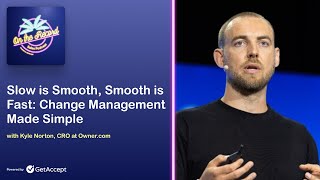
Podcast interview (On the Record #14) with Kyle Norton (CRO, Owner.com) on change management while scaling a revenue org. Key interventions: an enablement/engagement survey revealed friction from rapid growth (10x revenue, ~3→100+ team growth); consolidated role-specific docs from Notion into Guru for better searchability; introduced a traffic-light change-deployment method (green/yellow/red) with templates and required enablement steps for yellow/red projects; added project heuristics (project brief required when ~2 people × >2 weeks × >2 tasks) and system 'nudges' (auto-created tasks, meeting-agenda templates) to enforce behavior; promoted async-first culture and an operating-methodology document with principles (e.g., "slow is smooth, smooth is fast", "async by default", "minimum effective dosage").
Questions this video answers
~10x revenue growth in a little over two years; team grew from ~3 to over 100 (revenue team).
July (year not specified, referenced in the enablement survey feedback).
Guru (migrated from Notion).
Green (minor changes), Yellow (moderate/affects day-to-day), Red (foundational changes; requires videos, notion docs, enablement deployment).
If ~2 people will work on something for >2 weeks with >2 tasks, it qualifies as a project and needs a project brief.
Chapters
From the creators of off the Record, one of the most exclusive invite only events for revenue leaders. Get accept is now bringing these conversations and insights on the Record. This is the podcast where revenue leaders share their biggest challenges and how they overcame them. And here's your host, Morgan Ingram.
Growing your company at a fast rate means that you're moving in the right direction, you're doing all the right things, yet at the same time, there's going to be a ton of obstacles that you face along the way when this occurs. That's why I brought in Kyle Norton, the CRO@owner.com who took their company from 3 to 100 employees and how he integrated certain systems to make sure to address the challenges that they were facing as they were growing at this hyperspeed. So if you're going into a season right now where you're going to be growing super fast, you know, you're going to be hiring a lot of people and you're already facing these obstacles. Listen into Kyle on how he's did this as a leader, how he handled the those struggles and came out on top. All right, everybody, welcome back to the pod. And as you all know, we start off immediately with a question that Kyle isn't prepared for, but the answer will always be fun. So did some research and I'm actually so curious on this. So I saw that you were a judge for the great Canadian sales competition. So my question to you is, who are you still doing that and what was that experience like?
Man, you went deep. That's a, that's a deep cut. So this was a sales contest that was run by Sales Talent Agency and Assad Zaman, who's now a good buddy of mine. It's his company. And so it was university students basically doing like a pitch competition and they brought in a bunch of people who ran big sales teams here in Toronto. They haven't done it in a while. I think Covid paused it and I'm not sure that it's come back. I'm not, I haven't done it, but it was a blast. Like, I met a bunch of good folks through the judging group and it was awesome to see university students get engaged in sales and they go through like a training process. And it was, I hired a bunch of people out of it actually, back in the day. So I hope it comes back. Maybe I'll bug Asad about that.
Yeah, shout out to Assad. We both need to bug him about it. Hey, you need to bring that back. He's good people. And why do you Think more uni's. Colleges don't have sales education. Like, I feel like now it's starting to progress. But why don't you think there's more?
It's funny you say that because in two hours I'm talking to one of my professors from Queen's University where I graduated, about this exact topic. And so he's building a program. This guy, Jim Hamilton, he's building a sales. He's built a sales program at Queens. I was involved in, in, in its early days. A lot of it's the stigma. Sales has never been like a glamorous career that people aspire to. I think that's changed a lot in the last couple years. Tech, tech, tech. Sales in particular has brought a lot of pedigree and prestige to it. But typically like when I was in university, I graduated in 2008, you know, people thought about sales as in like car sales. And maybe you're selling like Wolf of Wall street type stuff, like, you know, you're a broker. But it didn't have the same cachet that it does now. And we're starting to see it like a bunch of universities here in Canada have programs now. There's some really well known ones in the US as well. So hopefully it gets more and more attention over the next couple years because like we, you know, a big portion of people end up in this profession, but totally by mistake. I'm sure it was the same for you.
Complete mistake.
Yeah.
The last thing I was trying to do. And then here we are. Right. So obviously sales has so much rewards once you can get it right. But it comes with a lot of challenges which we're going to talk about today. So we always ask people when they come on, what is the like number one challenge that you have faced as a sales leader? We're going to talk about how you overcome it, what you learn from it. But let's start with the challenge first.
Yeah. So I picked a fairly recent one here in our owner journey and it's all about change management and this theme of like, what got you here won't get you. There's. And so to set it up, we did an enablement survey in the summer and we asked all the reps a bunch of questions sort of based off of Patrick Lencioni's framework, the five dysfunctions of a team, sort of trust, accountability, etc. And one of the, one of the big themes that came out of that survey was people were having a really hard time keeping up with what was. What was happening in the Business. They felt like things, things had gotten chaotic and things would just like change on a dime and they didn't feel like they understood what was happening and they didn't know how to implement that new thing. Whether it's a complaint change, changes to our rotators or our rules of engagement or like a lot around the product. You know there's a new integration or we thought we were integrating with this and we've done a couple integrations. We don't think it's like actually good for the customer. So we're pulling reps, wouldn't really know, wouldn't have the most up to date information. And that was for good reason because we weren't doing a good job at bringing people along and it was just causing a lot of, a lot of noise and stress on the entire sales system, the entire go to market system. And our reps in particular, like they were frustrated by it. They feel they weren't able to do their job as well as they could. It was, was bunch of their time because they were asking, there was a bunch of questions getting asked in Slack. And so this is a good example of a business growing up very fast. You know we've grown like 10, we've 10x revenue in a little over two years and grown the team from. It was like three people when I started and now my team is over a hundred. You just need to mature how you do things in a pretty significant way to be ready for these next horizons of growth.
When you, when you think about the horizons of growth and, and when you need to mature, is that a forcing function of. There's a lot of friction. So now we need to have this conversation. Are there things where you notice, okay, I know this is about to be a challenge because I've experienced this before as a leader. So I need to address it to my team. How do you know when this friction is going to happen and how do you communicate that message?
Both for sure. I mean I've now done a number of like scratch builds, like hyper, hyper speed builds. Yeah. And so I've definitely developed some pattern recognition and like learned from the mistakes I've made in the past.
I probably have built up anxiety.
Yeah, yeah, yeah. An old boss of mine used to say I pay you to be paranoid. And so I carry that, that like slight paranoia with me. And a good example is like as a first time VP of sales I hired way too much headcount too early. You know, like we, I didn't push back against the financial model. We piled a bunch of Bodies in didn't have the pipeline to support it. And we ended up having to lay off like 20% of the team. I won't make that mistake again. And so that's a good example of something that I'd been through and now know to look out for. But some things you really just have to have like, a pulse in the business and a rhythm. And so even today, like, I will do like multiple skip levels with our manager team, like our frontline manager team, hear what's going on. I listen pretty carefully to the slack channels and hear what's happening. And then we have rhythms in place to collect feedback at scale. So this enablement survey is a great way to do it. You know, we learned some really good things, like, people wanted more career development, clarity. You know, we had a career like a career planning page with things laid out fairly. What I thought was fairly clearly. But then the feedback from the team was like, hey, we, you know, we get it. We get that at. In broad strokes. But like, what does it mean to me, like, where I'm at in this journey? How do I. How does my performance in my evaluation compare to this promotion framework? Metrics, habits, skills, business need. And so that's a good example of something that we thought was actually like, pretty well documented. But then the feedback from the team in this engagement survey was different than that. And so you need. If people don't have surveys happening every six months, I would encourage them to do so. We learn a ton of, like, we reprioritized a bunch of our roadmap based on that July survey, including this work on change management.
That. That's actually what was the. So you mentioned that there was the promotion piece. Was there any other challenges or obstacles that occurred in that survey that you weren't expecting where you're like, well, I thought we were doing that. Amazing.
The career one was a little surprising when people told us that they had a hard time understanding all of the changes. That wasn't surprising. I think we all sort of knew that we were moving really fast and we had just changed. We had just completely overhauled our comp structure and done that fairly rapidly. And there's a couple other changes we rolled out that like, we knew weren't very good. Like, because people were like, I don't know what's going on, and people were confused. And so the noise had rolled up to me. But definitely, like, seeing it in the survey results was. Was really helpful because we got specific feedback. And I think one thing I'll call out is for these Engagement surveys or just pulse surveys. To be useful, you have to have enough trust built up that people feel like they can tell you what they really think. And you have to loop back with everybody and show them that you've actioned the things that they've told them. So, like, we did the survey, we collected all the feedback, we packaged it up, and we shared actually the exact slideshow that my head of enablement and his second in command did for the leadership group. We basically shared that entire thing with the broader team. And some of the stuff was like, you know, pretty pointed feedback. You know, people were not, not shy about like sharing their, their feelings. And so I think like, that transparency builds a lot of trust so that when we do these things over and over, people know that they can, they can open up and tell us what's up, what's going on. And then we actually made changes based on it. We like, as part of that, as part of sharing back the information we talked about, hey, this is what we're changing. This is how we're reprioritizing. Because then that builds trust and you'll be able to get the right information the next time.
It's a good call out. Because even when people take the. I've seen it a couple times where people take the right measures, they get the feedback or they know these challenges are going to happen. Either one, it's not communicated effectively or, you know, it's not as transparent as you just laid out, or what happens is, oh, we hear everything and then it's like, it's going to change and then it doesn't change. Like reminds me, they fix it now, but it reminds me of like, going to like the New York airport where they say it's always under construction. It's like we've been under construction for like six years and they finally figured it out. But like, every time I come here, I was like, this is probably never gonna get fixed. Right. So it always will crack me up. And so what you're saying is like, okay, cool. Making sure to address that and go into it. And the kind of, the next component of that is you said you started making those changes. So this is kind of overcoming that challenge, getting past that friction. What were some things you already mentioned it that you were doing to overcome the friction of like, hey, I don't understand this, I don't know what's going on. And then how did you enable your team to make sure to address those?
Yeah, so the big themes from the survey that we really double clicked into is just like communication in general, communication and transparency, deploying change in a much more thoughtful, well managed way. So like how change was communicated and just like the overall communication cadence. Knowledge management was another piece. Like we were pretty good about documentation. We documented everything. Like everything was in notion but the feedback from the team was like, it was a little overwhelming. And so folks wanted to simplify and condense that knowledge base experience and be able to get to information faster. And, and I knew this personally because when I tried to go find information in notion, it was really challenging. Like notion search is horrendous. Like you can't find, you can't find.
As bad as Slack search.
Oh bro. Yeah, they're pretty bad. And, and so unless you're using like the exact right words, you can't find the page. And so which is sort of crazy. We're also spoiled with Google and some of these other search experiences. And so I had had an inc. I knew how that this was frustrating for me when I couldn't find my own pages that I had written. Like did I call it this or did I call it like something different? But people were just like there's way too much in there. We don't know how to navigate it. And so we were sort of proud of how well we documented things. But then the feedback was actually like there's actually too much documentation and it needs to be easier to navigate and like simplified. And then we needed to like get out of Slack, just like stop using Slack as a way to communicate things. Because the feedback was like, just like it's a constant cavalcade of information in Slack where there's all these channels, there's all these updates and it's impossible to keep up. Like one of the, one of the comments was like, there will be like an important update shared and then within 45 minutes that update gets buried by. You know, there's the automated dashboard that gets posted into that channel and then somebody like sharing a message of like you know, a shout out from the previous day. And so, so stuff disappears. And so this was all in this basket of when you're a team of like 10 or 20 people and there's only a handful of people working on the business. So like when we were a team of 20 and there's one person in RevOps, one person in enablement, there's like me and a couple managers that are working on projects, the velocity of things is manageable so you can just write a Slack post and push it out there. But now when there's multiple people in Revops multiple people in enablement, a bunch of managers working on stuff and then product velocity is increasing, then just the pace of information increases so much that clearly the team just couldn't keep up and, and they were like feeling overwhelmed by it. So, so that was like the core problem.
Do you, and when it comes to communication, because I, I think about this as well is that you know, you were shifting and you allocated. Are there things moving forward with your own reps that you also communicated as well? So what I mean by that is, was it saying like, hey, we're only going to do text moving forward or just saying, hey, we're only going to do these calls moving forward. Did you get like preferences from, from the reps as well? Of like, hey, this is where they need to communicate if they want to do something outside of like the norm.
They didn't tell us exactly how they wanted the information, but they just asked us to make it easier. And so my enablement team took that away. So we shared all of the, the survey feedback with the team and, and we're like, hey, we read you loud and clear. You know, we document a lot but it's like not easy to navigate. So like we're going to go fix this. And then we showed them the projects that the enablement team was specifically going to work on. And so Rob Yuen, who runs enablement here, he built a bunch of stuff for this. So like we made some systems changes. So we actually pulled tons of information out of notion and pushed it into Guru. So Guru is a knowledge management system, more traditionally for support, but highly searchable. There's like an AI creation component. Like we were looking for an AI content creation solution to capture internal knowledge and we looked at point solutions and we're like, oh, do we want another point solution? And we had Guru for support and they had a really good product there for it. So we decided to push all of the role specific information there because it's really easy to find. You can search from it from Slack if people ask questions Guru can automatically answer. And so we just like yanked a ton of stuff out of notion because it was just, it's too hard to navigate and like wage your way through. And so that was a big infrastructure investment and then we had to go fill in a bunch of blanks, sort of details that we didn't have cards for. So we made a big systems change and that's gone really well. I personally find it so much easier to find what I need now that it's in Guru. As long as I Remember to go searching guru. And I'm not like, where is this? And I'm in notion. And then the second piece is we built some new rituals and rhythms for the business. And so one of the big pieces was what we're called, what we've called this like traffic light methodology.
Okay.
For change management. And so you could have a green, green light, yellow light or red light change. And so a green light is something that is pretty easy. Like you know, reps need to be informed. It might be like a change that we're making to support process that like maybe a customer asks, but it's not really going to affect their day to day all that much. And it doesn't have like a huge ripple effect. And so we've set specific expectations of like how that change should be made. Then there's yellow light, which is like a moderate change that'll affect their day to day. It's something they really like, need to know and understand and be able to action. And then there's a red light change which is something that's like a pretty big foundational change in the way we operate. So when we changed our comp structure in July, that's a red light change. And so the expectation for management is that there's notion documentation, there's an explainer video and so they're attached to this traffic light methodology. There's a change log template based on these and then the template. So when you're deploying the change, the template guides you to like do the things you're supposed to do. So if it's a red light change, you have to record a video, you have to write a notion page. The change has to be deployed through enablement. We need to talk about these changes in all of the team meetings. So it needs to go on the team meeting agendas and we should be talking about this in one on ones and answering questions. Now there's this structure so information can flow a lot more easily across the organization. And the other structural change we made to this methodology is in our project management system now, which is also a notion. When you are working on a project that is a red light scope, the project management template automatically has an enablement deployment step. So like you can't push something to reps unless it goes through enablement so that they can help you really make sure that the comms are built in a way that we know is going to like meet the standard for what we're trying to do in comms and deployment. So that's another structural I love, I.
Love that, that method because again, it allows you to know what is the, the level of speed that we need to do something and the level of depth we need to do something. Which I really like and I guess at least to the question, because we're talking about change management and it's an obstacle. It's like some people are upset what's going on? How do you handle it when people don't follow this stoplight method? What do you do when people are like, I don't want to do this change and they actually being toxic to the organization. Did you face any of this? Because, you know, I've heard where people don't like to change. They like the old guard of how they made their money. They're the top rep, and then now they're causing this stir and you're like, what's going on? Did any of that happen? How did you handle it?
We didn't have any of this pushback. Like really the pushback would have been from the managers because this is technically slowing them down from pushing things out to the reps. But they were all really engaged. I mean, like, I have, I have awesome managers. They are very like, deeply steeped in a servant leadership mentality. And they knew that this was a problem. Like they could experience it themselves because they were getting a bunch of questions from their reps. They were fielding this sort of chaos. In fact, almost, I would say the managers were the most eager the, to get this done better because, you know, like when reps are confused or frustrated, the manager has to clean it all up. Like they're, they're in the line of fire. So yeah, no one was, no one pushed back. The reps were excited about it.
And.
But also the system is built to guide them along. And so like, you can't, you can't work on a, on something structural unless you have a project opened for that thing. And so the project, the project template really defines how we want people to manage something here. And so there's a quick heuristic. Like if there's going to be two people working on something for more than two weeks with more than two tasks as a part of this initiative, then that is considered to be a project and you need a project brief. And if you don't write a project brief in your weekly update, you're like, oh, I worked on this thing, then that person's manager will be like, hey, do we have a project brief for that? And this project brief guides people through it. So it guides them through the comms and deployment process. It ensures that they've thought carefully about the frontline implications. So we didn't have any pushback. People were pretty excited about it. It's really about like establishing a new rhythm, a new behavior that, that is the thing that is the barrier to adoption. But you know, this is very much like a James Clear thing. It's environmental design. You know, like, if you want to build a new habit, like, hey, every project should, should have a brief, every deployment should go through this process, then what are you doing in terms of your internal systems design to like to encourage that to happen? And so the example is, you know, in the project management template for yellow and red, there is like an enablement. There's an enablement deployment section and those auto create tasks for the enablement team, it shows up in there, project management center. And so you don't have to remember this stuff. Like that's the hard thing to remember that we've like made a big behavior change. But if, if your templates and guides and rhythms all guide people down this path, then makes it, makes it a lot easier. Environmental design is like massive.
Massive. Yeah, it's because now the, because these habits are built and now it's cohesive. Cohesive. Everyone knows exactly what to do. And now it just becomes what you do, which is a. Yeah, call out.
Now it's all ingrained. Yeah. And it's funny, in reflecting on this, just in this conversation, it is interesting to note how seamless it was to get the managers on board with it. A lot of that is just the, you know, it's really credit to the managers. They, they lean into change heavily. It's, it's, it's part of our culture, but we were able to, and it's called nudge theory from behavioral economics. Like, what are all the things that you can do to build into the environment of an individual to nudge them towards doing the right things? And that's like templates or calendar alerts or, you know, changing. Like, I wanted to spend more time talking about our most important projects and touching base on those things. So I changed our senior leadership team meeting agenda to the top section being the key projects listed out. And then when you click the like create new meeting agenda button in notion, it automatically like pulls those things in. And so that's like another nudge to be like, are you paying attention to your key projects? Did you have a conversation about your key things? Like all of those little nudges are pretty critical.
And, and throughout the journey of making these changes, building these rhythms, these systems and even reflecting for yourself, like, how have you grown as a leader? What are things you've learned for yourself throughout this entire process?
Yeah, I learned a lot about change management for, you know. Yeah, I, I would have done this much earlier. In reflection, I would have done this much earlier. Now, you know, it's good that we listened to the team and we made these changes when, when we did. But if I was building a team through this same, through this same journey, like stages of like 20 to 100, 50 to 100, I would, I would now pull that forward. The other thing I've taken here is, you know, what I'm working on right now is documenting our entire operating methodology.
Yeah.
Because, you know, we built these systems which have been really helpful, but it would have been better had we had clear principles of how this should be done from much earlier. And so I'm now writing this document which is basically like our entire. It's called our operating methodology. And so when you build new rep facing systems or guidelines or processes now we have documented sets of principles for people to follow like comms and deployment is a good piece of it. Like slow is smooth and smooth is fast is one of these pieces of the operating methodology. We're definitely going slower by having like all of these steps in the project management and deployment process. But it helps us actually go much faster because it means we're not having 100 different meetings to explain the same thing or like rewriting documents because people don't get it or it's more streamlined.
It's not confusion. Right?
Yeah, yeah, you're measuring twice and cutting once. And so I've really, like, this has been crystallizing for me to understand the importance of having really clear principles for this stuff so that everybody can operate by the same things. And it's not about like the specific, specific guide in this instance. It's about like understanding. Like when you're going to build a system at owner for our teams, these are the things you need to be thinking about like slow is smooth and smooth is fast is a good principle. One of the other principles is it's about the customer, then the business, then the team, then them, as in the reps, then us. And that's an important principle as you build a new reporting solution. Like how does this serve the business and then the rep, or don't just build a bunch of stuff for me, for you as the manager, that requires the rep entering a bunch of information in one place that you could find in another. That's like a, that's like one of the principles, Async by default is another one. We want things documented. Don't just like tell somebody something important you like. The expectation is that has to be written down. Minimum effective dosage is. The other one is like another really important one. Like make the process as small as it can be to get the job done so that you don't have a bunch of organizational bureaucratic bloat. And so like now that these are getting written down, I think how we develop things more generally will get a lot, a lot sharper.
Yeah, those follow up question I was going to ask is that you mentioned Async and then you also mentioned having a lot of meetings. I'm assuming you have less meetings overall where people can then execute and do the work they actually need to do more is what I'm assuming.
Yeah, that is also one of the principles in here which is, which is it's about doing the work, not talking about doing the work.
Yeah.
And so people comment on this, they're like man, you guys just have like no meetings here. It's like, it's a weird, it's sort of weird. Like I feel like sometimes I don't talk to people enough. And it's, it's because we're trying to encourage like a written culture because you know, if you can't, I can't remember who's saying this is. It's me like Mark Twain or something. But like if you can't write well, you can't think well. And I think writing, writing things out and spending the time documenting your thoughts clearly forces you to clarify those thoughts and it allows people to react to it in a thoughtful manner because then they can read it, they can go back, they can like think through their thoughts, then they can leave a comment, then you can have like a, a synchronous conversation in person. We definitely, we, we strive heavily for this async culture one because we're remote. But even if we, we now have an office in San Francisco and even with an office there for, for, for sort of our executive team, we still run the business remote by default because it, we, we believe in this written culture.
Yeah, I, I started for my own team. We, I said okay, we need to do next to no weeklies. We could probably do a lot of the stuff Async because we need to go and execute and actually do more of the work and more people are starting to gear more towards that. And I agree if you need to be in person for certain reasons for sure, but for the most part a Lot of this stuff can be async. And I love the quote of like, doing the. Do the work less talking about the work. And as we do wrap up here, any shout outs or mentions that you want to say to anyone before we. Before we get out of here.
It's cliche, but definitely got to shout out the team. You know, like, they did the work. They were the ones that had to implement this stuff and lean in and, you know, it was pretty seamless to deploy a fairly big change in terms of how we operate. And that's really just a credit to the frontline managers, to the leaders across the team. So they get the shout out.
Awesome. Well, Kyle, thanks so much for taking the time walking us through the challenge, how you've overcome it, how the team is now progressing moving forward. And we'll see you all in the next episode. Appreciate everybody. This episode is one of my favorites because I'm a huge person about tactics and I'm a huge person on the strategy, and that's exactly what we got. We got a walkthrough and a whole entire breakdown on how you as a sales leader today can approach different things. We've learned about the traffic light, what you need to do for systems and processes to make sure that your team is doing things appropriately. We also broke down how you can communicate change management to your team so they're not stressed out, and then also how can you work more async with your team so they can do more of the work instead of talking more about the work. So hopefully you all enjoyed this. This gets you excited going into 2025 and you can execute some of these.
Strategies for your team.
More from Kyle

E99: How GTM Revenue Leaders Are Operationalizing AI for Growth with Kyle Norton of Owner.com
Scaling SMB to $30M, Investing in RevOps Early, and Stage-appropriate Sales Hiring with Kyle Norton

Building Repeatable Revenue Engines at Outreach and Catalyst with Mark Kosoglow
The Untold Strategies of High-Impact Sales Recruitment with Asad Zaman - CEO, Sales Talent Agency