
How to Get Lucky in Life... Is Luck Real?
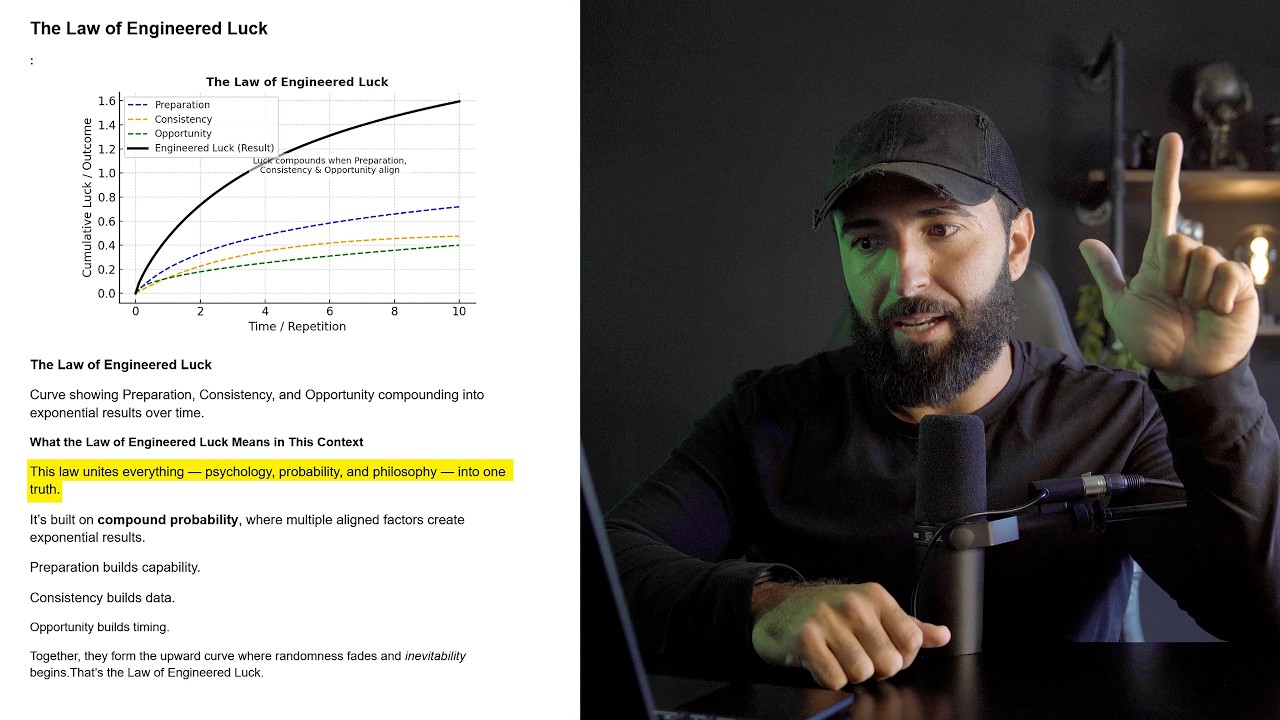
Matt Jimenez breaks luck into three parts: psychology (noticing opportunities), probability (repeated attempts smooth randomness), and philosophy (preparation meeting chance). He argues luck isn't random but engineered through exposure, skill, and consistent output.
Chapters
You're not unlucky because you were dealt a bad hand. You're unlucky because you never learned how to get a good one. Because luck isn't something that you find or stumble upon, but rather it's something that you create. And I would know because I went from broke to rich in just a few years. Some would call it luck, but really I implemented a system that allowed me to start attracting luck inside of my life because luck is something that is mathematical. It's something that you can engineer. It's an identity that you need to embody. Because the truth is, everyone that you call lucky isn't lucky. They know how the rules work. So in this video, I'll prove to you why luck isn't a mystery. It's math, mindset, and motion all colliding at the same time. And once you start understanding this, you could embed it into your own existence to change everything about you from this moment on. Now, in this video, you're going to learn is the 3 Ps behind luck. Now, the 3 Ps are psychology, probability, and philosophy behind what people even call the word luck. The second thing is why certain people can attract opportunities repeatedly inside of their life. And then the third thing is how to apply the same mechanisms to your life and/or your content to make success predictable. Now, if you're new here, my name is Matt Jimenez. I went from broke to rich all inside of the YouTube space, and everything Everything I teach on this channel is about becoming a better you because I believe better content starts with a better you. Now let's go into the key things so you could start being lucky inside of your life and get the opportunities that you deserve. Now, the first P is the psychological view. This is what I called perceived luck because luck is a lens. It's not about what happens. It's about what you notice and how you interpret it. Two people can experience the same exact setbacks. One calls it failure and the other one calls it feedback. One stops and then the other one adapts. In fact, there's a really cool study that I want to tell you about. There's this psychologist, Richard Wiseman. In one of the largest luck studies ever conducted, he found that lucky people consistently display these 3 characteristics. Write them down if you want to be lucky forever. The first one is they notice opportunities others ignore. Number 2 is they trust their intuition instead of overthinking. And number 3 is they expect positive outcomes which alter their perception and actions in the world. Now, in his experiment, pay attention because this is super interesting to see and it validates even further why those three traits are so prominent amongst lucky and unlucky people. In his experiment, he gave two groups a newspaper and he asked them to count the photos. The unlucky group missed a huge sign that was on page two, and this sign wrote, and I quote, Stop counting. There are 43 photos in this newspaper. The lucky people noticed it instantly because their brains were open to surprise. That's not luck. That's awareness bias. And that really proves why our internal focuses control what our external world reveals to us. Buddha said it best, and I quote, the mind is everything. What you think you become. And I put this chart right here. This is called the luck feedback loop. And this is something that starts to happen to you when you start to become a lucky person. And it's something you can't escape. Andrew Tate said it best. You know, there's a downward spiral. There's also an upward spiral. I call this the spiral of luck. In this, it's a self-fulfilling prophecy that continuously makes you lucky in life. And let's go through it. This self-fulfilling prophecy at work states these two things. Let's talk about what it looks like in an unlucky person. In an unlucky person, it looks like this. You believe you're unlucky, so you act cautiously. You act cautiously, and now you miss opportunity. You miss opportunity, which reinforces your belief that you're unlucky because you never get opportunities. Now let's flip it. Let's talk about the lucky person. You believe you're lucky, so you act confidently. You act confidently, which attracts opportunity. Opportunity only reinforces the belief that you're lucky because now you have an opportunity. And in content creation, that determines your longevity because creators who believe that their message matters will keep posting even during those dry periods up until the algorithm catches up to all of their efforts. Because beliefs drive behavior, behavior drives opportunity, and that cycle is what we call luck. Now let's go to point 2. This is the mathematical view. This is the second P, which is the probability. I like to call it probability in disguise. From a statistical standpoint, luck is a variance. It's not magic. Life is a probability game. So that means every single decision, conversation, content upload, or investment that you make is a coin toss in the hidden odds. If you flip once, That's random rules. If you flip 100 times, that's pattern appearance. That's why gamblers lose and investors always win, because volume reveals the truth. Thomas J. Watson said it best: If you want to increase your success rate, double your failure rate. In fact, one of the wealthiest people on the entire planet said these exact things, and I'm speaking about Jeff Bezos. Once said his entire success from Amazon came from a few bets that paid off massively. But what people don't see behind that is they only worked because he made thousands of smaller bets, because luck rewards the one who's still flipping. Meanwhile, everyone else is stopping. And that brings me to this chart here, which is the luck versus consistency chart. Or if you wanted to look it up on your own, it would be the law of large numbers. And I find this super fascinating. So the red line represents a few attempts, which, as you can see, makes things extremely volatile. 0 to 20 attempts will experience sheer chaos. Now, the blue line is consistent attempts. As you can see, the line carried on at the bottom is the number of attempts. This blue line is representing 100 attempts. The more attempts that this has, the smoother the line becomes. The dotted line is the expected outcome because again, it's a 50/50 game. So the more that you do it, the more likely it's always going to average out. Now, to sound smart, let me give you exactly what it states. The law of large numbers says the more you repeat something, the closer your results move to a true average. One flip equals luck. 100 flips equals skill and consistency. So if we bring that into life, or to make it relevant to this channel, if we bring it to YouTube, the more attempts you make, the less luck decides and the more your systems do, the more uploads you do, the more the system decides and the less luck does. So going viral isn't a matter of if, but rather a matter of when. That's why consistency turns chaos into data and data into predictability. Repetition doesn't just build skill, it filters out the randomness, which is that volatile period that I showed you on the chart with that red swing. And that brings me to the third P, which is the philosophical of you, probably my most desired part to talk about. And this is the preparedness meets fate era of cultivating luck inside of your life. There was a very famous quote once said all over the internet, and it's this: Luck is what happens when preparation meets opportunity. This Stoic idea reframes luck from superstition to symmetry. You control one half, which is preparation, and the universe controls the other, which is opportunity. You can't schedule luck, but you can be ready for when it arrives. I like to think of this analogy because it really puts that together for me. Think of wind and sails. You can't control wind blows, but what you can do is build a larger sail and keep it raised. That way, when the random wind gusts, all of a sudden you got lucky. You see, what happens to lucky people is they're ready for those random gusts, not only on a sailboat, but throughout life. They're ready for when that luck is thrown their way. So this is bringing me to the chart of the intersection of luck. And as you can see, half of luck is preparation. Luck is what happens in the middle when preparation and opportunity meet, and that is where success lies. So if you fail to prepare, you fail to be successful. And the Stoic determinism really said it best. You can't change fate, but you can be ready for its timing. No preparation automatically equals missed opportunities. No opportunities will never equal wasted preparation because in the pursuit of preparing, you're becoming better. Now, in the creator world, this is when months of skill building and consistency on putting your face out there, your content out there, your ideas out there finally catch some wind and all of a sudden you have success overnight when really it was just the algorithm catching the wave of all your preparation and consistency on the platform. So again, going viral or being successful online is not a matter of if, it's a matter of when. The only thing that's causing those two to have the gap is the time in between where most people don't ever see it through. I've said it in other videos and I'll say it again, you don't even have to be good. You just have to do the thing long enough and eventually everyone else will fizzle out and you'll be the only person doing the very thing that everyone once started. So now that we're out of the 3 Ps, I wanna talk about the fourth. Thing about luck, and this is the modern view. This is the common thing online that everyone's talking about, which is engineered luck. In today's hyper-concentrated world, you can manufacture luck by expanding your luck surface area, which is a term coined not by me, by Naval Ravikant. And he has one of my favorite quotes on the luck surface area analogy, and he says, build your character so opportunity has something to collide with. So with that being said, every single tweet, Every video, every interaction is a node in your web of potential collisions. Each one increases your chance of being discovered, shared, or connected with the right person. That's why the internet isn't oversaturated. It's under-executed. Most people don't show up long enough for the compounding to work, which I spoke about a little bit earlier. And there's a chart that illustrates that perfectly. And that's called the Luck Equation. And what the Luck Equation means is that probabilities compound in motion. When you take luck and extract what's underneath, what you get is exposure, skill, and time all combined. And when you have each one of those variables, the more you increase all three, the higher the chance of a breakthrough in content creation. That means publishing, which would be exposure. Refining, which would be skill, and persisting, which would be time. Eventually, when people call it luck, it just compounded visibly. And now that we have a good understanding of what luck is and how to cultivate it, let's talk about the parallels to content creation, because I believe content creation is the biggest opportunity moving forward for the next decade. And if you're not building a brand, you're consuming one. So let's talk about what that looks like for the creators out there. Every upload you make is a coin toss. Every thumbnail, title, or idea is another test in the realm of probability. The creators who get lucky didn't stumble on virality. They designed the conditions where it had to happen eventually because luck favors motion, not mastery. And there's a great quote that illustrates that by Samuel Goldin: The harder I work, the luckier I get. So the 3 most important things you could do right now to create your own luck after understanding all of that. Number 1 is you need to expand your surface area. Post more, meet more, move more. I'm such a big proponent on doing more. I spray painted it on the wall of my garage and that is not a joke. This is the clip. Number 2, improve your preparation. You want to refine your craft. Until opportunity recognizes you. And number 3, you want to stay in motion because why? Because luck favors motion, not mastery. As I said earlier, consistency converts randomness into results, and that is where you want to be. The moment you stop waiting and start iterating, you stop needing luck because you've built the machine that attracts it. And I'll leave you with this last chart. This is the Law of Engineered Luck. And what the Law of Engineered Luck means in this context is that This law unites everything— psychology, probability, and philosophy— into one truth. It's built on compound probability, where multiple aligned factors meet and create exponential results. Preparation builds credibility. Consistency builds data. Opportunity builds timing. And together they form an upward curve where randomness starts to fade and inevitably begins. That's the law of engineered luck. It's not fate, it's design. And if you just look at the chart, you could see if you just focus on each one of those dotted lines, you're not going to have that exponential growth. But if you combined it all lines, you have that black line and look how much more accumulative luck you get. Look at the outcome. It's vastly higher than if you just focused on being consistent or you focused on preparation or you focused on looking for opportunity. When you put those three together, all of a sudden your results compound beyond anything that you can ever imagine. If you want to find luck in your life, subscribe to this channel because I might just tell you something that could increase the odds of you getting lucky.








