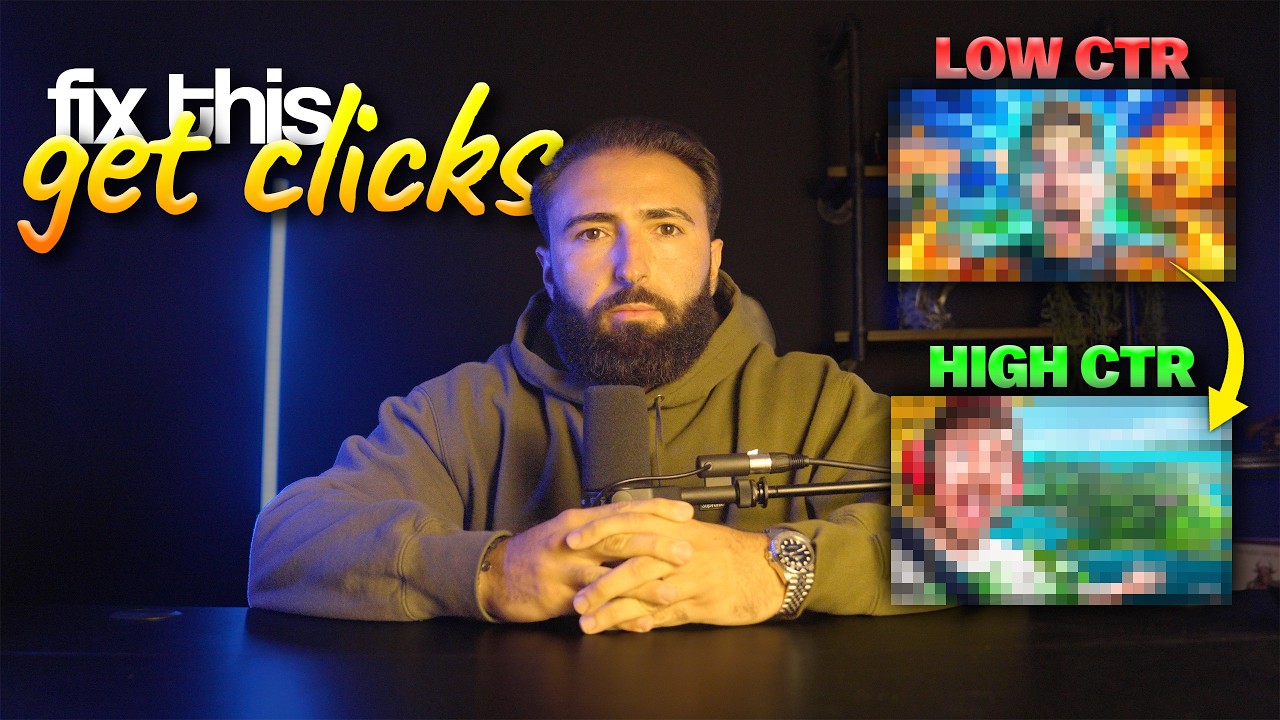
In this instructional YouTube video, Kyle Fernandez—founder of a content agency with millions of views and tens of millions in revenue—explains why many creators struggle to get clicks and how to fix it using proven psychological principles. He first introduces Dual‑Process Theory (System 1 vs. System 2) and shows that clicks are driven by fast, emotional System 1 responses, so titles and thumbnails must trigger fear, excitement, curiosity, or surprise within under two seconds. He then presents Loewenstein’s Information Gap Theory, arguing that curiosity arises when a knowledge gap is highlighted, and that this gap can be engineered into video metadata. Fernandez illustrates both theories with concrete title examples and references studies (Nelson 2019, Marketing Research 2014) that quantify their impact on click‑through rates. He moves on to a practical 4‑element framework—pain, solution, proof, urgency—detailing how each component maps to the psychological triggers and offering template titles. Real‑world examples from top creators (MrBeast, Veritasium) demonstrate the framework in action. Finally, he provides a ready‑to‑use ChatGPT prompt that rewrites any existing title using the dual‑process and information‑gap lenses while embedding the four elements, encouraging viewers to test it and comment on results. The video ends with a call to subscribe for more growth‑focused content.
Chapters
You ever wonder why some YouTube videos get thousands of clicks, meanwhile you are struggling to get any, and it almost feels like your hard work is being ignored? Well, those clicks aren't just luck. In fact, it's psychology. Today you're going to learn two of the most powerful psychological principles that top creators use to make their videos irresistible. In this video, we're going to break down why the human brain decides to make that decision and click on a video with real research backing everything that I'm saying. If you know anything about me, you know I'm obsessed obsessed with psychology, and I've owned a content agency for the last 7 years and have garnered hundreds of millions of views and generated tens of millions of dollars for all of our clients over the last several years. And I spend loads of time learning these things so I could give my clients the greatest results and continue growing my business. And once you understand how viewers think, you could design your titles and thumbnails that they just simply can no longer ignore. Now, the first thing is, let's start with dual process theory, made famous by Nobel Prize-winning psychologist Daniel Kahneman, who wrote in Thinking Fast and slow. Much of what you think as of thinking is actually remembering. But even more important, System 1 runs the show. What does that even mean? The human brain has two systems for processing information. System 1 is fast, automatic, emotional, and intuitive. Now System 2 is entirely different. It's slow, deliberate, logical, and analytical. Here's the truth that most YouTubers miss. Clicks almost always come from System 1. When someone is scrolling through YouTube videos, they don't sit there and analyze the title for 10 seconds to make a decision. In fact, they act in less than a second. According to a 2019 Nelson study on social media consumption, the average time people spend deciding whether to engage with content online is under 2 seconds. That's how little time you have to invoke an emotion to cause a reaction. And a reaction always leads to an action, which is a click. Think of your title or thumbnail. They have to work like a giant stop sign for the brain that instantly triggers those emotions, which always return in a reaction. You always want to think of fear, excitement, curiosity, or surprise when you're trying to generate a title or thumb— thumbnail. Things that you should always add is using high, bold contrast visuals, use big clear text with emotional words, and show strong facial expressions. And the last thing that you always want to have, of course, is FOMO. You always want to add urgency to any titles or thumbnails that you're making. If I was to make a comparison for a title, let's say, improve your YouTube strategy through avoiding common errors, that would be very boring for a click. In fact, that would cause someone to operate under the mechanism of System 2 of thinking. Now let's do that again. The new title could be, stop making these 3 "Make mistakes." Now that is instant emotional. That will cause System 1 to activate. Or a better example, "Warning, don't upload without watching this first." You're not asking the viewer to think, you're making them feel, and that's why it works. Now let's talk about the other theory, and this is called the Information Gap Theory, developed by behavioral economist George Loewenstein. Loewenstein's research showed that curiosity is triggered when there's a gap between what you know and what you want to know. He writes, to include curiosity, one must provide stimulus that reveals a gap in a person's knowledge. Think about seeing a wrapped present with your name on it. You have no choice but to open it. That mental itch is the information gap. Your brain can't stand not knowing. Can you recall one of those moments that you actually feel a physiological change? Reason being is because your brain knows something and it's making assumptions what this conversation could be. So there's a gap. That's the information gap. And that's why you almost want to say to the person, let's just talk right now, because you have that mental itch that need an answer right now and you need to resolve it immediately. You need to invoke those exact same methods inside of your title and thumbnails. Now, one thing to keep in mind with your titles and thumbnails, they need to be cohesive. The thumbnail must always insinuate what the title is saying but never giving it out direct. And that is a very key principle to having a successful thumbnail and title. But this is a core principle for good clicks, and if you use it ethically, it's just good marketing. And ways to do that is by teasing but not telling and leaving open-ended loops. If you haven't seen my other video on open-ended loops where we go over a whole nother theory of why that actually works, check out this video on the channel and it'll answer a lot of the curiosity you may have now. The other thing is you want to ask a question or hint secrets and make the viewer feel that they need to click it in order to get closure. Let's look at an example. Let's say the title is How to Succeed on YouTube. Instead of that, you would want to say why 90% of YouTubers fail, but you don't have to. Now the viewer immediately is thinking, why do they fail? Am I making those same mistakes? How do I avoid them? Now, that's the information gap at work once again on a YouTube title. A study of the journal Marketing Research back in 2014 found that curiosity-invoking headlines increased click-through rates by over 30% compared to ones that did not have that. This isn't just a theory. This is proven. And you can do the same exact thing inside of your titles. If we go on YouTube and look at the top YouTubers, let's see how they use these principles every single day. We all know MrBeast, and he famously once said in an interview, the thumbnail and title are more important than the video itself. Now, I agree with that statement to a certain degree. You can have a good video go bad based off of clicks because it never gets seen. But on the other hand, you could have a very strong click to a bad video, and that bad video would get attention. But for the overall growth of a channel, it's very important that you hit both of them. You want a strong video and you want a strong click, which is thumbnail and title. So yes, thumbnail and title, I do agree, are just as, if not just a little bit more important than the video itself. Let's just look at some of his titles. I gave $500,000 to random people. That's an instant emotional hook. I survived 50 hours in a coffin. Who wouldn't want to know how? Those two are very strong. Let's look at educational channels like Veritasium. This is why you don't hear about the world's deadliest virus. This immediately creates a curiosity gap. What's the world's deadliest virus? Now, these aren't just accidental titles that got loads of clicks. They're engineered to work with human psychology, whether the creators are aware of it or not. They fit exactly to the frameworks of these theories. And now that you understand the psychology behind people's clicks, let's make it even more practical. I want to share with you a 4-element framework that I've used for years for all of my clients that has been proven to increase click-through rates on YouTube titles, and it'll hit all the psychological triggers that we just discussed. The first key element is highlighting the pain that your viewer may be experiencing. People pay attention to avoid pain. It's hardwired. By showing their pain, you hook them emotionally. Let's do an example on some titles. Why No One Is Clicking Your Videos. That's the pain. It speaks directly to the creators frustrated with low click-through rate. Now the second key element is you don't want to just point out the pain, you want to promise relief. This engages System 1, which we just talked about, by offering hope. It also creates the information gap and makes them want to know even more. Let's do another example in a title. Psychology Hack to Fix It Now. It's not just a problem, it's the answer they've been searching for. Now the third key element is proof. People need to believe that you can deliver. Proof builds trust and authority. And if you read the book Influence, it stated people will follow the lead of credible, knowledgeable experts. So putting something like psychology hack inside of your title will immediately make them think that you're a little bit more credible because you're using something that's backed by science and it gives it credibility. And the fourth element that I use for all of my titling and thumbnail frameworks is urgency. Without urgency, they'll watch it later and forget all about it. I know that you have, I have as well, where you see a video and you're like, save to watch later, and you probably never watch it again. If I go through my YouTube history, I'm probably gonna see loads of videos that I never went back because I simply just forgot. So if it's happening to me, then I know it's happening to some of you. And what that means for the creators making those videos that get saved to later, they miss out on the click, they miss out on the view. So putting urgency triggers that System 1. Remember, System 1 is intuitive, it's responsive, it acts out of emotion rather than System 2, which is analytical and very deliberate. And for clicks, that's what we want. We want immediate action. So putting warning at the start would be very good, or put fix now at the end. These words add pressure to click right now. Let's put all that together to complete the title. That would look something like this: Warning: Why No One Is Clicking Your Videos. Psychology Hack to Fix It Now. The pain: why no one clicks your videos. This triggers fear of failure. The solution: hack to fix it now. This offers an easy fix. The proof psychology hack, which of course signals something backed by science, which immediately gives you some type of credibility. And the last one is the urgency, which is where we put warning and we put now. This creates that immediate pressure. This title isn't guesswork. It's engineered using both psychological theories and the 4 element frameworks. And now I'm going to give you the prompt that I use to elevate all of my titles. This video that you're watching right now, when I put the information together, the idea of a title that I had was Click Psychology: What Makes Viewers Viewers click on your videos. Now that's a little bit boring because it's not adding all the frameworks that deliver a high desired click-through rate. Even reading that title out loud doesn't even come close to the one that we just did here together. Think about yourself when you're scrolling on YouTube. The first thing that you do is look at the thumbnail. If the thumbnail provokes curiosity, the next thing that you do is look at the title to decide whether this video will answer something that you need to know. Now let's talk about how you can use this right now inside of your videos. Rewrite one of your own titles with the 4 elements: pain, solution, proof, and urgency. And luckily, you don't have to be smart to write titles or good thumbnails. You have ChatGPT. Steal this exact prompt and use it for your next video. And if it increases your click-through rate, leave me a comment. The prompt would go something like this. First, you put in your original title, then tell ChatGPT, make me a new title using the dual process theory and the information gap theory. I also want you to add these 4 elements to the title: pain, solution, proof, and urgency. It'll then generate you titles based off of those frameworks. And this has a whole new theory that you could add to this prompt. And I promise you, this will increase your click-through rate for your next video. So stop guessing whether your next title is going to be good or your next thumbnail is going to be good. Use psychology and use what works. This doesn't have to be guesswork. This could be a proven framework in which you could teach people like I just did for you. And if you want to continue to grow your YouTube, subscribe to this channel because I'm giving out helpful things that I've used along the journey of building my business that has generated millions and millions of views, millions of dollars, and has well over 2 million subscribers under management. I'll see you on the next one. Peace.