AI: How It Will Impact Leadership & Business
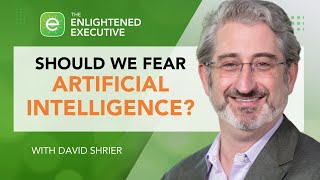
David Schreier built an AI tool that analyzes meeting dynamics like speaking time and interruptions to improve team performance. His classroom pilots showed high completion rates and better outcomes for AI initiatives. He argues leaders should use AI to augment their work, not replace it.
Questions this video answers
Augmenting Your Career
Little, Brown; launching in spring (year stated earlier in metadata: 2021)
97% completion rate
~3% completion rate for many online classes (e.g., edX/Coursera)
150 students across 25 teams
Chapters
Hi, I'm Susan Drumm and welcome to the Enlightened Executive where your personal evolution sparks your leadership evolution. Each episode we feature groundbreaking techniques and strategies to help executives and entrepreneurs get the edge in personal and leadership effectiveness. Today we are focusing on artificial intelligence and its application to leadership. And I'm excited to introduce David Schreier and he is a globally recognized thought leader in technology innovation, a parallel entrepreneur and an author. He's co founder of ESME Learning, an AI enabled solutions company helping to shape the workforce of the future. He's also a professor of practice in AI and innovation with the Imperial College Business School in London. David's newest book, Augmenting youg Career. How to Win at Work in the Age of AI is is being published by Little Brown this spring. David also advises government in the us, UK and EU on technology policy. So welcome David.
Thank you, Susan. That's quite the introduction, but it's always a pleasure to talk to you.
It's so wonderful to see you again. I know you and I worked together with your C Suite team a while ago and so it's great to see what you're doing today and what, what cutting edge, truly cutting edge work you're doing in leadership. So thank you for joining me.
Pleasure to be here.
So you, how did you get into AI? And maybe you can tell us then after that a little bit, how does it apply to leadership and leadership development?
Well, you know, it was sort of interesting because I never imagined that these two things would intersect. I mean, I was playing around with computers starting when I was about eight years old. I wrote my first AI software program in 1991 when I was a student at Brown University. I just played around with data and AI systems in various ways and thought it was interesting technology. It was a lot of fun to maneuver around completely separately from that. I'd been working as a business development executive and, and working as an innovation executive. And that was because I was really attracted to new ideas and big ideas and how that would show up is I'd be talking to someone about something exciting and I'd get so excited by the idea that we were talking about that I would cut them off, I'd jump in the middle of their sentence. It was just maddening for people to talk to me candidly. And so my hit rate on biz dev improved dramatically when I got some great coaching from Lynn Andrews, who she was like the president of the Weather Channel and she was before that head of sales for CBS and she taught me an inquiry based method of sales where your first meeting was 10% you asking questions of the other person and 90% them talking.
Yes.
And it dramatically changed the dynamic of how I would show up in these conversations. And then I was working on a project with a guy named Tom Gardner, who is CEO of Data Monitor. He and I went out and tried to buy some cognitive intelligence companies. And Tom taught me about how basically keep a little notepad with me in meetings, and when I get excited by that big idea, just make a little note and wait until it was my turn to talk. So those were really great techniques, which helped me out a lot. Not just as a biz dev executive, but also as a leader where I create space for my team to contribute their ideas instead of it being the Dave Show. And so that was really some positive leadership coaching and development from very experienced and substantive leaders. And then I started working on a project in New York City with a few different folks where we were hitting on this idea that effectively. So Moneyball was a popular book and then movie around this time. We're hitting on this idea that you could pick better investment managers if you used computers to study how they were making decisions. We started playing around with this idea, and I realized I had neither the math nor the technology to pull it off. And so I said, okay, I'm going to take a break from my corporate work. I'm going to go dive in at MIT and hang out with the smart people who really understand this stuff. That was really where the two ideas started coming together of leadership on the one hand and AI on the other. I started working with an MIT professor named Sandy Pentland, who Forbes called one of the seven most powerful data scientists on the planet. My eyes were completely open to a whole new field of something called computational social science.
Computational. So tell us, what is computational social science?
Well, it's this idea that, you know, we can Moneyball people using AI. It actually, like, decode human behavior. We can understand mindset, shift mathematically, like quantitatively. And then we could stage interventions that we can take actions that cause people to change behavior. The computers will tell us what to do and actually help provide those little feedback loops. I'm sorry to say this, Susan, we can actually have a computer be a coach, an executive coach, and help someone shift their behavior towards more positive outcomes.
Well, AI is taking over on so many levels, so I'm not entirely surprised, although I'm wondering, wow, how does that happen? And. And how is it even possible? So can you tell us a little bit more about how AI is changing the landscape of Leadership?
Absolutely. Well, for one thing, Sandy studied a lot of questions around what makes for a high performing team. Because leadership is not a business of one. It's a business of one to many and many to many. And so he found that high performing teams had noticeably different patterns of communications than low performing teams. This was like paper of the year for Harvard Business Review. It was called the New science of building Great teams. What he found was that high performing teams had balanced conversations. Everyone had an opportunity to contribute in the discussion. Low performing teams, you had one person monopolizing the discussion. And that plays out all the way up to the boardroom.
Absolutely. When I see, and I've mentioned this before, when I see CEOs doing most of the talking in their team meeting, I'm like, that is not. What are you doing? This should be. You're together as a team for a reason.
That's right. And it doesn't have to be equal speaking time because different meetings serve different purposes. But you have to allow people to participate and engage. Otherwise it's just a YouTube video. You don't even need to be there.
Yeah. So where did you take it from there?
Well, we took this research and we turned it into technology. Then we turned it into some companies. So we spun a couple businesses out of mit. And the principal one that I'm leading is called ESME Learning. And what we're doing is we're actually trying to make this replicable. So we're actually working with mit. This is a little reflexive, but we're working with MIT on a class on leadership. Specifically, it's called AI Leadership and Extended Intelligence. And the class helps leaders understand how to use AI to change behavior in their organization, to shift mindset, to get tens of thousands of people to all move in a different direction. And we're using our AI technology platform to deliver that class.
Oh my God. Wow. So now you're delivering the class. Tell me a little bit about how your company is using AI to transform leadership.
Well, it's, you know, we spend a lot of time looking at how people interact with each other and then providing positive feedback loops to shift that behavior. So we have, for example, a piece of software that takes a video call. Maybe like this one, or maybe there's five people on the call. And, and there's a little AI coach that's listening in on the call. And it's not listening to the words. There's no invasion of privacy. It's just looking at the pattern of communications. Because it turns out more than 50% of the signal for positive collaboration is just on patterns, not on content. Content is only about 15 to 20% of what defines successful collaboration.
So besides a pattern? You said patterns. Besides the pattern of, you know, how, who's speaking and when and how frequently.
How often they're interrupting. Are you building on me? Am I building on you? Are you affirming me? Am I affirming you? These are little signals of trust. And if you have high reciprocal trust, you have a high performing team.
And so it's. So it's looking, but in that way it's looking at the content. It's not just looking at the quantity of speaking and the diversity of speaking, but it's looking at the quality of speaking too.
It sounds like it looks at the quality without looking at the content. That's the crazy part. There's no semantic analysis. We're not doing any looking at the words themselves. It's more like, if I say something, do you say something? If I say something really long, do you say something really short like huh? That would be categorized as an affirmation or an interjection where you're basically, you're still with me, you're indicating that you're with me, but you're not actually taking over the mic. You're just saying, keep going, Dave. But you're not using the words keep going, Dave. You're going, uh huh. Yeah. Those little interjections shows that we're having a dialogue and you can do it non verbally. So you're nodding right now when I'm talking. And so the next frontier is to look at gesture recognition, to see non verbal cues that tell me, okay, you're with me, I should keep going? And we give positive reinforcement on this. So there's this little meeting mediator that says basically when you're engaged in a dynamic conversation versus a static one, and.
So you get the data, how do you use, let's say the team analyze the team meeting. The team gets the data. How do they actually change behavior? Because you know how that is. I often laugh. Sometimes people use a lot of biometric feedback tools. And I say, did you? Well, great, you have all this data. What are you doing differently with it? Are you just like, oh, this is fascinating data, what do I do with it?
So basically what happens is there's a very simple circle that appears on the screen. So you got your video chat, you have everyone showing up in a window. There's another little window and the window says meeting mediator on it and it shows a little circle that represents the meeting and if I start talking too much, there's a little purple ball in the middle of the screen that starts floating towards me. If you start talking, it starts floating towards you. And the game is keep the ball in the middle. It's a very simple visual cue, but when you explain it to people, it takes them three seconds to understand. They start looking for it. Then after the meeting, you immediately get this dashboard that shows your percentage speaking time versus other people's percentage speaking time, how many times you interrupted different people, how many times they interrupted you, how many times you affirmed someone else, how many times they affirmed you. And very, very simple feedback. But it's powerful. And we found, we did research, for example, on 150 teams of Sloan MBA students. Sorry, 150 students across 25 teams. And we found that over the course of four or five weeks, the behavior of the teams changed because you were getting this feedback every time you had a conversation. And over time you started to see that, oh, you know what, I need to maybe shut up a little more or I need to contribute more. This eliminates the free rider effect where you have someone who just sort of drags along with the team, but they don't really do anything or say anything. People change their behavior when you just give them this feedback and show them, here's how many times you spoke. 97% of the time in that meeting.
Right.
Showing that pie chart causes someone to change their behavior.
Absolutely. Oh my God. I can think of at least five teams I could use this with to help shift behavior. That is just fascinating.
Okay, well, I mean it's training wheels for eq. Someone with a high EQ already knows this.
You're right.
Cognitively you can do it on a one on one call. If you had a six person meeting, it's very hard to keep track of what you're saying and also all the interactions across the meeting. This gives you a little help, do you find?
So one of the things that I would say might be difficult for people is, is it distracting if I, I'm both trying to contribute and think about the highest possible thing to question, to ask, or can you. And at the same time I'm trying to look at this signal and worry about is it. And we know you really only focus on one thing at a time and the switching cost of going back and forth. I'm wondering how this could it sort of make people a little crazy, you know, and they feel like they can't be themselves.
We've worked a lot, like several years making it effective and Unobtrusive. Mm. And second of all, you know, the best meetings have a facilitator.
Right.
And so the facilitator focuses more on the little meeting mediator than everybody else. Everyone else sees it. So it's level playing field. You've got a data driven discussion, but the facilitator has this like, extra prompt that shows what's going on.
Yes.
And what we found is it makes for transformational differences in learning outcomes. And learning no longer becomes a check the box compliance exercise. Corporate learning actually becomes a vehicle for corporate digital transformation because we learn better in teams. And if you take the same management team that's like struggling with a management problem and you put them in a learning environment, you remove a lot of the personal battles around that problem and it becomes around, hey, we're learning about how to use AI in the company, but it actually changes the team dynamic because they learn how to work together differently.
And so how do you monitor the results that are being able to produce? Have you been able. I mean, I figure you're using AI for everything else. Like, how can you tell that the team, by using these tools is actually getting more effective?
Well, in a few ways. So the simplest way is, since we deploy this in a classroom environment, we can see differences in grades, both individual and team performance, differences in, frankly, how many people actually finish a class. So most online classes that you see about, like on EDX or Coursera, only about 3% of people who start the class finish it. That's 3%. Our classes, we have 97% completion rates.
Oh my gosh.
Dramatically different performance. But then we wanted to go further. We wanted to look at real economic impact. So we did a project with the government of Canada around helping companies adopt AI innovation inside the company. And there we found that executives who went through our program were 50% more likely to launch an AI innovation initiative inside their corporate environment than people going through a traditional in person accelerator program. So dramatic improvement on direct economic impact. So we're taking it a step further now. And we were approached by the chief learning scientist of a major Fortune 50 heavy manufacturer. And they are dealing with some significant problems. And he's looking at how to address those problems and how he can play his leadership out against his KPIs, which in this case are to get the behavior of the organization to shift through learning. We're doing a pilot with him right now around using this AI platform in a learning environment to actually help digitally transform the organization.
Amazing. Incredible. So you've got a book coming out. Tell me a bit about how do you win at work in the age of AI?
You embrace it rather than run from it. So I've run into a lot of particularly mid and late career executives who say, I'm going to fight this new technology tooth and nail for the next five years, then I'm going to take early retirement package and it's someone else's problem. And that's not the answer. And frankly, you can't wait that long because it is. Now, I wrote part of the book with an AI. It helped me write a chapter. And so even the humble author is being, let's say, augmented by AI if you do it right, or replaced by it if you don't. And so there's this emerging concept of centaurs, right? Half human, half horse in Greek mythology. In this case, it's half human, half AI that can do things that neither people nor AI can do by themselves. And this is where the future lies. And this is how you win at work in the age of AI. Don't let AI replace you, let AI make you better and work with AI to generate things that didn't exist before. So if you look at this in major companies, I was talking to Julia Sweet, the CEO of Accenture at Davos a couple of years ago, and she was saying how they are taking 60% of the savings that they're getting from AI automation, and they're reinvesting it in reskilling their people and helping them be more cognitively flexible and able to work better with technology. It's that kind of thinking, it's that kind of collaboration between people and machine that's going to help not just individuals and not just leaders, but entire companies and entire economies to win in the future?
Yeah. So how do you do that to make sure that you're not replaced with AI, but you're up leveling what you're doing? Do you have any sort of tips, suggestions or things to look at for someone who is taking this seriously and sees that wave coming and wants to know, well, what can I do?
Yeah, well, first and foremost, and not to. To speak to my own projects, but this is such a big problem, I decided to focus a lot of energy on it. So you need to get better literacy around AI. You need to understand what is AI, what can it do, what can't it do and how can I work with it? And so we're putting together a class with mit, with Professors Sandy Pentland, who I mentioned before, the father of modern computational social science, and Deborah Ancona from MIT Sloan who is a major thought leader in the leadership world. She created the Sloan Leadership center and they're putting a class together around AI leadership and extended intelligence. It's this really provocative idea that you can be smarter with an AI and they're going to teach you how to do that and teach you how to lead your organization with that extended intelligence.
Got it. And what about the people that fear that it's just going to take over and become we're going to be ruled by machines one day. We'll be the ma. We're servant to the master machine. What do you say to that?
The Wall E future. We're all going to be just sitting in float chairs, slurping big gulps. I mean, you know, the answer is you can't stick your head in the sand like an ostrich and hope that it'll pass you by. It is inevitable. It is going to change everything. And you need to pivot into that future and embrace it. You can't run away from it. It's coming.
Yes. So people want to learn more about how to pivot into that future. Where would you suggest they do that? Research and exploration.
Yeah. So the MIT AI Leadership class is one place. My book is available for pre sale on Amazon. It's launching this spring. But that also talks about how you can what AI is in very easy to understand language and then how that can affect your career and what you can do about it. So that's another place to look. Augmenting your career is the name of the book.
Fantastic. So if you could leave our listeners with one thing that you want them to take away, what would that be?
AI is coming. But don't be afraid of it. We can help you. At ESME Learning as well as some of our other projects, we can help you figure out how to win using AI. All right.
Well, it's possible and anything's possible. This has been such a fascinating conversation. I'm thrilled that you joined us today to talk about AI and leadership. And I can't wait to get dive into the book. Thank you so much, David.
Great. Thanks.
Hope you enjoyed today's episode. And I'd like to point you to the next important step. Hit the subscribe button and the bell to get notified when we release new content. I'll see you on the next episode of the Enlightened Executive.
More from Susan


Why the Biggest Doors Open When You're Not in the Room | Michael Roderick & Susan Drumm





The Simple Audit That Adds a Human Touch to Every Customer Interaction #shorts


