Dealing with Anxiety Through Havening (feat. Stephen Travers)
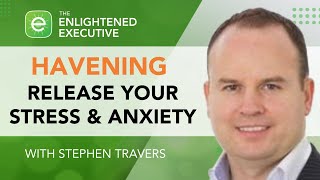
Stephen Travers demonstrates Havening, a technique developed by Drs. Ronald and Steven Ruden that uses gentle stroking to calm the amygdala and reduce anxiety. The method works by activating AMPA receptors and inducing delta waves through sensory touch, with applications for trauma, anxiety, and performance. Travers walks through a live demo you can try yourself.
Chapters
Foreign.
I'm Susan Drumm and welcome to the Enlightened Executive where your personal evolution sparks your leadership evolution. Each episode we highlight a groundbreaking technique or strategy to help entrepreneurs and executives get the edge for personal and leadership effectiveness. And we highlight a different Dream Office backdrop. Today we are focusing on Havening and its application to business. With me today, I am pleased to introduce from Ireland, Stephen Travers. Stephen is the Director of UK and International Havening. He's one of the world's foremost experts in this breakthrough neuroscientific approach for healing trauma, anxiety based disorders and producing confidence and resilience. Steven excels at teaching people how to use this Havening to create fast and lasting and empowering changes in their lives. So welcome Stephen.
Hi, Susan.
So I decided to get certified in this powerful technique because I was blown away by the results that I saw with clients and helping them deal with triggers in the workplace. But I'm sure several of our listeners, or many of our listeners may not know what Havening is. So can you tell us a little bit about what is this technique?
Yes. So Havening is a groundbreaking neuroscientific based approach for helping people quickly and effectively gain freedom from anxiety based disorders and trauma primarily. So it's excellent at helping people overcome issues such as panic attacks, fears, phobias, post traumatic stress, pathological emotions as well, feelings of maybe unresolved anger, grief, guilt, feelings of not feeling good enough. It's very good at clearing up past trauma and for building that emotional resiliency which we all know is very good to have in business. There's also applications for Havening around performance so we can use Havening to help us, for example, maybe have more confidence socially or for public speaking and presentations or even going into a business meeting. So Havening helps us to be at our best in terms of changing what's actually happening inside our brains and bodies. So that's kind of like a summary of what Havening can do.
Yeah. So what I found fascinating about it is a lot of the science behind this. And in fact, to get certified you have to do quite an extensive science exam, understanding the neuroscience and what's happening in the brain to, to almost in a way rewire the neural pathways so that the same triggers don't happen. And so I'd love for you to elaborate a little bit on that because I think it'd be important for people to understand that this is truly a scientific. There's been research studies on it, how it was developed. So maybe you can share a little bit like how was it developed. And what exactly is happening in this technique?
Yes, Havening was originally developed by the American doctors, Dr. Ronald and Stephen Rudin. Back in 2001 is really where it all began when Dr. Rudin started studying and examining tapping techniques, things like TFT and really wanting to understand how they worked from a neurobiological perspective. Dr. Rudin himself is a Harvard University academic. He's a neuroscientific researcher. He has published a couple of books, being published in various peer reviewed journals. So he really comes from that background of neuroscience and medical Western thinking. So he really wanted to understand how trauma and anxiety based disorders become encoded in the brain and the body and how we can use Havening, which is really about the neurobiology of sensory touch and how that can actually change what's happening in the brain and the body. One of his big discoveries was that when you have a traumatic event or a very distressing experience where you feel trapped, or a sense of inescapable stress, something called AMP receptors get encoded on neurons in your amygdala. And these receptors download all the emotional and physical stress that you're feeling as you go through that event or episode. So if your heart's palpitating, you have a knot in your stomach, you're sweating, you feel fear, or you feel trapped or angry, all that data is getting encoded into the amygdala through the receptors and also into the body. So as you go through your life, if anything reminds you of that past distressing event, be it consciously or subconsciously, so any cues or stimuli in your environment, it has the potential to fire off these AMPA receptors and release cortisol and adrenaline in your body and create that fight, flight or freeze response. And those traumas, if you like, or distressing events are the root cause of almost all anxiety and stress based issues that we all have. And when we can pinpoint and identify those traumatic memories and events and apply Havening to them, not only can it completely free you from the trauma of the past, that also has a massive positive ripple effect right into the present to help you feel more calm and confident in the sense that the things that used to trigger the anxiety can't and won't trigger it anymore because those amperoceptors are now gone and have disappeared from the amygdala. So when something reminds you of that event, the amygdala doesn't fire off in fight or flight anymore. The amygdala is now calm and at ease, which means that you feel calm and are these are more resilient within yourself.
That's extraordinary. And I think, you know, one of the things in doing leadership development work that I noticed is, you know, leaders would maybe get triggered or upset by something that in a way they would just read it out of proportion. Right. They're watching something happen. And I remember working with one particular leader who had some challenges with feeling surprised about things. And so it was never intentional by some of the colleagues to do that. But man, if he saw anything that felt to him like he was being surprised, his response was outsized. It was to the point of like, you know, you don't need to get so upset about that. And I think we've all had times like why am I getting so upset about this? Why? What is getting under my skin about it? And so what you're suggesting is it has something to do with the fact that in your past you were in a situation where that trauma or something related to that got encoded in the brain. And so you're just reactivate when you see something out there like that, it's just reactivating that and zip, you're right back in the thick of things. Is that an accurate description?
Yeah, that's very close, yes. And we talk about having a vulnerable neurochemical landscape and a resilient neurochemical landscape. So that person you talked about as an example, who when they feel surprised, it really upsets them or something small becomes something big in terms of their reaction or feeling stressed or upset. The more that's happening for someone, the more of a vulnerable neurochemical landscape it's creating and reducing, which means that you can actually start developing even more anxiety based issues. So you often see when stress and anxiety is left untreated or it's not successfully dealt with, more symptoms appear. Maybe you just can't sleep as well anymore. Maybe you're easily startled. Your ability to focus and concentrate is diminished. Your ability to be creative or solve problems is diminished. You may shy away from challenges because you just don't feel you've got the resilience to do them. You're like, you're living on edge and you can even become hyper vigilant. So if these stress related issues are left unresolved over time, they can cause big problems in life and in business.
Yeah. So maybe you could share a little examples of how does this improve leadership? How would this help people in business? How have you seen it, applied this technique? And we're going to talk about the specific technique in just a little bit, but I want to give the context. Yeah.
What I'D like to do today as well is to give people an experience of the Haven. And because we want to do a live demo and get everyone to follow along with it. And the audience can take some stress related issue if they wish as well. Well, first of all, stress and anxiety, be it in life or business, if left unresolved and if it's pervasive, is not a good thing. It affects your ability to focus, to. To concentrate, as I mentioned. It affects your ability to make good decisions. It affects your ability to go for things. Sometimes people become more hesitant to start lacking confidence. Public speaking and presentations is quite a big one I come across in working with executives. For example, I remember working with a lady a while back and she got a promotion at work where she now had to present to more senior people within our company. And this was bringing up a lot of anxiety for her. She's actually having sleepless nights about it. So she came to me and we discovered that it all went back to childhood. Having some bad experiences at school with teachers. One or two interviews she did when she was younger and we haven't them and in the space of a couple of sessions, the issue was completely resolved. She was going in, doing the meetings feeling really calm. In fact, she was feeling really confident and she was even getting some praise about how well the meetings were going. And that was in the space of a couple of sessions. So the good news is that people don't have to suffer for long periods of times with these type of issues. We now have a solution that works quickly and effectively and actually produces lasting results as well.
Yeah, I love that. It actually changes almost that from coming out forever. Right. It's not something that you keep working on and working on and working on. If after a couple of sessions you're able to transform these from everything from public speaking to other types of triggers in the workplace. So it's.
I've done like over 5,000 havenings in the past eight years. And my approach is like a four session program with the vast majority of people. And even within the space of session one and two for so many people, most if not all of the anxiety issues resolved. Then we start really moving into more resiliency work where we're looking at the future and helping to increase their confidence, their productivity. You know, we kind of look at maybe our goals and have them really move towards what we want as opposed to moving away from what they don't want. So I've seen it time after time again, some of my colleagues around the world in regards to how remarkable and effective the Havening is for these type of anxiety and stress based issues.
Yes. Yeah. What if you can't remember a specific memory? Does it still work? You just know that you're generally anxious, but you don't know where it comes from.
Yeah. Well, when we train Havening practitioners, part of the training is we teach you how to pinpoint and identify where the issues are coming from. Because even when clients ring me, they often say to me, well, I don't know where the issue is coming from, or I don't know what caused it. And my answer generally is, well, that's not really your job. That's my job. As if you like the expert to pinpoint identify where it's coming from, so you don't have to worry about that. But I suppose, worst case scenario, if the therapist doesn't even know where it's coming from or they're not sure, we can use Havening on the presenting problem. So if it's something that's happening on a daily or weekly basis, we can start using the Havening immediately on the current stressor. As you know, when we use Havening as well, it can bring a lot of stuff up from the unconscious into the client's conscious awareness. And that can help us also to reveal and identify where some of these symptoms are coming from.
Yeah. Yeah. Okay, so tell us, tell us a little bit about the technique you mentioned using, I think, psychosomatic touch. What, what does that mean? And, and this is something we do for ourselves, I'm assuming.
Yeah. So Havening is a psychosensory approach, which means that we use sensory touch where we gently stroke the arms, the palms of the hands and around the face. And we also use pleasant psychological distractions. So when we're working with someone with a stress related issue or an anxiety based issue, we would ask them, for example, to close their eyes and think about or remember something that's caused them stress or that's causing them anxiety and depressants. Then we'd ask them, on a scale of 0 to 10, 10 being very uncomfortable, very stressed, and 0 being calm, how high do they go? That helps to activate the amygdala. Now we only do that for about 30 seconds. Then we ask the client to open up their eyes and then we apply the Havening touch, which the client can self apply. When we're applying the Havening touch, it's producing something called delta waves in the brain, which occur in slow wave sleep. So it starts calming the whole brain down. And simultaneously the delta waves start to produce positive neurotransmitters in the brain and the body chemicals such as serotonin, oxytocin. So that starts calming the whole body down. Your heart rate starts to reduce. Your nervous system calms down, your breathing slows down. It puts you into a very calm, relaxed state, both emotionally and physically, within seconds and minutes. Because your brain is an electrical chemical organ, it's important to understand that. So when we're applying sensory touch, we're actually producing an electrical brainwave that's simultaneously changing the chemistry of the brain and calming the whole system down.
Great. What I understand, there are three different types of havening, and this is what you do for yourself. One is rubbing your hands down your arms, from the tops of your shoulders to your elbows on every second path. The other one is rubbing the palms of your hands together back and forth. That's also one of the techniques. The third one is called washing in the face, which is you're taking your hands across the forehead and down the cheeks. Across the forehead and down the cheeks. And in doing the research, so I understand, it's particularly the cheek that can touching the cheek, self touching the cheek that can produce the greatest delta wave. And so the greater the delta wave, the more you're actually transitioning. That piece that you talked about, the AMPA receptor, that begins to get dissolved and no longer is it a neural pathway that's locked in. Is that right? Is that accurate?
Yes, pretty much. So. So, yeah, we call this havening touch. And it's worth mentioning that the word havening comes from the word haven. So we're havening you. We're bringing you to a safe place, to a safe haven. And that's the emotional physical effect. And feeling off is a feeling of comfort, safety, calmness. So, yeah, These are the three key areas. When, Dr. When the doctors studied the three points in the body, the arms, the hands and face produce the highest amplitude of delta waves in the brain. So we can do a demo for everyone. Yeah, follow along. I do know there's a podcast on this as well. So if you're watch listening to the podcast, you can jump onto the YouTube video or just simply follow along by stroking your arms, your hands and your face quite gently.
Sounds great. Let's do it.
So for everyone listening, I don't want you to take anything too traumatic or too stressful. In other words, don't take some massive trauma from your past. Maybe take something that's creating some sort of annoyance or something that maybe is stressing you in your life at the moment. That's preoccupying your mind that you'd like to get a positive shift on or some freedom from. So we're going to begin. So I'd just like you to follow my instructions and sit back and relax for a moment. And I'd like everyone just to close their eyes. And with your eyes closed, just focus on your breathing and on the sound of my voice. And I'd like you to think about something that's making you feel uncomfortable, Something that has been stressing you maybe recently, over the last few weeks or months, or even something that's causing you some sort of anxiety. Really think about it in your mind. Picture it. Think of the signs associated to it. Really focus in on what's causing the distress or what makes you feel most uncomfortable. And just notice. On a scale of 0 to 10, how high do you go? 10 is very uncomfortable. 0 is calm and neutral. Just notice if you can feel it in your body and the emotion. Then open your eyes. Just look at me. Clear your mind. Then I'd like you to put one hand on your shoulder and one hand on the other shoulder, just crossing your body. And then begin very gently stroking from the top of your shoulder all the way down to the elbows. Imagine if you were comforting a child, or even gently stroking a dog or a cat. And then gently close your eyes. And then I'd like you to imagine walking out onto a beautiful beach on a bright summer's day. Begin to imagine a beautiful blue sky, yellow sands, the sound of the waves lapping in against the shore. And as you imagine walking along this tranquil beach counter, lured from 1 to 20 with every step you imagine taking. And I'll count with you, starting at 1, 2, 3, 4, 5, 6. Relaxing with every step. 7, 8, 9, 10, 11, 12, 13, 14, 15, 16, 17, 18, 19, 20. Very good. Keep stroking. Keep your eyes closed. Then we're going to do an auditory distraction and this can be a bit of fun. We're going to sing a happy song. It can be anything at all. Let's take a roar your boat so you can sing along or hum along with me. Row, row, row your boat gently down the stream Merrily, merrily, merrily, merrily Life is fully dream Row, row, row your boat gently down the stream Merrily, merrily, merrily, merrily Life is but a dream. Very good. Keep stroking from the top of the shoulder all the way down to the elbows, taking in a slow, gentle breath. And just ask yourself, on a scale of 10 to 0, what number comes to mind now? And just Go with the first number that comes to mind. And then I'd like you to look at me for a moment. Gently open your eyes. Let's do some palm havening. So palm havening is where we just gently massage the palms at the hands together. Talk about washing our hands. Gently caressing, massaging the palms just to get those delta waves going. Then gently close your eyes and keep massaging the palms. This time we're going to count backwards down from 30 to 0 in twos out loud together, starting at 30, 28, 26, 24, 22. Relaxing with every number. 20, 18, 16, 14, 12, 10, 8, 6, 4, 2, 0. And keep stroking the palms, your hands. And this time I'd like everyone to sing Happy Birthday to me for the fun of it. So let's begin. Happy birthday to you.
Happy birthday to you. Happy birthday, dear Steven. Happy birthday to you.
Happy birthday to you. Happy birthday to you. Happy birthday, dear Steven. Happy birthday to you. Very good. Now take in a slow, gentle breath and keep massaging, pressing the palms of your hands as you do. Just notice, noticing your mind and body can relax. And just notice on a scale of 10 to 0, what number comes to mind. Now just go with the first number that comes to mind. Keep stroking. Then gently open up your eyes and look at me. And now we're going to do some face havening. The face actually produces the highest amplitude delta waves in the brain. Just stroking gently around your forehead and around your cheeks. Like you're gently massaging, caressing your face or gently washing your face. This time, gently close your eyes. And I want you to think about a time when you're on a beautiful holiday. Maybe it was on a beach again. Or maybe you were walking through the countryside or some mountains with beautiful scenery. Maybe it was a beautiful city or park that you're walking through. Just go back to a very pleasant, happy memory of time when you're on a lovely holiday. And as you begin to imagine that scene of that place you were in, really pictured in your mind what you saw. The sands. And with every step you imagine taking, count out loud from 1 to 20. Starting at 1, 2, 3, 4, 5, 6, 7, 8, 9, 10, 11, 12, 13, 14, 15, 16, 17, 18, 19, 20. Good. Taking a slow, gentle breath. Keep stroking. And this time just holding Twinkle Star with me. Twinkle, twinkle little star How I wonder what you are up above the world so high like a diamond in the sky Twinkle, twinkle little star How I wonder what you are. Very good. Keep stroking, taking in a slow, gentle breath. Then gently open up your eyes and we'll just finish up with a few strokes on the arms again. Just close your eyes for a moment, taking in a slow, gentle breath, feeling that sense of relaxation and comfort from gently massaging your arms from the top of the shoulders all the way down to the elbows. And just notice on a scale of 10 to 0, what number comes to mind now. And if you wish, you can go back and watch this video as well and do even a few more rounds of the havening and repeat this entire process. But like everyone now, just open up their eyes, take a little stretch if you wish. So it'd be interesting to see and check in how everyone's feeling. Do feel free to leave comments on the video myself or and Susan, we can come back and give you some feedback or give you some more tips or advice. But what I'd like everyone to do for a moment is just notice how you're feeling. Some people may notice to feel a bit lighter, bit calmer, a bit more relaxed. Some people feel a bit tired or spacey. It's also worth checking in on the memory. So I'd like everyone just to close their eyes for a moment. That's it. Just relax and think about that thing that was causing you some discomfort or stress and just notice what the difference is. Often you'll find that the image itself, the memory, if there's any image to it, or sounds, will seem more distant or faded or blurry or fuzzy. Even the sounds themselves, you might be able to hear them quite as clearly. And that emotional and physiological feeling that was attached will now be reduced. And for some people it might even be completely gone. So, as I said, do feel free to share on the comments section.
Yeah, I picked. My parents are in their mid-80s and I'm concerned for them given the pandemic, and creates a lot of anxiety of keeping them healthy and away from any harm. And so I feel a lot calmer about it. You know, it's keeping me up at night, so I feel like that was a good one. So I just. I definitely feel a little bit more sense of peace and calm around it. Great, thank you.
What's lovely about havening is you can use it every day. It's a brilliant technique, especially when I do work with people in business and executives, they're generally really busy. They don't have loads of time to do hours of meditation or mindfulness and yoga every week. Some of them do. A lot of them don't. So what's great about this technique, you can use it anywhere. Once you've got your hands with you. And once you start applying it, even like four or five minutes a day can really down regulate your stress, keep your resiliency high. If there was something that was bothering you, that was ongoing, you could use havening on it over a couple of days and that can keep clearing it, keeping the stress low. And you'll probably get to a point very quickly where the emotional charge will just be gone from it and you'd be able to think more clearly on how to handle the issue. If it's something that needs to be dealt with in the present, if it's something in the past, you'll probably, in some ways, you know, it'll just become like any old memory.
So when people do this, should they try to also do some of the counting or the humming techniques? Should they do that? And why do we do that? Why is that part of the technique?
Yes, great question. The distraction does look strange. Some people can even feel a wee bit silly doing the humming at the beginning.
Right.
What the distraction does, it helps to displace the stress and thought or memory out of your working memory. Because your brain can't really think of two different things at the same time. It's also giving you an escape to something more pleasant in that moment. So as well as the sensory touch creating the electrical chemical changes, psychologically, you're bringing yourself also to a safe haven, to a more relaxed place. And it just makes the treatment, if you like, more pleasant for the client that you're not sitting there going through the trauma and the stress, replaying it over and over and over. It's really a case of activating the amygdala. There's ampho receptors there. Once they activate, there's a phosphate molecule exposed. That's why we activate it. Once that's exposed, the delta waves are creating chemicals that are delinking that phosphate molecule off and making those ampa receptors disappear. So it's really case there's triggering off the anxiety or stress for maybe 10, 30 seconds and then getting into the havening and the distraction. And that's what's great about it as well. You're not left sitting. Some people spend months in some traditional therapies going over the same problems and getting very upset and go through boxes of dishes. This approach is very different. It's much more about obviously pinpointing the issue, but actually getting you a very tangible, if not a life changing result.
Well, incredible. I am so grateful that you joined us today to walk us through this technique and share what's possible for people given the amount of stress that's going on right now, I think a lot of executives and entrepreneurs could really use the down regulation of the amygdala. So how can people learn more? How can they. What did you suggest to get in touch with you or any other information you'd like to pass on?
Yeah, well I would like to say if you have like serious issues, you know, more deeper of the trauma if you like, or anxiety based disorders, it's best to work with a certified Havening techniques practitioner. I run trainings as well in Havening so people can go onto my website. I know you're going to share it on the links. It's asknosis.com or just type my name into Google. Lots of information will come up. There's lots of information there about Havening. I do do one to one sessions on Zoom. I do be booked up about two months in advance but do feel free to call me, contact me and I can do a free phone consultation. I generally do about 10, 15 minutes just to make sure that the issue is a good fit for my program and the way I work for clients.
Fantastic. Well thank you so much. We'll put all that information in the show notes and yeah, I feel much better. I'm ready to, ready to keep going for the day.
Great. And after that little demo we did, you know people, if you want to, you can go back and do and do another few rounds of the Havening again if there's still a residue there or you want to just to experience and practice the haven. Just go back and re watch the video. As I said, do share some comments and we're more than happy to give you some feedback.
Fantastic. Well, thanks so much for joining us today and thanks for listening in and we'll look forward to the next episode. Hope you enjoyed today's episode and I'd like to point you to the next important step. Hit the subscribe button and the bell to get notified when we release new content. I'll see you on the next episode of the Enlightened Executive.
Sam.
More from Susan


Why the Biggest Doors Open When You're Not in the Room | Michael Roderick & Susan Drumm





The Simple Audit That Adds a Human Touch to Every Customer Interaction #shorts


