Driving Innovation and Creativity from Within [Kaihan Krippendorff]
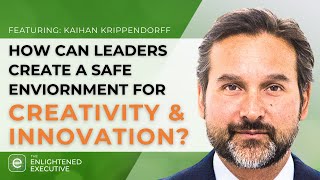
Kaihan Krippendorff explains how established companies can foster innovation by moving beyond the typical three options to a "fourth option," using 36 thinking patterns across business areas. He outlines barriers to internal innovation and describes the cultural, structural, and leadership changes needed to let employees experiment and protect unconventional ideas.
Chapters
Hi, I'm Susan Drumm and welcome to the enlightened executive where your personal evolution sparks your leadership evolution. Each episode we feature groundbreaking techniques and strategies to help you get the edge in personal and leadership effectiveness. Today we're focusing on strategy and innovation and I'm excited to introduce my dear friend and colleague, Kaihan Krippendorf. Kaihan began his career with McKinsey & Company, but with before founding the growth strategy and innovation consulting firm Outthinker. His growth strategies and innovations have generated over 2.5 billion in revenue for many of the world's most recognizable companies including Mellon, Citibank, l', Oreal, Microsoft and Viacom. He's the best selling author of five books, most recently the Edison Award nominated Driving Innovation from A Guide for Entrepreneurs. He's a member of the prestigious Thinkers50 Radar group who has recognized Kaihan as one of the eight most influential innovation thought leaders in the world. Kaihan is founder of Outthinker Strategy Network, an exclusive network of chief strategy officers from large organizations with over 1 billion in revenue. With a mother from Bangladesh and a father from Germany, Kaihan brings a diverse, holistic, global perspective to everything he does. So welcome.
Kaihan. So great to be here and see you. Susan, thank you for having.
Me. Yes. We were just talking. I think we have known each other for almost 15 years. We have collaborated together and I am really excited for you to share your wealth of knowledge around driving innovation from within, coaching to drive innovation thinking. And that is where we are going to.
Start. Awesome. Yeah, yeah, yeah. So I think that that would be a great topic. You know, I know that you know, you know so much about coaching and I think that you, a lot of the people that are listening here, you know when they're often doing work through others. Right. As you get to be more senior, you're doing work through others. So how you not manage them. But I like to look at managing the conversations that you had and some of those conversations lead to exciting big ideas and possibilities and sometimes they don't. Right. So that's what I've really been interested in is how do you as a leader engage in discussions and use language that opens.
Possibilities. I love that. So it's a combination of coaching and driving innovation from within, which is your latest book, you have talked about something called the fourth Option. Can you explain that concept? And after we talk about that, maybe we talk about how to generate that within and using coaching your employees to find the fourth.
Option. If you look at breakthroughs and strategy in all domain, whether that's sports or business or chess or there are breakthroughs in how it's played. It's rarely that the innovator did something that others couldn't do. If Dick Fosberry went over backward in the Olympics, 1968 and the high jump, people could have done that four years before, eight years before, 12 years before, blockbuster could have bought Netflix, Yahoo could have bought Google. It's rarely. And this one of the issues I have in the study of strategy as strategy being about doing something your competitors can't do. But it almost never is the case. It's usually that others don't choose to do it. And so like this fourth option idea, it's a metaphor. It says there's a point at which others stop thinking when they start repeating themselves. That's represented by three. Three is just as, you know, great orders repeat in threes. The three is kind of magic. You know, in, in Christianity, there's the holy trinity at McKinsey. They train you to break everything down into threes and three sets of threes and three sets of true. It's the same at BCG as well. And, and so that sort of just symbolizes that moment where you feel like, okay, we got the options, let's start narrowing down the.
Options. And that's we have three, we should be.
Good. Exactly, exactly. It feels good. And yeah, so what you want to do is recognize when other feeling feel people feeling that and saying, okay, well what.
Else? Right. So pushing beyond to the fourth option will open doors to look at things in a new way. From what I understand. Can you. So why four, why not five, six.
Whatever? Well, there are usually, usually there are many more. Right. So we're actually, just before this, I was working with a client, really fascinating small client called Earth Doggy. They, they have a website that sells earth friendly dog products like collars and beds and things, but primarily focused on rescue dog owners. And so we went through the. Anyway, we're at the stage where we're looking at our options. We have 148 options. So the way to get to that fourth option is to come up with 148 options and then work your way down. I think if you look at like the companies that are really vibrant, let's look at like anything Elon Musk does. Right. They are looking constantly like idea machines. Right. It's just a flow of ideas. And not just product ideas, pricing ideas, promotion ideas, positioning ideas, people, hr, organizational ideas across the whole spectrum. And so it's really about, you know, firing on all cylinders to get those ideas.
Flowing. Absolutely. So what about the organization that fears that if we just go through all these different ideas and we're not executing, executing, we're scattering our forces? We just need to decide, commit and move forward? What would you say to.
That? Oh, you do need to decide, commit and move forward and you can't do more than you can do. There's always bandwidth, there's always resources. The risk is to start making choices and executing when you haven't considered all of your ideas. I think it's almost frustrating how lazy people are when designing their strategies. I mean, if you, if you, you know, if you were going to install a kitchen, right. Think about all of the little choices that you would make, you know, what color and where, where does it align and where, you know, and you go through all these different iterations with the architect and the looking at materials. Right. We spend, I would, you know, probably a company probably spends 5% of that time in designing their strategy. Like they're in a rush. So they build these kitchens that are just, you know, cookie cutter. Right. So I think if we can, you know, embrace it as something that's creative and fun, you know, then we can bring that kind of energy to designing our.
Businesses. Yes, yes. And I also like the whole concept of driving innovation from within because the people that are closest to the customer, closest to the front line, probably have the best ideas that you haven't really tapped.
Into. Right, yeah.
How. And so what's your strategy to involve the rest of the organization in generating all of these.
Options? Well, the book, I was inspired for writing it from a client of mine, McMillan, and there's a woman, Jean Faywall, and you maybe don't know her if you're not in literature, but she is kind of the person behind goosebumps and Babysitters clubs. And so you know, her work. Anyway, she came up with this idea and she just made it happen from within. And it's this platform for would be self published authors to put, to put up manuscripts and kind of get. It's kind of like a crowdsourced platform and I could go into it, but they made a whole bunch of radical decisions. So anyway, she did this and I thought, wow, it's pretty amazing that she did this. Usually it doesn't happen. And so I wanted to find out is she the rule or she an anomaly? And what I found is actually she is the rule that 70% of society's most impactful innovations came from employees working inside established companies. And so this idea, this mythology that we Follow that I follow. I'm an entrepreneur. I love entrepreneurs. But, you know, you talk about who's most innovative business person and it's the same names, right? It's. They all look the same, they all have the same story, the same narrative, but it's not true. So, you know, that's what spurred me to write this book, is honoring, encouraging, recognizing the real the employees, because they are the ones that are going to come up with the next Internet, with the next vaccine, with the next, you know, heart pump. It's going to be them.
Right? Yes. And so there's a number of things that need to be in place to make that happen.
Right?
Yes. I mean, number one, you need to be able to create the platform to generate those ideas from those employees and be listening. Number two, you have to make it safe to fail. Innovation requires failure, right? You get to try and look and explore. And a lot of organizations that I work with, they come in and when I ask those questions about are you able to take risks and try new things, I think a lot of employees feel like there isn't the appetite to do that and it's just easier to do what works and stick with the status quo. So I'm curious to know what you recommend for how. And maybe there's other things that need to be in place besides what I listed. So what do you.
See? I mean, in my research, I interviewed 150 internal innovators and he asked them this question, what's the barrier? And they're really seven. And I forced it into an acronym that hopefully is easy to remember. It's innovate with one N. And so versus intent. They're not trying.
Anymore.
Need. They don't understand what the company needs. So when you do encourage the ideation, they're not innovating in areas that are strategically important to the company. And so then what happens then is then they get told bad idea, bad idea by idea. And then they lose the intent. You know, so options just generating lots of options, not, not four or three options, but 148 options. These about value blockers is that we. You have to understand how it's not understated, but you got to learn how to design business models. And because it's very likely that the business model around your innovation is going to be in conflict with the business model that you operate in. So just learning business model design the next one's act, and I think this is where the risk comes in, is making these small, frugal experiments instead of asking for a lot of Money. Most of the innovations I studied, they didn't get formal. The innovator didn't get formal approval from the boss. And which is also why important cultural value is proactivity. But they. They scaled down the first step. So they're only risking $5,000, something like that. Right, right. Team is. It's hard to pull together the team that you want to work on with this with, because they don't all report to the same boss. And then environment is. There's a bundle of things around culture and leadership and organizational structures and the kind of talent that you need. But the thing is, these are all actually well understood. You know, it's almost like, I don't know if you went to a doctor and the doctor was just making it up. Right. And hadn't actually gone to.
Medical. Sometimes I feel like they.
Are. But, you know, that's. Oh, yeah, that's. I think that there's a lot known. We know what they are and we know how to. What techniques to help overcome.
Them. Yeah. So the environment piece I want to dig into. But before we do that, I actually. So how do you help people think of A140 ideas? Because there must be some techniques or things that you can share with listeners on. How do I possibly get people to think outside the box at that.
Magnitude? Yeah. So two things I'd say about that is it's very hard to think outside the box. And I try not to ask people. I give people different boxes to think in. And I know that sounds kind of like a phrase or something, but I really do. So in my methodology for the ideation, you pick an area of the business, because I focus on business ideation, but you could do anything else. So there are these eight P's I started alluding to before. Positioning, product price, place, promotion, processing, physical experience of people. All of those five, eight areas are areas to look for innovations. And then you have this eight rows, if you will, and then you have 36 columns. And these represent different strategic thinking patterns. And so I think that there are 36 patterns. And so move early to next battleground is about like plan for tomorrow rather than today. Coordinate the uncoordinated is kind of like platform and network. And so then you pick an area and you say, okay, let's pick pricing for this year and we're going to come up with some great pricing ideas. Okay, where is the next battleground in pricing? Oh, should we accept cryptocurrency? Oh, we should have touchless payment. Oh, and forcing them into that box, it restrains Those restraints actually encourage.
Creativity. Got it. So you have that ability to focus the attention in one area, but that within that. That gives me not just a blank canvas, but something to work.
With. Yes.
Exactly. I like it. I like.
It.
Yeah. And I know those stratagems because we've. You and I have done some work around.
That. You did a career one.
Remember? Yes, we did. We did some work helping people find new careers using the 36 stratagems. And those are in ways. Ways for competition, ways to, you know, ways to outthink your competition. And I, I love that framework and how you use it in the innovation space. And. Well, let's talk about the environment piece, because in leadership development, that's obviously one of the most important areas that we want to create. The conditions that allow your employees to thrive and contribute and feel engaged and be collaborative. What do you see from your research that creates the right type of environment for that to.
Happen? Yeah. So as part of the research for the book, I read every academic study I could find that showed a statistically significant correlation between some organizational attribute and higher or lower levels of internal innovation. Technically, entrepreneurial intention is a measure, and they really fall into four buckets. There's leadership, there is organizational structure, there are cultural values, and then there's talent, the type of talent, you know. But which of those sound more interesting to you? Organizational structure.
Culture. I mean, culture and the talent piece.
Absolutely. So under talent, what's really interesting is that the attributes that make someone naturally effective at being internal innovators, they look different than entrepreneurs. And in some ways they are similar. They tend to be innovative thinkers, certainly they tend to really know the market and they tend to be proactive. You know, they take action. How they relate to risk, however, is very different in that they look to create risk asymmetry. They look to create a situation where they bet a little to get a lot because they're not betting their money. Another one is that they actually love the politics. It's not that the politics is necessary evil. I'm going to learn to do it. They view the political challenge as part of the problem solving process. So they take a lot of time to line up the cannons, but they know when the cannons are lined up and they go off all at the same time, because you're doing this inside a company with scale, then it's a big boom, you.
Know? Yeah. I would think that they're great collaborators and being able to build coalitions around the idea, they know they can't just lead and jump in and wave the Flag and say, here it is, here it is. They've got to bring people along the journey. So how do they collaborate? How do they engage other parts of the organization, other thinkers of the organization, so that it almost feels like a joint solution versus just coming from them? And I think then that goes to the individual psyche as well. If I need to hoard it and keep it for me so that I get all the accolades because I'm. What I'm really going after is try to get the accolades, then I'm going to struggle and actually getting the idea implemented. It's this weird.
Paradox.
Yes. Whereas if I'm just. If my mission is about the good of the idea and the company, then I don't care. What if I get credit? You get credit. I'm not worried about. About that. I'm just driving it forward. And that's the difference, I think, between conscious leadership and not conscious.
Leadership. You're 100% right. The. That sixth attribute. So there's six attributes. The sixth one is intrinsic value. They get intrinsic value from for innovating. They're not doing it for the money. They're not doing it for the praise, which is, you know, not 100%, you know, always the case. But that's also why it was so difficult to find these people, because you find this great big innovation and wow, who came up with it. And you don't know because they are in the woodwork from behind, you know, is spurring from behind. There's that Dallas phrase. I'm not going to get it exactly right, but something about the great leader and the people say, we did it ourselves. And that's what happens. It's hard to find these people to get in their heads and to.
Be able to be able to take that on. Well, do you have any suggestions on how to hire for that? And if. Yes or no, depending on where we go, I'd also. Well, then how do I coach internally based on what I got? How do I get them more innovative if that's what I'm looking.
For? Yeah. Well, I think you should look for if someone gets intrinsic value from innovating and if they have the other attributes that make them good at innovating, they probably have done it before. So you can look for in their past roles where they have rolled a ball that, you know, went down a hill. So where they've made something happen or started something that happened. And it won't be necessarily on their resume. It won't be, oh, VP of New whatever, you know, it will be, you Know, it'll be part of their job description. So asking them for examples like that, I think is a great way to find them, you.
Know?
Yes. And then the coaching, you know, this coaching methodology that. That I use from outthink the competition ideas, which are basically kind of five steps, right? Yeah. Unlike coaching methodologies that you use. Imagine what's the future look like? What do we want to be in that future? Dissect. What part of the problem should we focus on? Expand. What are some options and options and options and options and options and options. Analyze and choose those options that we're going to move forward with. And then the last one sells. Getting people on.
Board. How long should you let the ideation process run in your mind? Is it a certain number of ideas? Is it a certain time frame before you choose and.
Commit? I like the number. And the number depends on what type of problem you're solving. If you are looking for one big idea, your core business is doing fine, but you're looking for one big idea. I want to get at least 40 ideas if it is both core and new.
Right?
Yes. We need ideas to also protect the next two to three years. In addition to, like, what's going to be really a breakthrough idea. Usually we're at between 100 and 200.
Ideas. Got it?
Yes.
Wow. So, and what does it take to generate that? Is it over multiple sessions? Is it. How is it them working independently and then bringing the ideas? How do you suggest.
Implementation? You know, I think that best practices are supposed to be let people ideate and then bring ideas and then continue. But for practical reasons, I rarely have the time with the client to do that because the client's like, I think tomorrow I'm going, or Wednesday I'm going into the city. And they want to get it all done in three.
Hours.
Yes.
Okay. Oh.
Yeah. But if you really want to increase the volume of ideas, what you can do is you can take the team and break them up. We did this for a television network. This was one of my favorite products projects. And we had just like the top leaders, right? So the head of the two studios, the head of daytime, the head of news, the head of. Of ad sales. Right. Just like the rock stars. And then we put them into different groups. And we had the people group, HR group, we had the distribution group, which is the placement group. You notice I'm doing. I'm doing the APs again.
Right?
Yeah. And then they all work. They worked in groups of like six or seven people. They each had like 50 ideas that narrowed it down to their top 10. So now we had a top 10 list. So eight. No, I think it were seven different. Seven different top 10 lists. So 70 ideas. There was some overlap there. So then we went down to like 50 ideas, and then we kind of voted in a certain way and then got this heat map and then we massage them down to the five big themes. And I don't know that really whether that ended up becoming the strategy, but I think it informed the strategy. And if you look at how well they're doing now, you can see that they started thinking about these five things in different.
Ways. Yeah. Well, this is one. I would love to hear some examples of what doing this work difference. It's made for some of your clients. And I know you've got some of the best stories, so I'd love for you to share.
That. Yeah, well, that was. See, that was a great one. So this was kind of. If you're not in finance, this probably won't make a whole lot of sense. But there is this one woman, and she ran a group that managed $25 billion in agricultural real estate. And they were looking at, how do we increase the value of her holdings? And so we started brainstorming and people were going through kind of operational things. Let's get more efficient at our M and A activities and things like that. And she's a real out thinker. She said her name's Heather Davis. She said, wait a second, guys. Imagine this future. Someone walks into Starbucks and while they're waiting in line, they pick up their phone, they open their E Trade account, and then they buy or sell a security that's backed by agricultural real estate. Seems like not a big deal, but you can do that with commercial real estate. And there are REITs and other tradable, you know, vehicles. You could do that with residential real estate, but you can't do that with agricultural real estate. And a part of the reason is, you know, you can like, you can look at like a pool of buildings and you can, based off of the zip code and the size and the average rents, you can calculate what that is without having to go in and look at the building. So you can then put all these together and you could say, these are all worth this much. But agricultural real estate is, you know, it's. Everyone's a different shape. There are too many variables. So what they decided to do was they gave a grant to a university to start tracking transactions and start creating this database of agricultural real estate so that they would have the information base to launch such a, such a, such a creating in the context to do that. So I think that they, I think that they're close. There's a lot of normalization you have to do. But that's, I think an example, right. Of you're about to go down one way, kind of end up doing the same thing everyone's doing, but then you disrupt that and say, you know, and what you do makes no sense. If what you want to do is just optimize, you know, for the near term. Does that make.
Sense? Yeah, absolutely. And I love in both innovation about how to approach, like how can we figure this out? But the use of a partnership, let's leverage the university to be able to do some of the research. We'll give them the grant to be able to do that. That then we can, I mean that that's innovative in.
Itself. Yeah, right. Yeah, yeah, yeah. And I think increasingly we are competing in ecosystems as well. And so I think that that's also a skill that we all need to build. Especially when you're doing big innovation. Big innovation usually is done and there's been a long, long term trend. It's not, it's, it's less and less done by one organization, but rather through partnerships and coalition.
Building. Yeah. You know, how, what have you seen in terms of leaders being able to make it safe to fail in anime? You mentioned already, they, they take smaller bets. But I also think it has to be something about how the leader shows.
Up. Yeah, yeah. I think that there's a lot, I think, you know, the whole area of psychological safety and showing how it correlates with innovation, diversity of thought, you know, which can correlate with gender and race and things, but it's really diversity of thought that matters. So, you know, creating those contexts. But you know, I think that as a leader, real useful, immediate thing that you can work on is when someone shares an idea, what is your micro reaction to that idea? Do you giggle? Right. Do you smirk or even do you praise? And that's dangerous because at least when I'm, when I'm facilitating, I try never to respond to idea. I don't even say, oh, that's a great idea. Because then the next person with an idea, I'm gonna have to say great idea to every idea.
Right?
Yeah. Otherwise I'm telling them that's not a great idea. So can you really like be just like open to ideas and look at that moment, at how you react to ideas? I think that's the number one.
Thing that you can, that is Interesting. So in a way you're just staying curious but not commenting, not judging the idea, good or.
Bad. Right, right. That will come later. That will come later in ideas. Imagine, dissect, expand in the expand you're ideating or expanding options and then you just know that later we're going to go to analyzing them and judging them. But when you collapse those two, when you have a conversation like here's an idea, oh, we tried that before, here's an idea, oh, let me tell you why that won't work. Or here's that idea, whatever, that's when you collapse those, it just sucks out the, sucks out the air. There's no space for ideas. The other thing, I think the other part to look at is in my framework in analyze, we have this one type of idea, we call it the crazy idea, which is a difficult high impact idea. And difficult high impact ideas. Most people shrug them off, most companies shrug them off. They put them on the back burner until three years later a competitor has done them and they're jealous that the disrupting, like I had that idea three years ago. But the difference is you didn't do anything with it. Right. And so having space for impossible ideas now we can do that usually with technology. If someone says let's build some new technology, a rocket ship or whatever, technically we can't do it. But that's what we have R and D departments for. Right. But when the barriers are, oh, customers won't want it, oh, we can't sell it, oh, we don't know how to price it. Right. Oh, we can't, how do we operationalize it? Those are all like problems to solve. So having, circling some crazy ideas, high impact, difficult ideas and having them on your agenda. And every month or every quarter whenever you have a meeting, you work on those crazy ideas and keep those alive. Make it okay for people to hold on to.
Crazy. Yes, yes. And do you even. I would say that the next best thing you could do tomorrow is create one of your team meeting sessions where you identify the crazy ideas and then keep them alive in your.
System.
Yes. Right.
Yes.
Yes. That's a simple thing to start doing. Let's put crazy ideas on the table and we'll keep a running list of.
Them. Yes. And have them explicitly on your strategy as things that you're not going to execute but you're going to work.
On.
Yeah. Turning into winning moves.
Yes. Well, this has been so fascinating. Kaihan, thank you for coming on board. Where can people learn.
More? Probably the best is my speaker website which is my first name.net, kaihan.net K A I H N NET.
Excellent. I love it. Well, thanks again for sharing all the amazing wisdom you have. So many frameworks. It's amazing. Such a good.
Concep. I do love frameworks. Thank you for having me. It was so great seeing you.
Again. Great to see you again. If you like this episode, you're not going to want to miss my interview with Chris Michelle, who shares with us how to build a culture of trust and promote excellence by normalizing constructive feedback. Let's lead the way. Hope you enjoyed today's episode, and I'd like to point you to the next important step. Hit the subscribe button and the bell to get notified when we release new content. I'll see you on the next episode of the Enlightened.
More from Susan


Why the Biggest Doors Open When You're Not in the Room | Michael Roderick & Susan Drumm





The Simple Audit That Adds a Human Touch to Every Customer Interaction #shorts


