Empathy: The Essence of Digital Leadership (feat. Erik Qualman)
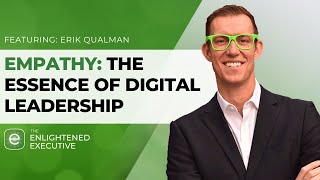
This is a recorded interview (YouTube) of Susan Drumm with Erik Qualman (recorded Jan 7, 2024). Qualman defines digital leadership as empathy — using digital tools to improve customer, client, team experiences — and illustrates the point with case studies (Disney allowing guest photos; Sleep Number shifting customer-service thinking). He argues leaders should treat AI like past tool-adoptions (the calculator), learn to use it (e.g., ingest your website into ChatGPT for SWOT, marketing plans, press releases), and emphasizes focus techniques from his Focus Project (half-hour daily sales focus and the 20-20-20 rule: every 20 minutes take a ~20-second break looking at an object ~20 ft away). Contact: equalman.com.
Questions this video answers
January 7, 2024.
Empathy.
About a half hour a day (focused on sales).
Every 20 minutes take a ~20-second break and look at a fixed object at least 20 feet away (stand up briefly to reduce eye strain and boost energy).
equalman.com
Chapters
Foreign.
Welcome to the enlightened executive where your personal evolution sparks your leadership evolution. And we are so excited to welcome Eric Qualman here today, who has written so many amazing books. One on digital leadership, another on how to focus in an unfocused world. So, Eric, thanks for joining me today. Tell me a little bit about what is digital leadership?
Yeah, when I talk about it in my class at Northwest University, I always say empathy. That's it. Empathy. It's funny because we came really, the word sort of didn't exist. When I was 12 years ago when I was working with companies, they brought me in on the book Social Nomics to talk about social media. And then I'd come in to say Mont Blanc, and I go, all right, what do you want to do? And I go, well, we'll send them to your website from social media. Oh, we don't have a website. I go, oh, whoa, okay, hold on, hold on. You're only selling through your retail outlets, through your maisons. Let's talk. So I realized, quickly realized, wait, they need the basis of digital leadership. And at the highest level, again, that's empathy. Do I have empathy? Do I care enough to solve an issue with digital tools for my customer, for my client, for my teammates? And then also, it's really Flintstones and Jetsons. It's not all digital, digital, digital. It's those combination of those two. Some people might say Omnichannel. I like to say it's Flint Zones and Jetsons coming together. Replace face to face. But when time, distance, and safety are an issue, how do I use these amazing tools to make sure I'm connected to my team, to my customers, and to my clients and to my partners?
And what's an example of companies that have embraced this and leaned into it?
Yeah, there's so many, but I'll use one. This is really good example of, okay, that's the digital realm. So if you look at Disney parks, so all of a sudden, Disney parks are amazing, right? Everyone's got that iconic shot of their family in front of Cinderella's castle. All of a sudden, digital comes along. Everyone's got a phone, they've got a camera with them in the park. It became a big issue in their minds to Disney. Was it lessening the experience for everyone in the park, but specifically to Cinderella's castle? All right, we make $30 every time we take a photo of this family in front of Cinderella's castle. Now people are kind of taking pictures in front of the castle. Should we allow all these phones to Be in the park. And there's a big debate for three hours. And then I was working on an animation project for them. So they bring me in, I go, look, let's just boil this down. Let's focus on the end, which is, how do I put a smile on this customer's face? If you're in the park with your kids, a lot of you have kids, right? Raise your hand. Boom. They all raise your hand. If you're in the park with your kids and you have your phone with you, wouldn't you want to take a picture in front of Cinderella's castle? Absolutely. Okay, that answers that question. You. You should let them take a picture in front of the castle. Two, if that photographer's not busy, can they hand the camera, can they hand your iPhone to that photographer, professional photographer, lawyers sitting there? No, absolutely not. They drop the phone and smash it. So all good reasons on why they shouldn't do that. But then again, we pause and go, if you said no to that customer, what do you think they're going to feel? Do you think they're going to have a great day at Disney? Absolutely not. So then it answers that question very easily. So then the chief Revenue officer goes, what about the lost revenue from that $30 a shot? Great point. You're gonna lose some revenue, but they're gonna be able to broadcast this around the world about the amazing time they're having at Disney World. So they eventually make the decision after several, several meetings. Cause this stuff's not easy. I'm oversimplifying it. But they came to the right conclusion, because when you go to first principle, how do I make this experience the best for that person that comes into Disney Park? Okay. That allows us to answer those questions a lot easier and then those complicated questions a lot easier. So then all of a sudden, Disney, they lose revenue on the photos, but all of a sudden, they made a ton more revenue because all of a sudden they have this free marketing, because the happiest place on Earth all of a sudden became the most Instagram place on Earth. So that's really what digital leadership looks like. It's that empathy for your customer, for your teammates, and then using the digital tools to get to that. So having the tools allow you to make it the best customer experience, the best client experience.
Absolutely. I love that story because it is so. It seems so simple.
Of course.
What do you think? But yet. Yet, you know, there was a lot of fear driving all of those questions that they seem to have and not want to move forward with the Reality of how people engage with digital today.
Yeah, exactly. And then another time. And it's great because these are great companies, like great brands. I was doing a project. They wanted me to do an influencer project. So for sleep. Sleep number. They came out with. This is going back six or seven years ago. So they came out with a sleep number bed that could track your sleep at night. So I go up there for meetings and we're talking. I go, all right, oh, yeah, got it. You sleep eight hours a day. This should be. Why are people waiting in line for the iPhone? They should be waiting in line for this bed because this is a smart bed. Also. They go, oh, yeah, that's what we should call it. It is a smart bed. And then so then it becomes, all right, send me the bed. If I don't like it, I'll send it back. They send me the bed. It was great. We had a good time with it. It was fantastic. I could say snore, and my wife doesn't snore, but if she did, it can kind of roll you over so you don't snore anymore. She probably did it for me, to be honest. And then. But then there was a. The bed moves, right? You can move the bed. And so at one point, the bed kind of got stuck and I didn't really know how to get it unstuck. And it was night. I want to go to sleep. So I call the customer service line. But you can imagine the customer service is open from 9 to 5. Because your lens of focus is on your internal organization rather than external. Who's going to call about the bed during the day? Not many people. When are they going to call? It's at night. So you should flip your customer service hours at night. So that was a big aha moment. And there's just things like that from a digital leadership perspective that a lot of people get in the weeds too quick. They get really into the details and they miss the big picture. Often with some of these digital aspects.
Yeah, yeah. Well, the biggest digital push right now, digital is AI key. Can you share a little bit about how leaders should approach the use of AI from the lens of your empathy and digital leadership and focusing?
Yeah. And it's always these new things that people. I always like to look at history and try to figure out what is this related? Like, so, like at Northwestern University, big debate. Don't let the kids use. Don't let any students use what I teach. Don't let any students use artificial intelligence. I go, all right, actually, what this is. Is. This is the calculator. So back when the calculator came in, people said, don't use a calculator in the classroom. I go, that's fine. You can have tests where they're not allowed to use the calculator, but they're going to use the calculator when they get out of school. So maybe have a test with it and one without it. So you've got to teach them how to use these tools. And so people always ask, is AI going to take my job? I'm like, absolutely not. But someone that knows how to use AI is absolutely going to take your job. And the beautiful thing about AI is it's here and now, it's all around us. So if you have a Lux in your home that's already using AI, it's funny enough, it can actually predict when you're about to have an argument with your spouse. Alexa can, just by what's being said and the tone of voice. So that's fantastic. And then. So it's really just about interrupt.
Maybe you both.
Yeah, yeah, yeah, yeah. No, it's, it's, it's wild. So. So there's some scary parts to it, because we can get into that if you want. I don't think it. But, Jermaine, to your audience, it's really just go out there and test it. You can do a lot of cool stuff. Like with Chat GPT, you can actually go out and crawl your website. So just go and go, like to go to my web, and then you can kind of hit a button that says, convert my HTML text on my website to regular text. You're only doing that so ChatGPT can digest it. So if you want to do it manually, you could, but this will save you a lot of time. But here's what my company's about. So copy and paste it. Your website. Boom. Put it in the chat GPT. Type in. Learn my company. Put it in there. Paste. All right, it's learned your company. Now you can do a lot of cool things. You can say, who are my top competitors? You probably know them. But all of a sudden, it's going to be like, whoa, that's like a magic trick. It nailed it. Okay, then do a SWOT analysis for me. My strengths, weaknesses, opportunities, and threats. Boom. It does it for you. Gosh, it did it in three minutes. That's amazing. All right, now can you write a marketing plan? There you go. Here's a marketing plan on how you can attack it. All right, now write a press release for Us. Boom. Done. Now it's not perfect, so you got to still have human eyes, but probably get you 90% there. And then you just adjust what you need to adjust. So there's a lot of things you can do. It's only going to expand, but it's pretty exciting times.
Yeah, it's better jump in and start learning because it's changing fast too, and your competitors are using it. So how. How are you going to think about using it to really transform what you're doing?
Yeah, you can use it for like a podcast. What are the top questions I need to ask Susan? You know, just. And then it comes up. It's great.
That's true. Last. Last segment I wanted to ask you about was how to create focus in an unfocused world. Your book, tell us a little bit about what are some strategies there for leaders. Because certainly we are pulled in so many different directions.
Yeah. So the focus project was supposed to be a year. It's a book that I took on Margaret Bruz. And you'll be able to relate all you listeners. My hair was on fire. As an entrepreneur, I go, oh, did I focus on the busy things today again? I'm not going to do that again tomorrow. I'm exhausted. And then what happened? Boom. Rinse, wash, repeat. I go, enough. Stop the madness. Let's figure out how do I focus on big versus busy. So I wanted to address one thing a month. So the first one, a lot of you will start with sales. That's what I did to make sure that I. One, it worked. And then two, that allowed me the ability to do it for the next. I thought it was gonna be a year, but it wound up being two years. But just by focusing a half hour a day on sales. I know it sounds crazy, but I was doing other things. I was signing books, I was doing podcasts, I was traveling, doing a lot of stuff on the business. But then I'd lose sight of the number one thing we needed to do, which was to get me booked on stage. And so just by focusing a half hour a day, literally it was just a half hour a day. And I failed like the first three months. Cause it was just a gravitational pull. It'd be 18 months. Oh, 18 minutes for the month. Great. I was supposed to be a half hour day, and now it's 18 minutes a month. And then all of a sudden I was failed to get it on the fifth try. And then we had a record amount of sales for not only that month, but for the year just within that month by doing that. And so that afforded me the ability to do it the rest of the year. But also it's like that is the power of focus is just making sure these are non negotiable time that I have got a block off to address the stuff that's the most important. The big versus the busy.
Yeah, absolutely. Well, leaving our listeners with one thing they can do tomorrow. You gave a great strategy that I've heard around the 20, 2020 rule. Can you share what that is and something that people can put into place tomorrow?
Yeah, I'll do two things. 1, 20, 20, 20. So it's really about most of this. You're gonna kill two birds with one stone here. So we've got too much blue light coming at us. We're consuming more blue light than ever before. We have no idea what the long term impact of that is. But the short term impact is, is it causes eye strain. The big deal with eye strain is your eyes are tired. But most importantly, it causes your entire body to be tired. So to help combat that, every 20 minutes you should take a strategic break. It's usually a one minute break. So you'd physically stand up because motion creates emotion, which creates energy. You'll look out a window at a fixed object in the distance. Normally that's a tree or a sign. So every 20 minutes just pause what you're doing, physically stand up, look out a window at a fixed object at least 20ft in the distance for 20 seconds. And that'll reduce your eye strain. But most importantly, that'll increase your energy by reducing that eye strain. Now the reason I said it kills two birds with one stone is irregardless of blue light. Most of us work best in 20 minute segments. Some are 25, some 30. Some it won't work at all. So test it out. But I had it all wrong. I'd sit there and go, all right, I'm going to sit in this chair and just rock out this marketing plan for four hours. I'm going to write on this book for four hours. Absolutely not. You want to take that one minute strategic break and just do that 20, 20, 20 as much as you can. It'll give you more energy and also you'll just see that when works for most people. It's been fantastic for me.
Excellent. All right, well, I imagine you got to get the book. He's got to have so many more tips like this. Where can people learn more?
Yeah, it's just equal man across the board. So it's easy because my name truncates from Eric Qualman to equal man. So equalman.com equalman and equal man. And then obviously the super you podcast, which you've been a wonderful guest on before. So yeah, look forward to connecting with your audience.
Fantastic. Thanks for joining today. And if you like this episode, you're not going to want to miss my interview with Doug Dane, who's on a mission to guide those struggling to overcome a troublesome past and create a brighter future for themselves, their families, and the world. Let's all lead the way. Hope you enjoyed today's episode, and I'd like to point you to the next important step. Hit the subscribe button and the bell to get notified when we release new content. I'll see you on the next episode of the Enlightened Executive.
More from Susan


Why the Biggest Doors Open When You're Not in the Room | Michael Roderick & Susan Drumm





The Simple Audit That Adds a Human Touch to Every Customer Interaction #shorts


