How Music Can Transform Your Leadership [The Leader’s Playlist]
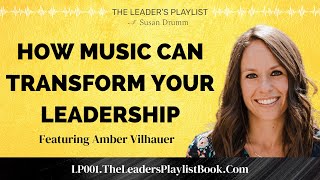
Susan Drumm explains how childhood survival strategies shape the way we lead, and how music can interrupt old patterns and build new ones. She walks through a client who used Adele's "Hello" as a cue to change their behavior, and why neuroscience backs this up.
Questions this video answers
October.
Chapters
Foreign. Hi, I'm Susan Jerome and welcome to this special edition seven episode podcast of the leaders playlist where you can use the power of music and neuroscience to transform your leadership and your life. And I'm here today with Amber Vilhauer and I've asked her to come on the show to ask me anything she wants about the book. And Amber is just a complete rock star because she's an online digital marketing expert. She supports authors, speakers and coaches. We've been in a mastermind together. I love her energy, I love her focused on the power of connection and decided she would be great to come and talk about the book together. So welcome Amber, thanks for coming on.
This is actually a super special moment for me. This feels personal to me, Susan, so thanks for letting me be one of the lucky seven. And it's personal because I've watched this journey and I have heard about your remarkable client success. And I mean that this is a woman that impresses me so much everyone. I cannot believe who she gets to talk to and the impact that she makes. And so when I heard about her book that was coming out and this was what, maybe a year, year and a half ago, Susan, that we started this conversation, I was hooked. I was interested. I mean, I launch books for a living. I've never heard of a book like this before. So I was sort of Susan, your cheerleader. Like, keep going. This is amazing. And as we got closer to the book timeline and I got to learn more and more about it and look at your media kit, it just felt so aligned with what the world needs right now. So it's really exciting for me to be here. And I want to start by taking you back to the moment when you had the idea to write a book. Like, I want to know what's that story? And it could have just been a Saturday afternoon when you got an idea or maybe it was some other catalyst. But that's really interesting to me because the idea of writing a book, it's a scary one, it's a daunting one for a lot of people. So what made you come up with a crazy idea to write a book to begin with?
Right, right. Well, you know, I have wanted to write a book for years. I almost feel like a decade. And I really enjoy the process of writing, but I never really give myself that opportunity to do it. And I wanted do it through a book. And so to take that on, it always felt daunting. How am I possibly going to find the time to do this on a steady, consistent basis? And on top of it, I also knew that I did not want to put out and rehash the same things that were already out there in the leadership world. And so many books are, like, saying the same thing. And I was like, oh, my God, I can't. I won't be able to pour my heart and soul into something that doesn't have a fresh take, a unique spin, offer something that will be really valuable to people because that I can put my energy around. Right. That I can invest. So I think it was finally, I was like, I'm not even sure what I'm writing about initially, really, but I had these experiences, and I knew that there was something there, and it was. It came together through the writing process, honestly.
Ah, that's so great. So can you shed a little bit of a light on, like, what have you observed in the leadership space and how is that different than what you're bringing to the world?
Yeah, I've been doing this work a long time, I think before people even knew what leadership coaching was.
I remember.
I mean, it's been almost 20 years. Back when I would describe what I did, people like, huh? And now it's, you know, the big consulting firms are in it. The recruiting firms have their leadership practices. So it's. It's really been an industry that's blossomed and grown and changed over the years. But the thing that I've seen along the way is so much of what's happening in the workplace and how people are leading was a direct reflection of whatever strategy, survival strategy, they needed to learn to get by in their childhood, and ultimately whatever wound they sustained. And we all have some kind of wound from childhood, whatever wound they sustained shows up in how they lead and where their focus of attention goes and how they perceive the world. And some of that can be good, and it lights our fire. And I often talk about that being more of a superpower, but it comes with some heavy liabilities, particularly as you try to scale in an organization when you're leading now multiple levels down, and you find that old strategy just doesn't work as effectively.
So true.
And so you've got to go beyond that. And that's what I was most interested in, really helping leaders both see the patterning, see the connection, and understand that that survival strategy, it doesn't have to be the way that they lead going forward. Wow.
Deep work. Really a critical time for that, too. I mean, even with COVID kicking off and then we face so much uncertainty and fear, and then all of the changes in the Workplace and then battles with retention. And I mean, it feels like a really chaotic environment right now, the world of business. And so how does that relate to the leaders playlist? Like, why is now the perfect time to launch your book? And why is now the right time for any type of leader in an organization to get their hands on it and to really immerse themselves so that they can change and adopt these principles? Why now?
Yeah, now is, you know, you look at the level of complexity that we're dealing with is far beyond anything we could have imagined. I mean, you know, post pandemic and supply chain and great resignation and all these macro trends, inflation.
Right.
All these macro trends are hitting leaders and they're having to juggle far more than they ever could. And I think it's a little bit like if we try to approach these issues, you know, with an, like let's say an old iPhone, if you had like an iPhone4 or something and you tried to run the apps that are required today, you just can't do it. Right.
And it's the same thing with our.
Our brain and our leadership and how we perceive the world. And there's this great quote by Einstein that has just become sort of a mantra to me that the, our current problems cannot be solved at the level of consciousness that created them. And so if we're in a situation where it feels like I don't know how to solve this problem, we've got to upgrade our own internal operating system to do that. And I think that that's. We are at that stage. Right. And. And then you look at the mental health challenges that many people are dealing with coming out of such a stressful time, you've got to get a handle for yourself of like, where is my sort of mental capacity limited and what do I need to do in order to be the kind of leader to help others through this? And so I think it's sort of now more than ever and it's kind of like we've got to do.
I know. And I'm think. And like all of these issues are converging and it's all stacked on top of each other and compressed down. And I experienced that in my own business. I mean, so this is very personal to me. Even at my level, I've observed what's going on in mental health and even seeing how team members, family members, and just the general public, it's impacting everybody. And leaders have never had so much pressure, especially headed into some of the economic uncertainty that we're headed into right now. This season, the pressure is outrageous. So let's say I get your book. Walk me through like the journey I'm going to experience in your book. Could you do that?
Yeah. So first we, we talk about why. Now we talk about this concept that your childhood wounds do show up in your workplace, but that actually music is a unique way to shift this patterning. So it goes into the detail around how music affects the brain and how it's such a powerful, almost a brain hack to help you make change. And the reason is that that music lights up all regions of the brain. It's why Alzheimer's patients come alive when they are, that are unresponsive and you put on their favorite music and all of a sudden it's like back. So think about the power of just that. And, and when music, because it gets to our emotional core, ultimately music has this power to shift state. And as a former actor, I am, I know the power of that. You study how to shift state. Right. And I thought, God, if, if music is sort of a shortcut to help people shift state, how can we both do that but also get to the deep rooted issues, not just like, hey, I'm going into presentation, let me put on my favorite song. Like, yes, that's awesome. But let's take it like many layers deeper to say, what's this undercurrent patterning going on and how you show up in the world and how do you change that using music? So it's a ambitious undertaking, but it works because it worked for me and it works for the clients I've worked with. Well.
And I was fortunate enough to get some early access to some of your materials. And on one of them you have different playlists, right, for different moods that you want to evoke. And there was a song on there, Freedom. And I remember one day a few months back where I was in the thick of it, Susan. I was just having one of those days where it felt like everything was caving in and I was frustrated. And I had a big company meeting that I was running later that afternoon and I thought, I'm just going to put this song on and see what happens. And I started filtering through the different songs in that playlist that you recommended. Oh my gosh. First of all, it was an instant state that was shifted. I mean, it was just all of a sudden it was like I was able to let go of some of that overwhelm or anxiety or confusion that I was feeling. I felt lifted up. But then I thought what happened was so interesting because it Almost allowed me this freedom, not to use the word of the song, but it allowed me almost this freedom to then look at. Wow, look at the state that I was in before. Where was that coming from? So it was like, it put me in this state of being where I could actually look at it objectively and understand that. And then when I started to look, okay, so this is almost a patterning of when I get in this situation. This is my reaction. So what's my unmet need? And how can I. Who do I want to be going into this meeting? Like, by the way, this. This whole experience I just described happened within maybe three minutes. It was so fast. And I just thought, wow, Susan Drum. Like, this is powerful work. And that's probably just scratching the surface of what people are actually going to experience when they start to use this work consistently. I'd be curious, do you have a story of a client? Something that comes to mind is one of your favorite stories that relates to this work that you could just share with us for fun?
Yeah. I worked with a woman who was getting 360 feedback, which often.360 meaning they get feedback from peers and direct reports and their bosses. And she was a senior leader, and the feedback was that she came across as controlling and trying to be in every conversation and felt like she, you know, was a little bit like she needed to stay in her own swim lane, so to speak, not necessarily, you know, do the work. And so we. We took a deeper look at. To say, gosh, what's really going on? And from her perspective, she's like, but those things impact my business and they impact. And I'm like, I get that. Let's. But there's something about the way you're coming across that isn't working in this environment. So let's look at what that is, because you've got good intentions there. And when. When honestly we looked at this pattern, her old playlist was I'm left out. And it started from childhood when her sister got all the attention.
She was.
Her sister was sort of the beautiful one in her eyes, and she was the mousy one in her eyes. And, you know, sister got all the attention. And I think it was a recurring pattern growing up of feeling left out of that. And so, wow, to not relive that again. Her big strategy was like, I'm not going to let that happen again. And so her focus of attention was pointed on where she was left out of things as opposed to looking at where she was included. So we used the song we Wanted to have an old playlist that. That would catch her before she would go down the eight line highway to hell, I call it. And. And what. What would that song be? That Catcher? And she picked Adele's hello, because that song for her is just like, hello, can you hear me? Like, you know, yes. Sort of woman a little bit pleading, oh, my gosh. And she's like. So she. When she felt that, like, oh, my God, this is happening and I'm not part of it, she's like, oh, there's Adele again. Yeah, there's Adele. Like, she could catch herself and say, I don't want to be that. I don't want to come with that energy. And her new playlist is I am welcome. You know, she played these songs, and the more she did that, the more she sort of relaxed that energy, and the more it's surprising she got invited to things. Right. Because she wasn't pushing. Gosh, but because her energy shifted, the external world shifted. So that's really one of my favorite stories because it just really highlights how you use an old playlist to interrupt the pattern and how you can create a new playlist to really start to groove in an additional pattern.
Gosh, that is so cool. That's really inspiring, Susan. I don't know anybody else having these types of conversations. That's got to be so exciting for you as you're headed in to launch this important work into the world with that kind of confidence and empowerment. I mean, I know in general, launching anything can be a little like, you know, but.
Right.
And I have to tell you, from my perspective, I just want everybody watching this to please pay attention to Susan. I want you to follow her. I want you to buy bulk copies, give it to your mastermind friends. I want you to share it with podcast hosts. This is the type of woman. This is the type of content that deserves to be elevated and heard. And I'm not just saying that because I know Susan. I think Susan spoken for herself on this interview and in the work that she's doing in the world. But I just hope that right now, when people are so stuck in their own head and their own experience. Experience, that I can break a little bit of that barrier to say, this is real and this is. This is the real work that I think is going to make a difference. One last question, if I may. I love asking authors this question, but is there. Is there a moment in the book? Is there a section or a story or a teaching point or something in that book that's like your favorite part or the thing that if you just. If people can only hear one story or one teaching point from you, this is the thing that you want people to know. So either your favorite or the most important or both.
I think, I think, you know, I'm. I'm fairly also vulnerable about my own story and my own wound and how that showed up in my life. And I tell a story from two different perspectives, vastly different perspectives, and about a work situation that I had. And it really just highlights the power of what you focus on, really becomes your story. And you think it's the truth, but it doesn't have to be. And you can take any circumstance that feels like, you know, you're frustrated because you weren't able to manifest what you wanted or you felt blindsided or whatever it may be and tell the story from a different perspective. And this sort of idea, the same way you can get off the old playlist and onto the new playlist. And I think that story just really highlights that perspective and how we. We will add or delete important information to bolster our point of view or story. And as human beings, we do this all the time. Right. You just. All you have to do is see this. Right. And we don't even know we're doing it.
Yeah.
Wow.
I can't wait. I cannot wait for October. Susan, I'm proud of you. Congratulations. This is. This is big. I'm so happy. I'm so grateful.
Thank you for being such a supporter of this work, helping me magnify the message out here, coming on today to talk about it and being curious enough and applying it right, but actually using it and testing it out. So that just makes me super excited. And this is probably the biggest endeavor of my career, career to put something like this out here. And my hope is it just really helps people and catches on like wildfire.
So that's my goal. The exact same thing for you. So we need all of you listeners right now to share this with as many people as you can, put it in your email list, share it on your social media, tell your friends about it. That is what it's going to take. It takes a village to lift somebody up with such an important message. So you've got my full support and we're.
Thank you. And we're all in it. So, you know, we all have a role to play in the transformation of what could happen for leadership, for our planet. And we, we're all going to be affected by that if we don't. So it's time to kind of really step out and do that. So thank you and thanks for supporting the work. And let's all lead the way. Curious about the concepts we talked about in this episode? Go to the Leaders Playlist book to learn more and purchase the book. And stay tuned for the next episode of the Leaders Playlist.
More from Susan


Why the Biggest Doors Open When You're Not in the Room | Michael Roderick & Susan Drumm





The Simple Audit That Adds a Human Touch to Every Customer Interaction #shorts


