How Small Acts of Kindness Create Big Leadership Impact | Susan Drumm & Braxton Kilgo
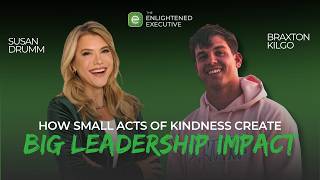
Braxton Kilgo started the I Believe in You movement after handing out stickers to middle schoolers in his Texas hometown. His kindness bracelets come with an app that tracks each one's journey worldwide. He's built a three-pillar business around direct sales, branded partnerships, and school tours, with stories of reconnected families and prevented suicides.
Chapters
Many people dream about wanting to change the world, to do something big, to make an impact. But sadly, most people never get past thinking about it. But my guest today turned a simple act of kindness into a movement, and what started as one small gesture became a powerful reminder that real impact often begins in the most human way possible. I'm Susan Drumm, and this is The Enlightened Executive, where your personal evolution sparks your Leadership Revolution. Each week we spotlight cutting-edge strategies to help executives and entrepreneurs grow in leadership and in life. Today my guest is Braxton Kilgo, who is fully immersed in his quest to change our world for the better. Braxton is an entrepreneur and the founder of I Believe in You, a movement designed to inspire small acts of kindness that create global impact. Braxton has built a powerful ecosystem that connects businesses, communities, and causes through an innovative bracelet and a mobile app. Each bracelet carries a story, encouraging users to pass it on and follow its journey of impact, fostering authentic connections and unforgettable moments. With over a decade experience in business consulting through his company Digicast, Braxton has served more than 1,000 clients from startups to corporations and over 100 personal brands, including collaborations with world-class artists, athletes, and celebrities. Well, welcome Braxton. I'm excited to have you on the show.
I am so excited to be here. Thank you for having me, Susan.
Well, you have a very interesting story, so let's begin there. Tell us about the journey of Braxton, where you've come from, and what your mission is today.
Yeah, well, one of the cool things is where I came from is actually where I happen to be today, and, uh, it's a small town called May, Texas. It's the geographical center point of Texas and there's only about 200 people that live here. So there's definitely more cows than people. And, uh, yeah, so I grew up here, wonderful place, my favorite place in the world. Everything moves a little slower here, but it's one of those places where, you know, I think it's changed a little bit now, but when I was growing up, it was kind of, you either work in a farm, a factory, the oil field, or you make it to the NFL or some sort of sport. Right? And so I'd done enough farming and knew enough family in the oil field to know that I was wanting to do something different. So sports was, uh, my very first aspiration, and that was phenomenal, and I learned so many things. But I ended up getting injured and wasn't able to continue down that path. And so I dropped out of college, and while I dropped out, I came back and did some farming and went into the oil field and reminded myself that's not what I wanted to do. So I went back to college and while I was there, I started a clothing company called Vision. It was going really good. I stuck it out with college a little bit longer, but since I was paying for both things, I finally decided I'm going to drop out again and go all in on my business. So went all in on that. It was really amazing. And I learned a lot from that first business, but what's really cool is that that business is actually what sparked what I'm doing today. And so it was called Vision. It was very mission-driven. The clothes and stuff were really awesome. Don't, don't get me wrong, but It really grew because of the message behind it. And so it was all about helping people define their own version of success. Like whatever it is you love, like go get it. You don't have to just check the boxes. You know, these aren't the only things available for you. Like if you can dream it, you can do it. And that was our message all the time. And so because of that, I started getting asked to speak in middle schools and high schools and graduations. And that's really what sparked what I'm doing today. And I had this middle school that asked me to show up and come and give a speech and I was ready to rock and roll just like the rest of them. I still wasn't any good at it, but I was ready and prepared. But I had this principal call me about 24 hours before I was supposed to be at this school. And she just called and said, hey Braxton, we're so excited that you're coming tomorrow, but I want to let you know what some of these kids are going through, not only at school, but at home, just so you really know who you're speaking to. So I said, yes, ma'am. And then she just spent 10 minutes with just the most heartbreaking information possible. And, you know, I went through some things growing up, but it was, it was heavy, you know? And so, share with you, really just, you know, the things that they were dealing with at school were pretty typical and what you would expect. But I think it's just, especially because I was still a teenager, right? So I think when she started sharing this stuff, I had the perspective of like, I'm going to show up and I'm going to motivate them and hard work pays off and like dream big. And then after she told me all of these stories, I was like, these kids might need something else. They might need a little bit of that and a little bit of, you know, kind of hype you up. But I was like, man, I think I wrote the wrong speech, you know? And she was just telling me about all these things that these kids are going through. And I'm thinking all of them are thinking like, what's this next thing? What's this big dream? And some of them are just trying to have a stable environment and know that people care about them. And so I frantically rewrote a new speech and I, because I had a little label printer for my clothing company, I printed these little stickers that said, I believe in you. And I showed up, had the staff hand out the stickers to all the kids. There was like 1,200 or 1,300 kids and I gave the speech, but at the end they all had those stickers and I just told them, I said, hey, the stickers that I gave you are not yours. Trade with the person next to you if you want. Give it to somebody in the hallway, favorite teacher, or go home, give it to your mom or dad, your brother, your cousin. Give it to your neighbor or the mailman. I don't care. But take that message that I gave you today and find somebody to go give it to. And I left. Honestly, like, nobody asked me anything too crazy. People were clapping. I was like debating like if I should really do this anymore. Like I didn't feel like I was qualified and I wanted to make sure that I was really serving these kids. And anyway, a few days later, the principal calls me back and she was like, Brax, these kids ran with these stickers. They're being nice to each other in the hallways, making new friends, nice to our staff. She was saying dozens and dozens of parents called telling these stories of these kids bringing home these stickers and wanting to have a conversation or asking if they could give it to this person. And I get off the phone with her, you know, I told her, I was like, well, thank you for telling me. And I really appreciate that. And to be honest, I was like, really? With these ugly little stickers? Um, but it was really cool. And so I got off the phone and I was like, man, I should do that at all schools for all kids. And the more I was thinking about it, I was like, most of those stories were from adults. I was like, okay, people need people, man. And it only takes 5 seconds and 4 words to change somebody's day, maybe change their life. And that's when I decided that it was not just gonna be on an ugly little sticker and that it needed to be on something cool, something that made sense to share. And that's where I had the idea for these bracelets. And it all came from a bunch of—
From that experience.
Yeah.
Tell us a little bit about, so you're an entrepreneur at heart because you said you dropped outta school and you created this clothing company. Tell us a little bit about about the success of that. How, how big did it get? What kind of impact did you make there? And then we'll talk about this sort of second iteration around the bracelets.
Yeah, so what was really cool about the clothing company is I was really figuring it out, you know. I grew up somewhere where everybody kind of wore the, the starch jeans and real country, and growing up I was always trying to cut my sleeves and write on my own stuff and dye it. And so I was always kind of had a thing for fashion. And so whenever I launched the clothing company, I definitely got the side eye from, you know, people from where I grew up of like, he dropped out and he's doing t-shirts? Oh, okay, well, good luck, you know. And I didn't really know what I was doing, but I was enjoying designing and sending it out to friends. And before I knew it, there were people with lots of followers that really fell in love with it. And I started traveling to different fitness expos because I wasn't playing football anymore, but I was— when I got out, I didn't know what to do, so I was doing bodybuilding, powerlifting, CrossFit. I was doing all of it. So naturally it kind of started in like the athleisure, like fitness space. And I realized that there was like fitness events and things that people threw. And I was like, well, people love this if I can just get it in front of them. Funny enough, I couldn't afford to get a booth or anything in the beginning, so I would just fill my gym bag full of t-shirts and I would sell them to people standing in line and different things like that. Amazing. A cool full circle moment is that now we're doing a partnership with the Mr. Olympia and Muscle Fitness, and I got to tell the CEO of that company the other day, which now we're partnering with them, that I used to sell t-shirts illegally out of a gym bag. That is a bit— so it was really awesome and we had a lot of good success. I, I figured out how to utilize affiliates pretty early on. Mm-hmm. And then I started getting into these expos and started traveling to those when I could afford a booth. And when we were in person, we sold out every time. And so it was, it was really cool. We even had a, an apartment I lived in. People just throw stuff away all the time and I found this old tabletop that someone threw away and. It was this big table and I had this girl paint like the mission and the vision of Vision on it and it would sit at the front of our booth and everybody that walked by would stop and read it and it was so awesome. So we had a lot of success.
Oh, wait, share that vision. What was the vision and mission of the company?
I can't remember it word for word. I still have it out here in the barn, but it was basically just about, ironically enough, humans believing in other humans and being nice and being kind and being willing to take the risk and chase your dream because what else really is there? And so it was kind of just this really raw, we believe in you and whatever that thing is that lights you up, we want to encourage you to find a way to make it happen.
Yeah. Well, that's sort of the story of your life, isn't it? I mean, it's you, it's your belief set, your values out there in the world. And one of the reasons why I wanted to have you on the show is it's just a great example of such a mission-driven company and how the mission is really driving the success that you've had. I mean, how else do you explain some of the success that you've had with just like selling t-shirts, you know, in line? I also love the grit and the, um, just putting yourself in the right places at the right time and believing in what you have to offer, right? All of these things didn't get in your way. Some people like, oh, you have to have a booth to get that, or, oh, what do you mean you're doing a t-shirt company? Like, really? Like, that's But you didn't let any of that stop you. And so I'm curious to know why. Why do you think that is for you? What's that thing that you have that maybe other entrepreneurs who try to start companies falter on?
I think it's a few things. I certainly had people who believed in me. I think in the beginning I probably took more motivation from the people that didn't. I had a little bit of— at first it was kind of chip on the shoulder, like, you know, at first it was kind of The people that were close to me that didn't believe in me and even some of my family, you know, that kind of gave me the chip on my shoulder. So I think some of it was prove people wrong.
Yeah.
I also really just believed in what I was doing. Like everything that I was putting on a t-shirt or a bracelet or an Instagram post, it really was just who I am and what I believed in. So the products were truly aligned and I really, really believed in what I was selling. And I put a lot of time into the product, the design, the message, all of the things. So I think it was that, but then also like the feedback that I was getting, right? It'd be one thing to just like sell a bunch of people on something, but whether it was the t-shirts, whether it was the bracelets, every single time that somebody came back to me with a story of how it impacted them or somebody they gave it to, or that they wear it every day and it reminds them. One of our shirts said, just a kid with a vision. Right. And people really gravitated towards that one. And that's all that was, is what I called myself.
Mm-hmm.
And other people identify with that. And so I think for me, the thing that still to this day drives me the most is that I really just believe in wholeheartedly what we're selling. When you show up to serve, not sell. Now, if what I'm selling serves you, then let's do it. But when you really show up to serve and you believe in what you're doing, it's really hard when you constantly are getting feedback about how incredible this experience is for them and whether it's the product, the mission, the community, whatever it is they get from it. It's hard to let off the gas when people are reminding you every single day that it makes a difference to them.
Yeah. And that's the, that's the reward for you is knowing that the things you're creating are actually impacting people emotionally. We're talking about— let's talk about the bracelets and a little bit more about what kind of success that you've had there. What kind of impact are you having? Love to hear some stories.
Yeah. So What's interesting is kind of to pick up where I left off from earlier, I decided to turn them into bracelets, right? And not these ugly little stickers. And I wanted them to be cool. And then the vision just kept getting bigger and bigger that I decided that it needed to be its own company. Because at first I just thought, well, maybe this will just be a bracelet that we have inside of— Yeah. And so that's how it started. But then the more I sat on the idea and started to put it together, I was like, this has got to be its own thing. So I decided to launch it as its own company, I Believe in You. And I was 19. So still, you know, pretty young, but amazing. Going like, I'm figuring it out. It was so cool. I kind of just did the same model from Vision, took a bunch of the people that already supported that and kind of leveraged that community. And we threw up a website and within 4 or 5 months we sold every state in the US, like 16 different countries. And what's funny is I was living in my high school bedroom with a laptop, a label printer, and a box of bracelets, and people thought it was this like massive global, huge company. But that was just because all of the people getting these bracelets and sharing these bracelets and all the content they were giving us, the impact wasn't even really being made by us. We were just supplying the vehicle, the tangible piece to it. So it was really incredible. We sold bracelets all over the world. It was growing really quickly and it was super fun. I got to be on ABC, NBC. I got to do NFL Network. I always thought it was going to be for hitting people, but it was for kindness.
A different mission, right? Yeah.
God had a plan. I just didn't know what it was. And it was really incredible. But ultimately, as that was scaling, if you can imagine the stories that I got from the middle school kids, now try to imagine that from every state, multiple countries, all ages, all walks of life. Now the stories that we're getting are all ages, all kinds of people, everything from brightening somebody's day, rekindling a relationship with somebody, a stranger, people starting their own business, all the way to people not taking their own life because somebody gave home a piece of plastic. It was kind of like a repeat moment of the students and the weight of all of these stories that she was telling me. And then after, it was really heavy, but it unlocked for me, like, really understanding how powerful these small acts of kindness are, right? It was all these little micro moments, almost like a pebble, right, in the water, right?
Yeah, because the idea is you don't buy this necessarily for yourself, you buy it to give to, right? To give to—
you wear them with the intention to give them away to somebody else. You wear it so you're inspired to give it away, whether it's a stranger or somebody you know. And so as these stories are coming in now from all over the world, ranging from the bottom to the top of, of every situation, that's when I decided, I was like, man, there's got to be a way to show everybody else how powerful this is. Because I always believed, like, be a good person, like being kind, like giving gives back, but you never really have a whole bunch of evidence for it, right? You buy the person's thing behind you and you just hope that people pass it on.
Yeah.
When I was seeing this, I now had evidence. And so I kind of was like, uh, I wanted to show people like, hey, look at this. And that's where I had the idea for the mobile app. Again, mind you, I don't know another entrepreneur at this point in my life. I announced to everybody, I'm going to build this mobile app. It's going to measure impact. Little did I know that that was, for one, way past my price range. And there was a lot of things that I didn't know. And because it was getting big from all the different media channels and TV shows, I started having like big organizations reach out to me wanting to like purchase it and all of these different things. And I drove my little F-150 farm truck in my boots and jeans and white t-shirt to some corporate meetings. And every one of them that I walked out of, it just, it didn't feel right. They all wanted majority and they wanted to change the name, vision. And so ultimately what I did was I announced to everybody, hey, look, the truth is I need to go learn how to be a business person. And I'm not willing to change the vision. So I'm gonna put this on pause. I'm gonna learn how to be a business person. I'm gonna go meet all the right people. I'm gonna get all the resources and I'm gonna bring this back with the exact vision that I told you it would be today. So to kind of fast forward through that, I had a really awesome launch, came up with the concept, people were really excited, turned down the offers, and then I went into figure out how to build businesses and learn. And so I started a couple other companies. And then over the last like 9, 10 years, the one that really stuck and the one that is what I actually funded I Believe in You with was a digital marketing and production agency where we worked with everybody from personal brands, startups, all the way to corporations. Obviously didn't start there, but we learned along the way. And that's how I funded IBIY. And I just was able to leave that company a little over a year ago. And now I do I Believe in You full time.
Great. And so is now what is the company today, the I Believe in You company? What, what are, are Are you still producing bracelets? Have— did you move into the app space and what does that look like?
Yes. So we have a mobile app now and it is awesome. We are about to launch our e-commerce store where we sell the bracelets and every bracelet goes back to a different cause or nonprofit. So we're about to launch e-com and then we have a school tour because that's where it started. And so up to date, we've spoken a little over 1,000 schools. It's called the Culture Shift Tour. I Believe in You. So we still serve the schools. We're about to launch the e-com. And then we have a B2B side of the business, which is actually what I've been operating off of for the last year. And that's where we're creating fully co-branded bracelets, packaging, and we're basically creating our exact movement for other organizations and aligning it to like their mission, their message, their audience.
So each one of these cases is so that the common theme is that ability to be so mission-driven and have a really crystal clear messaging on that because it's not that hard to like, it's a very simple statement, but you built a company and a movement behind a very simple belief. Like, it's not just a statement, it's the passion and belief that you have behind it that it can clearly see just gravitating all of the followers and all of the business that's coming to you. So it's really fascinating to hear how you built your company. What do you, looking back, say? Like, I also believe sometimes our mistakes are our biggest teacher. What mistakes have you made along the way and what did they teach you?
I think honestly, one of the biggest things that I've learned is when you try to do something really good, sometimes people don't want that to win. And, you know, I think I've had some moments through building this where people see the vision kind of like in the beginning, right? Those companies that wanted to come in and they loved it, but it was kind of like a good idea, kid, we'll take it from here. They wanted majority, they wanted to take everything over. And I've had a few 2 big organizations that we've, you know, been in talks with and, you know, they want to sell you the moon and the stars. And it's hard because we believe in everybody. We're about kindness and positivity and we believe everybody is good. But the truth is not everybody has the best intentions in mind for you and your business. And I think I've just had to learn that as much as we believe in other people and what we're doing, the mission and the business and our core partners and our people, our community, that's what's most important. So we have to be really protective and selective of who we allow into this mission that is real and was not just, hey, because mental health is trending or kindness is this, or we built this because of a bunch of middle school kids. And it's because it's fully who I am, not off of some trend. And so I think just making sure to be a little bit more diligent. I think in the beginning it just, somebody had a cool idea and thought it was amazing and they were going to put it here and all their followers and all their events. I would just get excited and just trust people, whereas now I've got a little bit more of a filter and some hoops that people have to jump through.
More discernment about who's actually going to support the vision and mission that you've outlined and who is just using it only for, let's say, profit, profitability. But there's a belief like you can have both, right? And you're a walking example of that and that piece. So you built that discernment over time. And what do you want it to be in the future? What's your vision? You are a visionary. Where does it go from here?
Yeah. So it's a few things. What we're focused on at the moment, I would say like with the 3 kind of pillars that we have, we have the B2B, D2C, and our school tour. For our school tour, it is absolutely incredible. Like, you know, when I haven't done one in a while, you kind of, it kind of feels like this is good, you know, but whatever. And then I go to one and I'm like, oh my God, this is why we do this.
That's really cool.
Like big rock goals for the next phase is right now we're bringing on more speakers to our tour. Tour because we have more schools than we can go to ourselves. So we're trying to get like a corporate sponsor so not only we can go to more schools that I can't afford it, but all of these other schools that deserve it but don't have the budget or whatever, so that we can just tour around the country serving 24/7. So that's kind of the goal with the tours, that we're touring around the country every year and it doesn't have to do with any school's financials. We just get to show up and serve. The B2B side, I want to partner with the biggest companies in the world and the smallest. And the vision of that is just when we were talking about what our mission for the company is, we want to change the world, right? And we want to lower these statistics of disconnection, depression, lack of resources. There's all of these problems in the world that it's a long list. And we were kind of debating like, well, what are we going to do? Start 85 branches of the company, right? For mental health, addiction, helping build school, all of these things. That's where we decided it was like, no, what we need to do is we need to find people who have dedicated their life to solve that problem that believes in what we're doing. We believe in what they're doing and we just become a multiplier to what they're doing. And ultimately with the B2B side, and, and this will line up with the D2C in a second, we're building like an army of kindness and we're installing this very simple, tangible kind of vehicle to these interactions and aligning it with their missions. On the B2B side, it's really like I want concerts, throwing them out. I want your favorite athlete making a touchdown and handing it to a kid in the stands. Like, I want to just get all of these big organizations that have good missions involved. And then on the D2C side, it's the same thing. It's just, we want to just provide this vehicle and this kind of this mission and a very simple template for your life to just encourage people to go be nice once a day, once a week, whatever. Encourage as many people to do that as possible. And if we can collectively, between the tour and the organizations and all of the individual, what we call wavemakers, if we can have this whole giant army all moving in the same direction and working together and supporting each other's causes, I think that's how we actually can change the world. Because when a problem comes up, we have an army to put towards it.
So this is just so much bigger even than that message, from what I hear. I love the fact that you're partnering with other organizations that are aligned with your mission and finding a way to serve through them, because that is your multiplier effect. Really creative process. Is there a certain way in which you encourage people to think about who they're going to give the bracelet to, or how they're going to pay it forward and show kindness? It seems simple, but I almost wonder, having just focused on this, if there are certain things that you notice work and what maybe doesn't Yeah.
So everybody's a little bit different. You know, let's like remove the technology for a minute. Right. So all of our bracelets, they say, I believe in you. And so I know what these things did when there was no technology. So even without the mobile app, like, you know, the people that get into it and use it, wonderful. But the truth is, whether you just don't say a word and leave this on the table for your server or the person checking you out, you only say one sentence and give it to them. Like, there's kind of levels to it. You can leave it, you could say something simple, you could have a 20-minute deep conversation, or it might be 3 hours and you're crying. I think it's one of those things, and everybody tells me this now. I used to say it, now there's a bunch of other people involved. When you have this on, it almost like kind of wires something in the back of your The truth is we could all go just tell people all day, hey man, I believe in you. I believe in you. We can do that. And I think that's awesome. Do it. But this is like almost the reminder for one to believe in yourself, right? And it's a good self reminder. But when you have it on your wrist and you look down, you start looking at every situation differently. Whether you're getting gas, you see a homeless person, talking with a friend on a Zoom call. Wherever you are, you start to look at the world a little bit differently. You're just, you're naturally going to look for an opportunity to give it away. And I think for some people that radar is a little bit more like mine of like, it's almost every person that I ever come into contact with, I find a reason. But for others, that's kind of why we say like, wear it until you're inspired to give it away. And as long as you have it on and you know, that's what it's for. There'll be a moment where you're like, ah, even the person that doesn't like to, to interact or they're a little more introvert, they'll recognize the moment and they'll find some way to give it to them.
To give it to them. That's beautiful. How does the mobile app tie into the bracelet?
Yes, so, well, I'll do it as an example. Let's say we were in person today having a conversation. I decide I want to give you my bracelet. I take it off my wrist, hand it to you. All you have to do is touch your phone to the patch of the bracelet right here. Every single bracelet has a unique ID code written to it, so no other bracelet is like any other one. So whenever you touch that bracelet to your phone, when you got it from me, it's going to pull up either a picture or a video that I made for you with a caption, the message to you. And so when you tap it for the first time, you'll be able to see that message from me, and then it'll give you the opportunity to leave a message for the next person. So whether that's a stranger, somebody you know, but what's really cool about it is you'll be able to see every single person that had it before me, all of the stories. You can see every city and country that it's ever been to. So you can see the entire lifeline of it before it got onto your wrist. And then when you give it away, you get to watch where it goes around the world. Let's say you had 10 bracelets, you gave them all away and you forgot about it. You come back a few months later and you check in your profile, it'll show you, for one, there's a feed of your impacts that you can scroll through and you'll see it on the globe. It'll show you that you have 10 bracelets that have been to 17 cities and 3 countries and impacted 35 people. People. So it'll actually measure for you.
That is such an important point. Oh my God, that's amazing. Because it's not just like a one-time thing that you throw away. You're never going to throw this away. It has a history, it has a meaning. Yeah. And then who you decide to give it to also has a special meaning too.
So I just love the way it doesn't end, you know, like even if you give it away, you're still a part of it. And then we also have a social feed too. So kind of like any other feed, but our feed is just a live feed of all the people around the world just being nice to each other. So it kind of has a social aspect too.
Yeah. Wonderful. Well, you're such a wonderful example of enlightened leadership, Braxton. I think that I started the show to highlight leaders like you. So thank you for being on the show. Maybe let people know where they can learn a bit more about this work or finding the bracelets so that we can pass it on.
Yeah, that would be amazing. Well, Susan, I appreciate all the kind words and just spending some time with me today out here, uh, on the farm. I know we had a little bit of Wi-Fi issues for a minute, but yeah, to find us, it's just ibelieveinyou.io. That's our website, and that's all of our social media handles. So it's just ibelieveinyou.io.
All right, excellent. Well, thank you, and, and thanks for sharing your story, and thanks for also including middle school kids in part of your journey, because I think starting young and letting people know the impact that they can have in others' lives will give their life purpose and meaning. So by you connecting to your own purpose and meaning, you're giving others the ability to find theirs.
Thank you so much.
If you like this episode, you're not going to want to miss my interview with Laura Gassner-Odding, who tells us that for some, success Triggers self-doubt, pressure, and imposter syndrome, and she teaches leaders how to turn this uncertainty into personal growth. Let's lead the way. Hope you enjoyed today's episode, and I'd like to point you to the next important step. Hit the subscribe button and the bell to get notified when we release new content. I'll see you on the next episode of The Enlightened Executive.
More from Susan


Why the Biggest Doors Open When You're Not in the Room | Michael Roderick & Susan Drumm





The Simple Audit That Adds a Human Touch to Every Customer Interaction #shorts


