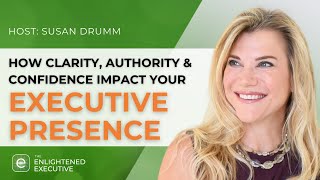
Susan Drumm (Enlightened Executive series) outlines three core elements of executive presence—clarity, authority, and confidence—and gives practical, actionable advice to develop each: be explicit about intentions and outcomes to increase clarity; build earned authority by demonstrating trustworthy intentions and focusing on mission rather than rank; and cultivate confidence through audience-focused attention, pacing, vocal variety, and recorded self-review. The video closes with an offer for workshops/coaching and contact info.
Chapters
Foreign welcome to this Leadership Insights episode of the Enlightened Executive, where your personal evolution sparks your leadership evolution. In this episode, we're going to walk you through three aspects of executive presence and how to develop them. Number one Clarity. No one likes confusing directions, meetings that run long, or guidance that's hard to follow. You can increase your executive presence by increasing the clarity of your communications and expectations up front. Make sure your intentions are clear and make sure you're easy to follow. Many times I see executives speak on a topic and I think to myself, what's the purpose of their communication? What is it that I'm listening for? Do they want my feedback on something? Are they asking for decision? What is it that they really want me to pay attention to? When people don't know what to listen for, their minds are more likely to wander. These days I nip this in the bud when one of my C Suite clients starts a diatribe, I tell them to stop and say, please tell me what I'm listening for so I know what to pay attention to. It's surprisingly easy to make your intentions clear. Just share what the outcome is that you're hoping to achieve. So instead of starting with here's what happened, say I'd like to get your opinion on how I should handle a conflict on my team, so I'll start with some context. Here's what happened. Do you see how much clearer that is? And you're much more likely to get the outcome and support you need when people know what they're listening for. You want to be explicit about your expectations and what you're asking for. Again, just tell your people what you want right there in the presentation slides or in the meeting agenda or at the top of the conversation. It's about laying out your goals and expectations. Those with strong executive presence communicate this in an upfront, clear, concise way and direct the conversation the way they need it to go to achieve the result. Number two Authority. Authority isn't about speaking in a loud voice and name dropping all the conferences you've keynoted. True authority comes from the ability to build trust. Does your team trust your competence, reliability and intention? Find the authority from your intention rather than leaning in to your role or position. Nobody appreciates when someone pulls rank or plays the because I'm your boss card. Instead, reference the intention behind your Ask if you need someone to work late on a new product launch. Remind them of all the customers whose lives will be improved by this new product. Rather than saying because I told you so, shift away from traditional egoic drives such as being right or looking good and look into a meaningful mission outside of your ego based needs. Leaders are successful when their teams are successful, but it's hard for a team to be successful when they're brow beaten by an executive with a my way or the highway approach. And it's hard for a team to do their best work for a leader who's only concerned about how they look to others. I can always tell when a leader is truly committed to the mission or more committed to looking good, being right, or being in control. Instead, focus on the mission or the purpose of what you're doing for the company, the clients and other stakeholders. What's in it for them? Put your attention there and your communication will have the integrity and earned authority that exudes executive presence. Number three Confidence okay, confidence isn't just good posture. True confidence is a combination of strength and warmth that brings people in and builds connections. In other words, it makes everyone around you feel at ease by your strength and your warmth. Now, there are many ways to communicate confidence. As an executive, you demonstrate confidence in the speed of decision making, asking tough questions, emitting vulnerabilities. But let's talk about how to showcase your confidence in conferences, meetings or presentation situations, as that's where the lack of confidence is most on display. Public speaking is a confidence shaking experience for a lot of people. Here's the trick. Move your attention away from your inner critic, that voice inside your head, and towards connecting with your audience. This was one of the best things I learned from my postgraduate degree in acting from the London Academy of Music and Dramatic Art. Rather than obsessing about how you look standing in front of people or the typo on that slide, focus on what you think they need or how this information will shift their thinking to help you remember this. In moments of stress, when in doubt, focus out. If you can use this method in a presentation setting, you can use it in a one on one setting as well. You also communicate confidence with the right pacing, vocal variety and gestures. You know an unconfident speaker when you hear one. Maybe they mumble and rush through their presentation or speak in a monotone voice the entire time. Or maybe they've got that one go to gesture that they repeat every time they want to make a point. None of these things communicate confidence to the audience. If you're not sure how you come across, ask someone to record a video of your next presentation. Take a look at it and I know it can be hard to watch sometimes, but be honest with yourself. Where could you speed things up or slow them down? Could you lower or raise your voice for emphasis? What gestures could you introduce other than those air quotes you use all the time? People crave vocal variety to keep things interesting, so look where you can create greater impact with your language, tone and pacing. Increasing your executive presence isn't something that's going to happen overnight, but with some time and effort, it's absolutely achievable. If you want to develop greater executive presence in your senior leadership, we can help. We have specific models, workshops, video and coaching to up level your communication. Get in touch with us@susandrum.com we'd love to help you. And if you like this episode and want more leadership insights like these, hit the subscribe and the like button and we always appreciate our five star reviews. Let's lead the way. Hope you enjoyed today's episode and I'd like to point you to the next important step. Hit the subscribe button and the bell to get notified when we release new content. I'll see you on the next episode of the Enlightened Executive.