Leading with Courage: Insights from Col. Martha McSally
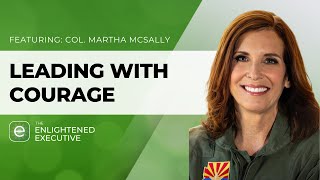
Col. Martha McSally, first woman to command a fighter squadron in combat, discusses how she built courage by choosing action despite fear and declaring identity-based visions. She shares lessons from 26 years in the military and her shift to coaching and speaking, including a practical exercise to identify five words describing your higher self.
Chapters
Foreign.
Hi, I'm Susan Drum and welcome to the Enlightened Executive, where your personal evolution sparks your leadership evolution. Each episode we feature groundbreaking techniques and strategies to help you get the edge in personal and leadership effectiveness. This episode is brought to you by Meritage Leadership. At Meritage, we strengthen leaders and empower teams to achieve high performance. Are you curious about your development path to enlightened leadership? Take our free 5 minute quiz@susandrum.com to discover your superpowers and the roadblocks that could get in the way of effective leadership. Today we're focusing on courage and the importance of understanding your true identity to be an effective leader in the face of chaos and change. And I'm honored to introduce my guest, Colonel Martha McSally. McSally is a real life top gun fighter pilot, pioneering leader, inspiring speaker and celebrated author. She is a compelling example of overcoming adversity and fear to achieve amazing results. And it all started when she lost her dad at the age of 12 and survived sexual abuse and assault. Martha persevered to become the first woman in U.S. history to command a fighter squadron in combat. Along her journey, she overcame huge obstacles, including a U.S. law that wouldn't allow women to fly fighter jets. And she held on to her dreams and sword. And so during her 26 years in the military, she was deployed six times to the Middle east and Afghanistan, ultimately earning a bronze star. But it doesn't stop there. In addition, Martha became a top ironman, triathlete, mountain climber and paragliding pilot. And she served four, four years in the U.S. house of Representatives and two years as a U. S. Senator. So welcome, Martha.
Thank you, Susan. It's great to be with you.
What an amazing career you have had. And it, I have to believe that you have walked the journey of becoming a more enlightened leader. So let's talk a little bit about that journey first. Who were you initially and how did you make the transition and where are you now?
Well, yeah, well, I started as a shy, motion sick girl and the trajectory of my life was started to be propelled when I lost my dad at 12. And then the other adversity that you shared, being abused by a coach who I looked up to as a father figure as I was dealing with that grief and you know, off I went to the Air Force Academy, I didn't know what I was doing. I mean, if anybody's got teenagers, you know what I'm talking about. I was still dealing with the volatile emotions inside, but I was driven to make my father proud, which what he shared before he died. And those were not easy years. But I thought, hey, I'll go, like, do something purposeful that'll kind of keep me in check. Give me some guardrails, you know, not settle my mama debt and pay back in service. But I've got this kind of change agent, entrepreneur, rebell, questioning spirit. So a lot of people didn't think I could, you know, I was going to make it. But off I went to the military and I thought I was going to be a doctor. And I found out when I got there it was against the law for women to be fighter pilots. And it just pissed me off. And I just like, well, that's exactly what I'm going to do. And you know, it was like, well, but it's against the law. I'm like, yeah, I know we live in America. Laws change. And so I just put this dream in my heart and I blew where I was planted. I just kept, you know, making decisions to keep those options open. But I willed this destiny into existence for me. These are some of the tools that I now teach, actually, about just declaring what my vision was, that I am a fighter pilot in the present tense. And it took 10 years, but eventually I was in the right place at the right time when everything changed and the door finally opened for us. And I was given the opportunity to go through and I, you know, for my journey to kind of categorize it, like, I was very driven. Like d. You know, just like dictionary definition of driven. In. In a lot of ways, I was proving. I was trying to prove people wrong, you know, that girls can't be fighter pilots. Right. So some. That's. That can be an okay motivation until it. Until it's not right. Like that can't drive you for your whole life, but it certainly gave me some jet fuel. I definitely was propelled by my adversity, for sure. I look back, having lost my dad and then even being abused by my coach. I look at it like, even before I had unpacked any of that, really, and healed from it, I allowed it not to hold me down or hold me back. And I just was like, don't tell me I can't do something because I'm a girl. I really feel like those events actually gave me that kind of grit and drive even before I was healed, if that makes sense. So we could do amazing things with our adversity even when we haven't fully been freed, you know, from it. And so I just was, you know, very driven, very grinding my schedule. I'm Sure. A lot of your listeners can relate to this. Just, I mean, grinding demands from the. My time in the military and then, you know, political combat, a whole nother chapter, and kept setting really big, amazing goals and achieving a lot of them, you know, failed along the way, for sure, but also realizing that it wasn't ultimately deeply satisfying to my soul. I mean, there it was, satisfying to a point along the way. I'm not trying to just throw it all out. And that whole journey really served a purpose. The honor of my life was to command men and women in combat, bring them over from Arizona all the way to Afghanistan, providing 24. 7 coverage for our troops. I mean, with all the complexities that come with that leadership of the team where lives are at stake, a lot of pressure, a lot of high risk, complex scenarios. So I'm grateful for all those experiences, but I think hopefully people can relate to, especially those who are kind of in, you know, middle age. Like, at some point you kind of go like, is this it? Like, is okay, what's next? Or there's this deep dissatisfaction inside you, and you've got to kind of go like, all right, what is that coming from? Am I. Am I not doing what I'm supposed to be doing? Am I. Is there something more? Am I out of balance? And so my journey.
Because also just to. To interject that fuel of, okay, I'm going to do it because you said I couldn't do it. And then you do that, but you're still feeling this sense of incompleteness. So then what is that? Yeah, so go ahead.
And so for me, it was always like, okay, what's next? You know, And I very easily shut.
Off.
Identities that were, you know, that were attached to me of, like, the uniform. I mean, there's a lot of people who really do struggle when they. When they shift a role that they're in. They leave the military, they sell their business, they. The kids, you know, move out of the house, they get the divorce papers. And for me, as I think about, like, what are my superpowers? Reinventing myself is a superpower. Like, I would just be like, all right, what's next? You know, and it's time to go do something different. I left the military. I was a professor for a while, and then I was yelling at the tv. So then I found myself running for Congress and, you know, found my. I didn't find myself, but, I mean, I worked my butt off to get there and, you know, became a U.S. senator. Then that season ended, and as difficult as it was because I really gave it my all in order to continue to do that. That season was over. And very quickly I go through grief. It's not like I don't feel the grief, but then I'm like, all right, what's next? So there's this element of, as I reflect on it, in my growth, of expanding always. We're just like living an expansive life and always wanting to challenge myself, but also realizing that I'm not. I'm not looking for external accomplishments to satisfy something that is deep within my soul and spirit, that cannot be satisfied by doing something in the world I'm most proud of, of, of. Of who I've become as opposed to anything I've done. And so. But this is not an easy journey for us to go on, who are very driven, very results oriented people. But it is the most important journey. It's the inner journey that you need to go on in order to get to a place. That doesn't mean you're just sitting on your couch all day, like, you know, meditating. But it does include some practices where you do, you know, slow down. But then it includes taking more inspired action in the action you take, as opposed to just like brute force action. So, yeah, a lot of lessons packed into all that.
But that's so much, so much. I mean, one of the things that is your superpower, I also heard, is this is just ability to lead from vision and create vision. So no matter what's happening, what do I want to create now? What vision can I stand in? What's meaningful for me versus why did this happen?
What?
You know, all of the. All of this that can weigh people down and get them stuck. You keep moving forward because you lead from vision.
Yes. And I do believe that, again, in my own personal growth. Right. We all, as humans, spend a lot of time in a narrative of the past, or we spend a time in fear of the future, or we're living in this, like, oh, hope for the future that we think our satisfaction will eventually come if something changes. The real superpower is actually being able to be fully present in today because all we have is now. Like literally now. This moment, this second. That's all we have. Everything that happens, happens in the now. All the things that happened in the past that were bad when they happened, they happen in the now. But we actually perpetuate the suffering with the story and the narrative and how it's going to impact us when we're past focused, future focus. We just have to take great care. I don't set goals anymore. I set identity based visions using the sentence I am and I set the vision because you do need to have a sense of what direction you're going. It's like taking off in a plane, like, all right, I got to decide from Arizona am I going to, towards New York or California. But I don't cling on to that goal as it being where my satisfaction comes from, because that is a spirit of wanting where you're then not actually feeling satisfaction in the present. You're thinking, as soon as this changes, then I'll be happy. So you have to be really careful, set those identity based visions. Ask yourself, why? Why do I want that vision? And we're talking about, you know, professional stuff here, but also personal stuff. Why do I want my company to 10x? Why do I want us to launch this new product and be able to change the world with it? Why, you know, whatever it is that your vision is. Yeah, why do you want that? Okay. Oftentimes again, this is just getting into that in this inner work, oftentimes for all of us, it's attached to some sort of feeling that we are looking for. Right. A feeling of, of being impactful, a feeling of satisfaction, a feeling of personal side. Right. So then the question is, how do I take that feeling that I think is future facing and how do I make sure that my me and my team embody that now, even in our current circumstances? Because that helps you not be feeling like, oh, things will get better when, things will get better when. And so if you're future facing where you're, you're not present, then that actually can be dysfunctional. Almost as dysfunctional as past facing, if that makes sense. So it's okay to have the vision, right? Connect it to the feeling and then how do you embody that feeling now, even if the external circumstances, they feel like they suck right now. Right. Even if for sure it's just like you're not where you want to be, like, all right, but if I want to feel empowered then and impactful, then how do I feel impactful now? Your best chance to actually making that happen is for you not to be in a place of complaining and wanting and feeling lack. It's actually embodying that now that will then allow you to bring that bigger future to you.
I love the I am statements because that's also what I use as the playlist. I call it the playlist in my book around the Leaders playlist. And taking the old statements of I'm treated unfairly or I'm not safe or I'm an imposter, whatever. Identifying first, like, what is that old thing driving me? But it's an I am statement. And the new playlist title is, I mean, for me it was I am empowered. Right. Others, it's like, you know, I am not alone. I'm, I'm supported. Right. What are those feelings that you're really going for and practicing the vibration of being in that space. And that's what I talk about is how you can use music to do that. But there's so many different ways. So I love that you lead with the I am statement because it's so incredibly powerful. And like you said, it's the how our identity, our true identity is really the journey of the enlightened leader.
Yes. And it's not, I, I think about becoming a fighter pilot. I declared I am a fighter pilot. I didn't say I want to be. I hope I might be someday. It might happen. No, it was I am in, in the present. And it, it's, it may sound, you know, unfamiliar to people to do that, but you are taking on that future self vision and embodying it like it's the present. And that actually gives you the flight path to the future, but it also gives you what you're looking for in the present, which is that satisfaction, that gratitude, that empowerment, that whatever it is that you're actually, you know, seeking and not not being in a place of, again, lack or want. Because if you're in a place of lack or want, you are going to stay and get more of lack or want. And you're never going to be able to get from, you know, point A to point B, which is where you're trying to, you know, where you're trying to grow to. And it's all about those, like, it's, it's not just what you're saying out loud, it's important, important to say things out loud because you can, you know, again, speak it into existence. But it's also what's going on in the monkey brain. What's going on in your head, what as a leader, especially if, if you've got all sorts of narratives going on in your head and you think you're showing up to your team and you're. No, I didn't say that to anyone. I just said this. But if what you're saying is actually in conflict with what is actually going on and what kind of vibration you're on, your team is going to sense that. They may not consciously sense it, but they are going to sense that if you are, you are talking, you're trying to say words that are courageous, but you're actually in a vibration and a, in a monkey brain narrative of fear and all your personal fears of whether you're enough or whether, whether it's a scarcity fear, whatever that is, or you're afraid of what's happening in the economy and disruptions that are happening in the, in the world. Like, they will sense all that. So that, like, the most important work is to get yourself to that place of, like, having the audio and the video match for yourself and for your team so that when you show up, you know, whatever words you say, they can sense that you're. They can sense that you're filled with gratitude, they can sense that you're filled with love for them and your customers and those who you're serving. And then they'll take the hill with you. Because that's what they feel coming.
Yeah, yeah, absolutely. Because that is the, the energy that's emanating from you. That's a vibration.
Right.
And vibrations, emotional vibrations can be measured. So people. It can be measured 3ft off your body. In terms of, like, what are you really feeling? I mean, you just asked your dog, we were talking about. We both have dogs, right?
Yeah.
Your dog knows when you're excited and when you're sad. You have to say a word. Like, they can tell when you're grieving, Right? How can they do that without you saying a word? Well, guess what? So can your team. Your team can tell exactly what's going on. But tell us a little bit about. We started about courage because certainly you've had plenty of circumstances where you had to come up with unbelievable courage in the face of adversity with Afghanistan and being the fighter pilot that you were. What lessons do you have for those on the path to enlightened leadership around courage?
Well, I think fear is one of the biggest things that holds us back from living the life that we came here to live and having the impact that we were intended to have as a leader. And whether you're conscious of it or not, you could have unconscious fears. But I mean, I just believe that fear is like one of the biggest things that holds back. So when it comes to courage, a lot of people, I think, look at those of us who, you know, fly into the face of danger, who do very challenging things that take courage, as if we're not like them or we're some sort of action figure. It's just not true. Courage is, is like going to the gym. You build Courage. It's not the absence of fear. It's choosing to do things afraid in the midst of the fear. Dan Sullivan's a entrepreneurial coach. If you. I'm not sure if you've heard of him before, but yeah, he has. Yeah, he has a phrase where he says cour is, he's actually quoting a sergeant when he was going through basic training. He says, courage is doing what you need to do with wet pants, right? And so I think about the first time I took off in the A10, having never flown it before with no two seat models and no simulators. First flight was solo. And this was 10 years after I had this dream in my heart to become a fighter pilot. Now it's becoming a reality. I remember it like it was yesterday sitting at the end of the Runway when the tower cleared me for takeoff. I did not feel courageous. I felt like I was going to throw up. I was like, this is crazy, right? The fight or flight was kicking in. My heart was racing, right? My mouth was dry, all the, all the things. But I had a choice in that moment. I could taxi back in and say, I'm going to give into the fear and give that fear power, or I could push up the power and take off afraid. And so I chose to take off afraid, which then built my courage and confidence. Then I was like, I did it. You know, there's like, oh, crap, I got to figure out how to land. But over time, taking off and landing was almost like, you ever driven to work before? And you like, how did I get here? It becomes so kind of unconscious. You're, you know, you're not having to be fully in the frontal cortex, right, To. To make every move. First time you learn how to drive, that's the way you are. But then eventually you're like, yeah, how do I get to work? You know, then I got to fly in, you know, tactical situations and learning how to do weapons delivery and flying at night and air refueling and flying in the weather and then flying combat. And so, like going to the gym, you build the muscle memory of it's a familiar feeling. And then you choose to do things afraid. And then you actually build your capabilities, your confidence, your courage. And then guess what? If you're. If you are committed to a life of expansion, you're always going to be right on the edge of your current capabilities, which means you're always going to feel fear. You're always going to feel discomfort because you're about to do something you've never done before. And oftentimes we turn that narrative into imposter syndrome, right? I don't belong here. I don't know what I'm doing. No, if you're expanding, you, by definition have never done the next thing before. But if you choose to first have awareness of the fear, right, make sure, obviously, you are safe, you're not doing something reckless. It's about just managing risk. But then you choose to do the expansive thing, choose to do things afraid. Then you realize the fear doesn't have a power over you. And then you build your capabilities, you build your competence, right? And then it's time to expand again. So it's that way, I think, for all of us. And some people can get stuck in a cycle where they give into the fear, and every time they have that familiar feeling, they contract, right? How do I try and make myself safe? How do I try to mitigate risk? Well, you can't live in a bubble. As a person and as a leader, you cannot mitigate and eliminate all possible risks for any sort of physical or emotional or financial or whatever. The issue is, we make good decisions by managing risks, but we choose to live an expansive life. So we choose to be right on that edge. We're always uncomfortable, and we're familiar with the fear. You can name it. You know, name it Charlie, Name it, you know, whatever. Give it a name so it's familiar. Be like, hey, Charlie, there you are again. No, you just sit right here. You can stay right there, but you're not in the driver's seat. I'm piloting this plane of my life, my team, my business, and we're going to move forward, and you've just got to hold it there inside you. I do a lot of breath work now. I didn't. I didn't understand it before, but I'm sure I was doing breath work in the cockpit. Now I'm doing it more consciously. Like, you literally got it. If you've got to do some conscious breathing in order to kind of manage your nerve, you know, your. Your neurological system, go ahead and then lead your team into the unknown. So the first thing is just being aware of what fears might be driving you. I mean, it may be a great journaling exercise for your audience to see. Be honest with yourself. What fears might be driving you unconsciously that are holding you back and holding your team back. Is there a fear of the unknown? Is there a fear of success? Is there a fear, a fear of failure? Is there a fear of missing out? Is there. Is there. I mean, is there something that even came from Your childhood, where just like you were told you were never going to be good enough, that there's something running in the background that you don't even realize that's taking up energy of, am I good enough? I'm not good enough. And then if you're acting out of that, that's not going to be expansive. And so just the, the turning the light on it, the first step is awareness. It can actually dissolve it right there. In some cases, you've got to go through more modalities in order to be freed from it. But just that first step is awareness. And just turning that light on clears out the darkness. You don't shoot the darkness out, you just turn the light on.
Yeah. Well, let's talk about what your next chapter, your present chapter and upcoming chapter is about, because you shared with me a little bit about how you're helping other leaders come face to face with those things that are holding you back. So share with us a little bit about that.
Yeah, I'm in Martha 3.0 now, Susan. So Martha 3.0 is after 26 years of grinding service in the military, nine years of grinding political combat. Right. Martha 3.0 is about maximum impact on people's lives, maximum abundance to me and through me, maximum freedom in my life. Right? That's what it's about. So I am passionate about all these lessons that I've learned, sometimes the hard way. Right. Sometimes I did the brute force way when I realized, like, oh, there is a better way. There is a. There is a more evolved way to address it. But I had to do that to come to this lesson. So I'm helping people through keynote speaking. It's, you know, just a passion of mine to be able to inspire and equip people with actionable, actionable things that they can take home. But then sometimes you will come up after my speeches, like, how do we go deeper with you? So I'm doing coaching now. I actually have created a Facebook community. I'm offering, actually some free coaching once a month if people want to join my Facebook community. It's the U 3.0 Facebook community. We can make sure everybody has all the info on that. And I'm also leading adventure retreats now. I'm super adventurous person. I paraglide, I backpack. And I just had so many people saying, I want to go deeper with you, and I would love to do some of the adventurous things you do. So I, you know, looked around like, nobody is offering opportunities for us to connect with nature, rediscover our true essence, and Emerge. This first one is called the Youth 3.0 Adventure Retreat. Emerge as you 3.0, like, fully connected with your true essence, with clarity on what to cut away, you know, what to stop doing, what inspired action to take as you move forward and connecting with each other, connecting with nature, connecting with your creator, you know, however, whatever that means for you. So I'm bringing people out in nature. I'm not making you suffer, but we are going to do some challenging, like hikes and repelling and things like that with some content and reflection and magic happening around the campfire. I'm super excited about this. My first one is going to be this August. It's already spilled up, but you can go to my website, Martha mixali.com and sign up for the wait list for the next iteration. I really believe this is transformational opportunity for people. There's great seminars and masterminds and things that are out there, but there's just something different about being in a hotel conference room with fluorescent lighting versus being out in nature and in Queens.
In nature. Absolutely. In fact, I was just in Vail hiking and feeling that connectivity to the land and how important it is.
Yes.
I think you discover more about yourself going away like that and really have that space. And we don't do it enough in our modern life by any means, and we're missing something. So really excited about what you're doing and how you're having people connect to themselves through connecting with nature.
Exactly. Getting.
Getting closer to where. Where we really come from. Yeah.
We have so many distractions and so much noise going on, and it won't be easy because you're breaking addictions to our electronics and all the, you know, responsibilities we have. But getting out in nature, it's. There's something spiritual, energetic, neurological that, you know, you're just moving your body in nature that allows you to just like, slow the monkey brain down, open up that creative space. The divine downloads happen every time I go out in nature, do this, and I do it a lot. So now I'm bringing people with me so that they can also experience those divine downloads, get that true clarity. What do they need to be shedding? What do they need to say no to? What do they need to be freed from? What fears are holding them back? What is their vision of their inspired future? And then they're not leaving until they take some action. That's the other, other thing. We've all been to some inspiring events where. Sounds amazing, but then you just get back to your regular life and you never open the notebook again, right? Yeah. So I'm not letting them leave until they actually take the action. They make the phone call, they set up the meeting, they start writing the business plan. Like, we want to have wins and momentum before they actually leave the retreat grounds.
Well, speaking of that, what's one action item that you would want our listeners to take today, tomorrow, to fuel their future vision for themselves?
Well, I would encourage you, when somebody asks you the question, who are you? How do you answer that? And usually what we do is we answer with our roles. Right? I'm an entrepreneur. I'm a CEO, I'm a cfo, I'm a mom, I'm a dad. I'm a husband and wife. That's usually how we answer. I could have answered. You know, I'm a colonel, I'm a senator, I'm a fighter pilot. I'm a mountain climber. The reality is that that is not who you are. Those are just things that you've done. And I truly believe that taking time, which doesn't take much time to reflect on what is my true essence? You are unique. And no one is ever going to embody and be what you are. Nobody. Like, I mean, I Snowflake, you know, is not a great analogy, but you know that you are unique. No one, no one has come before you that is you. Nobody that is coming after is you. And you are here in this impermanent physical vessel in order to express your unique qualities and impact in your unique ways. So reconnecting with that true divine essence of who you truly are is, I think, one of the most fundamental things that you can do. And you can do this very simply. Now, words don't quite capture. I mean, words are limited. They don't quite capture essence. But if you would just sit down before you go to bed tonight and just pull out a piece of paper and brainstorm, what words would you use to describe you? Right. Like the higher self. You. Okay, that. Not when you're at your lower self, but your higher self.
You.
Your uniqueness, your superpower, your zone of genius, whatever you want to call it. Your unique attributes. They could be nouns, adverbs, adjectives. Don't get stuck up on that. Just write words down. My list is right here in the back here. Starting with I'm courageous. I am integrity, I am generous, I am growing, I am relentless. And it keeps going after that. Okay? What I also did is I reached out to a handful of people who are very close to me, and I asked, what five words would you use? And I Say that. Think about it like, if, you know, your eulogy was next week, what words would you want to be spoken? If it was your 80th birthday toast, what words would you want to be spoken that people like? Yes, they got me. Do this for yourself. And identify those top five words. Just keep writing. Brainstorming, brainstorming, brainstorming. And then circle those top five words and then ask for input by people who are close to you, who love you, who want the best for you. Sometimes people who are closest to us are going to answer on lower, lower version. You really want people who, like, they. They're championing you. And because actually some of my words came from some of those people, I was like, oh, yeah.
Relentless.
Yeah. Like, that's actually, that's. That's it. So I would just encourage you to go through it doesn't take a lot of time. Just ask five people, hey, what five words would you use to describe my true essence? Doesn't matter if they're nouns, verbs, or adjectives. Pull in from them. Sit with that list and your list. Identify those top five and, like, write them down. Put them on your refrigerator, put them on your bathroom mirror, and I'll tell you. You can. Then when you have to make decisions on anything, it's. It becomes an easier decision. Like, is this in alignment with who I truly am? Yes. No. Is this relationship? Is this business? Is this partnership? Yes. No. It becomes so much clearer because you're coming from a place of, is this aligned with who I am or is it not? So I just that that would be an easy drill that you can go through that can be really deeply grounding and really helpful for decision making.
I love it. Well, thank you so much for sharing all of this amazing wisdom and your energy and your passion around this. I'm excited for Martha 3.0 and also the retreats. What are you going to create now, given everything that you've created so far? So thank you for being with us and if you like this episode, you're not going to want to miss my interview with Jesse Israel, a meditation leader, keynote speaker, and coach known for pioneering the mass meditation movement. The Big Quiet. Let's all lead the way. Hope you enjoyed today's episode and I'd like to point you to the next important step. Hit the subscribe button and the bell to get notified when we release new content. I'll see you on the next episode of the Enlightened Executive.
More from Susan


Why the Biggest Doors Open When You're Not in the Room | Michael Roderick & Susan Drumm





The Simple Audit That Adds a Human Touch to Every Customer Interaction #shorts


