Practical Techniques for Building Trust (featuring Sue Dyer)
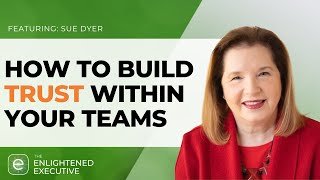
Sue Dyer draws on decades of experience in construction and large organizations to share how to build trust in teams. She emphasizes recognizing interdependence, focusing organizational energy through aligned strategy and culture, and using co-creation forums so people don't argue with what they help create. Fear drives poor communication, and listening well can silence internal rebuttals.
Questions this video answers
April 19, 2023
More than 48,000 executive leaders
About 4,000 different construction projects
By the time she arrived the project was $50 million off budget and six months behind schedule
Five levels of trust
Chapters
Foreign.
Hi, I'm Susan Drum and welcome to the Enlightened Executive where your personal evolution sparks your leadership evolution. Each episode we feature groundbreaking techniques and strategies to help you get the edge in personal and leadership effectiveness. This episode is sponsored by Meritage Leadership. At Meritage, we strengthen leaders and empower teams to achieve high performance. Go to meritageleadership.com to learn more. Today we're focusing on building trust with your teams and customers and I am happy to introduce Sue Dyer to join me for this conversation. Sue is the best selling author of the Trusted Use the Partnering Approach to become the Leader People Want to follow and has helped more than 48,000 executive leaders improve their results by building high trust cultures. In 1980, sue was the first woman in the US to head up a collective bargaining group and negotiate with unions on behalf of 200 construction companies and has used her vast experience in the sector to perfect her partnering approach model. She's on a mission to have 1 million leaders devoted to building their business on a foundation of trust. Sue has an MBA from St. Mary's College and is a Master Leveled Certified Partnering Facilitator. Welcome Sue. It's wonderful to see you again. Thanks for having me on your podcast last fall.
Well, that was so fun. Thank you, Susan. It's so fun to be here with you today and share more about our love leadership.
Yes. And so you particularly focus in the realm of building trust, which of course is a bedrock to anything. So I would love to delve into your perspective on building trust and and how you recommend leaders do it. Let's start with asking what makes your approach to building trust maybe unique than others? Because there's a lot of books out there right on building trust. So what's your approach?
You know, there are a lot of books out there on trust and then they're mostly a research telling us how important it is. There's people talking about trust being a pinnacle event or a thing that we need for our culture. There's people talking about how important it is and why, but there's few people that know how to actually build it. And that is why I wrote the book, because that's what I've been doing for 37 years is going into high conflict organizations and helping them to learn how to turn that into high trust through creating alignment and focus and building a collaborative culture. And that's really what my book is about. It walks through the journey that I've taken over 35 years. The very first meeting I ever went to when I was the executive director of that union based construction organization, I was, it was a nonprofit that I was executive director for. There was literally a knockdown, drag out fight. Like that's the level of conflict I had to deal with. Yes. And then when you talk about going into the unions and negotiating with them where they would take their shoes off and hammer them on the table, fist fight. And I didn't know you could construct entire sentences with swear words, but you can. I've had my life threatened, I've been shot at, I've had to leave home, I've had my phone tapped. High conflict situations. And yet we were able to create high trust, high performing relationships over a period of time, even there. And it changed the industry, it changed what was possible and I think really set things up for decades now that have been hard, highly functional and successful in a relationship between labor and management in the construction trades. But also then if you go into the associations, you go into the companies and then I've worked with whole governments, like at the federal level, the state level, helping them to go from being adversarial to being highly collaborative. And so I would say really what sets mine apart is that it's practical, pragmatic and proven. Yes, yes, no, it works. I have no doubt. I have worked on 4,000 different construction projects with different teams and dozens and dozens of large, very large like hundred thousand employee organizations to help them develop a high trust, high collaborative team.
That is so fascinating, your background and the story that got you to where you are. So what were some of the things you discovered that worked in such high conflict situations?
Well, one of the things I've learned is that you've got to create common ground. And what we ignore in business and doesn't matter whether you're in construction or you're in tech, we ignore the fact that we're interdependent and that we act like we can go in and just have our own way. And what I want, I can get. But the truth is that if you don't help me, I can't get what I want. And if I don't help you, you can't get what you want. We're interdependent. And as the global economy has emerged and grown, we have become more and more and more interdependent. And that is a very unique relationship in that it's only win, win or lose, lose. And I can't tell you how many businesses and business leaders are actually negotiating to make sure the other person or other group loses more than they do. Hey, that's still a Lose.
Right.
It happens all the time.
Yeah, watch. Look at how much I can get.
Yeah, watch what's going on. We, the interdependent nature of business means that we cannot afford to not be high trust, high collaborative. And we also know high trust equals high performance. So if you want to blow your competitors out of the water, the higher the level of trust, the higher your momentum is going to be in your ability to perform. And you're going to get smarter because people are going to talk to each other. You're going to get faster because people are going to coordinate better and you are going to be able to achieve things that right now would be impossible.
Yeah. Without this foundation of trust, there's so much drag to the system and being able to really accomplish anything and it becomes a protection of ego and who is winning.
Right.
Just like we are in our home relationships, needing to be right or needing to be in control or needing to win above the other person has its costs. And so when you adopt that mindset and you're coming into these conversations with that mindset, you're ultimately gotta. You're not playing the long game, you're playing the short game. And, and that will burn you well.
You're gonna waste resources there. You know, all it is is drag. If you're interdependent and you are going to be adversarial in any way, like I'm, I'm going to do. Blaming. There's blaming, there's positioning, there's protecting. There's all kinds of things we do. All of that wastes the resources of the business and diminishes what's possible. And then people get ticked off and they don't want to participate, so then they start pulling back. And then what's possible becomes it's just a vicious cycle. That's why it's either win, win or lose, lose. Because now you are really going in a vicious cycle of negativity, of negative momentum. And we say it all the time, but it doesn't have to be that way. And what's. What I get excited about, because I'm just weird, is that when an organization or a team, especially executive level team, is in conflict, it is easy, relatively speaking, to take that conflict, that energy, and turn it into positive force to move forward.
Well, let's talk about that. How do you do that since. Since that's your gift.
Yeah. So the way that I do it is what I call the nozzle effect. So if you had a hose and, and you had water running through it, those are your Resources and you put a nozzle on it and you tighten it down to a very narrow spray. What happens? The same amount of resources now have a huge thrust and huge force, huge momentum. So that's what we do within the organization, we get them to co create. I absolutely trust and believe that there is a collective wisdom in a team, a group, especially a committed executive team that they can figure out what it is, are committed to doing and want to do where they need to go. And the narrower they can be to that and the more they can be focused on it and then align the entire organization behind it. All of a sudden that conflict goes away and it narrows and it thrusts towards that one thing that they are focused on. And if it's two or three or four things, this is where I see large organizations making a huge mistake, is that we have this initiative and we have this initiative and we have this initiative and no one knows which one of higher priority. It almost doesn't matter what it is, just pick one, align people behind it and then what are the roles and responsibilities. So when I'm doing a strategy, it's strategy which is external forces focused on your business. What do you need to do? Strategy. Then structure. How do we structure to enable ourselves to optimize for that strategy? Then it's leadership. What's the culture? What kind of leaders do we need for which is the next one culture that we need and then it's operations and technology. So you need to align all of those subsystems towards that one thing and then you're going to begin to see trust is going to begin to merge and grow. And of course you have to have a culture which is open, honest, transparent, you know, all the tenants of partnering, which is what's in my book, the six values of that creates an open, honest environment. But it starts with the leaders having a clear focus, getting that leadership team focused at that. And then the conflict is so interesting because usually they're symptoms of other things. It really isn't about what they say it is, it's something else. Like for example, I had a team that was fighting and this was on a construction project, but it, it could happen anywhere and it does happen everywhere. And they had their little modules where they work were side by side next door, 10ft apart from each other, but they had the door locked, they wouldn't allow each other in. So all they did was send emails back and forth all day long about how you're to blame, you're to blame, you're to blame, your blame. So when I Started talking to everybody. I finally, finally came out that in the very first meeting they had, one of the leaders took offense to what the other leader said and he felt slighted. So then he started saying, well, I'm going to get even with him. I'm not going to make that happen. And then the rest of the team's going, well, why are they treating us this way? This. Well, we're not going to. So you see the snowballing. So by the time I was there a year later, $50 million off budget and six months behind schedule. That's right.
So there's something more here that's not just focusing in on getting aligned on a specific mission and vision for where you're going, because there's something more at play. It doesn't just magically disappear the conflict. Even with that, at least what I've seen in the teams I'm with, what I see is just as an example of the leader that you gave, it's about making it about themselves versus taking that personally.
Right.
Making assumptions. And that has everything to do with what happened to them in childhood, like. Attention, the meaning they give, that they've got to sign a lot of different meanings. But yet this leader assigned a certain meaning and therefore it shaped his behavior going forward.
The other thing that I see is that the leaders, of course, we bring our own baggage with us. We all do. But one of the tenets of the intentions, the principles of partnering, is that people don't argue with what they help to create. So as a leader, if you can create a forum that, that allows people to have an open dialogue and share their perspective, share their ideas, and then the group together co creates the solution or the direction. People don't argue with that. It really is a matter of creating forums for people to have a dialogue in a meaningful way and trust in the collective wisdom. It doesn't matter whether it's a board of directors or you're leading a small group of people on a task force. It's the same concept for building trust. And one of the things I'll just say is, from my experience and actually our research is that, you know, trust is one thing, but what is it? The other side of that is fear. So you're really, you really, you're really driving out fear? Yes.
Yeah, for sure, for sure. And I think it's also learning about what does it take for the person that I'm working with, my colleague, to build trust versus me? Because I've seen, you know, I use the model of the Enneagram A lot with teams. And what I've noticed and what we talk about and teach is based on my Enneagram style. What I'm looking for in behaviors to build trust is different than yours. And that's usually very eye opening for people. Like I thought the same things that matter to me would matter to you. For some people, and I'll give you an example. For some people, it's really about reliability. Do what you're saying you're going to do. If you say you're going to get me that report by Monday, then you either get the report by Monday or you follow up and say, sorry, I know I said I was going to get the report by Monday, but something else has come up. But when you don't actually even get in touch, then I lose trust with you. Oh well, to the other person, they didn't see that because what they're looking at is something entirely different. How open and honest are you about your motives? That's what I look for for building trust.
Right.
And, and when they see that actually there's certain things. Like what? Actually having the dialogue around what you do that increases my level of trust in you. And what you do that diminishes that level of trust can really be an eye opening conversation because people just weren't aware of that. They thought everybody approached the world the way they do, particularly with building trust.
Well, I think that we all do that. Especially as a leader. You think, well, I've risen to this point, a little bit of me is good, A lot of me has got to be great. And so that's kind of how leaders are not realizing that everyone is unique. But it takes a level of trust to even have the dialogue to talk about the differences. And what I see is that when you begin to create an atmosphere and a culture of trust, then you have, then you begin to know in the interpersonal level, which is sort of what you're talking about, what the differences are and what I need to do to help you trust me and, and help you know what I need in order to trust you. Because like we were talking earlier, there's really five levels of trust. There's the number one is at the top is trusting yourself. And a lot of organizations are suffering from really, I don't trust myself well enough that I'm going to follow through or what my ideas are good enough or whatever. And believe me, all your people are feeling that way too. So trusting yourself then the interpersonal, which is where you are fabulous at, and understanding building trust between two or Three people. And then there's building trust between your entire team, wherever you are. If you're a division leader, if you're a team leader of a, of a group of or for an organization, that group is again, you got to build cohesion and that strength of high culture, high trust culture so that they can act as a unit together. Because what kills organizations is complexity. Complexity will waste your resources constantly and it makes it very difficult to communicate. So for example, if there's three of us, there's three lines of communication. When my team has 20, I now have 120 lines of communication. That complexity undermines our ability to really form a cohesive team. And so that's why trust is so essential, so that we are open, honest, and we form into one team. It melts away complexity. And then of course, we have inter organizational. So the whole organization, a team, an organization, inter organizational because none of us operate in a vacuum. So we have to build trust with those people. Could even be a customer, like a key customer, a key vendor. We have to build a high trust relationship there too. And most leaders don't even think about it. They just sort of take it for granted that it's going to happen. And I think you have to set an intention that that's what you're going to do and then it can happen.
Right, Right, right. And so what do leaders get wrong that you've seen in building trust? They, they want to, they have good intentions. What is something that they go about in the wrong way that it's actually not helping them?
Well, I think most of them that I see that struggle tend to go into that blaming, protecting mode. So whenever your mind goes into that or it happens in an instant, like you're talking to me and I'm talking to you, and in my head I hear, yes, but that's not what's going to happen. Yes, but I'm never going to do that. Yes, but you don't know that that's, that's not happening. No, that, that'll never work. So in your own head, just like that, this. Yes, but has stopped the communication. We are now not communicating. We have shifted into an adversarial relationship and you don't even know it yet. So that now what I'm going to say, my brain is going to be hijacked and it's going to start working on my rebuttal to what you said. And so I'm going to want to prove to you that I'm right and you're wrong and we are no longer Communicating. We are now having an argument, a debate. So whenever that happens in an instant in your head, you have just broken down communication. And that is what happens all the time, which is what my research shows, is that fear shows up as poor communication. So that look, in your business, anywhere, at any level, where do you have communication not working well? And I think that's what leaders fail to look for. Where do we have communication? And when breaking down and when it. After that, if the communication continues to not work, then it shows up as lack of coordination. Right hand doesn't know what the left hand's doing. Why are you doing this? No, we needed to, to develop it on this day? No, that isn't the deadline. Well, I needed these things in order to finish my project. Then when that happens, after that, if that doesn't get fixed, then it moves into true conflict. And conflict happens in different ways. Sometimes it's just like I sit and wait for an order. Sometimes it happens where I say no to you. And sometimes it happens is that I'm leaving. Right. And we have a lot of that happening right now. And all of those are signs of fear.
And the fear, then how do I as a leader get out of that internal rebuttal going on? How do I stop that from happening? Because that's very natural. Right. I'm not listening to you because I'm already formulating what I'm going to say next.
Well, I always think first is just understanding. When you do that, you're undermining yourself. And so then what I do to silence that inner judge is ask questions. And a lot of people think, well, if I, if I ask questions or if I sit there and listen to you, somehow they're going to think I agree with you. And I don't agree with you. I would, I would spend my life disagreeing with you. Well, no, listening does not mean you're disagreeing. It means you're listening to understand what they're telling you they need. And so ask questions, probing questions that will silence the inner judge. And then you will learn a lot. Plus, they're highly likely to listen to you. If you've listened to them. And amazing things happen then, because I understand you and you understand me. And even if we don't wholly agree, we now can understand a problem in a more complete way.
Yeah, and it's so important what you, what you mentioned. When I see leaders feel like the person keeps saying the same thing to them. Right, I got it. I got it. Well, the per. The other person hasn't gotten that you got it. So what are you going to do to display that you got their point? Because that's a signal to you that they have not heard you or they don't feel like you've heard them.
Right.
And so usually in those cases. Yes. I love your. Your points about asking more questions. I often say curiosity is the opposite of judgment. So what are you curious about with their response per perspective, why do they have that? And as opposed to getting ready to show why their perspective is wrong, like dig in a little bit and then rephrase it back. So what I'm hearing is your perspective is xyz. Do I have that right? Once the person says yes, now you can finally share your perspective. And sometimes I even do it where, like ask permission, like, great, can I share my perspective on that? I think what gets in the way is impatience as well. It's like I've got to jump in there and I've got to correct them immediately.
And I think that they think that if they listen, somehow they're going to lose or they're somehow going to be seen as agreeing.
Yes.
When that isn't the case, it's not.
The case at all. And it's also actually slowing the process down. So if you think it's going to be faster, it's actually not. Because why does the person then keep reiterating what they're saying? Because of this very thing. So I think it's getting in our, our impatience, like our wanting everything yesterday. One thing, wanting them to get it. It doesn't, it doesn't really work that way.
Well, and the person, both sides don't feel listened to, they don't feel trusting and they don't feel trustworthy.
Yeah.
Yeah.
Well, tell me a bit. You've got a course coming out or it's launched.
Yes, it just launched this week. Yeah.
So it's called the Trusted Leadership, about your, your course and what you're hoping to do.
Yeah. So I wrote, I wrote the book last year, the Trusted Leader, based on my experiences and research to want to share the models. I've created several models and this is one of my models, the Trusted Leader mod, where you can have a feared leader or you can have a trusted leader and there's sort of what are the scenarios that happen? And there's five different styles along the continuum and I actually have a free assessment for your listeners. If they wanted to go to sudoko.com profile and that's s u d y c o.com profile you can take a free assessment and see where you fall along the leadership continuum between feared leader and trusted leader. Because the scenario, what happens when you're a trust leader is quite significantly different than when you're a feared leader. And so I wrote the book and now many, many people kept saying, well, can you turn, can you get a course where you can walk me through this so I can apply it directly to what I'm doing in my world? And so that's what I've spent the last year doing, is creating a course. It's self study. Do it yourself, study at your own pace. And the reason I decided to do that, kept getting this feedback, well, no, we want to be able to do it whenever we want. I want to be able to take as much time. I want to apply it directly. And then it also includes 12 months of weekly group coaching with me. So it's learn and then get your questions asked, answered, learn more hot seats so that they can really be applied and learned. And so that's, you know, that's what I love to do. I love to learn, so I love to teach as well. So, yes, that's, that's what I'm doing. And I, I think it's going to be one of the funnest things I've ever done in my career. Yeah, that's awesome.
Well, tell us what's one thing that you would suggest leaders do starting tomorrow to help build greater trust within their organizations?
I would say, just as what we were talking about is seek out where the fear is, because that's where you need to go and work to build trust and that will show up as poor communication. Where in your organization, where in your team, where in your working relationships do you have communication that isn't going as it needs to?
Got it. Okay. All right. Well, thank you. This has been so helpful. Where can people learn more? I know you you slated, but maybe just to wrap. Where can people find.
Well, they can find me on Instagram. I'm at Sue F. Dyer on Instagram and I'm on LinkedIn. And you can find us on a website which is Sue Dyer, excuse me, Sudoko at sue dyer company sudiko.com and you can also email, email me@sue dyerudico.com awesome.
Thank you so much for joining. This was such a fun conversation about, gosh, the incredible importance of building trust. So thank you for being here.
Thank you so much for letting me be a part of your great podcast.
If you like this episode, you're not going to want to miss my interview with Nima George, who shares the importance of creating a workforce and culture that prioritizes inclusion, belonging, and a space for people to thrive. Let's all lead the way. Hope you enjoyed today's episode, and I'd like to point you to the next important step. Hit the subscribe button and the bell to get notified when we release new content. I'll see you on the next episode of the Enlightened Executive.
More from Susan


Why the Biggest Doors Open When You're Not in the Room | Michael Roderick & Susan Drumm





The Simple Audit That Adds a Human Touch to Every Customer Interaction #shorts


