Rhythm and Music as a Tool for Effective Collaboration with Doug Manuel
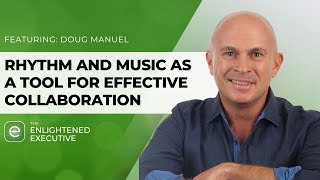
Doug Manuel, a former BBC producer, uses West African drumming and rhythm in leadership workshops to teach listening and break down organizational silos. He contrasts communal African practices with modern isolation and offers leaders simple techniques like body percussion and breathing exercises to build deeper connection.
Chapters
Foreign.
Hi, I'm Susan Drum. And welcome to the Enlightened Executive where your personal evolution sparks your leadership evolution. Each episode we feature groundbreaking techniques and strategies to help you get the edge in personal and leadership effectiveness. This episode is brought to you by Meritage Leadership. At Meritage, we strengthen leaders and build teams to achieve high performance. Go to meritageleadership.com to learn more. Today we're focusing on purpose and collaboration and I'm honored to introduce my guest, Doug Manuel. Doug is a speaker, workshop leader and performer specializing in fostering purpose driven engagement and collaboration. He's spoken at TED Global events and opened for a super soul event for Oprah Winfrey. His speaking focuses on using African drums with the audience to give people a felt sense of true collaboration. The foundation of his work draws on the wisdom of rural Africa where people still live in community and have an innate sense of how to collaborate. For more than 25 years, Doug has traveled, lived and worked extensively across the African continent as a filmmaker, humanitarian and pursuing his passion for West African music and culture. So welcome Doug.
Susan, thank you. It's so great to be here with you today.
Well, I'm very excited to have you on the show because we both know the power of music to improve our effectiveness as leaders. But let's start with what led you to Africa and the focus on African drumming.
So I, I was, I'm actually an ex documentary producer for the BBC and back in, I think it was like 96, 97, I had a double whammy introduction to Africa. So for the last two years that I worked at the BBC, I was making a film about African elephants. So I got to travel all over the continent to film these majestic animals. It was extraordinary, just extraordinary.
The elephants. I've been to Africa three times and love the elephants. Yes.
And so in parallel to making that film, a friend of mine invited me on a djembe workshop. The djembe is the West African drum. You can see a bunch of them there behind me. And I fell in love with the instrument and I packed my job in at the BBC and I took myself off to West Africa where I literally played five, six hours every day until I couldn't move my fingers with the African masters. And I don't think I realized at the time that I wasn't just studying music and I wasn't just studying drumming. I was studying people and I was studying community and I was studying collaboration. And so really I found something awakened inside me and I found a new way of connecting with people within community and for Me, everyone needed to, in one way or another, experience the djembe. So that was kind of my journey. And I then went off and bought a house in Senegal in West Africa, where I also run leadership retreats and try and go four, five, six times every year.
Amazing. And so you fell in love with this instrument and then. And then what? How did you end up like to the scene behind you, where looks like on every person gets a drum to play. I want to hear about that too.
Yeah. So I came back from Africa after a first six month study trip with 15 drums and started running workshops in schools and high security prisons and refugee centers. And of course this was in London. And when you're working in the public sector, it's really difficult to make any money. And at the time there was an organization in London called Arts and Business and they were running courses to show artists how their art form could be used in organizations. And I did a few courses with them and they had an amazing methodology where they had us break down the skill set that we used in our art form and then really go into that and understand how that could be useful for organizations. So if you take drumming, for example, you have to listen to each other, otherwise there's no music, you can't think rhythm, you have to feel rhythm. So there's immediately a whole piece around coming back to that felt perception of who we are and emotional intelligence. You have to have eye contact, you have to know when to start, you have to know when to stop, you have to master a skill set. And all of these things are really exactly what we need in organizations.
Yeah, exactly, exactly. And people would talk about that, but they wouldn't necessarily have the embodied experience. What does that feel like? Tell us a little bit more about how you use that to speak about it and have people have the experience of it and what it means.
So sometimes I go into organizations with lots and lots of drums as you see, as you see behind me. Sometimes I just take my drum and I take my looping pedal and I show people how rhythm is made. The fact, because with my looping pedal I can layer. So that's an amazing way of breaking silos and people understanding that when they're just focused on themselves and what they do on their, their daily tasks and they're not really aware of the overview of what happens within an organization, then we're just working in our silos and every company wants to break silos. So I talk about these things, I talk about active listening, but then I always bring it to life in One way or another. So it's either bringing drums for everybody, or I do it through body percussion, quite simply, where I've created a backing track explaining people to people, how rhythm is built, and then I use that as the backing track so that we can actually have a lived experience just with our bodies through clapping and stomping and finger clicking. But when you have multiple rhythms going on in a room, one thing on its own doesn't make any sense. The magic comes when there's lots of different things happening at the same time. So it's the same in organizations. It takes every department to function well in order to. In order for anything to work and in order for us to then be able to go and serve our clients.
Yeah, right, right. So when people walk away from your speaking engagements or having this experience, what do they. What. What feedback have you gotten that. How they approach their leadership differently?
Well, I always, particularly with the workshops, which is in smaller groups, where we can take a deeper dive into human connection and working in small groups and rhythm. I think it's things that really make a difference in our organizations in terms of what a culture is. So it's smiling to each other, it's eye connection. It's taking time to slow down, to truly listen to each other. I mean, these are the things that. That really create a culture of an organization. It's not the processes or the products. It's how we interact as people with each other. And, of course, this is one of the things that partially got lost during COVID and the struggles that organizations really have now in terms of being able to build back their culture. But it all comes down to how we connect to each other and how we feel within any given organization. And I think anything that we do with rhythm and anything that's interactive, these are the things that just inherently happen. And I mean, I love keynote speakers. And at the same time, I think the days have gone where we load people up with more and more and more theory. Actually, today, what we have to do is bring things to life. And there's no better way. I mean, you know as well as I, there's no better way than music to infuse energy and to bring. To bring life. And everybody loves music. Everyone is touched by music. I've actually even run run sessions for deaf people, and that was incredibly interesting because they could actually feel the beats of the drum that we were playing.
Yes.
And so I could even run a group session with deaf people. What was key with that was to make sure that they weren't facing A window. Because all of their other senses were so overly, I suppose, active. So I couldn't get them to play. There was a window behind me. When I first ran a session for deaf people, there was a window behind me. And I was like. I couldn't get them to focus. And then when I realized what they were doing, when I was watching their eyes and I could see that anything that was happening outside, they were kind of looking for. And I turned the room around so that there was just a plain wall behind them. And then all of a sudden, they were even able to make music together and play and rhythm together. And it was purely, you know, from feeling.
Well, you think about that in, you know, extrapolating. Getting them focused to focus on each other is what created the collaboration. If they were turned away or focused on something else. We never got. You never got to that level with that community?
Yeah, completely. And, I mean, I think it's actually possible to have really deep collaboration when we're working in the virtual space as well. But it just takes more effort. And so it's really about where we put our energy and our intention in order to be able to achieve the intended outcome.
Why is rhythm so important in your mind?
Well, I think it's that I'd like to say it's the most primal form of music, but actually, if you search up what's the oldest instrument, the answer that comes up on Google is a flute, interestingly. But I think rhythm. I think rhythm is really what calls us home in a sense. I mean, the most primal form of rhythm that exists in all of us is a heartbeat. And for the first nine months of our lives, we're actually listening to our mother's heartbeat all the time. So there's something very primal about rhythm that really brings us back to, or has the capacity to bring us back to ourselves. And I guess building on that, the methodology that I have is it starts with awareness of ourselves. And the more aware that we are of ourselves, then we can become more aware of each other. And the more aware that we become of each other, then we can go to a place of group synergy. But it's actually a process. But it starts with us. It really starts with us.
Yeah. First starting with us understanding ourselves and then understanding how we're connected to others.
Exactly. Right, Exactly.
And for me, it's really about the fact that rhythm and music is vibrational and everything. What people, a lot of people don't realize is that everything vibrates, right? The. The earth vibrates, the chair vibrates, the. It doesn't feel that way because it feels solid to us, but it actually, the density depends on the. The level of vibration. And if what we have to realize is we're vibrating and so we're putting something out there in terms of our ability to collaborate or not, we're very, at the end of the day, also primal beings.
Right.
And I don't think we realized how much we're giving off a sense of. Of openness, closeness, judgment, curiosity, all of these different things. They're sending signals, and we, as animals, are sensing them before you even say anything. So I think music helps us get in touch with what is that signal. Right. And is that signal working for us? I love when people try to, like, underneath it. They think they're not showing, like, what they're really feeling. And, like, oh, no, we can tell, you know, what's really going on for you. And so that's what I love. In the work that you're doing, I'm curious to know what the African communities that you worked with have to teach us about collaboration and shared purpose.
So it's a great question. And I'm actually making a documentary at the moment. I've gone back to my filmmaking days and I'm making a documentary. It's actually a documentary about the loneliness and isolation epidemic.
Oh, yes.
And the fact that rural Africa really has the answers for us because they still live in community and they still know how to collaborate and what's absolutely key. And it hits me every time I go back to West Africa, where I go back to my house, there is how connected people are to each other. There is no separation between work and life. The whole notion of work, life, balance.
Right, right.
Work is life. Life is work.
Yeah.
Yep. There is an inherent sense of how to collaborate, and I think that starts very, very, very young. I mean, if you go to the school, there's no janitor at the school, there's no caretaker. The kids are responsible for clearing up the classroom, for going fetching each other water, for cleaning the chalkboard. If somebody needs help, someone else is always there. It's. It's. Yeah, it's a. It's. They survive on community. And I think as a species, we need to go back and learn what we've forgotten.
Yeah. Yeah. I was just working with someone last night, and they had the most fascinating reminder, or the way they remind around being grateful, but noticing that you are part of the system. And the system is everything in your house was made by someone and they're giving. They created the drywall, the Person, you know, put in effort to do that. And I think we get ourselves, they just become things but we don't realize the energy that went into them. Whether it was the design, whether it was the color, whatever it may be, there was someone who put their energy into it. And if you can start appreciating more the efforts of others. It sounds like in, in the African community they see it right then, right. You can see who is taking out the trash, you know, who is straightening up because you have a more visible. But in our day to day lives today, we're more removed from that and it's, it doesn't have the sense of humanity and that how we can see all the sense of responsibility and how everyone is contributing to that outcome.
That's so true. And that makes me think about purpose. Actually it's because during this documentary I interviewed a village elder and I asked him what he was afraid of. And the answer that I was expecting was that perhaps he would say I don't know what I'm going to eat tomorrow, I don't know how I'm going to feed my family next week or I don't know what I would do if my family fell sick. I mean those were the answers I was expecting. And he actually turned around and he said my biggest fear is what happens to all the young people in the village when I've died and I'm not here to guide them anymore. And that's selfless purpose.
Yes.
And I think that, you know, you talk about, you know, the beauty of even just a wall or a light or clothing or whatever we have, somebody's designed that someone's put their heart and energy and soul into what they do. And if we were all just to put our heart and energy and soul into what we do without thinking about processes, without thinking about what we're going to get back. I mean that then becomes selfless service and Africa, rural Africa certainly is an extraordinary example of that.
It makes me think also in this morning's news it was which generation is the unhappiest? And saw some statistic that just breaks my heart. Gen Z 75% say they're unhappy. So you think about that and I sort of think about the drivers of some of that and, and there are many, many drivers. But I think we, the isolation that you talk about because we're using or they are growing up in a world where community is thought to be what's online, when it's a false sense of community, it's not, you know, truly and not to Say there aren't some online communities that are. But when I think of the social media, the other thing that's different than from what the West African cultures that you're talking about is the authenticity of what is really going on versus the sort of fake show of what's going on in social media and what you think your community is doing.
Yes. I mean, certainly you. You can't give someone a hug online. You. I mean, in West Africa, that no one, they never cook just for themselves. That never happens. There's always. There's always enough food for a neighbor or two or three or four or five.
Yeah.
And, you know, that's what true community is. And I mean, even today, you know that there's communities, online communities that we pay to be a part of. I mean, the thought of paying to be a part of a community is you pay to be. You might pay to be a part of a network, but not a community. And words are important. So I think it's interesting, you know, where we've gone today in terms of, you know, making it about revenue as opposed to really about people and revenue and money is important. We all need food to eat, we all need clothes to wear. We all love luxury items. We want to feel good, we want to smell good, whatever it happens to be. But it's not necessarily putting profit first, it's putting people first. And actually that's what sells products at the end of the day.
Like, can you tie back to what you're really doing about how you help people or the environment or other sentient beings like animals? Right. You've got to find some purpose, because if not, everything starts to ring hollow. And that's what I think is if you get connected to a meaningful mission that is something that's outside your cell, you're not going to worry about your happiness anymore. And the examples you're giving about the African communities where they don't just cook for themselves, they're cooking for others. Well, then that brings a whole new purpose and meaning behind cooking.
Oh, totally. Totally. And they smile all the time and. Yeah, a lot of the time they have nothing.
Yes.
So it's. I think it's exemplary. And at the same time, I don't want to say we'll all be happy with nothing, because I don't believe we would be. You know, I really don't believe we would be. And I think that their biggest problems is knowing what they're going to eat tomorrow. Yeah. And yet they have a level of faith that it's going to be all right. One way or another. And it generally is because the neighbor is always there or someone is always there to support and take care of. Yeah, it's.
Well, they're also learning to. To trust one another. So that's part of the piece of collaboration that I think sometimes get us in the way, is can I really trust that you're going to show up for me in the way that I need you to in order for us to be collaborative, you know, effective collaborators?
And. And the same. The same goes for rhythm as it does trust. You don't think trust. You know, you trust somebody because you feel it. You have a gut feeling. And hence the power of rhythm in terms of bringing us back to that felt perception, part of who we are.
Right, Exactly. Exactly. What is something that you would recommend that leaders do to start to bring this sense of collaboration or shared purpose into their organizations as a result of maybe connecting with music or maybe not. I don't know what words of sort of the actionable step that they could take.
Well, for music, for me, music is, Is. Is everything. And at the same time, it's also beautiful to have silence sometimes. And one of the exercises that I take groups through is linked to the word inspiration, because all leaders need to be inspirational. So I invite them to take a breath and then take a breath, and then take a breath and take a breath and take a breath. And then I change one word and I say allow a breath. And all of a sudden there's this silence that comes in the room. And I believe that the foundation of listening is allowing. It's not about taking what we can get. It's about allowing. And from an entrepreneurial perspective, that's where the real magic of opportunities are. And if you really want to dive into connecting with the true essence of somebody, just allow a breath when you're with them, because then you go into a place of deep, deep, deep listening. And then music comes to life in different ways. So I think there's this whole notion of allowing space and also just bringing a smile to what you do. I love that with gratitude because as I said earlier, that's what creates culture and organizations. It's not about the processes, it's not really about the products. It's about how we are and how we connect with each other and taking that time to really, truly connect. I think that that's. That's what we all need to do. I mean, particularly leaders, so that they. They lead by example with that.
That's amazing because I see so many leaders and I find myself included in this, where I'm just racing from one thing to the next. And it gets in the way of being present to what's really happening. And if I'm not present to what's really happening, how can I be effective in the moment? And your mindset shift around? You know, we've always heard just take a breath, take a pause. Right. But actually allowing a breath is allowing space. And in the space is where the learning happens, but also the bond or the connection gets formed. You've got to have the connection to be effective at collaborating completely.
And. And it starts with listening and listening starts with allowing. So absolutely, yeah.
You can't play going back to your drums in that amazing room behind you unless you're listening to what the rhythm is so that you know when to come in. Well, I love this. Thank you so much for joining. Where can people learn more about you and your work?
Well, essentially from my website. So it's www.dougmanual M A N U E L.
Excellent. Well, thanks so much for joining us. And if you like this episode, you're not going to want to miss my interview with Lucinda the Horse Whisperer at Miraval, who facilitates insightful, nonverbal conversations between guests and their equine partners to achieve personal growth. Let's all lead the way. Hope you enjoyed today's episode and I'd like to point you to the next important step. Hit the subscribe button and the bell to get notified when we release new content. I'll see you on the next episode of the Enlightened Executive.
More from Susan


Why the Biggest Doors Open When You're Not in the Room | Michael Roderick & Susan Drumm





The Simple Audit That Adds a Human Touch to Every Customer Interaction #shorts


