The Leader's Playlist Virtual Launch Party!
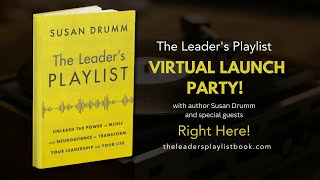
Susan Drumm launches The Leader's Playlist, a book about how personal emotional patterns limit leadership and how music can rewire the brain for resilience. She interviews peers on music and vulnerability, and donates half of launch-day proceeds to Solid Rock, Alice Cooper's nonprofit.
Chapters
Foreign. Hi, I'm Susan Drum, author of the Leaders Playlist and welcome to our live Stream launch party. I am so excited that you are here with me to celebrate this and so thank you for taking the time. We have some special guests coming to speak at the party and I'm very honored they can join us. We're going to have first up, Dina Kaplan and Noi nominee. Dina Kaplan is the founder and CEO of the Path, which hosts high end meditation retreats and meditation teacher training programs and Noi Nominee who is head of HR at a New York City hedge fund and both are my dearest friends. Then we have an extra special guest, Bill Adams, who is the CEO of the Leadership Circle and just a legend in the leadership development community. Then finally we've got two entrepreneurs, John hall and Mike Monroe. John is co founder@calendar.com and Relevance, a marketing and PR firm. And Mike is is a former senior executive and entrepreneur specializing in outsourced CFO services and benefits programs. So I am so excited they could join us. Before they do, I would love to share a little bit about the book with you and why I wrote it. I believe we all have a program or playlist that is running in the background that acts as a ceiling on our leadership effectiveness. If you're in a leadership role, you have no doubt been challenged in the last several years. You may feel like you can't retain or engage your people as well, or you may be feeling burnout or your team is overwhelmed by the pace of change, or you may feel you can't delegate or trust your team to deliver. You know the impact of the pandemic has been so far reaching that every leader has struggled in some way in the face of massive disruption, mental health challenges, supply chain and global inflation woes. And it may feel like there's nothing we can do to change these external events. And the truth is, the only real power we have is is how we respond to them. Have we built up the inner resilience to handle the storms impacted all of our lives? How can we do so well? In the book, I share a process to uncover the playlist impacting your leadership. And I'm going to share research that explains why music is such a powerful tool for understanding and and reshaping your behavior. And then I'm going to teach you how to leverage music to help you be a better leader and better human. Look, the thing is, this isn't just a metaphor. Music has the ability to help make change stick by priming the neurological landscape to form new neural pathways. Faster and more efficiently. So. So in the book you're going to learn more about these unique approach and a specific seven step process to create a new, more powerful playlist that I believe will transform your leadership and your life. I am so glad you're here with me. Thank you for helping me celebrate this endeavor. But what really matters most is helping me spread this most important message. And I think the message is needed now more than ever. I am on a mission to inspire and guide leaders to heal what holds them back and help them develop the capabilities to lead in today's increasingly disruptive environment. What I'm hoping to catalyze is real and lasting change needed more than ever. People are divided. Anxiety is at an all time high. Political leaders continue to attack each other and lead from a highly wounded perspective of power and control. The impact of poor leadership on our planet is evident. It's literally creating a meltdown of our environment, along with the destruction of people and wildlife and even the threat of nuclear war. The answer does not lie in controlling or fixing others. As much as we would like it to be. We've tried that. The only answer we have is in healing ourselves. I love this quote from Einstein that says the solution to our current problems cannot be solved at the level of consciousness that created them. We must elevate our level of consciousness, our awareness of how our demons, our wounds, our triggers are contributing to the collective experience. So you may be wondering, how did I come up with the idea of music having the ability to transform leadership? Well, because it started with me. After breaking up with my significant other, I couldn't seem to shake the resentment and sense of betrayal I felt and the catastrophic loss of feeling. I had wasted the last important years on this man who surely didn't deserve it. I knew as a coach that this loop of resentment wasn't serving me. I mean, he moved on with his life. Why couldn't I? But when nothing else seemed to work, I turned to music to soothe me. But what I found was that music did more than soothe me. That music had the power to heal me. I created an empowerment playlist and I would play it anytime. I felt myself going down that old pattern. And the more I used it, the less the resentment had its grip on me. And so I became deeply curious about the power of music and its impact on the brain. I'd always loved music. I mean, I have a master's degree from the London Academy of Music and Dramatic Art. And as one person said to me, only you could have written this book.
But.
But the More I uncovered the research, the more I became enchanted with how I could apply this research to shift deep seated patterns that I've seen hold leaders back from being truly effective. And then through writing about different parts of my life for this book, the highs and the lows, I started to see my own patterning that I had a playlist of. I'm treated unfairly going on in the background every time I experience some of these low points. I could also see the patterning in others that how they were leading today had its direct roots in what happened to them in their childhood. The Leaders playlist is for any leader, and frankly any human ready to evolve to a higher level of consciousness beyond our ingrained patterns. I believe this includes young leaders yearning for examples of true leadership who are going to be faced with being the change they want to see in the world, and senior leaders who want to more effectively scale their organization in the midst of a very disengaged workforce. This book isn't just about how to use music to shift your state energetically. We know that already. We use music to work out to pump ourselves up, right? But it's also about how to use music to essentially interrupt deep old seated patterns and build more enlightened neuron pathways that will, I believe, not only serve you, but impact everyone around you. So how can you help spread this message? Well, the launch day is today and of course the goal is to get as high on bestseller list as we can because the higher up you are, the more Amazon or Barnes and noble.com pushes you out in their algorithms to others. If you haven't already, you go to the leaders playlist book.com and click on the order button and you'll get some special bonuses for purchasing the book today. I'll be sharing more about these a little later in the program and then whatever you can do to shout out on social media about it, which includes LinkedIn, I'd be so grateful. You can direct them to go to the leaders playlist book.com as well to get their bonuses. And if you're not a book reader but you're curious about these concepts, how do we use music to transform our leadership and our lives? We are also launching today a masterclass that's the perfect tandem guide and we'll be taking a deeper dive into applying this process in your own life. So more on that in just a bit. And finally, we are going to be donating 50% of the proceeds of the book sales from launch day to a charity who understands that the power of music can Change lives for the better. Solid Rock was founded by Rock and roll hall of Famer Alice Cooper, who is dedicated to giving back to the community that helped shape his career when he was a teen. So we'll be sharing more about this wonderful charity a bit later in the hour. And now I want to welcome my guest, Dina Kaplan and Noi Nominee, who are joining us today. And just to refresh your memory on who they are, as I said at the top, Dina is the founder and CEO of the Path, which holds high end meditation retreats that I have been on. They are amazing, incredible. And she is a meditation teacher as well. And my dear, dear friend, Noi Nominee, who is a rock star head of HR at NYC Hedge Fund. And I'm so glad you could join.
Hi.
Hi. Thanks for coming on.
Is Dina going to be.
Dina hasn't jumped on yet, so it's you and I to start. Okay. Hopefully she'll be on soon.
Well, congratulations. I am so incredibly proud of you. I've witnessed you through this journey of just thinking about this book, creating the book, rewriting and Rewriting.
Yes.
So. And what you said at the beginning of your introduction just really resonated with me of just kind of who you are and how this showed up in your book in terms of your playlist. And as you're, as you're talking, I was just thinking about, you know, our many road trips and the playlist and like, there's particular songs that I can't name off the top of my head that I know that they're your songs and they're like, that's, that's like your calling song.
Yes, yes. Like the anthem. My anthem. Right.
That's your anthem.
Exactly.
Yes. Yeah. I, and, and Noi, you've seen me through some, a lot of highs and lows through the process and seen me really grapple with some of the deeper seated patterning that I needed to change and how, why I have such a gravitation to music and how it's, it's incredible power to heal. So I'm glad you could be here because you've, you've witnessed me through this journey and seen the power of music firsthand.
Well, it's not just the power of music, but it's just the power of you and how you show up in friendship and in leadership and in business because I've been involved in all of those facets and you show up exactly the same way, which I think is just so honorable, regardless of who, if it's the server, if it's me, Calling you because I'm just having a bad day or we're actually just talking about, like, business. You show up with this, like, this vulnerability, and you're just a really great listener.
Oh, thank you. That is so sweet. I, I, I do. I'm curious about what happens to you. How can I help? You know? And I really believe friendship is a give and take. You've been there for me just as much as I've been there for you. And listening and really hearing what's going on beneath the words, I think is really important. Like, what's the dream? What's the wish that's unfulfilled? If you're struggling with something or what's something that you're so excited about and you want someone to be a witness to, that's how we show up for each other. And that's how I want to do my best, to show up in every relationship as best I can. And I'm human. It's not like it happens all the time. I do the best I can, and that's.
I mean, that's all we can do every day, right? Is just take it one day at a time, one phone call at a time. But I'm just so incredibly proud I have the book.
Oh, great.
Yay. Yay.
And it's actually interesting because my assistant was like, you're really horrible at being like, of showing up sometimes, because I've always got a lot of, you know, 100 things going on. But in my calendar, I wrote, you must show up for this. She was like, lloyd, this is really important. Never asked me to do that before.
Oh, my God. So great. Hi, Dina.
Oh, my God. Two of my favorite people in the world. This is awesome.
This is awesome. Thank you for joining us. I'm so excited that you are here. We were just talking about the power of music, the power of friendship, and how we show up for each other. So big, big thanks for you two for showing up for me today on this live stream. Really grateful, grateful to be here. So, Dina, I know. I'm. I'm not sure, because you're this world traveler, and Dina is somebody who's always on the move. I mean, if people think I'm the world traveler. Oh, oh, this. This one, Actually, Noi is also my world traveler. All three of us share this love of travel.
We.
We do. But someone does it far beyond the two of us, and that's. That's. Dina, you're always on the road, so I don't know if you've gotten a copy of the book yet.
But.
If you.
Because of your travels. But I wanted to ask if you. You know, what, what you were thinking about the concept, what if you had questions, any of that.
So I bought it. Of course. I am reading it and already posted a review, because I'm loving. I literally am loving every word of it. It feels. Dare I use this word, harmonious, but it feels just like a harmonious lullaby to the mind and how each of us can be better leaders.
But a lot of that feels, often.
When you hear that, like, it takes grit, and this is the opposite of grit. This is. We can learn to become better leaders, and it can be fun and beautiful and harmonious. So I love it, what you're writing. Sorry, am I creating an echo? Is that on?
I don't hear one. I think you're good. Yeah.
Dina. Yeah, you do?
Yeah.
I don't know how to stop that. Oh, maybe if I turn down my own volume. But then I don't know if I'll hear you. Anyway, we'll sort it out. But I love this idea. I mean, I, as a teacher of mindfulness, know that our leadership depends on the myth of goss, or lack thereof, that's going on in our mind and our past and our triggers and our demons and all of that. So the fact that you get right in there and talk about that, but talk about how we can work to overcome them, wrestle them down to the ground, whatever the right language is around that, through the use of music and emotional playlists, is. It's really innovative, Honestly, Susan, it's groundbreaking and inspiring and awesome and fun, and I feel like it's everything you want it to be and more.
Oh, thank you. Thank you. I'm. I'm excited that you're into it. I can't wait to get the feedback from people.
You know, you.
You write this, and it's. There's some real personal things in there, and so you put it out to the world, and it's a little like, you know, how is this going to be received? But, you know, I don't feel that it's valid for me to sit removed from the process without talking about how I try to walk the talk and how I try to use this in my own life. And really, it was, as I mentioned at the top, it was through using it in my own life that I. That I. I found how it worked. So I think what's really interesting about music is that the impact it has on all regions of your brain. I mean, it. That's amazing. And it's really instant and fast. So think about like. So I'm wondering if either of you. Do you have an anthem that you like? Is there like, is there one your go to song? Do you have one, Dina?
I definitely do, but Noi, do you want to go first?
Yeah.
Sabotage, Beastie Boys.
And why is that your anthem? Tell me more.
Because it doesn't matter, like what type of funk I'm in. I'm always going to get up, I'm going to dance, and I'm going to just rap. And I'm the worst rapper. So it just puts a smile on my face. And that's. And that's my goal is right. Is just Is to be happy. And it triggers something in my body. Like it puts my mind into my body again. And sometimes it becomes so disconnected throughout the day. I'm staring at four monitors during the day and it becomes so disconnected that I need to have a dance break. And that instantly puts me in a good mood.
I love it. Dance break and everything. Yes. It's like it's this instant reaction. And that's why I think also some people say, well, there are certain songs that I need to be listening to. And part of the work is that depends on what the music does to you. So someone else may find Beastie Boy. Sabotage does not work for them.
Right.
And so it's finding what is. What is the emotional state that you want to be in in more of your life and finding the music that resonate, that brings that out in you or triggers that pattern. And that's exactly you. You got it. Exactly. That's awesome.
I love it.
We need to make a playlist of all our favorites. Okay. Dina, what about you?
Yeah, that's an awesome one. Noye friggin. Also a little non obvious too. I didn't expect that coming through you. It's.
No one does.
So let's see. I love. This is what you came for. This is what I came for. The. Which is written by Taylor Swift, actually, although her name isn't on it. She wrote it under a pseudonym with Calvin Harris and sung by Rihanna, who I love, love, love, love, love. And I also love Rihanna, better known for singing.
Oh my God.
How can I be blanking on my absolute favorite song? Oh my God. The one was like diamonds in the sky. I actually just played it the other day. I cannot believe it.
Yes, I know. It's Shine bright like a diamond.
Yeah. Oh my God, this is so funny. But anyway, pretty much any song by Rihanna because I also Love Rihanna and T.I. singing Live youe Life, which is about how some people in their world are counting money, but it's really about what's going on in your mind that dictates your happiness. And I freaking love that song. In fact, we all have a mutual friend, Cheryl, who went through a, like, a really tough moment having to do with one of her pets. And so I just played that song and we just shook it out.
Shook it out.
Shook it out. Because we know that trauma and negative energy can live in the body. If you can shake it out, then it's awesome. So, yeah. Oh, We Found Love. That's a song. Of course. Another Calvin Harris Rihanna song, We Found Love. I just love it because I think that, I guess if we listen to the messages, if you're in really, really, really deep trauma or deep depression or a chemical imbalance, obviously that's something that medical help will help with, and that can be really valuable. But a lot of times if we just feel badly, we can get ourselves out of a little bit of a funk by just choosing to be happy and choosing love and found love. I actually think she wrote about a tough relationship and then is saying, but we found love. And we made that choice to move towards love. And I think this is something that we can move towards. So it feels really empowering and freeing. And it's also just. Those are all great dance songs.
Yes. Yes, they are. There's something about moving your body, too, at the same time that you brought up, I think is really, really important. And. And, you know, it's not to say, and I say this in the book, that we want to ignore emotions that we experience. You know, if something occurred and you're feeling angry about it, that's important information, right? You want to recognize the anger and determine, do I want to take action on that? Is there a boundary I need to set as a result of, you know, a boundary being crossed? What we're really talking about with this is when you get stuck in a pattern that, you know is not serving you right, You've got. Okay, how often are you going there? Are you continuing to rehash the same incident over and over as I was? And that's where I think it gets really destructive, because each time you're doing that, you're grooving a new neural pathway, deeper and deeper and deeper. And. And music is like the fastest shortcut I could find to get myself out of it 100%.
In fact, Amishi Jha is a neuroscientist who's really passionate about mindfulness, and she wrote A new book, a very recent book about mindfulness. And she's saying that if we train our minds, which you're helping people to do in cultivating their leadership ability, it's like shining your attention like a flashlight where you want to. So having the ability to do that is friggin awesome, right? It's kind of everything that's freedom and the ability to sort of. It's almost like reframe, right? We've all studied Mama Gina, but it's like finding these frames but reframing things where you might say, oh, I'm just in a funk. And that's how I'm going to be this day, this week, this month, this year. But you can actually shift your attention and music can, as you're saying, music can help us do that. And then so yeah, it's not, we're not just being fake happy, which none of us would be an advocate for, but yeah, you can shift your attention and move towards something that feels happy, feels delightful, Beastie voice, sabotage and all. Then, then why not, why not choose to live in a happy way? And if that can help you be a better leader to your team, as you about in your book, Susan, then then why not live that way?
Yes. Yeah, exactly. Exactly. Noy are you, you work with a lot of leaders being in an HR role and you see kind of firsthand the impact on leadership when it's working and when it's not. And so I was curious if you had any insights around that that you want to share, like who are the best leaders, how do they show up and. And who are. Who are not. Not not naming names.
Well, I've definitely have worked with many masters of the universe type individuals. The best leader, and I will actually name him, his name is Steve Fatum. And I remember during my interview with him, he asked me what I wanted to do and he said, I know this isn't really your destiny. And so we actually talked about what my legacy was going to be. And he was like, let me figure out how to help support you and I'm going to hire you so you can make an income, but I know that's not your passion. And that was just such an interesting conversation that. And he told me, you know, this isn't my life's goal is to be the CEO of this major company. And we just had like a 40 minute conversation about our legacy. And he didn't just do that for me. He would go up to the most junior person of this company's 500 employees and he would ask Them like, hi, you know, my name's Steve Fatem. I haven't met you before. How are you doing in your job? Do you have the resources? Do you need to do your job? Where do you live? So one time there was a blizzard and he called me at like 4 o' clock in the morning, said we need to send out this notification now because this gentleman lives in an Atlantic City and he needs to make. I need to make sure that he gets this before he gets in his car. And that just resonated so much to me that he just showed up exactly like you show up, Susan. He's just a normal human being that's interested in you. And I think that the. So he was Steve Fatem, most amazing leader of boss, leader, friend I've ever had in this business capacity. And I can quickly tell you the most ineffective leaders are ones that think that they don't need to lead, that the numbers, the margins, the profits are going to speak for themselves. And people do not leave companies purely on compensation. That is not the number one reason. And during. And I'm going off on a little bit of a silk box, but, and we've talked about this using during this pandemic as leaders and for myself, I had to show up in an HR capacity with a different toolbox than I normally would. I'm speaking to people at home and they're, I'm like, don't shave, don't change out of that like T shirt with holes. Show up as you are. I'm going to show up in my Gryffindor T shirt and we're just going to have a normal conversation. I'm going to show you that I'm struggling with the pandemic. I might not have washed my hair in five days, but that's okay. And so, and it's been a different type of toolbox. And I think the, the most effective leaders now have recognized that toolbox is different. You need to show up with a different type of vulnerability than just this corporate toolbox that.
Yeah.
To work prior.
Yes, yes. Oh, you described it so well. It's really about vulnerability. If when you look at this book, I really encourage people to go in with a sense of vulnerability of like, where am I getting stuck in my life or in my work? Where am I bumping my head up against the ceiling and what do I notice about a pattern there and how am I contributing to that? Because this book is going to ask you those questions.
Right.
And you're creating a different playlist and how to be a Better leader and a better.
Yeah. Well, I'm so glad you guys came on today. Thank you. Thanks for just being you. Thanks for being in my life. Thanks for showing up in the way that you do. You both do. And I'm just looking forward to many more adventures abroad with both of you. And at the next. Yes. All right.
Thank you.
They are lovely. They're just incredible people. And I am excited to bring on the next guest, who is Bill Adams, who's the CEO of the leadership circle, who, as I said at the top, he's just a legend in the leadership development community. And so how honored am I, Bill, here with me live. Thank you so much for coming on, Bill, to talk about the book and sharing a little time with me, because I think you're in Europe too, right?
Yeah, I'm actually. Can you hear me okay?
Yeah.
So I'm outside an Italian restaurant in London and Cindy and my daughter are inside. We just finished a full day session with a client and I can't even tell you how great it is to be with you. So one of my favorite people in the world is Susan Drumm. There's no question about that.
Thank you. You're in Italy. Oh, I'm jealous.
We're just not London. I'm in London.
International live stream.
No, I actually am in London in an Italian restaurant.
Oh, wait, wait.
Okay, sorry.
I heard Italy and my mind went there.
Well, you.
You heard the Italian piece? Yeah, it was really clear about 30 minutes ago that the pace of which the meal was coming was not going to suit the time we were scheduled. So I went, now this is easy. I'll just go right outside. So I'm sitting just outside. We're just a little ways from Windsor Castle, actually.
Oh, wow, that's great. So I love it. Well, thank you for coming on. Because when I say this man is a mentor, definitely groundbreaking ideas, concepts that I use in my work, I'm just grateful for you. So I thought you could come on and share a little bit about your thoughts on leadership and where it's going. And I know you've also read part of the book or. And I'd love to read the book. Oh, you read the whole thing.
Okay, good.
Yeah. You know, quite honestly, Susan. So let's. Let's play that out. I. It wasn't one of those books that I could just. Because it got me hooked and it got me in. In a way that not only did I see the application in my work, I was in the application on myself. So I've got a belief that we are our own biggest project. And there's no question in this situation that's true for me. In fact, I just was saying to my daughter, Cindy and I were talking about our work, and as you know, Susan, Cindy and I are business partners as well as partners in life. And I said to my daughter, who's 38, well, actually, Cindy has a really big job and it's me. So I'm constantly that kind of project. And my experience was that you have nailed something that resonates deeply when I think about what playlist has actually been running my life, and what is my playlist going to be and what does it need to be given where I am in my life now? And that was unexpected. I didn't expect that to come up for me. And I was pleasantly surprised and significantly interrupted. So, you know, I'm. I'm like, been in this work for 40 years. Good job for you. I mean, good job for you. That's not. That's not easy to do. And you've really done it. You nailed it.
Oh, man, that is. I mean, I'm thrilled to hear that. And it might seem to other people like, what do you mean that's not a good thing?
It's awesome. Are you kidding me? I mean, you know this. I. We have a firm belief that we're built to grow. That's how we came in. That's hopefully how we'll go out. And I love this definition. I was listening to your previous guest and leadership today is all about understanding the meaning. And growth doesn't just have to do with financial growth. It's just not about what happens at the bottom line, what happens, the top line, how we do it on ebitda, et cetera. It's about how is it we're growing within the organization, are we setting the container for that to happen? And that's what I find that the really best leaders are doing now in a way that they haven't previously. And thank heavens, we need a desk for them.
Yeah, we sure do. And I think the old style of leadership thinking that that is the brass ring. How we did on our financial performance, yes, it's important, but it's not the only factor. And if we don't get it right, we have all sorts of problems, real societal problems as a result of this. Right?
Yeah.
It's myopic focus, no question.
And I've got a place that I really come from in this, which is we put so much of our waking hours in this thing that we call work. It needs to actually be something that feeds our life's blood. And because it's finite, we don't have any more of it than we have whatever that means, each of us then that finite piece of it. We need to get that kind of fulfillment of work. And otherwise we're not setting the stage as leaders in a way that we need to be. So it's a really important piece of what we do.
Yes, yes. Now, can I ask you to share what you discovered about you in that book? Would you be willing to share that? Put you on the spot.
Yeah, I can. So first of all, you'll appreciate it. I'm sitting in a changing light situation. It just turned from blue to green and I think the next one's red. So understand what's going on the right side of my face. So there was a couple of deep patterns in here for me that I didn't understand were running me. So I didn't get underneath those. And you know, we're talking about a lot of years in this work. And when I started thinking about the playlist, for me, it was more harder, faster. And it was all about drive and it was all about literally divine defining myself based on the results that I either achieve or don't achieve. And that was part of what I didn't understand, was still more outside in than it was inside out. And I thought that. I'm like, seriously. I thought I'd actually got that and I thought that I'd actually understood that. And what I realized, and I was talking about it this evening with Cindy and my daughter, I was still calling up some of those old, literally old playlists from my relationship with my dad. And all these years later, you know, 67. All these years later, I'm like, oh, you know what? That doesn't at all factor in anymore. And I outgrew it and didn't let it go and didn't know it. And so there was still something in me that was trying to be enough, good, enough match up. I'm like, are you kidding me? And I actually, Susan, you appreciate it. I found humor in it.
I'm like, good, yes.
Are you kidding me? And yeah, there's also a little trauma in there. There's no question about that. Less so what needed to be cleaned up and healed from there more so the fact that really.
You know what.
It actually was funny to me.
I mean, look, here's the thing. And we can have grace with ourselves on this.
We exactly.
A neural pathway. That's an eight lane highway. And that's. I call it can be an eight lane highway to hell. It will be there. You can.
Well, that's one of my songs. And.
And give me a little.
Give me a little highway to hell.
Right.
We don't realize that we're going down that path, but. But until we catch ourselves, like, whoa, there I was again on this. And I didn't realize I caught the bus down that. Down that wrong road. So it will always be there. I think it's. It's a. It's a continued choice of building awareness of when we're on that wounded pathway and how we switch from it. And that's why music is a great way to, like, no question.
Well, it goes. It goes directly in. So it goes directly in, in a way. And I so appreciated what you brought to the fore for me, which is the resonance that goes hand in hand with what I listen to or what actually meaning to me and music is that is so significant in the way that plays itself out. I don't know anyone that it won't resonate with. Susan.
Yeah. Yeah. And that's why I say it's really for any human. But I focus on leaders. But really anyone can get value from it.
Yeah.
I'm also asking everyone one other question before I let you go, which is what is your. What is your go to anthem that will help you get into the space that you want to be in and show up as. Do you have a son.
Yeah. Believe it or not, it's Amazing grace. Oh. Literally, for me, I believe in a world and universe that is filled with grace. And the hardest part of the most difficult is to apply that to myself. And I think that's true for everyone. And so the amazing grace piece of that for me, less secular and more spiritually tied in a way that I get. The grace is built into the system. And all I need to do, which sometimes is easier said than done, is actually activate it. And I'm like, wow, are you kidding me? And it's a combination of grace and gratitude, and those two things go together for me in that. And I'm actually hardcore rock. So for me to say Amazing grace, like, okay, there's something that's transitioning. My dad would not believe it. He'd go, are you kidding me? I was like, seriously, we'd have a great conversation.
I love it. I love it. Well, Bill, thank you for taking the time out of your Italian dinner in London to be.
Yeah, I really appreciate it. Thanks for reminding me. And Susan, I have this memory of you, and you'll know exactly what I'm talking about. But one of the things that I absolutely love about you is you showed up for us to go in one of the most difficult coaching situations we had ever had with one of the most difficult leaders we'd ever had hat and someone that everybody knows, very famous. And we won't talk about that. And I will never forget both you going in and then the conversation afterwards and the impact that you had. So I got to tell you that I not only love your courage, I love the way you're willing to put yourself out there and enter in and trust yourself. And you nailed it. And that goes back a lot of years ago now. So that's what you bring to the table. And we're all better off because of you.
Oh, thank you, thank you. I'm better off because of you and everything you've done. So thank you, Bill. Thanks for showing up. All right, awesome. Well, in a bit we're gonna have a couple more guests that are also just as phenomenal. I wanted to tell you a little bit about something else we're launching today, which came out of early readers of the book who loved the concepts in the leadership, the Leaders Playlist, so much that they wanted more one on one coaching to uncover their old limiting playlist and developing a new, more empowered playlist. And so I wanted to provide some more hands on approach to helping people do that in a way that felt more scalable. And so the Leaders Playlist Masterclass, which you can find out@susandrum.com masterclass, is a very practical 10 lesson online course that's going to pick up where the book leaves off. So when you get your hands on the book and you're like, wow, I need, I want some more support in how to bring this to life because that's ultimately what I want to do. I don't want it to become just shelfware.
Right.
I want you to dive deeper into the concepts and what I want to provide more step by step support. So that's what it does. And what I hope is by the end of that class, the program, you're going to identify the root cause of where you might be stuck in your career or leadership or your life. You'll be able to also pinpoint the early life messaging, as Bill just alluded to, that could be affecting your leadership today, even if you're not quite aware of it now. And you're going to be able to create a personal playlist to shift that emotional state, the behavioral patterns and ingrained beliefs, and truly design a routine around using your playlist to become what I hope a more enlightened and effective leader, something we're all working towards. And here's the thing. I really believe it's more critical than ever that we see start shoring up our internal world if we want to effectively deal with a highly volatile external world. We are living in an age of exponential change, which means there's not only more change to deal with in our world, but the changes are happening at a faster and faster rate. So the reality is, if we don't upgrade our internal operating system to build our resilience, which is our capacity to deal with adversity and change, it's going to feel more and more like we're mentally caught in a washing machine and the external world is going to just put us through the wringer. We've already seen some of the impact of these changes. The polarization of ideology, right? Anxiety at all time high, a national mental health crisis. And then we're going to have additional changes coming down the pike, like web 3.0 and the metaverse, and it's going to be more important to shore up your own sense of self. Why you know is because the external world is going to continue to publicly rate you on any dimension they can think of or you can think of. Just like, think about it. Right now you have an Uber score. Right now, when you take an Uber, you have a score and the driver has a score. This type of thing is only going to get worse with Web 3.0. You know, we have a glass. We have Glassdoor now to rate employers. Soon there's going to be something similar to rate you as an employee publicly. So why does this matter? Because if your identity or your sense of self worth is tied so tightly to what other people think of you, you've lost all your internal power. And the next decade is going to be a really tough one. So I'm trying to get ahead of that and I'm trying to help even what's already established in some of the real symptoms and challenges out there with integrating the book with the masterclass. And so I hope if you fully integrate the concepts I teach in the masterclass, you'll be able to have built the resilience and weather the current and upcoming storms to really find the sense of peace and joy that you've actually been searching for all along. So in a little bit, I'll give you a flavor for what's in those couple of the modules with it and let you know that up until November 1st, we're discounting that as part of the launch by 20%. So never again will it be this low below. And if you want to learn more, of course, it's@susandrum.com masterclass. But now I want to turn my attention to bringing in. Let's see, we've got. I think. Let's see who's coming in, because I. It's almost a mystery which John. It's going to be. It's going to be one of the Johns and Mike Monroe. All right, let's do it. Come on in. Hi, Mike. I love it.
Good.
It is John Hall.
You get John. I just finished a speech, and then I had that interview. And so that's how important you are to me, Susan. I'm. I'm. I pulled over the side of the road to make sure I can make this.
Oh, my God, this is great. So I have somebody who's pulled over on the side of a road. I just had someone who was at a Italian restaurant in London step out to do this.
By the way, he means it because he was late to his own wedding.
Actually, I was late to my own wedding. How did you know that?
Secrets.
We know your secrets, John. Well, thanks for dressing up for the occasion, too, John, with the jacket, too. It's looking.
I did. This is for sure the nicest. Well, you. You know, I got done with a keynote because I always speak in pink, so. Because I. My daughter say that they miss me when I'm away. So I always say I'm thinking about you because I'm wearing your favorite col.
Oh, that's so nice. Well, thanks, guys for coming. I wanted to bring you in to talk about. We all know each other from an amazing group that we're part of where we all try to support each other. It's called Selfless Givers. And here they are doing their duty, supporting me today. So, first of all, thank you for doing that. Thank you for being part of this amazing group. Thank you for having me part of the amazing group. I love to hear anything you want to talk about related to the book or questions or. Fire away. Whatever you want.
Yeah, something I can start off, Mike. Something about me. And we can get into the book because obviously that's what we're here. I've just been reading it while I've been driving. No, I read this earlier, and it's great. But I think also when I look at authors and book and content, I think it goes down to the foundation of the author and what they truly want to do. And what I mean by that is I've seen authors that write to get views. I've seen authors that write to gain a following. And I truly believe, Susan, you are one that, you know, when you first did our Enneagram, I think in Mexico, did the, you know, did that. The exercises with us. I think that it shows through the people, the author, and also through their writing on how much they care about actually making a difference. And so, like, I, like, as I was reading this one, I wasn't one of your testimonials, so I wasn't cool enough to get to the front of the books. But I did like the rest of the book after that. But like, I like the creativity because in reality, like leadership books, like, I read a lot. I mean, I'm probably sent a leadership book every week. And this, this idea was not even on my radar. I'm going to be honestly, like, I'm tying in the music. And I'm like, when something's not on my radar, it intrigues me. So I think you did a really good job of doing that. And it's almost like as I was reading, I was like, I don't know how you're going to connect the dots here. And you really did, like, it was a good job of identifying how you can apply music to. And also like, just the early stages of life as well. And so it got me thinking about my kids and I'm like, reading some of this stuff and I'm like, all right, am I doing everything I can to support my kids? And so overall, I thought it was a great book. And I think it backs up the exercises and kind of cla. Or I don't know what you'd say class that we went through in Mexico, where you did a great job of getting us all in gear and all in the right mindset.
Yeah, great, great. I'm so glad. And you do. I know you get a lot of books, so I'm excited that this one caught your eye and you didn't read it to be nice to me.
I liked it.
It was fun.
I'm gonna need. Susan, I'm gonna need about 30 more of these to hand these out like Santa Claus hands out candy canes. Let me tell you, this is a relevant story. Last week when I was in Scottsdale and because of our international conference, I didn't have the opportunity to see, which was so stinking lame. I was at an event, an after conference event, and we rented out this place called the Deuce. And they brought in all these performers and there was music going, everyone was dancing and earlier on in the day, I had met a young entrepreneur, small business owner. Really, really, really impressed me. This guy, I thought he was charismatic. I thought he was funny. And I saw him at this event, sitting on his hands, physically sweating, like, sweating because everybody else was dancing and everybody else was having a good time. And he was in a space where he just. This was not his place. This was not his right. So I go up to him, you know, hey, man, you know, put my arm around him since we'd gotten time earlier. And he proceeds to get really, really vulnerable with me. And all I could think about was his playlist, right? Like, his playlist in his mind was that six years ago, somebody whom he respected saw him dancing, pointed at him and made some type of, like, you know, why you dance like that? You know, where's the chapstick? You know, comparing him to John's laughing, because you remember that. Where's the chapstick, right? And you have this successful, you know, wealthy, like, good look like. And he is. He is a. I mean, he is a fish out of water. And so I got his address. I'm sending him the book, by the way. And I wish I would have had your neuroscience expertise to have been a little bit more, like, able to kind of go in and maybe weed some of his garden. I know it's hard work. I've done a lot of the work. You know, I've done a lot of the work to change our playlists here. But here's what's really, really encouraging. Even with what I had learned, having read the book a week earlier, by the end of the night, he was up on the dance floor, he's single. I saw him talking.
It was.
I was pretty fired up for him. And so he's going to get a copy of this.
You're budding coach?
Yeah, yeah, I. He's going to get a copy and the order to join your. Your master class, by the way, because I think it'd be a really good fit for him. But it's just. It's so unbelievable, right? I mean, you call them. In the book, you called them childhood traumas or childhood tragedies. It's amazing how we just hold on to these things and they literally become our subconscious operating system. And I mean, hall, you know, you've done the work too. Like, if you don't wean the garden, it's just. It just grows crazy.
Well, I was just actually at a speech this morning, and somebody made the comment to me that people don't change, and that always sticks out to me that people don't change and that like a tiger never changes stripes and, and. And like I was actually one of the her. Susan's last thing. She says, change your playlist is not only possible, but believe it's imperative that we take this mission on. We know change is possible. We know about the neuroplasticity of the brain. So let's say let's start harnessing our ability to make these changes and free ourselves from the feathers of the wounding of our ancestors. I look at like, like when I look at content like that, I'm like, I actually do believe change is possible. I think that I've worked on myself really hard. I don't think either one of you guys would like me 10 years ago. And I think that people can change. And I think that that was one thing where when I wrapped up the. The book, it's like, I like how you ended because that was one part of it. Because it's like I do believe in change and I think that it goes by. It's like it like right now the way that leadership and like our society is. There's a lack of trust, there's all these issues and. And we have to all strive to be better. So it's like we should all try to change each other's playlists for the better and get in a better place. And it brings me back to the. The part before it where it says, ultimately it's my hope that all of us can learn these lessons so we can move forward together in our society toward a more evolved, more loving and more successful future. So it's like I think that change and you know, Susan does a good job of with the playlist. Like I said, she did a great job of tying that together because I do think it puts you and it gets you thinking about what can I do to change my playlist? What can I do and actually believe in change? And if we are going to move forward together at this point with where society is and where there's generational differences, there's so many lack of trust situations going on. I think this stuff like this is imperative or content like this is imperative to change for the better so we can move forward. And those are like two paragraphs I highlighted when I wrapped up the book. And so you did a good job of kind of summing it up there.
Oh, thank you. I mean, I do believe this is. This is my mission and I want others to form a community to continue this and join with me because we can. We know the brain can change. So whenever I hear like, it can't change, it's not true. It just means that as I said earlier, you have a neural pathway that you've grooved very deeply and you can always choose to go down that. But we have the option to create a new one. Is it easy? No. But what can make it easier is music. And we, you know, it's a little bit like taking as opposed to going down a paved eight lane highway. You're taking your car and you're going on a dirt road and it's bumpy and it's a little awkward, but the more you do it, the more you keep running down that neural pathway, the more more the road widens, gets smoother, gets easier and easier and easier. So a lot about how we learn and how we change, I also highlight in, in the masterclass, which I think brings it home. Well, I gotta ask you guys, what is your favorite. What is your favorite anthem? Your go to song that brings you. That will bring a smile to your face, get you out of a funk? Whatever you need.
So I'll. Johnny, do you mind if I answer this one first?
Go ahead. It's all you. Yeah, I'm gonna copy whatever you are because you're pretty cool.
I can assure you when I copy what I'm about to say. So I grew up as not entirely an only child, but like an only child because my sister was 10 years older than me. I was, you know, the only boy apple in my mom's eye. And sometimes when you get stuck, spoiled, you manifest that spoiling in the groove and in the neurological rut, as a, you know, I deserve, gimme, gimme, gimme, gimme everything, right. The way I manifested it was almost like this deep kind of like obsessive sense of, oh my gosh, I can't disappoint others and like this unworthiness. Right? And so if I think about my old playlist, and I'm gonna put a caveat on this because, you know, the song Guns N Roses don't Cry, you know, is not. Is not, you know, not actually a song about. Right. Don't cry. It was just, it just the moroseness, the mood of it was like constantly a reminder to me of like, you're not enough.
Right?
Yeah.
I think over the course of doing this deep work, you know, hitting the pillows and sometimes lying horizontal on the couch to become a better leader, to become a better husband, father, all the things I would say my newest, My newest song would be staying in the genre of classical rock. Def Leppard, Rocket, where not only did it fire me up, but it also really is a song about. Here's this band that wasn't supposed to do anything, that is essentially living on the shoulders of other people and getting inspiration from other people. And that just typifies how I want to live my life. I don't need to be the original thinker, but if I can be a great learner and I can admire and build up those people that have impacted me, like you, Susan. Like you, John hall, then hey, man, let's frickin rock out, right?
I love it. I love it.
I appreciate that you tied me into Susan. That's like. I'm sure she's done more for you than I have. I make fun of you a lot though, so that's fun.
What's yours, John?
You know what? For some reason, like, it was almost two different things. Like the. The song that brings me like a smile on my face immediately is I want to dance with somebody. For some reason that just does it. But that's not my anchor song for this. I just want you to be honest. You. I just. And I just started doing my keynote every time now. Like I did it this morning. I play Whitney Houston. I want to dance somebody when I get on stage now. And it just brings me joy. But I don't think that should be my anchor song. That just brings me joy. But I. I Got a Feeling is probably one that's been in there for a while because for me, like, it's like I got a feeling tonight's gonna end like the. The meaning behind, like the way I look at life now is that the future is going to be better. And it's like, when you think about the lyrics of that song, it like almost brings you. And also there's some family stuff with it that kind of brings joy. And I think that for me, I gotta take a screenshot of that.
Oh, man.
Okay. But yeah, like in reality, like that's. I think that the. The positive and the optimistic person that I want to be now and like how it's embedded in me or how I want it embedded in me and. And as a human. And so I would say that if I'm gonna anchor. Even though this. It's not necessarily an old song, it's pretty old, but I would say I Got a feeling it's more of an anchor song for me.
Oh, that's such a great one. Tonight is gonna be a good night. And yes, it is. Well, guys, thanks for joining me. I'm so Excited you could be here to celebrate and. And share your laughter, your joy with me. Oh, my God. Yeah.
Congrats, Susan.
You guys rock.
Unbelievable what you've done. And. And knowing you the way I do, how your personality just leaps off the page in your words and. And it's just. It's remarkable. So congrats.
Yeah.
Thank you.
Thank you for letting two weirdos wrap this up. I was really weird. I was really worried about where it was going to go with Mike and I on this one. But I feel like we were fairly. We were pretty reasonable and, you know, we're supportive of a great friend and a great person. So thanks for having us.
Thank you. Thank you so much. Awesome. All right, well, I mentioned that there is going to be a. There's a charity that we're supporting we. When we started. So we're donating 50 of the proceeds of book sales from the launch today to an. To a charity who really understands that the power of music can change lives for the better. So Solid Rock was founded by Rock and Roll hall of Famer Alice Cooper, who's dedicated to giving back to the community that shaped his career when he was a teen. Solid Rock's primary mission is to make a difference in the lives of teens by offering a safe, engaging environment during after school hours to build their creativity. In a time I think, where most public schools are cutting funding for music and dance and art, Solid Rock is there to inspire teens to embrace their artistic excellence and reach their full potential there. So they have these teen centers that provide free private lessons in guitar, bass, drums, piano, vocals, group classes, and songwriting, an a studio recording. And the teen centers welcome hundreds of teens daily and are totally free to all that attend. So I'd like to share a little video that. That speaks more to this really important mission that we're looking to support.
What if there wasn't art, music, literature, dance? What would we be? All right, so what if nobody believed in me? But what if I believed in me first? I believed that there was something in me that had something to say. Search for that thing that makes you unique to everybody, and then that's what you're nurturing. Everybody has this. It's just fine. Finding it, going down and mining it out and finding it. That's the whole idea behind Solid Rock is to come in, find your talent, and then work on it, nurture it. And that's what we're here to do, is to encourage that.
Once I was introduced to the rock.
And what the rock has to offer for young local musicians, Everything boosted. It was incredible. I went from playing local dive bars of 15 people on a good night to opening up for ZZ Top in front of 20,000 people at Bike Week.
I've made this place a second home to me.
What the Roc does is it take something that you love and it can enhance and further progress how you go about doing that. It provides a safe space for all teams. You can come here and spend time with people that do nothing but share love. Really a community.
We believe in the youth. We believe that you believe in the youth. You want to see these kids flower and blossom and become great, great, great, great people. The only way to do that is to support them. The only way to do that is to encourage them. And then in the end, what do you get? You get a great big garden of flowers and they're all talented, they're all beautiful and they're all great.
So. Oh gosh, I love that. Obviously we wanted to focus on music. And since opening its doors in 1990, Solid Rock has impacted thousands of at risk teens. And that's why we're donating half the proceeds of the book sales from launch day to really further these opportunities for local teens. Because the power of music can transform your life and the lives of others. So thank you for helping me support our youth and the love of music. So I also wanted to share ways you could do that. And we've got some bonuses that if you go to the leaders playlist book.com you'll find the opportunity to get those and you can purchase through there. So. And that'll it'll link you over to Amazon if that's your, you know, purchasing place of choice. Right. So first, if you buy one book, you're going to get a digital toolkit which has the playlist booklet. You're going to get a quick guide and a seven step guide to creating your own playlist. I also am offering my recommended reading and podcast list things that I've found really inspirational. And I also have a digital copy of the book that will be there available for you. So that's with one, if you buy seven, you'll get access to the first module of the Leaders Playlist Masterclass which I talked about earlier. I think it's a great thing to go step by step and go deeper into the concepts. And then you'll also be able to get a recorded keynote that I've delivered on the playlist and some sample playlists for old and new. And we're also going to do a little, I would say, raffle to help seven people build a custom playlist. And we'll help you design what that would be. For those that are out of the group that purchases, we're going to pull seven names out of a hat. And then there's a whole bunch of custom design bonuses. If there's bigger bulk purchases, there's coaching, there's a live keynote that I can do or retreats that we are doing and would love to host for you. So that's a little bit more about some of the bonuses. I also had a couple people who wanted to share some lovely messages and sent in videos. And I just want to share a couple of them now. So we'll. We'll tee them up.
I've had the pleasure of working closely with Susan for over the last five years. Susan, you've been a key contributor to various leadership development program that I've run. Your insights have helped develop our talent and accelerate their growth through better self awareness and their leadership capabilities. During this time, not only have they benefited, but I've personally and professionally benefited from our relationship. I'm not only a better leader today because of you, but I'm also a better person. I better understand how I'm received by others and also how to better interact with those that are around me and who are part of my team. Because I know how I am received by them and how to better understand how they are as individuals as well and how to adjust my style for theirs. So for that, I'm forever grateful. Your energy and enthusiasm is palpable and you're one of the most genuine people that I know. I'm so happy that you're able to share your knowledge with the rest of the globe and the world through this book. But most importantly, that you're getting the recognition that you deserve for your hard work. Susan, I wish you nothing but the best with this. The message you're sharing is one that we can all learn and grow from individually and professionally. So thank you and congratulations.
Oh, that's so great. That's Michelle Graham, who is now the global head of learning and development for Aon. And we worked together. I helped support her implementation of some leadership development programs at a Big four accounting firm prior to that. And she's just a wonderful human being. So thank you, Michelle. That is so touching. It just brought tears to my eyes. Okay, I think there's a couple more and I don't know who's next. Let's see.
Hi, my name is Amri Dahan and I had the incredible pleasure of working with Susan years Ago, at the Dream Group, Susan and I designed and delivered dozens and dozens of leadership development workshops and worked with hundreds of executives both in the United States and abroad together. And one of the things I love most about Susan is her ability and willingness to take herself on. When we first started working together, she was in the earlier days of her career as a coach and a consultant. And we had some very intense conversations and some very intense experiences. We worked in an environment where the expectation was that we would each be in coaching ourselves, we would each be taking ourselves on with a great deal of courage and vulnerability. And I had the incredible pleasure of working with Susan on that and watching her become the coach that she would eventually be today and the leader that she would become today. It takes a great deal of courage to take yourself on. And I think especially in today's world, where both inside and outside the corporate environment, the intensity of ideology and points of view and even politics can seep.
Into.
The culture of an organization. And I think it's incumbent upon leaders to create a space where everybody can have a point of view that matters, even if it's a different one from the mainstream. And that takes a great deal of courage. And no one is better situated and positioned and capable of helping leaders do that than Susan. Thank you.
Oh, my gosh. This is like a blast from the past. So that was Omri, who I worked together early in my career, career in leadership development, like 20 years ago. It's crazy. And he was just a mentor to me, man. He. He is phenomenal, facilitating and taught me what I know and what I can do today. And I'm forever grateful. So thank you, Amri. That is amazing. Okay, I think we maybe have one more. Let's see. Hi, everyone. I'm Verad Kogan, and just delighted to leave this message for my dear friends, Susan. I met Susan about seven years ago, I think initially through an international Coach Federation event. And our friendship has evolved through the years. We've had a chance to work together, supporting clients, leaders, in terms of helping them be more resilient, helping them be more confident, more productive, and to influence change. But what I really want to share is about how kind and warm hearted Susan is, how deeply she cares about people, about leaders, about our ability to create positive, lasting change in the world. So, all my love, Susan. I wish you all the best with this book, with the podcast, with all the wonderful things that you're doing to transform our planet. All my love. Oh, my God, this is so overwhelming. There it is. An amazing coach that I've had the pleasure to work with and so grateful to see these incredible messages. It's really quite moving to have people show up in this way for me. So I'm so grateful, and I'm also grateful that. But again, what I'm really committed to is this message because it is so important now more than ever that we. That we take the journey that we need to take to heal ourselves and hopefully heal our planet. So I just want to thank you for joining us today and for being here to celebrate with me. And if you could just imagine a day where the more enlightened, the more conscious leader was more of the norm than the unicorn. Imagine if most of your bosses were like the best leader you've ever worked for. You know what would be possible for you, Your colleagues, your organization's mission. And then I want you to manage. Imagine that you are that enlightened leader. How would your leadership impact you, your family, your organization? Changing your playlist is not only possible, but as John said, I believe we must take this mission on. We do know chain is change as possible. We know about the brain's ability to build new neural pathways. So let's start harnessing our ability to make these changes and free ourselves from old patterning. When we heal ourselves, we help heal the world one song at a time. So please go to the leaders playlistbook.com to order your copies. And again, 50% of the proceeds from from today will be going to Alice Cooper's foundation, Solid Rock. Thank you for joining me, and let's all lead the way.
More from Susan


Why the Biggest Doors Open When You're Not in the Room | Michael Roderick & Susan Drumm





The Simple Audit That Adds a Human Touch to Every Customer Interaction #shorts


