The Making of a COO (feat. Cameron Herold)
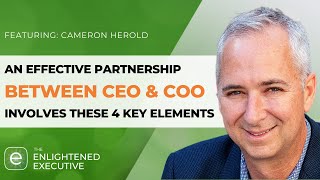
Cameron Herold, former COO of 1-800-GOT-JUNK, scaled the company from $2M to $106M by building trust with the CEO and hiring an executive assistant first. He describes the CEO-COO partnership as yin-yang roles, shares how a cash shortfall nearly bankrupted the company, and explains why COOs must privately tell their CEOs hard truths.
Questions this video answers
1-800-GOT-JUNK; grew from $2 million to $106 million during his COO tenure.
October 2000 until May 2007.
Joined as the 14th employee; left with 3,100 employees system-wide.
$420,000.
The COO Alliance, the Second in Command podcast, and the InvestInYourLeaders course (investinyourleaders.com).
Chapters
Foreign. Hi, I'm Susan Drum, and welcome to the Enlightened Executive, where your personal evolution sparks your leadership evolution. Each episode we feature groundbreaking techniques and strategies to help you get the edge in personal and leadership effectiveness. This episode is brought to you by Meritage Leadership. At Meritage, we strengthen leaders and empower teams to achieve high performance. Go to meritageleadership.com to learn more. Today we are focusing on how to unleash the power of your coo, the focus of a new book coming out in January written by my returning guest, Cameron Herold. Cameron earned his reputation as the business growth guru by guiding his clients to double their profits and double their revenue in just three years or less. Because he did that and more himself. And entrepreneurship is in his blood. At age 21, he had 14 employees. By age 35, he helped build his first $200 million companies. And by age 42, Cameron engineered 1-800-got junk spectacular growth from 2 million to 106 million in revenue. He's the author of the global bestseller Double Double as well as four other books. So I'm excited to have Cameron on the show again and hear about the latest book that you're bringing to the market. So welco.
Hey Susan, thanks for having me. And by the way, you're not the first person to kind of stumble over the whole like, at 35, 200 millions, the people like, wait, that doesn't even make sense that you could have done that. But yeah, it's, it's true. We'd done $200 million companies by then, and then 1, 800 got junk would have been the third. And Brian, who is the founder, he and I were in a mastermind group together. We were both EO members, entrepreneurs, organization members, and we were in a forum for four and a half years. So he watched me grow these two other companies and then he realized he needed a second command and he asked if I would come on board and really grow his company. So I joined as his 14th employee. And when I left six and a half years later, we had 3100 employees system wide. And I'd been the COO through that trajectory.
Yeah, talk about scaling up. I mean, you know how to do it, that's for sure.
It's not easy. Fast growth. People think, oh, that must be so simple. Fast growth is just as difficult as running any business. There's all kinds of complexities that come with that kind of growth.
I would say even more challenging because you, you don't have the connection to people, you're adding them so quickly. And to build that trust, you've got to do that so quickly. So it's spectacular that you were able to do that.
Yeah, it's interesting you speak to trust. I, I talk about that in my book. The Second in Command that's just coming out is my sixth book. Now the trust between the CEO and COO needs to be so implicit that you can literally run different areas of the business without almost even needing to check in. Because you just know like, you're like Navy seals, you know that the other person's got your back. Because if you need to start gut checking and seeing what's happening, all things kind of fall apart. And the team can also sense that as well. The team can see that there's something not quite in sync. It's almost like a traditional family with a mom and dad. You really need to be in sync with each other and if you're going to argue or fight, it needs to be away from the kids, never in front of the board, never in front of the team.
Yes, I'm, I'm learning that myself now with my first experience bringing on a CEO to my company. And we were just talking about this as we were getting started. I, I have a fractional coo. I'm not quite large enough for a full time coo, but I'm so glad I'm doing the fractional route because man, that's really changed what I can focus on and what I can do as a CEO.
You're smart to have actually done that because there's a lot of people out there that are making massive mistakes in over hiring too early in all different functional areas. You might need someone to lead marketing, but you probably don't need a full time cmo. But it's almost irresponsible to not have a fractional CMO coaching your director of marketing. Right. It's almost irresponsible to not have a fractional CFO overseeing your controller. But you often don't have the money to hire the real full time. You know, true. Like when I was the CEO at 1-800-got junk I left there 15, 16 years ago. Now I was getting paid $310,000 15 years ago like you, you know, every seven years that pretty much doubles. That's a million dollar salary. Most companies can't afford that. But you couldn't afford not to have somebody overseeing operations. And I think that's what I was able to bring to Brian was I had already built three other companies, two in the franchising space. So everything we had to do at 1-800-got junk for the first five years. I'd already done it a number of times that he was able to just sit back and grow and work on the other areas of the business like the IT side and the finance side. Well, I could just actually execute on all the areas of the business that I had, you know, the experience to actually do.
Yes, it's, it's really been the, the amount of time that's freed up where I could focus on more the external, which is the piece that I'm doing right where I'm focused versus so much of the key operations. Annie's just bringing systems and processes that have, have not been implemented and need to be at this stage.
Yeah, it's smart that you've actually done that. You know, another thing that I think a lot of entrepreneurial companies can do before they hire their second in command, and I speak about this in the book, the second in command is hire an executive assistant first. Most entrepreneurs and CEOs don't even have an EA. And I've always said if you don't have an executive assistant, you are one because you really want to get all the admin work off your plate. And if you're hiring a fractional or a full time CLO and then delegating $18 or $16 an hour tasks to them, why are you paying somebody 50 or $100 an hour to do 18 an hour work? It makes no sense.
No. Your first hire has to be your EA for sure.
Yeah, I can't even imagine, by the way. So your audience is all these senior executives and SVPs. Anybody who's really making 250,000 a year or more should really be getting an executive assistant for themselves as well. Right. It just is irresponsible. If I was the CEO of a hundred million dollar company, there's no way I would want to be paying people $300,000 a year to $15 an hour tasks. So hire them a 65, $70,000 EA. Offload the administrative of their work, free up their time to actually work on the business, to grow people, to be strategic, to work on the core projects and to work in their unique ability.
Yes, yes. Well, now tell us a little bit more about your new book, Second in Command.
Yeah, I wrote it for a couple of reasons. So I've been running an organization called the COO alliance for the last six years and it's the only network of its kind in the world for the second in command. There's lots of organizations for entrepreneurs, right? We've got EO and YPO and Vistage and Genius Network and Maverick, amazing groups for entrepreneurs. And some of them are even trying to bolt on these little subgroups for the close, but they don't focus on it. It's not their niche. So we created a mastermind community that's only for CEOs. And then I also have a podcast called the Second in Command podcast where I never interview the entrepreneur. I want the rest of the story right. I want to find out from the CEO's perspective, how did they grow the brand. So because of those two groups, I started recognizing there was this niche of someone needed to talk to the entrepreneurs and the CEOs of how do you find a COO? And we were spending so much time Talking to the COOs about how to build a strong relationship with their CEO, how to build that real yin and yang relationship, that I thought we could create a book and codify how to actually recruit and hire and onboard and then build that strong relationship with their second in command. So that was the purpose for pulling it together and actually the expertise level to speak to it.
So in a way, the book is, is truly for the CEO to think about how to best leverage a CEO and bring one in, or even if they already have one, how to make that relationship even stronger.
It's mostly for the CEO. And I'll speak to two other components of it. It's also for anyone who wants to become a CEO, because you're kind of going to be behind the curtain being shown what great CEOs are actually looking for. And it's important to you if you're trying to figure out, how does a CEO build a relationship with a CEO? Well, if you're a CEO, you really want to know how to build a great relationship with your CEO. But there's another point in here that I cover is one of the chapters is when it's time to get rid of your CEO and get the next one. And I'll give a very, very specific example of this. From October of 2000 until May of 2007, I was the COO for 1-800-got junk. I took them from 2 million to 106 million in revenue. And then one Thursday morning, Brian, my best friend and CEO, and I sat down for breakfast and he said, I think we're done. I started to cry, he started to cry. And that was the day my best friend had to ask me to step down as coo because I was the wrong person to take them from 100 million to the billionaire so he took 12 months, found the former president of Starbucks to replace me. She came in and looked around and said, what a cute little company. And I was pulling my hair out at 3,000 people thinking it was so big. Sadly, it didn't work for her. She was let go the year later. They then found another person, Eric Church, who I've been friends with for 35 years. He and I started a fraternity together 35 years ago. I was president the first year. Strangely, he was president the second year. He's now been the COO for 1-800-got junk for 10 years, has grown them from 100 million to 450 million. But he would have been a horrible COO for the first six years because he didn't have that entrepreneurial DNA and he didn't have any of the franchising experience. But he's been a spectacular COO in the more corporate politics, the growth, the really putting the professional services in place and building up the professional team. So often companies need to decide when is it time to top grade the team. And sometimes that means top grading your best friend or your current CEO as well.
Yes, that must have been a challenging period for you both given how close and I'm sure the loyalty that he felt for you. And yet putting loyalty aside, he wanted to do what was right for the.
Business when he was my best man at my wedding, three months before I joined him as his coo. So we were best friends. It took us a few years to recover from it. It was tough to go through. There was a lot of these emotions tied to it all and we've since become very good friends again. He actually wrote the foreword for the book the Second in Command for me and then his CEO Eric. I finally twisted Eric's arm to get him to write some as well because Eric is a very inward facing cmo. When I was cmo, I was very outward facing. I did a lot of speaking events, a lot of pr, a lot on culture. Eric is very kind of level five leader, very inward facing and never speaks to the media. So we actually got Eric to give us some content about the different styles of CEO is at different stages or trajectories of a company and some really unique insights there as well.
Oh, that's really fascinating. I can't wait to learn more about that piece. So you've been talking about the relationship needing to have such a symbiotic yin and yang between the CEO and CEO. Can you give us some insight of what helps build that, what creates that and how do you know you have it.
Yeah. And the yin and yang symbol is what I even put on the front cover of the book because it just has always been in my mind from when Brian and I were doing it together. So the first thing is the entrepreneur or the CEO needs to understand what are their unique ability areas, what are the areas of the business that they love to work on. They're really good at it. They get fired up and energized when they're working on it and delegate everything except genius. And then look to hire a COO who loves to do and is great at all the stuff that the CEO sucks at. That's the starting point. And then make sure the COO doesn't want to work on any of the areas the CEO wants to work on. It's what's really strange about the role though is that in every single company, the COOs are very different. In some companies the CEOs run finance, in some cases they don't. In some cases they run engineering and it, and some they don't. In some cases they run marketing and some they don't. So it's very, very different. I'll give another example. Harley Finkelstein, who's the CEO for Shopify, he's actually contributed to the book as well. Harley's a very outward facing gregarious business development, pr, sales clo. His CEO Tobias is a very inward facing CEO. And then you go to a company like Bumble, you have a very outward facing CEO and a very inward facing CEO. So they're so completely different based on that yin and yang need. The second part that makes that, as you put it, the symbiotic fit is how do you build that environment of trust, that environment of complete and absolute trust where really on day one you'd give them your bank account information, your passwords, because they're running your company. So you kind of have to. And then the other part is how do you actually like the person? Right. How do you spend time with them and get to like them? Especially when they're very different personality profiles from each other. Most CEOs are very high quick starts. Most COOs are very high fact finders and follow throughs. Most CEOs like to start projects by asking questions and putting systems in place. Most entrepreneurial CEOs like to start the project and plan later.
Yes. And running into those differences of the CEO saying, let's make sure we have the capacity to do implement all those ideas. And it also be, you know, the visionary integrator mix is, is really Fascinating. And if you get it right, it's spectacular. But.
Well, I actually. And I even speak to that. I speak to that idea in the book, what you're noticing of the. Oh, how do we have the capacity to do that? What I teach the CEO in the book to do is to say to the CEO, I love that idea. Let me just. Let's go for a quick walk together and let me ask you a few questions so I can catch up and fully understand your idea. So the CEO is like, oh, good, someone likes my idea. I'll do more of a dump and tell you more. After they tell you more, you can say, I still love your idea. Let's not do it this quarter, but let's put it on the list with the other 17 projects. And when we're coming up with next quarter's plan, we'll decide where it fits. And if the CEO is still completely assistant. No, no, it's now say, okay, that's cool. Here's the 12 projects we're working on. Which one will we bump off by inserting this? Because we only have so much people, time and money, so there's a real system to doing that. So the CEO feels safe and they can trust that their ideas are being kept somewhere and they don't feel like someone asking them questions is debating them. We're just trying to catch up because the CEO has been thinking about it for three weeks. We've only had 30 seconds to understand it.
Right, Right. I love that because it does give the opportunity also for the CEO to see the vision behind it and why it's important to the CEO. Obviously, if they're bringing it up and they think it's something important, there's some intuitive sense that this matters.
Right.
But then when you, okay, it matters, but how does it stack up against everything else in what matters? Yeah.
And often the CEOs. Because a lot of especially entrepreneurial CEOs add. Attention deficit disorder is not a disorder. It's a superpower for entrepreneurial CEOs. So they see everything. They see what's happening with the market, suppliers, the customers, the data, the internal politics, the opportunities, the strategy. But they're so overwhelmed with all the ideas. It's almost like their brain is a hard drive and the hard drive is full. There's nowhere to keep all their ideas, so they're dumping out on the floor. They need you to take care of their ideas. And without a system to take care of their ideas, they think the best way to take care of them is to start them. But as long as they see they're being taken care of, they're on a list, and they're understood. Okay, good. I can now go back to my CEO world of thinking and strategizing and coming up with the cool ideas.
Yes, yes. What's the biggest misconception that COOs have about the CEO role or where they get it wrong?
Well, what's interesting is most COOs have no desire to ever be a CEO. You know, a great example would be Sheryl Sandberg, who's probably the queen bee of all COOs. She was the COO for Facebook for 15 years. She has no desire to be a CEO of a company. She was perfectly happy being the second in command to Mark. Now she had lots of credibility and press and even wrote books, but she had no desire to ever be in the CEO role. I think one thing that the CEOs probably get wrong with the CEOs.
I.
Don'T know if they get it wrong, but the challenge would be how do you help the CEO slow down and treat themselves more like a racehorse so that they're actually working less and that they're disconnecting a little bit more so that they can step back and see the forest for the trees? So I think they probably have a harder time convincing or challenging the CEO to be able to do that when they can. When the CEOs can have those think weeks and go to conferences and be in mastermind groups and just think or, you know, do the skip level meetings and walk around the business. I think it's huge opportunities for the company.
And so do you often find the COO is pushing for that and the CEO is resisting, or is it more that the CEO should push the envelope a little bit more and really say, hey, I got this. You go do your thing.
I think the best CEOs are starting to understand that the struggle can be. And I was coaching a CEO the other day. They had 140 employees, and his COO is a member of the CEO Alliance. And the CEO laughed at me. And he said, you know, Cameron, I think I have to start breaking things again. I'm kind of bored. I don't know what to do. I'm like, no, Jason, don't start breaking things just because you. You've got time. Like, step back from the business, right? Slow it down, be more strategic. Think about bigger opportunities. So now I've got. I'm working on doing a couple of acquisitions instead of going in and muddling into a business area and then getting bored and walking away and everybody's now pissed off that you've poked holes in every one of their nests. Right?
Yeah. Yeah. What was the biggest mistake you made as a coo? I'm curious.
Oh, huge. Yeah. One was we almost bankrupted 1, 800, got junk. We were about 70 or $80 million in revenue, and we didn't understand how to leverage the balance sheet. So we were very profitable. We doubled the size of the company six consecutive years in a row. And we had a very quiet, analytical, very amiable head of finance. So VP of finance, Hendra and Hendrik, he was Indonesian. He would come to us very quiet, you know, are you sure we're okay? And I'm worried that we might be growing too quickly. And we're like, no, no, we got this. No, no, we got this. And we were up to, you know, operating in 330 cities and four countries and 13 operating businesses. And we had $5 million in cash. And we paid cash for an office renovation and office move, bonuses, about 800,000 in taxes. We used all of our cash to pay all that thinking, awesome. Just paid cash for it. All right. But then we're like, oh, shit. We didn't have enough money to make payroll, so we went to the bank to get a credit line and they're like, well, you don't have any cash. We're like, I know. We just spent it on all these things. Look how smart we are. They're like, you guys are idiots. You have no idea how to run 100 million dollar company. So they wouldn't loan to us. So Brian had to go to his mom and borrow $420,000 to meet payroll. We fired 20 people. We started calling all the suppliers in the company, telling them we couldn't pay them for three months. We were going to pay 20amonth for three months and then re up, threw up after three to four months. It was a really, really scary, scary time. And it was because we didn't listen to somebody. So the big lesson I got from that was, if you're not willing to listen to the people you hire, hire people you're willing to listen to. But I think the leader needs to shut up and slow down and ask questions. And remember, God gave us two ears and one mouth. We need to use them in that ratio a little bit more.
Yeah. Fascinating learning. And I'm sure you infuse that in all the COO work you do on the podcast and Mastermind and all those pieces. What? I mean, you were obviously. What do you think it was that made you so Successful as a CEO. What's the, what's the core thing?
I think there were two things. One was I have been an entrepreneur my entire life. So I had my first little business venture at 7. I had about 15 business ventures by the time I was 18. I did a talk that was on the main TED website about let's raise kids as entrepreneurs. And then when I was 20 or 21, I had 12, 14 employees. So I already had an operational company when I was in second year university. So I understood entrepreneurs. I grew up in a family of entrepreneurs. That's the first part. So understanding them. Secondly was I got into a franchise organization called College Pro Painters when I was in university and I had to actually go out and recruit, hire and train 120 franchisees over four years, one of which was Elon Musk's brother Kimball. And I had to train all of these people how to run franchises. So by, by 1993, I had coached 120 CEOs on how to run businesses on very simple systems. We learned how to dumb down the systems to replicate it over 800 franchisees every year. So I learned about operationalizing and reverse engineering and project planning and time management and creating very simple to execute systems that could provide the consistent results in every single market. Those skills became very, very strong CLO skills to a point to the 100 million part. I would be a terrible CLO of a billion dollar company. I used to coach the CEO at sprint, Jamie Jones, for 18 months. I was coaching Marcelo Colley, his CEO, but I didn't know anything about the telecommunications space. But I was teaching them how to be entrepreneurial inside of a massive corporate environment. But I would get off calls and go, what the fuck am I doing? I have no business coaching the CEO at Sprint. I have no idea what he's talking about. One day came to me and they said they had to cut opex by $4 billion. I mean, how do you even start, right? You cancel the lunch program. Like I didn't even know where to go. So I realized there was a zone that I was good in and then just don't go in those other zones.
Right, right. And it's interesting because you have such a CEO push that you ended up as COO of this company. So did you ever want that top job?
No, I, no, I didn't. And it's funny, when Brian asked me to coach him, I said, I'll coach you, but I would never work for you. I said, work, because he was already my best man at my wedding I mean, I'll coach you for a few months, but I said working or working for you would be like kissing my sister. So we've joked about it that my sister and I were basically making it for six and a half years because. Yeah, no, I didn't. I didn't ever want his job. Yeah, I really didn't want his job. I had no desire to. I was quite happy being. Now what I did want was the recognition that I built it with him. I wanted it to be. And if you read his book, WTF, Willing to Fail. My name is embarrassingly mentioned 16 times or something like that through the book. And no one on the leadership team that we were with was ever mentioned once, which I thought was really sad, but it was. I was definitely recognized as being the person that built it with him. That was good enough for me.
Yeah. Yeah, Great. Well, let's talk to the population, say the VP SVP level that wants to take the job of the COO at some point. What should they be focused on and paying attention to to get there?
Well, one is, and this is partially. If you read the book the Second in Command and read it from a different lens, read it from the lens of what? What are the needs of the CEO? What are they looking for in a real good partner? And if you can understand what they're looking for, you can understand how to show up. It's almost like if you read the book Men are from Mars, Women are from Venus. You need to understand, as a guy, I'm not a hairy woman, I'm a guy. We think that. Right? And. And women aren't hairless men. We. We're different. So how do you understand the other so we can show up and connect in the right way. So I think that's one. The second one is to remember that your job is to help them make their company iconic and help make their dreams happen. So everything you can do to help them with that is powerful. I guess a third would be to always confront the brutal facts and show them the real ugly truth that nobody will ever show them. But do it privately, right? Pull them aside over coffee in a boardroom by yourself. Otherwise they'll lash out at you because they need to protect their territory. But they'll be happy that someone's finally telling them the truth. You can sit down and go, dude, you totally screwed up yesterday in that meeting. You said this. You did this like, oh, shit, you're right. But you do it in a safe container where you're telling them because it's going to help the company grow. And I think if you show up that way they'll really appreciative of it because they understand that you've got their best interest at heart.
I love that. And showing not being afraid to have those hard conversations I think also shows your value and where you're really going to excel as a thought partner. Because ultimately, you know, the job of the CEO can be a lonely position and it really matters if you feel like you have somebody you can actually be a confidant to and you trust.
Yeah. It's why entrepreneurs and CEOs need to be a part of mastermind communities like El and YPO and Vistage and all these other groups for entrepreneurs. You need to be in a community like that. So you have a peer group to vent with, to learn from to. Because you can't tell your board how you're really feeling. You can't tell your leadership team how you're. But you need a peer group to talk to. But that's the same for the coo. They need a peer group like they. That's why we started the CEO of Alliance, which is only for them.
Yes.
We don't allow entrepreneurs to join. It's only for the cmo.
And I will tell you, it does have also as a member of eo, it doesn't matter that people are in different industries. In fact, it's even better helpful. It's better because you see things and you think, oh, how could that apply to my business? I never really thought about that.
Yeah. I call it ideas having sex. That you take one idea from one industry, one idea from another industry and something you've got and it kind of, oh, it morphs into something else. So we've got members from 17 countries. We have 40% of our members are women. Our youngest member is actually only 21 years old and he's the CEO of two $6 million companies. Like legit 6 million dollar businesses. He's actually from. From Arizona. And then our oldest member is 62 with, you know, $1.2 billion in revenue. So we're right across this full gamut. But the $1.2 billion called Sunbrella, the fabric company that we all know.
Yeah.
The CEO of Sunbrella shows up and learns from Cody, who's the 21 year old and he's like scribbling notes down and Cody's learning from, you know, the CEO.
Yes. Fabulous. I love it. So what's one thing that let's say the CEO needs to do tomorrow to be more effective? One thing that they could do that you don't see them doing when they come to start working with you.
I'm going to give you two. It's, it's. The first one is to really grow people. Right. I even launched a course called Invest in your Leaders. And it's kind of the 12 core skills that every manager and leader needs to be good at to excel in their role. The COO's job is to grow people, to grow their confidence and to grow their skills. And if the COO can focus on growing people's skills, not doing work, but delegating more and then growing their skills and confidence so they can do the work that really propels your organization. The second one is to show up and be vulnerable. They don't have to be the smartest person in the room. They need to show up and fit in with everybody else and actually connect with everybody else. And at times say, I have no idea, but let me try and find a who can help us figure out that part of the business as well.
Yes. Wonderful. Well, thank you so much for coming on. Where can people learn more about the new book and all of the different offerings you have?
Sure. Yeah. So the book the Second in Command, how to Unleash the Power of youf COO is available on Amazon, Audible, and itunes, as are my other five books. The COO alliance, for sure. People should check that out. And then investinyourleaders.com is the leadership program that is self guided learning. They should check that out too. And also check out the Second Command podcast where we interview all of these CEOs from great companies, great resources.
Well, thank you again, Cameron. I'm really excited that you came on today and good luck with the book launch. I know it'll be fantastic because everything you touch turns to gold.
It looks like I only touch gold. Thank you, Susan.
Love it.
Thank you.
All right, let's lead the way. Hope you enjoyed today's episode and I'd like to point you to the next important step. Hit the subscribe button and the bell to get notified when we release new content. I'll see you on the next episode of the Enlightened Executive.
More from Susan


Why the Biggest Doors Open When You're Not in the Room | Michael Roderick & Susan Drumm





The Simple Audit That Adds a Human Touch to Every Customer Interaction #shorts


