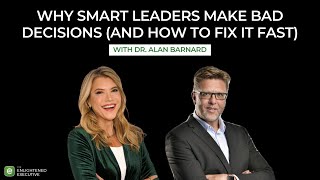
Dr. Alan Bernard, a decision scientist at GoldRat Research Labs, explains why intelligent leaders often make poor choices. He argues that underlying assumptions and beliefs, not circumstances, determine whether decisions are good and fast. Bernard traces this insight to his South African childhood and conversations with his grandfather about biography.
Questions this video answers
2008
Meritage Leadership
Chapters
Foreign Hi, I'm Susan Drum, and welcome to the Enlightened Executive, where your personal evolution sparks your leadership evolution. Each episode we feature groundbreaking techniques and strategies to help you get the edge in personal and leadership effectiveness. This episode is brought to you by Meritage Leadership. At Meritage, we strengthen leaders and empower teams to achieve high performance. Go to meritageleadership.com to learn more. Are you curious about your development path to enlightened leadership? Take our free 5 minute quiz@susandrum.com to discover your superpower and the roadblocks that could get in your way of effective leadership. Today we're focusing on how not only to make better and faster decisions, but also to avoid making slow and bad decisions. And I'm grateful to introduce my guest, Dr. Alan Bernard. Dr. Bernard is one of the world's leading decision scientists and theory of constraint experts. He is the CEO of GoldRat Research Labs, a company he co founded in 2008 with Eli Goldratt. Allen is passionate about applying science to developing new methods to help people make better decisions and move them closer to their goals. And his clients include Microsoft, Cargill N Nike, Cisco, SAP, Intel, Penguin, Random House, and Habitat for Humanity. So welcome, Alan. Thank you so much, Suzanne. I am excited to talk to you about, yes, making better decisions and, yes, not making the wrong decision. So let's first start out. How did you get into this, you know, realm, this focus on decision making and your connection with Eli, who wrote a very famous book called the Goal and that connection? Yeah, I grew up in South Africa and grew up, you know, without much resources. I was very close to my granddad. We had a farm. And he was the one that encouraged me to read biographies and autobiographies about successful people. And he gave me this book called the Marquis who's who when I was 10 years old. I don't know if you've ever seen the book, but it basically contains a listing of short biographies of the most successful people in every field. And he asked me, tell me what you notice about these successful people. And I said to him, I noticed that none of them had ideal starting conditions. You know, many of them suffered neglect and even abuse. Bullied, they don't always have good, great environments to work in, maybe poverty. And many of them suffered some kind of disorder, learning disorder or disability even. And so I said, my conclusion is that your starting conditions do make things a little bit easier, more difficult, but it doesn't matter in the end. What really matters is, is your basic assumptions and beliefs about what's possible and When I kind of looked further into that, I realized that's what informs our decision making. So ultimately, we get judged by the quality and the speed of our decisions, and that's what determines whether we successfully.