Work-Life Harmony with Bo & Luke
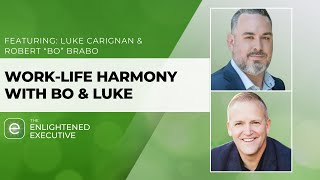
A YouTube interview (Enlightened Executive podcast) hosted by Susan Drumm featuring Beau Bravo (retired Army HR leader, White House communications) and Luke Kerrigan (healthcare talent acquisition, podcaster). Guests discuss 'work-life harmony' vs 'work-life balance', mindset, daily rituals, leadership development, values-based results, and practical tactics (rituals, planning, writing priorities) for aligning personal and professional life.
Chapters
Foreign.
Hi, I'm Susan Drummond. Welcome to the Enlightened Executive where your personal evolution sparks your leadership revolution. Each episode we spotlight groundbreaking techniques and strategies to help you get the edge in personal and leadership effectiveness. This episode is brought to you by Meritage Leadership. At Meritage, we strengthen leaders and empower teams to achieve high performance. Go to meritageleadership.com to learn more. Today for the first time, I am thrilled to host two distinguished experts in the corporate human resources space. Beau Bravo, a distinguished leader whose career spans the US army to the White House to serving Presidents Bush and Obama. BO is the founder of Hail Media Group and is currently a Sales executive with RCMND dedicated to enhancing HR professional skills worldwide. He has an MBA from the University of Michigan, is a celebrated author and co hosts the globally acclaimed podcast the BO and Luke Show. My other guest is his co podcaster Luke Kerrigan. With an impressive 15 year career in the healthcare talent acquisition industry and technology, Luke believes strongly in the concept of work life harmony rather than work life balance and that the quickest route to happiness is through helping others. So Beau and Luke are here to share some of their insights on leadership team building and achieving values based results in business. So welcome Beau and Luke.
Yay. Thank you. That was great.
That's an awesome intro. You do intros better than we do, I think.
Susan oh well, wow.
Thanks.
So I want to start this off by first talking about this concept of work life harmony versus work life balance. Tell us a little bit more about what you guys mean by that.
So Luke and I went down this road of work life balance versus work life harmony. Really just considering looking at balance like a teeter totter, right? When you're trying to balance something, you want to have equal weights on both sides to make sure that either one of them fall, right? So if you put work on one side, life on the other side, and you're trying to balance, something's always going to give, so you're going to be more on the work side, more on the life side, and then what's faltering? What's going to the wayside because you don't have that balance and how much effort are you putting into actually just trying to balance, right? And then what's getting lost. So in reality, what we have gone after and starting to achieve in life is harmony. So everything that we do from the moment we get up to the moment that we go to bed is all aligned. And that goes back to even in the introduction we talk about values based results, right? It's Your personal values. If you're living your personal values in the workplace and you're living them at home, you're already starting to get harmony, right? So bringing everything together under one roof of harmony and stop trying to balance one or the other really, really makes a big difference, I think around for yourself and all of those around you, friends, family, co workers, colleagues, whatever, it truly works.
Yeah, I'm with you. Yeah, I was gonna say. Yeah, I totally agree with everything you just said, though. For me, it's about mindset, you know, because we have to. If you're gonna say work life harmony as opposed to work life balance, then you have to go and live that every single day. And it's all about living it in those moments and being present where you're actually going to see the effects of it and the benefits of it. Right? So for me, work life balance means I need to sacrifice some something for the other, and it's a lose, lose situation every single time. All right? So if we, if we word it like that and like, okay, I'm going to balance something, you're either sacrificing a part of your career that day for your family or you're sacrificing part of your family for your career. And that is an awful proposition for anybody. It's a no win scenario. And speaking of mindset, like, that's a losing mindset to have because part of you, whether you say it or not to your family or your co workers, part of you is dying a little bit inside when that's happening, right? So if you think about work life harmony, how can I include everything to go in the same direction? So I'll give you a couple examples here. So I had one co worker reach out and I think they were looking for affirmation before they went on vacation. And they're like, luke, how do you handle vacation? Should I completely unplug, you know, and just spend the time 100% with my family, or should I be in there checking emails and, you know, stay? And I was like, you know, hey, that's up to you. And like, the, the goal here that we're going to think about is you being more present and having a great time with your family, which I totally get unplugging. However, if I do that, I was like, for me, I'm going to lose my mind. I'm going to have anxiety that whole time that there's fires I need to.
Put out or dread when I come back to work that I have five.
Thank you. Yeah, dread when I come Back, like, I. And that will actually take away from the time that I have with my family because I'm not going to be 100% present. So I said, you know, for me, I was like, do whatever you want. But for me, I'm. I get up 30 minutes early before the family does, and I just knock out any emails I need to and just make sure nothing's going absolutely crazy. And then I'm usually done for the day, maybe check it, like, before I go to bed. But that gives me peace and the ability to be 100% present with my family. So that's one example. Another one. And this just happened a few weeks ago. Bo and I got the opportunity to go the visit Alicia Aceveda at Advent Health down at their headquarters outside Orlando. So, you know, work trip. So usually folks just, you know, get, get to work, go on the trip. I decided to take my whole family to Disney World. So they came with me. We got an Airbnb. We went and had the day of work, and then we had two days where I could spend with my family. And it's just about bringing us all together to really embrace the whole aspect of what we're doing in this life and career. Right. Because the trick that I've learned is just enjoying it every single day makes you exponentially a better person, a better husband, a better coworker. It makes your career better. The benefits to that mindset are just incredible. But it is like a mindset thing that I think you have to have. You can't just say, like, work, life, harmony, and I'm going to do this just an everyday thing.
Yeah, for sure, for sure. That's what I was going to ask you next is what are the underlying mindsets that support this theory of living your life in harmony? What are some guiding principles or mindsets that people could start to adopt to really live this.
That's a good one. I'm gonna let Bo run with that first.
I think that's a great question. I think. I think you have to develop, number one, a very positive mindset. Right? And it's one mindset. Don't try to separate how you think at work or who you are at work versus who you are at home. Right. So it's one positive mindset. So from the moment you get up in the morning and how you have your day structured, we definitely believe in having structured days. You know, we even talk a lot about battle rhythm, which is like your routine. So how you go about your day has a lot to do with achieving harmony. Right. So the tactics behind it are having a set schedule and how you attack the day and starting with a positive, positive outlook and attitude so that no matter what hits you, if you can remain positive, you'll look at opportunity more than you'll look at any downside. And you'll approach making decisions in a whole different way from a positive mindset. For sure, Luke.
Yeah, agreed. Daily rituals, right? So personal. And I have personal rituals every morning and then work rituals, and they go something like this. So personal, you know, I'll wake up. Even part of my rituals, I'm going to make coffee in this, like, first 30 minutes is just groggy Luke shuffling around the house. And that's cool. Like, that's. That's my time. Then I'll meditate for 10 minutes and then work out. That gives me actually an hour with the family before I even start work. So that hour with the family, again, part of the ritual to where I'm starting the day on a positive note. I'm like, you know, putting everything in front of me. This is why I'm going to work. This is why I got to achieve and do great things. Then I sit down for work, and my ritual is, you know, I've put together the what I need to do the night before. So I double check that, pick out my to do list, and then I pick out the three biggest things that I need to accomplish that day and try to try to accomplish them before noon. Because, like, you know, after 12, you didn't do your best work before 12. Like, let's be real, right? So I'll try to get for most people, right? And then I'll zero my inbox every morning, right? So I'm starting every day with a clean slate, playing offense. I am not looking at the day from a defensive posture at all. And just having that ritual and things I do every day. It makes it easier to start with a positive attitude because I know exactly where I'm going that morning. But to Bo's point, like, these plans are all going to completely go to hell. Like, you know, Dwight Eisenhower, I believe, said, what is it? Plans are useless, but planning is indispensable. And it's so true. So if I at least have, like, the bones, the framework worked out here about what's going to happen, then I can pivot a little more. I can be more successful by going where the day needs me to go. But, yeah, Bo, I completely agree with that. You know.
Yeah. I also, you know, I travel a lot for my work, and some people say, how do you maintain a schedule the way you do with commitment to exercise. I work out six days a week and how do I do that with travel on top of it?
Right.
And so part of it is that initial part of getting those routines in place but having variety within the routine. So my. I talk a lot about enneagram Type and Enneagram Type 7 Hates, Hates routines. But what I found is if you vary, if you create the space but vary what happens in them. You know, certain days is yoga, certain days I'm doing, you know, Pilates and that mixes up, but the time block is always there. That makes a big difference, I think, in, in keeping it fresh for me. Right.
Yeah.
And, and so creating those rituals of also knowing where your weak points are. So my weak point is if I don't have a class scheduled, I might do something else or oh, work. Oh my God, there's a big thing happened. I need to, I need to pivot here. But more likely if I paid for the class, I'm more likely to go. So it's stuff like that. Make sure you don't check your phone right away because you. I think the. One of the biggest things is switching costs. Right. If you're trying to be present doing yoga, but you did happen to look at your phone and you saw those 50 emails that you now have to go through that are going to take a lot of thought. You can't actually be present in the yoga and so you lose out as well. So I think being present for what you do choose to do, as you mentioned in some of your V Values piece, is also important.
Yes. When it sets you up, people are going to feed off of your own. I don't know just what presence you give off in the moment matters. So I got, I have a quick lesson for listeners out there that I, that I learned from kids actually. But it's putting yourself in that mindset and posture to be successful. So we've interviewed Bo, what hundreds of folks on the podcast. Most of them are incredibly successful. And it got me thinking, you know, are these folks really happy just because they're successful and that comes with it. And I think it's the other way around that these folks have a great mindset and they're naturally happy and people are attracted to that and then that made them successful. So the little experiment that I learned, and so I have a one year old daughter and as she's growing up, like her, her older brother like is super calm, just cool. She is not that way at, at all. So like, you know, Tantrums, crying, you know, sometimes tough to put to bed. So I learned that, I don't know, they're feeding off our vibes somehow. So I learned that when I was putting her to bed, like, she could be just absolutely inconsolable. Crying. If I focus on my breathing, like I do, like, with meditation, like, just focus on slowing my heart rate and just sit there, I. It is miraculous. Within, like 15 seconds, she calms down. She's starts to go to sleep. It is crazy how well it works. Just. And that's with a human that, like, hasn't even learned anything yet. So then you think about that, like, as we're adults, how many people are feeding off of your vibe that you're just putting out there in the conversations that you have and how, you know, how you can leverage that for success. It's just. It's mindboggling to me how well that works.
Exactly. Exactly. Because our emotions actually have vibrations and they can be measured. Right. So, you know, when we're happy, we're in a higher vibrational state than when we're sad and depressed. And if you need any evidence of this, your dog knows. Your dog can tell when you're happy and excited. You don't have to say anything. Or when you're sad and something's wrong, it's pretty incredible because they're feeling that energy, and that energy can be measured through your. The. You know, the heart is the largest electromagnetic signal in the body. It can be measured three feet from the body.
Really?
Yeah.
Three.
All right, so this is fascinating to me. I'm so happy you mentioned this, Susan, because I'm, like, figuring this out on my own. I don't have the technical expertise to, like, back this up. So this is fascinating. Yes.
I mean, another source of electromagnetic magnet magnetivity is the brain. But the brain, you can only measure an inch and a half from the body. So the heart, which is the source of emotion and all can. Is actually what's generating what people are feeling. So I so agree with you that every day you wake up, you have a choice for how you want to start your day. And whether you choose to get into a certain state or not, it. It's going to play out the rest of your day. So why not start it the best way you can, right. Meditate or just write down three things you're grateful for, then you start your day in gratitude. Right?
Right.
There's just very simple things that don't take more than a few minutes that anyone could do.
Right. I think it all comes down to what each of us as a person is willing to do. Right. I often say that the difference between anybody is you, your level of courage to actually do something right. And I heard Arnold Schwarzenegger in a speech one time where it talked about. And you travel a lot, Susan, where he's. And he's traveling. He's like, I don't care what you do. If you've been traveling all day, when you get to your hotel, don't go to bed, go to the hotel gym. 15 minutes. Just work out 15 minutes. Way better for your mind, for recovery of your stressful day than just laying down on the bed and, you know, zoning out on, you know, flip the TV on your phone, you're on your phone, or whatever. So I think it's about the actions that we decide to take.
I'd love to hear a little bit more about your journeys to being a more conscious leader, because obviously in the work that you do, you're talking through how to be more present, more conscious, really bring this concept of harmony in what's been most impactful in your own journey of personal development.
Luke, take that one.
You want me to take that one?
All right, you take that one first.
So my background is super interesting. So, like, you know, much like Susan, you went to Harvard Law School. I was the complete opposite of that. I only have a high school diploma from Peoria, Illinois. Moved to Chicago when I was like 18 years old and started off at Red Lobster, as folks normally do. I ate tons of cheddar bay biscuits, which are amazing. But I spent probably the first nine, almost 10 years of my career in restaurants, working my way up to restaurant management. I wasn't always at Red Lobster. I worked my way up into some of the nicest fine dining restaurants in Chicago and then ended up, at 23, becoming the GM of a restaurant across the street from Wrigley Field, where the Chicago Cubs play, which was. I'm a lifelong Cubs fan. So that was like a dream job for me. Yeah. But then ended up getting into the corporate world, you know, nine or ten years later after that. But everything that's made me successful in the corporate space, like, I promise you, I learned from the restaurant industry. I learned everything about PNL from managing my own books. Of course, we had a corporate office ahead, you know, to help out. But all of the cost inventory came down to me, the payroll and working my way up and understanding people and how they operate is what really, really impacted everything I do. So I have a couple sayings that I'd like the, you know, everyone to really. They can write them down if they want, but they're pretty easy to remember. But one of them is that it all comes down to doing elementary tasks with master's level execution. So what I mean by that is a lot of us in business are doing the exact same things. And not only that, there's Daniel Pink talks about, like, information asymmetry that, like, you know, companies used to have all the info. You had to go to a salesperson, understand all that. Well, now it's flipped the complete opposite, where with the Internet, folks have access to people that have had experiences, good or bad. They have access to demos that are out there. They have 90% of the information before they even contact you. Right. So when they have almost all the information, we're, we're at a more level playing field than we've ever been at in history. So what I think it comes down to is doing those elementary tasks with master's level execution. And now in my role at Phenom, you know, I'm an, I'm an individual contributor. And what I love the most about this company is in our CEO. His name is Mahi. He will tell you, you know, he doesn't talk a ton to everybody, but if you're like, hey, I need, I need control over this division to do what I want, he's like, you don't need a leadership title at my company to be a leader. Go do it, like, right now. And I've just been doing that ever since, and it's been absolutely great. So I'm in, like, an individual contributor role now where I still get to scratch that itch of being a leader, but I don't have, you know, the crazy responsibilities that go along with it. And I, I, I just thank everything for where I'm at right now because I can run a podcast with bo. You know, we can, I can do all the things in life that I want to. I get more time with my kids. Money is great, and it's just hitting the stride really well.
Well, I also hear in your story that if you made almost every mistake there is out there, you didn't let any of that stop you. So your mindset around mistakes must have been a phenomenal one. It's like, oh, good, made a mistake. Great. Now one more quiver in my belt that I understand. Almost like collecting. I've collected gold. Can you imagine if we had this mindset that every time we made mistake, we actually picked up a piece of gold?
And it's true.
It's True, but we don't, we don't often view it that way. Right, but you did. That's what I heard in your story. You picked up all these pieces of gold and that's how you viewed it and cherished it, which allowed you to keep going and not use it as a self flagellation tool.
Right. It's so true.
Absolutely.
All the best lessons are learned from that. You know, you articulated that perfectly, Susan.
Yeah. Yeah. How about you, Beau? What's been most impactful in your journey?
Yeah, my journey is completely different from all of you, but I think that's one of the reasons Luke and I connect. I think mine was military, as you put out in the introduction. Right. So I spent 26 years in the Army. The last eight of that was at the White House under President Bush and then President Obama. Obama. I was the chief of HR operations and then I was a Presidential communications officer for both Bush and Obama. So I led communication teams around the country for each of them, delivering the exact kind of communication capability they have sitting in the White House. They need that same capability anywhere they are in the world. But the journey, the biggest impact of my journey, I think, and it's what I've brought with me to the corporate world, I've been retired from the army for a little over a decade now is the leadership development. So you can imagine in the military, especially the army, there's a very formal leadership development process that you have throughout your entire career. You stay in for 25 plus years, you've been to so many different leadership development courses and training, you almost stopped counting how many times you've been there. But the value of what you get is training with everybody else who's going through the same training. You get back to your organization, some of them have been through the same training, and then you have the opportunity to execute. Right. So you're learning, executing, learning, executing, learning, executing. It's all a journey. And each part of the learning just continues to build on your previous learning. One thing came out of the podcast and I think it was summarized in three points super well. And that's care for your people, give them the resources they need to do their job, and be grateful and thankful for them. Right. And I think we exemplified that in the military. And that's where I get the battle rhythm from the training schedules you just had to execute every day you knew what you were doing. They're put six weeks out and you know exactly how your days are going to go. And you have to develop a tough mindset. You Know, I look back on it, it's probably the most blessed period of my life I could imagine. Didn't always feel like a blessing when you're in it, but it was such an incredible time. And I think giving an example, what I learned, I was at the White House for a couple years. I left. I went to Germany for three years, went to combat in Iraq. But during those three years in Germany, I was responsible for. I had almost 100 person HR team. And we're serving a community of Americans, soldiers, civilians, of almost 20,000 people. And you get into a different world when you're living overseas and you're trying to get families over to match with their soldiers so they can live with them in a foreign country, visa requirements, all of these things. You're dealing with embassies and passports and you name it. But I really had to learn how to lead outside of my organization, if you will. So people who I had no control over, not only were they not in the same, the same company, they were in different organizations, completely in different geographic areas, but in order for things to get done and to support the families that we had to, I had to develop those relationships and lead those people in the other organizations to ensure that the people I'm taking care of actually have a priority and we can get these people together. At one time I was walking through one of a shop and somebody stopped me and they just looked at me and they said, are you Chief Brabo? And I said, yes, that's me. And it was a spouse of a soldier. And she just started crying and then she stopped and she's like, you're the one who brought us all together. Right. The impact of developing your leadership ability outside of your immediate subordinates, if you will.
Yes.
Your sphere of influence that you can actually grab onto or actually achieve is quite profound. But that's the kind of things that I have brought with me into the corporate world where like Luke said, you know, he's got a CEO that doesn't care about your title. I have had so many conversations, especially in the HR arena where it's why I need to get promoted and have this title because. And I need to supervise people so I can get leadership experience. I'm like, well, you don't really need to supervise anybody to be a leader. Right. And that's all part of informal development. But I wish every company in America had had people like you on staff or your companies in contract to do around the clock, all kinds of leadership development because it's needed.
Yeah. I think there's a misconception that as a leader I manage actions. And that's. And I really can only do that for the people that report to me. Well, as you start to rise through the ranks, you realize it's, that's just a small microcosm. Your real growth is how do you manage mindset? So I this phrase, managers manage actions, but leaders manage mindset. And that's how you influence outside your direct, supposedly spirit control. Although I would even argue that in today's generations coming up, you can't even manage that way anymore. Like the command and control doesn't work in that environment. So you're going to have to learn to lead through influence and through managing mindset as well.
So, yeah, I've always liked to say, you know, to break it down, you lead people, you manage tasks. Don't get them confused. Right. Managers may not be leaders, leaders may not be great managers. They can be both. But I think you're absolutely, you're absolutely right.
Well, tell us what's one thing that you'd recommend people do tomorrow to start to really get this concept of building harmony within their lives and work?
Clear the deck every single day. So just get in the mindset first. And people, you can start doing this tomorrow. No matter what happens in your day. I got great news for you. The day is going to end and it's going to be over right at 5 or 6 or whenever. Timing doesn't matter. It's over. You get a whole new deck tomorrow. So if you go in with that mindset just at the end of the day of like, oh, well, it's over now. Yeah, you're gonna, you're gonna do so many favor. You're gonna just be more productive and a better person to be around at home and at work because just own the fact that you get a whole new deck of cards tomorrow and you can do whatever you want with it. And you know, 90% of the things we worry about never happen anyways. So clear the deck at the end of every day. Don't take yourself so seriously. Like bad stuff happens to everybody. Just even if you audibly say at the end of the day, well, it's over now, it'll be helpful.
I love that.
Yeah, that's good stuff. You know, I, I would, I would give anybody the advice of taking pen to paper and writing down, because there's power in, in the written word connection between your hand and your mind and thinking through things. And I would write down what it is you're trying to achieve in your company. Right. And what it is you're trying to achieve on the home front, even if it's a list of 5 to 10 things and where do they match? Are they aligned? Are they not aligned? And start thinking about why they're not aligned and how you align them and get really crystal clear on, I think, what is super important and what you want to achieve at work or what your company's out to achieve so that you know what the distractions are and where you don't have to put your time. Because oftentimes you get bombarded with something and the next thing you know, like, you're. You're hating your day or it takes away from a certain block of time you had on your calendar, and it's something that has absolutely nothing to do with the strat, with your strategy, your mission, the goals you've set out to achieve for your company. It's nonsense. And it just wasn't identified as this is a total distraction or it's not my plate. That's somebody else's plate. I don't have to do that. That's why I hired this person to do that. So that you can start to align your work time, your lifetime, and start creating some harmony. But I think it starts with you writing down what is important to you, what do you want to achieve, and finding the alignment. Sometimes they don't align. You might have to make change.
Yeah, for sure. Well, I'm so grateful that you both were here on the show today. Where can people learn more about you and your work?
Yeah, I think one of the best places to go is go to the bo and lukeshow.com that's theboandlukeshow.com there's spots in there about Luke and I both specifically, and from there, you can get our contact information, our LinkedIn profiles, all of that type of stuff. Happy to talk to anybody that reaches out. I think that's one of the greatest things about podcasts, is most of the guests are always willing to say, yeah, reach out. Let's talk. Let's continue the conversation. And Luke and I are definitely up for that.
Awesome. Well, if you like this episode, you're not going to want to miss my interview with Dr. Sean Dill, who teaches us that health and success are fundamental truths rather than fundamental pursuits. Let's all lead the way. Hope you enjoyed today's episode, and I'd like to point you to the next important step. Hit the subscribe button and the bell to get notified when we release new content. I'll see you on the next episode of the Enlightened Executive.
More from Susan


Why the Biggest Doors Open When You're Not in the Room | Michael Roderick & Susan Drumm





The Simple Audit That Adds a Human Touch to Every Customer Interaction #shorts


